
Contents
Two small bowls from Kalopsidha in eastern Cyprus, catalogued by Paul Åström as A 666 and A 667, carry nothing on their upper body but encircling straight lines and zigzags, with one more straight line and one more zigzag painted round the inside of the rim [1, p. 24]. Åström made them the type of a named group, "White Painted V Bowls (Zigzag Style)", and described its standard scheme as "alternating zigzags and straight lines around the upper body on the exterior" [1, p. 88]. The zigzag is older and more widespread than that one style. It appears incised on Early Bronze Age Red Polished bowls, as paired and hatched chains on the White Painted wares of the north coast, and as a painted band down the handles of Iron Age jugs and amphorae. This entry follows it through those settings and sets out where it stops and its neighbours begin.
What counts as a zigzag
A zigzag is a continuous line that changes direction at sharp angles. Its nearest relative is the wavy line, and the boundary between them is a matter of drawing. L. A. C. Gagné, in a 2012 study of Middle Cypriot White Painted ware, calls the Kalopsidha zigzag "really a sharp-angled version of the wavy line" and notes that it "occurs on bowls in the same position as the wavy lines" [2, p. 190]; elsewhere she calls it "a pointed version of the wavy lines seen at other sites" [2, p. 215]. The site treats a band with rounded crests as a wavy line and one with pointed angles as a zigzag, while accepting that some painters worked between the two.
Several related motifs are built from the same unit. A chevron is a single V or a stack of them, used as a separate sign instead of a running band. Two zigzags drawn in opposite phase, so that their points touch, enclose a row of lozenges: Gagné describes this on a bowl from Alambra as "an alternating zigzag pattern that makes a diamond chain" [2, p. 178]. When those lozenges are hatched or cross-hatched the design reads as a diamond chain first, and when the lines multiply into a mesh it passes into lattice and checkerboards. Bands of parallel lines that meet at their ends make a zigzag; bands that pass through one another make crossing lines.
Incised zigzags on Red Polished ware
On Red Polished pottery of the Early Bronze Age the zigzag is incised, and on the Fitzwilliam Museum's examples the cuts still hold white lime that made the pattern show against the red surface [3, cat. 7]. A Red Polished I tulip-shaped bowl there from Vounous Tomb 90 (GR.5g.1939) is divided by vertical bands of parallel lines "flanking zigzags or dots", and "rows of dots, zigzags, and straight lines encircle the body"; a second Red Polished I bowl from the same tomb has "parallel horizontal zigzag lines" [3, cat. 7-8]. The same combination of zigzags framed by straight lines appears on a Red Polished bowl from Ayia Paraskevi in the British Museum, described in its record as having zig-zags framed by horizontal lines at the rim, and on a Red Polished black-topped tulip bowl from Vounous whose incised chevrons are made of groups of parallel lines. The Ashmolean has a later example, a Red Polished bowl with lug handle and zigzag decoration dated Early Cypriot III to Middle Cypriot I.
An incised Red Polished vessel in the Drakopoulos collection belongs to the same incised tradition, with bands whose oblique strokes meet in chevron-like angles.
White Painted ware on the north coast
When painted White Painted decoration took over in the Middle Bronze Age, zigzags became one element in dense geometric friezes, most of all at Lapithos. Gagné describes interlocking hatched triangles with a double zigzag beneath them as common on Lapithos bowls, with parallels at Lapithos and Dhenia [2, p. 221]; a Lapithos bowl, L.315B-C.31, has a "double zigzag running below the band of interlocking hatched triangles" [2, p. 178]. On a bowl from Alambra, AS.275, cross-hatched triangles sit above the alternating zigzags that form a diamond chain, and Gagné's closest parallel is a deep bowl from Lapithos, L.320.86 [2, p. 178]. A White Painted III amphora from Lapithos Tomb 320 in the Medelhavsmuseet, Stockholm, comes from the same tomb group.
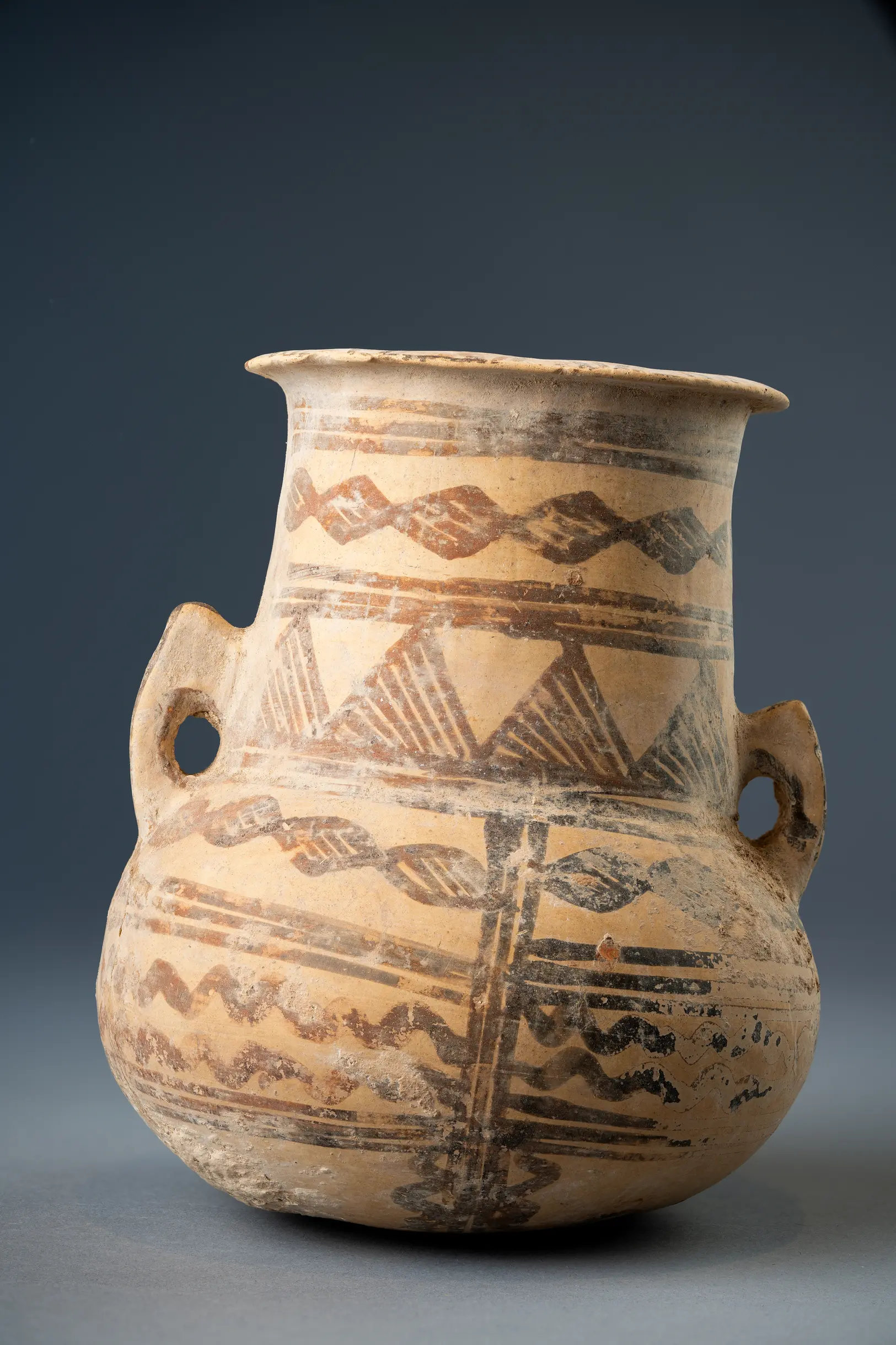
Gagné uses these friezes to identify production groups. She groups two bottles from Lapithos Tomb 316, L.316.102 and L.316.79, decorated with bands of hatched diamonds alternating with zigzags, and argues that they were "likely produced together as a group by a small number of potters" [2, p. 116]. Nearly identical bottles with vertical cross-hatched diamonds and zigzags were found at Ayia Paraskevi and Alambra, and she attributes them to a single potter or painter working at Lapithos [2, p. 213]. The cross-hatched zigzag also runs round a rare White Painted ring vase, and Gagné lists the same motif on jugs 50b.1 and 50b.2 from Vounous, on tankards from Kazaphani, on vessels from Toumba tou Skourou and on amphora 22 from Dhenia Tomb 6 [2, p. 170]. In this material the zigzag is one of the signals Gagné uses to trace workshops and the movement of their products.
The White Painted jar in the Drakopoulos collection (right) has on its neck the paired zigzags that close into a cross-hatched diamond chain, of the kind Gagné describes at Alambra and Lapithos. Its find-spot is not recorded, so the resemblance cannot be used to place it in a workshop. A White Painted jug in the collection uses bands of hatched triangles, the frieze under which the Lapithos painters set their double zigzags.
The Zigzag Style at Kalopsidha
Kalopsidha, whose settlement Åström excavated and published in 1966, gave the zigzag its own style name. Åström found sherds of the White Painted V Zigzag Style bowls in all the bottom layers of the settlement. The shapes are mainly hemispherical bowls with carinated shoulders, high everted rims and horizontal handles with fan-shaped terminals, and one mended fragment carries three horizontal zigzags framed by straight lines [1, p. 88]. The catalogued bowls are small: A 666 measures 14.2 cm across and A 667 13.8 cm, and A 667 adds a cross of two groups of three parallel lines on the base [1, p. 24]. Further examples in grey clay with matt black paint appear as nos 1059, 1063 and 1076 [1, p. 46]. One layer held Zigzag Style bowls together with Eyelet and Pendent Line bowls [1, p. 52], and a Pendent Line sherd combines "alternating straight lines and a zigzag line" [1, p. 82], so the scheme was not confined to one named group.
Gagné treats the style as "an eastern style, most likely centred at Kalopsidha", used mainly on the carinated hemispherical bowls, and suggests that a bowl in the Nicholson Museum (47.361) probably came from the site [2, p. 190]. She regards it as unique to Kalopsidha [2, p. 215]. Two museum pieces show the type. The Medelhavsmuseet holds a White Painted V bowl from Kalopsidha (MM 1956:328c), recorded as Middle Cypriot III, with framed zigzag lines outside and a zigzag encircling the inside. The Ashmolean's White Painted bowl with zigzag pattern (AN1956.26) is also dated Middle Cypriot III.
The White Painted bowl in the Drakopoulos collection, used as the image for this entry, is decorated with red-brown groups of parallel lines set obliquely so that they meet in chevrons round the body. It is closer to the second kind of linear decoration Gagné separates, "a zigzag pattern composed of alternating oblique lines", which she finds "most common on hemispherical bowls" [2, p. 170], than to the black-painted Kalopsidha style with its alternating straight lines.
| Period and ware | Form of the zigzag | Examples |
|---|---|---|
| Early Cypriot, Red Polished | Incised and lime-filled; zigzags framed by straight lines or rows of dots | Vounous T.90 bowls (Fitzwilliam); Ayia Paraskevi bowl (British Museum) |
| Middle Cypriot, White Painted (north coast) | Double zigzag under hatched triangles; paired zigzags forming diamond chains | Lapithos L.315B-C.31, L.316.79, L.316.102; Alambra AS.275 |
| Middle Cypriot III, White Painted V (east) | Alternating zigzags and straight lines round the upper body of carinated bowls | Kalopsidha A 666, A 667; Stockholm MM 1956:328c |
| Late Bronze Age, 1100-1050 BC | Zigzags inside oblique zones with lozenges and triangles | Palaepaphos-Xerolimni T.9 no. 141 |
| Cypro-Geometric, White Painted I-III | Zigzag band along the outer face of the handle | Palaepaphos-Skales T.200 nos 9, 13; T.203 no. 3 |
| Cypro-Archaic, White Painted IV and Bichrome IV | Zigzag on handles; W-motifs and chevrons as frieze or free-field filler | Stylli T.3 no. 3; Pilides and Papadimitriou 2012, cat. 230, 232 |
Late Bronze Age to Cypro-Geometric: handles and zones
At the end of the Late Bronze Age the zigzag turns up as one filling among several in zoned decoration. From Tomb 9 at Xerolimni, Palaepaphos, dated 1100 to 1050 BC, comes a small funnel-mouthed vessel (now in the Kouklia Museum) with "oblique zones on body filled with lozenges, zig-zags and triangles", published alongside a Proto-White Painted ring vase from the same tomb decorated with double triangles [4, cat. 140-141].
In the Cypro-Geometric tombs at Palaepaphos-Skales, the zigzag settled into one position: the outer face of the handle. A White Painted II-III amphora from Tomb 200 has a "zig-zag band on outer part of handles flanked by bands along the edges", and a White Painted I jug from the same tomb has the same band on its single handle [5, p. 48]. In Tomb 203 a White Painted III hydria has a zigzag band along its vertical handle, while a White Painted I jug in the same tomb has "wavy band along the middle of outer part of handle flanked by bands along the edges" [5, p. 48]. The two motifs occupy the same slot, framed the same way, which fits Gagné's observation about the Middle Bronze Age bowls: painters used the zigzag and the wavy line as alternatives. The Swedish Cyprus Expedition volume records the same idea on a White Painted III jug with "bordered zigzag lines on handle" [6, p. 85].
Cypro-Archaic: handle bands and filler
The handle band continued into the Cypro-Archaic period. At Stylli, in Tomb 3, first used in Cypro-Archaic I, the Swedish Cyprus Expedition recorded a White Painted IV barrel jug with a "zigzag line on handle" [6, pp. 203-204]. On Bichrome IV vessels the zigzag breaks into separate units: an amphora published by Pilides and Papadimitriou has a neck frieze with "a column of W-motifs", and a free-field jug in Brussels (A 1486) carries a vertical group of chevrons [7, cat. 230, 232] (on the style, see free-field art).
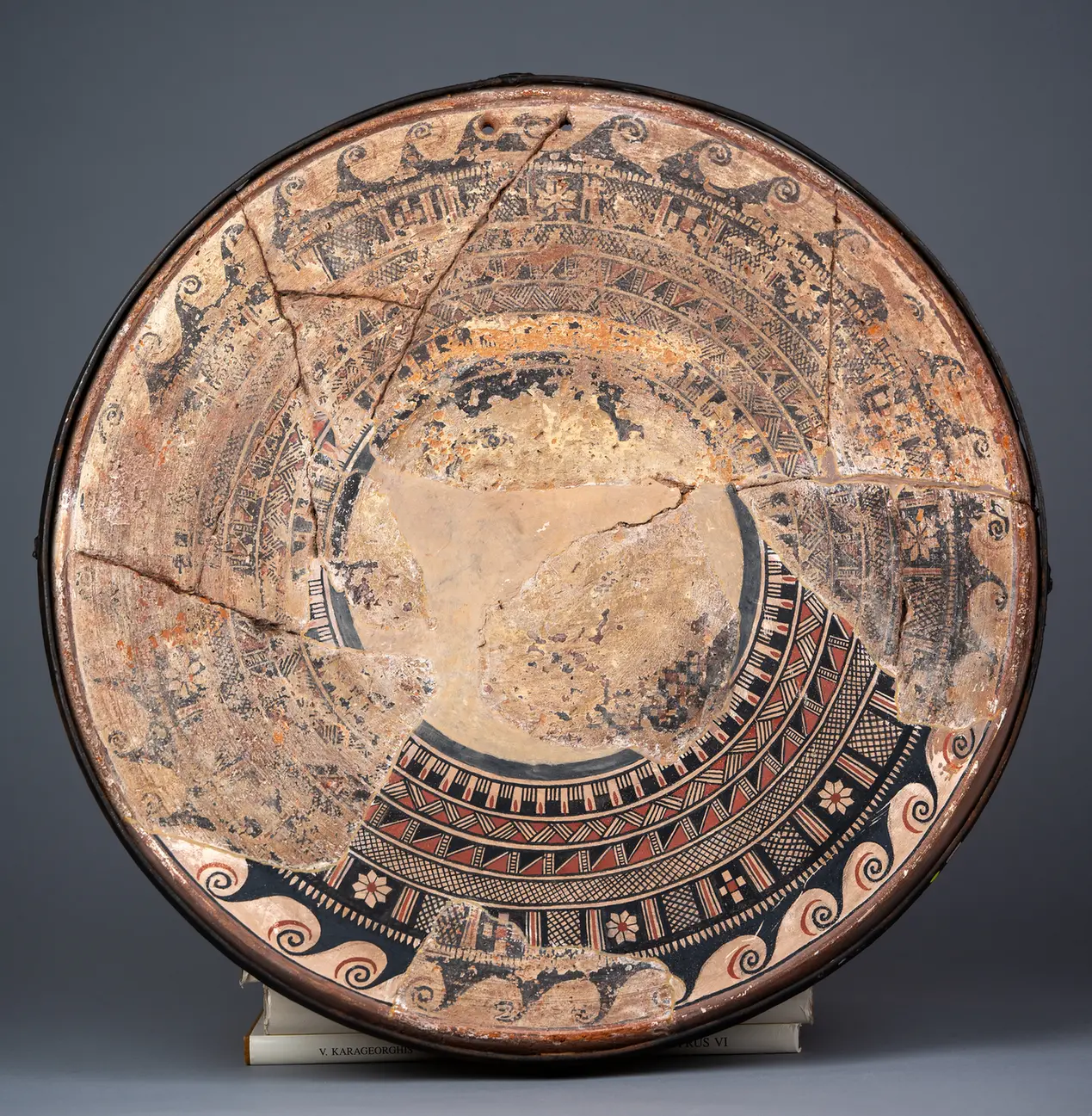
The Large Archaic Plate in the Drakopoulos collection has bands of alternating red and black triangles whose edges form a zigzag, alongside cross-hatched bands and rosettes. The plate is repaired and partly restored, with a modern painted extension of the existing design over one sector, so the original pattern should be read only on the ancient surfaces.
Reading the motif
A zigzag on its own does not date a pot, because the line was used from the Early Bronze Age to the Cypro-Archaic period. Its placement and company narrow the range. Incised with lime filling on a red surface, it belongs to Red Polished. Doubled under hatched triangles or closed into a diamond chain, it points to the north-coast White Painted workshops. Alternating with straight lines round a carinated bowl in black paint, it is the Kalopsidha Zigzag Style, dated Middle Cypriot III in the museum records. Painted down the outer face of a handle between two edge bands, it matches the Cypro-Geometric and Cypro-Archaic tombs at Skales and Stylli. For the history of the Kalopsidha excavation itself, see the article on Paul Åström and his biography.
Objects on this page
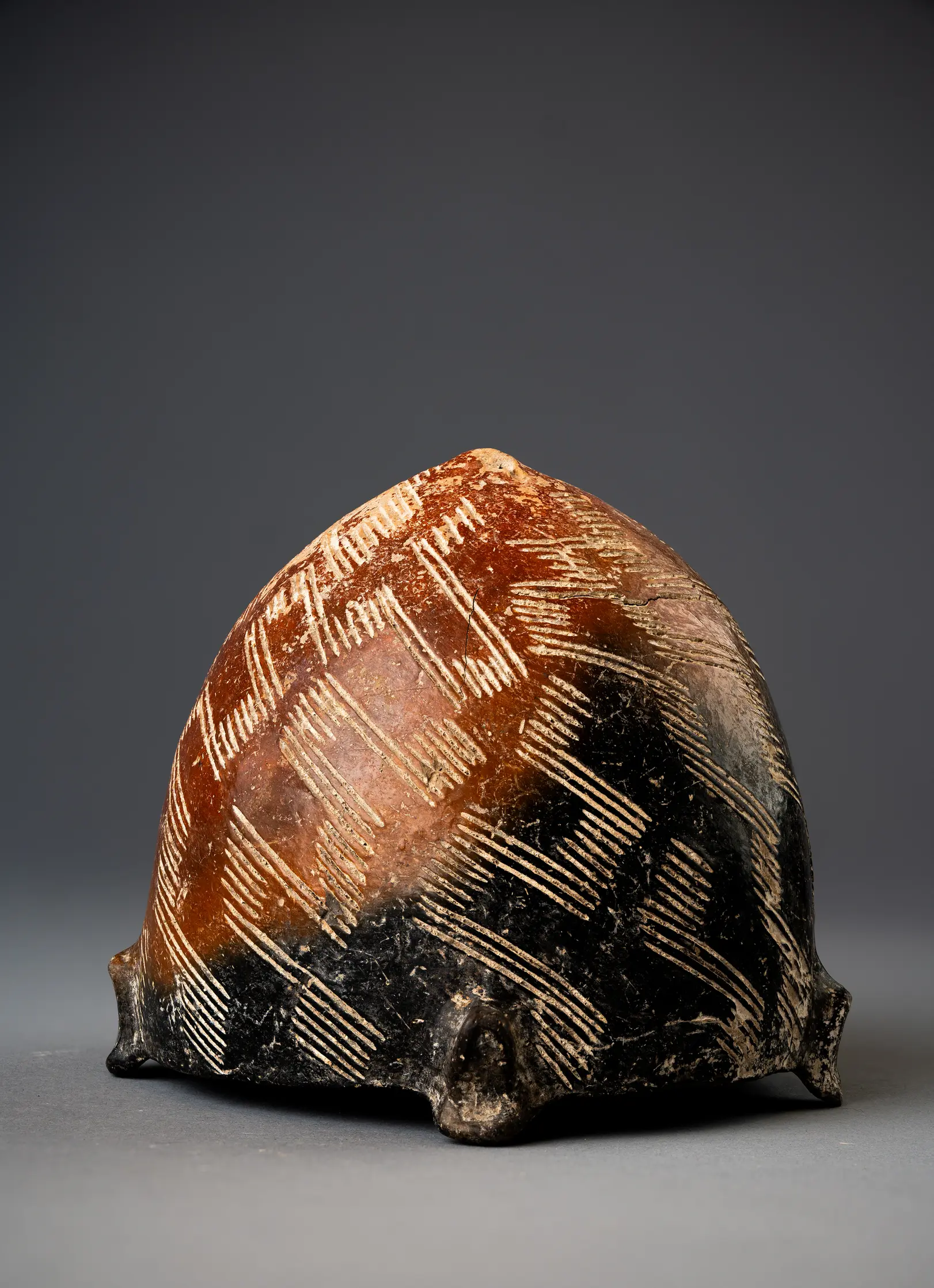 Black-topped Red Polished Tulip Bowl with Incised Hatched LatticeEarly Bronze Age II · 2300–2000 BC
- White Painted III-IV Amphora with Lozenge Chains and Hatched TrianglesMiddle Bronze Age II · 1850–1650 BC
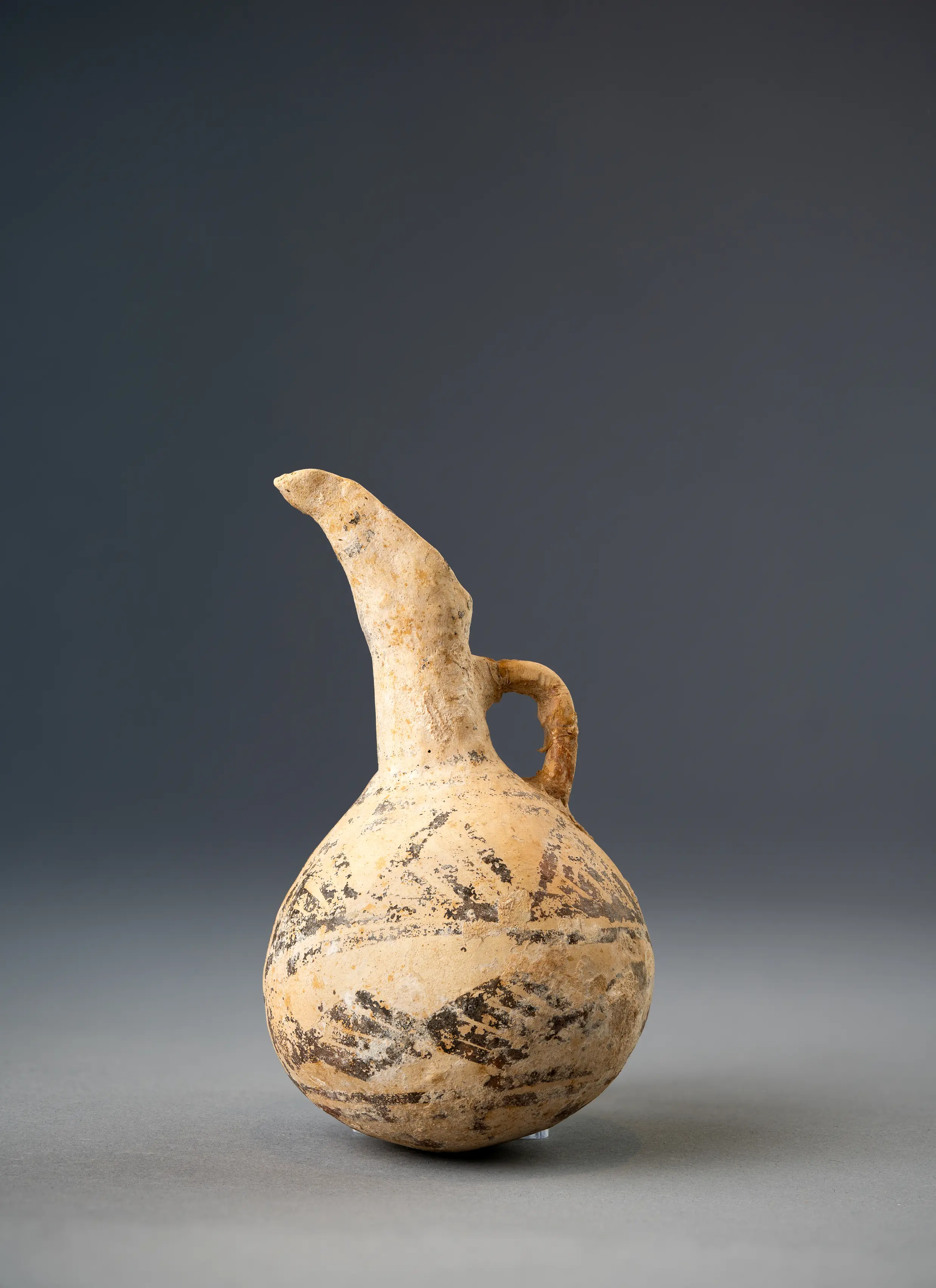 White Painted III-IV Juglet with Cut-away NeckMiddle Bronze Age II · 1850–1650 BC
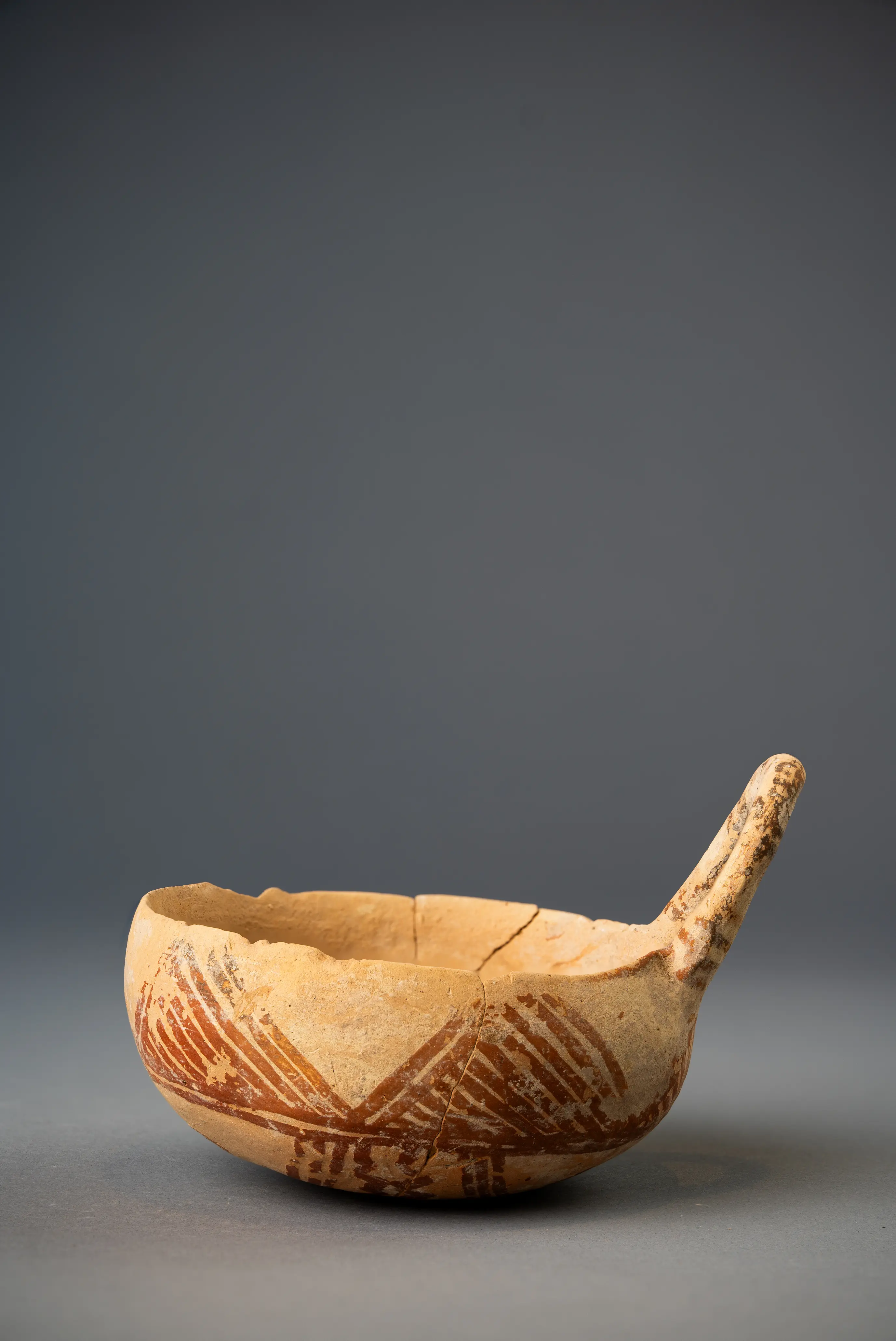 White Painted III-IV Bowl with Rising Handle and Hatched TrianglesMiddle Bronze Age II · 1850–1650 BC
 Large Bichrome Plate from Salamis with a Wave Band and Rosette MetopesArchaic I · 700–550 BC
References
- 1.Åström, P. (1966). Excavations at Kalopsidha and Ayios Iakovos in Cyprus. Carl Bloms Boktryckeri.
- 2.Gagné, L. A. C. (2012). Middle Cypriot White Painted ware: A study of pottery production and distribution in Middle Bronze Age Cyprus [Doctoral dissertation, University of Toronto].
- 3.Karageorghis, V., & Vassilika, E. (1999). The art of ancient Cyprus in the Fitzwilliam Museum, Cambridge. A. G. Leventis Foundation and Fitzwilliam Museum.
- 4.Tatton-Brown, V. (Ed.). (1979). Cyprus BC: 7000 years of history. British Museum Publications.
- 5.Karageorghis, V., & Raptou, E. (n.d.). Palaepaphos-Skales: Tombs of the Late Cypriote IIIB and Cypro-Geometric periods (Excavations of 2008 and 2011). (Page numbers follow the digitised text consulted.)
- 6.Gjerstad, E., et al. (1935). The Swedish Cyprus Expedition, Vol. II: Finds and results of the excavations in Cyprus 1927-1931 (Text). The Swedish Cyprus Expedition. https://archive.org/details/in.ernet.dli.2015.106120 (Page numbers follow the digitised text.)
- 7.Pilides, D., & Papadimitriou, N. (Eds.). (2012). Ancient Cyprus: Cultures in dialogue. Department of Antiquities, Cyprus.