
Contents
At Kalopsidha in eastern Cyprus, Paul Åström counted 21,021 sherds of one decorative style, more than any other ware on the site except Plain White Handmade and Monochrome [2, p. 83]. The style consists of little more than groups of parallel painted lines, usually three or more, laid obliquely across the body of a small jug so that the groups cross one another. "Triple crossing lines" is not a term used in the literature. Scholars call the motif crossing lines, crossed lines or intersecting groups of parallel lines, and the ceramic style built on it is the White Painted Cross Line Style, defined by Åström and dated to the end of the Middle Bronze Age. This entry uses the scholarly name for the style and the site's name for the motif.
Identifying the motif
The unit is a band of parallel lines, not a single line. On the White Painted jugs that carry it, Pamela Russell describes "intersecting groups of three to nine parallel lines arranged obliquely on the body of the vessel," with broad horizontal bands at the shoulder and neck [1, p. 616]. Åström's count from Kalopsidha is lower: the number of parallel lines in a group varies from two to six [2, p. 84]. Three is common, which is where the site's label comes from, but it is not a rule.
Two neighbouring motifs are easy to confuse with it. A lattice or network is made of single lines drawn so densely that they form a mesh, and Åström kept "White Painted Ware with Network Decoration" as a separate group at Kalopsidha [2, p. 81]; the site treats that under lattice and checkerboards. A chevron or zigzag uses the same bands of parallel lines, but they meet at their ends instead of passing through one another (see zig-zags). The test for a crossing-lines design is whether two bands visibly overlap and continue.
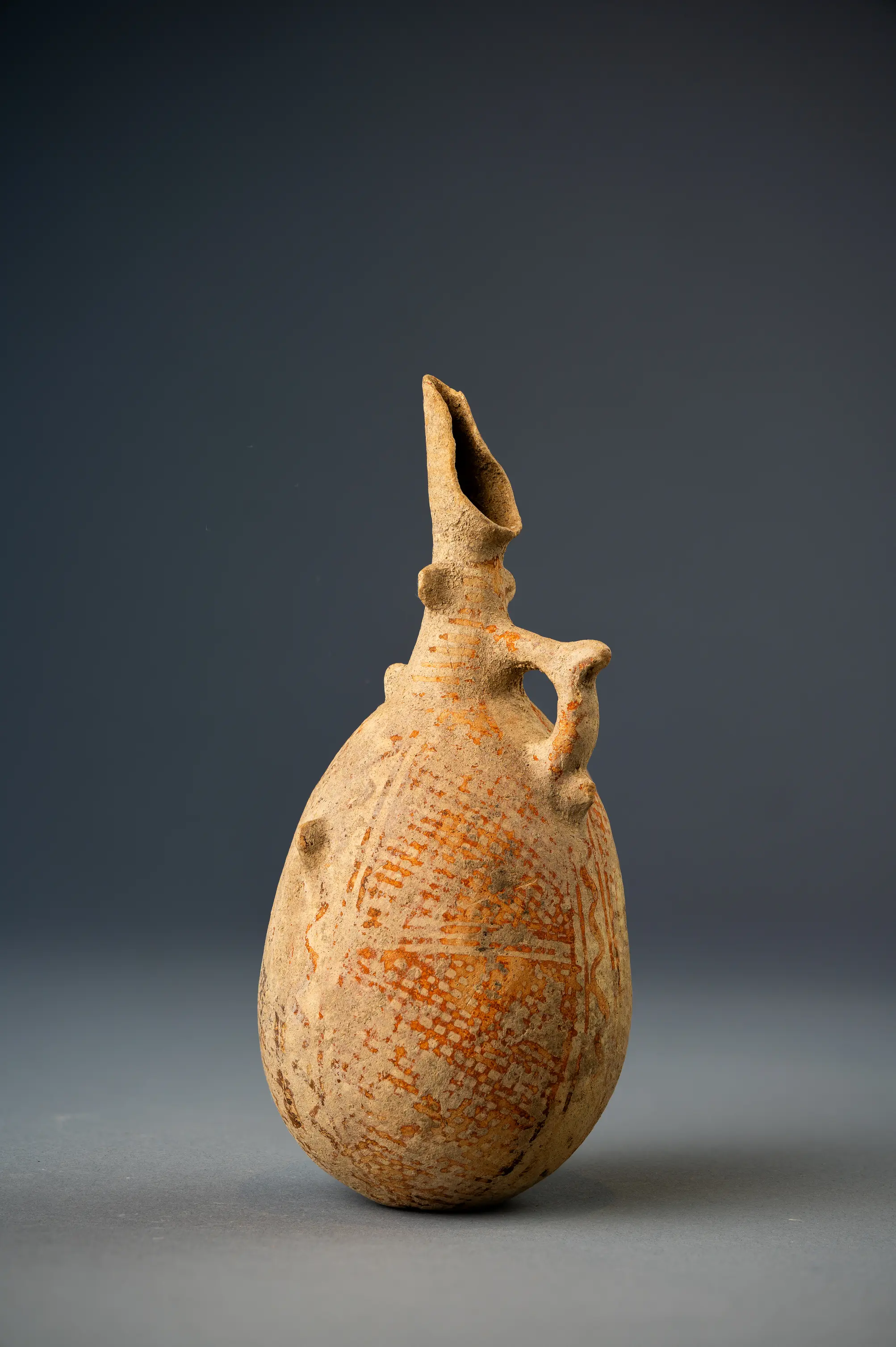
A spouted White Painted jug in the Drakopoulos collection (right) shows the distinction. Its body is covered in a fine red mesh of single crossing lines, which belongs with Åström's network group. Kalopsidha's Cross Line painters worked in bands.
The Cross Line Style at Kalopsidha
The Swedish excavation of the Kalopsidha settlement in 1959, published by Åström in 1966, is still the basis for the style [3, p. 182]. The jugs are "practically always the same": a medium-sized juglet with globular or piriform body, rounded base, concave neck, everted rim and a handle from rim to shoulder. The clay is buff, light brown, red-brown or greenish, with a matt buff to cream slip and matt black or red paint [2, pp. 83-84]. Russell adds a second common shape, the bottle with two string-hole handles at the base of the neck, and estimates that the style accounts for 6% of all Cypriot White Painted jugs and bottles [1, p. 616].
The stratigraphy showed a direction of change. In the bottom layer the fabric is of very good quality and "practically always painted red"; the lines are "regularly and neatly drawn". Higher up the paint turns black, the drawing careless and the fabric coarser [2, p. 83]. In one mixed layer the style supplied 884 sherds (29.5%) against 168 (5.4%) of the older Pendent Line Style [2, p. 52].
Åström divided the jugs into groups by how the crossing bands are arranged [2, pp. 84-86]. Laura Gagné's reworking of the Kalopsidha material in 2012 summarises the scheme [3, pp. 185-187]:
| Group | Arrangement | Notes |
|---|---|---|
| Style 1 (Close net) | About 5 to 9 groups of oblique parallel lines wrapped round the body like a net; schemes A, B, C | In 1C the crosses meet top and bottom to give an unfilled chequerboard |
| Style 2 | Encircling groups of lines forming a cross in front and below the handle, curving over the shoulder | More standardised; some jugs probably by one hand |
| Style 3 (Framed Cross Line) | Crossed lines framed by groups of vertical lines | Close to Bichrome Wheel-made decoration |
| Style 4 | Late, loosely drawn; very few lines actually cross | Piriform bodies; merges with Coarse Linear |
Gagné reads the groups less as a sequence than as the output of different painters, or groups of painters, with different skills working in one tradition. The earliest examples, she notes, "resemble net bags wrapped around the small jugs", and that may have been the intention [3, pp. 185-186]. Several jugs of Style 2 are so alike in shape that one potter may have made them [3, p. 187].
Origins and the Pendent Line debate
Åström argued that the Cross Line Style grew out of the Pendent Line Style, whose jugs carry vertical groups of straight lines with a single wavy line between them. His evidence was a jug from Kythrea Tomb 1 and six sherds from Kalopsidha that combine crossing parallel lines with a wavy line in the interstices [2, pp. 82-83]. He also read the Pendent Line Style as earlier "stratigraphically and stylistically" [2, p. 82].
David Frankel rejected this "simple genetic relationship" and proposed that the two styles were partly contemporary, which would explain the mixed pots equally well [1, p. 616]. Gagné notes that the transitional sherds at Kalopsidha come from layers later than most of the Pendent Line sherds, and that one comes from a much later layer, which could make the combination contemporary with the latest Cross Line jugs [3, p. 184]. The question is open.
The end of the style is better fixed. Russell places most examples in Middle Cypriot III, with a few in LC IA, including jugs from two LC IA tombs at Enkomi, and none later [1, pp. 616-617]. The Enkomi Tomb 21 jug that Åström classed as transitional, with a wavy stroke between groups of crossed bands, is in the Medelhavsmuseet, Stockholm (E. 021:001); the museum's record gives it a Late Cypriot II date, later than Russell's end point for the style [2, p. 83]. Åström also saw the decoration of the earliest White Painted Wheel-made ware as a "deteriorated version" of his Style 4 [3, p. 184]. Russell adds that the style had no effect on early White Slip, which seems to have developed in the west of the island [1, p. 617].
Distribution: an eastern style that travelled
On Cyprus the style is concentrated in the east: Kalopsidha, Milia, Nitovikla and Kythrea have produced the most, and over half the jugs from Kalopsidha carry it [1, p. 616]. Elsewhere it is rare. Lapithos has one import and some local imitations [1, p. 616], and the Cross-Line jugs from Enkomi are so close to Kalopsidha's that Gagné takes Kalopsidha as their source [3, p. 194]. Åström thought there was evidence for pottery production at Kalopsidha itself [3, p. 183].
Abroad it went further than most Middle Cypriot pottery. Cross Line vessels reached Ugarit, Ashkelon, Akko, Megiddo and Gezer, and neutron activation analysis of fourteen White Painted sherds from Akko, including Cross Line and Pendent Line pieces, matched eleven of them closely to sherds from Kalopsidha [1, p. 617]. At Ras Shamra (Ugarit) Claude Schaeffer found Pendent Line, Cross Line and Eyelet Style jugs that he considered similar to Kalopsidha's, and Åström concluded that Kalopsidhians had set up a trading post there [2, p. 139]. Robert Merrillees took the same view in 1965, and Hector Catling thought Kalopsidha controlled the east of the island at the end of the period [3, p. 183]. The Levantine finds are the reason the style matters for chronology and trade.
One jug reached Crete. In 1982 excavators at Kommos found a White Painted Cross Line jug (C 6112), 13.0 cm high, on the lower floor of Room 51 in a Middle Minoan III context. Its white slip carries groups of five oblique matt red lines crossing at the shoulder and at the widest point, and Russell placed it in Åström's Style 2 and in mid-Middle Cypriot III [1, pp. 615, 617]. With a Pendent Line sherd from Zakros it is one of the few Cypriot imports in pre-Late Minoan Crete [1, p. 618].
Museum examples outside Stockholm include a Cross Line Style jug in the Royal Ontario Museum (920.39.21) and a small White Painted IV bottle with two string-hole handles in the British Museum (1869,0604.4), dated Middle Cypriot III to Late Cypriot I, whose hatched triangles are matched by groups of parallel lines crossing on the underside.
Before and after: Red Polished and the Iron Age
Groups of parallel lines were already standard in the incised decoration of Red Polished ware in the Early Bronze Age. A Red Polished I bowl from Vounous Tomb 90, now in the Fitzwilliam Museum, is incised with wavy lines, a hatched band, parallel zigzags "and groups of oblique lines", with some of the original lime still in the cuts [4, cat. 8]. The British Museum's black-topped "tulip" bowl from Vounous (1939,0217.3) is decorated with chevrons made of incised parallel lines filled with white lime (record).
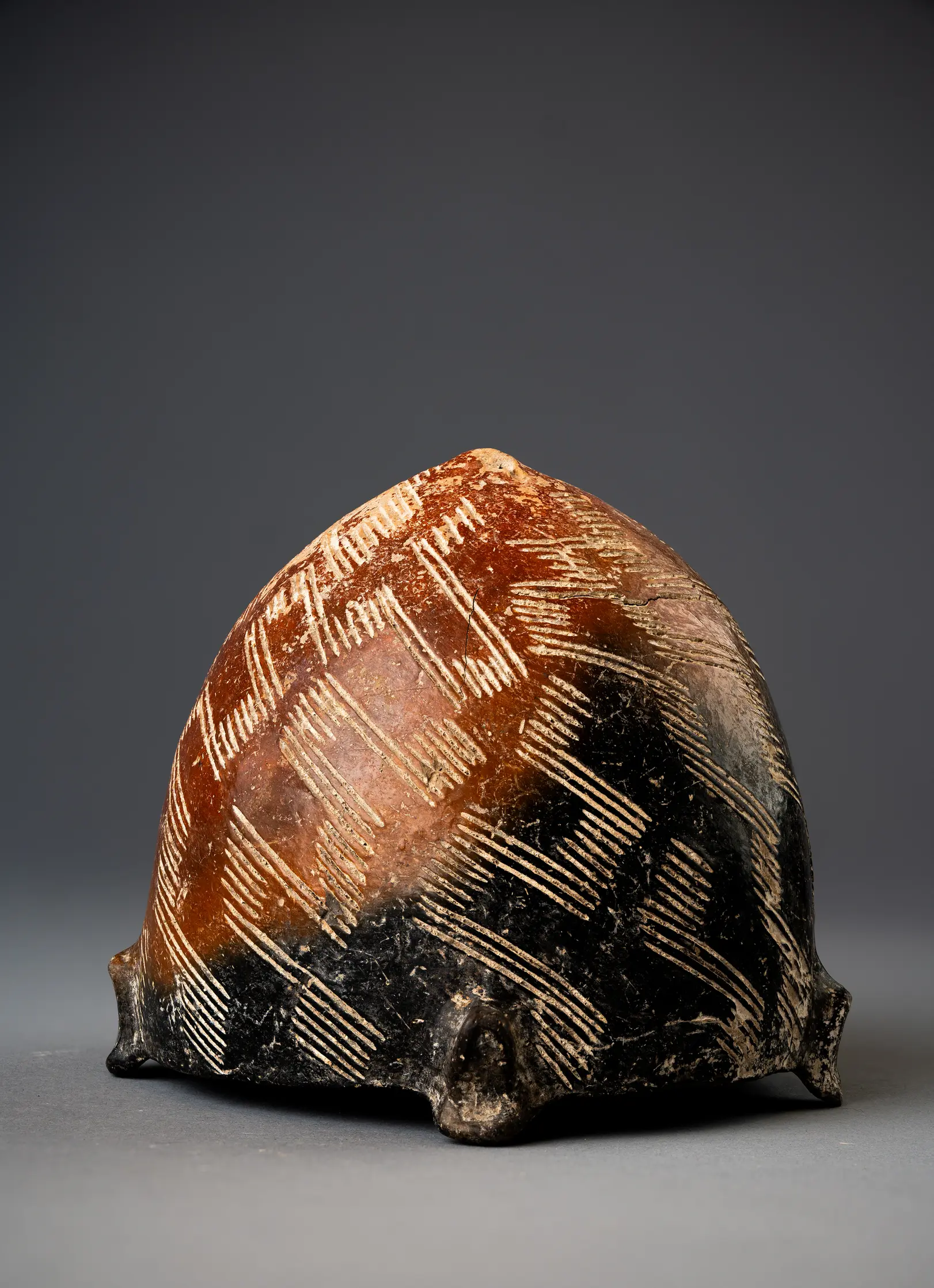
The Drakopoulos Red Polished bowl (catalogued as a bottle; it is a bowl with small lugs at the rim, photographed mouth-down like the British Museum example) carries bands of three to five incised lines that run obliquely and cross each other over the red lower body and the black-topped rim zone. It uses the same device as the Kalopsidha jugs, incised instead of painted and centuries earlier. The resemblance is best treated as a shared habit of banded linear ornament; a line of descent from one to the other has not been demonstrated.
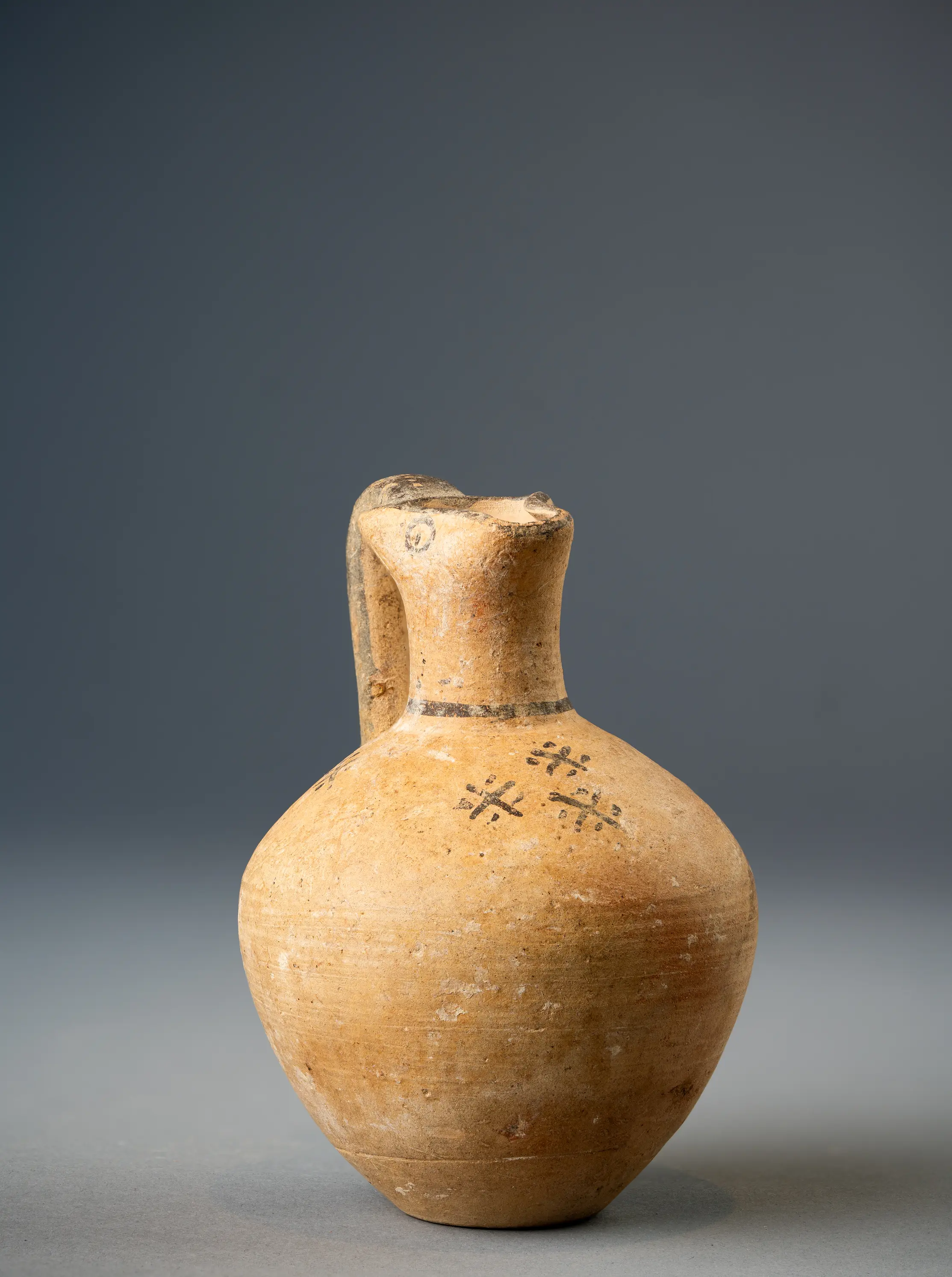
The motif also survives in small ways. A White Painted V Zigzag Style bowl from Kalopsidha (A 667) has "a cross of two groups of three parallel lines on base" [2, p. 24], a literal triple crossing. In the Cypro-Archaic period, crossing strokes return as scattered filling ornament: a Bichrome IV free-field jug in Brussels (A 1486) has three dotted crosses behind its bird and two rows of them in front [5, cat. 232]. The Drakopoulos White Painted oinochoe has similar crossed strokes with dots on its shoulder. These are single crosses, closer to the Maltese cross and the free-field fillers than to the banded Bronze Age style.
Reading the style
The Cross Line Style is a regional product that can be tracked. It was made in a small area of eastern Cyprus, mostly on one shape, over a limited period, and it travelled to the Levantine coast and once to Crete. Åström's stratigraphy gives it an internal development from neat red lines to careless black ones, and Gagné's study of the same pots finds the hands of individual painters behind his groups (see also the site's pages on Paul Åström and his work in Cypriot archaeology). A Middle Bronze Age jug with crossing bands of lines therefore points first to eastern Cyprus. Two questions remain open: whether the style grew out of the Pendent Line Style or ran beside it, and how its last loose version, in which the lines barely cross, turned into the painted bands of the first wheel-made White Painted jugs of the Late Bronze Age.
Objects on this page
References
- 1.Russell, P. J. (n.d.). A Middle Cypriot jug from Kommos, Crete. In Temple University Aegean Symposium: A compendium (pp. 615-618). Temple University.
- 2.Åström, P. (1966). Excavations at Kalopsidha and Ayios Iakovos in Cyprus. Carl Bloms Boktryckeri.
- 3.Gagné, L. A. C. (2012). Middle Cypriot White Painted ware: A study of pottery production and distribution in Middle Bronze Age Cyprus [Doctoral dissertation, University of Toronto].
- 4.Karageorghis, V., & Vassilika, E. (1999). The art of ancient Cyprus in the Fitzwilliam Museum, Cambridge. A. G. Leventis Foundation and Fitzwilliam Museum.
- 5.Pilides, D., & Papadimitriou, N. (Eds.). (2012). Ancient Cyprus: Cultures in dialogue. Department of Antiquities, Cyprus.