
Contents
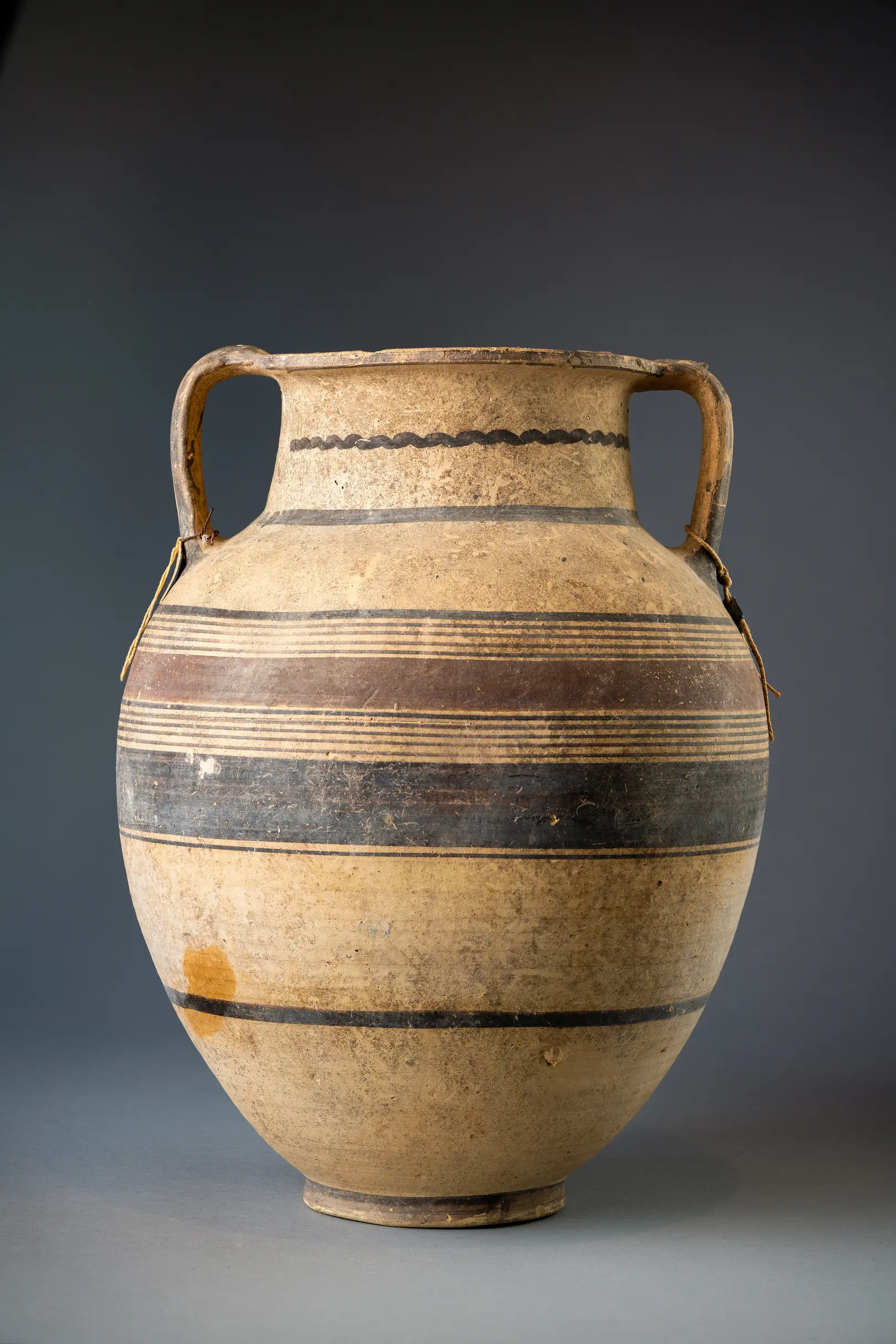
In Tomb 3 at Stylli, the Swedish Cyprus Expedition found a Bichrome oval amphora 41.9 cm high whose only figured ornament was "a wavy line between handles" [1, Stylli T.3 no. 6]. The 42 cm Bichrome amphora in the Drakopoulos collection, sold through the Cyprus Museum's sales register (SR 3477/65) and exported in 1969, is the same size and uses the same device: a single black wavy line on the neck, held between straight bands, above a body of red and black encircling bands. The wavy line had a long life on Cypriot pottery. It was incised on Red Polished bowls in the Early Bronze Age, gave its name to a White Painted style in the Middle Bronze Age, ran round the rims of White Slip bowls in the Late Bronze Age, and was still being painted between the handles of amphorae in the Cypro-Archaic period.
Identifying the motif
A wavy line is a continuous line that swings up and down in rounded curves. On Cypriot pots it almost never floats alone. The usual arrangement is a single wavy line framed by straight lines or bands, either encircling the vessel horizontally or hanging vertically from the shoulder. Doubled and tripled wavy lines also occur, as do wavy lines with rows of dots beside them. Excavators sometimes describe a slack, carelessly drawn example as a "degenerate wavy line", a term the Swedish Cyprus Expedition used for the line round the neck of a White Painted III jug and on a Bichrome IV open bowl [1].
Two neighbouring motifs share its ground. A zigzag is a wavy line with pointed turns instead of rounded ones. Laura Gagné, in her 2012 study of Middle Cypriot White Painted ware, calls the White Painted Zigzag Style "a sharp-angled version of the wavy line" and "a pointed version of the wavy lines seen at other sites" [2, pp. 190, 215]. The two could sit on one pot: Paul Åström describes the White Painted V Zigzag Style as "alternating zigzags and straight lines", yet one bowl he assigns to it carries "two wavy encircling lines inside rim" [3, p. 88]. This entry treats a line as wavy when its turns are rounded and as a zigzag when they come to a point. The second boundary is with wavy hooks, where the wavy line ends in a curl or spiral hook; those belong to their own entry.
Early Bronze Age: incised wavy lines
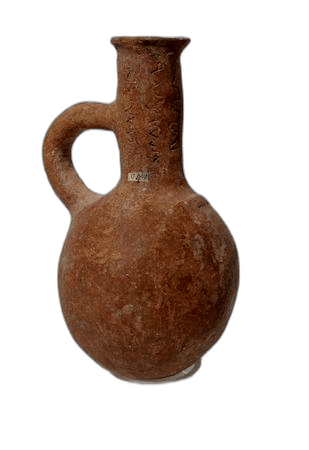
The earliest Cypriot wavy lines are incised. A Red Polished I bowl in the Fitzwilliam Museum, Cambridge, from Bellapais-Vounous Tomb 90 (no. 27), has incised "horizontal wavy lines, a hatched horizontal band, parallel horizontal zigzag lines, and groups of oblique lines", with lime left in the incisions [4, cat. 8]. The pairing of wavy and zigzag lines on one bowl shows that the two were separate choices for the potter from the start. The British Museum holds later Red Polished pieces with the same device, among them a Red Polished III jug from Phoenikiais with an incised wavy line on the neck and a sherd from the same area with an applied wavy line modelled in clay.
Middle Bronze Age: three White Painted styles
The wavy line became a style marker in White Painted ware. Pamela Russell lists a "White Painted I Wavy Line Style" among the named styles of the ware, alongside the Latticed Diamond, Stringhole, Framed Caduceus, Pendent Line and Cross Line Styles [5, p. 616]. Three of these styles use the wavy line as a main element.
| Style | Main use of the wavy line | Region and date | Source |
|---|---|---|---|
| WP Wavy Line Style | Wavy lines on hemispherical bowls and a few amphorae | Karpass; Ayios Iakovos | Gagné 2012, pp. 180-181 |
| WP III-IV Pendent Line Style | One wavy line between groups of straight vertical lines hanging from the shoulder | Eastern Cyprus (Kalopsidha); before the Cross Line Style | Åström 1966, p. 82; Gagné 2012, p. 184 |
| WP III-IV Alternating Broad Bands and Wavy Lines | Broad encircling bands alternating with thin wavy lines on the upper body of jugs | Several regions of Cyprus and the Levant; probably MC II-III | Åström 1966, pp. 81-82 |
In the Wavy Line Style, Gagné describes most of the hemispherical bowls at Ayios Iakovos, and an amphora and a deep bowl, as decorated in this style, with "quite similar motifs and syntax" to the local Red-on-Red and Red-on-Black wares. She concludes that "the White Painted Wavy Line Style, which originates in the Karpass region, is based on these two traditions", that the vessels were made by the same painters who worked in Red-on-Red and Red-on-Black, and that they did not travel outside Ayios Iakovos [2, pp. 180-181]. It is a local style, and a wavy-line bowl found elsewhere should not be assigned to it on the motif alone.
For the Pendent Line Style at Kalopsidha, Åström defined a scheme in which there is "always one wavy line between straight ones": two bands encircle the shoulder and groups of three to six parallel straight vertical lines hang from them, with the wavy line in the middle of each group. Two wavy lines are rare. The paint changes over time from red to black and from lustrous to matt, and the style is earlier than the Cross Line Style [3, p. 82]. Gagné's reading of the same material gives a single wavy line between groups of three or four straight verticals [2, p. 184].
For the third style, Åström grouped White Painted III-IV jugs whose upper bodies carry horizontal broad bands alternating with thin wavy lines; his index also calls it the "Straight and Wavy Line Style". He cites complete jugs in the Cyprus Museum (from Arpera Mosphilos Tomb 1A and from Stavroti "Alaminos"), one in the Metropolitan Museum and one in the Haifa Museum from near Acre, and sherds from Kalopsidha, Politiko, Bey Keuy, Kythrea, Galinoporni and Tell Jerisheh. He judged them "likely made in Middle Cypriote II and III" [3, pp. 81-82].
The wavy line also marks the change from the Pendent Line to the Cross Line Style. Åström described transitional pieces with crossing groups of parallel lines and a wavy line in the spaces between them: a jug from Kythrea Tomb 1, six sherds from Kalopsidha, and a jug from Enkomi Tomb 21 with a "wavy stroke" [3, p. 83], now in the Medelhavsmuseet, Stockholm (E. 021:001). Russell sets out the disagreement over these pots. For Åström the combination showed that the Cross Line Style evolved from the Pendent Line Style. David Frankel rejected this "simple genetic relationship" and argued that the two styles were partly contemporary, which would explain both appearing on one vessel [5, p. 616]. The question is still open. See the pages on Paul Åström and David Frankel.
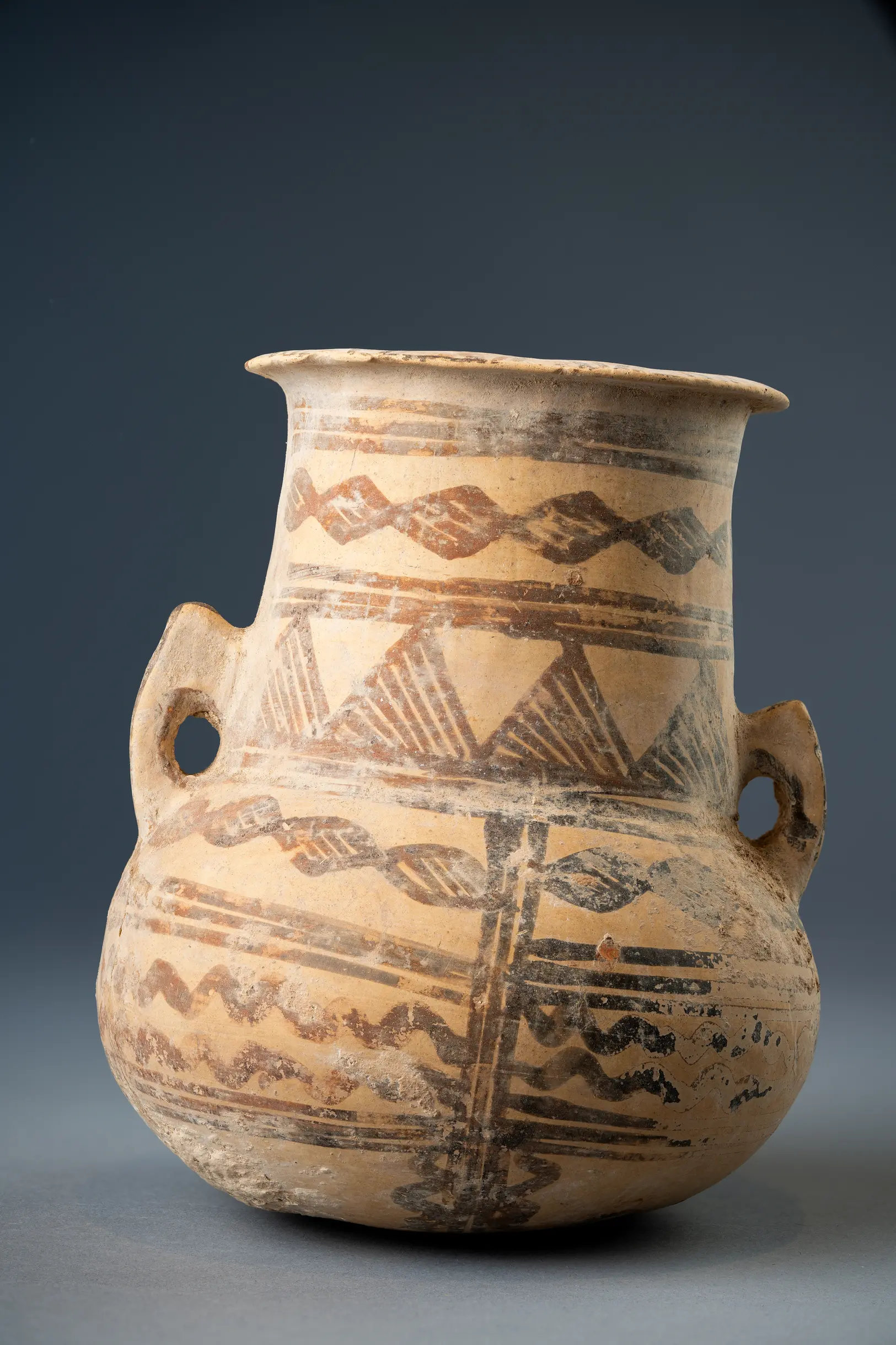
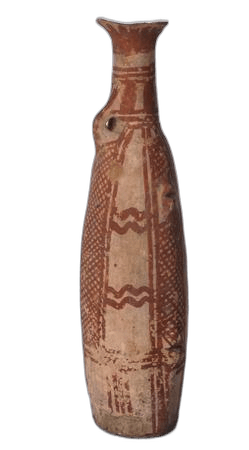
The motif also appears on White Painted from the north coast. The Drakopoulos White Painted jar (right) is a two-handled jar with pierced lug handles. Single wavy lines run between horizontal bands on the body, beside a vertical ladder band; the neck has a chain of cross-hatched diamonds and the shoulder a band of hatched triangles. Its closest parallels are two White Painted III amphorae from Lapithos Tomb 316 in Stockholm: L. 316:104, with vertical ladders and wavy lines, and L. 316:117, with a wavy line on the neck and a cross-hatched diamond chain. The British Museum has later examples of the combination: a White Painted IV juglet from Klavdia with red wavy lines and latticed lozenges, a White Painted flask with latticed panels between horizontal wavy lines, and a White Painted V amphora from Enkomi with horizontal, vertical and wavy lines on the body. On White Painted V open shapes the wavy line moved inside: Åström's Eyelet Style bowl no. 1068 from Kalopsidha has a "dotted wavy line and parallel wavy lines" on the interior [3, p. 46].
Late Bronze Age: White Slip and the wavy-line horizon
On White Slip I bowls the wavy line became a rim motif. The White Slip report in the Kalopsidha volume names a "Framed wavy line style" and counts fragments of about seven bowls of it from Trench 9, one in bichrome red and black [3, p. 96]. The same report notes that some of the earliest White Slip II sherds kept "a wavy line around the rim instead of the usual line of dots" [3, p. 95]. A White Slip I hemispherical bowl from Enkomi in the British Museum has a wavy-line rim motif and a frontal motif of double wavy lines framed with dotted lines. The White Slip I bowls from Kazaphani Tomb 2A (nos. 212-216) carry a wavy line, or a wavy line between horizontal lines, round the rim, and one has a pendent triple wavy line flanked by dots [6].
At the end of the Late Bronze Age the wavy line returned as the main ornament of a whole class. Gunnar Lehmann notes that the Aegean "Granary Style" of LH IIIC Middle is mostly linear or monochrome on open shapes, while "wavy lines characterize the Cypriot repertoire". In Cyprus the style is "the hallmark of LC IIIB, although a few examples are already present in Enkomi Level IIIA" [7, p. 279]. He reports Susan Sherratt's view that wavy-line decoration was not introduced from the Aegean but originated in the eastern Mediterranean, possibly in Cyprus itself, and spread westward, and he treats the Cypriot Granary Style as a local product. Because Granary Style and Proto-White Painted were contemporary and both used the wavy line, the two are sometimes not told apart; Lehmann follows Iacovou's distinction between them [7, p. 279]. A Proto-White Painted amphora from Alaas Tomb 19, 39 cm high, has three horizontal parallel wavy lines on the body between the handles and is dated to LC IIIB [8, cat. 82].
Iron Age: bands, handles and rims
In the Cypro-Geometric and Cypro-Archaic periods the wavy line was a filler between bands, on necks, shoulders, rims and handles. A White Painted cup from Gastria in the British Museum, of Cypro-Geometric date, has black bands and a wavy line. Stylli Tomb 3, which Gjerstad dated to Cypro-Archaic I with a reuse in Cypro-Archaic II, shows how the motif was spread across a single burial group: besides the Bichrome amphora with a wavy line between the handles, a White Painted III jug has a framed wavy line on the handle, a White Painted III bowl has a "broad, wavy line around rim", and a White Painted IV barrel jug has a zigzag line on its handle [1, Stylli T.3 nos. 3, 4, 6, 8]. The large Drakopoulos amphora belongs with this group. Its wavy line sits on the neck instead of between the handles, but the scale, the Bichrome palette and the syntax of a single line between bands are the same.
The motif also crossed into Black-on-Red. The Drakopoulos Black-on-Red bowl has a red slip, a ring foot and a horizontal handle, with a black wavy line between bands below the rim. The shape matches a Cypro-Archaic Black-on-Red bowl with one horizontal handle in the Ashmolean Museum (AN1953.299).
In Cypro-Archaic I a related variant ended each wavy line in a spiral hook. Bourogiannis traces the Rhodian "Kreis- und Wellenband" class, with wavy lines ending in spiral hooks, to Cypriot White Painted IV of that phase [9]. That variant is covered under wavy hooks.
Dating a pot by its wavy line
A wavy line alone does not date a pot. The same motif is found on Early Cypriot incised bowls and Cypro-Archaic amphorae, and within a single period it can mark a local style (the Ayios Iakovos bowls) or turn up in several regions and abroad (the Alternating Broad Bands jugs). What dates it is the ware, the shape and the syntax: whether the line is incised or painted, whether it hangs vertically between straight lines as in the Pendent Line Style, rings a White Slip rim, or runs as a thin filler between broad Iron Age bands. For the other linear motifs see zig-zags, triple crossing lines and lattice and checkerboards; more pieces with the motif are in the Drakopoulos collection and the British Museum collection.
Objects on this page
 Large Bichrome Amphora with a Wavy Line on the NeckGeometric III · 850–600 BC
 Red Polished Ware JugMiddle Bronze Age I · 1950–1750 BC
- White Painted III-IV Amphora with Lozenge Chains and Hatched TrianglesMiddle Bronze Age II · 1850–1650 BC
 White Painted FlaskMiddle Bronze Age I · 1950–1650 BC
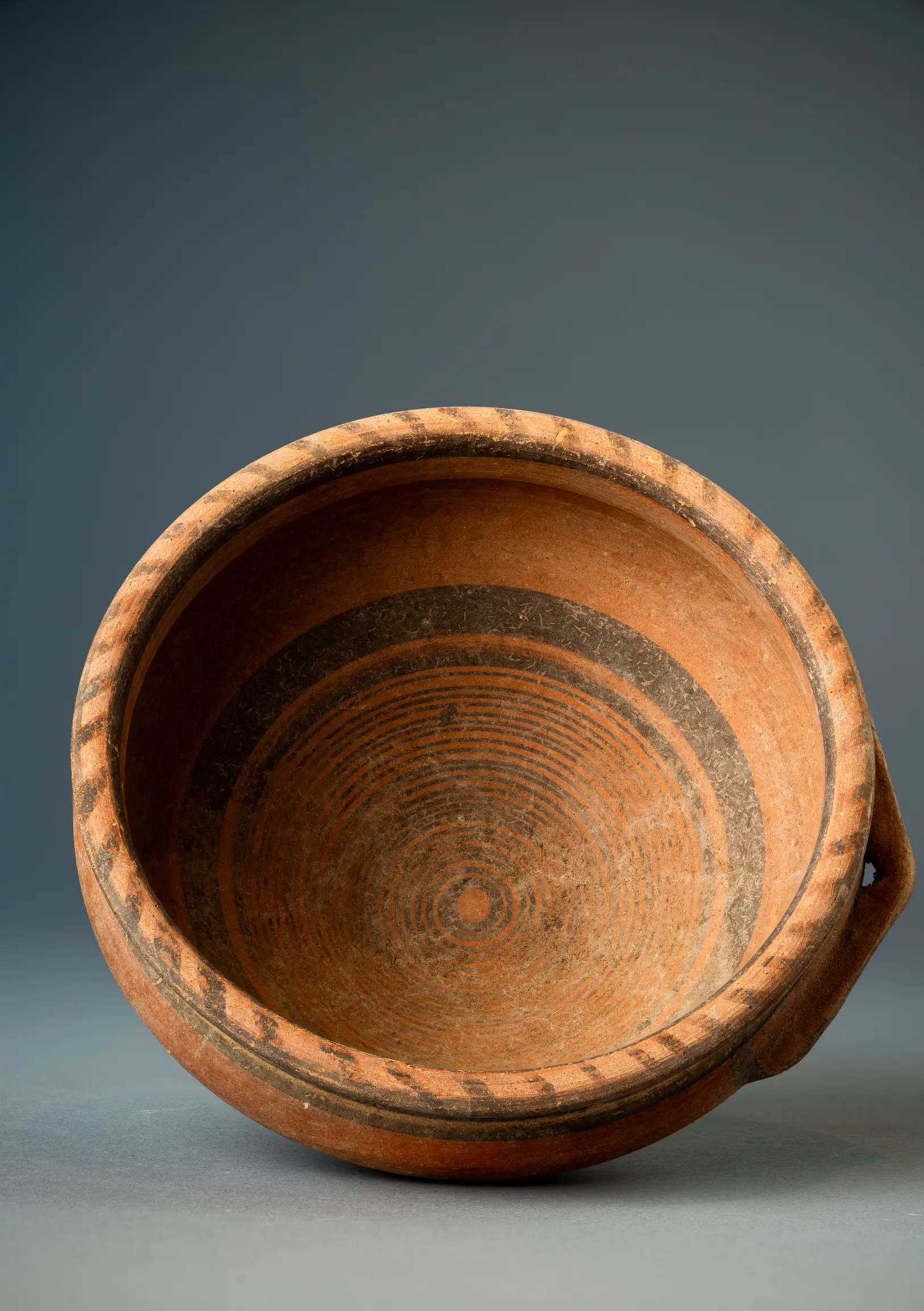 Black-on-Red One-Handled Bowl with Wavy-Line RimGeometric III · 850–600 BC
References
- 1.Gjerstad, E., et al. (1935). The Swedish Cyprus Expedition: Finds and results of the excavations in Cyprus 1927-1931 (Vol. II, text). The Swedish Cyprus Expedition.
- 2.Gagné, L. A. C. (2012). Middle Cypriot White Painted ware: A study of pottery production and distribution in Middle Bronze Age Cyprus [Doctoral dissertation, University of Toronto].
- 3.Åström, P. (1966). Excavations at Kalopsidha and Ayios Iakovos in Cyprus. Carl Bloms Boktryckeri.
- 4.Karageorghis, V., & Vassilika, E. (1999). The art of ancient Cyprus in the Fitzwilliam Museum, Cambridge. A. G. Leventis Foundation and Fitzwilliam Museum.
- 5.Russell, P. J. (n.d.). A Middle Cypriot jug from Kommos, Crete. In Temple University Aegean Symposium: A compendium (pp. 615-618). Temple University.
- 6.Nicolaou, I., & Nicolaou, K. (1989). Kazaphani: A Middle/Late Cypriot tomb at Kazaphani-Ayios Andronikos: T.2A, B. Department of Antiquities, Cyprus.
- 7.Lehmann, G. (2013). Aegean-style pottery in Syria and Lebanon during Iron Age I. In A. E. Killebrew & G. Lehmann (Eds.), The Philistines and other "Sea Peoples" in text and archaeology (pp. 265-328). Society of Biblical Literature.
- 8.Karageorghis, V., & Stavrou, P. (1976). Treasures of Cyprus: An exhibition of Cypriot art.
- 9.Bourogiannis, G. (2019). Late Geometric, Subgeometric and Archaic pottery from Rhodes at Lund: A fresh look at some old finds. In S. Schierup (Ed.), Documenting ancient Rhodes (pp. 221-240). Aarhus University Press.