
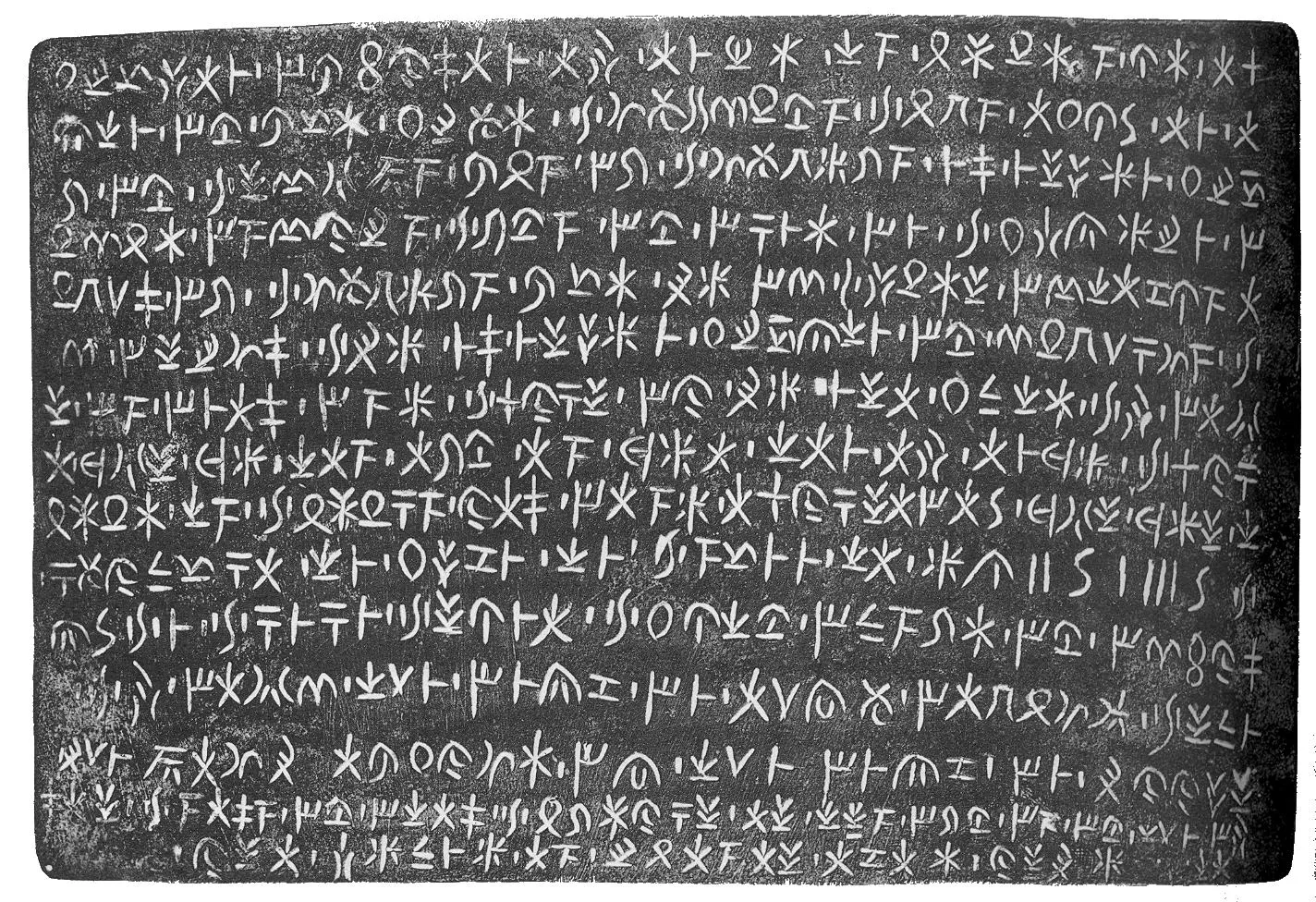
The Cypro-Classical period is the last segment of the Cypriot Iron Age and the terminal phase of the island's city-kingdoms. Conventionally it runs from about 480 BCE, the horizon of the Ionian Revolt and the Persian Wars, to about 310 BCE, when Ptolemy I of Egypt did away with the kings altogether. Its structure is unlike that of Classical Greece. There was no citizen polis and no democracy; there were seven to ten small monarchies, each named for its capital city, each striking its own coin and keeping its own cults, all held in a loose vassal relationship by the Achaemenid Persian Empire. Greek, Phoenician and a non-Greek language now called Eteocypriot were written side by side, the first two in a syllabic script of Bronze Age descent, the third in the Phoenician alphabet. The literary record is thin, external and mostly Athenian. Most of what can be said about the period's kings, wars and territorial changes rests on coins, inscriptions, sanctuaries and tombs. This entry sets out the chronology, the political history, the institutions of the kingdoms, their scripts and coinages, their material culture, and the process by which the whole system was dismantled between 332 and 294 BCE. It sits between the Cypro-Archaic and Hellenistic entries in the chronology of the island.
A borrowed label and its boundaries
"Classical," like "Geometric" and "Archaic," is an Aegean stylistic term that Einar Gjerstad applied to Cyprus in 1948 for practical reasons, adding the prefix "Cypro-" to mark the island's separate course [1, p. 130]. The scheme belongs to the Swedish Cyprus Expedition and rests on pottery seriation. Gjerstad fixed the boundary between Cypro-Archaic II and Cypro-Classical I at the palace of Vouni on the north-west coast: the earliest sculptures of the first palace date to about 500 to 480 BCE, pottery of his Type V lay below its floors and Type VI above, and a Bichrome V amphora found at Olynthos beneath the Persian destruction of 479 showed Type V still current at that date. He proposed 475 BCE, with the round figure 480 in many later tables reflecting the same horizon [1, p. 254]. The internal division at about 400 BCE rests on the imported Attic pottery in the tombs of Marion, dated by the Athenian Agora sequence [1, p. 254]. The subdivisions are therefore Cypro-Classical I (c. 480 to 400) and Cypro-Classical II (c. 400 to 310).
The closing boundary is contested because it is political rather than ceramic. Older tables close the period at 325 or 323 BCE, keyed to Alexander; most current usage closes it at about 310, the death of Nikokreon of Salamis and the end of the kingship system; a minority prefers 294, the year Ptolemy I definitively secured the island after the Antigonid interlude. Maria Iacovou has argued that the ceramic phases cut across the political realities that structure the first millennium, and that the useful periodisation of Iron Age Cyprus is the formation, consolidation and abolition of the kingdoms rather than Geometric, Archaic and Classical [2, p. 15]. On that view the Cypro-Classical period is simply the "abolition" horizon of a much longer story.
| Date (BCE) | Event | Principal source |
|---|---|---|
| c. 525 | Cyprus submits to Persia; assigned to the Fifth Satrapy | Herodotus 3.91 |
| 498–497 | Cypriot revolt under Onesilos; battle at Salamis; Soloi falls after five months | Herodotus 5.104–116 |
| c. 480/475 | Conventional start of Cypro-Classical I (Vouni stratigraphy) | Gjerstad 1948 |
| c. 478–470 | Idalion bronze tablet; Persian and Kitian siege of Idalion | ICS 217 |
| c. 450 | Kimon's expedition; siege of Kition; Kimon dies | Thucydides 1.112 |
| c. 450 | Kition annexes Idalion under Ozibaal | Kition royal inscriptions |
| c. 411 | Evagoras I seizes Salamis | Diodorus 14.98 |
| c. 400 | Conventional division CC I / CC II (Marion tombs) | Gjerstad 1948 |
| 392/1 | Milkyaton's trophy at Kition for victory over Paphians and allies | Yon and Sznycer 1991 |
| 387/6 | King's Peace assigns Cyprus to the Great King | Xenophon, Hellenica 5.1.31 |
| c. 381 | Sea battle off Kition; Evagoras defeated, keeps his throne | Diodorus 15.3–9 |
| 374/3 | Evagoras I murdered; Nikokles succeeds | Aristotle, Politics 5.1311b |
| c. 341 | Pumayyaton of Kition styled king of Kition, Idalion and Tamassos | Marble altar, year 21 |
| 332 | Cypriot kings bring 120 ships to Alexander at Tyre | Arrian 2.20 |
| 312 | Ptolemy executes Pumayyaton; Marion destroyed | Diodorus 19.79 |
| 311/310 | Death of Nikokreon; Marmor Parium dates Ptolemy's mastery of Cyprus | Marmor Parium B 17 |
| 306 | Demetrios defeats Ptolemy off Salamis; Antigonid decade begins | Diodorus 20.47–52 |
| 294 | Ptolemy I recovers Cyprus; Ptolemaic province | Papantoniou 2013 |
Persia, the revolt of 498, and the Athenian decades
Cyprus passed under Achaemenid control around 525 BCE and was listed by Herodotus, with Phoenicia and Syria-Palestine, in the Fifth Satrapy, assessed together at 350 talents [4, p. 56]. The Persian hand was light. No Persian official is attested as resident on the island, the kings kept their titles and their coinages, and their obligations seem to have been tribute and ships [3, pp. 44–46]. Gjerstad read the whole century as a structural confrontation between a Persian-and-Phoenician bloc and a Greek-Cypriot one, taking Isocrates at face value and reading the plan of the Vouni palace as an "anti-Greek" watchtower over Soloi [1, pp. 279–283]. That reading has been dismantled: Franz Georg Maier's essay on "factoids" targeted the chain of inferences by which ground plans had become political history [6], A. T. Reyes noted that the Vouni plan is not even characteristically Persian [4, p. 57], and Antigoni Zournatzi's survey of the sources concluded that alignments shifted with circumstance rather than ethnicity [7]. Even Gjerstad conceded that in 498 "Greeks and Phoenicians co-operated" [1, p. 278].
The revolt itself is the fullest Cypriot episode in Herodotus (5.104–116) and, in P. J. Stylianou's judgement, one of the most treacherous, since Herodotus's account of the Ionian rising is "little more than a caricature" [3, p. 47]. The trigger was dynastic. Onesilos shut the gates of Salamis on his pro-Persian brother Gorgos, then persuaded every kingdom except Amathus to rise, and besieged Amathus for refusing. Whether Phoenician Kition joined is doubtful; Stylianou argues that Herodotus's own line-up of Cypriots and Ionians against Persians and Phoenicians makes Kitian participation "inconceivable," and that Onesilos attacked Amathus precisely because Kition was too strong to attempt [3, pp. 50–55]. An Ionian fleet beat the Phoenicians at sea off Salamis, but on land the war-chariot contingents of Kourion and Salamis deserted, Onesilos and Aristokypros of Soloi were killed, and the cities were reduced one by one. Soloi held out longest and fell in the fifth month when the Persians undermined its walls [3, p. 56]. Archaeology corroborates the texts at two points: the Canadian excavators judged the Archaic city of Soloi to have been destroyed suddenly, and at Palaepaphos the Persian siege ramp survives against the north-east gate, with the defenders' counter-tunnels beneath it and hundreds of missiles, helmets and reused sculptures sealed inside the mound [3, pp. 56–57; 4, p. 54]. The weapons and armour from the ramp are the largest battle deposit on the island.
The Persian settlement confirmed reliable dynasts, and Cyprus supplied 150 triremes to Xerxes in 480 [3, pp. 63–64]. Yet Aeschylus, staging the Persians in 472, could list Paphos, Soloi and Salamis among the Greek cities freed after the naval defeat, and the allied fleet under Pausanias sailed to Cyprus in 478 [3, pp. 67–69]. Whether any Cypriot city then joined the Delian League is unresolved, since no Cypriot name is secure in the tribute lists [3, pp. 70–72]. Kimon's campaign of 451/450 took Marion, failed before the walls of Kition, and ended with the general's death; Athens never again committed major force to the island [3, pp. 82–86]. From the disputed Peace of Kallias to the King's Peace of 387/6, which named Cyprus explicitly as the Great King's possession, the island was governed indirectly through its kings and recoverable by Persia whenever Athens looked away [3, pp. 104–105].
The kingdoms and their dynasts
The only complete ancient list of Cypriot kingdoms is the prism of the Assyrian king Esarhaddon of 673/2 BCE, which names ten polities and ten kings; it is a document of the Neo-Assyrian period, and no later source repeats the number [2, p. 14]. By the fourth century the count had fallen to seven. Chytroi and Ledra vanish without leaving a coin or an inscription; Tamassos, the copper-richest of them all, never struck coin and was economically captive to whichever harbour kingdom controlled the export of its metal; Idalion was conquered by Kition around the middle of the fifth century; and two coastal kingdoms absent from the prism, Marion and Lapithos, appear in their place [2, pp. 15–17]. Iacovou's structural point is that by the Cypro-Classical period "not one polity was governed from an inland capital centre" [2, p. 17]. The seven that faced Alexander and Ptolemy were, clockwise from the east, Salamis, Kition, Amathus, Paphos, Marion, Soloi and Lapithos. The word "city-kingdom" is itself a modern shorthand; the Cypriots called their states poleis and their rulers basileis (in Phoenician, mlk), and members of the royal house bore the titles anax and anassa [9, pp. 48–50].
The following table gathers what can be verified for each polity. King-lists are skeletal and coin-dependent: at Paphos, ten of eighteen known kings survive only through their coins [15]. Dates are approximate.
| Kingdom | Dynasty and script of royal texts | Verifiable Classical rulers | Fate |
|---|---|---|---|
| Salamis | Teucrid claim; syllabic Greek, alphabet from Evagoras I | Gorgos (498, 480); Abdemon of Tyre; Evagoras I (c. 411–374/3); Nikokles; Evagoras II; Pnytagoras (to c. 331); Nikokreon (to 311/310) | Nikokreon appointed strategos 312; house extinguished c. 310 |
| Kition | Phoenician; alphabet, title mlk | Baalmilk I (c. 479–449); Ozibaal (c. 449–425); Baalmilk II; Baalrom; Milkyaton (392/1–361); Pumayyaton (361–312) | Pumayyaton executed by Ptolemy 312 |
| Amathus | Eteocypriot language in syllabary; Greek names | Wroikos (c. 460); Zotimos; Lysandros; Epipalos/Apipalos (4th c.); Androkles (c. 332–c. 311) | Androkles last king; kingdom ends c. 310 |
| Paphos | Kinyrad priest-kings; syllabic Greek, alphabet under Nikokles | Timocharis (c. 390–370); Echetimos; Timarchos; Nikokles (to c. 310/309) | Nikokles founds Nea Paphos; house destroyed c. 310/309 |
| Marion | Mixed onomastics; syllabary with Phoenician, later alphabet | Sasmas (c. 470); Stasioikos I; Timocharis (c. 350); Stasioikos II (c. 323–312) | City razed by Ptolemy 312; population moved to Nea Paphos |
| Soloi | Greek; syllabic and digraphic dedications | Aristokypros (d. 498); Stasias; Stasikrates; Pasikrates (332); Eunostos | Eunostos reportedly married Ptolemy's daughter |
| Lapithos | Phoenician legends to the last king | Demonikos II (4th c.); Praxippos (to 312) | Praxippos arrested 312 |
| Idalion | Greek; syllabic (bronze tablet) | Stasikypros (c. 478–470) | Annexed by Kition c. 450 |
| Tamassos | No coinage attested | Pasikypros (4th c.) | Sold to Kition for fifty talents; given to Salamis by Alexander 332 |
| Kourion | Syllabic Greek; no 4th-c. coins or inscriptions | Stesenor (498); Pasikrates (332) | Absent from the events of 321–312 |
The table also records the least understood cases. Kourion produced royal coins from the late sixth to the mid-fifth century and then nothing until Arrian names a Pasikrates of Kourion at Tyre in 332 [11, p. 6]. Kyrenia is known almost only from Diodorus's notice that its king sided with Antigonos in 315 and was arrested with the others; whether it was ever an independent kingdom rather than a dependency of Lapithos is not demonstrable [3, pp. 117–118].
Evagoras I of Salamis
The one Cypriot reign that can be narrated rather than listed is that of Evagoras I, because Isocrates wrote his encomium, Diodorus preserved Ephorus's account, and Athens voted him honours. He seized Salamis about 411 BCE from Abdemon, a Tyrian described by Diodorus as "a friend of the King of the Persians," and justified the coup as the restoration of the Teucrid line descended from the mythical founder Teucer [3, pp. 93–94; 13, p. 331]. The Great King did not intervene. After Aegospotami in 405 the Athenian admiral Conon took refuge at Salamis; through Evagoras's diplomacy he became commander of the Persian fleet that destroyed Spartan sea power at Knidos in 394, and Athens set up bronze statues of both men before the Stoa of Zeus [3, pp. 96–99].
Two innovations are recorded on his coins. He was the first Cypriot king to put the Greek alphabet on coinage, though only as the abbreviation EY or EYA beside the full syllabic name and title; Philippa Steele reads the three letters as addressed less to Greeks abroad than to his fellow Cypriots, advertising international connections [14, pp. 242–243]. He also struck gold on a unit modelled on the Persian daric, an act older handbooks treat as a claim of parity with the Great King. Evangéline Markou's analyses complicate the story: Milkyaton of Kition struck gold at the same time, and Evagoras's gold is markedly debased with silver and copper, the fiscal signature of an expensive war [15; 16, p. 480].
That war, the "Cypriot War" of c. 391 to 380, began as an attempt to unify the island. Kition, Amathus and Soloi appealed to Artaxerxes II; as Christian Körner stresses, "Soloi was as Greek as Salamis, Kition was ruled by a Phoenician dynasty, Amathus was autochthonous," so the conflict was one of Salaminian hegemony against the autonomy of the other kingdoms, not of Greek against Phoenician [13, p. 333]. The King's Peace isolated Evagoras, the Persian fleet defeated him off Kition around 381, and Salamis was besieged. In the negotiations Evagoras accepted every term but one: he would obey the Great King "as a king to a king," not "as a slave to a master." Stylianou reads the dispute as substantive, the Persian word behind doulos being bandaka, the term for a royal official, whose acceptance would have ended hereditary kingship [3, pp. 106–107]; Körner replies that bandaka carried no such institutional weight and that the final treaty simply restored the status quo [13, p. 334]. Both agree that Evagoras kept Salamis. He was murdered in 374/3 with his eldest son in a palace intrigue that Isocrates, whose Evagoras was composed for the memorial festival held by the successor Nikokles, passes over in silence [3, p. 109]. Reading Isocrates as panegyric rather than history, and inferring the king's aims from his actions, Körner sees "a petty king expanding his power in Cyprus in the slipstream of Persian supremacy," his policy "guided by Salaminian, and not Greek interests" [13, p. 332]. The Hellenic-liberator Evagoras of the older literature and this Salaminian power-politician are the two poles of the modern debate.
Kition, Idalion, and the bronze tablet
The Phoenician dynasty of Kition is, after Salamis, the best-documented royal house, reconstructed without a break from Baalmilk I to Pumayyaton. Its titulature records its conquests. Two royal inscriptions name Baalmilk II as "king of Kition and Idalion," son of Ozibaal "king of Kition and Idalion," son of Baalmilk "king of Kition" alone; the annexation of Idalion is therefore the achievement of Ozibaal, around the middle of the fifth century [11, pp. 9–12]. Milkyaton was not of the royal line. His trophy inscription from Bamboula, in five lines of Phoenician, records that "King Milkyaton, king of Kition and Idalion, son of Baalrom, and all the people of Kition" set up a trophy to Baal Oz for a victory over "our enemies and their allies the Paphians" in the first year of his reign, 392/1, plausibly the very clash in which Kition resisted Evagoras [12]. His son Pumayyaton bought Tamassos from its indebted king Pasikypros for fifty talents; a single altar of his twenty-first year (341 BCE) gives the triple title "king of Kition, Idalion and Tamassos," while inscriptions of his thirty-fourth to forty-second years revert to "Kition and Idalion," since Alexander had transferred Tamassos to Salamis after the siege of Tyre [11, p. 12; 3, pp. 112–114].
The Idalion bronze tablet is the longest text in the Cypriot syllabary and the single richest document for how a kingdom worked. Found by treasure-diggers in 1850 on the western acropolis, bought by the Duc de Luynes and now in the Bibliothèque nationale de France, it is the monument catalogued as ICS 217 [8]. It records that when "the Medes and the Kitians" besieged Idalion "in the year of Philokypros son of Onasagoras," King Stasikypros "and the city" engaged the physician Onasilos and his brothers to treat the wounded without fee, and in place of a silver talent granted them land in the district of Alampria, tax-free and heritable, with penalties for eviction [9, p. 234]. Three features matter. The formula "the king and the city" recurs seven times, and both swear the oath; payment was to come "from the house of the king and from the city," implying two treasuries; and the year is dated by an eponymous magistrate, named before the king [9, p. 73]. Konstantinos Spyridakis once read this as evidence of Athenian-inspired democracy at Idalion; the current view, set out by Beatrice Pestarino, rejects that but retains the civic reading: a kingdom functioning as a city, with a king who governs alongside a citizen body [9, p. 73]. The siege the tablet records failed, since Stasikypros was still reigning when it was inscribed; its date, c. 478 to 470, is a mainstream estimate rather than a fixed point, Gjerstad having placed it nearer 498 and Hill nearer 450 [5, p. 178].
The sequel is the Phoenician archive. Between 1991 and 2012 Maria Hadjicosti excavated, on the lower slope of the same acropolis, the fortified administrative building that succeeded the palace of the Idalian kings, and with it more than seven hundred ostraca and plaques written in ink, 702 in Phoenician and 31 in syllabic Greek, dating across the fourth century [10]. They are the only administrative archive known from anywhere in the Phoenician world: accounts of oil, wine and copper kept by officials from the court of Kition, showing Idalion run as the industrial and agricultural depot of a two-capital kingdom whose commercial front was the harbour at Kition. Most of the archive remains unpublished. Together with the tablet the two deposits show a Greek-dynasty city governing itself in the early fifth century and the same city administered in Phoenician after conquest.
Coins as history
Cyprus was among the earliest regions of the eastern Mediterranean to strike coin, beginning at Salamis under Evelthon in the last decades of the sixth century, with Kition, Idalion, Paphos and the rest following in the first half of the fifth [11, p. 6]. Each kingdom kept a badge: the recumbent ram of Salamis, replaced under Evagoras by Herakles and a goat; the Melqart-Herakles of Kition with a lion attacking a stag from Ozibaal onward; the sphinx of Idalion; the bull and eagle of Paphos; the lion of Amathus; Phrixos on the ram and Europa on the bull at Marion. The silver standard was a local siglos of about 11 g, which Anne Destrooper-Georgiades has shown to be unrelated to the Persian standard despite a century of Persian rule, correcting Hill's older inference; only the gold was aligned to the daric [16, p. 451]. Coins circulated as bullion in Egypt and the Levant before those regions had monetary economies, and Evagoras's third-sigloi appear in Cilician hoards, matching the daily pay of a mercenary in Xenophon's Anabasis [16, pp. 451–455].
The methodological point of recent numismatics is that coins are primary evidence rather than illustration. Markou's reconstruction of the Paphian king-list rests on them, the re-reading of dies for the new syllabic corpus corrected the royal names Epipalos to Apipalos at Amathus and the patronymic of Sasmas at Marion from Doxandros to Lysandros, and the metallurgy of Evagoras's gold gives a fiscal history the texts omit [15]. Hill drew the constitutional inference long ago: the Cypriot royal coinage was "a purely autonomous coinage," and the Great King never appears on it [5, p. 137]. The imperial coinage of Alexander, struck at Salamis and Kition perhaps as early as 332, was the first sign that this autonomy was ending [25, p. 10].
Three languages, two scripts, and the Hellenization debate
Cypriot epigraphy of the period records Greek and Eteocypriot in the Cypriot syllabary, and Phoenician in the alphabet; the Greek alphabet was a late and partial arrival, first visible in short sixth-century digraphic texts and only in the fourth century a tool of royal self-presentation [14, pp. 238–245]. The syllabary, a descendant of the Bronze Age Cypro-Minoan script, wrote an archaic Arcado-Cypriot dialect of Greek. Steele's reading is that the retention of a syllabic script centuries after the rest of the Greek world had adopted the alphabet was itself a statement: to an outsider it conveyed not "Greek" but "Cypriot" [14, pp. 251–252]. Eteocypriot, the non-Greek language of Amathus and a handful of other sites, is undeciphered; Steele accepts it as a real language on positive linguistic grounds while endorsing the core of Michael Given's objection, that the step from a language to a self-conscious "people" with its own material culture is unwarranted, since nothing in the archaeological record correlates with Eteocypriot speech [18, pp. 126, 184]. The kings of Amathus wrote Eteocypriot and bore Greek names. In their own inscriptions Cypriots identified themselves by city, as Idalians, Kitians or Paphians, and never as Greeks or Phoenicians [14, pp. 169–170].
This bears directly on the "Hellenization" question. The nineteenth-century master narrative held that Greek colonists made Cyprus Greek at the end of the Bronze Age, that Evagoras and Alexander completed the process, and that the Phoenicians were a passing mercantile episode. Iacovou's reassessment retains the linguistic fact of an early Greek-speaking migration but rejects "colonisation": no culturally distinct twelfth-century settlements have been found, the newcomers adapted the local script to write their own language, and the result was an island koine "neither purely Greek nor purely Cypriot" [19, pp. 640–642]. Carolina López-Ruiz adds that the traditional account compartmentalises the Phoenician presence and projects modern nationalism onto the first millennium [20, pp. 255–258]. Classical Cyprus was multilingual and monarchic, its elites blended Aegean and Near Eastern forms into a recognisably Cypriot product, and "Hellenization" names a slow, internal and deliberately constructed choice rather than a destiny.
Sculpture, pottery and tombs
Cypriot sculpture of the period stayed in the soft local limestone of the Archaic tradition, quarried near the inland sanctuaries of Idalion, Golgoi, Voni and Arsos, and it stayed votive: frontal worshippers with flat backs, lined against temenos walls [22, pp. 25–28]. What changed was the model. After 480 Greek naturalism reached the island through imported work, above all the bronze Apollo from Tamassos known as the Chatsworth Head, a Severe Style piece of c. 470 to 460 whose attribution is still argued: the British Museum treats it as Athenian, while Bouquillon, Descamps, Hermary and Mille have made the case for Cypriot casting and for joining it to a leg in the Louvre [23]. The Cesnola material from Golgoi and Idalion lets the reception be traced, from heads of the second quarter of the fifth century that keep the archaic smile but take their hair from Greek bronzes, to a late-fifth-century bearded head that Gjerstad compared to the Olympian Zeus of Pheidias [21, pp. 93–117]. The adoption was selective: frontality persisted, the athletic nude never caught on, and naturalism concentrated in the face. Because archaic conventions survived so long, style is an unreliable dating tool; the sculptures come from disturbed votive dumps without stratigraphy, and Reyes could tabulate five incompatible modern schemes for the "sub-archaic" phase [4, p. 90]. The one wholly new type is the temple boy, a seated child with amulets and a bird, produced from the fifth century into the Hellenistic period [21, pp. 202–212].
The ceramic record is defined by the retreat of the painted wares that had made the Archaic period what it was, and by a surge of Attic imports. Gjerstad's figures from the Marion tombs give imported wares 13.5 per cent of pottery in Cypro-Classical IA, 39.1 per cent in IB, 25.1 per cent in IIA and 18 per cent in IIB, with the peak at the turn of the fifth and fourth centuries; of 261 Attic vases, about half were plain black-glazed, a third black-glazed with stamped decoration, and only 13 per cent red-figure, "second rate mass products" for the most part [1, p. 178]. Bichrome figured pottery is almost absent at Marion; what persisted locally were plain wares, storage vessels, and the Marian jugs with a plastic female figure or bull's head on the shoulder serving as a spout [24, pp. 49–50]. The Drakopoulos collection reflects the same shift: its Iron Age pieces are Geometric and Archaic painted wares, and nothing in it is later than the seventh or sixth century.
Tombs remain the richest archive, and the disjunction between wealthy cemeteries and almost invisible cities is the central problem of the period's archaeology. At Marion the fourth-century tombs are larger, with cut-stone walls and vaulted roofs, and their goods are the defining assemblage: Attic vases, local jugs, jewellery, limestone and terracotta statuettes, and small inscribed name-blocks placed inside the dromos rather than above ground [24, p. 49]. Palaces are known at Vouni, destroyed around 390 to 380, and at Idalion; the "Persian building" at Palaepaphos may have been a royal residence [4, pp. 57–58]. The kingdoms' mortuary practices and sanctuaries carry most of what is known about their wealth, and Vasiliki Kassianidou's study of the copper economy shows why: the export of copper through the harbour kingdoms was the base of royal power, and the one large Classical bronze from the island comes from a sanctuary at Tamassos in the metalliferous foothills [17, pp. 59–66]. The copper kingdoms of the Iron Age were, in this sense, the Classical kingdoms.
Alexander, the Successors, and the end of the kings
After Issos in 333 the Cypriot kings sailed to Sidon with about 120 ships, Alexander pardoned their service in the Persian fleet, and their squadrons blockaded the northern harbour of Tyre until the city fell in August 332; a Tyrian sortie sank the flagship of Pnytagoras of Salamis and the ships of Androkles of Amathus and Pasikrates of Kourion [3, p. 114]. Pnytagoras received Tamassos; Pumayyaton of Kition, "as a Phoenician, less favoured by Alexander than the Cypriote Greeks," lost it [1, p. 294]. The kings had changed suzerains, not gained independence, and the imperial coinage began to displace their own.
Alexander's death in 323 turned the island into a prize between Ptolemy and Antigonos. Nikokreon of Salamis, Nikokles of Paphos, Androkles of Amathus and Pasikrates of Soloi sided with Ptolemy; Kition, Lapithos, Marion and Kyrenia with Antigonos [3, pp. 116–117]. In 312 Ptolemy executed Pumayyaton, arrested Praxippos of Lapithos and the king of Kyrenia, razed Marion and moved its people to Nea Paphos, and appointed Nikokreon strategos over the island with the cities and revenues of the deposed kings [25, pp. 10–11]. Then comes the knot in the sources. Diodorus (20.21) describes the destruction of a royal house, the king forced to suicide, his queen Axiothea killing her daughters, his brothers firing the palace, and names the king as Nikokles of Paphos in 310/309; the Marmor Parium records the death of Nikokreon of Salamis in 311/310 and ties the abolition of the kingdoms to him. Hill transferred the drama to Salamis, treating Diodorus's "Nikokles" as an error, and Vassos Karageorghis read the burnt cenotaph with unbaked clay portrait statues at Salamis Tomb 77 as the monument of the last Salaminian house [5, p. 161; 27]. Others take Diodorus at his word and let Nikokles live on at Paphos until about 306. Giorgos Papantoniou's conclusion is that the identity of the king matters less than the fact: the deliberate self-destruction of a royal house rather than submission to the new regime [25, p. 11].
Demetrios Poliorketes then beat Ptolemy at sea off Salamis in 306, and the Antigonids held the island for a decade; 306 is the last year in which any Cypriot king could have struck coin. Ptolemy recovered Cyprus in 294. Roger Bagnall's study of the administration cautions against imagining a finished provincial system at once: Menelaos is already called strategos of the forces in 315, the coins of Nikokreon and Menelaos keep the title basileus and even a syllabic sign, and a unitary governor answering to Alexandria is securely attested only under Ptolemy IV at the end of the third century [26, pp. 38–49; 25, p. 12]. The kingdoms were not abolished by decree; they were hollowed out between 312 and 294, their bearers killed, exiled or co-opted, and their functions transferred to a governor.
Assessment
The Cypro-Classical period is defined by an institution, the plural monarchy of the city-kingdoms, and by the loose imperial frame that let it persist through the century in which the Aegean was inventing the citizen state. Its history has to be assembled from coins and stones and checked against a Greek literary tradition that was usually looking elsewhere. The revolt of 498, the annexation of Idalion, the reign of Evagoras, the trophy of Milkyaton, the sale of Tamassos and the killings of 312 to 310 are the substance of that history, and each rests on evidence whose date or attribution is still argued. What ended around 310 BCE was a political order five centuries old; what followed is treated under the Hellenistic period.
References
- 1.Gjerstad, E. (1948). *The Swedish Cyprus Expedition, Vol. IV, Part 2: The Cypro-Geometric, Cypro-Archaic and Cypro-Classical periods*. The Swedish Cyprus Expedition.
- 2.Iacovou, M. (2013). Historically elusive and internally fragile island polities: The intricacies of Cyprus's political geography in the Iron Age. *Bulletin of the American Schools of Oriental Research, 370*, 15–47. https://doi.org/10.5615/bullamerschoorie.370.0015
- 3.Stylianou, P. J. (1989). The Age of the Kingdoms: A political history of Cyprus in the Archaic and Classical periods. *Μελέται και Υπομνήματα, 2*, 375–530. Archbishop Makarios III Foundation.
- 4.Reyes, A. T. (1994). *Archaic Cyprus: A study of the textual and archaeological evidence*. Clarendon Press.
- 5.Hill, G. F. (1940). *A History of Cyprus, Vol. I: To the conquest by Richard Lion Heart*. Cambridge University Press.
- 6.Maier, F. G. (1985). Factoids in ancient history: The case of fifth-century Cyprus. *Journal of Hellenic Studies, 105*, 32–39. https://doi.org/10.2307/631520
- 7.Zournatzi, A. (2005). *Persian rule in Cyprus: Sources, problems, perspectives* (Μελετήματα 44). Research Centre for Greek and Roman Antiquity, National Hellenic Research Foundation.
- 8.Masson, O. (1983). *Les inscriptions chypriotes syllabiques: Recueil critique et commenté* (2nd ed.). De Boccard.
- 9.Pestarino, B. (2022). *Kypriōn Politeia, the political and administrative systems of the Classical Cypriot city-kingdoms* (Mnemosyne Supplements 459). Brill.
- 10.Hadjicosti, M. (1997). The kingdom of Idalion in the light of new evidence. *Bulletin of the American Schools of Oriental Research, 308*, 49–63. https://doi.org/10.2307/1357408
- 11.Satraki, A. (2012). The archaeology of the Cypriot basileis: Manifestations of royal authority in Iron Age Cyprus. In M. Iacovou (Ed.), *Cyprus and the Aegean in the Early Iron Age: The legacy of Nicolas Coldstream* (pp. 285–319). Bank of Cyprus Cultural Foundation.
- 12.Yon, M., & Sznycer, M. (1991). Une inscription phénicienne royale de Kition (Chypre). *Comptes rendus des séances de l'Académie des Inscriptions et Belles-Lettres, 135*(4), 791–823. https://doi.org/10.3406/crai.1991.15043
- 13.Körner, C. (2019). The kings of Salamis in the shadow of the Near Eastern empires: A relationship of 'suzerainty'. In S. Rogge, C. Ioannou, & T. Mavrojannis (Eds.), *Salamis of Cyprus: History and archaeology from the earliest times to Late Antiquity* (Schriften des Instituts für Interdisziplinäre Zypern-Studien 13, pp. 327–339). Waxmann.
- 14.Steele, P. M. (2019). *Writing and society in ancient Cyprus*. Cambridge University Press. https://doi.org/10.1017/9781316729977
- 15.Markou, E. (2011). *L'or des rois de Chypre: Numismatique et histoire à l'époque classique* (Μελετήματα 64). Research Centre for Greek and Roman Antiquity, National Hellenic Research Foundation.
- 16.Bourogiannis, G. (Ed.). (2022). *Beyond Cyprus: Investigating Cypriot connectivity in the Mediterranean from the Late Bronze Age to the end of the Classical period* (AURA Supplement 9). Faculty of History and Archaeology, National and Kapodistrian University of Athens. https://doi.org/10.26247/aurasup.9
- 17.Kassianidou, V. (2013). The exploitation of the landscape: Metal resources and the copper trade during the age of the Cypriot city-kingdoms. *Bulletin of the American Schools of Oriental Research, 370*, 49–82. https://doi.org/10.5615/bullamerschoorie.370.0049
- 18.Steele, P. M. (2013). *A linguistic history of ancient Cyprus: The non-Greek languages, and their relations with Greek, c. 1600–300 BC*. Cambridge University Press.
- 19.Iacovou, M. (2008). Cultural and political configurations in Iron Age Cyprus: The sequel to a protohistoric episode. *American Journal of Archaeology, 112*(4), 625–657. https://doi.org/10.3764/aja.112.4.625
- 20.López-Ruiz, C. (2021). *Phoenicians and the making of the Mediterranean*. Harvard University Press.
- 21.Hermary, A., & Mertens, J. R. (2014). *The Cesnola Collection of Cypriot art: Stone sculpture*. The Metropolitan Museum of Art.
- 22.Connelly, J. B. (1988). *Votive sculpture of Hellenistic Cyprus*. Department of Antiquities, Cyprus, and New York University.
- 23.Bouquillon, A., Descamps, S., Hermary, A., & Mille, B. (2006). Une nouvelle étude de l'Apollon Chatsworth. *Revue Archéologique, 2006*(2), 227–261.
- 24.Childs, W. A. P., Smith, J. S., & Padgett, J. M. (Eds.). (2012). *City of gold: The archaeology of Polis Chrysochous, Cyprus*. Princeton University Art Museum.
- 25.Papantoniou, G. (2013). Cypriot autonomous polities at the crossroads of empire: The imprint of a transformed islandscape in the Classical and Hellenistic periods. *Bulletin of the American Schools of Oriental Research, 370*, 169–205. https://doi.org/10.5615/bullamerschoorie.370.0169
- 26.Bagnall, R. S. (1976). *The administration of the Ptolemaic possessions outside Egypt* (Columbia Studies in the Classical Tradition 4). Brill.
- 27.Karageorghis, V. (1969). *Salamis in Cyprus: Homeric, Hellenistic and Roman*. Thames and Hudson.