
Contents
The bowl is the one vessel shape that runs through the whole Cypriot ceramic sequence without a break, from the first combed pottery of the Sotira culture to the wheelmade skyphoi of Cypro-Archaic tombs. On this site "bowl" is one of the nine descriptive shape buckets used to sort the collection: it holds every open vessel that is deeper than a plate and has no pouring neck, regardless of ware, period or handle. The flat two-handled plate has its own entry under dish, the high-handled scoop under dipper, and the multiple and ring bowls under complex. The site's article Cypriot Bowls and Plates tells the story period by period; this entry is its reference companion, concerned with how the shape is defined and classified, what the evidence says about use, and where bowls are actually found.
Definition and typologies
The standard typologies cut the same material along different lines. Einar Gjerstad's Iron Age scheme sorts open vessels by depth and handle system: dishes, shallow bowls, bowls of medium depth, deep bowls, and bowls on a foot, each ware and each type carrying its own numbered list of variants [1, p. 44]. For the Bronze Age, James Stewart ordered his Corpus by shape rather than fabric, so that the small hemispherical knob-lug bowl and the great decorated deep bowls of Vounous each received a Roman-numeral type (the knob-lug bowl under Type XIII, the decorated deep bowls under Type XXV) [2, pp. 333, 344–345]. Desmond Morris, cataloguing his own collection, abandoned both and used a structural scheme keyed to the base: round, flat, tulip, conical, ring and stem bases [3, pp. 69–72]. All three agree on one thing: the typical Cypriot bowl of any period is small and hemispherical, and it is the exceptions (spouted milk bowls, tulip bowls, footed skyphoi) that carry the chronological information.
Two cautions from the classifiers themselves are worth keeping in view. Morris warns that calling the smallest bowls "cups" and the stemmed ones "goblets" "implies that they were drinking vessels, for which we have no hard evidence"; they may equally have held small food offerings [3, p. 69]. And Robert Merrillees points out that the commonest Bronze Age bowl of all, the knob-lug hemispherical bowl, is filed as Red Polished II by Stewart's date-driven logic although "technically the majority belong to Red Polished III and some are Red Polished IV" [10]. A bowl's ware label, in other words, is not always a description of the pot in front of you.
Neolithic and Chalcolithic: the spouted bowl
At Sotira-Teppes, the type-site of the Ceramic Neolithic, Combed ware comes in only two shapes, bowl and jug. The bowl is hemispherical with a tubular spout at rim level, decorated with multiple wavy bands pendent from the rim inside and out [4, p. 186]. A Combed ware bowl fragment in the Drakopoulos collection shows the technique at close range: a group of six or seven pale lines ripples in step across a deep red slip, as if drawn by one pass of a many-toothed comb. Smaller shallow bowls and platters with flat bases and diverging sides occur alongside it, and Dikaios recorded rim fragments with bridge spouts, tubular spouts of several kinds, and pieces blackened around the outside of the rim [4, p. 199]. The blackening is ambiguous (firing and use both produce it), but it is the earliest hint in the Cypriot record of a bowl standing near fire. The finest surviving Neolithic bowl comes from the upper levels at Khirokitia: a Combed ware vessel 32.5 cm across, almost hemispherical, with an open spout rising obliquely above the rim and a slightly flattened base, combed inside and out with broad wavy bands arranged across a diameter running from the spout [5; 6, no. 1487].
The Chalcolithic Red-on-White potters of the south-west kept the same family of forms and painted them. The deep spouted bowl from Kissonerga-Mosphilia (KM 400, 21.7 cm high), with a tubular spout rising from the widest part of the body just below the rim, and the deep bell-shaped "Erimi" bowl (KM 87/1346, 17 cm high, latticed checks outside and solid red inside) are the two canonical types [7, cat. 25–26]. Jennifer Webb and David Frankel, defining the Philia facies that opens the Bronze Age, observed that of the whole new Philia shape list "only the tubular-spouted bowl has clear local antecedents"; the jugs, flasks, amphorae and cooking pots were novelties [8, p. 39]. The spouted bowl is therefore the one Cypriot form that crossed the Chalcolithic-to-Bronze Age divide intact, which is a useful thing to remember when reading the migration debate summarised under Red Polished Philia ware.
Early and Middle Bronze Age: Red Polished bowls
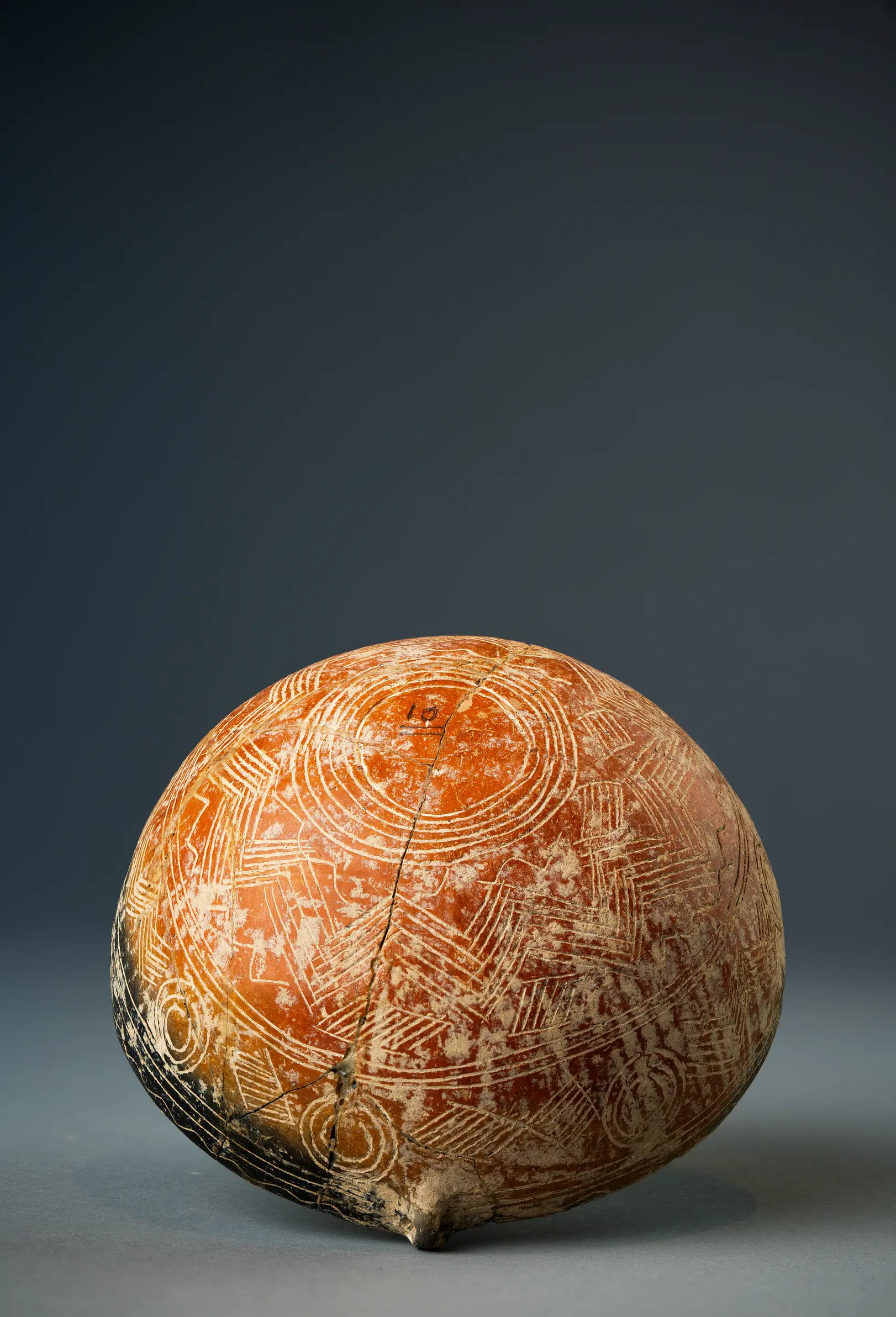
The everyday bowl of the Early and Middle Cypriot periods is a small, handmade, round-bottomed hemispherical vessel in Red Polished ware, with an incurving rim and, usually, one or more pierced lugs or a knob at the rim. At the settlement of Marki-Alonia in the central plain, three quarters of the small open vessels in the first season combined the same three rim attributes (incurved, thinning, rounded end), making it the most uniform shape on the site [9]. Louise Steel reads the shape as body-knowledge: round bottoms mean pots were set into hollows in earth floors rather than on tables, and the small handle-less bowls were "designed to fit in the hand," held cupped for a hot meal or drink [11]. The Drakopoulos collection holds a run of these Red Polished bowls of Early Cypriot II to Middle Cypriot I date, most with a single knob or pierced lug at the rim. The deep hemispherical bowl is the plain form, its rim rising and falling where the potter's fingers pressed the wall; the knob-lug bowl shown here is a decorated one, with a black-fired rim and white-filled incision over the whole outside, a target of concentric circles on the base and panels of hatched chevrons round the body.
Above this domestic baseline sit three larger classes. The first is the deep spouted bowl, called a "milk bowl" after the modern Cypriot plain-ware vessel used to milk goats and sheep. Vassos Karageorghis traces the form to Early Cypriot I, "deep at first" and becoming shallow in its Middle Cypriot development; the Fitzwilliam's example from Vounous Tomb 90 (Red Polished I, 22.7 cm high, 34.4 cm across the handle) is among the earliest [13, cat. 16–17]. At Vounous Dikaios catalogued such bowls under his own "Type II a": large, deep, convex-sided, with small flat base, flat handle and tubular spout, often with a U-shaped or snake ornament in relief pendent from the rim [14, Tomb 8]. A smaller Red Polished spouted bowl from Vounous cemetery B, Tomb 139 in the Manchester Museum, is catalogued as Early Cypriot I-II. A small, deep Red Polished spouted bowl in the Drakopoulos collection has the usual arrangement: a tubular spout just below the rim and a knob lug on the opposite side. What they were for is not settled. Andrew Sneddon, summarising the Marki evidence, notes that spouted bowls and basins occur in all periods at the settlement, that their precise function is uncertain, and that the likeliest use is to collect and store liquids, possibly as milking or yoghurt vessels [12]. We know of no residue study that confirms dairy for the Bronze Age form; the name is an ethnographic analogy, not a result.
The second class is the tulip bowl of Early Cypriot I, a deep conical-to-convex bowl on a small flat or pointed "nipple" base, black-topped inside and around the rim, red below, and covered in lime-filled incision (a tulip bowl in the Drakopoulos collection is covered in diagonal bands of close parallel strokes that read as a loose lattice, and cannot stand on its pointed base). Morris calls it "one uniquely Cypriot shape" and thinks it "a special local form" of the hemispherical bowl, "possibly with a specific function as containers" [3, p. 69]. Webb and Frankel are more specific: tulip bowls "first occurred in EC I and appear to have served as individualized (possibly single-draught) drinking cups," their deliberate variety of form and decoration marking out particular consumers at the graveside [15, p. 65]. The most elaborate examples, with rings of modelled bull, ram and bird heads alternating with disc projections on the rim, are Stewart's Type XXV "decorated deep bowls," the objects the older literature called cult vessels [2, pp. 344–345]. Unlike most Early Cypriot grave goods, which had been used before burial, the Vounous figurative bowls show no obvious wear, and Webb and Frankel conclude they were made specifically for deposition [16]. The site's Vounous article discusses the cemetery; the multi-bowl and ring forms that grew out of the same workshops are treated under complex vessels.
The third class is the large scenic bowl whose rim or interior carries modelled figures. The Vounous Bowl from Tomb 22, with its circular enclosure, seated figures and penned cattle modelled inside the bowl, is the famous case, and Steel's re-reading of it is the current point of reference [17]. Her inventory of Tomb 22 is also a neat measure of proportions: alongside the one scenic bowl, one composite vase and one ring vase, the chamber held fourteen hemispherical bowls with string-hole projections, two with loop handles and one incised [17]. Even in the richest figurative tomb on the island, the plain bowl outnumbers everything else.
Late Bronze Age: wishbone handles, milk bowls and the deep bowl
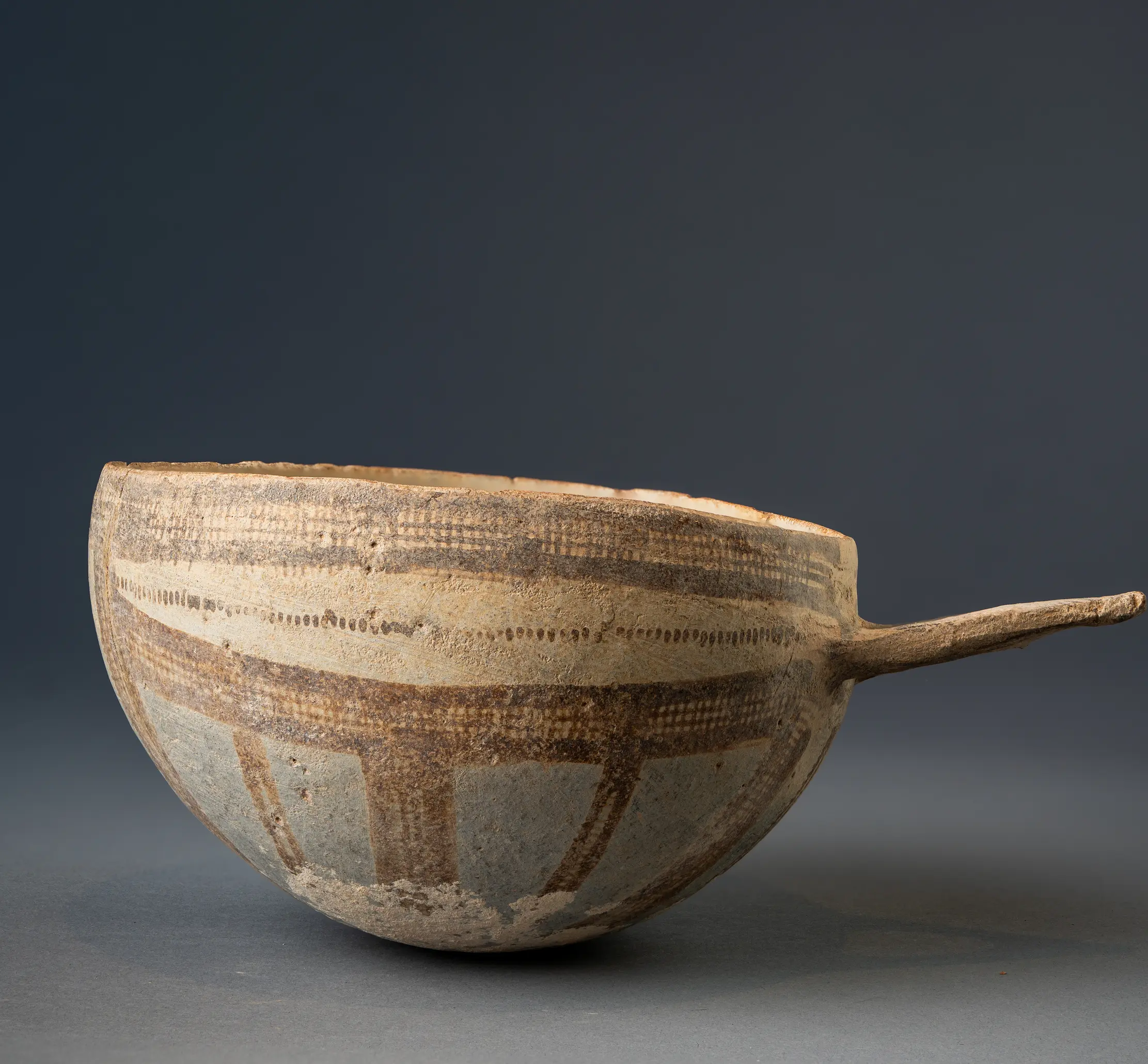
The Late Cypriot bowl is recognisable at a glance by its wishbone handle, a forked horizontal handle set on the shoulder or below the rim. Morris describes the long-run change as bowls that "lack handles in the Early period, develop them in the Middle period and modify them into a wishbone shape in the Late period" [3, p. 69]. Two handmade wares carry the shape. Base Ring ware bowls are thin-walled, carinated or Y-shaped, on a spreading ring base, with the wishbone handle on the shoulder (for example a Base Ring bowl with wishbone handle in the Ashmolean and a Base Ring II conical bowl in the Rijksmuseum van Oudheden, Leiden); the Kazaphani tomb catalogue lists Base Ring I and II bowls between 7.3 and 10.3 cm high and 12 to 17.3 cm in diameter, some with vertical relief bands [23, nos. 457–461]. White Slip ware bowls are the "milk bowls" of the Late Bronze Age, hemispherical, handmade, coated in a thick white slip and painted in brown-black lattice, ladder and framed-band patterns, like the White Slip II bowl from Enkomi in the Ashmolean, the White Slip II deep bowl at Harvard and the White Slip II bowl with wishbone handle in the Drakopoulos collection, whose thick slip runs from cream at the rim to blue-grey towards the base under a band of fine lattice and a row of dots. Five White Slip II examples in Turin from the Cesnola collections (inv. 4795, 4807, 3935, 3982, 3985) measure 7.2 to 9.4 cm high with rim diameters of 14 to 17.5 cm, which is the normal size range of the type [19, cat. 049]. A late example (Turin inv. 4795, 6.7 cm high, rim 14.4 cm) shows the thick walls and reduced "parallel line" decoration by which White Slip II Late is recognised in Late Cypriot IIC contexts [19, cat. 060].
The "milk bowl" name has two competing explanations in print. The Oriental Institute, cataloguing a Megiddo Tomb 50 bowl (OIM A13122, 10.4 by 18.6 cm), attributes it to the "distinctive milky white painted slip," notes the suggestion that the near-perfect hemisphere was formed over a gourd, and records that the fabric is somewhat porous, so the bowls were never meant for storage, transport or cooking but for the table [20]. Karageorghis, as above, attributes the name to the modern milking vessel [13, cat. 16]. Anna Georgiou, by contrast, stresses that the hard fabric and thick slip "rendered the vase impermeable," which is why the bowls were valued abroad along the Syro-Palestinian coast and in Egypt [21]. Both porosity claims cannot be right for every bowl, and the point deserves a proper absorption test. A well-provenanced example is the White Slip II deep bowl from Kourion Tomb 54 (Cyprus Museum A1301, 14 cm high, rim 19.4 cm) [22, cat. 68].
The end of the milk bowl is well dated. From Late Cypriot IIC the wheelmade Aegean-style bowls of White Painted Wheelmade III, above all the bell-shaped deep bowl or skyphos with two horizontal loop handles, took over the functions once served by the handmade White Slip and Base Ring bowls; at Enkomi Level III and Kition Floor III the wheelmade ware already made up almost half the pottery [24]. Georgiou records a wheelmade bowl from the Evreti wells at Palaepaphos that is a White Painted Wheelmade III version of the old milk bowl, painted in the White Slip II Late manner, and notes that White Slip milk-bowl production had ceased by the end of the twelfth century [21]. The skyphos it replaced is the direct ancestor of every Iron Age deep bowl.
The Iron Age: painted bowls on the wheel
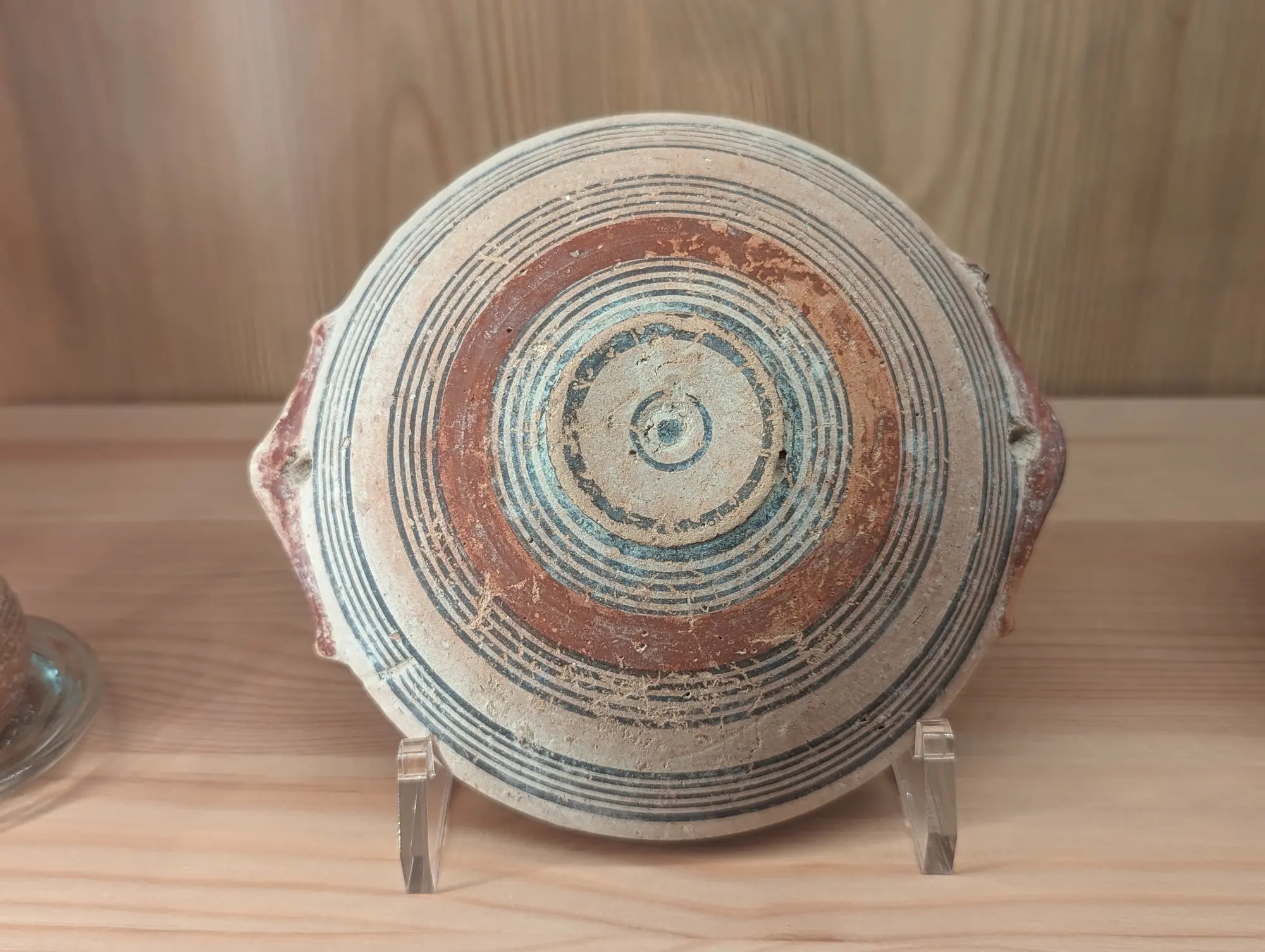
Gjerstad's White Painted I catalogue is the reference list for the Cypro-Geometric bowl. Shallow bowls differ from dishes in their narrow base, usually flat or with a base-ring, and normally carry two horizontal handles, plain or knobbed; bowls of medium depth have convex sides; deep bowls have angular or double-curved sides on a base-ring; bowls on a low foot have double-curved sides; a rare but characteristic type has a miniature bowl perched on one handle; funnel-shaped bowls have straight or flaring sides; and there are bowls on three loop legs [1, p. 44]. In White Painted II the bowls "have lost their elastically curved outlines," turn heavier and more angular, and trade the high base-ring for a flat bottom or a very low ring [1, p. 46]. White Painted III makes the dishes very flat and the shallow bowls much deeper, and introduces the shallow bowl with a wavy handle at the rim [1, p. 47]. In White Painted IV several bowl types, including a round-based bowl with splayed raised rim, openly imitate metal prototypes [1, p. 48], and in Bichrome IV bowls without handles become common, among them shallow bowls with a flat rim pierced by two suspension holes [1, p. 51]. The Drakopoulos Bichrome IV bowl with red-painted pierced lug handles, about 15 cm across and of Cypro-Archaic I date, is a small bowl of this kind: its two lugs at the rim are painted red and pierced with string-holes, and its underside carries a black dot and ring inside groups of fine black circles broken by one red band. The three-legged bowl, Gjerstad argued, is of Syro-Palestinian origin, copied from metal or wickerwork tripods and present in Cypriot pottery from Late Cypriot III onward [1, p. 180]; the Bichrome tripod bowl in the Drakopoulos collection, a deep round-bottomed bowl on three solid legs dated between Cypro-Geometric III and Cypro-Archaic I, belongs to this line. Handles ending in outward-turned points, which appear at the end of Cypro-Geometric II, he took as an influence from Greek Geometric dishes and bowls [1, p. 190].
The tomb groups at Palaepaphos-Skales show how these bowls were used together. Cups with double-curving sides and a conical foot were part of the funerary drinking set of Cypro-Geometric I tombs there, with many minor variations in foot and in the two wavy bands round the body [25, Tomb 185]. The excavators separate shallow bowls (narrow flat or ring base) from dishes (large flat or ring base) and admit that the ratio of base to rim diameter is an unsatisfactory criterion [25, Tomb 199]. Stemmed bowls with cylindrical body and vertical handles are common in early Iron Age contexts in White Painted III-IV and Bichrome II-III [19, cat. 073], and shallow dishes and kalathoi in the Athens collection are dated Cypro-Geometric I on the same typology [26, cat. 117–119]. Two fragments of a White Painted deep bowl in the Drakopoulos collection come from the Iron Age descendant of the skyphos: each keeps one horizontal loop handle, painted dark, below a tall rim zone of fine encircling lines, with a panel of close-set vertical lines on the body. They date between Cypro-Geometric III and Cypro-Archaic I, probably in the eighth century BC. A Bichrome skyphos with stags in metopes from the same collection, probably Cypro-Archaic I, shows the Greek Geometric panel scheme taken over whole, with antlered stags boxed between chequer and ladder panels and a Cypriot red added to their bodies and to the rim. The full range of Archaic wares is described under Bichrome and Black-on-Red.
Function: what the evidence supports
Direct evidence for how Cypriot bowls were used is thinner than the confidence of the shape-names suggests. The Bronze Age case rests on form and context. Small hemispherical bowls fit the hand and are found in domestic deposits in large numbers, which supports Steel's reading of them as individual eating and drinking bowls [11]. Spouted bowls are large, deep and provided with a pouring spout, which fits liquid processing; the milking and yoghurt reading rests on that logic and on the modern analogy, not on chemistry [12]. Tulip bowls hold roughly a single draught and were individualised, which is the basis of the drinking-cup interpretation [15, p. 65]; the elaborate ones were not used at all before burial [16]. Vounous tombs held "large bowls containing smaller ones and animal bones," which is why the bowl assemblage is read as the residue of funerary feasting [14, Tomb 8; 18]. For the Late Bronze Age, the porosity question decides whether White Slip bowls could have held liquid for long, and the two published characterisations disagree [20; 21]. For the Iron Age, the strongest functional evidence is the repeated association of cups, bowls and jugs as drinking sets in Cypro-Geometric tombs [25, Tomb 185]. Sooting, use-wear and residue studies specifically on Cypriot bowls remain rare, and any statement about milk, wine or beer in a Cypriot bowl should be read as inference.
Tombs versus settlements
Because the typologies were built on complete tomb pots from the north coast, bowls look more elaborate in the handbooks than they were in life. At Marki, the settlement assemblage is dominated by plain incurving-rim bowls that rarely survive whole [9], while the cemetery assemblage at the same site under-represents the earlier cylindrical spouted forms found in the houses [12]. At Vounous, the plain bowls outnumber the figurative ones fourteen to one even in Tomb 22 [17]. In the Iron Age the bias reverses in an interesting way: dishes and shallow bowls decorated mainly on the exterior were, the Skales excavators think, made to be displayed when not in use [25, Tomb 199], and it is precisely those display pieces that were chosen for the grave. The bowl you see in a museum case is therefore usually the tomb bowl; the bowl that fed a household is a sherd in a study collection.
Named examples
| Vessel | Date | Collection and number | Size |
|---|---|---|---|
| Combed ware spouted bowl no. 496, Khirokitia | Late Neolithic | Cyprus Museum, Nicosia | H 15 cm, D 32.5 cm |
| Red-on-White spouted bowl KM 400, Kissonerga-Mosphilia | Middle Chalcolithic | Lemba Archaeological Project / Cyprus Museum | H 21.7 cm |
| Red Polished I spouted bowl, Vounous Tomb 90 | Early Cypriot I | Fitzwilliam Museum, Cambridge (cat. 16) | H 22.7 cm, W 34.4 cm |
| Red Polished deep conical bowl with string-holes | Early to Middle Cypriot | Metropolitan Museum of Art 74.51.1278 | H 16 cm, D 45.4 cm |
| White Slip II milk bowls, Cesnola collections | Late Cypriot IIA–C | Musei Reali, Turin, inv. 4795, 4807, 3935, 3982, 3985 | H 7.2–9.4 cm, rim D 14–17.5 cm |
| White Slip II milk bowl, Megiddo Tomb 50 | Late Cypriot II | Oriental Institute, Chicago, OIM A13122 | H 10.4 cm, D 18.6 cm |
| White Slip II deep bowl, Kourion Tomb 54 | Late Cypriot II | Cyprus Museum A1301 | H 14 cm, rim D 19.4 cm |
| Bichrome IV bowl with pierced lug handles | Cypro-Archaic I | Alexis Drakopoulos collection | D c. 15 cm |
| Bichrome bowl on tripod legs | Cypro-Geometric III to Cypro-Archaic I | Alexis Drakopoulos collection |
Summary
The Cypriot bowl is conservative in its core and inventive at its edges. The small hemispherical bowl held in the hand persisted from the Ceramic Neolithic to the end of the Bronze Age with only its lugs and handles changing, and the spouted deep bowl is the single form that Webb and Frankel could trace across the Chalcolithic-Bronze Age boundary. Around that core the north-coast workshops produced tulip bowls and scenic bowls made for the grave, the Late Cypriot potters produced the exported White Slip milk bowl, and the Iron Age wheel produced the footed skyphos and the display dish. The typologies of Gjerstad, Stewart and Morris each capture part of this, and the site's nine-shape scheme deliberately flattens it so that every bowl can be found in one place. What remains open is function: for most of the sequence the names (milk bowl, drinking cup, cult vessel) are hypotheses about use that residue and wear analysis has yet to test.
Objects on this page
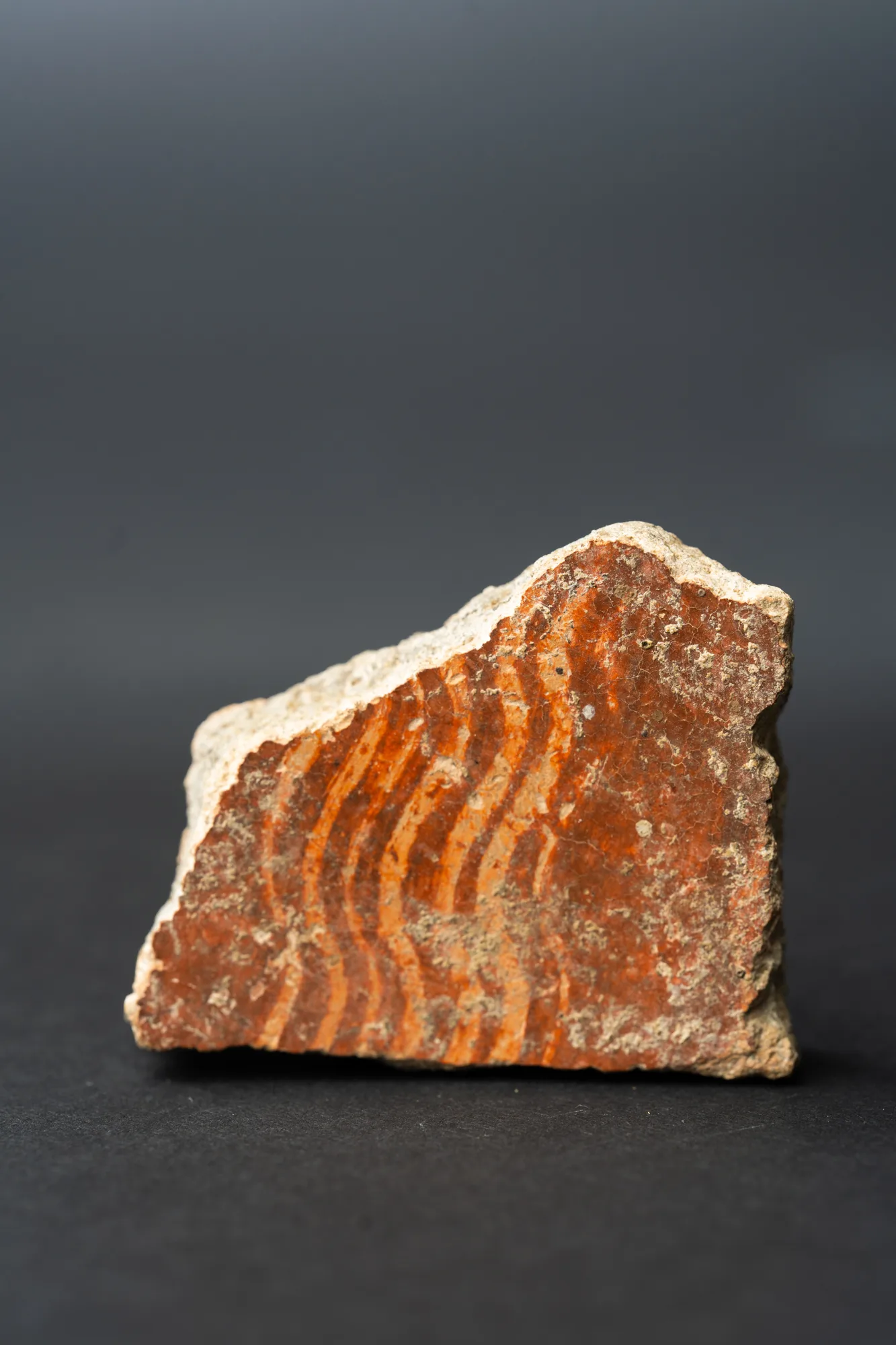 Combed Ware Bowl Fragment with Multiple Wavy BandsNeolithic · 4500–3900 BC
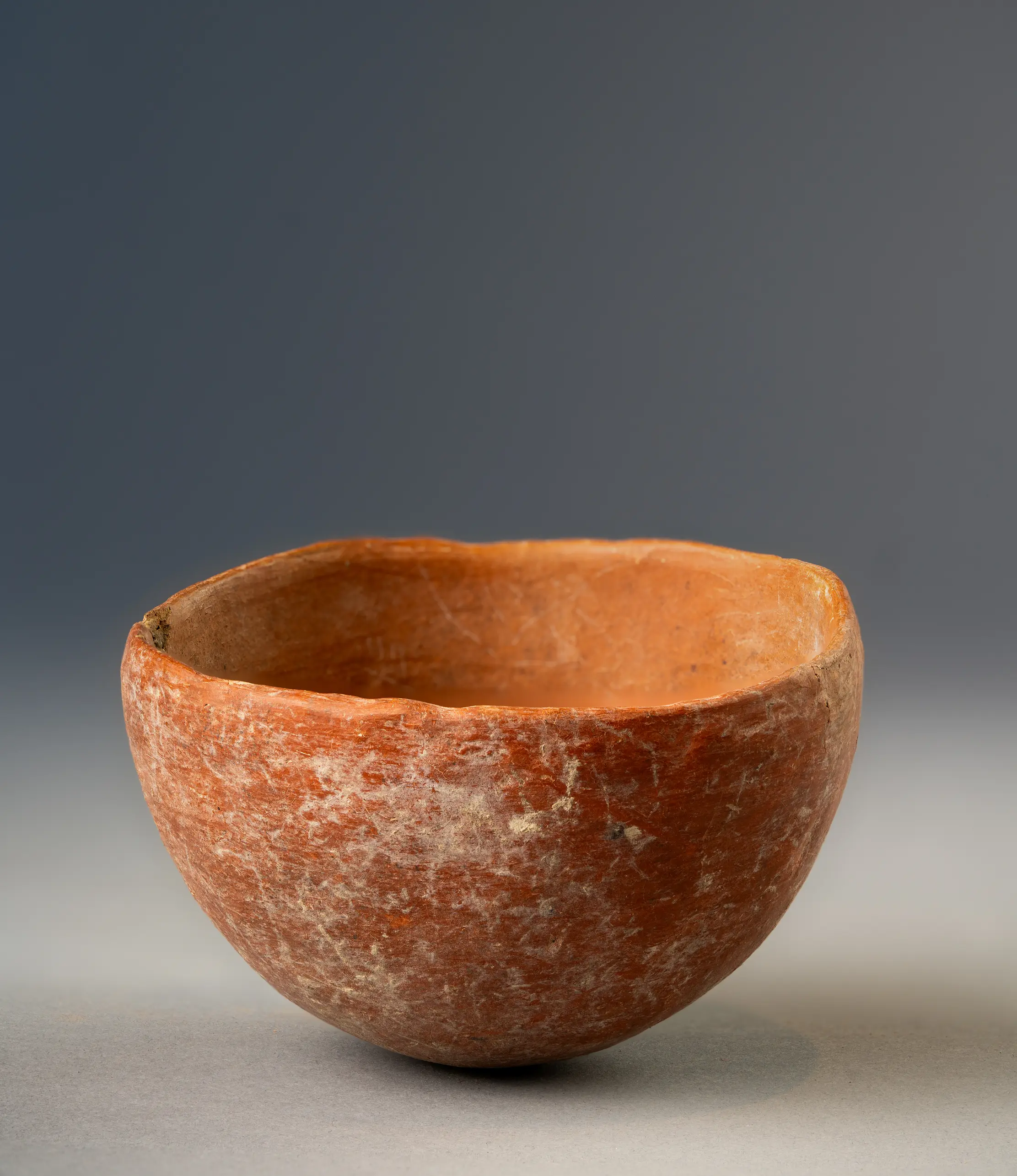 Deep Red Polished Hemispherical BowlEarly Bronze Age II · 2200–1900 BC
- Red Polished Knob-lug Bowl with Incised Concentric Circles and Hatched ChevronsEarly Bronze Age II · 2200–1900 BC
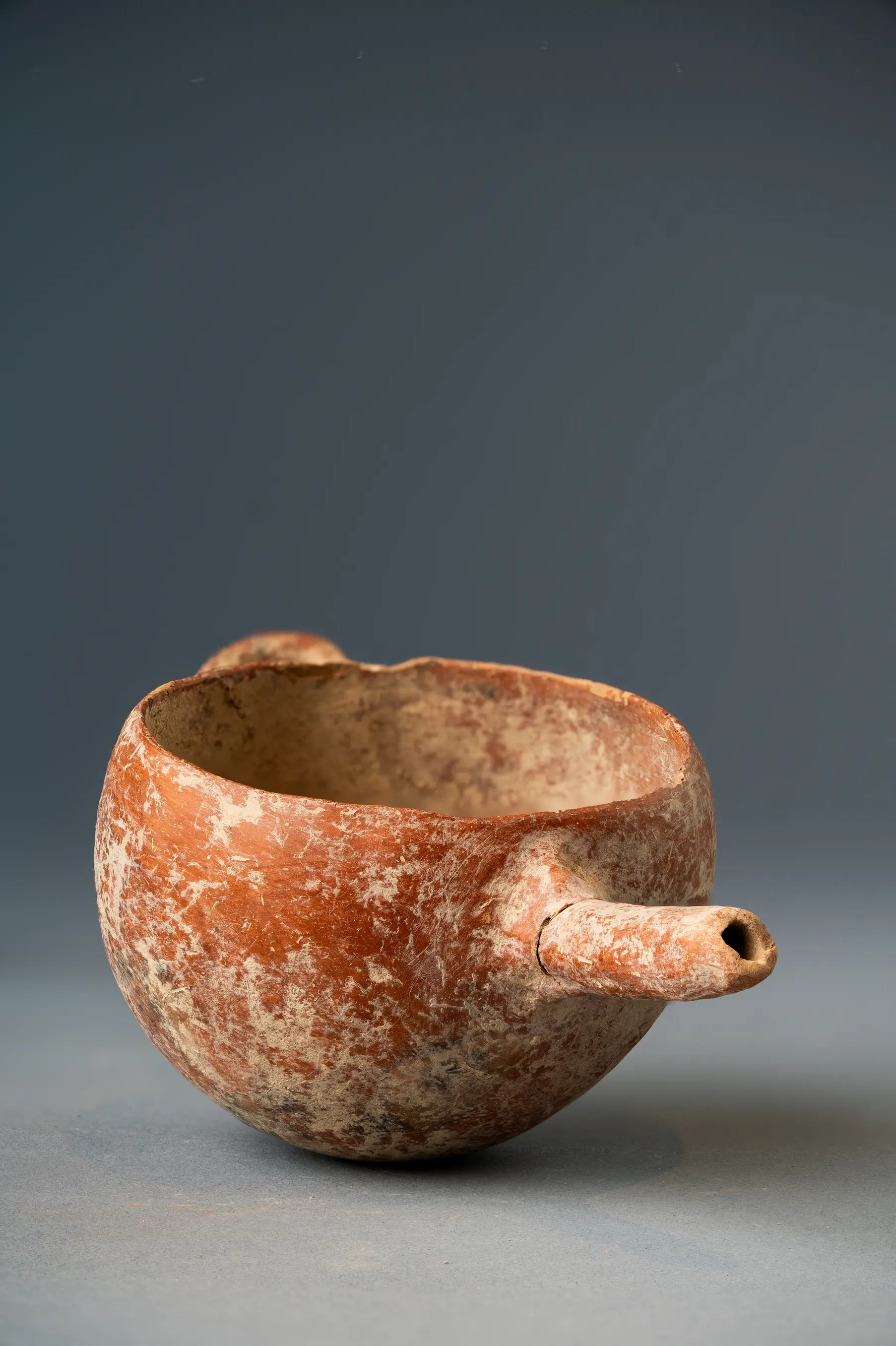 Red Polished Spouted BowlEarly Bronze Age II · 2200–1900 BC
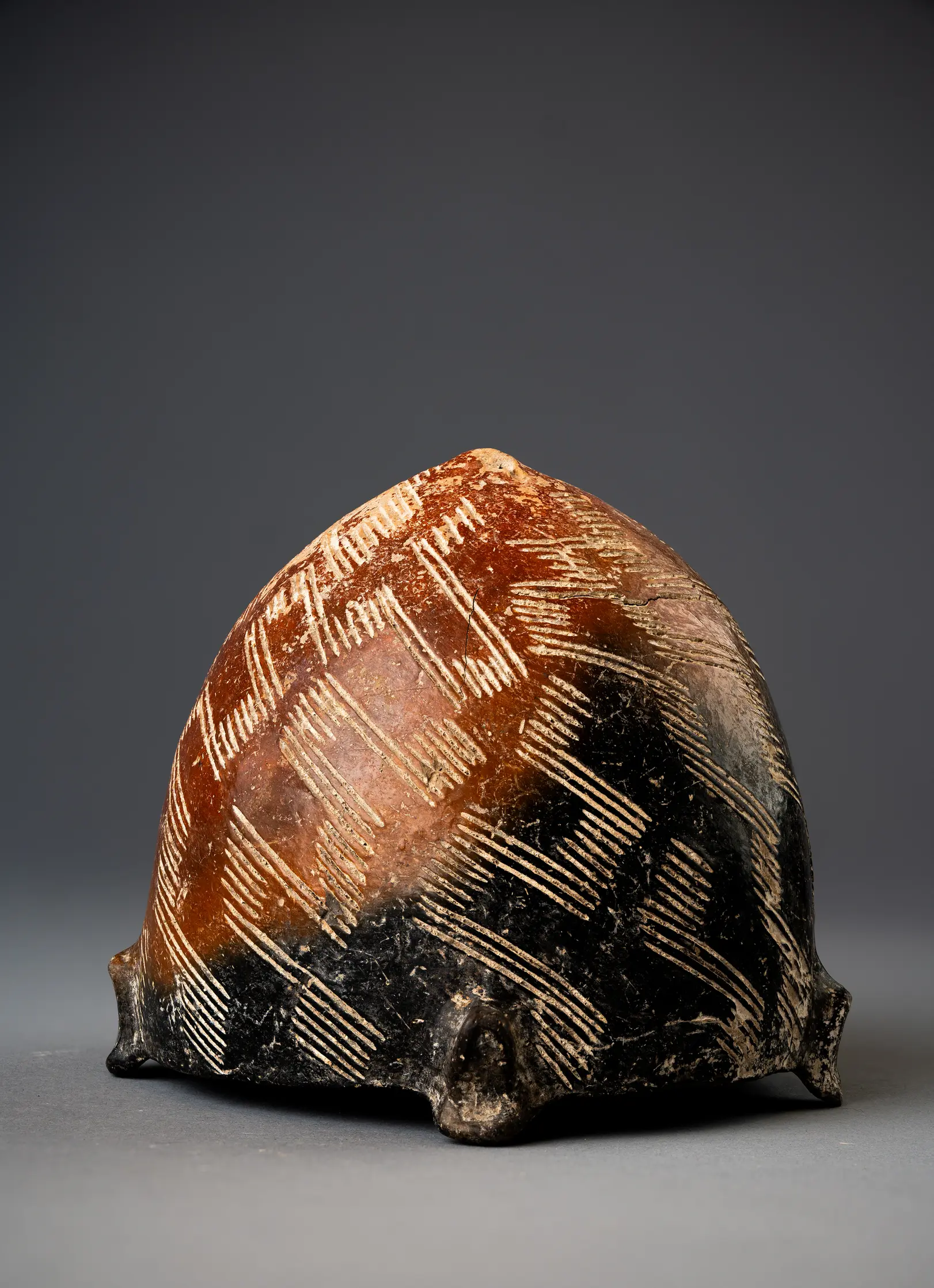 Black-topped Red Polished Tulip Bowl with Incised Hatched LatticeEarly Bronze Age II · 2300–2000 BC
- White Slip II Hemispherical Bowl with Wishbone HandleLate Bronze Age II · 1450–1200 BC
- Bichrome IV Bowl with Red-Painted Pierced Lug HandlesArchaic I · 750–600 BC
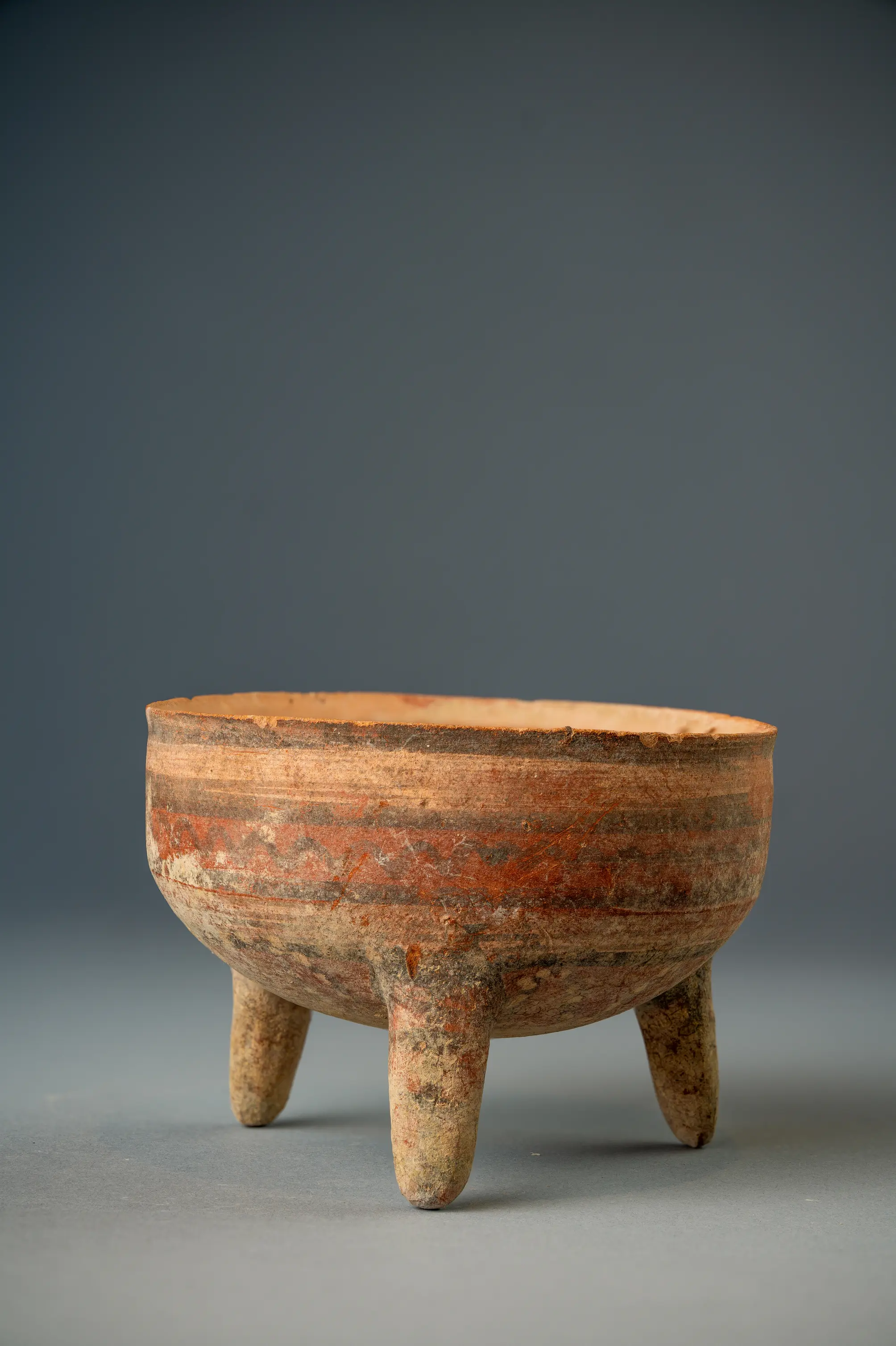 Bichrome Tripod Bowl with Painted BandsGeometric III · 850–600 BC
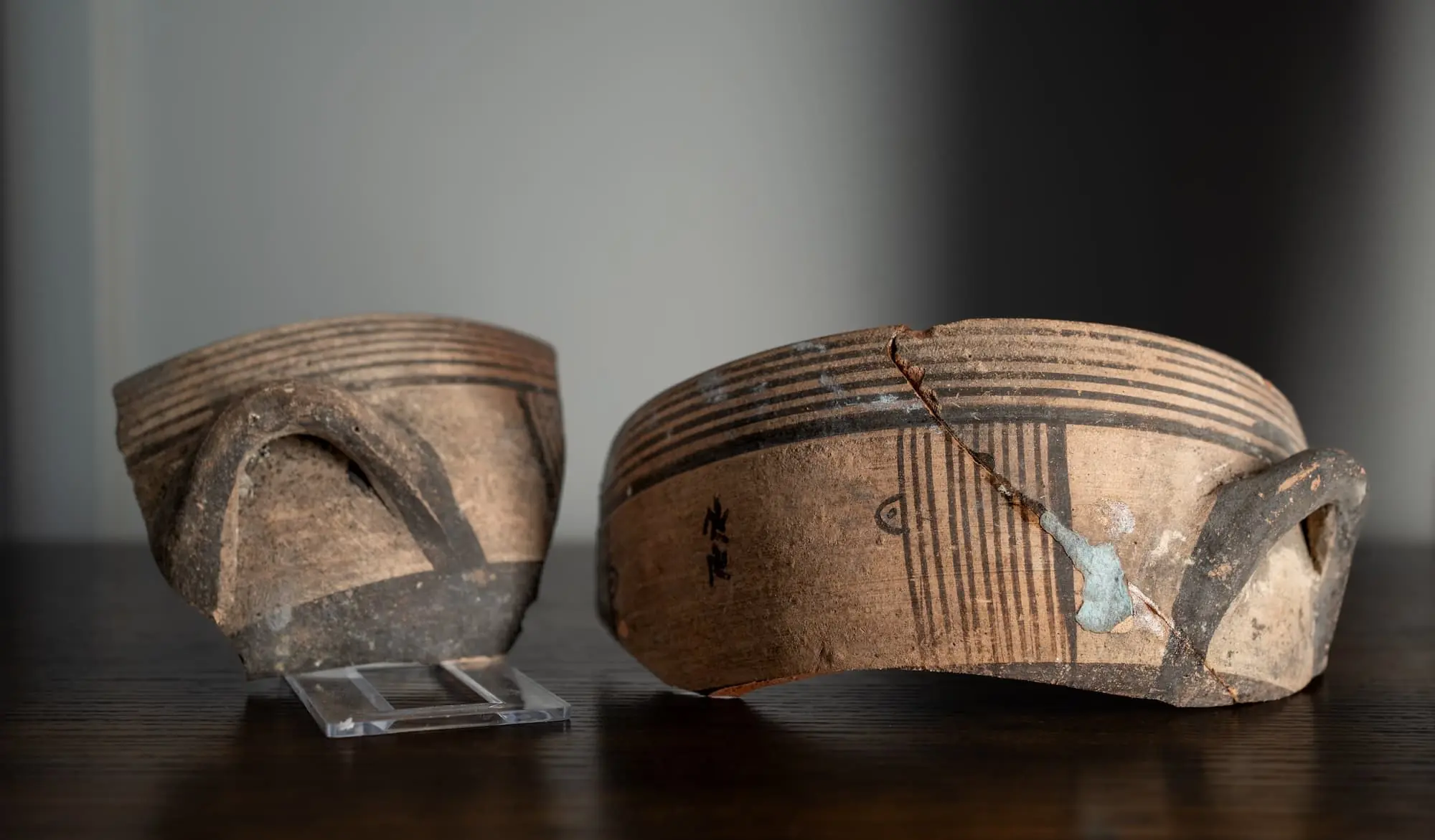 Two Fragments of a White Painted Deep Bowl with Panel DecorationGeometric III · 850–600 BC
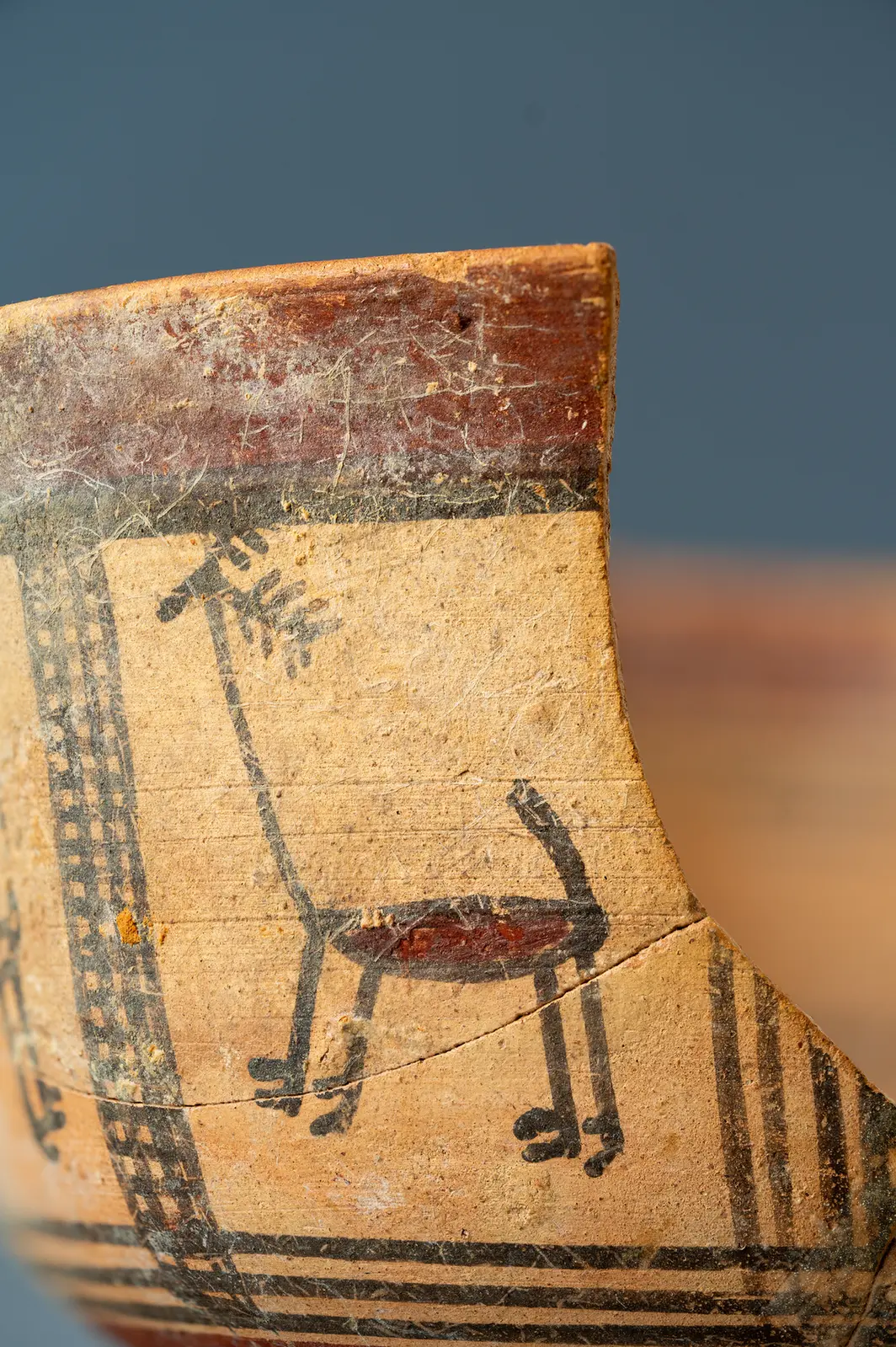 Bichrome Skyphos with Stags in MetopesArchaic I · 750–600 BC
References
- 1.Gjerstad, E. (1948). The Swedish Cyprus Expedition, Vol. IV, Part 2: The Cypro-Geometric, Cypro-Archaic and Cypro-Classical Periods. Stockholm: The Swedish Cyprus Expedition.
- 2.Stewart, J. R. (1962). The Early Cypriote Bronze Age. In P. Dikaios & J. R. Stewart, The Swedish Cyprus Expedition, Vol. IV, Part 1A (pp. 205–401). Lund: The Swedish Cyprus Expedition.
- 3.Morris, D. (1985). The Art of Ancient Cyprus, with a Check-list of the Author's Collection. Oxford: Phaidon.
- 4.Dikaios, P. (1961). Sotira: A Neolithic Settlement in Cyprus. Philadelphia: University Museum, University of Pennsylvania.
- 5.Dikaios, P. (1953). Khirokitia: Final Report of the Excavation of a Neolithic Settlement in Cyprus on behalf of the Department of Antiquities, 1936–1946. London: Oxford University Press.
- 6.Buchholz, H.-G., & Karageorghis, V. (1973). Prehistoric Greece and Cyprus: An Archaeological Handbook. London: Phaidon.
- 7.Karageorghis, V., & Peltenburg, E. J. (Eds.). (2001). Cyprus Before the Bronze Age: Art of the Chalcolithic Period. Los Angeles: J. Paul Getty Museum.
- 8.Webb, J. M., & Frankel, D. (1999). Characterizing the Philia facies: Material culture, chronology, and the origin of the Bronze Age in Cyprus. American Journal of Archaeology, 103(1), 3–43.
- 9.Frankel, D. (1993). Inter- and intrasite variability and social interaction in prehistoric Bronze Age Cyprus: Types, ranges, and trends. Bulletin of the American Schools of Oriental Research, 292, 59–72.
- 10.Merrillees, R. S. (1991). The principles of Cypriot Bronze Age pottery classification. In J. A. Barlow, D. L. Bolger & B. Kling (Eds.), Cypriot Ceramics: Reading the Prehistoric Record (University Museum Monograph 74). Philadelphia: University Museum.
- 11.Steel, L. (2016). Kitchenalia in Bronze Age Cyprus. Gastronomica: The Journal of Critical Food Studies, 16(3), 79–90.
- 12.Sneddon, A. C. (2002). The Cemeteries at Marki: Using a Looted Landscape to Investigate Prehistoric Bronze Age Cyprus (BAR International Series 1028). Oxford: Archaeopress.
- 13.Karageorghis, V., Vassilika, E., & Wilson, P. (1999). The Art of Ancient Cyprus in the Fitzwilliam Museum, Cambridge. Nicosia: A. G. Leventis Foundation.
- 14.Dikaios, P. (1940). The excavations at Vounous-Bellapais in Cyprus, 1931–2. Archaeologia, 88, 1–174.
- 15.Webb, J. M., & Frankel, D. (2013). Cultural regionalism and divergent social trajectories in Early Bronze Age Cyprus. American Journal of Archaeology, 117(1), 59–81.
- 16.Webb, J. M., & Frankel, D. (2010). Social strategies, ritual and cosmology in Early Bronze Age Cyprus: An investigation of burial data from the north coast. Levant, 42(2), 185–209.
- 17.Steel, L. (2013). The social world of Early-Middle Bronze Age Cyprus: Rethinking the Vounous Bowl. Journal of Mediterranean Archaeology, 26(1), 51–73.
- 18.Keswani, P. (2004). Mortuary Ritual and Society in Bronze Age Cyprus. London: Equinox.
- 19.Bombardieri, L., & Panero, E. (Eds.). (2021). Cyprus: Crossroads of Civilizations (exhibition catalogue, Musei Reali, Turin). Turin: Musei Reali.
- 20.Novacek, G. V. (2011). Ancient Israel: Highlights from the Collections of the Oriental Institute, University of Chicago. Chicago: Oriental Institute Museum.
- 21.Georgiou, A. (2016). The White Painted Wheelmade III ware from the Evreti wells. In C. von Rüden, A. Georgiou, A. Jacobs & P. Halstead, Feasting, Craft and Depositional Practice in Late Bronze Age Palaepaphos: The Well Fillings of Evreti (Bochumer Forschungen zur Ur- und Frühgeschichtlichen Archäologie 8). Rahden: Verlag Marie Leidorf.
- 22.Hadjisavvas, S. (Ed.). (2010). Cyprus: Crossroads of Civilizations (exhibition catalogue, National Museum of Natural History, Smithsonian Institution). Nicosia: Government of the Republic of Cyprus.
- 23.Nicolaou, I., & Nicolaou, K. (1989). Kazaphani: A Middle/Late Cypriot Tomb at Kazaphani-Ayios Andronikos, T.2A, B. Nicosia: Department of Antiquities, Cyprus.
- 24.Sherratt, E. S. (1991). Cypriot pottery of Aegean type in LC II–III: Problems of classification, chronology and interpretation. In J. A. Barlow, D. L. Bolger & B. Kling (Eds.), Cypriot Ceramics: Reading the Prehistoric Record (University Museum Monograph 74, pp. 185–198). Philadelphia: University Museum.
- 25.Karageorghis, V., & Raptou, E. (2016). Palaepaphos-Skales: Tombs of the Late Cypriote IIIB and Cypro-Geometric Periods (Excavations of 2008 and 2011). Nicosia: The Cyprus Institute.
- 26.Karageorghis, V. (2003). Ancient Cypriote Art in the National Archaeological Museum of Athens. Athens: A. G. Leventis Foundation.