
Contents
The dish is the youngest of the nine basic shapes used on this site, and the only one with a datable birth. Desmond Morris put it plainly: "The flat dish is a late arrival on Cyprus, being absent from the indigenous Bronze Age repertoire," arriving "eventually as a Greek import" and "establishing itself firmly in the Geometric Period at the beginning of the Iron Age" [1, p. 73]. Maria Iacovou, working from the stratified tomb groups, is more precise and disagrees about the origin: the flat plate "is not found in Proto-White Painted; it did not exist in LC IIIB," and it is "a shape of local inspiration" that appears first in the White Painted, Bichrome and Black Slip Painted wares of advanced Cypro-Geometric I groups [2]. Either way, the two-handled painted plate is the diagnostic open shape of the Cypro-Geometric period, and its decorated underside is one of the oddest features of Cypriot ceramics. On this site "dish" holds flat plates and platters of every period; the deeper open forms are under bowl, and the open-work basket-bowls that are sometimes catalogued with dishes are under basket. The site's general article, Cypriot Bowls and Plates, and its shorter piece on Iron Age wheel-made white slip plates cover the collection pieces; this entry is the reference.
Definition: dish against shallow bowl
The boundary between a dish and a shallow bowl is a matter of base rather than depth. Gjerstad, defining the White Painted I types, wrote that the shallow bowls "are sometimes rather similar to the dishes, but differ from them in the narrow base," which on a bowl is flat or ring-shaped and occasionally a low foot, whereas a dish has a wide flat floor [4, p. 44]. The excavators of the 2008 and 2011 tombs at Palaepaphos-Skales apply the same rule and admit its limits: they classify vessels with a narrow flat or ring base as shallow bowls and those with a large flat or ring base as dishes, and note that "attempts to use as a criterion the ratio between the diameter of the base and the rim diameter have not been very satisfactory" [5, Tomb 199]. In the older Skales typology the dish with two horizontal loop handles is type XIII (iv), and it is described as common in the Cypro-Geometric I repertory of Palaepaphos and throughout the island [12; 5, Tomb 185]. Handles are the other defining feature. Most dishes have two horizontal handles, plain, knobbed or wishbone-shaped; Morris records a rare three-handled type and a one-handled form "with a finger-like projection opposite the handle," a tapering spike on the rim [1, p. 73].
What came before: platters, basins and the absent plate
Cyprus was not without flat open vessels before the Iron Age, and the point needs stating carefully. At Sotira-Teppes in the Ceramic Neolithic Dikaios recorded "small shallow open bowl or platter" fragments with flat, slightly concave bases and sides that diverge and then curve inward, in thick slipped and polished ware [9, p. 199]. The Red Polished repertoire of the Bronze Age includes wide shallow basins and the shallow milk bowl of the Middle Cypriot period. What it lacks is the true plate: a wide flat floor with a low rim, made to be set on a level surface and eaten from. Louise Steel connects this absence to how people ate. The round-bottomed Red Polished pots "were not suitable to be laid on a flat surface such as a table," and she reads the appearance of flat and ring bases at the start of the Late Bronze Age as a possible move toward dining around a table [10]. The Late Cypriot shallow bowls of Aegean type, the wheelmade hemispherical bowls of the twelfth century, and the Proto-White Painted shallow bowls of the eleventh all stop short of the plate. Iacovou is explicit that shallow bowls of several kinds exist in Proto-White Painted and the plate does not [2]. John Benson, publishing the Kaloriziki tombs at Kourion, listed "the introduction of the plate form" among the innovations that "really give Cypro-Geometric pottery its particular stamp," at the same time as the White Painted I potters were hardening and shrinking the Proto-White Painted repertoire in other respects [3].
The disagreement between Morris's "Greek import" and Iacovou's "local inspiration" is real and unresolved in print. Gjerstad's own view, set out in his chapter on foreign constituents, was narrower: it was the handles "terminating in outward-turned, pointed ends," appearing at the very end of Cypro-Geometric II and in Cypro-Geometric III, that were "obviously influenced by the Geometric and Sub-Geometric Greek dishes and bowls with similar handles," and the later habit of fixing such handles to the rim of the dish, from Cypro-Archaic I, that continued the borrowing [4, p. 190]. On that reading the plate itself is Cypriot and its later handle fashions are Greek.
Types and development, Cypro-Geometric I to Cypro-Archaic
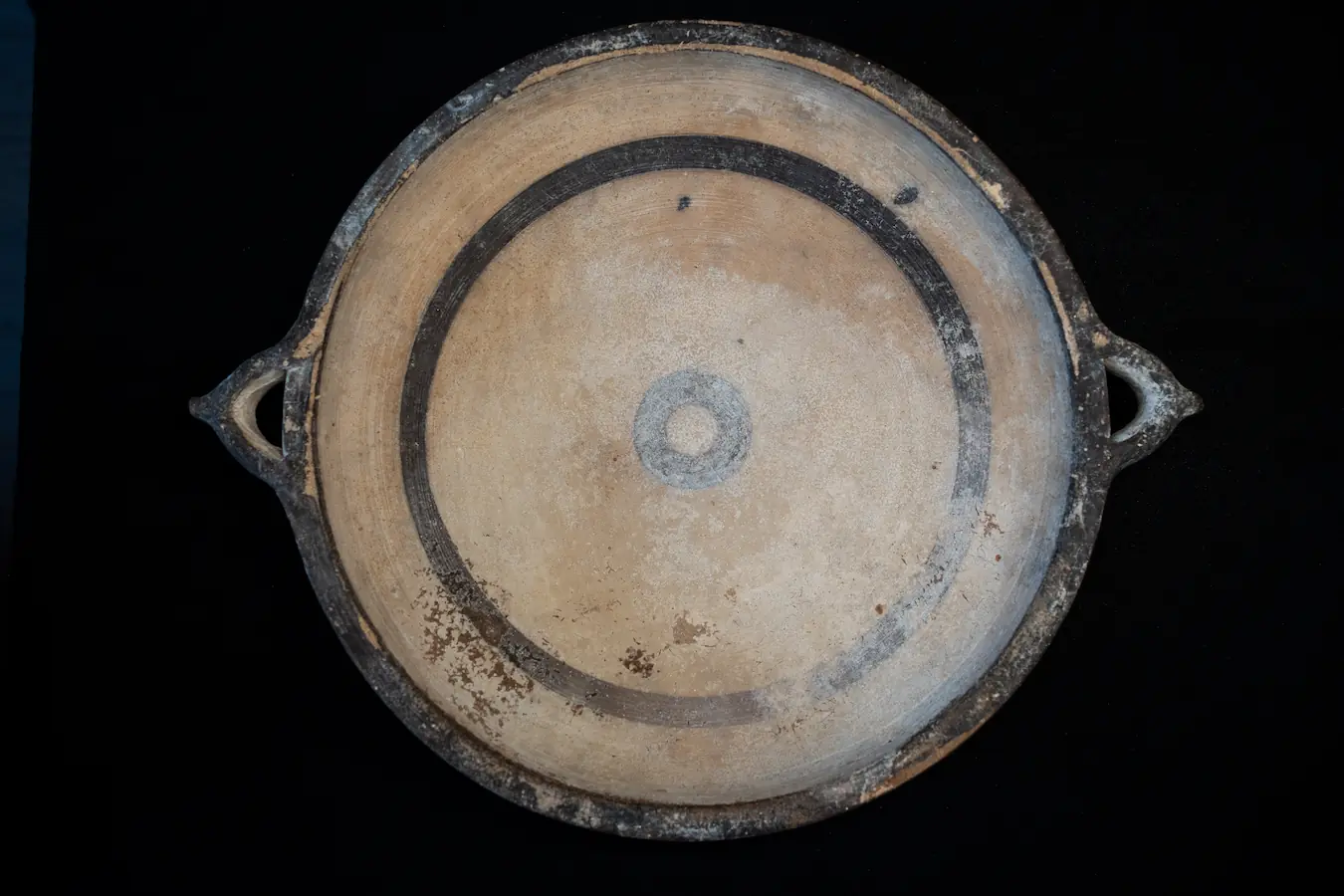
Gjerstad's sequence runs as follows. In White Painted I the dish already has its wide flat base and two horizontal handles, and most of the bowl types have an elastic double curve [4, p. 44]. In White Painted II the dish "has nearly the same shape as that of White Painted I, and the differences [are] mainly in the decoration," while the bowls turn heavier and more angular [4, p. 46]. In White Painted III "the dishes are very flat, and the shallow bowls are much deeper than the dishes," which is the point at which the two categories separate cleanly [4, p. 47]. The Bichrome series runs in parallel with the same shapes and a second, red colour. Sizes cluster around the modern dinner plate. One Lapithos tomb group in the Swedish expedition's first volume lists ten White Painted I plates in a row (nos. 50 to 59), 20.0 to 23.0 cm in diameter, all from the chamber floor, distinguished only by whether the underside carries lattice triangles meeting in concentric circles, an encircled dot, or an encircled wheel [11, p. 333]. Two Bichrome II plates in Turin and Vercelli from the Cesnola collections measure 24 cm across with a 14 cm base [8, cat. 069]. Miniatures exist: a White Painted I dish in Athens (inv. 23389) is 2 cm high and 13.4 cm across, with two wishbone handles at the rim, and the catalogue notes that "the commoner type is of a larger size" [6, cat. 119] (the Ashmolean's Cypro-Geometric White Painted plate with wishbone handles, AN1933.1680, is 13.7 cm across); a Severis collection dish (LS 378) is 2 cm high and 14.2 cm across, with a carinated profile, flat out-turned rim and two loop handles with a triangular knob at the rim [7, cat. 156]. At the other extreme Morris owned a three-handled White Painted dish 51.1 cm in diameter, which he believed to be the largest known [1, p. 73].
The Drakopoulos collection holds three wheel-made White Painted two-handled plates of the Cypro-Geometric period: a large plate 40 cm across including the handles and a plate of 33 cm, both of Cypro-Geometric I–II with loop handles drawn up into a small pointed knob, and a plate of 25 cm of Cypro-Geometric II–III. The 15 cm Bichrome IV bowl in the same collection, of Cypro-Archaic I, sits on the boundary that the Skales excavators found so hard to draw: the Swedish expedition called this small type with pierced rim lugs a "plate", but it is deeper in profile than most, and it is painted on the outside in the manner of a dish.
Decoration and the display hypothesis
What sets Cypriot plates apart from most ancient tableware is that the main decoration is on the underside. On the Turin and Vercelli plates "the main decorative pattern is painted on the base, geometric figures filled with a cross-hatched pattern and surrounded by a series of concentric bands and lines," while the interior carries only concentric circles at the bottom or below the rim [8, cat. 069]. A Bichrome plate with wishbone handles in Cambridge follows the same scheme: a plain interior, and on the exterior concentric circles, four swastikas and cross-hatching in black and red (Museum of Archaeology and Anthropology, Z 20816 A). At Skales the dishes are "as a rule elaborately decorated on the base," and the favoured motifs are zones of solid triangles and star motifs at the centre, arranged with strict symmetry; the excavators conclude that "these dishes must have been displayed, when not in use, since their main decoration is on the base" [5, Tomb 199]. The Athens catalogue draws the same inference for the small White Painted I dish: since the decoration is exterior, "these dishes may have played an ornamental role and were made to be hung on walls" [6, cat. 119]. The Severis dish carries a reserved rosette within reserved concentric circles at the centre of a black-painted base, and groups of transverse strokes on the flat rim [7, cat. 156]. The Maltese cross and the radiating star are the two commonest central base ornaments, and the lattice and checkerboard fills the triangles around them. The three Drakopoulos plates show the range. On the largest, four arms of parallel lines cross the underside like the spokes of a wheel round a small target of circles; on the 33 cm plate four framed, cross-hatched triangles radiate from a ring of concentric circles, alternating with four freehand wavy lines; and on the 25 cm plate a ring of solid triangles points outward round a nest of circles, so that the whole reads as a many-rayed star. The classification of dish decoration in detail was undertaken by Adelman in 1967, cited by the Turin catalogue as the standard reference [8, cat. 069].
The display hypothesis has an unexpected support in the evidence of repair. Morris's giant three-handled dish "was broken and repaired in antiquity," with pairs of drilled holes along the cracks where the broken parts were tied together before the object was placed in the tomb [1, p. 73]. A plate too cumbersome to serve from, mended with cord for burial, was valued as an object to be seen. The Cypro-Archaic successors carry the same idea further: a Bichrome plate of Salamis production in the Drakopoulos collection, 53 cm across and dated about 700 to 550 BC, is painted in concentric zones round a central figured tondo and has two suspension holes pierced near the rim. Whether the smaller plates were used at meals and hung up between them, or were made for display from the start, is not something the pottery alone can settle.
Function and find contexts
Plates are a tomb phenomenon in the surviving record. The Lapithos, Kaloriziki and Skales cemeteries produced them in series, and at Skales the dish with two horizontal loop handles is a standard component of Cypro-Geometric I chamber groups, alongside the cups with double-curving sides and conical foot that formed the funerary drinking set [5, Tombs 185, 199]. Settlement evidence is thinner because the plate's wide flat floor breaks into nondescript sherds, but the shape was clearly domestic tableware as well: it is common, plainly made in the smaller sizes, and sized for one person's food. Iacovou remarks that the circulation of the plate "is indeed limited to the Cypro-Geometric period" [2], which fits Gjerstad's observation that by White Painted III the dish had become very flat and had begun to give way, in the Archaic wares, to the shallow bowl with rim handles [4, pp. 47, 190]. The Cypro-Archaic shallow bowls that replace it, with handles fixed to the rim in the Greek manner, are catalogued on this site under bowls.
Named examples
| Vessel | Ware and date | Collection and number | Size |
|---|---|---|---|
| Ten White Painted I plates, one Lapithos tomb (nos. 50–59) | Cypro-Geometric I | Swedish Cyprus Expedition finds | D 20.0–23.0 cm |
| Shallow dish with two wishbone handles | White Painted I, Cypro-Geometric I | National Archaeological Museum, Athens, inv. 23389 | H 2 cm, D 13.4 cm |
| Shallow dish, carinated, knobbed loop handles | White Painted I, Cypro-Geometric I | Severis Collection LS 378 | H 2 cm, D 14.2 cm |
| Shallow plates, decorated on base | Bichrome II, Cypro-Geometric II | Musei Reali, Turin, inv. 4793; Museo Leone, Vercelli, inv. 423 | D 24 cm, base D 14 cm |
| Stemmed dish with two handles | Cypro-Geometric I | Metropolitan Museum of Art 74.51.869 | H 6.5 cm, D 13.2 cm |
| Three-handled dish, repaired in antiquity | White Painted, Iron Age | Desmond Morris collection DM-WWP-126 | D 51.1 cm |
| Two-handled plate, four-armed cross on underside | White Painted, Cypro-Geometric I–II | Alexis Drakopoulos collection | W 40 cm with handles |
| Two-handled plates, latticed triangles and sawtooth star on underside | White Painted, Cypro-Geometric I–II and II–III | Alexis Drakopoulos collection | W 33 cm and 25 cm with handles |
| Plate with two suspension holes | Bichrome, Cypro-Archaic I–II | Alexis Drakopoulos collection | D 53 cm |
Summary
The Cypriot plate has a short and well-defined life. It does not exist in the Late Bronze Age or in Proto-White Painted, appears in advanced Cypro-Geometric I in White Painted, Bichrome and Black Slip Painted wares, flattens through Cypro-Geometric III, and is replaced in the Archaic period by rim-handled shallow bowls. Whether it was a local invention or a Greek import is argued in print, with Iacovou and Benson on one side and Morris on the other, and Gjerstad confining the Greek contribution to the pointed handles of Cypro-Geometric III. Its decorated underside is its signature and the reason several excavators and cataloguers think it was hung or stood on display between uses. The Drakopoulos plates and the tomb series from Lapithos and Skales show the same thing at different scales: a standardised, wheelmade, dinner-plate-sized object, produced in sets, and buried with the cups and jugs that made up a Geometric table.
Objects on this page
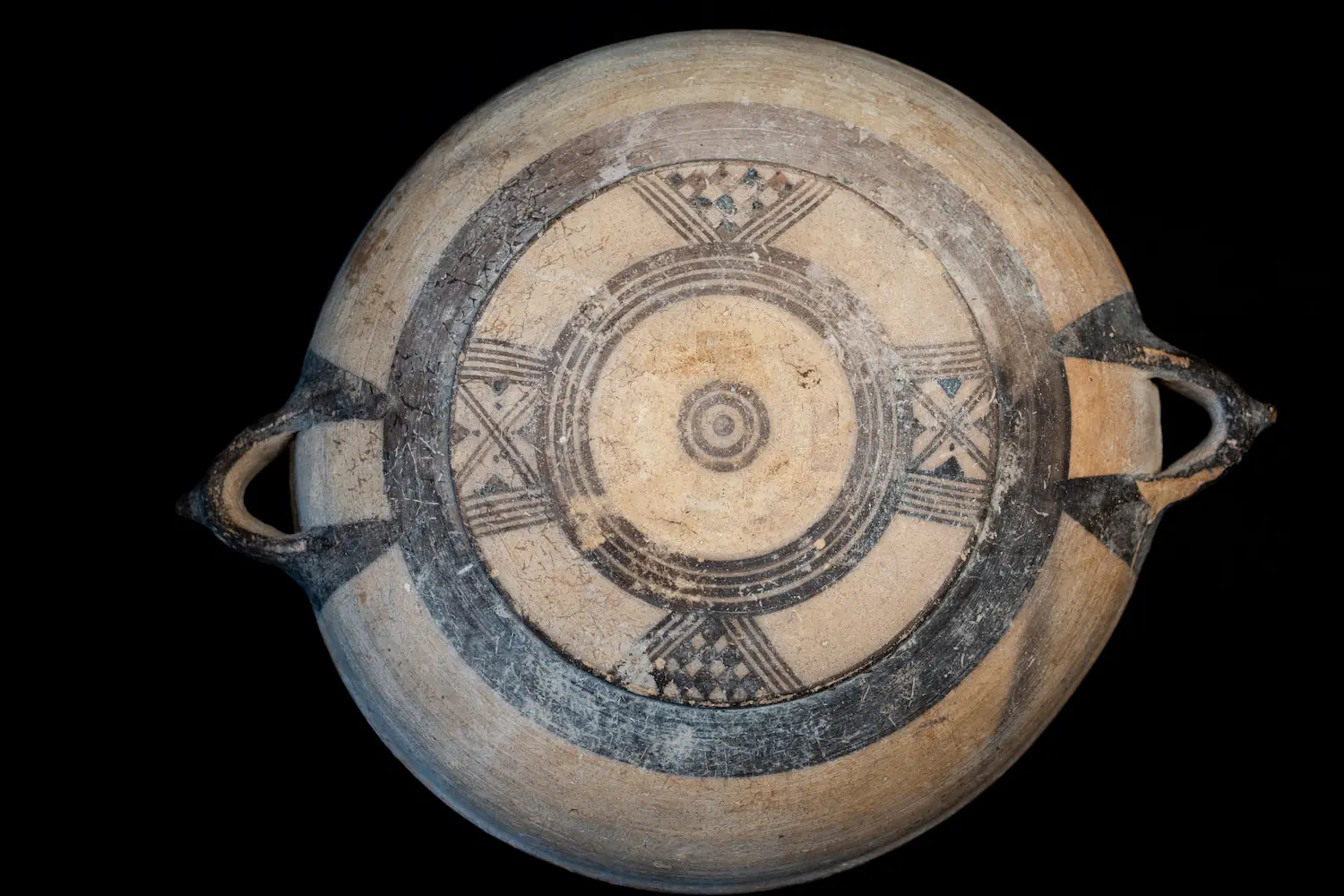 Large White Painted Plate with Knobbed Handles and a Four-Armed Cross on the UndersideGeometric I · 1050–850 BC
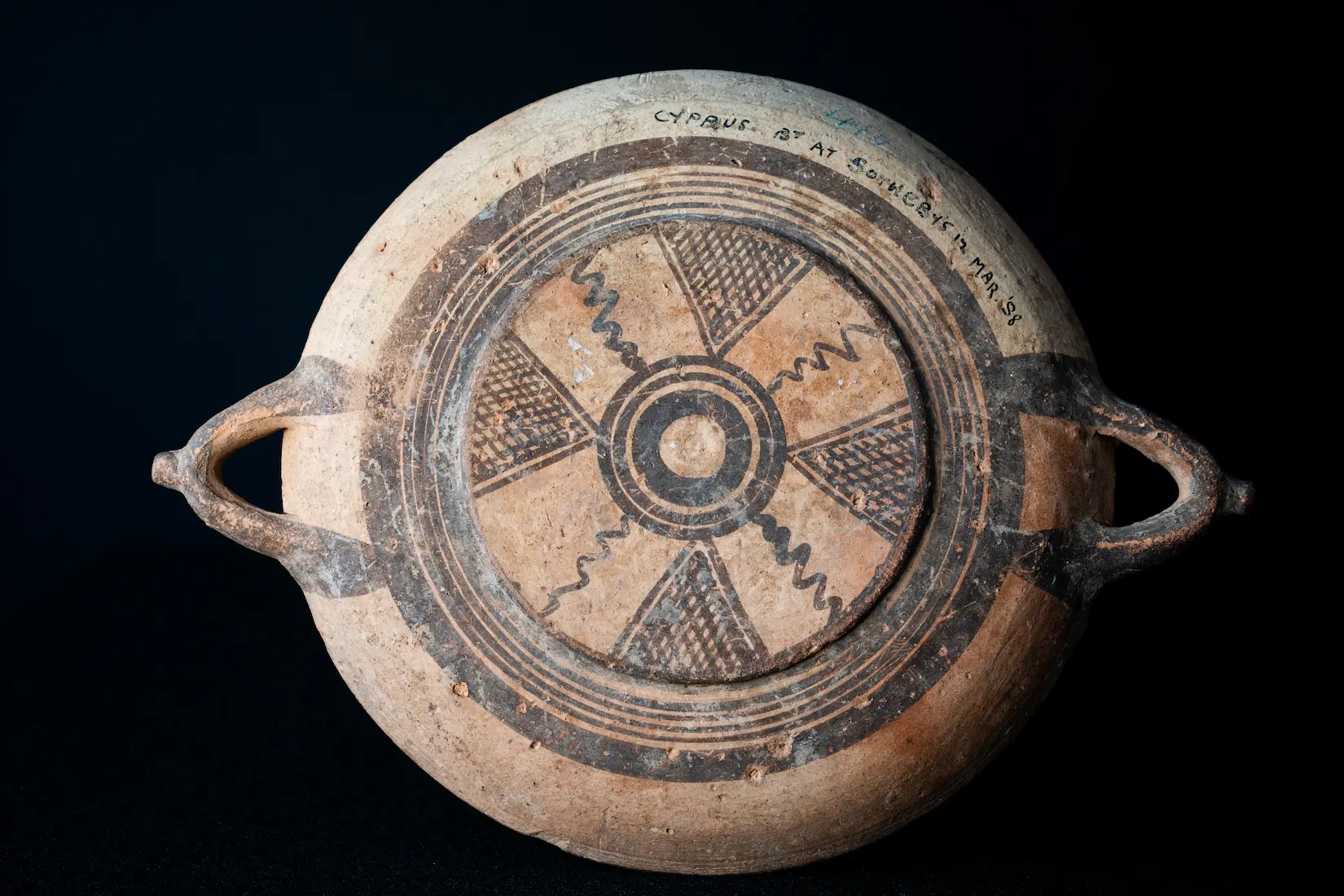 White Painted Plate with Latticed Triangles and Wavy Lines on the UndersideGeometric I · 1050–850 BC
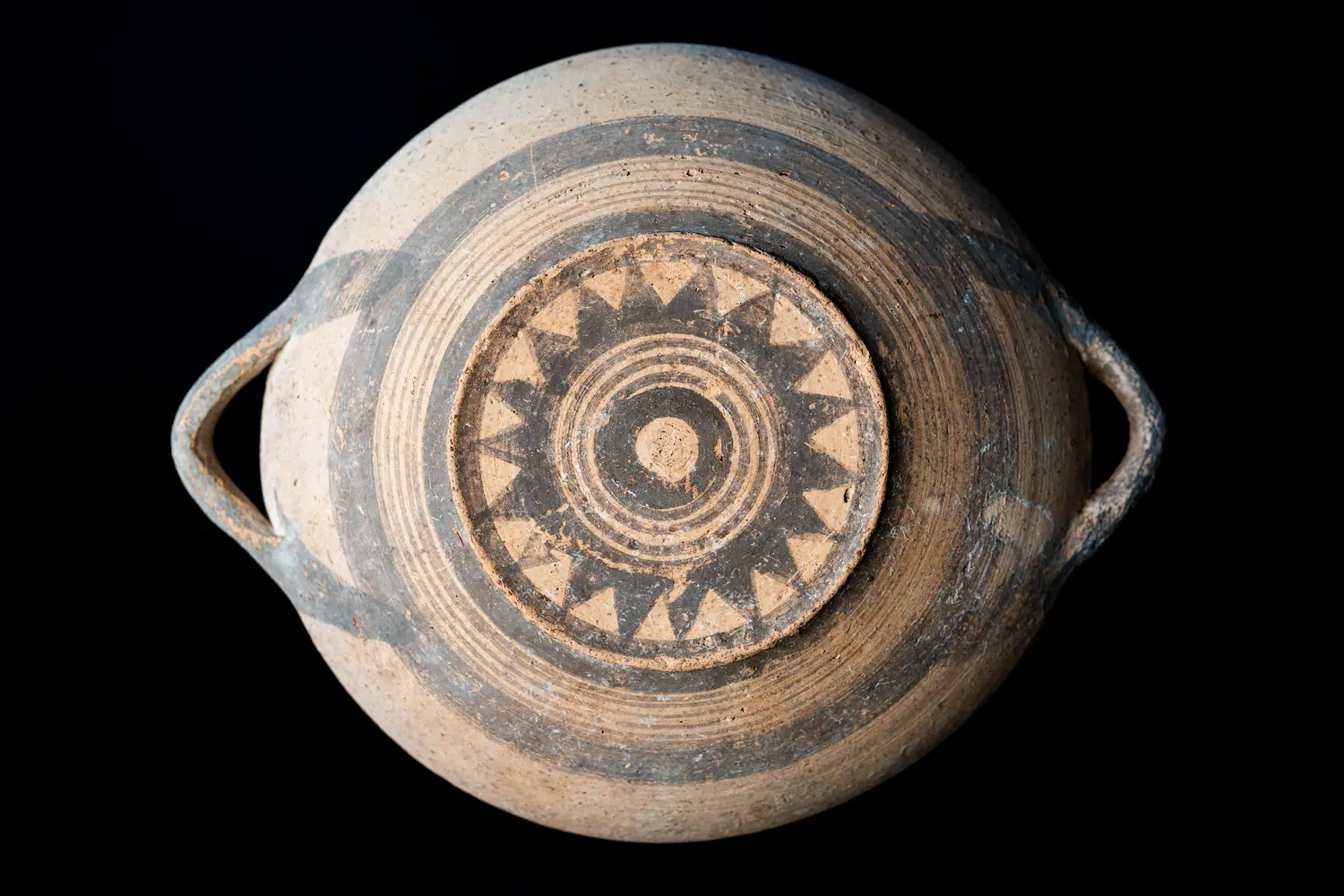 White Painted Plate with a Sawtooth Star on the UndersideGeometric II · 950–750 BC
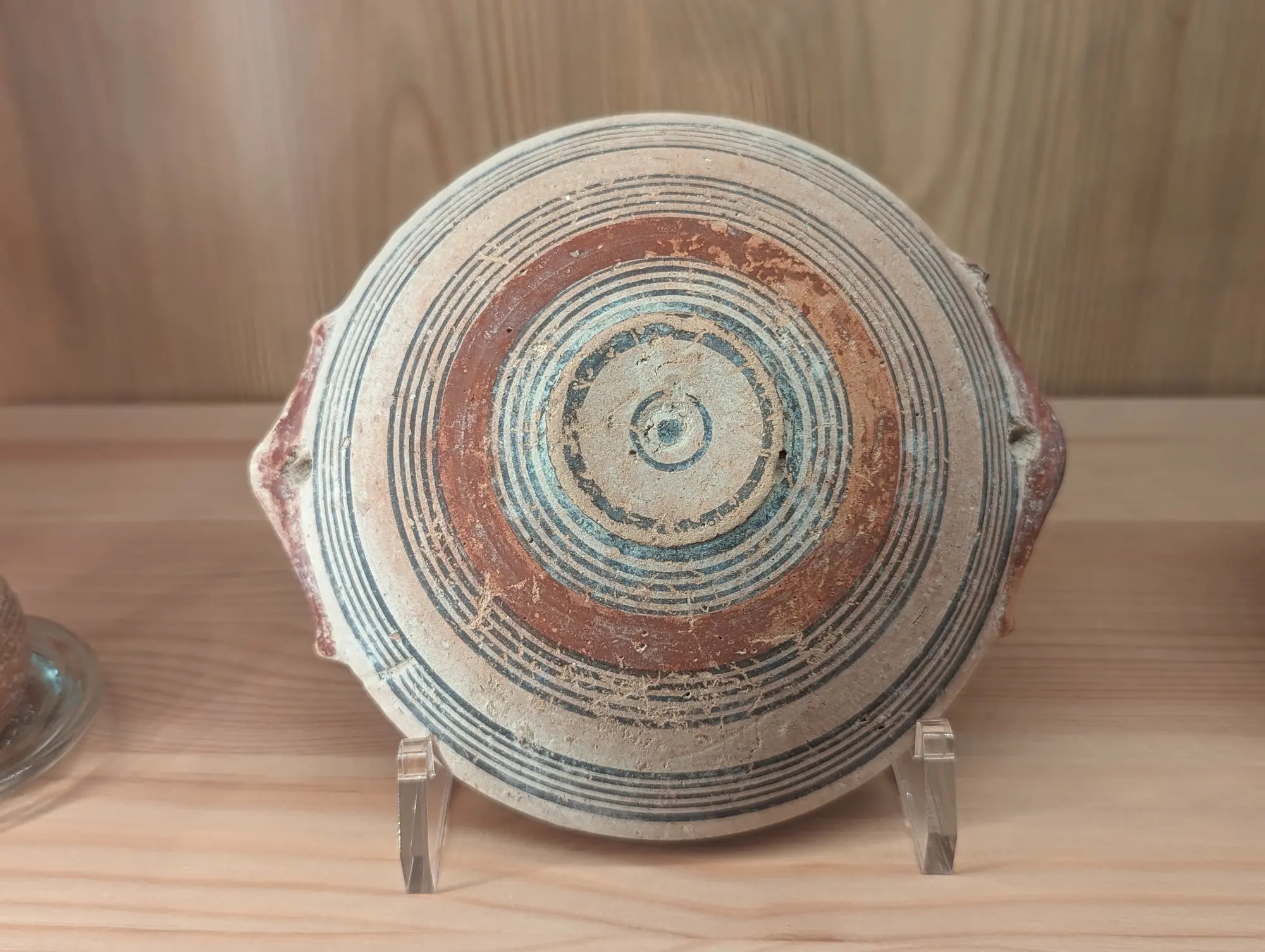 Bichrome IV Bowl with Red-Painted Pierced Lug HandlesArchaic I · 750–600 BC
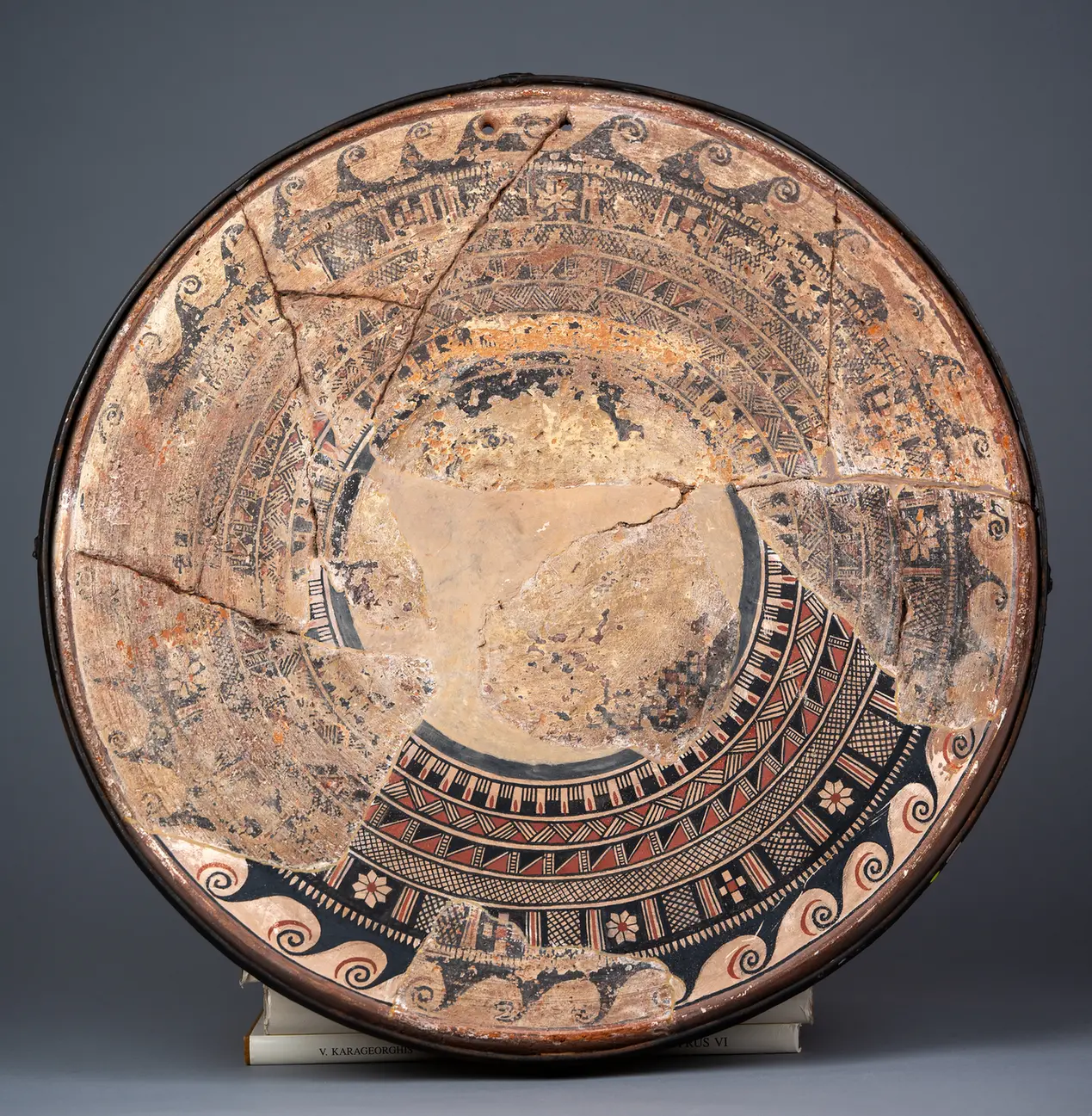 Large Bichrome Plate from Salamis with a Wave Band and Rosette MetopesArchaic I · 700–550 BC
References
- 1.Morris, D. (1985). The Art of Ancient Cyprus, with a Check-list of the Author's Collection. Oxford: Phaidon.
- 2.Iacovou, M. (1991). Proto-White Painted pottery: A classification of the ware. In J. A. Barlow, D. L. Bolger & B. Kling (Eds.), Cypriot Ceramics: Reading the Prehistoric Record (University Museum Monograph 74). Philadelphia: University Museum.
- 3.Benson, J. L. (1973). The Necropolis of Kaloriziki (Studies in Mediterranean Archaeology 36). Göteborg: Paul Åströms Förlag.
- 4.Gjerstad, E. (1948). The Swedish Cyprus Expedition, Vol. IV, Part 2: The Cypro-Geometric, Cypro-Archaic and Cypro-Classical Periods. Stockholm: The Swedish Cyprus Expedition.
- 5.Karageorghis, V., & Raptou, E. (2016). Palaepaphos-Skales: Tombs of the Late Cypriote IIIB and Cypro-Geometric Periods (Excavations of 2008 and 2011). Nicosia: The Cyprus Institute.
- 6.Karageorghis, V. (2003). Ancient Cypriote Art in the National Archaeological Museum of Athens. Athens: A. G. Leventis Foundation.
- 7.Karageorghis, V. (2010). Ancient Cypriote Art in the Severis Collection (2nd ed.). Nicosia: A. G. Leventis Foundation.
- 8.Bombardieri, L., & Panero, E. (Eds.). (2021). Cyprus: Crossroads of Civilizations (exhibition catalogue, Musei Reali, Turin). Turin: Musei Reali.
- 9.Dikaios, P. (1961). Sotira: A Neolithic Settlement in Cyprus. Philadelphia: University Museum, University of Pennsylvania.
- 10.Steel, L. (2016). Kitchenalia in Bronze Age Cyprus. Gastronomica: The Journal of Critical Food Studies, 16(3), 79–90.
- 11.Gjerstad, E., Lindros, J., Sjöqvist, E., & Westholm, A. (1934). The Swedish Cyprus Expedition: Finds and Results of the Excavations in Cyprus 1927–1931, Vol. I. Stockholm: The Swedish Cyprus Expedition.
- 12.Karageorghis, V. (1983). Palaepaphos-Skales: An Iron Age Cemetery in Cyprus (Ausgrabungen in Alt-Paphos auf Cypern 3). Konstanz: Universitätsverlag.