
Contents
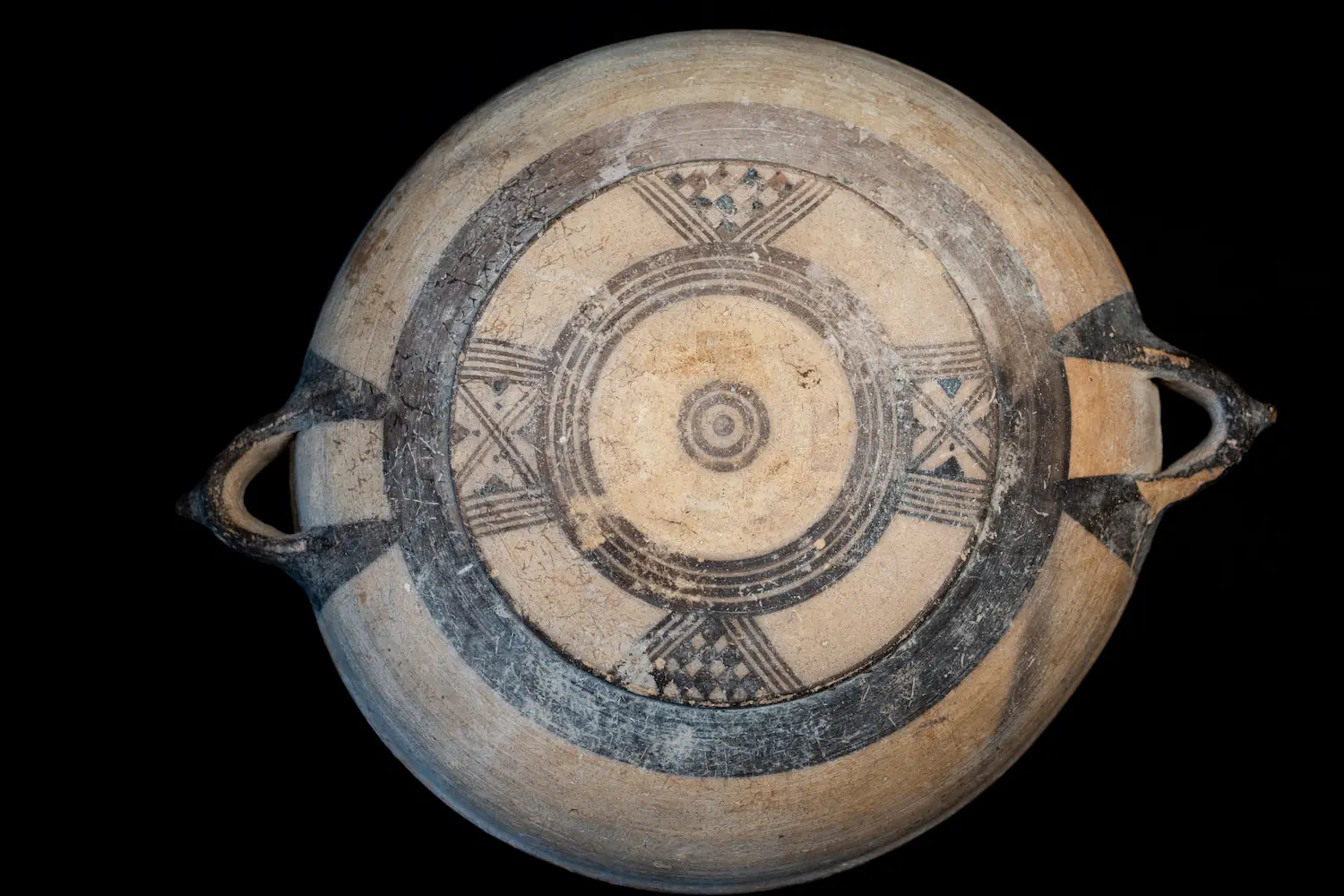
Turn over a Cypro-Geometric dish and the underside is often more carefully painted than the inside. On the base of a large dish in the Drakopoulos collection, a thick black ring encloses a smaller set of concentric circles, and four panels cross the field between them like the arms of a compass. Each panel is filled with a pair of crossing bands; in the angles between the bands sit small triangles of black-and-white chequers. The same few devices, lines crossed to make a net and squares alternated to make a board, fill a large share of Cypriot painted pottery for more than a thousand years.
This entry covers lattice (cross-hatching, a net of crossed lines, used to fill a shape) and chequers (alternating filled and empty squares, the checkerboard). They are rarely the subject of a vessel's decoration and almost always the filling of something else: a triangle, a lozenge, a band, a panel, even the body of a bird.
Terms and identification
The standard descriptions come from Einar Gjerstad's typology of Iron Age pottery in The Swedish Cyprus Expedition. His list of the "purely geometrical" ornaments of White Painted I includes "hatched and latticed triangles and lozenges; dotted lozenges" and the "butterfly ornament" [1, p. 45]. Three terms recur in Cypriot catalogues and are worth separating:
- Latticed: filled with crossing diagonal lines, forming a net of small diamonds. A latticed triangle or lozenge is the most common single ornament of this family.
- Chequered: filled with alternating dark and light squares or lozenges. Gjerstad writes "inscribed black and white chequers" [1, p. 47]; Karageorghis uses "latticed chequers" for a panel of lattice arranged as a board [3, p. 33].
- Diaper: an older word for an all-over repeating lattice. Gjerstad mentions "single triangles with diaper pattern" on White Painted I bowls [1, p. 45].
A lattice in a triangle framed by parallel lines, a latticed lozenge in a band, and a panel of chequers are separate motifs in the catalogues, even though they use the same filling.
Bronze Age precedents
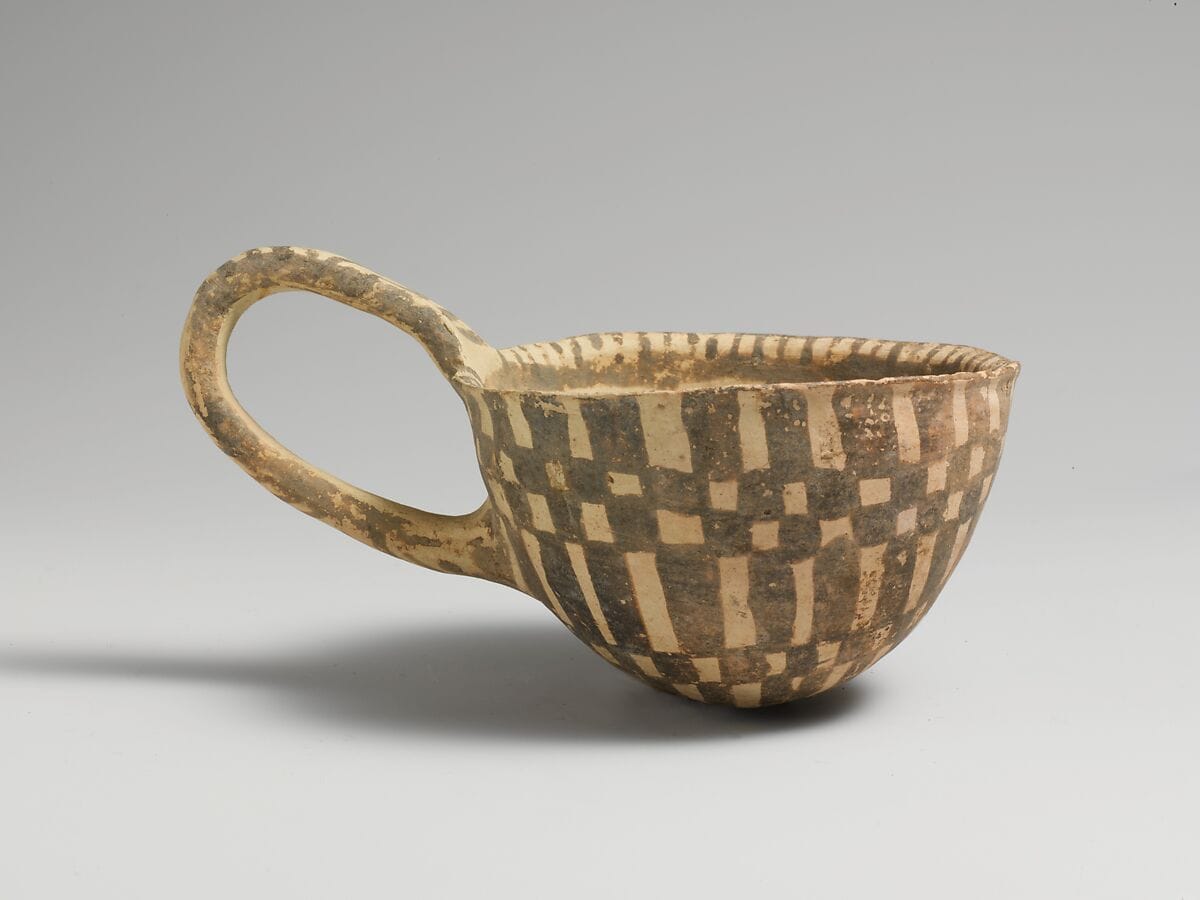
Chequer and lattice fillings were in Cypriot painting long before the Iron Age. A small Middle Cypriot loop-handled cup in the Metropolitan Museum (74.51.1116, /artifact/1762), dated by the museum to about 1900-1600 BCE, is painted all over with a bold chequer pattern in dark paint on a light ground (see Middle Bronze Age and White Painted ware).
The Iron Age grid did not grow from those Bronze Age designs. Gjerstad found that the survivals of native Late Cypriot ornament in the new Iron Age style were "very scanty: they are confined to poor relics of the White Slip ladder-pattern, which, moreover, soon disappear" [1, p. 181]. The ornaments of Cypro-Geometric I, in his account, are mainly Late Mycenaean in origin, transformed through the Proto-White Painted designs of Late Cypriot IIIB [1, p. 181]. He noted that J. F. Daniel had counted the "free-standing latticed lozenge with snake-like appendages at the four corners" among four Cypro-Geometric ornaments absent from Mycenaean pottery, but argued that it too had Late Mycenaean and Sub-Mycenaean predecessors [1, p. 181].
Cypro-Geometric I-II: the latticed grid
In Cypro-Geometric I lattice is everywhere in White Painted I. Gjerstad describes bowls whose zones are filled with "series of latticed triangles, single triangles with diaper pattern," and whose panels are separated by "bands of zigzag lines, dotted lozenges, etc., framed by parallel lines" or by "latticed bands" [1, p. 45]. Dishes and flat bowls carry their main decoration on the base: "rows of latticed lozenges, latticed triangles meeting in the centre, latticed squares or triangles forming a secondary ornament of a Greek cross in the middle," or "concentric lines in the centre, from which opposed latticed triangles or vertical bands radiate" [1, p. 45]. Barrel-shaped jugs often have "a row of latticed lozenges" on the middle zone, and pinched-mouth jugs have "isolated, latticed triangles" on the shoulder [1, p. 45].
The Palaepaphos-Skales cemetery gives tomb-by-tomb examples. Karageorghis's 1983 typology notes that on dishes with wide bases "a large variety of motifs decorate the base, either forming a homogeneous pattern, e.g. chequers (e.g. T. 49: 151; T. 67: 29)," or forming symmetrical combinations, crosses or rayed motifs [2, p. 223]. A White Painted I bowl has a base "decorated with concentric circles enclosing chequers and encircled by eight framed latticed triangles" [2, p. 50]. On small bowls a single frieze of lozenges could be "latticed on one side and solid on the other" (T. 44: 126) [2, p. 223].
The richest single piece is a White Painted I amphora 55 cm high from Skales Tomb 191, excavated in 2008-2011. On one side of its neck, from left to right: narrow triglyphs of hatched triangles; a bird whose body is two thin bands meeting at a right angle and whose wings are "two latticed triangles"; "a broad panel filled with latticed chequers (lozenges)"; a triglyph of chevrons; a large latticed Maltese cross; then "a broad panel of latticed chequers (rectangles)" [3, p. 33]. The same tomb held two White Painted I kylikes with latticed lozenges in their triglyphs [3, p. 33]. Lattice here fills the bird's wings and the cross as readily as it fills the panels.
White Painted II loosened the system. Gjerstad noted that in Type II "the latticed bands are not much used and are often replaced by bands of parallel lines," while bands of latticed lozenges survive, now with small filled triangles at their angles [1, p. 46].
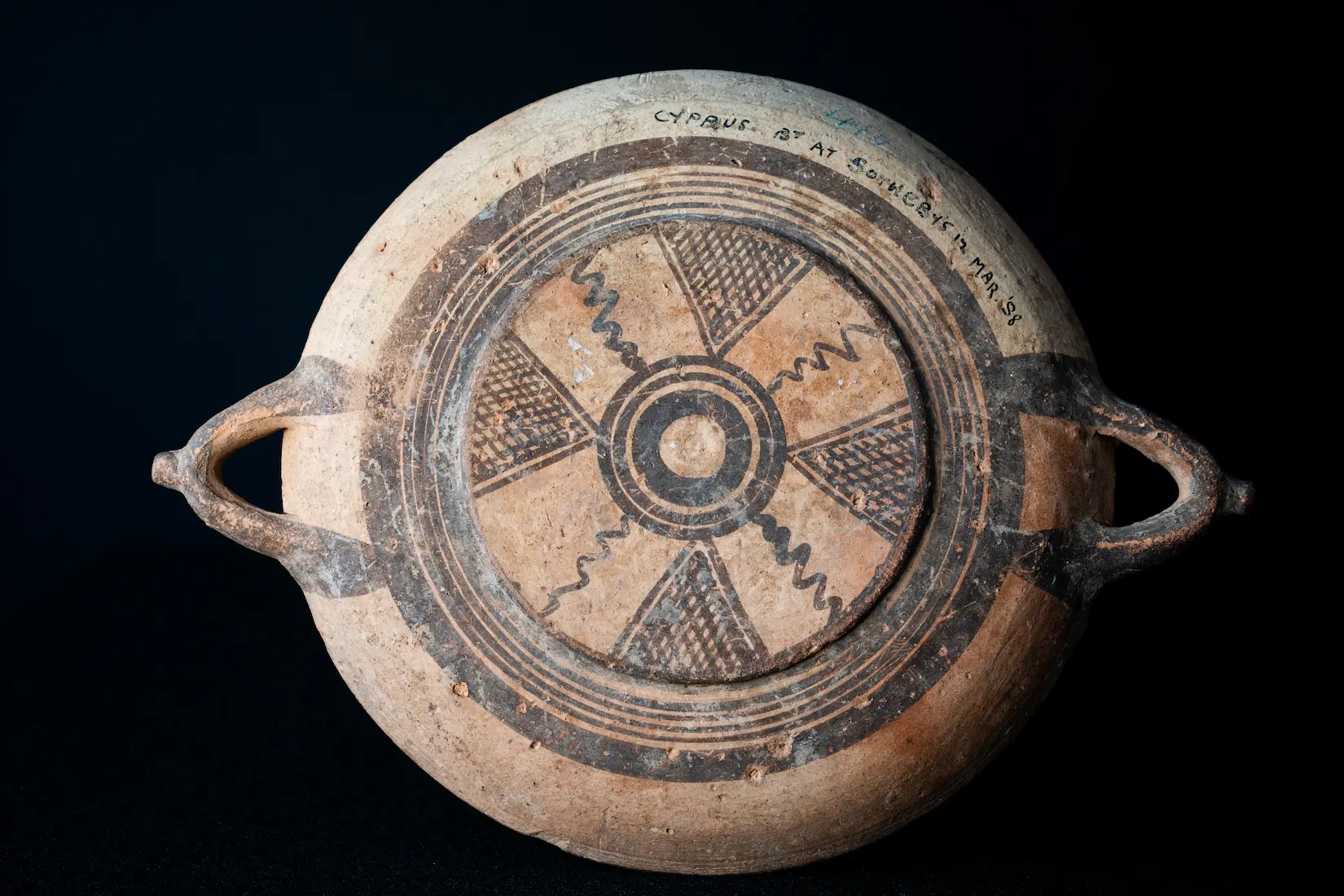
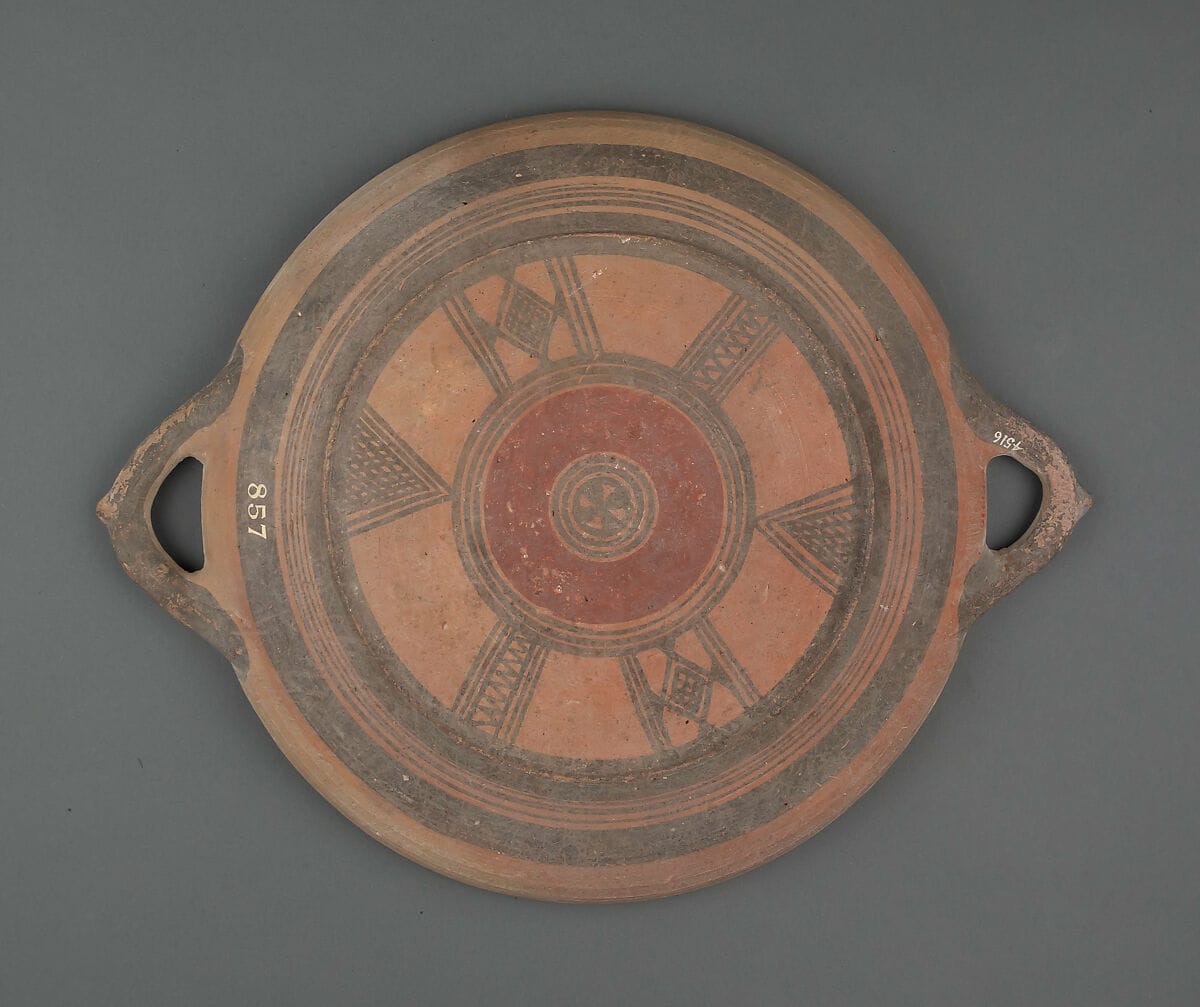
Two dishes in the Drakopoulos collection belong to this world. They are catalogued on the site as wheel-made White Slip ware; their shape (a shallow body, a wide flat base and two loop handles at the rim) and their base decoration match the Cypro-Geometric White Painted and Bichrome dishes described above. The medium-sized dish has four latticed triangles pointing inwards to a set of concentric circles, alternating with four wavy lines, exactly Gjerstad's "concentric lines in the centre, from which opposed latticed triangles ... radiate," with the White Painted II habit of alternating bands and triangles on the same plate [1, pp. 45-46]. The Medelhavsmuseet in Stockholm has a Bichrome II plate of the same scheme, with "a thin cross, framed by red and grey concentric circles. From this radiate four grey, framed latticed triangles" (MM Acc 0886); the Metropolitan Museum's Cypro-Geometric II plate 74.51.971 (/artifact/2010) is another. The larger dish, shown at the head of this entry, has crossed bands in four panels with chequered triangles in the angles, an arrangement of the "Greek cross" type [1, p. 45].
Cypro-Geometric III: chequers inside triangles and lozenges
White Painted III, the ware of Cypro-Geometric III, added a new generation of filled ornaments. Gjerstad's list includes the "winged lozenge with inscribed chequers, latticed or black and white; concentric lozenges and triangles; latticed triangles or triangles with inscribed black and white chequers, framed by parallel lines; concentric triangles and lozenges with inscribed black and white chequers; latticed triangle as 'reserved' ornament in a large, filled rectangle" [1, p. 47]. The black-and-white chequer is the characteristic filling of the period.
It also had a part in the invention of the free field. When Gjerstad described the new layout, a single ornament on the bare body of a pinched-mouth jug, his first example was "a triangle with inscribed black and white chequers, framed by parallel lines" [1, p. 47]. The geometric free-field jug with one chequered triangle is the direct ancestor of the free-field bird.
Gjerstad singled out the winged lozenge as a Cypriot creation: "Characteristically Cypriote is the rhomboid ornament flanked by opposing triangles gradually transformed into wings. This motive occurs also on Cretan pottery of the 7th cent. B. C., where the flanking part of the ornament is further developed into bees" [1, p. 187].
Cypro-Archaic: lattice in the service of figures
In Cypro-Archaic I and II lattice and chequers moved into the background and into the figures. On Bichrome IV amphorae the neck is often divided into panels of lozenges with lattice or chequer filling between lotus panels; the Metropolitan Museum's 80.3 cm amphora 74.51.972 has lozenge metopes of this kind on its neck above a lotus frieze, and Karageorghis notes that on such amphorae "lotus flowers in panels alternate with geometric motifs" [4, cat. 143]. See Lotus Flowers.
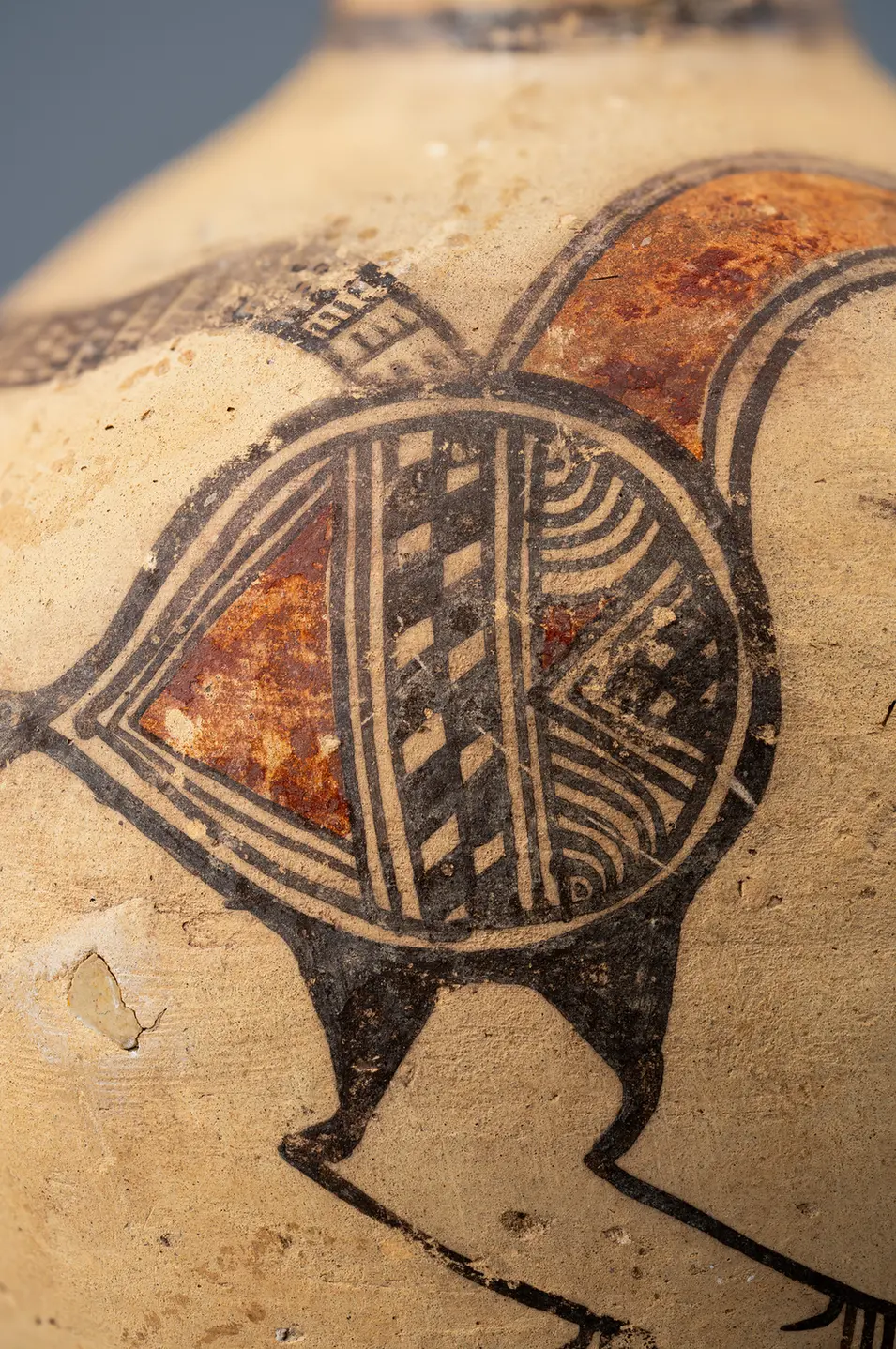
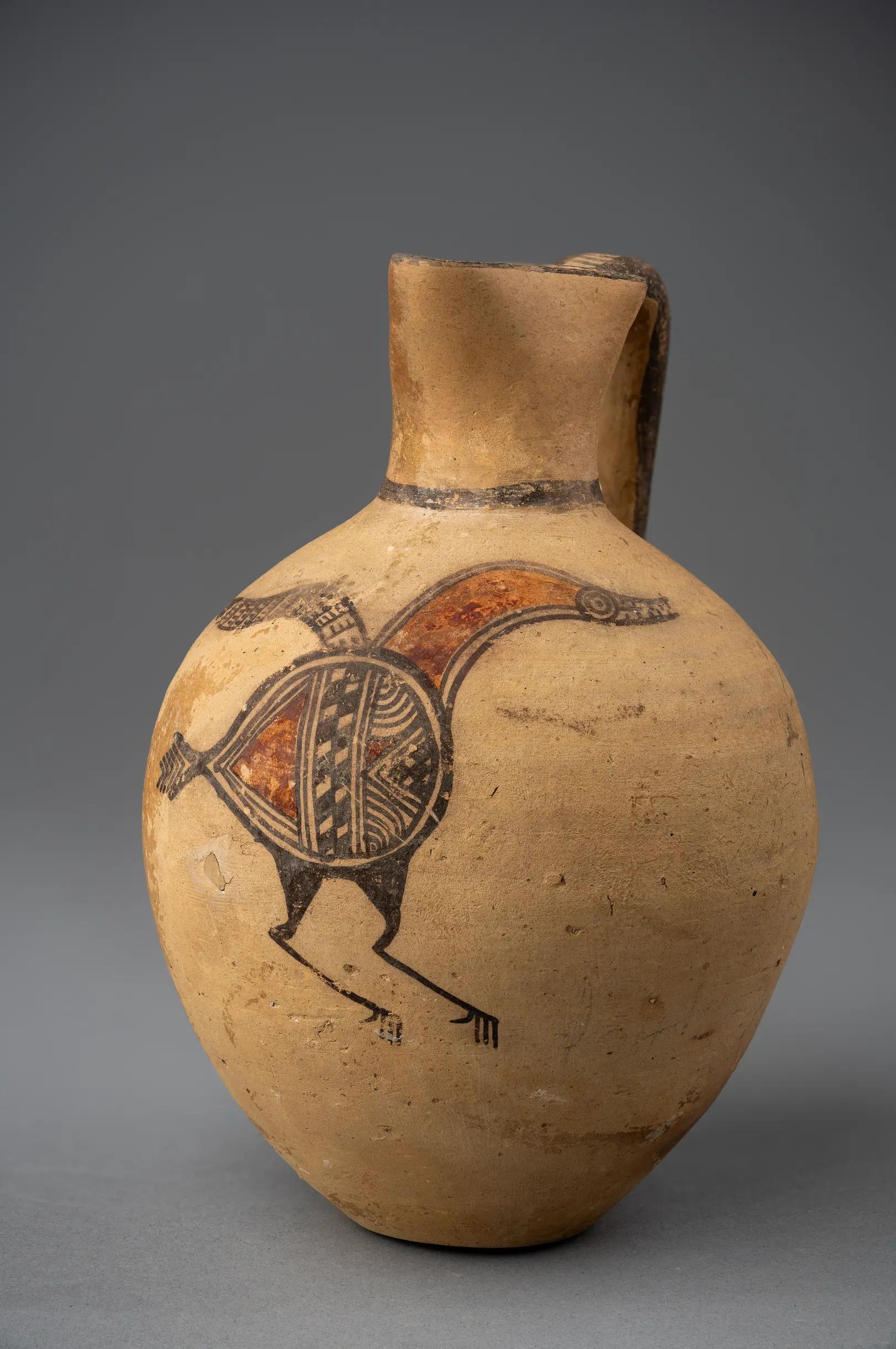
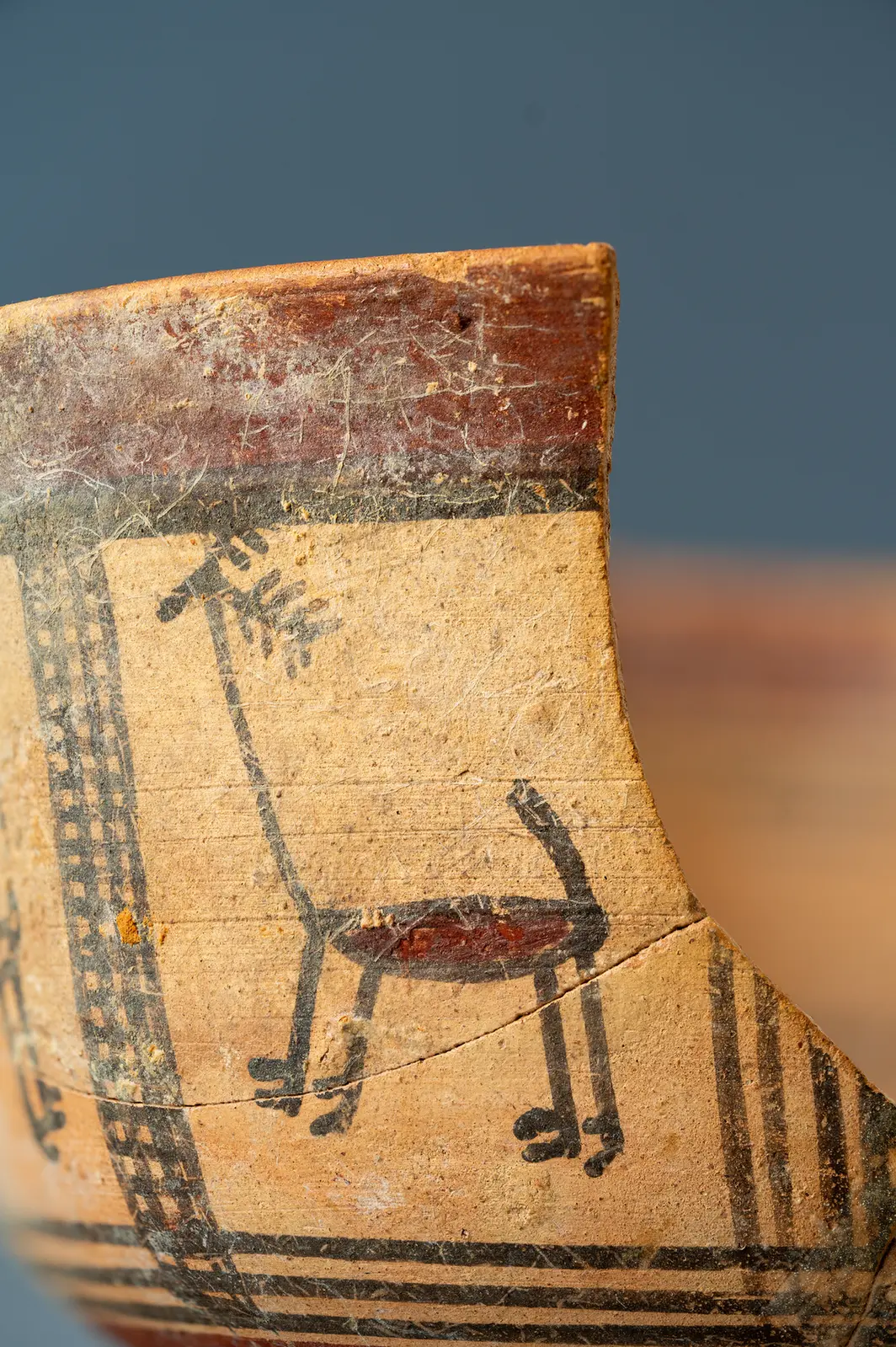
Painters also used the grid inside animals. The Drakopoulos free-field bird oinochoe has a body divided into vertical strips, one of them a column of black-and-white chequers, beside hatched and arcaded strips, with the wing filled in red. A fragment of a Bichrome kylix in the same collection (kylix fragments with stags) frames its stag with a vertical latticed band, the old panel divider still in use.
Late in the painted sequence the net returns as a main ornament in simpler form. On Black-on-Red II (IV) "the latticed lozenge ornaments have developed into a group of intersecting straight lines" [1, p. 55]; in the Western style of Bichrome V "lines, criss-cross lines, and strokes" are common, "partly in substitution for the circles" [1, p. 53]; and in White Painted VII, of the fourth century, "a new characteristic ornament is the field filled with crossed lines" [1, p. 49].
| Period | Ware (Gjerstad) | Lattice and chequer forms |
|---|---|---|
| Middle Cypriot | White Painted (Bronze Age) | All-over chequers on cups (Met 74.51.1116) |
| Cypro-Geometric I | White Painted I, Bichrome I | Latticed triangles, lozenges and bands; chequered dish bases |
| Cypro-Geometric II | White Painted II, Bichrome II | Latticed bands give way to parallel lines; radiating latticed triangles on dishes |
| Cypro-Geometric III | White Painted III, Bichrome III | Black-and-white chequers in triangles and winged lozenges; chequered triangle as free-field ornament |
| Cypro-Archaic I-II | Bichrome IV-V, Black-on-Red II | Neck metopes on amphorae; chequered bird bodies; criss-cross lines |
| Cypro-Classical | White Painted VII | Field filled with crossed lines |
Where and why
Gjerstad treated the decoration of the early Iron Age as one tradition across the island, "the uniform decoration hitherto characteristic of the Cypriote Iron Age pottery," until late White Painted III, when he saw it split into a rectilinear group in the east and south and a circle group in the west and north [1, p. 48]. Lattice and chequers belong to the rectilinear side, which in the Cypro-Archaic period is centred on Salamis. See Paphos for the Skales cemetery in the west, where the Cypro-Geometric I examples above were found.
On meaning, the standard studies are silent; lattice and chequers are treated throughout as fillings for other shapes. Gjerstad's observation that some Cypro-Archaic ornament derived from textiles concerns the guilloche and rosettes painted on the dress of terracotta figures [1, pp. 183, 188], and should not be extended to lattice without evidence. The Maltese cross, zig-zags, wavy lines and triple crossing lines entries cover the other geometric ornaments that share the panels with them. The Drakopoulos dishes are listed with the collection.
Objects on this page
 Terracotta loop-handled cupMiddle Bronze Age II · 1900–1600 BC
- White Painted Plate with Latticed Triangles and Wavy Lines on the UndersideGeometric I · 1050–850 BC
 Terracotta plateGeometric II · 950–850 BC
 Large White Painted Plate with Knobbed Handles and a Four-Armed Cross on the UndersideGeometric I · 1050–850 BC
 Bichrome IV Trefoil Jug with a Striding BirdArchaic I · 750–600 BC
 Bichrome Skyphos with Stags in MetopesArchaic I · 750–600 BC
References
- 1.Gjerstad, E. (1948). The Swedish Cyprus Expedition, Vol. IV, Part 2: The Cypro-Geometric, Cypro-Archaic and Cypro-Classical Periods. Stockholm: The Swedish Cyprus Expedition. (Page numbers follow the digitised text consulted, which is not paginated like the printed volume.)
- 2.Karageorghis, V., et al. (1983). Palaepaphos-Skales: An Iron Age Cemetery in Cyprus. Text volume.
- 3.Karageorghis, V., & Raptou, E. (2016). Palaepaphos-Skales: Tombs of the Late Cypriote IIIB and Cypro-Geometric Periods (Excavations of 2008 and 2011), Text volume.
- 4.Karageorghis, V., Mertens, J. R., & Rose, M. E. (2000). Ancient Art from Cyprus: The Cesnola Collection in The Metropolitan Museum of Art. New York: The Metropolitan Museum of Art. (Cited by catalogue number.)