
Contents
On the underside of a two-handled dish in the Drakopoulos collection, four latticed triangles point inwards to a small set of concentric circles, with a wavy line between each pair. Seen from a step back, the four triangles make a cross whose arms widen towards the rim. Cypriot archaeologists call the solid version of this figure a Maltese cross, and in the Late Cypriot III and early Cypro-Geometric periods it was one of the standard ornaments painted on the bases of Cypriot bowls and dishes.
The name is a modern convenience. Catalogues often print it in quotation marks, as Vassos Karageorghis did throughout the Palaepaphos-Skales publication ("a 'Maltese' cross") [3, p. 223]. The shape is simple enough to have been invented many times: the Ashmolean Museum has a sherd from Kish in Iraq, of the Early Dynastic I-II period (c. 2900-2700 BCE), catalogued as a "sherd with incised Maltese cross" (AN1930.206). The Cypriot motif needs to be traced through Cypriot contexts.
What the motif is
In Cypriot pottery the Maltese cross is four triangles, straight-sided or with curved sides, meeting at their points in the centre, so that the arms are narrow at the middle and broad at the ends. It is usually solid black, sometimes hatched or latticed, and usually enclosed by concentric circles. Two neighbours should be kept apart:
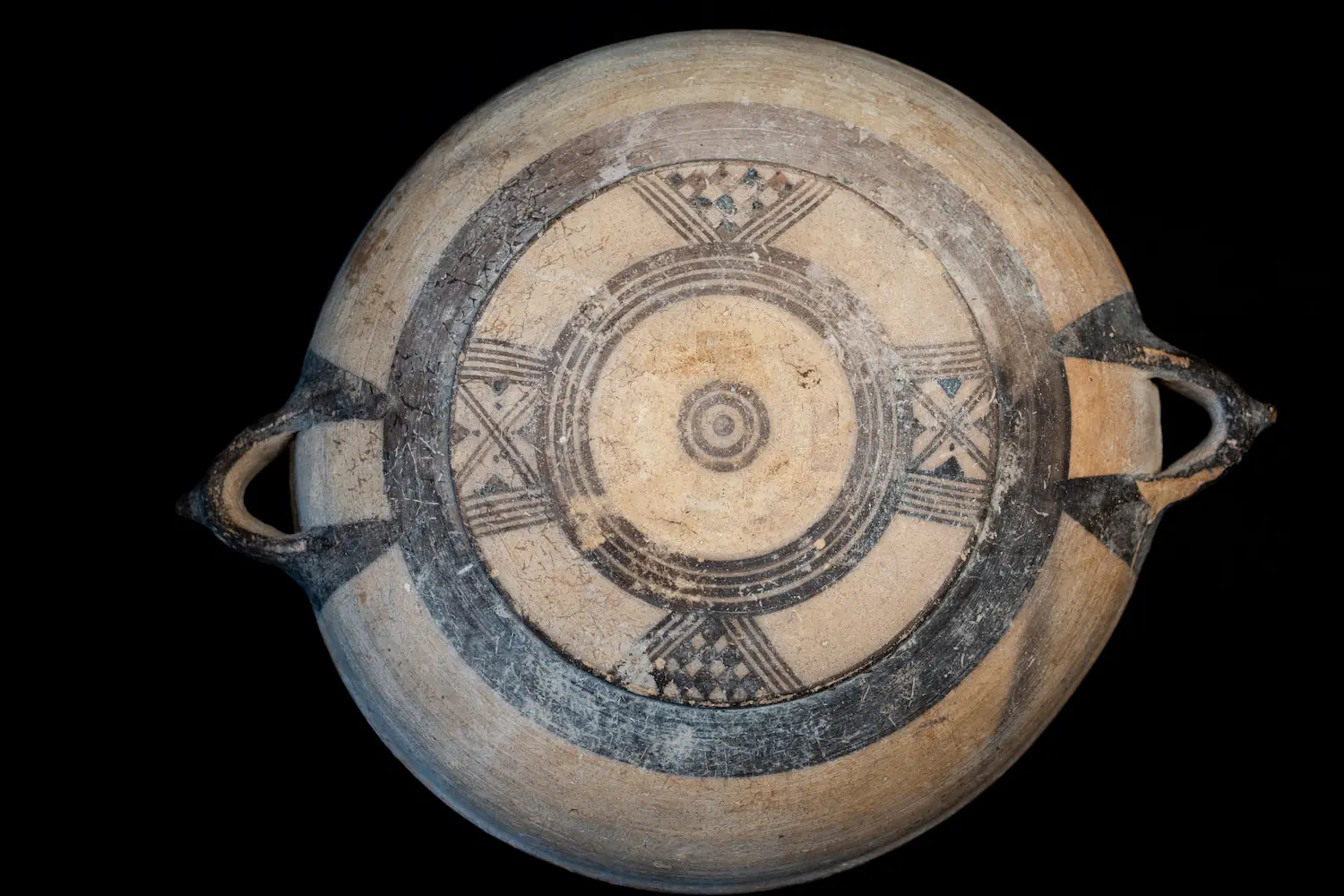
- The Greek cross, with arms of equal width. Gjerstad describes White Painted I dishes whose bases have "latticed squares or triangles forming a secondary ornament of a Greek cross in the middle" [1, p. 45]. The large Drakopoulos dish with crossed bands has its four panels arranged in this way.
- The dotted cross or dotted X, a small filler of the Cypro-Archaic period. Anna Georgiadou and Maria Dikomitou-Eliadou list "the dotted cross" and "a quatrefoil motif" among the small ornaments of the Salaminian workshops [6, p. 344], and Alicia Dissinger counts the dotted X beside birds on 22 vessels [7, p. 144].
Antecedents at the end of the Bronze Age
The earliest known Cypriot example comes from Kouklia-Evreti, near Palaepaphos, excavated by the Liverpool and St Andrews expedition in 1951-1954. Among the shallow bowls of Decorated Late Cypriot III ware from the Evreti tombs, bowl EVIA:41 has, "in place of the closed spiral in the centre of the bowl, … a central solid circle from which radiate four curved sided triangles, forming a Maltese cross pattern." The report notes that one type of triangle shows "some resemblance" to Furumark's Mycenaean motif FM 71 and "a distinct affinity with a Proto-White Painted motif" [2, p. 195]. It classes these bowls as Late Cypriot III in shape but "decorated in Mycenaean IIIC 1 style" [2, p. 195].
That fits Gjerstad's general account of the origins of Iron Age ornament: the decoration of Cypro-Geometric I owed almost nothing to the native Late Bronze Age White Slip tradition, and its prototypes "are mainly Late Mycenaean," transformed through the Proto-White Painted designs of Late Cypriot IIIB [1, p. 181]. See the Late Bronze Age entry and Mycenaean for the background.
Cypro-Geometric I-III: the base ornament
The Maltese cross is on Gjerstad's list of the "purely geometrical" ornaments of White Painted I, with the swastika and the arrowhead [1, p. 45]. His descriptions put it in three places:
- On bowls: "The bowls may have a central ornament on the base, e.g., a Maltese cross, filled triangles, diagonals, foliaceous rosette, etc." [1, p. 45].
- On dishes and flat bowls, where the base is the main field: "The base ornament consists either of a single ornament: a Maltese cross, a spoke ornament; or of a pattern with combined ornaments" [1, p. 45].
- On lenticular jugs and jugs with collar-shaped mouths: "ornaments composed of either concentric, encircling lines or Maltese crosses encircled by concentric lines" [1, p. 45].
The Swedish excavation reports give individual pieces. A Bichrome I barrel-shaped jug has "a maltese cross encircled by concentric lines and bands on both sides of body" [4, Vol. I, p. 273]; a White Painted I miniature jug has "an encircled, filled maltese cross on base" [4, Vol. I, p. 283]; a White Painted II flat bowl has "a black maltese cross on base" [4, Vol. II, p. 145]; a Bichrome II jug with pinched rim has a "black maltese cross at bottom encircled by black bordered, red band" [4, Vol. II, p. 126].
At Palaepaphos-Skales, Karageorghis's typology of the Cypro-Geometric I pottery shows how routine it was. Shallow dishes with a small base carry "small decorative motifs on the base, e.g. a 'Maltese' cross (T. 43: 64), concentric circles (T. 43: 52), a rayed motif (T. 49: 149), or nothing at all" [3, p. 223]. Kalathoi (deep bowls) have "a linear motif such as a 'Maltese' cross, a rayed motif or concentric circles" on the base, and deep bowls occasionally have one as an isolated motif between triglyphs (T. 49: 89) [3, p. 223]. On a White Painted I jug from the cemetery, 31.5 cm high, "concentric bands arranged vertically on body on either side of handle" enclose "a 'Maltese' cross at centre" [3, p. 73]. On another piece the base has "concentric circles at centre of base enclosing solid 'Maltese' cross," surrounded by four latticed panels arranged crosswise [3, p. 49].
The motif continued into White Painted III, where Gjerstad lists "the Maltese cross" among "the old ornaments" that carried on beside the new concentric circles [1, p. 47].
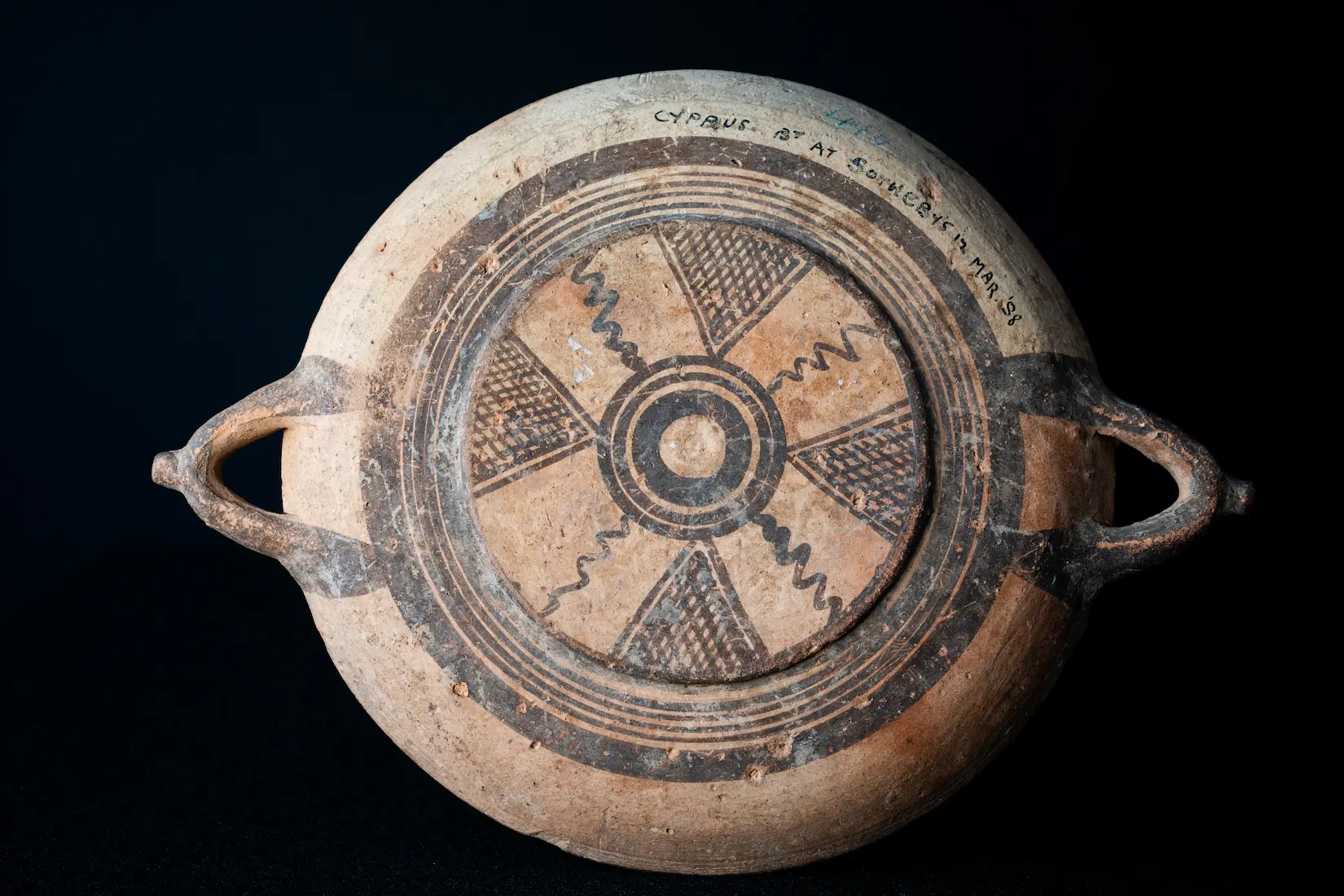
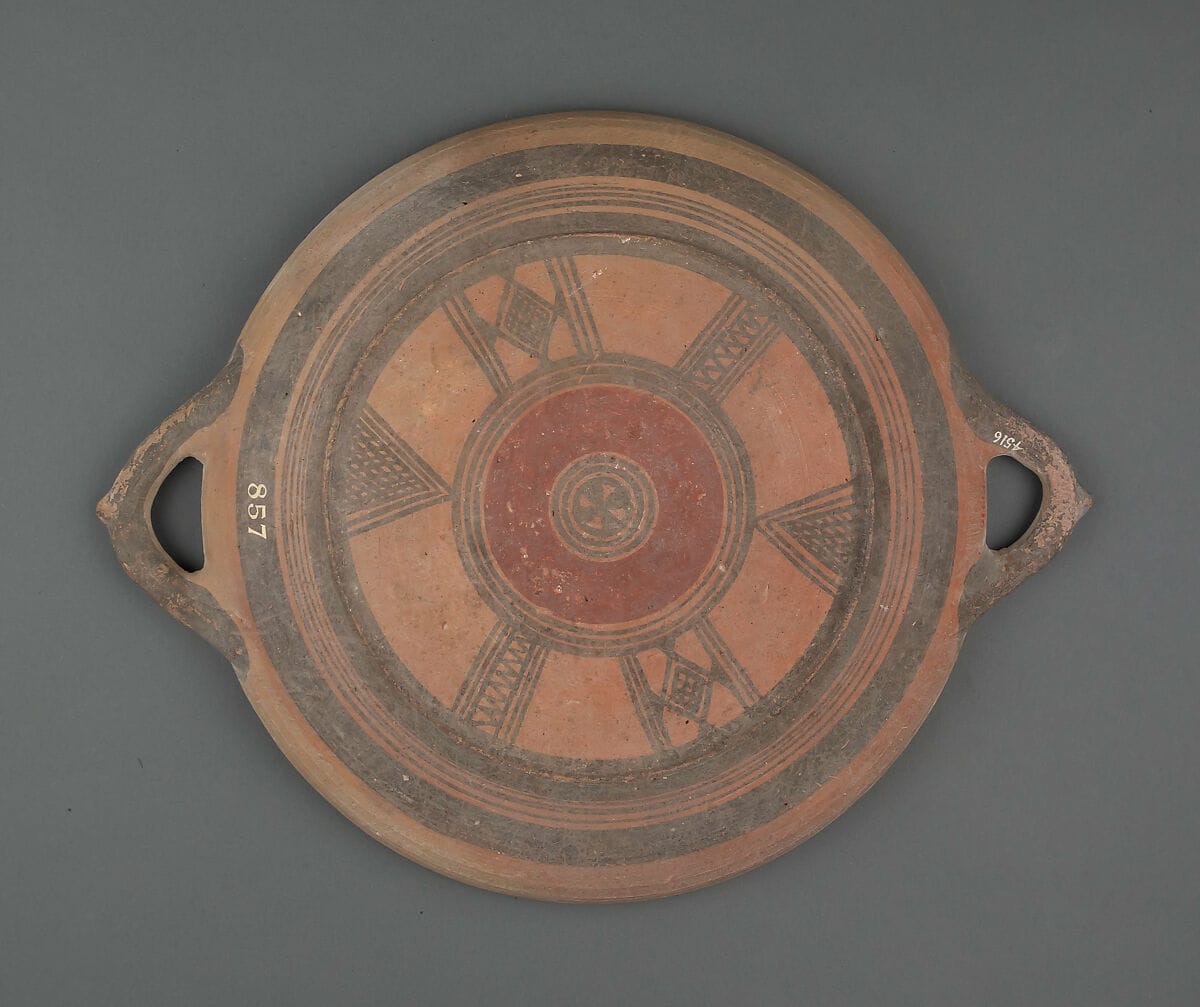
The Drakopoulos dish at the head of this entry is catalogued on the site as wheel-made White Slip ware; its shape, a shallow body with a wide flat base and two loop handles at the rim, and its base decoration place it among these Cypro-Geometric dishes. Its four latticed triangles pointing to a central circle are the open, latticed form of the Maltese cross, and the wavy lines between them follow the White Painted II habit of alternating "bands ... with triangles on the same plate" [1, p. 46]. The closest museum parallel found is a Bichrome II plate in the Medelhavsmuseet in Stockholm (MM Acc 0886), whose base has "a thin cross, framed by red and grey concentric circles. From this radiate four grey, framed latticed triangles"; the Metropolitan Museum's Cypro-Geometric II plate 74.51.971 (/artifact/2010) has latticed triangles radiating in the same way. The site's article on these plates covers the collection's three examples.
| Placement | Shape | Example | Source |
|---|---|---|---|
| Centre of base | Shallow dish, small base | Skales T. 43: 64 | Karageorghis 1983 [3, p. 223] |
| Centre of base, inside concentric circles | Open vessel | Skales piece with four latticed panels | [3, p. 49] |
| Inside concentric circles on the body | Barrel jug, lenticular jug | Bichrome I barrel jug; Skales WP I jug | [4, Vol. I, p. 273; 3, p. 73] |
| Metope between triglyphs | Deep bowl; amphora neck | Skales T. 49: 89; Skales T. 191/15 | [3, p. 223; 5, p. 33] |
| Base of closed vessel | Miniature jug; Bichrome II jug | Swedish Cyprus Expedition finds | [4, Vol. I, p. 283; Vol. II, p. 126] |
A slot shared with figures
Two finds show the Maltese cross occupying the same place in a composition as a figure. The White Painted I amphora from Palaepaphos-Skales Tomb 191, 55 cm high, has on one side of its neck a stylised bird, panels of latticed chequers and "a large latticed 'maltese cross' in the middle of a panel; at each of its corners is attached a small hatched triangle." The other side is decorated in the same way, except that "a horned quadruped (a bull)" stands "in the place of the 'maltese cross'" [5, p. 33]. The painter treated the cross and the bull as interchangeable centrepieces.
The second is a barrel jug from Skales Tomb 49. Karageorghis noted that "T. 49: 72 is also decorated with a bird and a solid 'Maltese' cross, motifs which seem out of place in the otherwise geometric decoration" [3, p. 222]. By Cypro-Geometric III the geometric free field, a single ornament on a bare body, had become an accepted layout [1, p. 47], and the same slot would later hold a free-field bird.
Distribution and later history
The examples collected here come from Palaepaphos-Skales and Kouklia-Evreti in the south-west (see Paphos) and from the Swedish excavations, and Gjerstad treats the motif as part of the island-wide White Painted I-II repertoire, before the split into Eastern and Western styles in late White Painted III [1, p. 48]. It appears on White Painted and Bichrome alike, and on bowls, dishes and jugs.
In the Cypro-Archaic period the solid four-triangle cross becomes rare. Its place among the small ornaments is taken by the dotted cross and the quatrefoil of the Salaminian workshops [6, p. 344] and by the dotted X on bird jugs [7, p. 144]. Whether these descend from the Cypro-Geometric Maltese cross or are separate inventions has not, to our knowledge, been argued.
Meaning
We know of no published study that offers a meaning for the Cypriot Maltese cross. In every description it is an ornament: one of several interchangeable base motifs (Maltese cross, spoke ornament, rayed motif, concentric circles) chosen to fill the centre of a round field [1, p. 45; 3, p. 223]. The Skales amphora, where a bull takes its place, shows that painters could swap it for a figure, which says more about the layout than about any symbolism. Readers should treat claims of a solar or religious meaning for this particular motif as unsupported unless a source is given. The related swastika, lattice, circles and triple crossing lines entries cover the other ornaments of the same repertoire, and the Drakopoulos dishes are listed with the collection.
Objects on this page
References
- 1.Gjerstad, E. (1948). The Swedish Cyprus Expedition, Vol. IV, Part 2: The Cypro-Geometric, Cypro-Archaic and Cypro-Classical Periods. Stockholm: The Swedish Cyprus Expedition. (Page numbers follow the digitised text consulted, which is not paginated like the printed volume.)
- 2.Catling, H. W., et al. (2020). Kouklia: Late Bronze Age and Early Iron Age Tombs at Palaepaphos 1951-1954, Vol. I (ed. R. W. V. Catling).
- 3.Karageorghis, V., et al. (1983). Palaepaphos-Skales: An Iron Age Cemetery in Cyprus. Text volume.
- 4.Gjerstad, E., et al. (1934-1972). The Swedish Cyprus Expedition: Finds and Results of the Excavations in Cyprus 1927-1931, Vols. I-IV. Stockholm. (Vols. I and II cited by page of the digitised text.)
- 5.Karageorghis, V., & Raptou, E. (2016). Palaepaphos-Skales: Tombs of the Late Cypriote IIIB and Cypro-Geometric Periods (Excavations of 2008 and 2011), Text volume.
- 6.Georgiadou, A., & Dikomitou-Eliadou, M. (2022). The Iron Age pictorial pottery of Salamis within and beyond: An overview of ceramic styles, wares and fabrics. In G. Bourogiannis (Ed.), Beyond Cyprus: Investigating Cypriot connectivity in the Mediterranean from the Late Bronze Age to the end of the Classical Period (AURA Supplement 9, pp. 335-348). Athens: National and Kapodistrian University of Athens.
- 7.Dissinger, A. M. (2017). Cypro-Archaic bird iconography: Types, uses, and meanings [Doctoral dissertation, University of Virginia].