
Contents
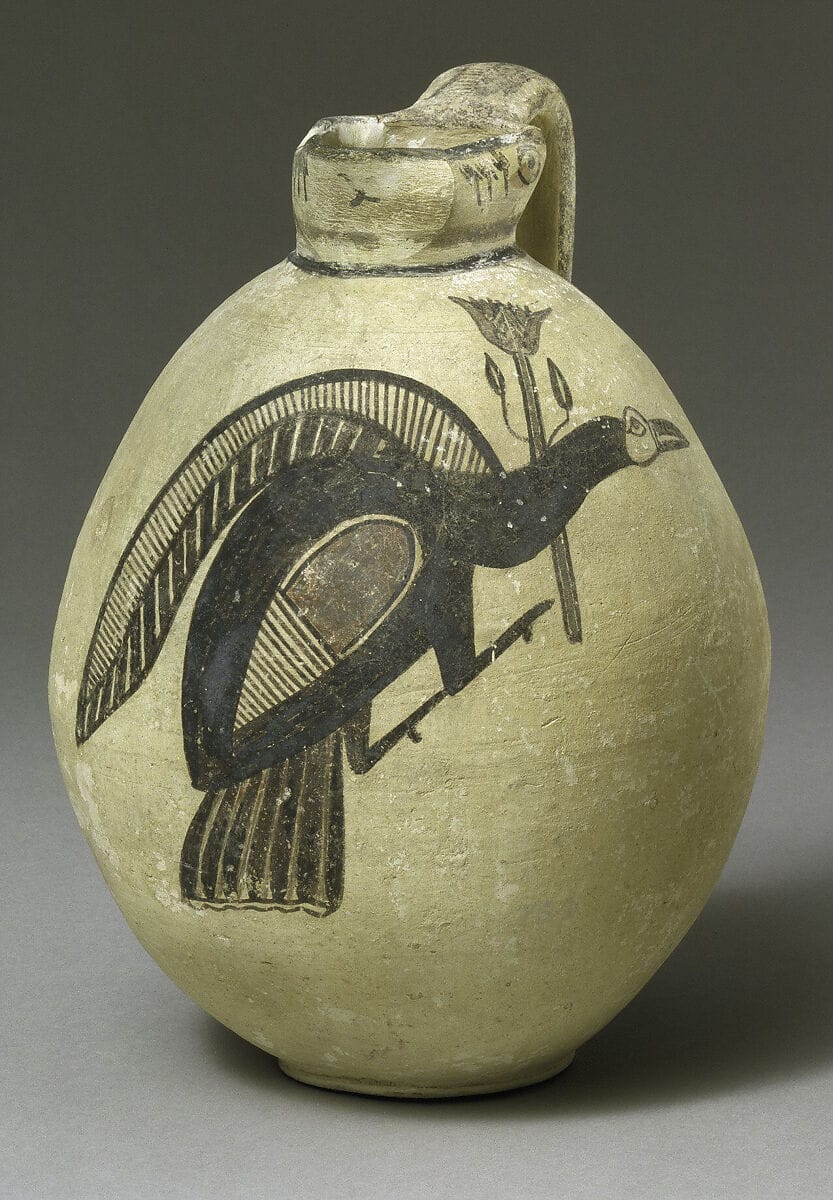
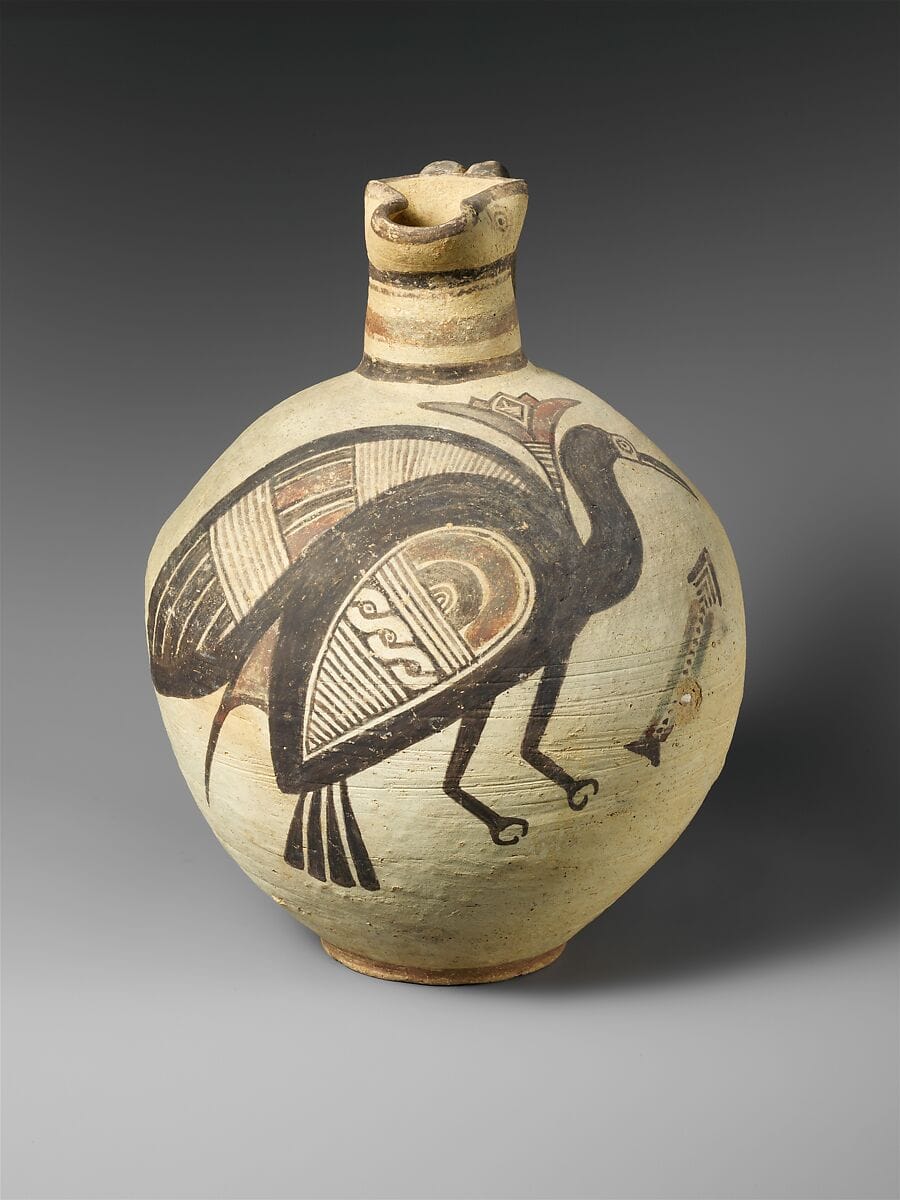
A Cypriot potter of the seventh century BCE could buy a finished trefoil-mouthed jug, pale and slipped, and cover it in the old way: bands at neck and base, circles or chequered panels between them, every motif held in its frame. Or the painter could leave the body bare and put one bird on it, the size of a hand, opposite the handle, with nothing around it except a lotus, a swastika and a little chevron arrow pointing at its beak. The second choice is what archaeologists call the free-field style, and it produced the Cypriot vases that museums most like to show.
The term is Einar Gjerstad's, from the fourth volume of The Swedish Cyprus Expedition (1948), and it names a way of laying out decoration on a pot. It is independent of ware, subject and period. This entry sets out what Gjerstad meant by it, how the style developed, which shapes and workshops carried it, what the painters drew, and where the arguments about it now stand. The repertoire's recurring pieces have their own entries: lotus flowers, arrows, swastikas, circles and plants.
What "free field" means: a layout, not a ware
Gjerstad described the painted pottery of the Cypriot Iron Age through three "ornamental systems" already present in White Painted I: the zone style, in which the body is divided into horizontal or vertical zones by bands and lines; the panel style, in which those zones are cut into panels each holding a single ornament; and the plain-bodied style, in which "the whole body is left undecorated between encircling bands round rim, neck, base" [1, p. 45]. In White Painted III, the ware of the Cypro-Geometric III period, he recorded something new: "a new style is introduced, viz., the free-field style, which occurs especially on the jugs with pinched rim. It is to be considered as a decorated variety of the plain-bodied style of White Painted I and II: on the free surface of the vase a single ornament is applied" [1, p. 47]. His examples were geometric: a triangle filled with black and white chequers, a few isolated circles and swastikas, rows of chevrons [1, p. 47].
Two points follow from that passage. First, free field began as a geometric layout, and Gjerstad placed its origin inside the Cypriot tradition, as a decorated version of the bare-bodied jug. Second, the term describes syntax. A free-field vase can carry a bird or a chequered triangle; what makes it free field is that the motif floats on an undivided surface. When Gjerstad reached Bichrome IV he said so directly: "The free-field style is generally employed on the jugs with pinched mouth, both for geometrical and pictorial designs, and the zone and panel-style on the other vases" [1, p. 52]. In his Western circle style the free field could hold nothing but "isolated circles or a vertical row of connected circles" [1, p. 52].
Anna Georgiadou and Maria Dikomitou-Eliadou keep the same distinction. "Free field" and "panelled", they write, are "conventional terms" that "describe the mode of arrangement of a pictorial scene; in the 'free field style' the scene occupies the entire vessel surface, while in the 'panelled style' figurative motifs are organised in horizontal zones or panels" [3, p. 342]. The pictorial repertoire is one thing and the free field another. A figured amphora with its figures in a frieze is pictorial without being free field, and a jug with one chequered triangle on its shoulder is free field without being pictorial.
Vassos Karageorghis's definition in the Metropolitan Museum's Cesnola catalogue is the one most often quoted for the pictorial form: vessels "produced in either the White Painted or the Bichrome technique; linear and geometric decorations are absent. The vase painter, freed from the spatial restrictions of encircling bands, lines, and panel divisions, applied a single figural motif or a figural composition to the curved surface. The most common shape is the jug with trefoil rim" [2, introduction to cat. 149-161]. In practice the "absent" geometric decoration is rarely absent entirely; necks and bases still carry bands, and the field is full of small fillers. What disappears is the grid.
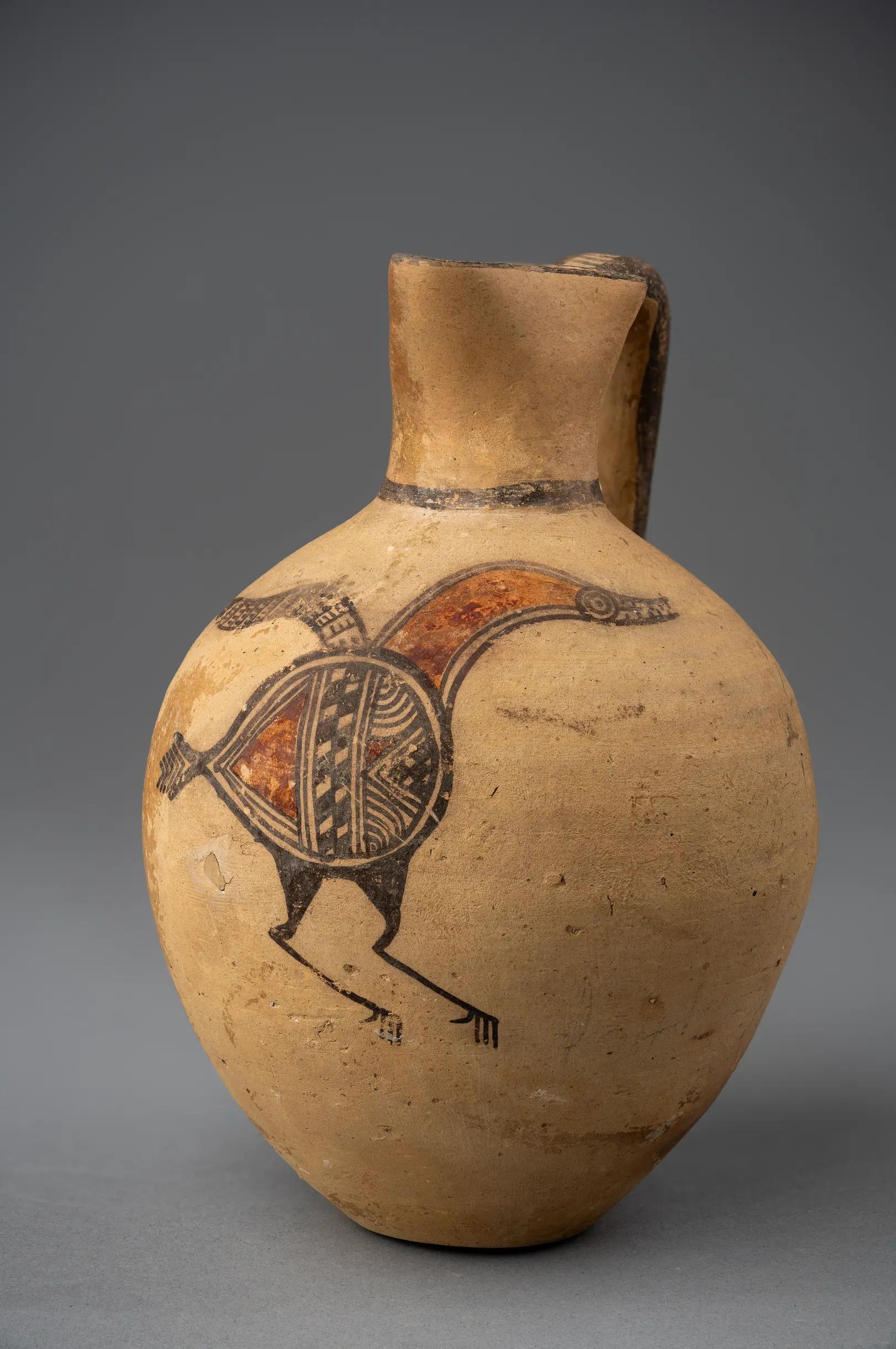
The free-field bird oinochoe in the Drakopoulos collection shows the layout at its plainest. A single bird strides across the body of a trefoil-mouthed jug, drawn in black outline with its wing and tail filled in red; its body is divided into vertical strips of chequers and hatching. Nothing frames it. The neck carries a single band, the rest of the pot is bare slip. The type is the "almond shaped" or oval-bodied waterbird that Alicia Dissinger catalogues by the dozen on Bichrome IV jugs [7, pp. 343-352].
From geometric panels to the open field
Figures were not new on Cypriot pottery in the eighth century. Gjerstad divided the pictorial decoration of Bichrome III into two groups. In the first, "the figures of birds, quadrupeds, men, etc. are still geometrical or geometricising" and "are used as ornaments of metopes"; in the second, "the figures are more freely drawn, with the body usually designed in contour-lines," and "form a continuous frieze" [1, pp. 50-51]. His type piece for the second group was the Hubbard amphora in the Cyprus Museum [1, p. 51].
Porphyrios Dikaios published that amphora in 1937. Wing-Commander O'Brien Hubbard of Kyrenia had "saved it from the hands of illicit diggers and dealers," and Dikaios traced it to Vartivounas, a cemetery near Platani in the Famagusta district, one of several sites he found freshly looted in the villages of Gypsos, Peristerona, Stylli, Ayios Iakovos and Ayios Andronikos [5, pp. 56-57]. He dated it to "the early part of the ninth century" and placed it between Gjerstad's Bichrome II and III [5, p. 58]. Karageorghis's later guide to the Cyprus Museum puts it at "the end of the Geometric period (beginning of the eighth century B.C.)" and describes the scene: a woman on a throne drinking through a straw, a winged sphinx sniffing a flower, a figure pouring into a jug, and on the other side dancers and a lyre player [6, p. 77]. The same guide records that J. L. Myres called its drawing "styleless" [6, p. 77]. The Hubbard amphora is pictorial and freely drawn, but its figures run in a frieze between the handles, which places it in the free-field style's prehistory.
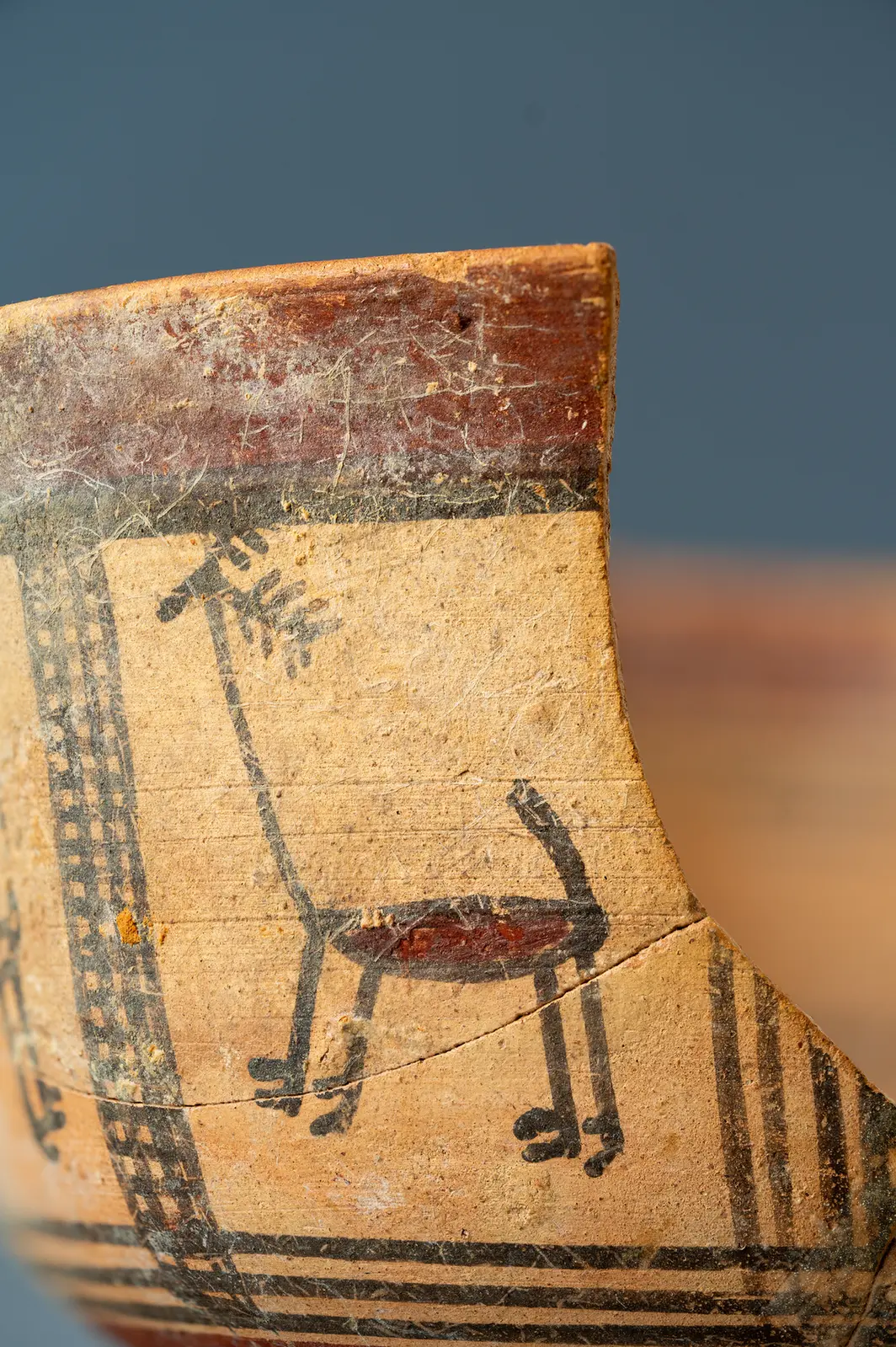
Georgiadou and Dikomitou-Eliadou give the sequence for Salamis as three overlapping modes: pictorial scenes in "panelled" syntax from Cypro-Geometric III (the ninth century), the free-field style "at the beginning of the CA period (ca 8th century BC)", and the "floral style" in the seventh and sixth centuries [3, p. 342]. The panelled mode survived alongside the free field. A fragment of a Bichrome kylix in the Drakopoulos collection (kylix fragments with bichrome stags) has a stag standing in a panel framed by a latticed band, the older syntax still in use.
| Mode | How the figure is placed | Start | Typical carriers |
|---|---|---|---|
| Panelled | Figures in metopes or horizontal zones between bands | Cypro-Geometric III, 9th century BCE | Amphorae, jars, footed bowls |
| Continuous frieze | Freely drawn figures in a band round the pot (Hubbard amphora) | Cypro-Geometric III to early Cypro-Archaic I | Amphorae |
| Free field | One figure or group on the bare body, opposite the handle | Beginning of Cypro-Archaic, 8th century BCE | Trefoil-mouthed jugs, barrel jugs |
| Floral | Dense lotus, rosette and guilloche over neck and shoulder | 7th-6th centuries BCE | Belly-handled amphorae, jugs, footed bowls |
The dates for the panelled, free-field and floral modes are Georgiadou's for Salamis [3, p. 342]; the frieze group is Gjerstad's second Bichrome III group [1, pp. 50-51]. Gjerstad's absolute dates for his types were lower, and the Metropolitan catalogue gives Cypro-Archaic I as c. 750-600 BCE for its free-field jugs [2, cat. 157-161]; see the Cypro-Geometric and Cypro-Archaic entries for the period framework.
Shapes, wares and technique
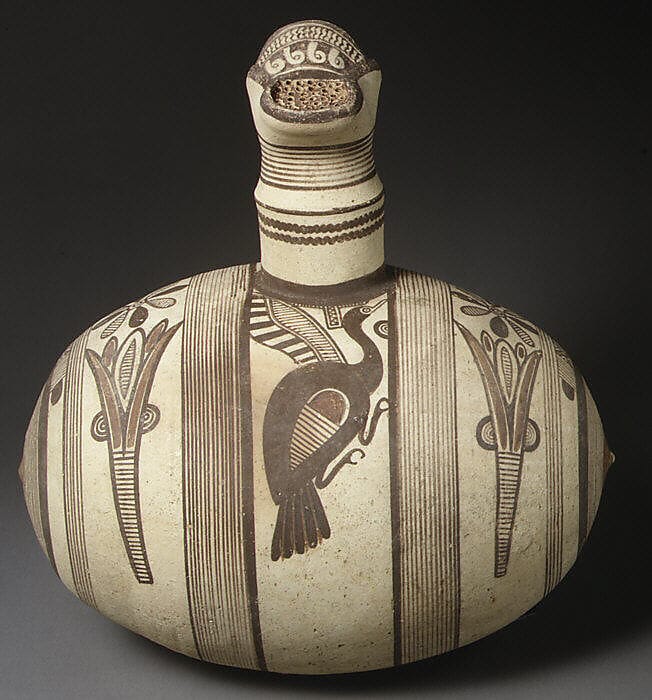
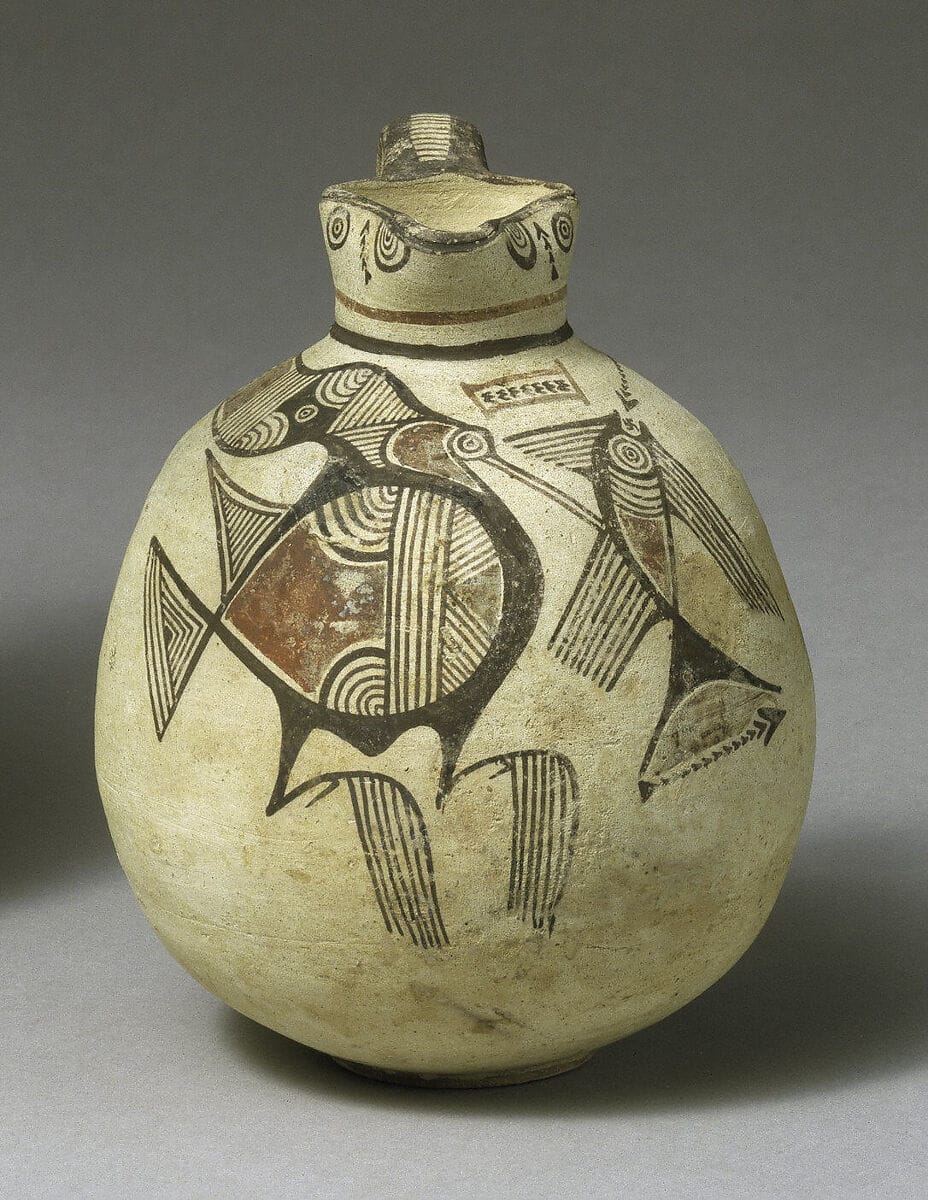
Gjerstad tied the free field to one shape: "the jugs with pinched mouth" [1, p. 52], the trefoil-mouthed jug or oinochoe. Georgiadou and Dikomitou-Eliadou define the Salaminian version closely. It is 20 to 30 cm high, with "an elongated ovoid or piriform body, a short neck and a large, pinched mouth." "The figurative representation always occupies the front of the vessel, opposite the vertical handle; and the mouth is always decorated with eye motifs, arranged on each side of the pinched opening, with added eyebrows" [3, p. 343]. The painted eyes turn the jug into a face, and the bird or bull is painted on its chest. Barrel jugs carried the style too: the Met's Bichrome IV barrel jug 74.51.517 has a bird of the same group as a free-field jug, but Karageorghis kept it out of the category because it is framed by encircling bands [2, cat. 159].
The ware is Bichrome in the great majority of cases, with some White Painted; Georgiadou and Dikomitou-Eliadou state that at Salamis the free-field and panelled modes "appear exclusively in Bichrome Ware" [3, p. 342]. They also note a Salaminian peculiarity in the use of red: elsewhere on the island red is a supplementary colour laid in bands, while at Salamis "red paint is not only used as a fill colour for various geometric ornaments and figurative representations, but also for outlining them" [3, p. 338]. Karageorghis in the Cyprus Museum guide wrote that the red and black "give the impression of embroidery on cloth," and that the aim of the style was "the perfect adaptation of the pictorial representation to the shape of the particular vessel" [6, p. 78].
Free-field figures on Black-on-Red are exceptional. The Met owns a Black-on-Red II (IV) dish whose outside carries a pictorial scene by "an inexperienced painter," which Karageorghis called "odd, because the outside surfaces of Black-on-Red dishes normally feature concentric bands, not pictorial images" [2, cat. 149].
The repertoire: birds first
"The most popular motif of the pictorial style of seventh century vase painting is unquestionably the bird," Karageorghis wrote; its body and wings suit the rounded field [6, p. 81]. Gjerstad thought the birds on free-field jugs "bear witness of a great decorative ability and artistic sense" and added, without argument, that "they may be interpreted as soul-birds" [1, p. 52]. That reading has no support beyond his sentence and should be treated as his opinion.
Dissinger's catalogue of Cypro-Archaic bird vases gives the best numbers. Of the vessels she recorded with added motifs beside the bird, the lotus appears on 89 and the swastika on 79; the chevron arrow on 57; plant motifs on 51; circles on 25; the dotted X on 22; rosettes on 12; palm trees on 6 [7, p. 144, Table 10]. (Her text gives 84 for the lotus, her table 89.) Chevron arrows sit "below the beak or behind the bird, but always point upward," and she judges them "typical Cypriot filler images or stock motifs" in use for centuries [7, p. 144]. Other figures share the field with birds: humans on 24 vessels, fish on 10, goats on 6 [7, p. 141].
The standard compositions recur often enough to be recognised at a glance:
- Bird and lotus. A Met jug said to be from Ormidhia (74.51.503, on this site as /artifact/2967) belongs, in Karageorghis's words, to "a group of vases, probably painted in a single workshop, that combine a highly stylized bird with a lotus flower" [2, cat. 160].
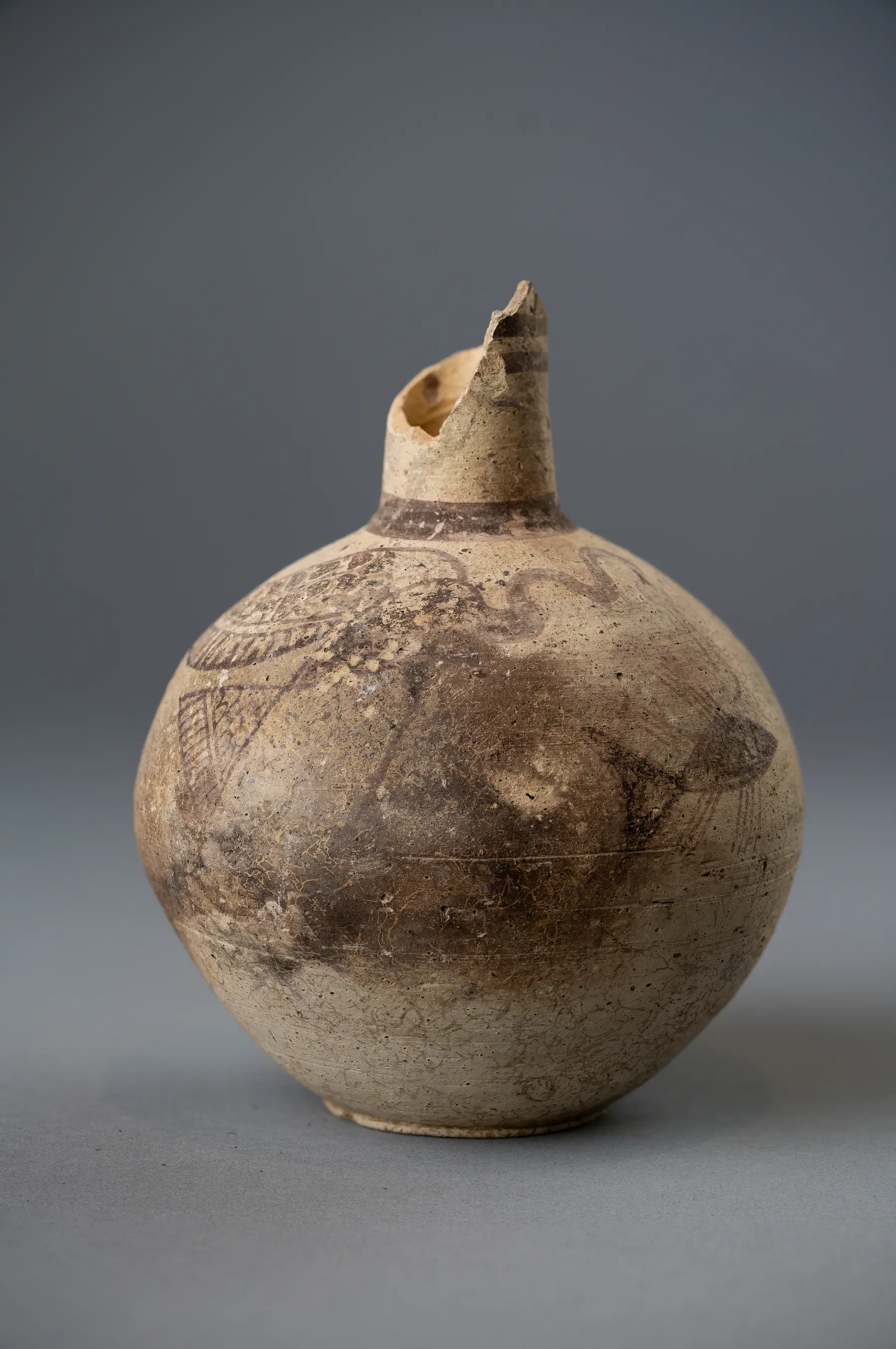
- Bird and fish. The Met's 74.51.527 (/artifact/1752): "The composition of a bird catching a fish was popular in Cypriot vase painting. Such vessels may have originated in one or two workshops in the eastern part of the island. The source of the scene may be Nilotic, but Cypriot artists adapted it to their own taste" [2, cat. 161]. The Drakopoulos bird oinochoe with a fish, badly damaged by fire, is of this type.
- Humans with the lotus. On Met 74.51.509 two human figures, two birds and a central lotus are laid out "strictly symmetrical"; a second jug, 74.51.510, is so close that Karageorghis gave both to one artist and workshop [2, cat. 157-158].
- Quadrupeds. The Cyprus Museum's goat jug 1968/VIII-23/1, probably from a tomb between Vatyli and Sinda, shows a leaping goat, a large lotus with red leaves, and an "arrow" motif on the front, with an eye on each side of the mouth [4, p. 99]. The guide to the Cyprus Museum illustrates a bull sniffing a lotus flower [6, p. 78].
- Warriors, riders and ships. The Met holds a White Painted IV jug with a man carrying spears drawn in silhouette, a Bichrome IV jug with a horse and a small running figure on its back, and a White Painted IV jug with a ship, a motif that "appears on only a few vases of the period" [2, cat. 150, 153, 154]. The British Museum's Bichrome jug 1926,0628.8 carries a warrior with a round shield and a long spear.
Some compositions carry a story. A Cyprus Museum jug from Arnadhi shows a large bird facing a small man with a ram's head; Karageorghis read it as a crane and a Pygmy, which would make it the earliest known picture of that myth [6, pp. 78-80]. Dissinger records hunting scenes and men holding birds by the neck, one with a stick she reads as a liming rod [7, pp. 141-143].
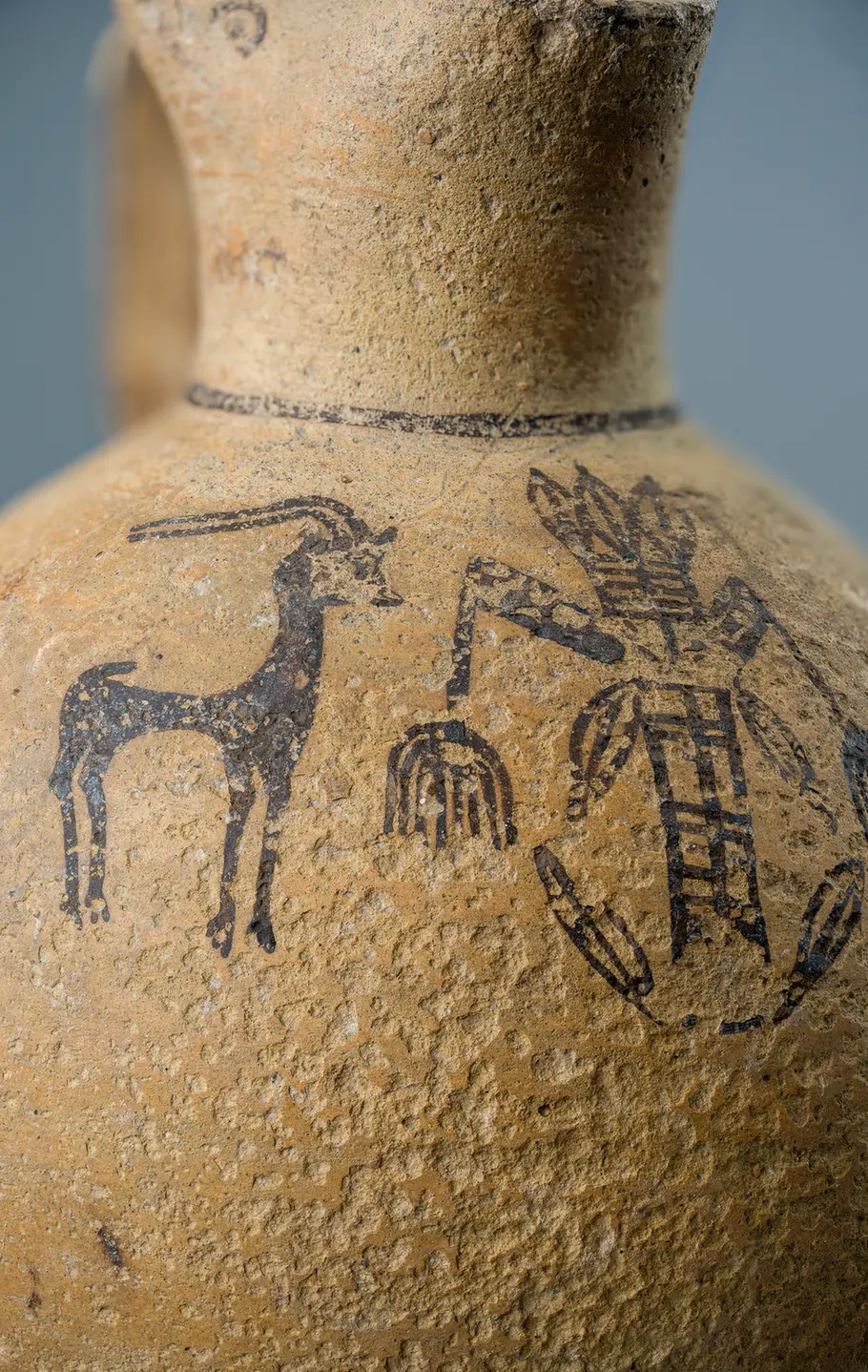
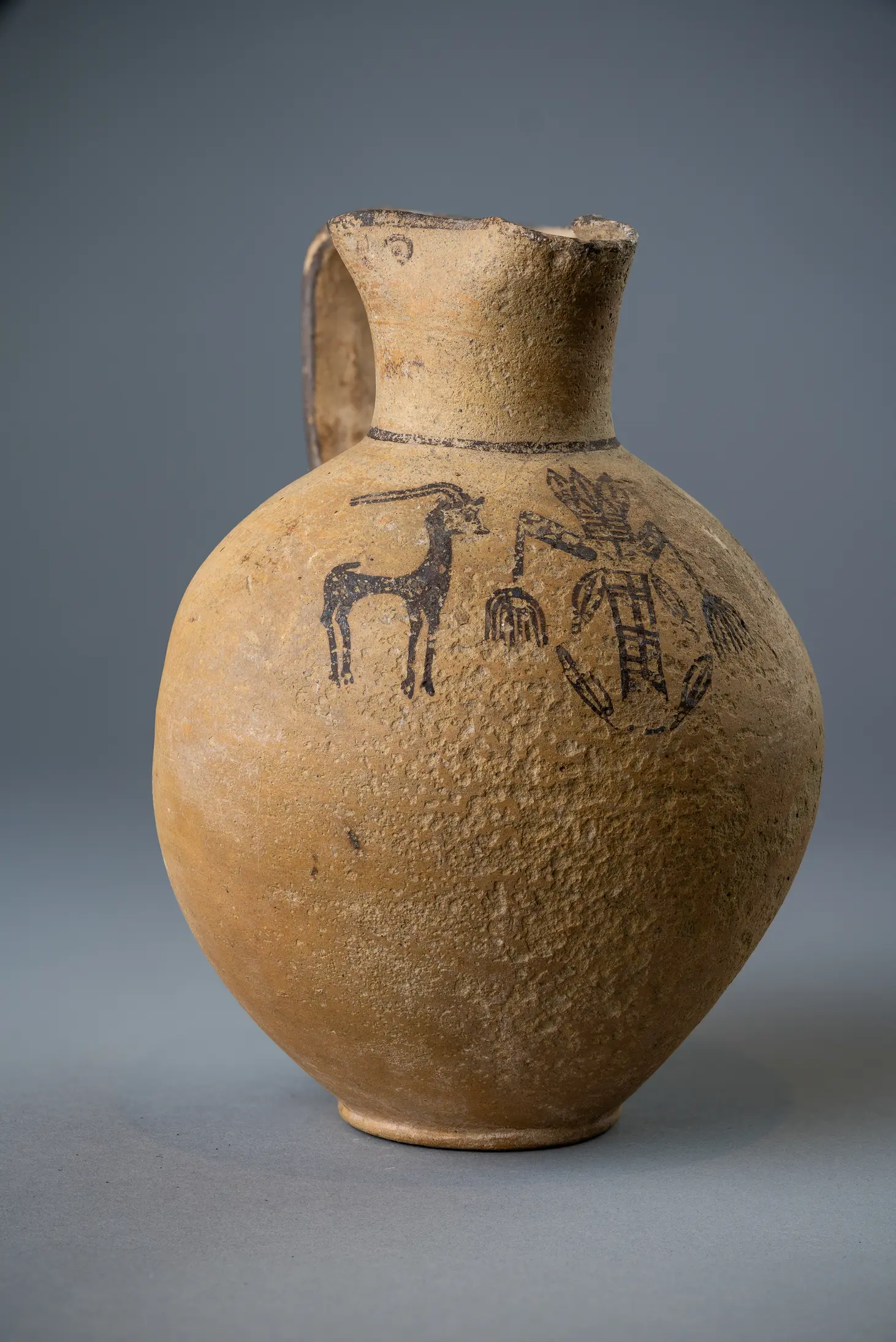
The Drakopoulos free-field jug with a goat and a composite figure sits at the stranger end of the range. A long-horned goat, in solid silhouette, faces a fan-shaped flower on a stalk and a tall figure built from a ladder-like trunk, feather-like fronds and a pair of arm-like strokes. The figure has been described as an anthropomorphic date palm; it could equally be a stylised tree with a human outline worked into it, and the site's article on this jug discusses the options. What is secure is the layout: goat and figure alone on the shoulder, opposite the handle, drawn in black on the bare surface.
Fillers and the empty space
Free-field painters did not leave the ground blank. Swastikas, dotted crosses, small rosettes, concentric circles and chevron arrows are scattered around the main figure. Georgiadou and Dikomitou-Eliadou list the small Salaminian motifs as "the dotted cross, the sun motif, a vertical chain of chevrons forming an arrow motif, pairs or groups of swastikas, groups of dots in panels, a quatrefoil motif and groups of M or W or Σ motifs," often "very small" and used as "supplementary ornaments, accompanying or flanking other larger geometric motifs or even pictorial designs" [3, p. 344]. The Met's bird jug 74.51.501 (/artifact/1232) has a lotus rising from its back and an upward-pointing arrow in front of it. Whether any of these small signs carried a meaning of its own is not known; the swastika and arrow entries give the arguments.
Workshops: east against west, then Salamis and Amathus
Gjerstad saw that the Bichrome IV repertoire split in two. The "circle style can be localized to the western and northern parts of Cyprus, and the rectilinear style to the eastern and southern parts of the island. The former may therefore be called the Western style and the latter the Eastern style" [1, p. 52]. The Eastern style took in "lotus buds and flowers, rosettes, sacred tree, aquatic birds, quadrupeds, and human figures" [1, p. 52]. Reyes, in 1994, found the distinction still holding, while noting that pictorial vases were also made in the west and that Western-style circles occur as far east as Meniko and Aradippo [8, p. 63].
Karageorghis's catalogue notes speak of "one or two workshops in the eastern part of the island" for the bird-and-fish jugs [2, cat. 161], and of the free-field style developing "in the eastern part of the island" during Cypro-Archaic I-II [2, introduction to cat. 149-161]. Georgiadou and Dikomitou-Eliadou make the east more precise: "the pictorial style, involving a wide variety of iconographic themes, was conceived and developed in the workshops of Salamis and prevailed in the eastern part of the island during the CA period. Amathus is the only other contemporary production centre where a pictorial style developed" [3, p. 341]. At Salamis the same painted style appears on pots and on the corselets of medium and large terracotta statues, which suggests potters, painters and coroplasts working in the same workshops [3, p. 341].
The second centre, Amathus, made its own bird jugs. Karageorghis wrote of a small squat Bichrome IV jug in the Met that "most jugs of this type were made in the region of Amathus toward the end of the Cypro-Archaic I period. They are always decorated with one or more birds, with long legs and spread wings" [2, cat. 155]. Reyes called them the Amathus oinochoai, with "somewhat sagging shapes," found from Kourion to Idalion and the Karpass, and attributed to a workshop founded by the "Amathus Painter" [8, p. 65]. The British Museum's 1876,0909.25, from Amathus, is a squat Bichrome jug with two stylised birds in flight facing a rosette, eyes on the mouth and a zigzag down the handle.
Attributions to individual painters exist but are thin. Reyes summarises J. L. Benson's "NBB workshop" of Bichrome bowls with birds alighting, founded by an "Armidale Painter" perhaps near Tamassos, and a single painter of bird jugs found at Leonarisso and Lefkoniko whose output "is largely confined to the areas of Salamis and the Karpass" [8, pp. 65-67].
Find contexts, and who bought them
The free-field jugs come overwhelmingly from tombs, and most of the famous ones have no recorded context. The Met's pieces came from Luigi Palma di Cesnola and are catalogued with a "said to be from" before every place name [2, cat. 157-161]; the Cesnola collection page covers how those attributions were made. Dikaios described the market of the 1930s as flooded with "early Iron Age pottery, most of it of the type with painted birds and animals or with human figures" from illicit digging in the Famagusta district [5, p. 56]. Georgiadou and Dikomitou-Eliadou observe that Salaminian pictorial vessels "are much sought after by private and museum collections," and that those of unknown provenance "far outnumber pictorial vessels from known archaeological contexts" [3, p. 344]. The excavated examples in their study came from tombs at Peristerona, Gypsou, Ayios Georgios Spatharikou, Arnadhi, Lythrangomi and Rizokarpaso [3, p. 344].
The same authors argue that the pictorial vessels "were produced primarily for local consumption within the polity of Salamis, with only a limited number distributed to other regions of the island or overseas," in contrast to the wide circulation of Salaminian pottery in the abstract geometric style [3, p. 335]. The few exports they list are telling: bird-decorated jars and bowls in the panelled style at Achziv and Qrayé, a bull-and-lotus amphora fragment and a jug fragment with a woman holding a lotus at Al Mina, and bird fragments at Tarsus that the excavator took for local imitations [3, pp. 344-345]. They also stress that pictorial pottery of any kind is "far more limited than those bearing abstract geometric decoration" [3, p. 343]. The free-field jug is the Cypriot vase people remember, and it was a minority product in its own time.
Interpretation: Nilotic, Assyrian, or Cypriot
Three questions run through the literature.
The first concerns where the images came from. Gjerstad listed the lotus, the sacred tree, sphinxes, hunting and chariot scenes among the "ornaments appearing on the pottery of Cypro-Archaic I" that "are of Oriental derivation," and suggested the Phoenician metal bowls found in Cyprus as one source the potters could have copied [1, pp. 182-183]. Karageorghis called the bird-and-fish scene possibly Nilotic [2, cat. 161], and Dissinger reads lotuses beside birds as shorthand for a Nile scene [7, p. 145]; the Egypt entry covers the wider borrowing. The Cyprus Museum guide, on the other hand, calls the bull sniffing a lotus a motif "popular in vase painting since the Mycenaean era" [6, p. 78].
The second is whether the warriors and chariots were Assyrian. Karageorghis and Jean des Gagniers, in their corpus of figured Cypriot pottery (1974), argued that chariot scenes, riders and warriors had been rare or absent before, and that "les rois guerriers assyriens apportèrent des modes nouvelles dans l'île" (quoted in [8, p. 43]). Reyes rejected this. He cited a study concluding that the chariots buried at Salamis and the terracotta chariot models "are not identical with the chariots seen on ninth and seventh century Assyrian reliefs," noted that chariots, warriors and horsemen already appear on earlier Cypriot pictorial pottery, and argued that any Assyrian influence reached Cyprus indirectly, through Phoenician intermediaries [8, pp. 43-44]. The Neo-Assyrian Empire entry sets out the political side.
The third runs west, to the Aegean. Reyes reports the argument that "the figured decoration of some Fikellura pottery derives from the 'free-field style' decoration of Cypriot Bichrome pottery," and a case in the other direction, a banquet scene on an Amathus amphora read as a copy of a Fikellura pot found nearby [8, p. 81]. Gjerstad had already traced the eye ornament on the lips of pinched-mouth jugs from Cyprus to Rhodian and Fikellura jugs [1, p. 188].
The Cyprus: A Dynamic Island catalogue frames the goat jug as a regional counterpart to the East Greek Wild Goat style, "different regional expressions of the Orientalizing cultural phenomenon" [4, p. 99]. That is as far as the evidence goes. The motifs were borrowed from the east; the layout, as Gjerstad's own account makes plain, grew out of the Cypriot plain-bodied jug; the result was made mainly at Salamis for Salaminian tombs.
Further reading on this site
The article Cypriot Free Field Art is a longer illustrated essay, and A Bird in the Hand follows one Cesnola bird jug through its owners. For the shape see the jug entry and the article on the Cypriot oinochoe; see also the pages on Dikaios and Karageorghis. The Drakopoulos free-field jugs are listed with the rest of the collection, and the Met's Cypriot holdings under Metropolitan Museum.
Objects on this page
- Bichrome IV Trefoil Jug with a Striding BirdArchaic I · 750–600 BC
 Bichrome Skyphos with Stags in MetopesArchaic I · 750–600 BC
 Terracotta barrel jug with strainerArchaic I · 750–600 BC
 Terracotta jugArchaic I · 750–600 BC
 Terracotta jugArchaic I · 750–600 BC
 Bichrome IV Jug with a Waterfowl Catching a FishArchaic I · 750–600 BC
 White Painted IV Trefoil Jug with a Wild Goat and a Composite Plant-like FigureArchaic I · 750–600 BC
 Terracotta jugArchaic I · 750–600 BC
References
- 1.Gjerstad, E. (1948). The Swedish Cyprus Expedition, Vol. IV, Part 2: The Cypro-Geometric, Cypro-Archaic and Cypro-Classical Periods. Stockholm: The Swedish Cyprus Expedition. (Page numbers follow the digitised text consulted, which is not paginated like the printed volume.)
- 2.Karageorghis, V., Mertens, J. R., & Rose, M. E. (2000). Ancient Art from Cyprus: The Cesnola Collection in The Metropolitan Museum of Art. New York: The Metropolitan Museum of Art. (Cited by catalogue number.)
- 3.Georgiadou, A., & Dikomitou-Eliadou, M. (2022). The Iron Age pictorial pottery of Salamis within and beyond: An overview of ceramic styles, wares and fabrics. In G. Bourogiannis (Ed.), Beyond Cyprus: Investigating Cypriot connectivity in the Mediterranean from the Late Bronze Age to the end of the Classical Period (AURA Supplement 9, pp. 335-348). Athens: National and Kapodistrian University of Athens.
- 4.Halbertsma, R. B., & Pilides, D. (Eds.). (2019). Cyprus: A Dynamic Island. Leiden: Sidestone Press / Rijksmuseum van Oudheden.
- 5.Dikaios, P. (1937). An Iron Age painted amphora in the Cyprus Museum. The Annual of the British School at Athens, 37, 56-72. https://doi.org/10.1017/S0068245400017974
- 6.Karageorghis, V. (1989). The Cyprus Museum. Nicosia: C. Epiphaniou Publications.
- 7.Dissinger, A. M. (2017). Cypro-Archaic bird iconography: Types, uses, and meanings [Doctoral dissertation, University of Virginia].
- 8.Reyes, A. T. (1994). Archaic Cyprus: A Study of the Textual and Archaeological Evidence. Oxford: Clarendon Press.