
Most of the Cypriot antiquities now in the museums of London, Paris, Berlin, Vienna, Stockholm and New York, and in private collections across Europe and North America, left the island lawfully. They went out under an Ottoman firman, under the partage clause of the 1874 Ottoman regulation that Britain kept in force after 1878, under the written permission of a High Commissioner after 1905, under a Department of Antiquities export licence after 1935, or across the counter of the Cyprus Museum's own saleroom. The rules were rough by modern standards and they changed roughly six times in a century and a quarter, but at every stage there was a lawful channel, and for most of the period the law was permissive of private acquisition by design rather than by neglect. This entry sets out that legal history period by period: the Ottoman decades of consular collecting, the British colonial regime that founded the Cyprus Museum and then sold from it, and the Republic, which inherited a licence system and closed it in stages down to 1996. It ends with what the history means for objects on the market now. The counterpart story, the looting of the occupied north after 1974, is told in its own entry.
Before 1869: firmans, consuls and the Larnaca market
There was no antiquities statute in Ottoman Cyprus before 1869. Permission to dig, above all for foreigners, was a personal Imperial firman, and a well-drafted firman not only licensed excavation but exempted the finds from customs, which is to say it authorised their export [1]. Where no firman existed, the applicable law was Islamic law, which did not know the category of antiquities; jurists reasoned by analogy from treasure trove, under which non-Islamic treasure found on private land belonged to the finder. Nicholas Stanley-Price, whose chapter in the British Museum's 2001 colloquium volume remains the authority on the subject, concludes that the digging of Robert Hamilton Lang and Luigi Palma di Cesnola on land they owned or leased was not illegal under the law then prevailing; their only real obstacle was the customs house at export [1].
The trade itself was older and local. Chance finds by villagers passed to the goldsmiths of Nicosia and Larnaca, who melted metalwork for bullion and sold gems and coins "for a few paras", or to the European consuls at Larnaca, whose port quarter, the Scala, held consuls of a dozen powers by 1878 [2, p. 54]. A French consular report of 1859 gives the end state: there was no collection of antiquities in Cyprus, because everything was sold to English, French and German travellers as soon as it was discovered [2, p. 55]. Collecting was a recognised consular function; in 1864 the British Museum circulated guidance asking consuls to watch for inscriptions, sculptures, coins and pottery. The French mission of Melchior de Vogüé, William Waddington and Edmond Duthoit worked five sanctuary sites in 1862, including Golgoi, and in 1865 arranged the transport of the colossal stone vase from the acropolis of Amathus to the Louvre, the event Anna Marangou calls the landmark that opened the era [2, p. 59].
Louis de Clercq, the industrialist and photographer who made the first photographs of Cyprus on the Rey expedition of 1859, built the Cypriot core of his collection by purchase rather than digging: he bought wholesale the holdings assembled at Beirut by Aimé Péretié, chancellor of the French consulate there, who had travelled Cyprus acquiring antiquities and who supplied a circle of French collectors [2, p. 57]. Two inscribed Cypriot vases in the de Clercq collection carry a documented itinerary, from Cesnola's digs of 1866 onward, to Péretié's house in Beirut by November 1868, to de Clercq in 1872, which shows how material moved through the trade with dates attached. The full story of the collection, its catalogue by André de Ridder, and its later partial dispersal through Nicolas Koutoulakis is told in the article on de Clercq.
The Ottoman regulations of 1869 and 1874
The first general Ottoman regulation, the Règlement sur les objets antiques of March 1869, had seven articles. Requests to excavate went to the Minister of Public Instruction; any request by a foreign power needed a special Imperial decree; and, decisively for the trade, export of finds from authorised excavations was forbidden with the single exception of coins, though finds could be sold within the Empire to private persons or to the state. Its Article 3 declared that every antiquity found on private property belonged to the landowner [1]. The same year saw the formal founding of the Imperial Museum at Constantinople, which the export ban was meant to feed.
These terms conditioned Cesnola directly. Told in 1871 that his licence allowed him to excavate but not to export, and that his firman now obliged him to send half his collection to Constantinople, he hurried to Athienou to buy the land on which his diggers had found antiquities; as landowner he could not be compelled to cede half his finds [1]. Several later writers state that the 1869 regulation itself required ceding half of all finds; the primary text imposes only an export ban, and the "half" was a term of Cesnola's personal firman. His export of the first collection was managed by diplomacy: holding the Russian as well as the American consulship, he had his cases loaded for Alexandria and London within hours of confirming that an order naming only the American consul did not bind the Russian one [2, pp. 158-160]. The Metropolitan Museum's trustees approved the purchase of that collection, at least 30,000 objects in 275 crates, in December 1872; the second, "Curium", collection followed in 1876, and Cesnola became the museum's first director in 1879 [3, p. 22; 4]. What survives of those purchases in New York, about 6,000 objects, and how the rest was dispersed, is set out in the article on Cesnola's colossal head.
The brief 1869 text was replaced on 24 March 1874 by the Règlement sur les antiquités of 36 articles, drafted under Philipp Déthier of the Imperial Museum. Its character was paradoxical: stricter on ownership and more liberal on export. Article 3 declared every undiscovered antiquity the property of the Government, and then divided the finds of a licensed excavation in thirds, one each to the Government, the finder and the landowner; a finder who was also the landowner took two-thirds. Permits ran through the Minister, with a registered inventory book. Unlicensed digging was punished by confiscation and a fine of one to five Turkish pounds. Export, however, was permitted with the Minister's leave: the Government could buy what it wanted for the Imperial Museum at an agreed price, and the rest could be exported [1]. This is the instrument the British inherited four years later, and its export clause is the hinge of the whole history.
Hamilton Lang, manager of the Imperial Ottoman Bank at Larnaca, worked without a firman in the years before the regulations bit. His excavation of the sanctuary of Apollo at Dali (Idalion) in 1868 produced some thousand pieces of limestone sculpture and the first plan of an excavated Cypriot site; the bulk went to the British Museum in 1872, with gifts to the Louvre and a votive statue from Pyla to Vienna [2, pp. 71-73; 5]. His methods of getting crates past the customs guard, a seven-foot statue carried out under a sheet, the dragoman luring the watchman away, belong to the pre-regulation world in which the customs house, not the law, was the obstacle [2, pp. 72-73].
British administration, 1878 to 1905: the liberal law preserved
Under the Convention of 1878 Cyprus remained formally Ottoman, and the Ottoman law in force on 13 July 1878 continued to govern. Within weeks High Commissioner Wolseley banned all excavation, a step Stanley-Price traces to the British Museum's Charles Newton, who argued that it was cheaper to excavate than to buy antiquities [4]. The ban's first test was Alessandro Palma di Cesnola, Luigi's younger brother, who had been digging for the London stockbroker Edwin Lawrence around Salamis and Ormidhia and kept digging without a permit. He was arrested in October 1878, tried at Larnaca under the 1874 law, fined four liras (remitted) and had his finds confiscated. His defence, that nearly every house in Larnaca held antiquities for sale, including some bought by the district commissioner, failed, and the case stands as one of the earliest prosecutions in modern cultural-heritage law [4]. The confiscated material was earmarked as a nucleus for a future museum. His best pieces had already reached London as the Lawrence-Cesnola collection and were sold at Sotheby's in four sales between 1883 and 1892, where General Pitt-Rivers was the most active buyer. One of those lots, a Free Field bird jug probably from Ormidhia, bought by Pitt-Rivers on 1 June 1883 and held in his Farnham museum, is now in this site's collection, its ownership documented at every step since.
Wolseley's ban lapsed when he left in May 1879, and policy reverted to the 1874 law. Then came the anomaly. On 21 February 1884 the Ottoman Government, under Osman Hamdi Bey, repealed the liberal export terms and forbade all export of antiquities. When the Ottoman Foreign Minister asked, through Ambassador Layard, that export from Cyprus be stopped, High Commissioner Sendall replied that a Turkish law passed after the British occupation did not apply to the island [1]. Cyprus thus became the one territory under nominal Ottoman sovereignty where licensed excavators could still export the majority of their finds, and it stayed so until 1905.
The 1874 partage was worked as a tradeable commodity. Because a finder who controlled the landowner's rights took two-thirds, the standard practice was to lease the land and pay the owner to renounce his claim. Max Ohnefalsch-Richter, the German journalist turned excavator who arrived in 1878, went further: in 1885, styling himself Superintendent of Excavations, he persuaded the Larnaca banker Charles Watkins to buy up the Government's share as well at Idalion, so that only a few duplicates went to the Cyprus Museum [1]. Ohnefalsch-Richter dug under permit for the Government, the British Museum, the Cyprus Museum and private licence-holders such as Falkland Warren, and sold his own share to European museums: Berlin's Antikensammlung received more than 2,000 objects, and the Kunsthistorisches Museum in Vienna took 176 pieces between 1884 and 1895, its largest single Cypriot accession [5]. His career, licensed and lawful throughout, is the subject of a separate article. Sir Henry Bulwer's minute of 16 June 1887 then confined excavation permits to foreign museums and recognised institutions, on the view that private digs served only speculative and commercial purposes [1]. Within that policy the Cyprus Exploration Fund, formed in London in 1887, dug the sanctuary of Aphrodite at Palaepaphos in 1888 and presented finds to the British Museum, and the British Museum's own expeditions of 1893 to 1899, funded by the Turner bequest, worked the cemeteries of Enkomi, Kourion, Amathus, Maroni and Hala Sultan Tekke. One third of the finds stayed with the young Cyprus Museum; the rest went to London [6, p. 28; 7].
The Cyprus Museum had been formally founded on 15 June 1882, at a meeting with High Commissioner Biddulph on a petition signed by the Cadi, the Archbishop and the Mufti; Stanley-Price credits Lieutenant Kitchener as its real instigator. It had no legal personality and no purchase budget, and was sustained by subscriptions and the Government's statutory third. It opened to the public, once a month, only on 16 May 1891 in a rented house in Victoria Road [1]. Its role in these decades was that of a residual beneficiary of the partage, not a regulator. A single attempt to tighten export, a law of 1896 allowing only duplicates to leave, was disallowed by the Crown after the British Museum objected, "to the astonishment and regret of all Cypriots"; a liberal market climate therefore prevailed, and the first Lambousa silver treasure reached the British Museum in that climate [4].
The London two-thirds was itself redistributed. In January 1895 the British Museum trustees agreed to give Amathus "duplicates" to a long list of British institutions, and Cambridge's Fitzwilliam Museum shows every channel converging in one place: Guillemard's gift of 1888, Bulwer's purchase of one third of Ohnefalsch-Richter's Tamassos finds, pieces from the Lawrence-Cesnola sales, and division material received as a Cyprus Exploration Fund subscriber. John Myres, who joined the British Museum digs in 1894, acquired a large number of antiquities "allocated to him under the terms of the then operating Antiquities Law" and gave them to British museums [8, pp. 9-12]. This is how the provincial museums of Britain, and by similar routes those of Germany and Scandinavia, came to hold Cypriot collections: by lawful division, not by theft. The Danish case is described in a separate article.
The Antiquities Law of 1905 and its repair
The smuggling of the second Lambousa treasure, found in 1902, produced the first British antiquities statute, the Antiquities Law of 1905 (Law 4 of 1905). It declared antiquities the property of the Government, required a permit to excavate, prohibited export without the written permission of the High Commissioner, and reconstituted the Cyprus Museum as a semi-official body under a committee chaired by the High Commissioner. Excavators could retain only what the Committee did not require [9, p. 23; 2, p. 387]. Governor Ronald Storrs later judged the total export embargo "unfortunate in two ways", because it encouraged illicit digging and smuggling while discouraging legitimate excavation by learned institutions [2, p. 387]. The second effect is documented: Myres's memorandum noted that in the thirty years under the Ottoman law dozens of excavations had taken place, and in the years after 1905 only one, the German dig at Rantidhi, because nothing in the law secured the excavator a share in advance [9, p. 23].
The repair came in two steps. On the proposal of the curator Menelaos Markides, the revised law of 1923 allowed the Committee to take "what are quite unique and of absolute necessity for the Museum" without payment, with the remainder divided into two equal parts, one at the excavator's disposal. The law was amended again in 1927 so that the Swedish Cyprus Expedition could obtain a share of its finds [9, p. 23]. Two sections of the 1905 law mattered for the trade in another way. Section 42(4) empowered the Museum Committee to sell, exchange or otherwise dispose of duplicate specimens when it was in the interest of the Museum, and Section 33 made the export licence for privately held pieces depend on the Committee being satisfied that the Museum already held exhibits "of the same kind and quality". That was the operative legal definition of a duplicate, and Stanley-Price observes that it was vague and ultimately subjective [10].
The Swedish partage of 1930
The largest single lawful export of the twentieth century was the Swedish Cyprus Expedition's share. Between autumn 1927 and spring 1931 Einar Gjerstad, Erik Sjöqvist, Alfred Westholm and John Lindros excavated some twenty-one sites and gathered nearly 18,000 catalogued finds. The division was settled in October 1930, timed to the visit of Crown Prince Gustaf Adolf. A three-man working group, Markides for the Museum, Rupert Gunnis for the Governor and Gjerstad for the expedition, drafted the scheme in three weeks, and the Museum Committee ratified it without change on 27 October 1930. The governing principle was that find-units, tomb-groups and deposits, were not to be split but would accrue whole to one side or the other, and that Sweden would receive a representative series of finds from all epochs and of all kinds of objects. On those terms Sweden received about two-thirds of the finds and all sherd material of scientific value; unique objects and most of the gold stayed in Cyprus, with casts made for Stockholm. The one exception to the no-splitting rule was the Ayia Irini sanctuary, whose two thousand terracottas were divided between the two countries [11]. In March 1931 the finds travelled by rail to Famagusta and 771 wooden crates sailed on the M/S Gotland; they became the founding collection of the Medelhavsmuseet [11; 12, p. 46]. Gjerstad's own defence of the criterion, that it satisfied the scientific requirement that finds not be split and the wish of both parties for a representative series, is quoted by Göransson, who also records the modern discomfort that so large a share of scientifically excavated material left the island [11]. That it was legal is not in doubt; the partage operated under the amended colonial law, and later Swedish scholars have been explicit that the principles were set in accordance with Cypriot legislation of the time. Expedition members were also permitted to sell up to five per cent of the finds to Swedish institutions to raise funds, which is how Swedish Cyprus Expedition material later reached Lund, Uppsala, Malmö and Copenhagen, and occasionally the Swedish market; a large Bichrome oinochoe in this site's collection is said to descend from such a gift and was bought at a Stockholm auction.
The saleroom in the courtyard
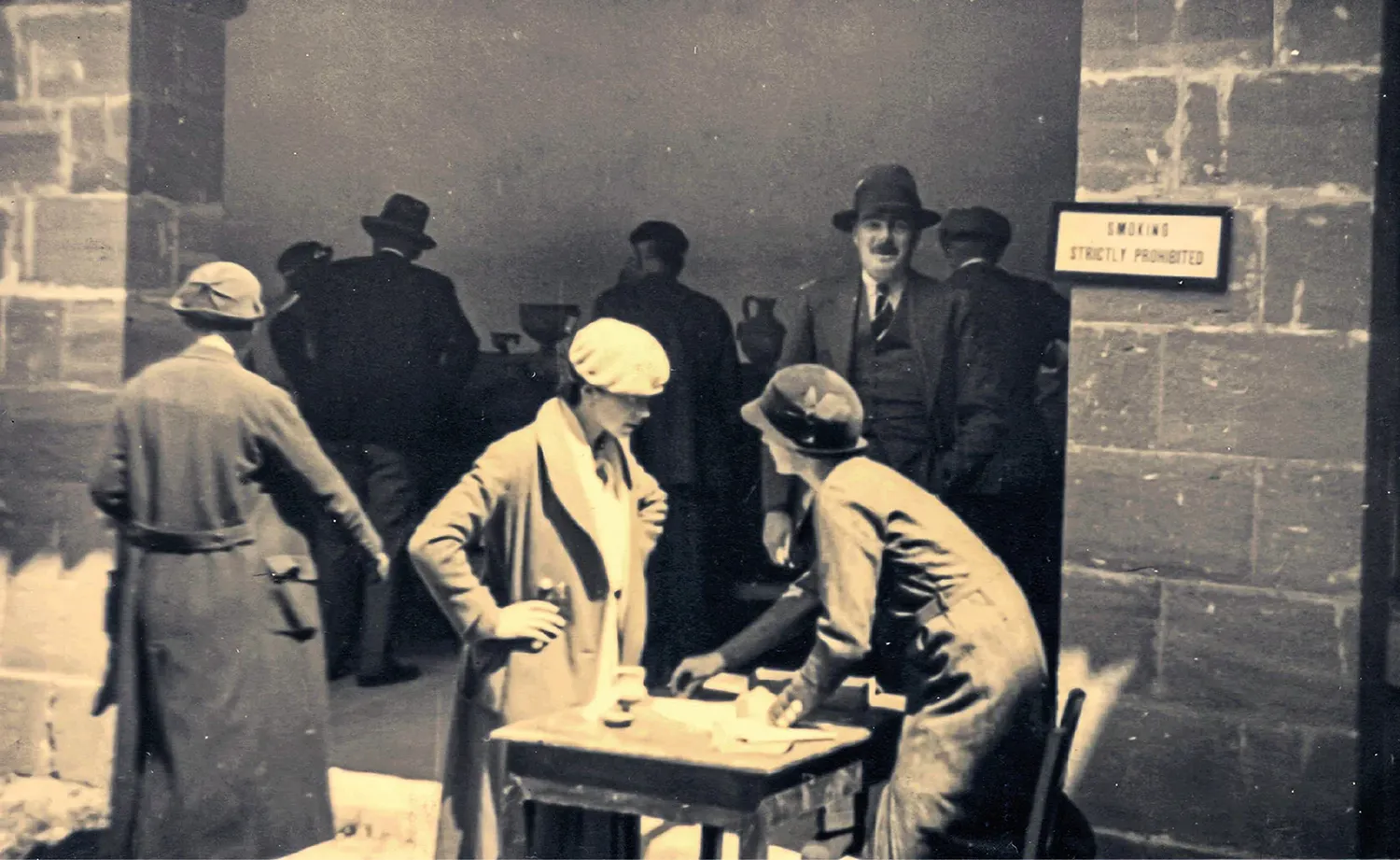
The least-known lawful channel is the Cyprus Museum's own. Under Section 42(4) the Museum kept a sale room in its courtyard where duplicate pottery could be bought, and by 1935 duplicates were also displayed in the entrance hall for cruise passengers. From 1926 the sales were run by Rupert Gunnis, aide-de-camp to Governor Storrs and a member of the Museum Committee, with volunteers including Olga Tufnell and Joan du Plat Taylor; a tourist agency tipped off the curator when a ship was due, and Gunnis went to the Museum as salesman. He found the duplicates unlabelled and unsaleable, had labels written in Greek, English and Turkish on Government House invitation cards, and expanded the saleable stock from about 500 items, mostly Iron Age and Hellenistic glass, to about 2,000. Revenue rose from around £200 in 1926 to a peak of £406 in 1930, more than the Museum's subscriptions and donations combined; Tufnell recorded one Sunday sale to 300 American tourists that netted £75 in an hour and a half [10]. George Hill of the British Museum thought the practice "not altogether dignified" and warned of the risk of selling what were not in reality duplicates, and Gunnis, who could approve his own export requests, was later accused by the first Director of Antiquities of using the permit power for himself [10]. The full account, with the photographs of du Plat Taylor at the counter, is in the article on the saleroom.
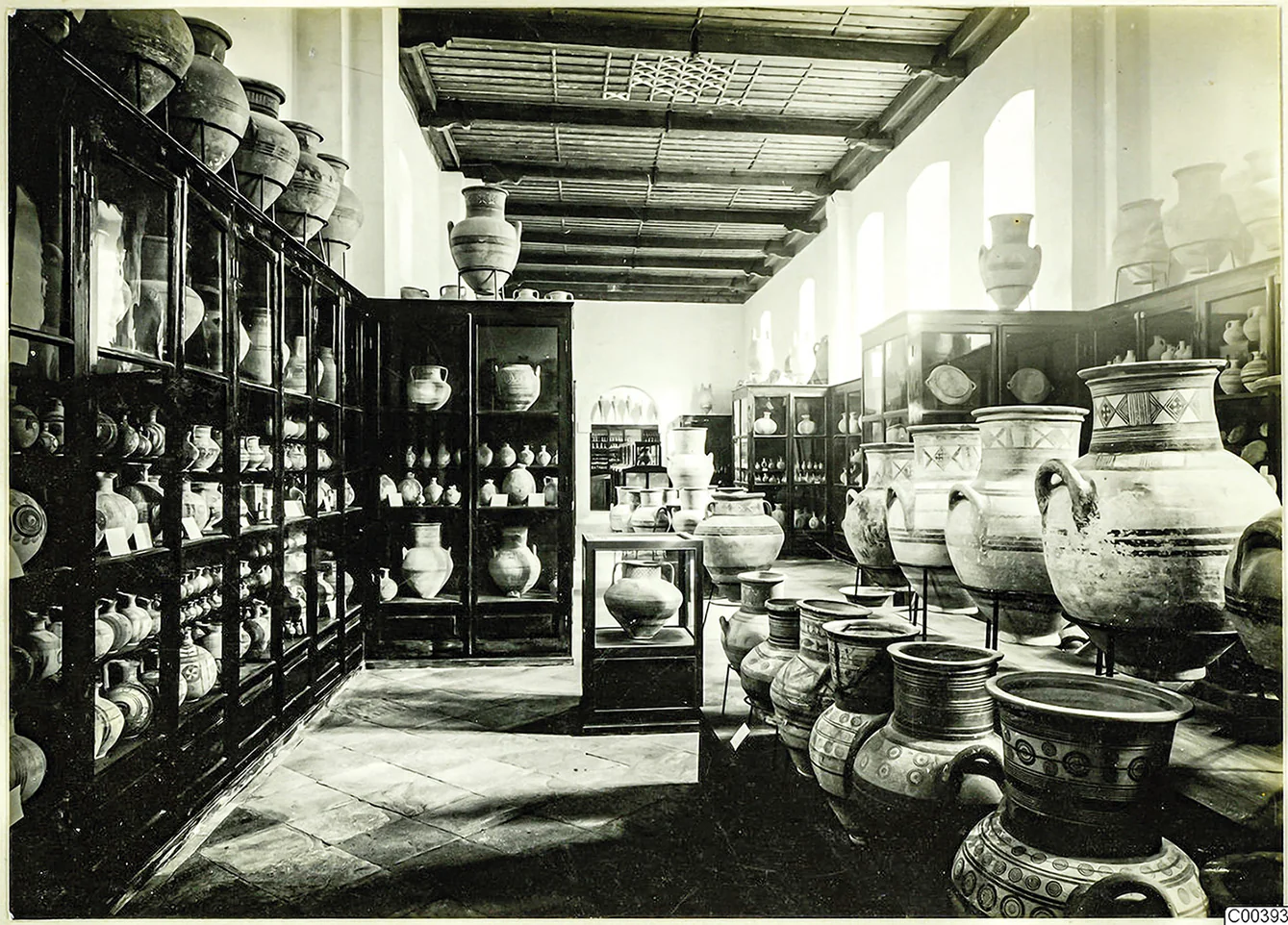
What matters for the legal history is that this was not an abuse of the system but the system itself. The colonial state retailed antiquities across a counter, issued export permits for them, and used the money to fund excavation. The practice outlived the 1905 law: the 1935 law expressly referred to duplicate antiquities exposed for sale at the Cyprus Museum, and sales of duplicates continued, in Stanley-Price's account, until they were finally abolished in 1991 [10]. In 1983 the Director of Antiquities, Vassos Karageorghis, could still describe a Sales Register of items available at nominal prices, with exports encouraged to universities and museums for educational purposes [18, p. 17]. One object in this site's collection came through exactly that door: a large Bichrome amphora purchased directly from the Cyprus Museum under Sales Register number SR 3477/65 and exported in 1969 by a United Nations officer, whose collection it stayed in until 2025.
The Antiquities Law of 1935 and the licensed dealer
The Swedish results prompted a reorganisation. A new Antiquities Law came into force on 1 January 1935 and created the Department of Antiquities, vested with the powers of the old Committee; the diplomat J. R. Hilton was its first Director, succeeded in 1936 by the architect A. H. S. Megaw, who served until independence, with Porphyrios Dikaios as curator. The law re-declared undiscovered antiquities Government property, made the only lawful excavations those licensed by the Director, ended the division of excavation finds with the excavator, and prohibited export without a licence from the Director [9, p. 23; 13]. It also, for the first time, made dealing in antiquities a licensed activity and permitted private individuals to hold declared collections, which is why Karageorghis could later write that private collecting "was allowed by the provisions of the Antiquities Law of 1935" [20].
Megaw's administration of the licence system was deliberately facilitative. One of his first acts was to place notices in the hotels used by foreign visitors: "Visitors are urgently requested to purchase antiquities only from dealers displaying a license from the Department of Antiquities", with a warning that imitations were made and circulated on the island. When tourists complained of the journey from Famagusta to Nicosia to obtain export licences, he began regularly checking the stock of licensed traders to identify and approve pieces for sale and export, believing it "in the interests of the Department to stimulate the trade in antiquities through the authorised channels". He licensed three dealers, one of whom was Petros Kolokasides of Nicosia [12, pp. 46-47]. George Basil Palma, a Famagusta chemist, was another licensed trader; he filed monthly returns of purchases and sales with the Department and submitted consignments for export licences [14]. Robert Merrillees's verdict on Palma applies to the whole class: right up till the 1960s there were licensed dealers operating legally on the island, the Cyprus Museum had no compunction in buying artefacts from the public and was still selling them to institutions and private individuals, and the Department accepted then, as now, that collections formed in that period have a historical status and can be studied and published [14].
Kolokasides was both dealer and collector. Karageorghis published his Mycenaean vases in 1965 as one of six main private collections on the island, describing him as "a licenced dealer in Antiquities in Nicosia, and at the same time a collector" whose stock was acquired "from various sources throughout the island" [15, p. 8]. His sales reached the Cyprus Museum itself, the Pancyprian Gymnasium, Harvard, a Canadian university collection formed in the 1960s, and private buyers in Britain and Australia; objects from his stock survive with the Department's lead export tag wired to a handle and a typed card, and the Department has confirmed such licences against its own archive [13]. A jug from his stock is reported in the trade with a Department export permit dated 1975. The physical form of the licence is the point: a numbered permit, a lead seal, a stock list. The Alexander Malios collection in Leipzig holds permits running from number 550 of March 1935 to number 7070 of January 1978, and four pieces bought by Ethel Inman in 1937 and 1939 whose framed permits were chained to the objects themselves [16, pp. 10-11]. The provenance chain the state now asks for was, for these objects, created by the state.
The 1935 regime also produced collections abroad by a second lawful route. Gatzsche notes that, moving away from the undocumented mass exports of the Cesnola era, the state regulated the export of duplicates, and that this gave rise to private collections both in Cyprus and abroad, among them Desmond Morris's in Britain and Dr Takey Crist's in the United States, the latter the basis of the Cyprus Museum in Jacksonville, North Carolina, which operated from 1988 until 2016 and whose contents were then largely auctioned [16, pp. 6-7]. The Jacksonville dispersal, and what it shows about lawfully exported material re-entering the market, is the subject of a separate article. Colonial officers and diplomats formed collections in the same way; the American ambassador William Crawford is one, and export permit 6403 of October 1972 in his name covered 42 objects [16, p. 11].
The Republic: the licence system narrows, 1960 to 1996
Independence in 1960 carried the 1935 law forward as the Antiquities Law, Cap. 31, and the Constitution reserved the state's right over antiquities. The old excavator's share, which the 1935 law had ended in principle, was abolished outright by the amendment of 1964, under which all antiquities found under licence vest in the Cyprus Museum without payment [13]. Dealing, collecting and export by permit continued. Karageorghis, Director from 1963, wrote to Antiquity in 1974 that during 1963 to 1973 a number of important private collections had been formed in Cyprus "with the silent accord of the Department of Antiquities", which considered this the best policy in the anomalous political conditions of those years; every item was registered on a card with a description and photograph, and the registration closed in December 1973 [17]. In the Severis collection, the Pierides collections and the Phylactou collection this policy produced the published private holdings that still anchor the study of unprovenanced Cypriot types. Two pieces on this site, a Cypro-Geometric amphora and a Bichrome amphora, descend from the Severis collection.
The export rule of the Republic was stated plainly by Karageorghis in 1983: objects legally acquired and duly registered by 31 December 1973, and not needed by the Cyprus Museum, could be exported with a permit from the Department; chance finds not wanted by the Museum could also be disposed of; and the Department's own Sales Register encouraged exports to universities and museums [18, p. 17]. Cyprus had ratified the 1970 UNESCO Convention in 1979, and Karageorghis welcomed the American ratification of 1983 in the same interview [19, p. 150; 18, p. 17]. The Convention is not retroactive and did not touch objects already lawfully abroad; its effect was on international cooperation against illicit traffic from that date, a subject treated in the article on UNESCO 1970. Fehlmann's summary of the period is direct: until 1996 the export of antiquities from the Republic was permitted so long as the Department had provided a licence, and thousands of pieces left in that way, some as diplomatic gifts and some for private collectors [19, p. 156]. After 1964 it became "virtually impossible" to form a large new private collection on the island, since nothing from a licensed excavation could reach private hands [20].
The end came with the changes of 1996. The law as it now stands provides in Article 27 that no person may export an antiquity without a licence, and that a licence may be granted only for temporary exhibition or for the study and scientific analysis of excavation material; penalties run to five years' imprisonment or a fine of 45,000 euros or both; and the same law specifies that no person shall deal in antiquities [13]. Lawful possessors of declared antiquities may keep them under the Department's supervision but may not dispose of them. In Cyprus the trade is over. Outside Cyprus, everything that left under the earlier rules remains where the earlier rules put it.
The sequence of laws
| Year | Law or event | Effect on export |
|---|---|---|
| 1869 | Ottoman Règlement sur les objets antiques | Excavation by permit; export of excavated finds forbidden except coins; finds on private land belong to the landowner |
| 1874 | Ottoman Règlement sur les antiquités | Buried antiquities vest in the state; finds of licensed digs divided in thirds; export permitted with the Minister's leave |
| 1878 | British administration; Wolseley's excavation ban; trial of Alessandro di Cesnola | 1874 law kept in force; ban lapses May 1879 |
| 1882 | Cyprus Museum founded (15 June) | A home for the Government's one-third share; no regulatory role |
| 1884 | Ottoman law bans all export | Ruled not to apply to Cyprus; partage export continues |
| 1887 | Bulwer minute | Permits only to museums and learned bodies; their shares exported |
| 1896 | Export law (duplicates only) disallowed | Liberal market climate continues |
| 1905 | Antiquities Law, Law 4 of 1905 | Export only with the High Commissioner's written permission; Museum Committee may sell duplicates (s. 42(4)); export of private duplicates under s. 33 |
| 1923, 1927 | Amendments | Excavator's half-share restored; Swedish share made exportable |
| 1930-31 | Swedish Cyprus Expedition division | About two-thirds of 18,000 finds shipped lawfully to Stockholm |
| 1935 | Antiquities Law; Department of Antiquities | Export only under the Director's licence; licensed dealers; division of excavation finds ends; Museum duplicate sales continue |
| 1960 | Republic; Antiquities Law Cap. 31 | Licence regime carried forward |
| 1964 | Amendment | All excavated finds vest in the Cyprus Museum; no new material reaches private hands from excavation |
| 1973 | Registration of private collections closes (December) | Registered objects remain exportable by permit |
| 1979 | Cyprus ratifies UNESCO 1970 | International cooperation against illicit traffic; earlier lawful exports unaffected |
| 1991 | Cyprus Museum duplicate sales abolished | The state's own sale channel closes |
| 1996 | Amendment of the Antiquities Law | Dealing prohibited; licensed export of private antiquities ends |
| Today | Antiquities Law, Article 27 | Export licences only for temporary exhibition or scientific study |
What this means for objects on the market today
The consequence of this history is numerical before it is ethical. Cesnola alone removed some 35,000 objects; Ohnefalsch-Richter supplied several thousand to German museums; the British Museum's digs of the 1890s and the Swedish partage of 1930 each sent thousands abroad; the Cyprus Museum sold about 2,000 duplicates a year at its peak and kept a Sales Register for another half-century; three licensed dealers and the Department's permit office worked from 1935 to 1996. A very large body of Cypriot antiquities is therefore outside Cyprus lawfully, much of it with paperwork, and it is that body which supplies the market now. The Department's own provenance officers say as much when they confirm a Kolokasides export licence against the archive, or recognise a lead tag [13]. Such objects can be owned, sold, published and studied without any question of title, and the Department's position, in Merrillees's words, is that collections formed under the old rules have a historical status and can be studied and published with impunity [14].
The scholarly value of such material is real but bounded, and the boundary should be stated. Karageorghis, who published more private collections than anyone, put it this way: objects without provenance are of less value than excavated ones, but they are usually complete and of good quality, and they contribute to typology, chronology and the study of artistic variation within groups whose date and origin excavation has already fixed [20]. That is the use this site makes of its own pieces. The Pitt-Rivers bird jug adds a dated, documented example to the Free Field style; the Cyprus Museum amphora is a Bichrome vessel whose descent from the state's own Sales Register can be cited in a footnote. Thomas Kiely's reconstruction of a limestone figurine's route from the Lawrence-Cesnola album of 1880 through the Sotheby's sale of 1888, Pitt-Rivers's museum and a house sale in Peckham to the British Museum in 2009 is the model: legitimacy is a recoverable itinerary, and the itinerary usually runs back to one of the lawful channels described above [21].
The practical test for a buyer follows from the dates in the table. An object whose history can be traced to an export under firman, partage, the 1905 permission, a 1935 licence or the Museum's own sales is a lawful object, and its owner is in the same position as the Metropolitan Museum or the Medelhavsmuseet. An object with no history before 1970, or, for ecclesiastical material, before 1974, has to be treated with the caution that the entry on collecting today sets out, because the other source of Cypriot antiquities on the market since 1974 is the looting of the occupied north. This site's collection is built on the first principle: every piece is published with its ownership history, the best of them back to a named dealer's stock list, a Sales Register number or a Sotheby's lot of 1883, and the reasoning is set out in full in the article on private collecting. The trade that put Cypriot pots in the world's museums was, for most of its history, a lawful one, and the objects it moved remain lawful to hold. The broader narrative of how the island's past was sold, and of the dealers who sold it, is told in How Cyprus's Past Was Sold, Selling Cypriot Artefacts, the Pierides family and the history of Cypriot archaeology.
References
- 1.Stanley-Price, N. (2001). The Ottoman law on antiquities (1874) and the founding of the Cyprus Museum. In V. Tatton-Brown (Ed.), Cyprus in the 19th century AD: Fact, fancy and fiction. Papers of the 22nd British Museum Classical Colloquium, December 1998. Oxbow Books.
- 2.Marangou, A. G. (2000). Life and deeds: The consul Luigi Palma di Cesnola 1832-1904. Popular Bank Cultural Centre.
- 3.Karageorghis, V., Mertens, J. R., & Rose, M. E. (2000). Ancient art from Cyprus: The Cesnola Collection in The Metropolitan Museum of Art. The Metropolitan Museum of Art.
- 4.Stanley-Price, N. (2018). Illicit excavation: The trial of Alessandro Palma di Cesnola in Cyprus in 1878. The Antiquaries Journal, 98. https://doi.org/10.1017/S000358151800001X
- 5.Bernhard-Walcher, A., Dembski, G., Gschwantler, K., & Karageorghis, V. (1999). Die Sammlung zyprischer Antiken im Kunsthistorischen Museum. Kunsthistorisches Museum Wien.
- 6.Steel, L. (2004). Cyprus before history: From the earliest settlers to the end of the Bronze Age. Duckworth.
- 7.Kiely, T. (2015). Finds from Kouklia in the British Museum. Cahiers du Centre d'Études Chypriotes, 45, 61-78. https://doi.org/10.3406/cchyp.2015.1622
- 8.Karageorghis, V., Vassilika, E., & Wilson, P. (1999). The art of ancient Cyprus in the Fitzwilliam Museum, Cambridge. A. G. Leventis Foundation and the Fitzwilliam Museum.
- 9.Pilides, D., & Papadimitriou, N. (Eds.). (2012). Ancient Cyprus: Cultures in dialogue. Department of Antiquities, Cyprus.
- 10.Stanley-Price, N. (2025). Illicit excavation and the sale of 'duplicate' antiquities: Rupert Gunnis and the Cyprus Museum, 1926-1932. Cahiers du Centre d'Études Chypriotes, 55, 269-301. https://doi.org/10.4000/151c2
- 11.Göransson, K. (2012). The Swedish Cyprus Expedition: The Cyprus collections in Stockholm and the Swedish excavations after the SCE. In A. Georgiou (Ed.), Cyprus: An island culture. Society and social relations from the Bronze Age to the Venetian period. Oxbow Books.
- 12.Powell, J. (2013). Love's obsession: The lives and archaeology of Jim and Eve Stewart. Wakefield Press.
- 13.Alphas, E. (2017). From a Bronze Age tomb in Cyprus to the estate of a gentleman in Sussex: Measures taken and problems faced in the investigations on the illicit trade of antiquities. In D. Pilides & M. Mina (Eds.), Four decades of hiatus in archaeological research in Cyprus: Towards restoring the balance (pp. 30-43). Verlag Holzhausen.
- 14.Merrillees, R. S. (2014). George Basil Palma, chemist and collector of Cypriote antiquities in Famagusta, Cyprus, in the 20th century A.D. Cahiers du Centre d'Études Chypriotes, 44.
- 15.Karageorghis, V. (1965). Corpus Vasorum Antiquorum, Cyprus 2: Private Collections I. Department of Antiquities, Cyprus.
- 16.Gatzsche, A. (2023). From Cyprus to Leipzig: Provenance research. In E. Poyiadji-Richter (Ed.), Alexander Malios Collection, Volume 1: Cypriot antiquities. Alexander Malios Research Institute for Cypriot Heritage and Archaeology.
- 17.Karageorghis, V. (1974). The illicit sale of Cypriot antiquities [Letter]. Antiquity, 48.
- 18.Herscher, E. (1983). The antiquities market: News and commentary on the illicit traffic in antiquities. Journal of Field Archaeology, 10(3), 349-369. https://doi.org/10.1179/009346983791504327
- 19.Fehlmann, M. Looting and losing the archaeological heritage of Cyprus. Bloomsbury Academic. https://doi.org/10.5040/9780755608331
- 20.Karageorghis, V. (Ed.). (2010). Cypriote antiquities in the Phylactou Collection. A. G. Leventis Foundation.
- 21.Kiely, T. (2021). Tracing the 'diaspora'. In L. Bombardieri & E. Panero (Eds.), Cyprus: Crossroads of civilizations. Musei Reali Torino.