
Smoking Strictly Prohibited: How the Cyprus Museum Sold Antiquities Across a Counter
For decades the Cyprus Museum kept a saleroom in its courtyard, selling pots it judged to be "duplicates" to passengers off the cruise ships. The man who built up the stock, Rupert Gunnis, was also signing his own export permits.

Alexis Drakopoulos
June 15, 2026·History · Collecting · Archeology·12 min read


Share


Alexis Drakopoulos is a Greek Cypriot Machine Learning Engineer working in Financial Crimes. He is passionate about Archeology and making it accessible to everyone. About Me.
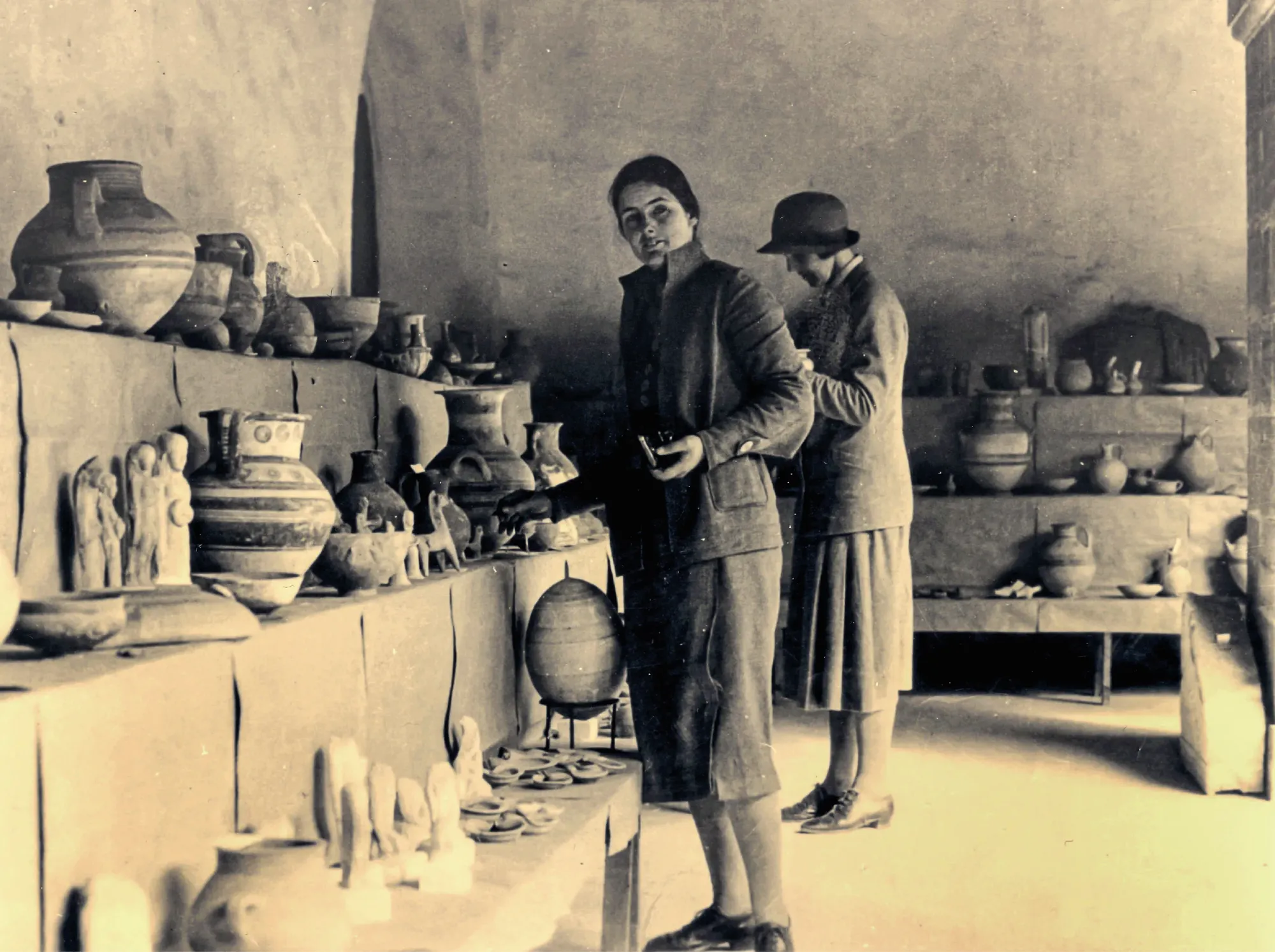
In a photograph taken about 1930, a young woman named Joan du Plat Taylor stands at a counter in the Cyprus Museum with a pot in her hands, the shelves around her loaded with hundreds more. A second view of the same room catches the governor's aide-de-camp, Rupert Gunnis, standing at her shoulder, and the printed notice on the wall behind them reads "Smoking strictly prohibited." A visitor's guide to Nicosia from those years tells you what the room was. "The SALE ROOM in the courtyard," it says, is where "duplicate pottery may be purchased." [1]
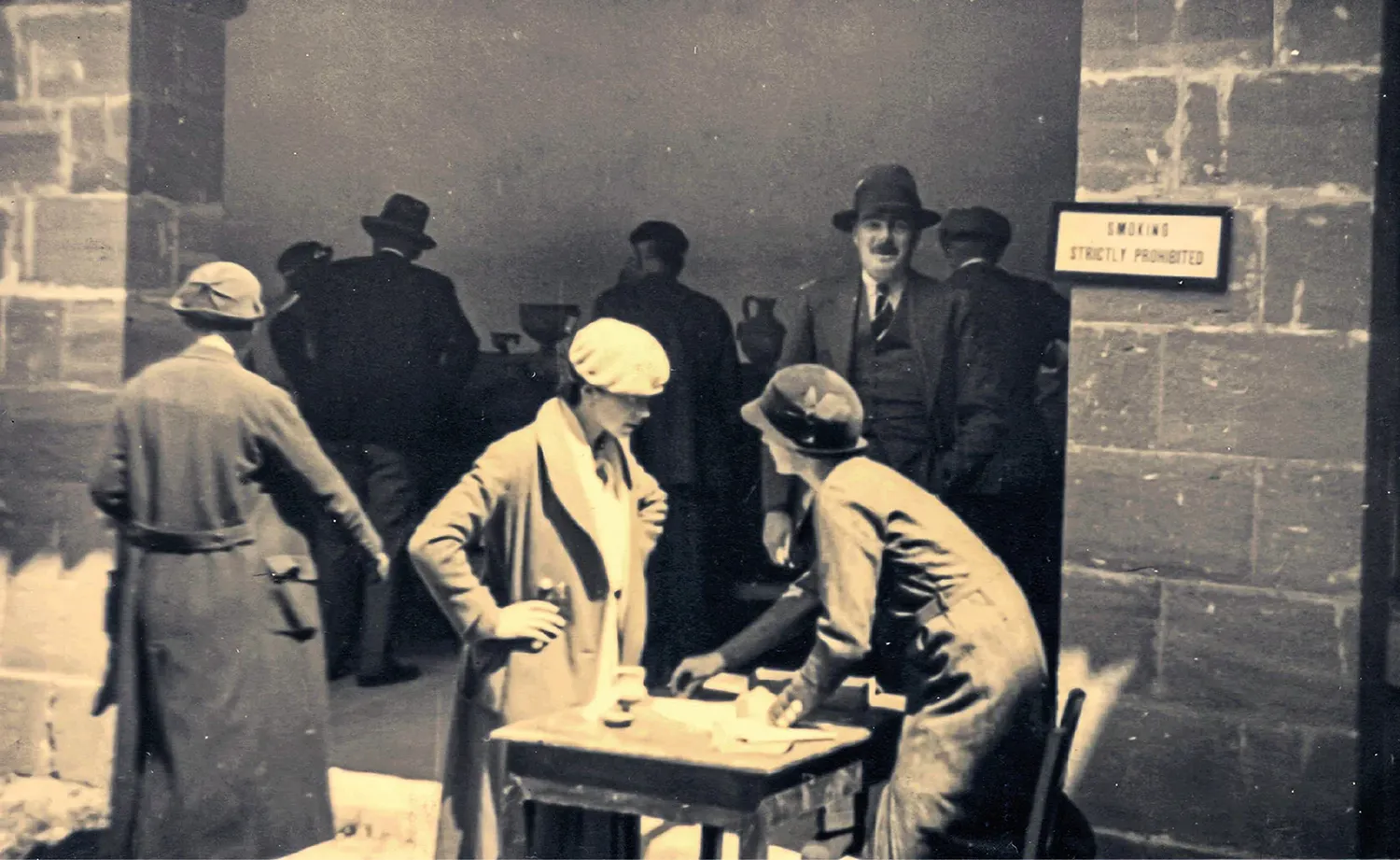
The Cyprus Museum had been founded in 1882 to keep the antiquities of the island on the island. By the time of these photographs it was retailing them across that counter, lawfully, to passengers off the cruise ships, and the man at Taylor's shoulder was the one who signed the export permits. He also signed his own. How a museum came to run a shop, and how the shop came to run partly for the benefit of its salesman, turns on a single word, and on a century in which the law of Cyprus was built to let antiquities change hands.
The word that made it legal
The authority was statutory. The Cyprus Antiquities Law of 1905 made every antiquity on the island government property and forbade export without a written permit (Section 32). But Section 42 told the Museum Committee it could "sell, exchange, or otherwise dispose of duplicate specimens of antiquities, when it is in the interest of the Museum," on one condition: that before doing so the Committee was "satisfied that they really are duplicates." Section 33 let a private owner export a piece only after the Committee had inspected it and found that "there are in the Museum exhibits of the same kind and quality." [1]
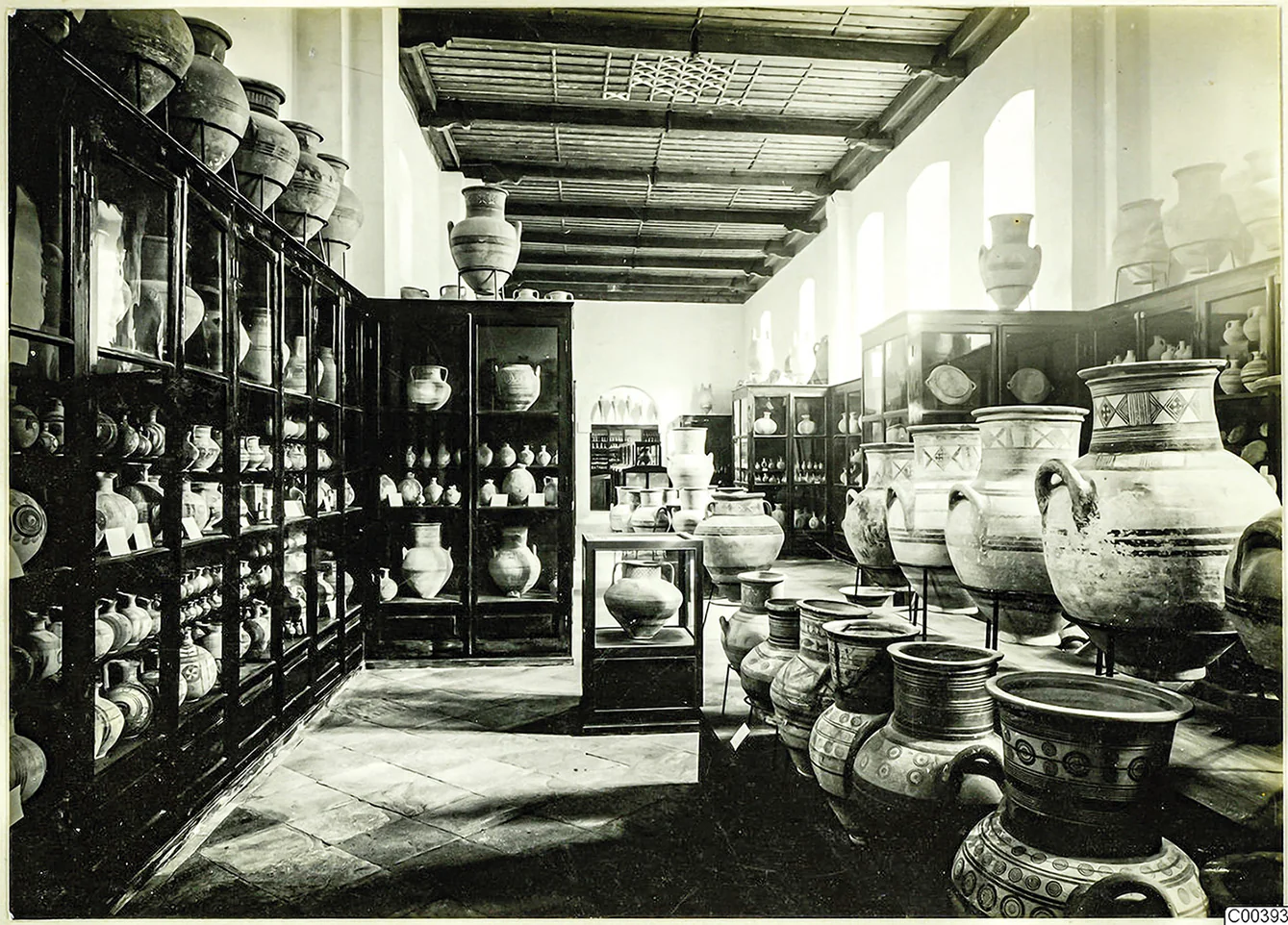
Everything turned on what a duplicate was. Nicholas Stanley-Price, whose reconstruction of the saleroom this account follows, calls the category "vague, and ultimately subjective." [1] A museum holding two comparable pots could keep one and sell the other; who decided that two pots were the same, and that the Museum needed only one, was the Committee, and in daily practice the person at the counter. The looser the line, the larger the stock for sale. The inspectors who came through in 1932 saw the result and disliked it, describing "wearisome rows upon rows of pots identically similar in design." [1] To Gunnis the same shelves read as inventory.
Buy the field
A museum selling its own holdings looks strange only against a model the law of Cyprus had never followed. The first general antiquities regulation to reach the island, the Ottoman text of 1869, forbade the export of finds from authorised digs but allowed their sale within the empire, and laid down in its third article that every antiquity found on private land belonged to the owner of the soil. [2] If the finds were the landowner's, the way to acquire them was to become the landowner. Luigi Palma di Cesnola, the American consul who dug through the 1860s and 1870s, "hastened to Athienou to buy the land on which diggers had found antiquities"; as the owner, he could not be made to send half his finds to Constantinople, a tactic the sources call commonly used on the island. [2]
The fuller Ottoman law of 1874 split the finds from a licensed dig three ways: a third to the government, a third to the excavator, a third to the landowner, and where the landowner did his own digging, two-thirds to him. [2] Export was allowed with the minister's leave. In practice the partage became a thing you could buy and sell on its own. An excavator paid the owner a cash sum to "renounce all claims" to whatever came out of the ground, and so took the owner's share along with his own. A lease of exactly this kind survives word for word. In January 1886 Max Ohnefalsch-Richter "hired a piece of land from Yoannui H. Loizi Argyre for 182 c.p.," a four-month let priced in Cyprus piastres, "and they are to fill up the holes again." [3]
Beneath the licensed digs ran a market that kept no paper at all. Town goldsmiths bought metal antiquities by weight and melted them: "At Nicosia, the goldsmiths part with such antiquities for a few paras," a contemporary noted, a para being a coin of almost no value. [11] This was the most destructive legal sale of all, and the least recorded; a gold ornament reduced to bullion leaves no catalogue entry, no lead tag, no later provenance. The objects that reached the Museum's counter, labelled and priced, were the survivors of a trade whose lower floor was a crucible.
When the Lambousa silver scandal of 1902, in which a second hoard of late Roman plate was largely smuggled off the island, finally produced the 1905 law and its export licence, the reform did not stand the Museum outside the market. It seated the Museum inside it. The institution still took its statutory share of finds, and Section 42 let it sell the surplus. The duplicate sale was the old trade conducted over a government counter. [1]
The salesman
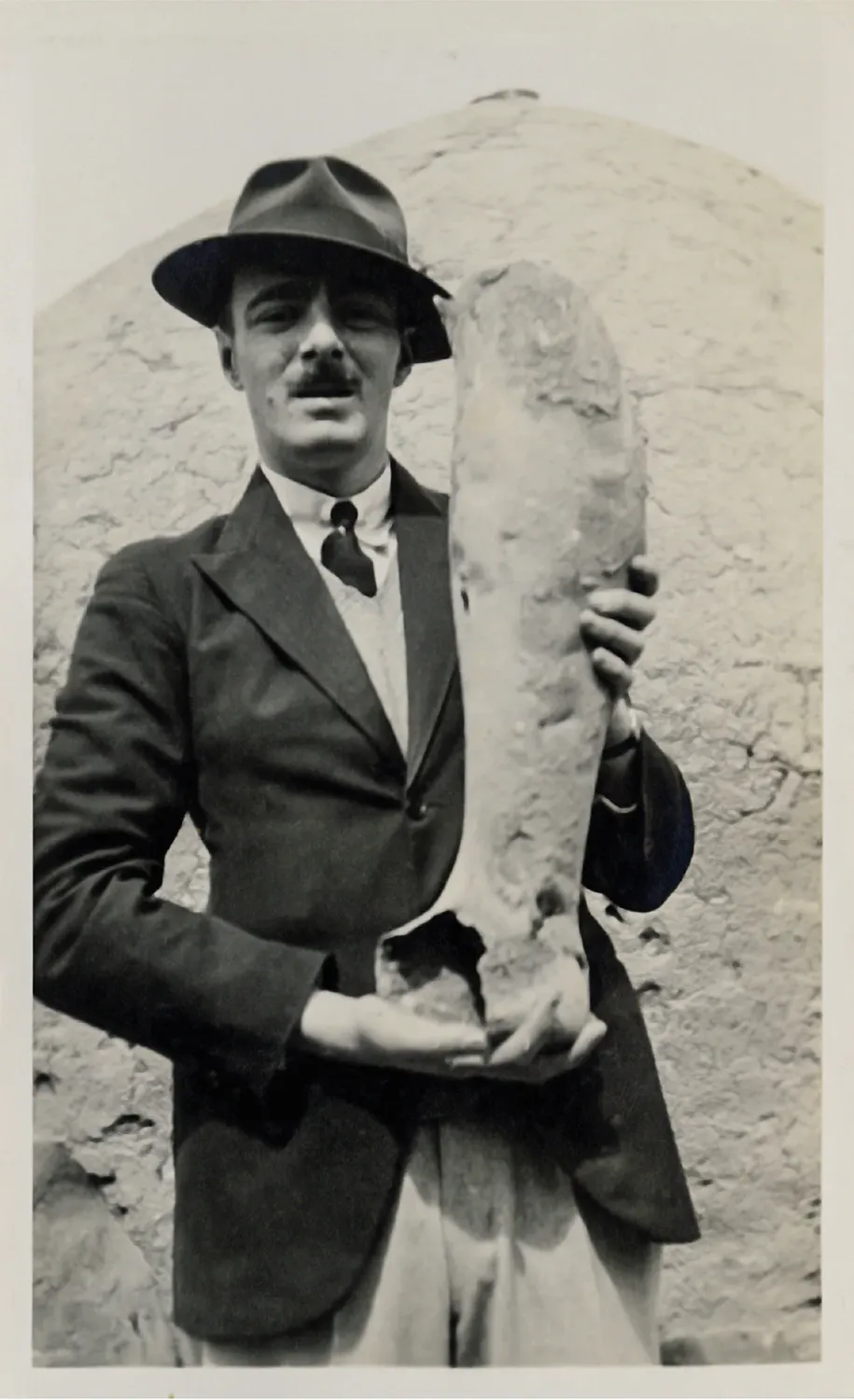
Rupert Gunnis reached Cyprus at the end of November 1926 as aide-de-camp to Governor Ronald Storrs, and within weeks had a seat on the Museum Committee. His first impression, set down in his diary on 12 December, was of a collection clogged with surplus: "There are however too many duplicates & nothing of real outstanding interest." [1]
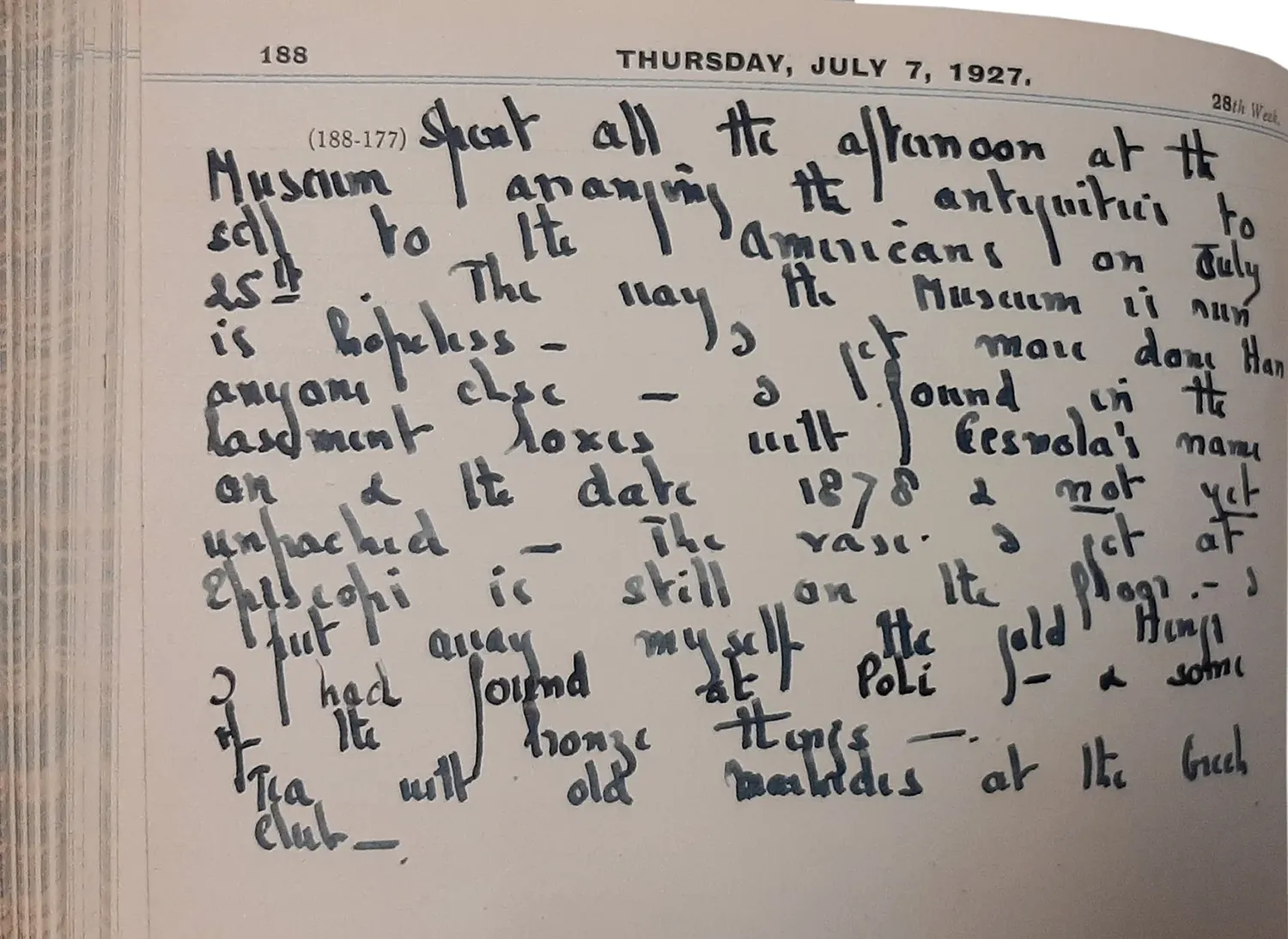
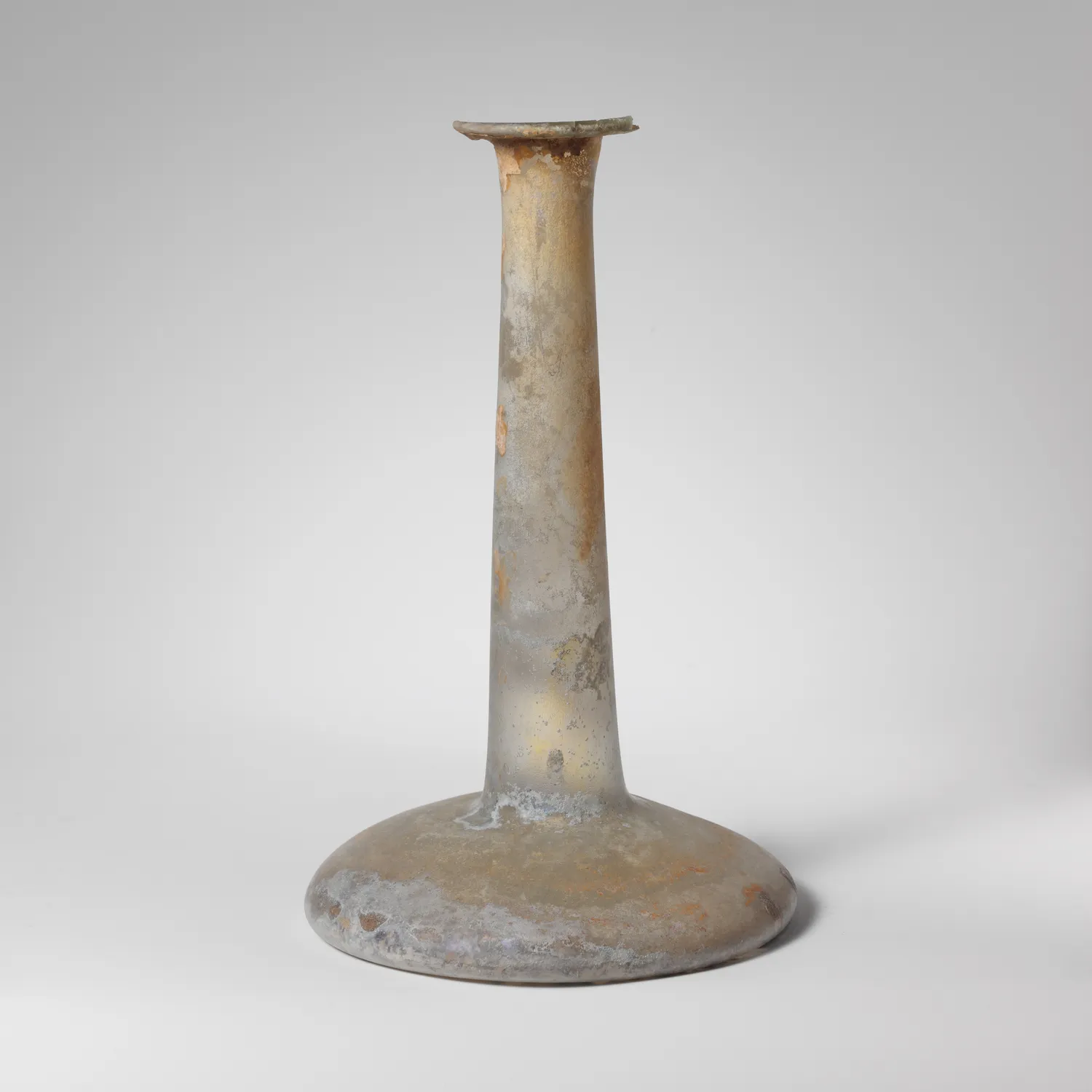
His first attempt at selling, in February 1927, was to a party he recorded as "very rude and ill-mannered tourists," and it took three pounds. [1] He then made the duplicates saleable. He found them unlabelled and arranged for writers of Greek, English and Turkish to letter tickets for them on Government House invitation cards, each ticket carrying a date. He raised the stock on offer from about five hundred pieces, mostly Iron Age and Hellenistic glass, to about two thousand. [1] The Mantovani tourist agency would tell the curator, Menelaos Markides, that a group was on its way, and Gunnis would hurry to the Museum to work the counter. [1]
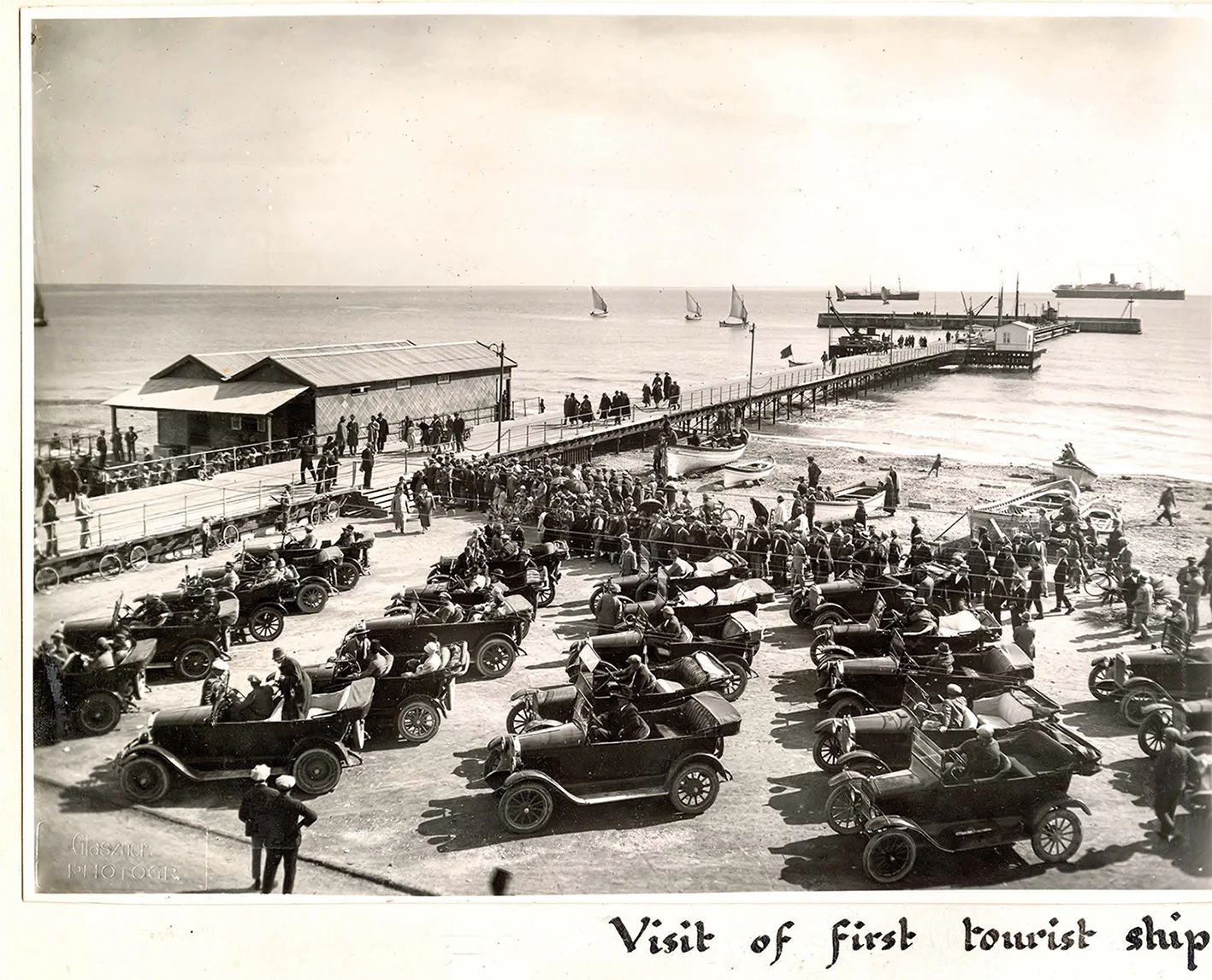
The money followed. Sales of duplicates brought the Antiquities Fund about £200 in 1926 and £406 in 1930, its best year, outweighing what the Museum took in subscriptions and donations. [1] Olga Tufnell, one of the volunteers who helped sell, described a Sunday in 1930 when a cruise ship put some three hundred Americans into the building: "altogether we made £75.10.0 in 1½ hrs so the Mus. will be able to afford some excavating." [1] For scale, Gunnis's salary as the governor's aide was £300 a year. The sale of last season's surplus paid for the digs that produced next season's, and each year's finds refilled the shelves the tourists had emptied.
Some inside the building thought the arrangement was doing harm. George Jeffery, the curator of ancient monuments, had written in 1925 that "the buying and selling of antiquities at the Museum tends to keep alive a commercial interest in such things, and a desire to supply the market." [1] A museum that sold duplicates to suppress the illicit trade was, on Jeffery's reading, advertising for it. Porphyrios Dikaios, who became curator at the close of the decade and began to curb the sales, made the narrower objection that the supply was finite: "our stock of duplicates cannot last always; on the contrary it is soon going to be exhausted." [1]
The permits he signed for himself
Gunnis had been given authority to sign the export permits for antiquities sold at the Museum. He used it on his own behalf. In March 1928 he shipped twelve packing-cases to England, far more than the handful of recorded sales to him could account for. [1] When his private collection came up at Sotheby's in London on 12 December 1933, it ran to some 390 Cypriot objects catalogued as the "Property of Rupert Gunnis, Esq."; the Ashmolean and the Institute of Archaeology in London were among the buyers, and he sold a further quantity to the Wellcome Museum. [1]
The risk that the saleroom would sell things that were not duplicates at all was real, and it was named at the time. Pottery from the official 1889 excavations at Marion, catalogued years before by John Myres, went out through the duplicate channel. [1] Sir George Hill, the director of the British Museum, inspected the operation in 1934 and thought it "not altogether dignified," with "a real danger, as past experience has shown." W. H. Buckler warned that it "supplies food for gossip as to the integrity of diggers and especially of officials." [1]
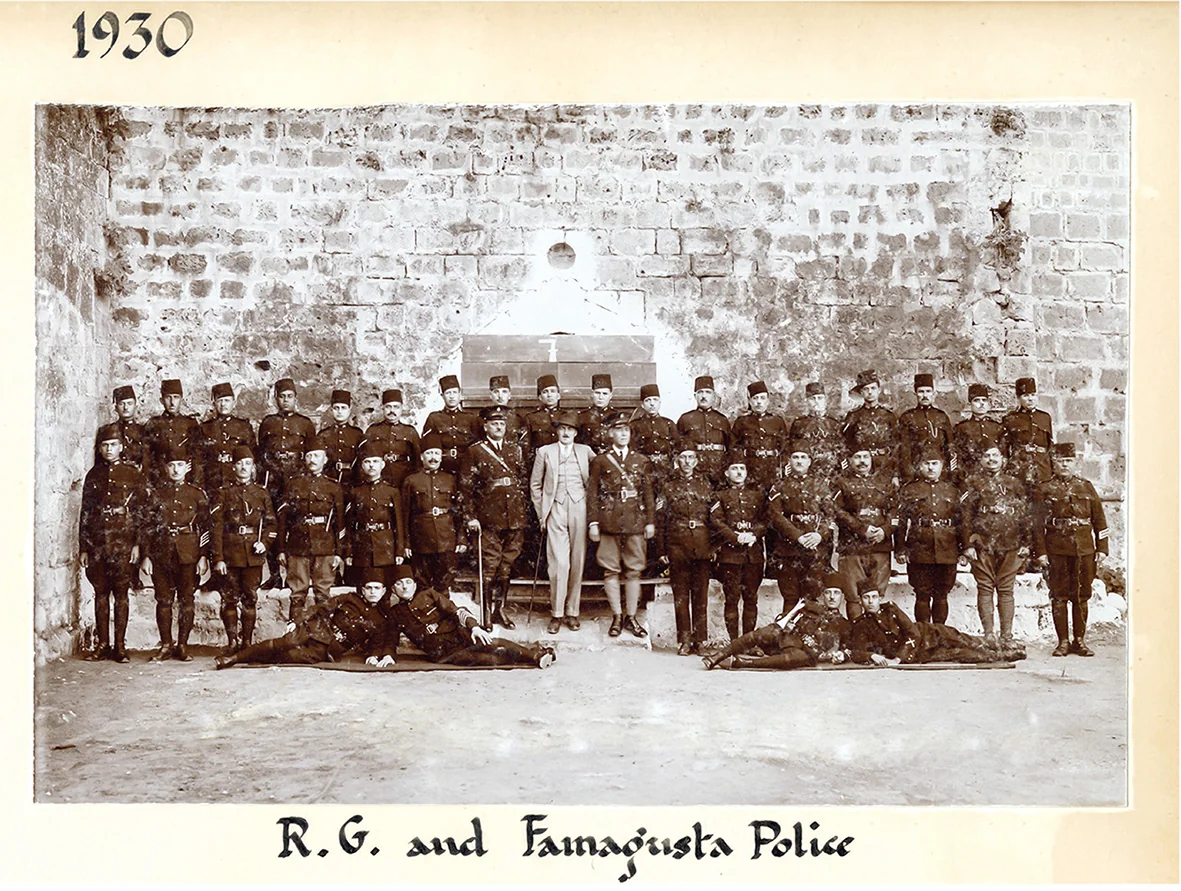
The reckoning came in 1936. The new Department of Antiquities had opened the year before under its first director, John Hilton, and Hilton set down in a formal minute what Cyprus and London had known for years: Gunnis held "a widespread reputation, both in the island and outside it, as an unauthorised exporter of antiquities on a considerable scale." He had used his permit authority "to sign permits … for the export of a large quantity of antiquities taken out of the island for himself." And he had pointed the police selectively, raiding the collections of Palma, the Famagusta dealer, and of Gaffiero in Nicosia, "while the notorious collections of more prominent members of the community were left untouched." [1]
The three licensed dealers
The 1935 law that created Hilton's department ended the old division of finds with excavators and tightened the licensing of the trade. [4] It also made a legal home for the resident dealer. The director who soon followed, A. H. S. Megaw, licensed just three men to deal in antiquities and required them to file returns and submit consignments for inspection before export. [8] One of the three was Petros Kolokassides of Nicosia. [5] Karageorghis, cataloguing the island's private collections thirty years later, described him in a single line that holds the whole trade: "Mr. Petros Kolokassides is a licenced dealer in Antiquities in Nicosia, and at the same time a collector. His Mycenaean vases were acquired from various sources throughout the island." [6]
A licensed dealer's sale left paper. Kolokassides issued typed stock lists, each item sketched and dated, that travelled with the object he sold. [12] When a piece was exported, the Department wired a small lead tag to it and issued a permit; the stamped tag is the physical receipt of a legal sale. One of his bichrome jugs, sold in Cyprus and licensed for export by the Department in 1975, is on the market today with its lead tag still attached and a photocopy of the licence in the file. [12][7] The private counter in Nicosia and the government counter in the Museum courtyard ran on the same authority and produced the same evidence: a labelled object and a piece of paper saying it could go.
The word outlives the room
The Museum kept selling. The duplicate sales that Dikaios curbed in the 1930s were abolished only in 1991. [1] In 1983 Karageorghis, by then long the director, still described the channel as open: "The Department of Antiquities itself has a Sales Register of items available at nominal prices; it encourages exports to universities, museums … for educational purposes, not as souvenirs." [9] Through the same years the Department let private collections form on the island "with the silent accord of the Department of Antiquities," each object entered on a card with a description and a photograph, and legal export under a Department licence continued until 1996. [10][7]
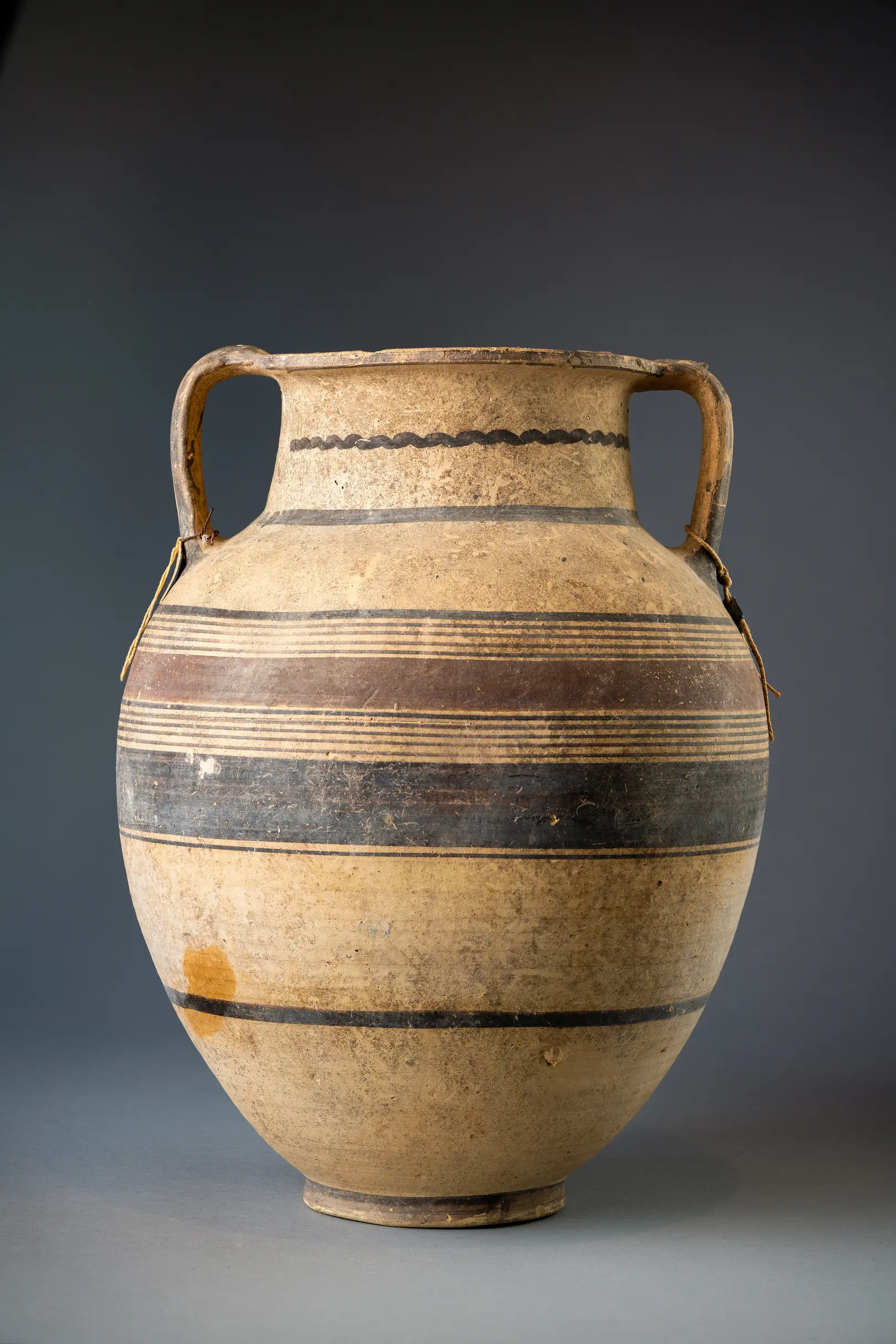
One of those register numbers survives on a pot. The Bichrome amphora shown above, 42 cm tall, carries the number SR 3477/65, entered against it in the Cyprus Museum's own Sales Register. It was bought directly from the Museum into a United Nations collection and exported from the island in 1969, and it survives in a private collection today. The number is not a catalogue mark. It is a sales receipt, the Museum's own record that it had sold the pot.
So the jug with its lead tag and the amphora with its register number sit at the end of the same line, one from the dealer's counter and one from the Museum's own. The line runs back through the Nicosia dealer's licence, through the saleroom counter and its prohibition on smoking, to the Ottoman article that gave the buried object to whoever owned the field above it. Stanley-Price's verdict on the whole arrangement is dry: "authorised sales of 'duplicates' have not been effective in suppressing the illicit market." [1] The Museum sold its surplus from the 1920s into the 1990s on the theory that a controlled trade would starve an uncontrolled one. The lead tag wired to the jug and the number written against the amphora are the same thing, the seller's signature on a sale, and both are still legible.
References
- 1.Stanley-Price, N. (2025). Illicit excavation and the sale of 'duplicate' antiquities: Rupert Gunnis and the Cyprus Museum, 1926–1932. Cahiers du Centre d'Études Chypriotes, 55, 269–301 (DOI 10.4000/151c2; open access at https://journals.openedition.org/cchyp/2109). Sections 32, 33 and 42 of the 1905 law; the courtyard saleroom; the duplicate category as 'vague, and ultimately subjective'; the Gunnis diary, the revenue figures, the Tufnell, Jeffery, Dikaios, Hill, Buckler and Hilton quotations; the Marion pottery; abolition of the sales in 1991.
- 2.Stanley-Price, N. (2001). Ottoman law, the partage, and the founding of the Cyprus Museum. In V. Tatton-Brown (ed.), Cyprus in the 19th Century AD: Fact, Fancy and Fiction (Papers of the 22nd British Museum Classical Colloquium, December 1998), Oxford, esp. pp. 289–295 with Appendices A–B (the texts of the 1869 and 1874 Règlements). Cesnola buying the land at Athienou at p. 290.
- 3.Given, M. (2001). Contribution to Cyprus in the 19th Century AD (ed. V. Tatton-Brown), Oxford, pp. 255–260, 279–281: the Watkins v. Warren litigation of 1885–86 and a sample excavation lease quoted from the Cyprus Herald, 9 January 1886.
- 4.Pilides, D., & Papadimitriou, N. (eds.) (2012). Ancient Cyprus: Cultures in Dialogue. Nicosia: Department of Antiquities, p. 23 (the defect in the 1905 law, the 1923 and 1927 revisions of the partage, and the 1935 abolition of the division of finds).
- 5.Powell, J. Love's Obsession: The Lives and Archaeology of Jim and Eve Stewart, pp. 46–47 (Director A. H. S. Megaw's three licensed antiquities dealers, one of them Petros Kolokassides of Nicosia).
- 6.Karageorghis, V. (1965). Corpus Vasorum Antiquorum, Cyprus 2 (Private Collections I). Preface, p. 8 (Petros Kolokassides, 'a licenced dealer in Antiquities in Nicosia, and at the same time a collector').
- 7.Brodie, N. From a Bronze Age Tomb in Cyprus to the Estate of a Gentleman in Sussex, pp. 12, 18–19: the Cyprus Museum lead export tag on a bichrome bowl ex-Polunin, the ending of the excavator's share in 1964, and of licensed export in 1996.
- 8.Merrillees, R. S. (2014). On George Basil Palma and the licensed-dealer regime. Cahiers du Centre d'Études Chypriotes, 44, esp. pp. 14–17.
- 9.Karageorghis, V. (1983), on the Department of Antiquities' Sales Register ('items available at nominal prices … for educational purposes, not as souvenirs'), corpus id 10.1179/009346983791504327, p. 17 (also 10.2307/529550).
- 10.Karageorghis, V. The illicit sale of Cypriot antiquities. Antiquity (corpus id 10.1017/s0003598x00108324, p. 2): the 1963–73 registered private collections formed 'with the silent accord of the Department of Antiquities.'
- 11.Marangou, A. G. (2000). Life and Deeds: The Consul Luigi Palma di Cesnola 1832–1904. Nicosia, p. 54 (the goldsmiths of Nicosia buying metal antiquities 'for a few paras').
- 12.Helios Gallery (Wiltshire), object catalogue: a Cypriot Geometric bichrome jug 'purchased in Cyprus from the licensed dealer P. Kolokasides and exported under permit by the Cypriot Department of Antiquities in 1975,' with a photocopy of the export licence; and a bronze mirror page reproducing a Kolokasides typed stock list (https://heliosgallery.com/antiquities/catalogue/).