
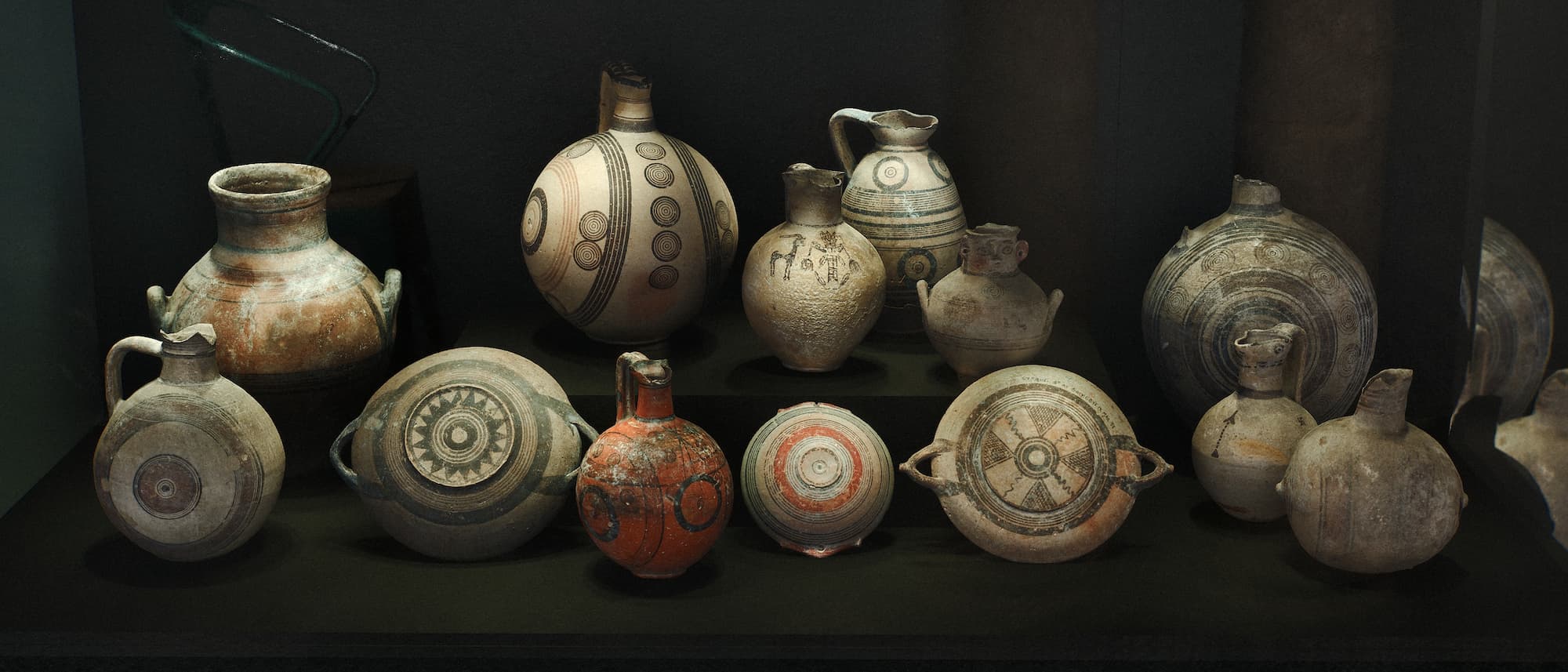
Owning a Cypriot antiquity outside Cyprus is legal in every major market country, and buying one is legal too, provided the object left the island before the Republic's export controls closed and nothing dishonest has happened to it since. The laws that matter are few and dated: Cyprus's own Antiquities Law, which governs objects inside the Republic; the 1970 UNESCO Convention, which market countries adopted at different dates and which is a date-line rather than a prohibition; a British criminal statute of 2003; an American import regime under a bilateral agreement first signed in 2002; and an EU import regulation that came fully into effect in 2025. Everything else is provenance: the paper, labels, catalogues and photographs that show where a pot has been for the last century. This entry sets out the legal position as it stands in 2026, describes how provenance is documented and checked, summarises what the market pays, lists the warning signs, and then makes the case, using this site's own collection as the worked example, for private collections that photograph, publish and give material back to study. It is a reference, not legal advice. The history of how objects left the island is told in Licence No. 7070 and in the sibling entry on legal export; the ethics of the 1970 line are argued in Navigating the Grey. Neither is repeated here.
What the law allows
The starting point is the law of the source country, because every other rule refers back to it. In the Republic of Cyprus the Antiquities Law (Cap. 31, first enacted 1935 and much amended) vests antiquities in the state and, since a 1964 amendment, vests every excavated find in the Cyprus Museum without payment. Article 27 forbids export without a licence from the Director of Antiquities, and licences are now granted only for temporary exhibition or for scientific study; the penalty for illegal export is up to five years' imprisonment or a fine of 45,000 euros, or both, and the same law provides that "no person shall deal in antiquities" [1, p. 12]. Licensed export of privately owned pieces continued until 1996, when it effectively ended [1]. Declared private collections formed under the earlier regime may still be held inside the Republic, but they cannot be sold or exported, and it is, in Vassos Karageorghis's words, "now virtually impossible for large private collections of antiquities to be formed" on the island [2, preface]. For a buyer abroad, the material lawfully on the market is the material that was already off the island by the mid-1990s, and in practice overwhelmingly before 1974.
The 1970 UNESCO Convention binds states rather than private individuals, and it is not retroactive: it applies only to objects stolen or illicitly exported from one state party to another after the Convention entered into force for both [3, p. 3]. The date has acquired a second life as an ethical benchmark. Museums that follow the codes of the ICOM and the major museum associations will not acquire an object whose history cannot be traced to before 1970, or to a lawful export after it, and auction houses and dealers have adopted the same date as the minimum they try to document. For Cypriot material the benchmark sits uncomfortably close to a real event, the division of the island in July 1974, which is why the sibling entry on the occupied north matters more than the treaty text.
In the United Kingdom, the government accepted the Convention on 1 August 2002 and took the view that existing law already met its obligations, so no recovery mechanism was legislated [4, sec. 2.23]. Instead Parliament passed the Dealing in Cultural Objects (Offences) Act 2003, in force from 30 December 2003. It makes it an offence to dishonestly deal in a "tainted" cultural object knowing or believing it to be tainted; "dealing" means acquiring, disposing of, importing or exporting, or agreeing to do so, and an object is tainted only if it was excavated, or removed from a building or monument of historical, architectural or archaeological interest, in breach of the law of the place where that happened, after the Act came into force [3, p. 4]. The Act is not retrospective, it requires proof of dishonesty, and it does not by itself oblige a buyer to carry out provenance checks, though the government's stated intention was to formalise the due diligence that the trade's own codes already required [3, p. 4]. Ulph and Smith describe its scope in practice as narrow, and ordinary civil law (a thief cannot pass good title) remains the more important route to recovery [4, sec. 3.66]. For a Cypriot object that left the island before 2003 the Act is essentially irrelevant; for anything dug up or exported after that date it is the statute that would apply.
In the United States, the Senate consented to the Convention in 1972 and Congress implemented it through the Convention on Cultural Property Implementation Act of 1983, which allows the President to impose import restrictions on designated categories of archaeological material at the request of another state party. Cyprus requested them early. An emergency restriction on Byzantine ecclesiastical and ritual material was imposed in 1999, and on 16 July 2002 the two governments signed a Memorandum of Understanding restricting the import of pre-Classical and Classical archaeological objects from Cyprus unless the Republic certifies that their export was lawful [5, p. 3]. The MoU was amended in August 2006 to fold in the Byzantine material, extended in July 2007 with the addition of coins of Cypriot type, and renewed in 2012, 2017 and again by an agreement signed at Nicosia on 14 June 2022 and in force from 14 July 2022 [6, p. 5; 7]. Two things follow for an American buyer. Objects already in the United States before the relevant restriction took effect are unaffected, so a Cypriot pot that has sat in an American collection since the 1960s can be bought and sold freely. Objects arriving from abroad must be accompanied by evidence that they left Cyprus before the restriction date, or by an export licence, and the designated list is what Customs and Border Protection uses to detain shipments [7]. A London auction purchase shipped to New York therefore needs documentation that a London-to-London sale does not.
In the European Union, member states had for years regulated only the export of cultural goods (Council Regulation 116/2009) and the return of objects unlawfully removed from another member state (Directive 2014/60/EU). Regulation (EU) 2019/880 on the introduction and import of cultural goods changed that. It applies to goods created or discovered outside the EU customs territory, so it covers Cypriot antiquities entering from Britain, Switzerland or the United States, though not objects moving between member states. Archaeological objects more than 250 years old now require an import licence, granted on evidence of lawful export from the country of origin, or, where the object left that country before 24 April 1972 (when the UNESCO Convention entered into force), on evidence of lawful export from the last country in which it spent more than five years; other categories need only an importer statement [8]. The licensing provisions became fully applicable on 28 June 2025, once the central electronic system was in place, with exemptions for objects entering for exhibition, restoration or research [8]. The effect is felt at the external border: a collector bringing a Cypriot piece from London into Paris or Leipzig now has to produce the file.
| Instrument | Date | What it does for a Cypriot object |
|---|---|---|
| Cyprus Antiquities Law (Cap. 31), 1935, amended 1964 and later | Export licences for private pieces to 1996; Art. 27 now limits export to exhibition or study; no dealing | Governs objects inside the Republic; the reason lawful market material is pre-1996 and in practice pre-1974 |
| 1970 UNESCO Convention | Cyprus 1979; USA 1972 (implemented 1983); UK 1 August 2002 | Treaty between states; not retroactive; adopted by museums and the trade as the provenance date-line |
| US-Cyprus MoU under the CCPIA | Signed 16 July 2002; amended 2006; extended 2007, 2012, 2017, 2022 (to 2027) | Import into the USA of designated Cypriot archaeological and Byzantine material needs proof of prior export or a Cypriot licence |
| UK Dealing in Cultural Objects (Offences) Act 2003 | In force 30 December 2003 | Criminalises dishonest dealing in objects unlawfully excavated or removed after that date; not retrospective |
| EU Regulation 2019/880 | Adopted 17 April 2019; import licences fully applicable 28 June 2025 | Archaeological objects entering the EU from outside need an import licence with evidence of lawful export |
How provenance is documented
A provenance is a chain of custody, and for Cypriot material the links are of recognisable kinds. The oldest are the nineteenth-century sales. Luigi Palma di Cesnola sold two large batches through Sotheby, Wilkinson & Hodge in London in January and May 1871, and his brother Alessandro, with Edwin Lawrence, sold more than 14,000 objects in four Sotheby's sales between 1883 and 1892; the annotated catalogues, some of which survive with buyers' names in the margins, are what allow a piece to be run back to Cyprus today [9, p. 23]. The Metropolitan Museum's own de-accessioning came next: the "duplicates" set aside from the Cesnola collection before the First World War were sold between 1916 and 1926, with final sessions at the Anderson Galleries in New York on 30–31 March and 21–22 April 1928, described in a two-part catalogue, Cypriote & Classical Antiquities: Duplicates of the Cesnola & Other Collections [10, p. 23]. A sculpture or vase that carries a Met accession number of the 74.51 series, or a label from the 1928 sale, has one of the strongest provenances a Cypriot object can have, and the market prices it accordingly: Alphas noted a limestone votary head de-accessioned from the Cesnola collection opening at a US online auction at nearly 30,000 dollars, well above comparable lots, "probably due to its 'safe' acquisition history" [1, p. 19].
The British Museum's excavations of the 1890s produced a different kind of paper. Under the partage terms of the day the museum kept two-thirds of the finds from Amathus, Kourion and Enkomi and then distributed "duplicate" artefacts to public museums and universities across Britain and Ireland: Eton College received Kourion material in 1895, the Yorkshire College in Leeds received Amathus objects the same year and Enkomi, Klavdia and Paphos pieces in 1902, and Manchester and Birmingham took teaching collections [9, pp. 43–44]. When provincial museums de-accessioned in the twentieth century, as several did, these objects re-entered private hands with a museum number written on them. The British Museum also acquired from private buyers who had attended the Cesnola sales: the potter figure it bought in 2009 could be traced from a Peckham house sale to the 1888 Lawrence-Cesnola sale, lot 777, and to Pitt Rivers' Farnham museum only because the album, the annotated catalogue and the Pitt Rivers registers all survived [11].
On the island, the state itself was a vendor. The Cyprus Museum kept a sale room in its courtyard where "duplicate pottery may be purchased," run from 1926 by Rupert Gunnis with volunteer help from Joan du Plat Taylor and Olga Tufnell; Gunnis labelled the stock with dated tickets and expanded it from about 500 pieces to about 2,000, and the practice, under section 42(4) of the 1905 law and then section 5(4) of the 1935 law, continued until it was abolished in 1991 [12]. Karageorghis, interviewed in 1983, described the Department's "Sales Register of items available at nominal prices," used to encourage exports to universities and museums [13]. From 1935 the Department also licensed a handful of dealers, three under A. H. S. Megaw, of whom Petros Kolokasides of Nicosia is the best known [14, pp. 46–47]. George Basil Palma, whose Famagusta pharmacy doubled as a licensed antiquities shop, filed monthly bought-and-sold returns with the Department and submitted consignments for export licences [15]. A piece bought through that system left with a typed permit and a Cyprus Museum lead tag wired to a handle; the tags survive on objects still in the trade, and the Department can check a licence number against its own archive, as it did for a Bichrome bowl from the collection of the botanist Oleg Polunin, "acquired during the 1950s–1960s from P. Kolokasides, Cyprus," with its lead tag still attached [1, p. 19]. A Bonhams sale in 2026 offered a Cypro-Archaic barrel flask with "two lead export bullae attached to the handle," which is exactly what a licensed 1960s export looks like sixty years on. The oldest export licence in the Malios collection in Leipzig, for an oil lamp, was signed in 1935 by the Cyprus Museum's curator Porphyrios Dikaios under the 1905 law, weeks before the Department of Antiquities came into being [16, p. 7]. The same Leipzig research found the other side of the coin: the permits "were often lost," so that lawfully exported objects went on shedding the proof of their export for decades [16, p. 7]. The article on how the Cyprus Museum sold antiquities treats the saleroom in detail.
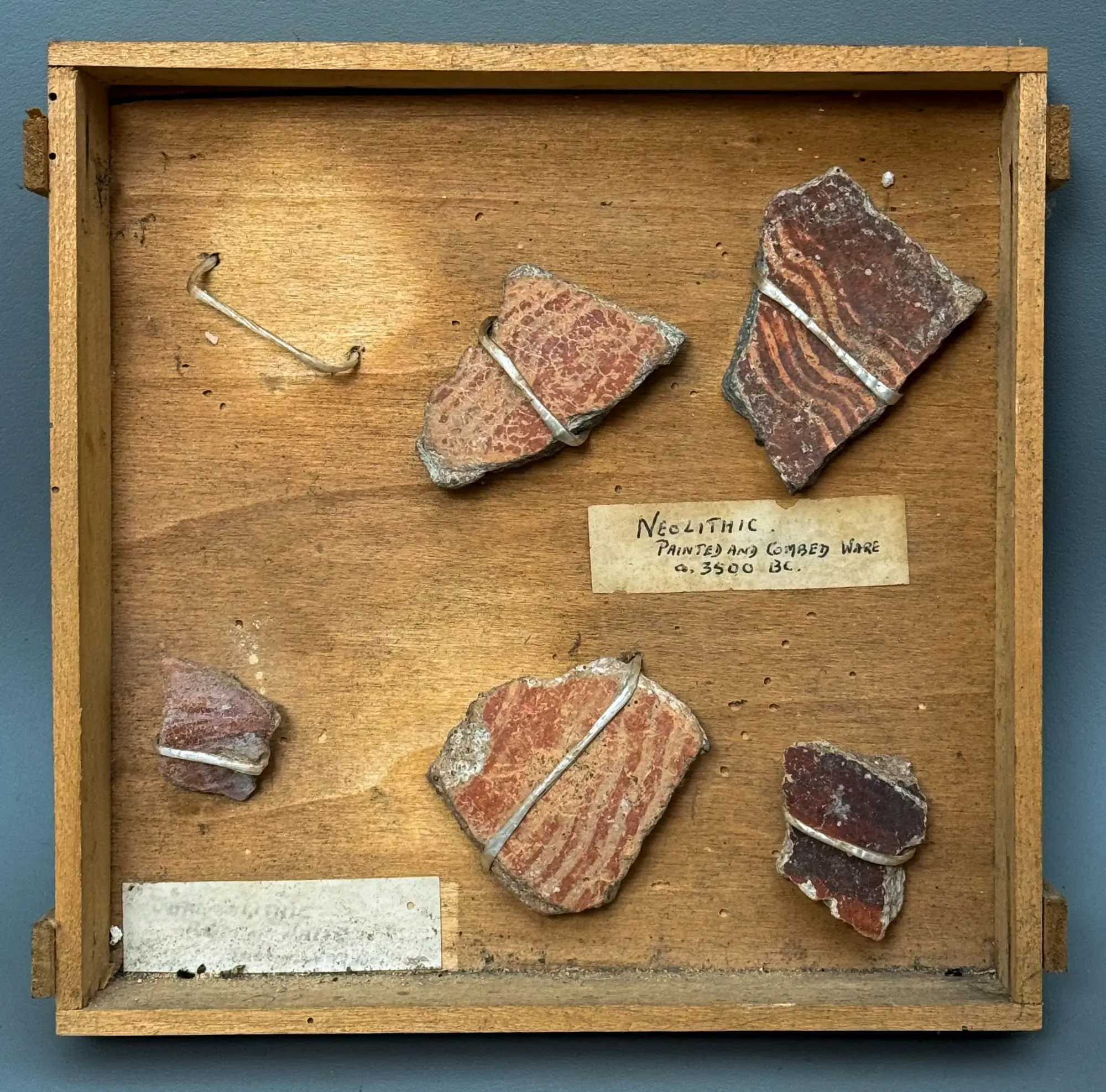
The last major category is the colonial-service collection: objects acquired by British officials, soldiers, teachers and engineers posted to Cyprus between 1878 and 1960, and by their successors in the 1960s, and carried home with their household goods. Two are documented on this site. Judge G. C. Griffith-Williams, a puisne judge of the Supreme Court of Cyprus from 1938, ran a Department-sponsored salvage excavation of Middle Cypriot tombs at Dhenia in 1953, and Early and Middle Bronze Age material from Dhenia with 1953 accession numbers is in the Ashmolean Museum [17]. The Chalcolithic sherds from his collection now held here came in a Droste chocolate box, five sherds clipped into wire with their old labels; how they were established as his is told in The Judge, the Escape, and a Chocolate Box. James Alfred Brew (1923–2008), an art teacher at British services schools in Cyprus in the 1960s, placed his collection on indefinite loan to the Ashmolean on 30 August 1972; his two multi-headed Red Polished plank figures were published by Frankel as Ashmolean nos. 151 and 152 in 1983, remained on display until the loan closed in September 2025, and are described in the Brew plank figures [17]. Both collections illustrate the evidence that a colonial-era provenance rests on: a dated inscription on an object, a museum loan file with a number, a publication under the collector's name, correspondence, and family testimony, none of which is an export licence and all of which together are stronger than one.
Checking a provenance means testing each link. The auction catalogues are in libraries and increasingly online; the Met's 1928 sale catalogue is digitised; the Ashmolean, Fitzwilliam and British Museum publish their registers; the Department of Antiquities will confirm, for an object in front of it or well photographed, whether a licence number or a lead tag matches its files and whether the piece appears on any register of stolen objects [1]. Family stories are tested against the dates of the family's residence on the island, against the kind of object (the licensed trade sold Iron Age pottery, lamps and glass by the thousand and very few fine sculptures), and against physical evidence: Cyprus Museum labels, dealers' stock numbers, old collection numbers in ink, the ghost of a removed lead seal on a handle. The declared collections of twentieth-century Nicosia, the Severis, Giabra Pierides, Phylactou and Lyssarides cabinets among them, have catalogues, most published by the A. G. Leventis Foundation under Karageorghis, that are themselves provenance documents for anything that later left them [2].
Private collections as case studies
The private collections of Cypriot antiquities that survive in the record show the range of what a collection can become; each is a model for a different outcome.
The Pierides collection is the oldest. Demetrios Pierides (1811–1895) began collecting in Larnaca in 1839 with the stated aim of keeping antiquities on the island at a time when there was no museum to keep them; five generations added to it, and it is now the Pierides Museum, the oldest private museum in Cyprus [18]. Leto and Costakis Severis assembled some 2,500 pieces in Nicosia, catalogued in 1999 and now shown in the Severis collection; a Cypro-Geometric amphora on this site carries a Severis provenance. Vassos Lyssarides, physician and politician, and his wife Barbara gave "a large part of their private collection, duly registered" to the Cyprus Museum in 1984, where the pieces were accessioned in batches through the year and have since been re-published piece by piece [19]. That is the first model: a registered collection formed on the island under the 1935 law and given outright to the state.
Thanos Zintilis (1929–2019), a Cypriot businessman based in Amsterdam from 1963 and honorary consul general of the Republic in the Netherlands from 1975 to 1993, formed a collection of about a thousand catalogued objects over forty years, then in 2002, with the consent of the Cypriot state, placed its core on long-term loan to the Museum of Cycladic Art in Athens, where it has been on public display since 2004 [20]. The catalogue records fabric and find-spot "wherever possible" and states plainly that none of the objects came from a scientific excavation [20]. That is the second model: a diaspora collection published in full and lent to a public museum, with its documentary gaps declared rather than hidden.
The third model is repatriation, and two living collectors illustrate it from opposite directions. David Johnson, an English artist, built a collection of 250 to 300 pieces, strongest in the Early and Middle Bronze Age, in about five years from 2013, then concluded that objects without a documented history before 1974 could not honestly be kept and resolved to give the whole collection back to Cyprus; the visit recorded in Visiting the David Johnson Collection describes the objects and the man. Alexander Malios, a Dresden-born Cypriot citizen and honorary consul in Leipzig, began collecting in 2016 and turned the collection into a research institute, AMRICHA, whose first catalogue (2023, 320 objects) opens with a provenance essay that reconstructs the nineteenth- and twentieth-century history of each piece, reproduces its export permits and lead seals, and records the voluntary return to Cyprus of an object found to have been removed from the north after 1974 [16]. Between them Johnson and Malios show that the decision to return can be total or targeted, and that the mechanism in either case is documentation: a collection that has been photographed and catalogued can be given back piece by piece, with the history of each piece attached, which an undocumented one cannot do.
The fourth model is dispersal, and it is the commonest: the second Pitt Rivers collection came onto the market in the 1960s and 1970s and pieces from it still surface, each with a fragment of a good provenance waiting to be reconnected [9, p. 53]. Karageorghis's assessment of what such material is worth to scholarship stands: objects in private collections are "of much less value than those found in proper excavations," but they "are usually complete and of good artistic quality" and fill out the typological range of classes whose chronology excavation has already fixed [18]. That is the case for publishing them, and for collecting them in a way that makes publication possible.
What the market looks like
Cypriot antiquities are inexpensive by the standards of the wider antiquities market, and the aggregate figures bear that out. Fehlmann's students at the Eastern Mediterranean University counted every antiquity sold at Christie's and Sotheby's worldwide between 1988 and 2008: 52,482 lots, of which 1,842 (four per cent) were identifiably Cypriot, and of those 377 had a history reaching before 1970 and fifteen could be traced to the Met's 1920s Cesnola de-accessions [21, p. 161]. The figures below come from the ARTEMIS auction corpus, which records about 603,000 ancient-art lots from 1,376 selling houses between 1996 and 2026 with estimates, hammer prices and outcomes. Prices are in US dollars at a static exchange rate, nominal for the year of sale, and sell-through rates are computed only from houses that publish unsold lots (Bonhams, Sotheby's and the Invaluable aggregator) from 2013 onward, since Christie's removes bought-in lots from its records.
| Segment (ARTEMIS query) | Lots / priced | Median hammer (USD) | Middle half of hammers | Median since 2017 | Sell-through | Main houses by volume |
|---|---|---|---|---|---|---|
| Cypriot pottery (vessels of all periods) | 910 / 760 | 892 | 419 to 1,903 | 597 | 71% (n = 502) | Bonhams (310 lots, median 1,384), Christie's (198, median 1,119), Artemis Gallery (102, median 400) |
| Cypriot terracotta figures | 232 / 195 | 1,219 | 457 to 3,224 | 600 | 73% (n = 133) | Bonhams (73, median 1,619), Christie's (51, median 2,238), TimeLine and Ancient Resource (23 each, medians under 300) |
| Cypriot limestone sculpture | 400 / 317 | 3,425 | 1,197 to 11,275 | 3,251 | 65% (n = 220) | Christie's (153, median 8,100), Bonhams (75, median 1,336), Sotheby's (14, median 9,175) |
Three features of the table stand out. The market is tiered by house rather than by object: a Bichrome jug that makes 1,400 dollars at Bonhams makes 400 at an American online gallery, and the online houses sell fewer than half their Cypriot lots while Bonhams sells more than nine in ten. The median has drifted down since 2017 in the pottery and figurine segments, from about 900 dollars to about 600, as the volume of small online sales has grown; the top of the market has not followed. The highest prices in the corpus are for the rarest classes with the best histories: two Red Polished plank figures sold at Bonhams in 2023 for 53,740 and 42,000 pounds against estimates of 5,000 to 7,000, a Bichrome amphora at Sotheby's in 2009 for 31,250 dollars, and Archaic limestone male heads at Christie's for 158,500 pounds (2015), 150,000 dollars (2017) and 107,100 dollars (2023). Third, unsold lots are common at every level: the Bonhams barrel flask with its two lead export bullae was bought in at an estimate of 2,000 to 3,000 pounds in 2026, and a hammer-to-estimate ratio below 0.75 accounts for a quarter of all Cypriot pottery sales. Estimates, in other words, are not prices. The site's articles on what antiquities cost, how to sell Cypriot antiques and how dealers provide liquidity go further into the mechanics; the short version is that a documented Iron Age jug is a few hundred pounds, a documented plank figure or limestone head is a serious purchase, and in both cases the documentation is a large part of what is being paid for.
Red flags
The warning signs are the mirror image of the provenance categories above. The first and most serious is an object with no history before 1974 and a plausible northern origin. The classes most associated with the occupied districts are the north-coast Bronze Age cemeteries (Vounous, Lapithos, Karmi and their neighbours, the sources of the finest Red Polished ware and plank figures), the Karpas, the sanctuaries around Salamis, and Byzantine ecclesiastical material of any kind; an unrecorded piece of these types, offered without a pre-1974 history, is the case the US import restrictions and the UK's 2003 Act were written for, and the sibling entry on looting in the occupied north sets out what is known. Any buyer who suspects one should report it rather than buy it.
The second flag is the anonymous provenance: "old European collection," "property of a gentleman," "acquired on the continent in the 1970s," without a name, a date or a document. Such phrases are sometimes true and always unverifiable. The Brew collection shows how the wording can drift even in good faith: two 2019 sale catalogues described it as "acquired 1970s–1980s" when the primary documents, a lamp inscribed "Paphos 1965, J.A. Brew" and the 1972 Ashmolean loan file, put its formation in the 1960s. A named prior owner with dates that can be checked against a residence, a publication or a museum file is the minimum; a name that cannot be checked is decoration.
The third flag is inconsistency between the object and the story. Tourists and expatriates in the 1950s and 1960s bought Iron Age pottery, lamps, glass and small terracottas from licensed dealers and from the Cyprus Museum's sale room. They did not, as a rule, buy large Bronze Age scenic vessels, stone figures or inscribed objects, because the Department did not license the export of such things and the saleroom did not stock them. A grandparent's Bichrome juglet with a lead tag is ordinary; a grandparent's complete plank figure with no paper is not, and the burden of proof rises with the rarity of the class. Restoration is a related point: heavily restored pieces are commonplace in old collections and are not themselves suspicious, but undisclosed restoration in a fresh sale is, and a buyer should ask for a condition report. A seller's reluctance to allow the object to be photographed, published or shown to the Department is a flag in itself, since every legitimate provenance improves with daylight. The article on what to do with antiquities covers the practical steps for an heir who finds a box of Cypriot pots and does not know what they are.
The case for documented private collections
The argument against private collecting is that demand funds destruction and that an object without context is a loss to knowledge. Both points are true of undocumented material, and neither applies with the same force to the population of Cypriot objects that left the island lawfully over a century and a half and now circulate among heirs, dealers and salerooms. Those objects exist and will be owned by someone. The question a collector can answer is whether their ownership adds anything to the record, and the collections described above show that it can: photographs, measurements, publication, scientific analysis, comparison with excavated material, and eventually a public destination, whether a museum loan, a gift, or a return to Cyprus with the file attached. A documented private collection is a small archive that happens to be made of pots.
This site is one such archive, and it is presented here as a worked example rather than a model. The Drakopoulos collection holds 108 catalogued Cypriot objects, each with an entry that records dimensions, ware, period, condition and a provenance chain written as a list of dated custodies. The chains are quoted here as they appear in the catalogue, gaps and question marks included, because the honesty of a provenance lies partly in what it admits it does not know. An Archaic limestone head carries: "Early 1900s (Pre 1969), Chevallier-Verel Collection, Paris, France"; "1969 - 2024, Mr X, Paris, France"; "2024 - Present, Alexis Drakopoulos, London, UK". A Bichrome jug, one of a group from the same French source, carries: "Late 1800s/Early 1900s - 1950, Alfred Boucher, France"; "1950 - 2024, Boucher Estate, France"; "2024 - Present, Alexis Drakopoulos, London, UK". A Bichrome bowl came through the Museum's own channel: "Unknown - 1969/1972, Cyprus Museum"; "1969/1972 - 2020s, Private Collector"; "2023 - Present, Alexis Drakopoulos, London, UK". A Cypro-Geometric amphora descends from a Nicosia cabinet: "Unknown period, Leto and Costas Severis Collection, Cyprus"; "early 2000s - 2023, Cheshire, UK"; "2023 - Present, Alexis Drakopoulos, London, UK". And a free-field bird oinochoe shows what a chain looks like when a link is only half known: "???? - September 2000, Galerie Samarcand, Paris, France"; "200X? - 2024, Private Cambridgeshire Collection, UK"; "2024 - Present, Alexis Drakopoulos, London, UK". Every object in the collection has been registered with the Department of Antiquities and checked against its records, and the collection's stated policy is that any piece later shown to have left the island unlawfully will be returned.
What the collection does with the objects is the other half of the case. Each piece is photographed from several angles at high resolution and, for a growing number, recorded as a photogrammetric 3D model that can be measured and rotated by anyone with a browser. The catalogue entries link each object to the compendium entries on its ware, shape and motifs, so that a Red Polished jug is presented alongside the excavated comparanda from Vounous that date it. The distinction between provenance and provenience is kept explicit: none of these objects has a recorded find-spot, and the site says so, attributing them to workshops and regions typologically rather than by invented origin. Public collections such as those in Denmark show what the same material looks like after a century in museum cases; a private collection online can offer comparable access at a fraction of the cost, and can fund research, conservation and publication that public budgets do not stretch to.
Summary
The legal position for a buyer of Cypriot antiquities in 2026 is settled and, for the most part, permissive: objects that left the island before the Republic's export controls closed may be owned, bought and sold in the United Kingdom, the European Union and the United States, subject in the US and EU to import documentation and in the UK to a criminal statute that bites only on objects unlawfully removed after 2003. The 1970 date-line is a professional standard rather than a law, and for Cypriot material 1974 is the date that matters. What separates a defensible purchase from an indefensible one is the file: a Cesnola or Lawrence-Cesnola sale lot, a Met 1928 duplicate number, a British Museum distribution label, a Cyprus Museum sale-room ticket or lead export tag, a licensed dealer's stock list, a colonial official's inscription and loan file, a declared Nicosia collection's catalogue number, or a published collector's name. A buyer who insists on one of these, checks it, and then adds photographs, measurements and publication of their own is doing what the collections above did in their different ways: turning ownership into record.
References
- 1.Alphas, E. (2017). From a Bronze Age tomb in Cyprus to the estate of a gentleman in Sussex: Measures taken and problems faced in the investigations on the illicit trade of antiquities. In D. Pilides & M. Mina (Eds.), Four Decades of Hiatus in Archaeological Research in Cyprus: Towards Restoring the Balance (pp. 30–43). Holzhausen.
- 2.Karageorghis, V. (Ed.). (2010). Cypriote Antiquities in the Phylactou Collection. A. G. Leventis Foundation.
- 3.Gaimster, D. (2004). Measures against the illicit trade in cultural objects: The emerging strategy in Britain. Antiquity, 78(301), 699–707. https://doi.org/10.1017/S0003598X0011333X
- 4.Ulph, J., & Smith, I. (2012). The Illicit Trade in Art and Antiquities: International Recovery and Criminal and Civil Liability. Hart Publishing.
- 5.Eftychiou-Evans, J., & Cortiñas-Garcia, J. (2002). Cyprus and the U.S. agree to protect cultural heritage. CAARI News, 25 (Fall 2002), 3.
- 6.Kline, T. R., et al. (2012). Cyprus providing leadership in protecting cultural property. Proceedings of the Annual Meeting (American Society of International Law), 106, 462–471.
- 7.U.S. Department of State. (2022). Agreement between the United States of America and Cyprus concerning import restrictions, signed at Nicosia June 14, 2022, entered into force July 14, 2022 (TIAS 22-714). U.S. Government Publishing Office.
- 8.European Parliament and Council. (2019). Regulation (EU) 2019/880 of 17 April 2019 on the introduction and the import of cultural goods. Official Journal of the European Union, L 151, 1–14.
- 9.Ulbrich, A., & Kiely, T. (2012). Britain and the archaeology of Cyprus. I. The long 19th century. Cahiers du Centre d'Études Chypriotes, 42, 305–356.
- 10.Hermary, A., & Mertens, J. R. (2014). The Cesnola Collection of Cypriot Art: Stone Sculpture. The Metropolitan Museum of Art.
- 11.Kiely, T. (2021). Tracing the 'diaspora'. In L. Bombardieri & E. Panero (Eds.), Cyprus: Crossroads of Civilizations. Musei Reali; DeArtcom.
- 12.Stanley-Price, N. (2025). Illicit excavation and the sale of 'duplicate' antiquities: Rupert Gunnis and the Cyprus Museum, 1926–1932. Cahiers du Centre d'Études Chypriotes, 55, 269–301. https://doi.org/10.4000/151c2
- 13.Interview with Dr. Vassos Karageorghis, Director of the Department of Antiquities of Cyprus. (1983). Journal of Field Archaeology, 10.
- 14.Powell, J. (2013). Love's Obsession: The Lives and Archaeology of Jim and Eve Stewart. Wakefield Press.
- 15.Merrillees, R. S. (2014). George Basil Palma, chemist and collector of Cypriote antiquities in Famagusta, Cyprus, in the 20th century A.D. Cahiers du Centre d'Études Chypriotes, 44.
- 16.Gatzsche, A. (2023). From Cyprus to Leipzig: Provenance research. In E. Poyiadji-Richter (Ed.), Alexander Malios Collection, Vol. 1: Cypriot Antiquities. AMRICHA.
- 17.Frankel, D. (1983). Corpus of Cypriote Antiquities 7: Early and Middle Bronze Age Material in the Ashmolean Museum, Oxford (Studies in Mediterranean Archaeology XX:7). Paul Åströms Förlag.
- 18.Karageorghis, V. (1973). Cypriote Antiquities in the Pierides Collection, Larnaca, Cyprus. Ekdotike Hellados; Pierides Foundation.
- 19.Karageorghis, V. (1985). Chronique des fouilles et découvertes archéologiques à Chypre en 1984. Bulletin de Correspondance Hellénique, 109, 897–967.
- 20.Lubsen-Admiraal, S. M. (2004). Ancient Cypriote Art: The Thanos N. Zintilis Collection. Museum of Cycladic Art.
- 21.Fehlmann, M. Looting and losing the archaeological heritage of Cyprus (Chapter 8). In Proceedings of the MedWorlds II Conference, Istanbul. Bloomsbury Academic. https://doi.org/10.5040/9780755608331