
Contents
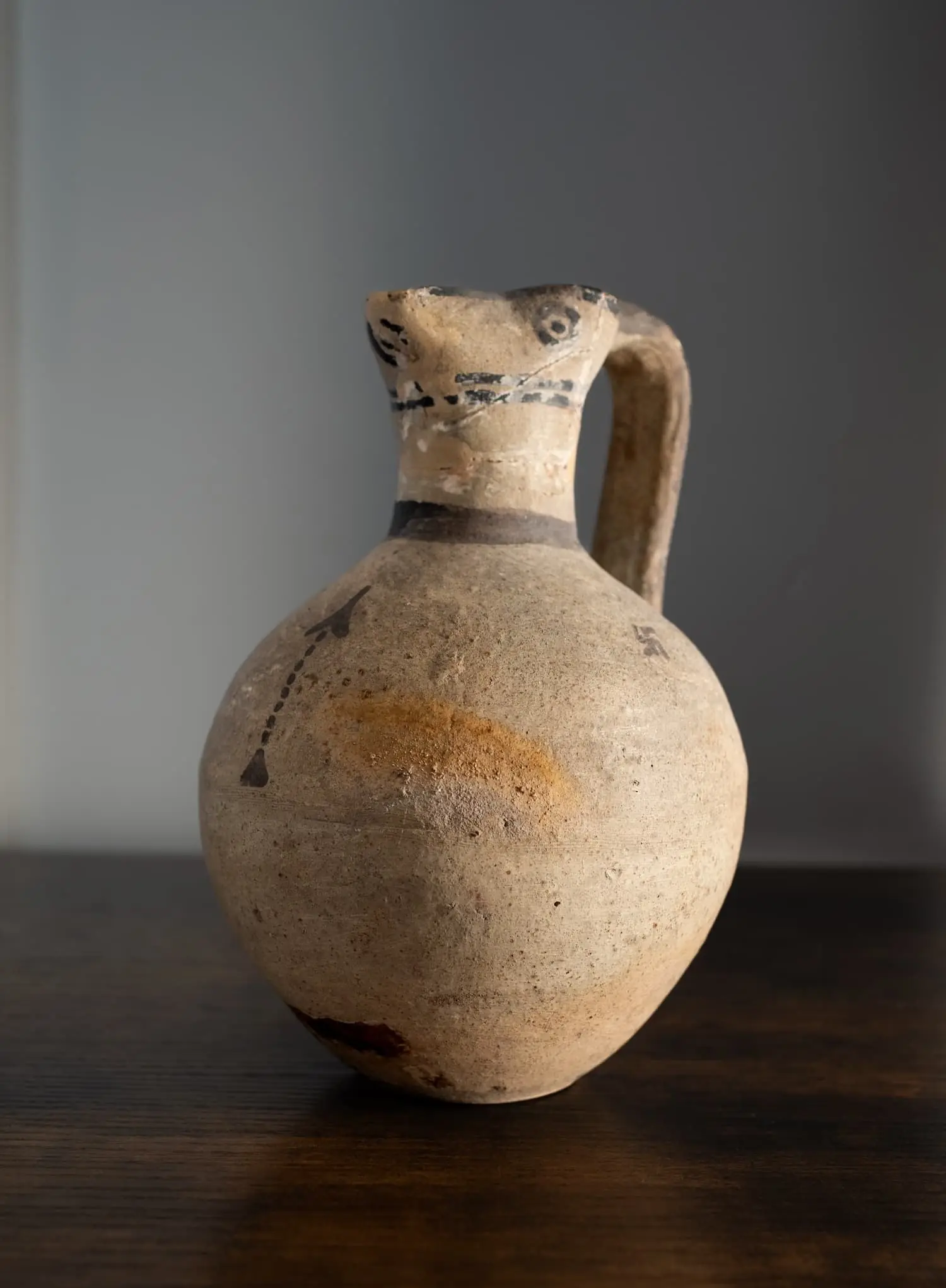
On the shoulder of a small jug in the Drakopoulos collection a line of short black strokes runs down the body, capped at the top with an arrowhead and closed at the bottom by a small solid triangle. A swastika floats beside it. The pinched mouth has an eye painted on each side, so the jug looks back at whoever holds it by the handle, and the arrow sits where a face would have a chest.
Archaeologists call this sign a chevron arrow or an arrow motif. It is one of the small, stock ornaments of Cypriot Iron Age painting, and it is easy to overlook beside the birds and lotuses it usually accompanies. It has a definite history: a place in Gjerstad's typology, a regional home at Salamis, and a counted frequency on bird vases.
What the motif looks like
The Cypriot arrow is built from chevrons. Anna Georgiadou and Maria Dikomitou-Eliadou describe it as "a vertical chain of chevrons forming an arrow motif" [2, p. 344], and Alicia Dissinger defines "chevron arrows" as "chevrons creating a pointed arrow" [3, p. 143]. The chevrons may be full V-shapes stacked one inside the next, or reduced to a column of strokes or dots between two lines; the top ends in a point. A solid triangle at the foot, as on the Drakopoulos jug, gives it a fletched or feathered end. It is almost always vertical.
Two related motifs should be kept apart. Gjerstad's list of White Painted I ornaments includes "arrow-heads" as a separate item, along with the Maltese cross and swastika [1, p. 45], which suggests a single pointed ornament rather than a chain. And a plain "vertical row of chevrons," without a point, is one of the ornaments he lists as new in White Painted III [1, p. 47]. The chevron arrow sits between the two: a vertical chevron row that has acquired a head. The simpler zig-zags and horizontal chevron bands belong to a different family.
Dating: Cypro-Geometric III onward
The arrow belongs to the moment when Cypriot painters began setting single motifs on an open surface. When Gjerstad described the new free-field layout of White Painted III, the Cypro-Geometric III ware, his examples of a single ornament on the bare body of a pinched-mouth jug included "rows of chevrons, sometimes combined with a single ornament as filling ornaments" [1, p. 47]. On the plates of the same ware "the fringed concentric circles, the swastika, and the row of chevrons are used as filling ornaments" [1, p. 48].
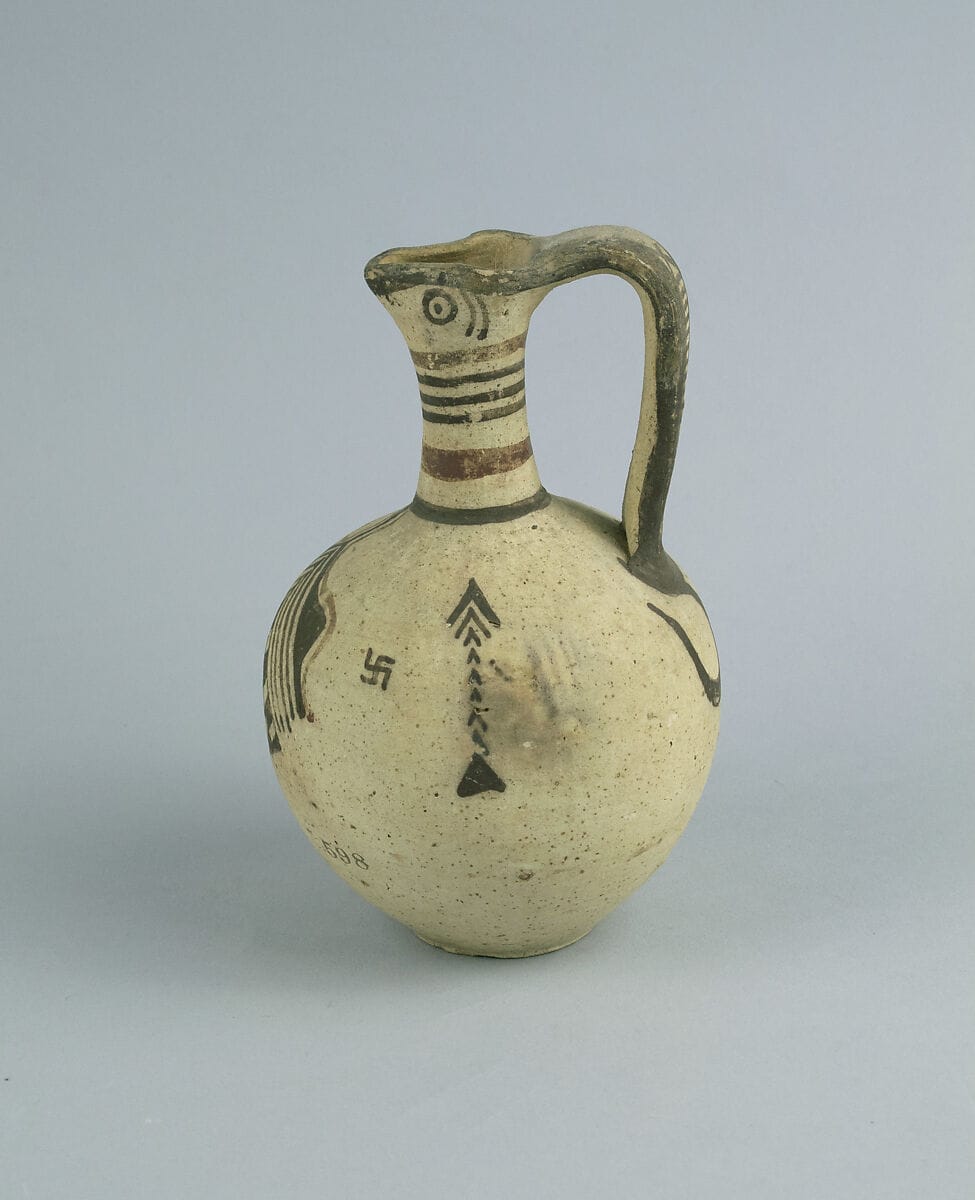
The Metropolitan Museum's jug 74.51.447, from the Cesnola collection and dated by the museum to Cypro-Geometric III (850-750 BCE), shows the type early in its life. It is a small pinched-mouth jug with an eye on the rim, bands on the neck, and on the body a vertical chain of chevrons ending in an arrowhead, with a swastika on either side. On this site it is /artifact/3113. The Drakopoulos oinochoe with swastikas and arrows is its close relative: the same shape, the eye on the mouth, the arrow of strokes with a triangle at the foot and the swastika beside it. The two jugs illustrate Gjerstad's geometric free field exactly: one or two ornaments on a plain body, nothing framing them.
The motif lasted into the pictorial phase. On Bichrome IV jugs of Cypro-Archaic I it becomes the standard companion of the bird, and Dissinger notes that such "linear decorative motifs were in use for hundreds of years, thus, the CA painters were using typical Cypriot filler images or stock motifs" [3, p. 144].
Wares, shapes and workshops
The chevron arrow appears on White Painted and above all on Bichrome. Georgiadou and Dikomitou-Eliadou place it among a set of small motifs "mainly attested in Bichrome Ware" that characterise the workshops of Salamis: "the dotted cross, the sun motif, a vertical chain of chevrons forming an arrow motif, pairs or groups of swastikas, groups of dots in panels, a quatrefoil motif and groups of M or W or Σ motifs." They appear "on amphorae, jugs and footed bowls," are "often very small," and occur "individually in panels or as supplementary ornaments, accompanying or flanking other larger geometric motifs or even pictorial designs" [2, p. 344]. One Salaminian footed bowl exported to Qrayé in Phoenicia carries "a range of typical miniaturised geometric motifs" of this kind beside its birds [2, p. 344].
The main carrier, though, is the trefoil-mouthed jug, where the arrow stands on the front of the body opposite the handle. A Bichrome IV jug in the Cyprus Museum (1968/VIII-23/1), probably from a tomb between Vatyli and Sinda and attributed to Salaminian workshops, has a leaping goat, a large lotus and "an 'arrow' motif," all "placed on the front side of the vessel, opposite the handle," with an eye on each side of the mouth [4, p. 99].
The arrow and the bird
Dissinger's catalogue of Cypro-Archaic bird vases gives the arrow a number. Among the motifs that accompany painted birds, the chevron arrow is third, on 57 vessels, after the lotus (89) and the swastika (79) [3, p. 144]. "Typically, chevrons or chevron arrows are located below the beak or behind the bird, but always point upward" [3, p. 144]. Her entries show the variations:
- British Museum 1876,0909.27, a Bichrome IV jug: "a chevron arrow is below the bird's beak; swastikas and dotted 'X' accompany the bird" [3, p. 347].
- Cyprus Museum B 1947: "a chevron arrow extends downward from the bird's beak and is flanked by swastikas" [3, p. 347].
- Another jug in her catalogue: "chevron arrows and a column of 'W' motifs accompany the bird; one chevron arrow points up to the tip of the bird's beak where a swastika is painted" [3, p. 348].
- One jug with four swastikas over the bird's back, a chevron arrow behind the bird, a second arrow below the beak flanked by dotted X's, and a stylised lotus rising from the back [3, p. 352].
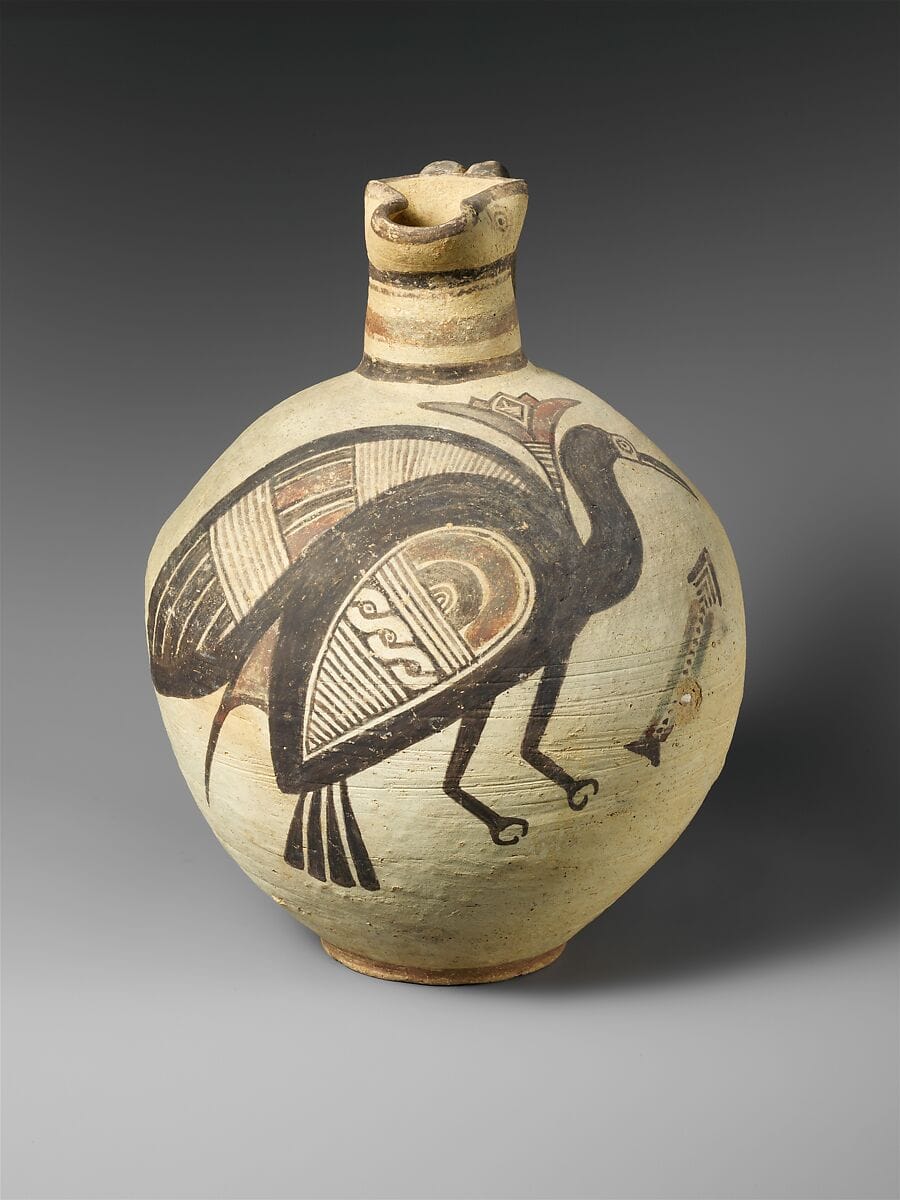
The Met's Bichrome IV jug 74.51.501 (/artifact/1232) is a clear museum example: a large bird with a lotus growing from its back, and in front of it a small upright arrow. The arrangement recurs so often that the arrow reads as part of the formula of the free-field bird jug, alongside the lotus and the swastika.
| Object | Collection | Date | Arrow placed |
|---|---|---|---|
| Pinched-mouth jug 74.51.447 | Metropolitan Museum | Cypro-Geometric III | Alone on the body, flanked by swastikas |
| Oinochoe with swastikas and arrows | Drakopoulos collection | Iron Age, geometric free field | Alone on the body, swastika beside it |
| Bichrome IV jug 74.51.501 | Metropolitan Museum | Cypro-Archaic I | Before the bird, pointing up |
| Bichrome IV jug 1876,0909.27 | British Museum | Cypro-Archaic I | Below the bird's beak |
| Bichrome IV goat jug 1968/VIII-23/1 | Cyprus Museum | Cypro-Archaic I | Beside goat and lotus |
The Met dates are the museum's; the British Museum and Cyprus Museum entries follow Dissinger and the Cyprus: A Dynamic Island catalogue [3, p. 347; 4, p. 99].
What did it mean?
Nobody knows, and the literature is short. The name "arrow" is a modern description of the shape; no text tells us that Cypriot painters meant a weapon. Three readings are possible from the evidence above.
The first is that it is a filler. Dissinger calls chevrons and chevron arrows "typical Cypriot filler images or stock motifs" [3, p. 144], and Georgiadou and Dikomitou-Eliadou describe the small Salaminian motifs as "supplementary ornaments" [2, p. 344]. Its long life before the pictorial style began, on jugs like Met 74.51.447 where it stands alone, supports that view.
The second is compositional. Dissinger's observation that the arrow is placed below the beak or behind the bird and points upward [3, p. 144] means painters used it to direct the eye towards the head of the main figure, or to balance the bird's mass in the empty field.
The third possibility, that the arrow carried a meaning of its own, has not, to our knowledge, been argued.
In short
The chevron arrow is a Cypriot motif of Cypro-Geometric III and Cypro-Archaic date, built from a vertical row of chevrons with a point, painted mainly on White Painted and Bichrome jugs and most characteristic of the workshops of Salamis. On geometric free-field jugs it can be the main ornament; on Cypro-Archaic bird jugs it becomes the bird's regular companion, placed under the beak and pointing up. The Drakopoulos jug and its Metropolitan twin show it at the first stage, alone on the body with a swastika, under a pair of painted eyes. Both are listed with their collections: the Drakopoulos collection and the Cesnola collection at the Met. For the shape, see also the article on the Cypriot oinochoe; the lattice and checkerboard, Maltese cross and wavy line entries cover the other small ornaments of the same repertoire.
Objects on this page
References
- 1.Gjerstad, E. (1948). The Swedish Cyprus Expedition, Vol. IV, Part 2: The Cypro-Geometric, Cypro-Archaic and Cypro-Classical Periods. Stockholm: The Swedish Cyprus Expedition. (Page numbers follow the digitised text consulted, which is not paginated like the printed volume.)
- 2.Georgiadou, A., & Dikomitou-Eliadou, M. (2022). The Iron Age pictorial pottery of Salamis within and beyond: An overview of ceramic styles, wares and fabrics. In G. Bourogiannis (Ed.), Beyond Cyprus: Investigating Cypriot connectivity in the Mediterranean from the Late Bronze Age to the end of the Classical Period (AURA Supplement 9, pp. 335-348). Athens: National and Kapodistrian University of Athens.
- 3.Dissinger, A. M. (2017). Cypro-Archaic bird iconography: Types, uses, and meanings [Doctoral dissertation, University of Virginia].
- 4.Halbertsma, R. B., & Pilides, D. (Eds.). (2019). Cyprus: A Dynamic Island. Leiden: Sidestone Press / Rijksmuseum van Oudheden.