
Two Birds, Two Necks: A Vounous Jug, Its Louvre Cousin, and a Lost One from Tomb 46A
A Red Polished flask from the Cypriot Early Bronze Age, about 57 centimetres tall, reassembled from some thirty fragments with its two necks and two modelled birds intact. It carries no tomb number, and is still one of the more precisely placeable objects of its age: its nearest published kin both come from Vounous, one now in the Louvre, one known only from a 1930s excavation plate.

Alexis Drakopoulos
June 24, 2026·Archeology · Ceramics · Collection·15 min read


Share


Alexis Drakopoulos is a Greek Cypriot Machine Learning Engineer working in Financial Crimes. He is passionate about Archeology and making it accessible to everyone. About Me.
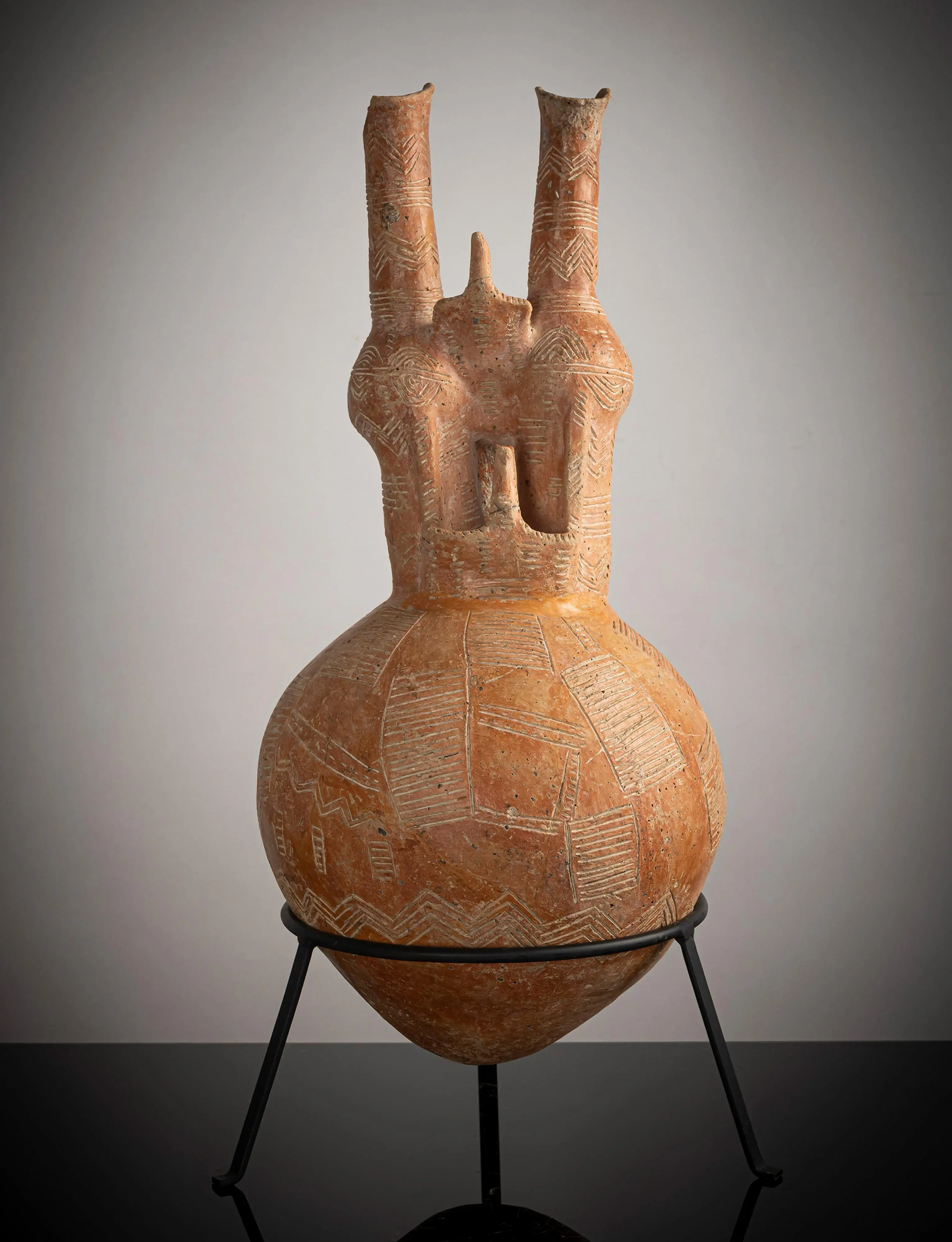
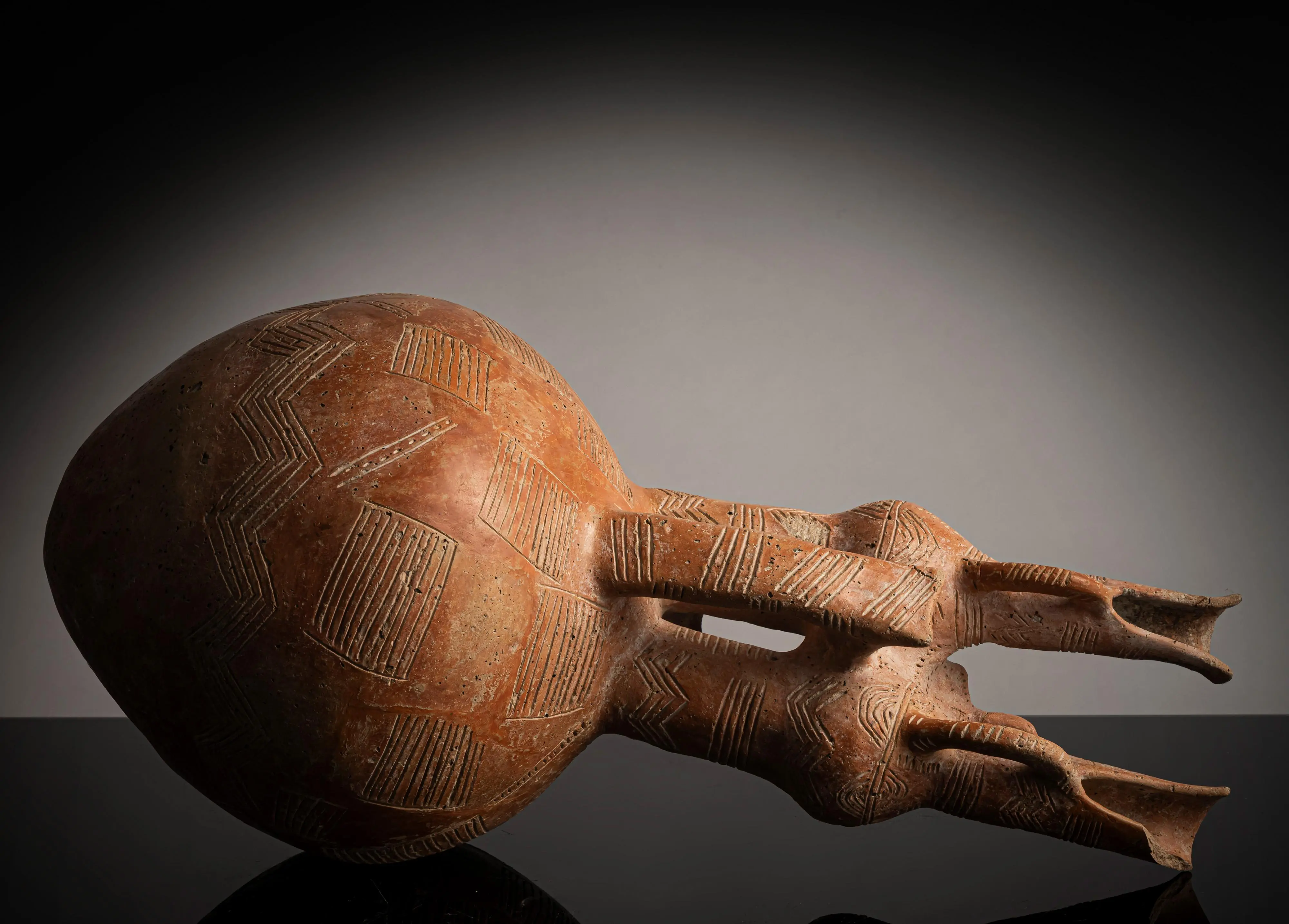
Reassembled from about thirty fragments with almost nothing lost, the jug carries two tall tapering necks, and set between them, one above the other, a pair of flat, plank-like birds that lean out over the front of the vessel, each drawn up into a small stylized featureless head. Below them the body swells to a near-sphere and draws down to a rounded, and slightly pointed, base. The whole surface is carpeted in fine incised pattern: a loose patchwork of hatched squares set at angles to one another, zigzag bands across the lower body, and the close filler-strokes packed inside the panels and up the necks, all once filled with white to read pale against the red.
It stands about 57 centimetres, a Red Polished jug of the Cypriot Early Bronze Age, made on the north coast of the island in the last centuries of the third millennium BC. It came with no excavation number and no recorded tomb. And it is, even so, one of the more precisely placeable objects of its age, because the double-necked bird-jug is the product of a single small tradition, and the features that pin it down, the necks and the birds, are exactly the ones a buried, broken pot is least likely to keep.
Its nearest published relative sits in a glass case in the Louvre, dug from a Vounous tomb in 1933, and carries a single bird where this jug carries two.
What Dikaios would have called it
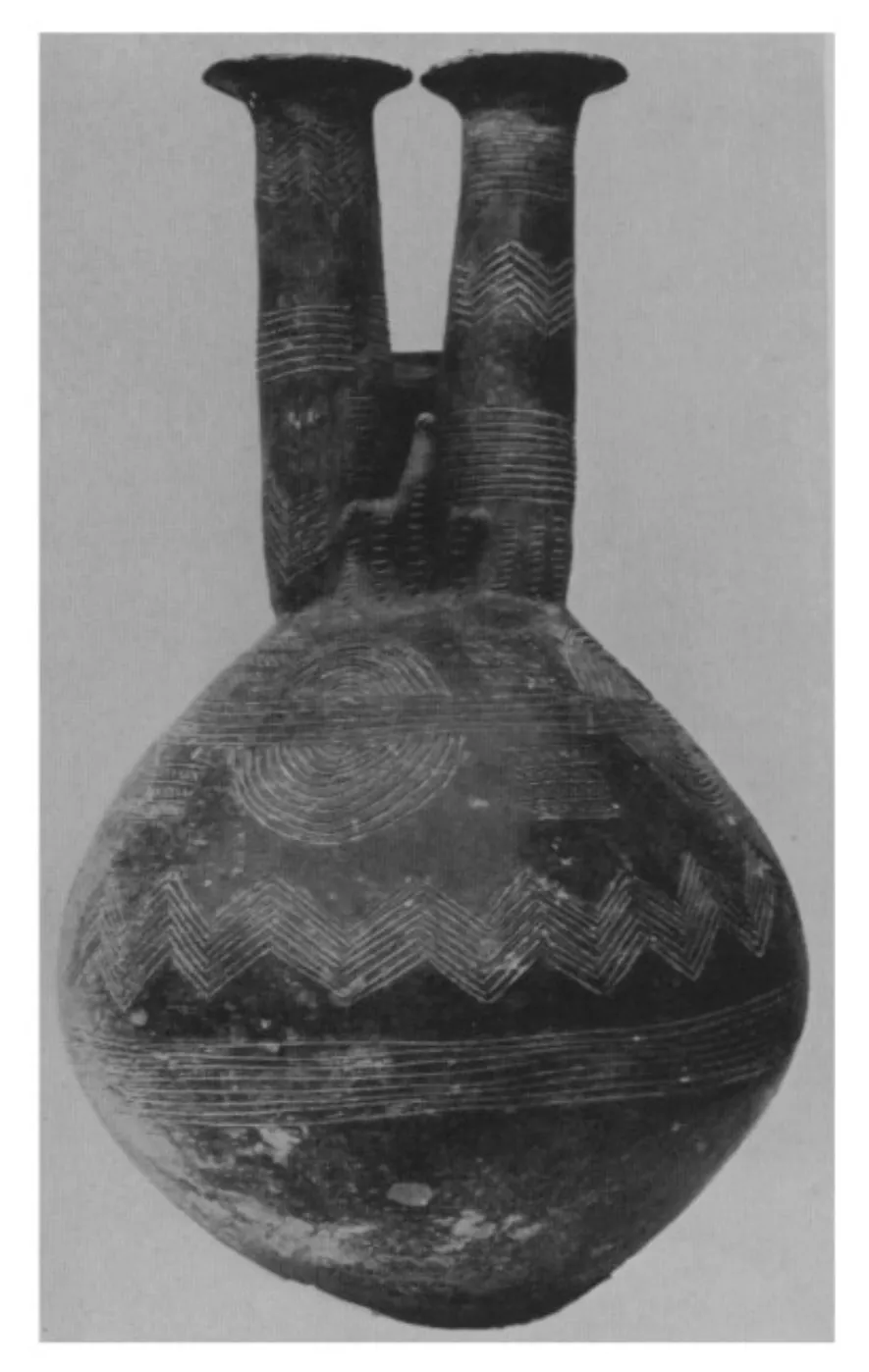
When Porphyrios Dikaios, curator at the Cyprus Museum, excavated the Vounous cemetery in 1931 and 1932 and sat down to sort the pottery, he gave this shape a label. It was one of his "big incised jugs," Type II c, and he noted that the same type "occurs with two necks," with, "in the space between the necks," the upper part of a bird. [1] His dig came before radiocarbon dating, and his calendar dates for the cemetery now read two or three centuries too high, though his relative sequence and his pottery types have held. [10] His catalogue type-piece is a jug numbered 23, lifted from the intact side-chamber of Tomb 46:
Jug, oval, with pointed rounded base, two tapering necks, and upper part of bird between the two necks in front. Incised. Type II c.
That sentence describes the new jug almost as well as it describes the one Dikaios held, and the differences are all in the figures. Dikaios's jug had one bird, set on the bridge between the necks. This one has two, in that same space between the necks but stacked one above the other. The lower bird springs from the shoulder where the necks divide, a plank-like body bridging forward to a small head, with a short strut to either side tying it to the front of each neck. The upper one sits halfway up, where each neck swells into a rounded knob and the handle joins the two at the back, its body pushing forward.
We were unable to track down that Tomb 46A jug. It possibly passed into the keeping of the Cyprus Museum with the many of his 1931–32 finds and then dropped from the published record. Its closest living counterpart is the jug in Paris from nearby tomb 54, and the closest counterpart to both is the one on the stand in these photographs.
The cemetery on the hill
Vounous, the name means "the hill," is the cemetery, and only the cemetery. It lies on the north slopes of a low hillock about two and a half kilometres above the village of Bellapais, under the Kyrenia range, with the ground falling away uninterrupted toward the sea. [1] No one has ever found the village that buried its dead here, so everything we say about the living at Vounous is read backward out of their graves: a wealthy community whose source of wealth is still unexplained.
Three excavations cut the cemetery, and their order is the key to its tangle of tomb numbers, which run continuously by the date a tomb was opened rather than by where it sits. [6] Dikaios and the Cyprus Museum came first, in 1931 and 1932, and took Tombs 1 to 48. In 1933 Claude Schaeffer dug alongside him for the National Museums of France and cleared roughly thirty more, Tombs 49 to 79, the finds divided by partage, the legal split of a season's discoveries between the excavating mission and the host country; the Louvre's jug left Cyprus that way, and the catalogue of Schaeffer's tombs was not published in full until 2003. [6] [5] Last came James and Eleanor Stewart for the British School at Athens, in 1937 and 1938, who opened the eastern ground and the earliest graves, carrying the count past 160. Stewart, looking at the density of figured and ceremonial pottery, decided the place "was either a leading religious centre or the population was unusually religious." [12]
The cemetery was being opened well before any of this. North-coast Red Polished had circulated through the island's antiquities trade for decades, and partage and private collecting moved it abroad in quantity; a great deal of Vounous and Lapithos pottery entered European and American collections through entirely ordinary channels. A vessel of exactly this type, surfacing without a tomb number, points back to the Vounous–Lapithos workshops, very plausibly to one of the many tombs cleared before the recorded seasons began, whose contents were dispersed and never written down.
What that label would not have conveyed is the kind of event the jug was made for. A Vounous tomb is a chamber cut into the soft white havara subsoil, reached down a sloping passage, the dromos, and closed at the chamber mouth with a wedged limestone slab; families reopened it across generations, sweeping earlier remains aside to make room, sometimes lifting out a skull and setting it apart. [1] [7] The floors of the richer chambers were laid with large Red Polished bowls stacked full of smaller ones, milk-bowls nested by the dozen, and among them stood the big jugs. Livestock, predominantly cattle, was killed and butchered at the graveside, its bones recorded in roughly a third of the tombs, the meat given to the dead with the marrow left in the bone, a conspicuous waste that argues for real surplus and for feasting by the living. [11] [7] Three tombs in the eastern ground carry the strangest signature of all: their doorways were carved to imitate wooden house-fronts, with uprights and a lintel, one of them apparently with an upper storey, a window and a bolt-slot. Stewart called them houses for the dead. [11]
Out of the same impulse came the figured pottery the cemetery is known for: a double-necked jug from Tomb 19 modelled with an embracing man and woman, ox-skulls and a bird drinking from a tiny cup; a triple-necked jug from Tomb 37 with a small figure bent over a saddle-quern, grinding grain, where the three rims almost meet; and the circular clay model from Tomb 22 of a walled enclosure full of seated and standing figures, the most ambitious thing Vounous produced. [1] Priscilla Keswani has shown that this escalating display was not the badge of a closed elite. The median outlay on graves rose along with the mean, which means the spending was broadly shared across the community rather than concentrated at the top. [7] The elaborate jug was a move in that contest, a thing made to be seen put into the ground. The piece in these photographs belongs to its upper register.
The cousin in the Louvre
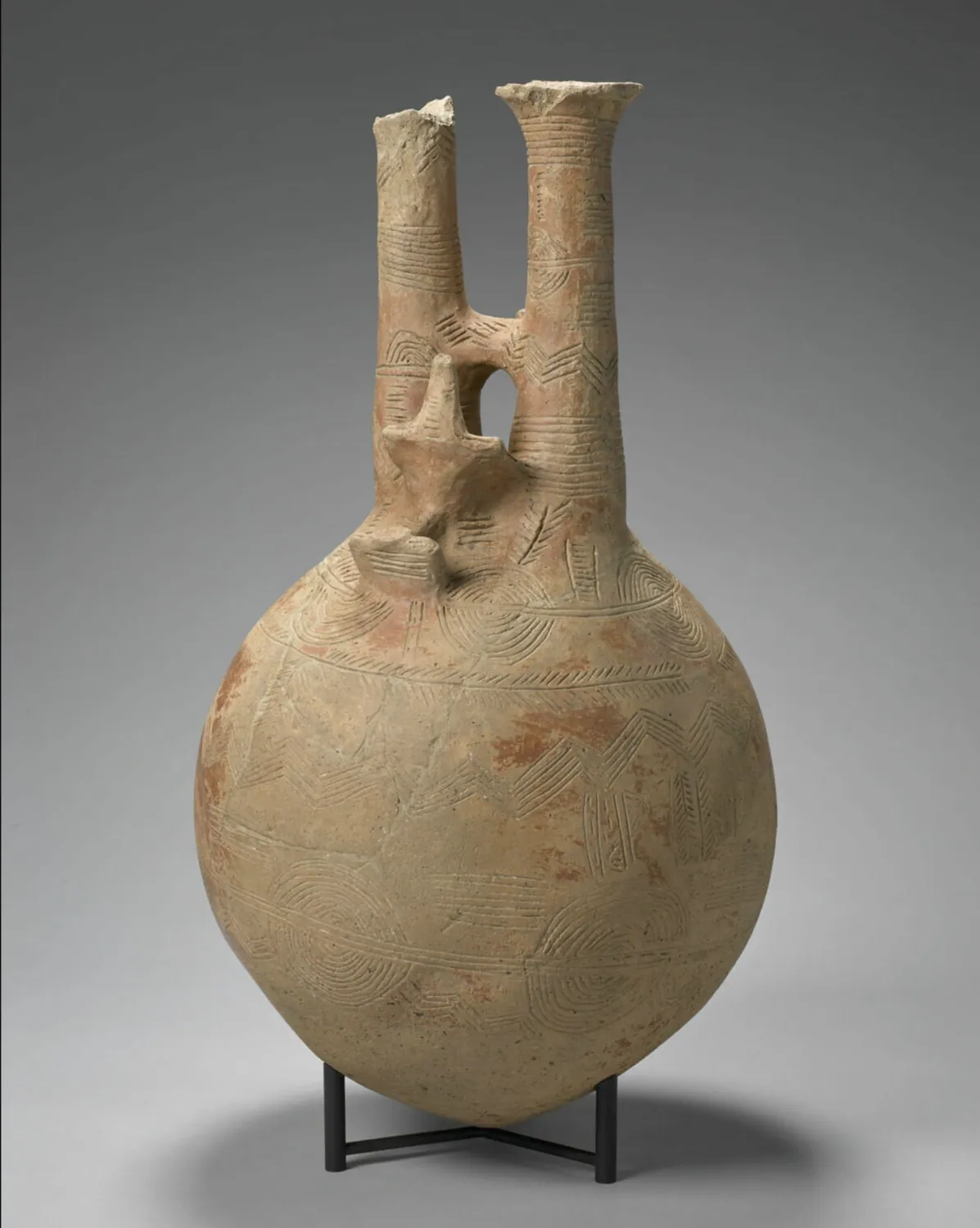
The Louvre jug is inventory number AO 17526, on display in the museum's Levant and Cyprus room: a Red Polished double-necked jug, 50 centimetres tall, dug from Vounous Tomb 54 by Schaeffer in 1933 and carried to France by partage. [5] [6] Vassos Karageorghis catalogued it in 1991 as number XII.15 in his survey of Cypriot terracottas. [2]
Set beside the new jug, the Louvre piece is the same object in a quieter key, though not as finely modelled. Same near-spherical body, same two long necks rising close together, same all-over skin of fine white-filled incision, and almost the same height, though the Paris potter leaned more on curved and concentric lines where this one keeps to hatched panels and zigzags. The Louvre jug carries a single bird, modelled at the front in the angle between the two necks and leaning forward over the shoulder, exactly the slot where this jug carries two. [2]
Birds fused to the body
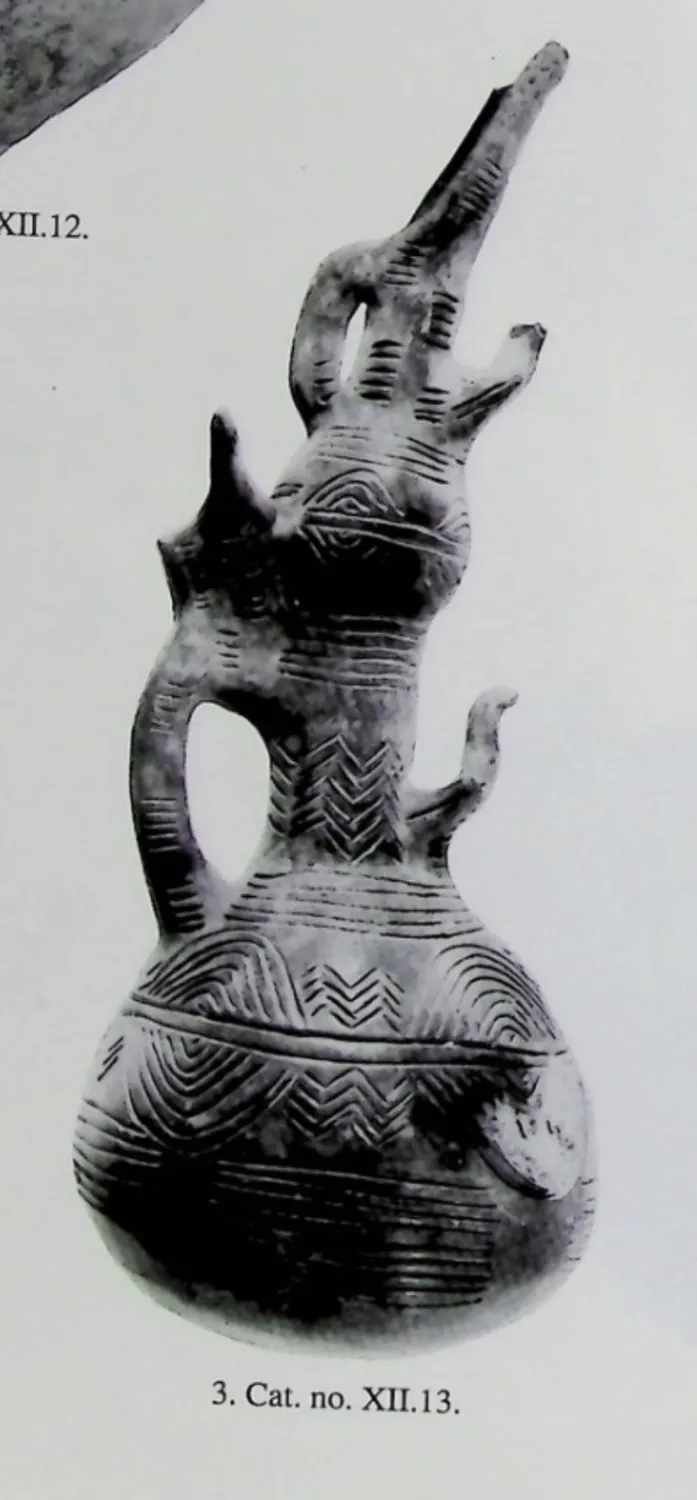
Karageorghis gathered jugs like these into a group he called, plainly, "Bird Figures Attached to Vases." Most of the birds in it perch: they sit upright on a shoulder, on the top of a handle, on a bar slung between two necks. A smaller set behaves differently. In three entries, he noted, "the birds are fused to the body of the vase, without any support." [2] That is the company the new jug keeps, the birds that grow straight out of the pot.
Laid out together, the three show how few survive and how little they resemble one another. Number XII.13, the one a collector tends to reach for, is a different solution to the same idea: a composite of two jugs stacked into a single vessel, 26 centimetres high, hung about with birds and arched by a basket handle, now in the Cyprus Museum. [2] Number XII.14, a jug with two birds and a long forward-tilted neck, was recorded in a private collection in Famagusta and has not been seen since 1974. [2] Number XII.15 is the Louvre jug. None of the three matches the new piece, which has its own answer again: two birds stacked one above the other between the necks.
Desmond Morris, looking at the north-coast multi-necked jugs in 1985, went further than counting them. The group, the Tomb 46A type-piece among it, "appear to have been made by a single Vounous artist." [3] That is a connoisseur's claim rather than a proven one, but it is the reasonable shape of the evidence: a handful of objects, one cemetery, one set of habits of hand. The two pieces with the best claim to be this jug's siblings, the Louvre's and Dikaios's lost one, each carry a single bird. This is the largest of the group, at 57 centimetres against Morris's recorded range of 53 to 58, and the only one of them to come through with both necks, both birds and almost all of its body. [3]
The wider family stretches past two necks. On the plate where Dikaios published the Tomb 46A jug he laid out its relatives in a row, ending with the triple-necked grain-grinding jug from Tomb 37. [1] For the all-over patchwork of incision, the closest matches are two more double-necked jugs, from Tombs 15 and 34, whose globular bodies are paneled edge to edge in hatched squares and zigzag friezes, the same scheme the new jug wears. [1]
Why the clay says north coast
North-coast potters worked a soft clay with few inclusions, the kind of fabric that takes a fine line cleanly, and they covered it with crisp white-filled incision. The centre and south of the island used something else: a hard, gritty fabric that fired to a blotchy red-and-grey mottle, and on which, as the pottery specialist David Frankel puts it after running the chemistry, "fine incised decoration was rarely used." [4] The two zones made the same kinds of things, grand multi-necked funerary jugs among them, and the products do not look alike.
The southern version is easy to see in Athens. The Museum of Cycladic Art holds a set of Cypriot twin-necked and composite jugs, recorded as coming from Sotira and Erimi in the Limassol district, that belong to that other world: rounder bodies on wide flat bases, surfaces clouded with the smoky red-to-grey mottle, and on the bars between the necks, modelled in the round, little long-necked goats or pairs of facing birds, with a basket handle arching over the top. [8] Morris assigned that southern group to "a single south coast artist," a different hand from his Vounous one. [3]
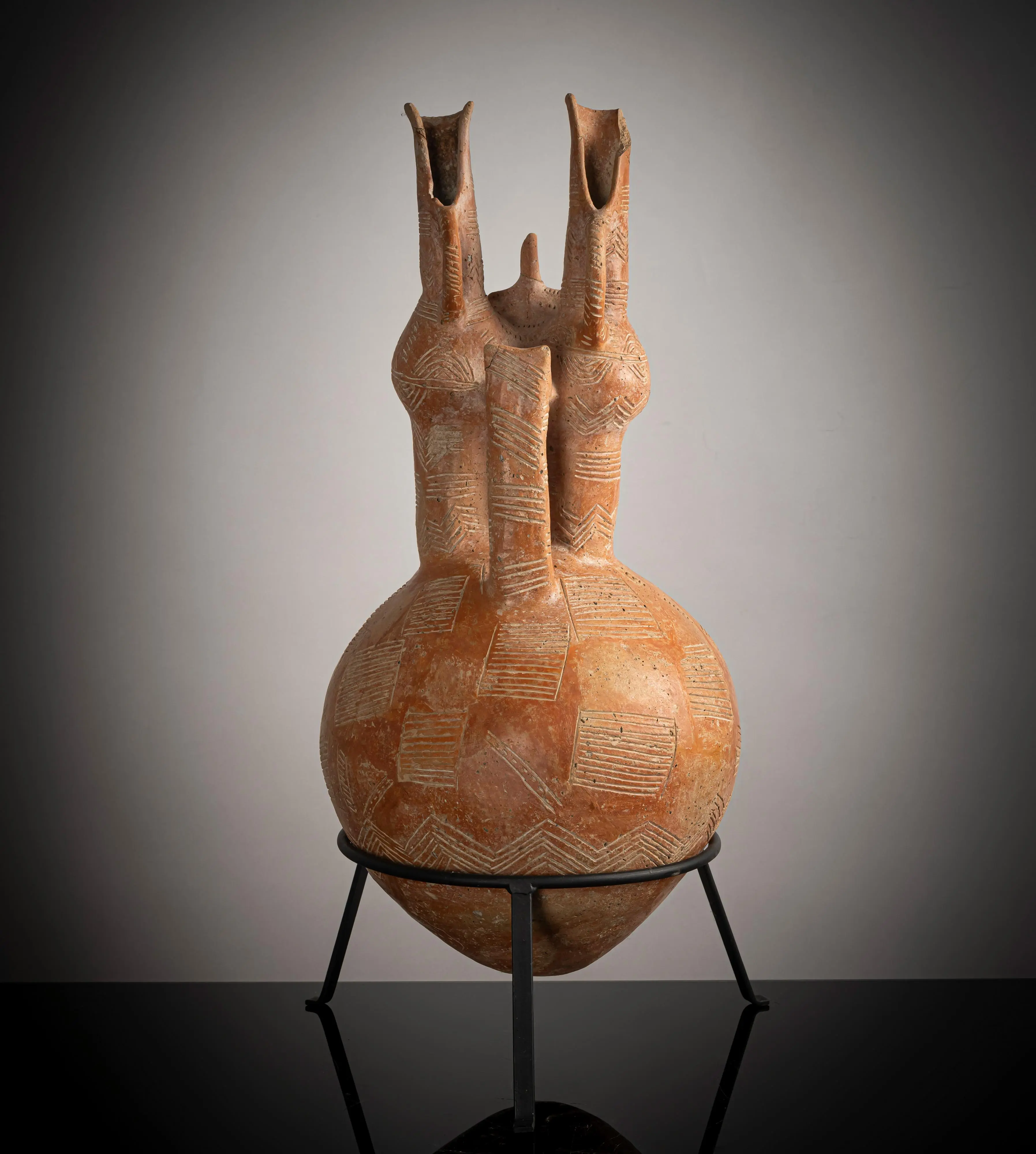
Hold the new jug against that. An even, lustrous red without the mottle; a rounded base, not a flat one; the birds modelled as flat, plank-like plaques fused to the front, their heads barely featured, rather than livestock perched on a bar; and the deep, exact, white-filled incision a soft clay allows. There is a caveat worth keeping honest: the grandest southern funerary jugs were incised too, so incision by itself does not settle the question, however the surfaces and designs do. The mottle, the flat base and the animals on the bars say south; the clear red ground, the pointed base and the plank-birds say north, and on the north coast that means Vounous and its neighbour Lapithos.
Cut before the fire
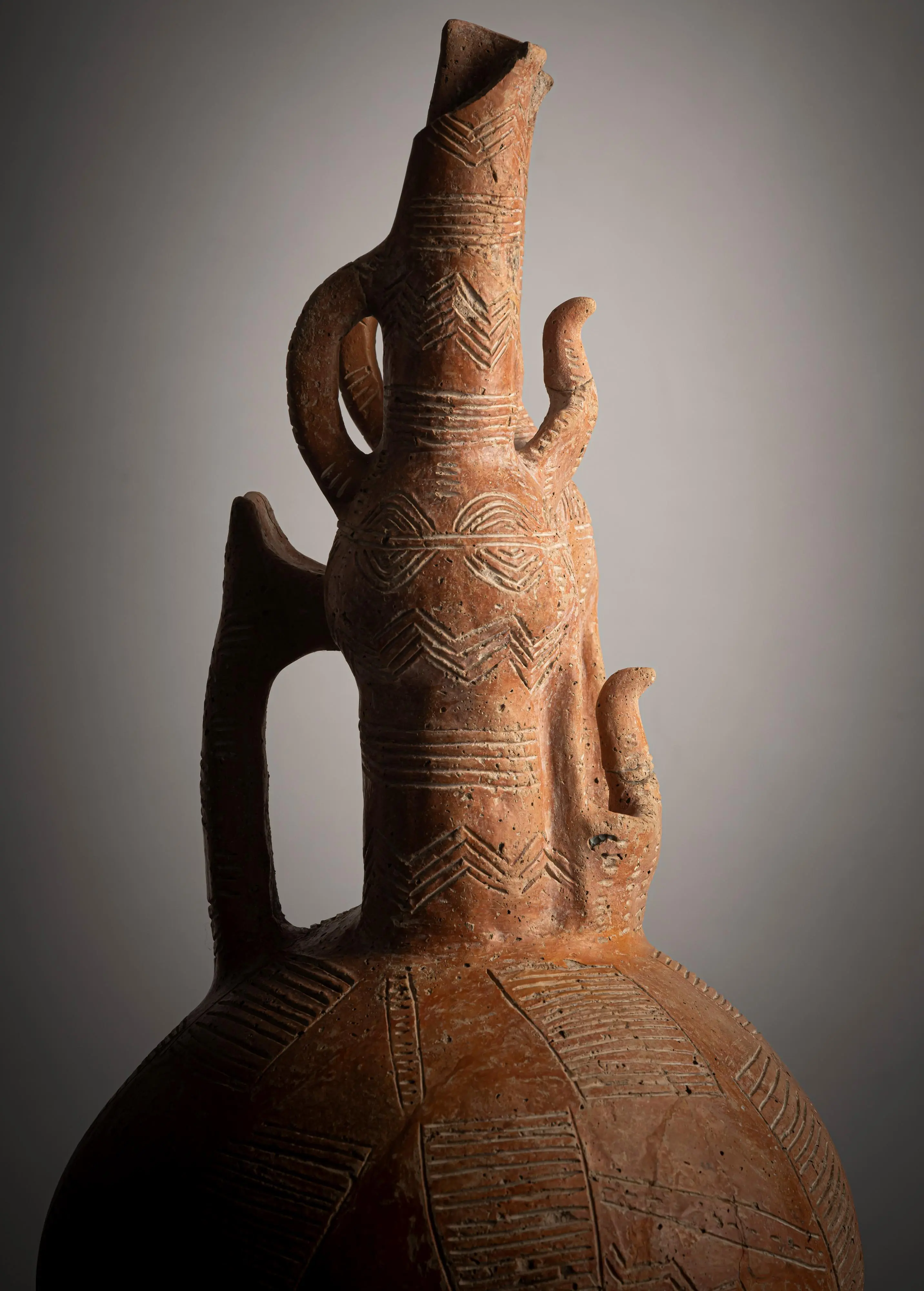
There was no potter's wheel in Cyprus until the very end of the Bronze Age, several centuries after this jug was made, so the whole thing was built by hand, coil on coil, the walls drawn up and smoothed. The decoration came next, and in a fixed order. The lines were cut into the clay while it was still leather-hard, before any slip went on and before firing, with a sharp point; only then was the surface coated in the iron-rich red slip and burnished to a shine with a smooth pebble. The cut lines were packed with a white paste, lime or gypsum, so the geometry would stand out pale on the red ground. [1] On a shape this convoluted the burnish could not reach everywhere, and the dull patches between the necks and around the handle-roots are where the pebble could not follow.
The birds were modelled separately and pressed onto the leather-hard pot before it went into the kiln, and this is where the thirty fragments matter. The parts added last, the necks drawn up thin and the birds stuck on at the front, are the first things to snap off a buried pot and the least likely to be found again when one is reassembled. On this jug they came through whole: the two birds and the necks they stand beside are original, and the body lost almost nothing in the break. A pot that arrived in thirty pieces is, against the odds, the most complete of its kind.
What the birds were for
The birds look as though they ought to mean something, and Dikaios, in 1940, partly thought so. He built a scheme of three recurring attributes on the Vounous pottery, the bull, the snake and the bird, and on his richest jug the case looks strong. That jug, number 10 from Tomb 19, is the crowded double-necked one: a man and a woman modelled embracing, ox-skulls, horned animals, and, between the two necks, a bird bending its head down to drink from a tiny cup set there for it. Dikaios thought the couple were portraits of the two people buried in the tomb. [1]
About the plainer birds, though, the ones with no couple and no cup beside them, he drew back. They "may be simply of ornamental character," he wrote, and "it is quite possible that the different attributes developed into mere ornamental motifs." [1] Half a century later Karageorghis, cataloguing the whole class, put it without the hedge: a bird was "an easy enough motif to render," and "there is no justification" for reading prehistoric Cypriot birds as symbols of anything at all. [2] The bird on this kind of jug is a habit of the workshop, repeated because it was what the shape wore.
What the jug was for is less in doubt. Pots like this were made for the grave, not the table. Where the question has been tested, on the south coast at Episkopi-Phaneromeni, the tomb pottery turned out to be poorly fired and sometimes too heavy to use, "made specifically for offerings in graves." [9] At Vounous the dead were laid in their rock-cut chambers with the pottery massed beside them and the cattle killed at the door, and an elaborate jug set among the offerings was a statement in that funerary economy. [7]
Which leaves the two birds on the front doing what they have always done on this shape: leaning out over nothing. On the jug from Tomb 19 the bird had a cup to bend to. On this one, a few workshop generations later, the cup is gone and the birds stay, kept for the look of the thing.
References
- 1.Dikaios, P. (1940). The Excavations at Vounous-Bellapais in Cyprus, 1931–2. Archaeologia, 88, 1–174. (Type II c 'big incised jugs', the double-necked variant; the bird jug of Tomb 46A no. 23, pl. xxv c; the patchwork-incised double-necked jugs of Tombs 15 and 34, pl. xxiii; the Tomb 19 jug no. 10; the triple-necked grain-grinding jug of Tomb 37; the Tomb 22 enclosure model; on the bird as ornament, pp. 125–27.)
- 2.Karageorghis, V. (1991). The Coroplastic Art of Ancient Cyprus. I: Chalcolithic to Late Cypriote I. Nicosia: A. G. Leventis Foundation. Group XII, 'Bird Figures Attached to Vases': cat. XII.12; XII.13 (Cyprus Museum, Nicosia, a composite of two jugs); XII.14 (ex-Hadjiprodromou Collection, Famagusta, lost since 1974); XII.15 (Musée du Louvre AO 17526, Vounous Tomb 54); comment p. 171 ('On jugs nos XII.13–15 the birds are fused to the body of the vase, without any support'; 'there is no justification for such a concept during the prehistoric period').
- 3.Morris, D. (1985). The Art of Ancient Cyprus. Oxford: Phaidon, pp. 86–88 ('Multi-neck vessels'; the north-coast jugs 'appear to have been made by a single Vounous artist', the south-coast jugs 'seem to be the work of a single south coast artist'; recorded heights of the north-coast group, 53–58 cm).
- 4.Frankel, D. (2012). Pottery production and distribution in prehistoric Cyprus (a pXRF study), p. 2: north-coast vessels 'made of softer clays with fewer inclusions, well suited to the fine incision which was the preferred mode of decoration'; in the central lowlands and south coast 'a hard, gritty fabric was produced, with a characteristic… mottled' surface on which 'fine incised decoration was rarely used'.
- 5.Musée du Louvre, collections.louvre.fr, inv. AO 17526 (Département des Antiquités orientales): Red Polished double-necked jug, terracotta, H 50 cm, Diam. 26.5 cm, find-spot 'Vounous tombe 54', excavated 1933 by C. F. A. Schaeffer, acquired by partage après fouilles; on display in the Sully wing, Room 300 (Levant and Cyprus).
- 6.Dunn-Vaturi, A.-C. (2001). Les fouilles de Claude Schaeffer à Vounous en 1933. Cahiers du Centre d'Études Chypriotes, 31, 13–28; and (2003) Vounous: C. F. A. Schaeffer's Excavations in 1933, SIMA 130. Jonsered: Paul Åströms Förlag. (The continuous tomb-numbering Dikaios 1–48 / Schaeffer 49–79 / Stewart 80–164; the 1933 finds divided between the Louvre and the Cyprus Museum.)
- 7.Keswani, P. (2004). Mortuary Ritual and Society in Bronze Age Cyprus. London: Equinox. (Graveside cattle slaughter and funerary feasting; the rising median, not only mean, of mortuary expenditure as evidence of consumption 'broadly based within the community' rather than a fixed hereditary elite; the curation of skulls.)
- 8.Lubsen-Admiraal, S. & Crouwel, J. (1989). Cyprus & Aphrodite. (The Zintilis Collection south-coast double-necked jugs, recorded as from Sotira–Erimi in the Limassol district, now in the Museum of Cycladic Art, Athens; cf. Karageorghis 1991, attributed to a south-coast workshop.)
- 9.Merrillees, R. S. (1973), reporting G. Weinberg's Episkopi-Phaneromeni evidence that tomb pottery was 'seldom well fired' and sometimes too large and heavy to be useful, 'made specifically for offerings in graves' (p. 63).
- 10.Knapp, A. B. (2013). The Archaeology of Cyprus: From Earliest Prehistory through the Bronze Age. Cambridge University Press, incorporating S. W. Manning's radiocarbon framework, which lowers Dikaios's 1940 absolute dates for the Early and Middle Cypriot.
- 11.Webb, J. M. & Frankel, D. (2010). Social Strategies, Ritual and Cosmology in Early Bronze Age Cyprus. Journal of Mediterranean Archaeology, 23.2: 185–216. (The carved 'house of the dead' façades of Vounous Tombs 114, 116, 117; cattle slaughtered and butchered at the graveside, joints sometimes deposited unfleshed; jars standing in the dromos; Vounous as the principal centre of the central north coast through the Early Cypriot.)
- 12.Stewart, E. & Stewart, J. R. (1950). Vounous 1937–1938: Field-Report on the Excavations of the Stewart Expedition. Skrifter utgivna av Svenska Institutet i Rom XIV. Lund. (Site A, the predominantly Early Cypriot I ground; the headless skeletons of Tomb 164A; J. R. Stewart's judgement that Vounous 'was either a leading religious centre or the population was unusually religious'.)