
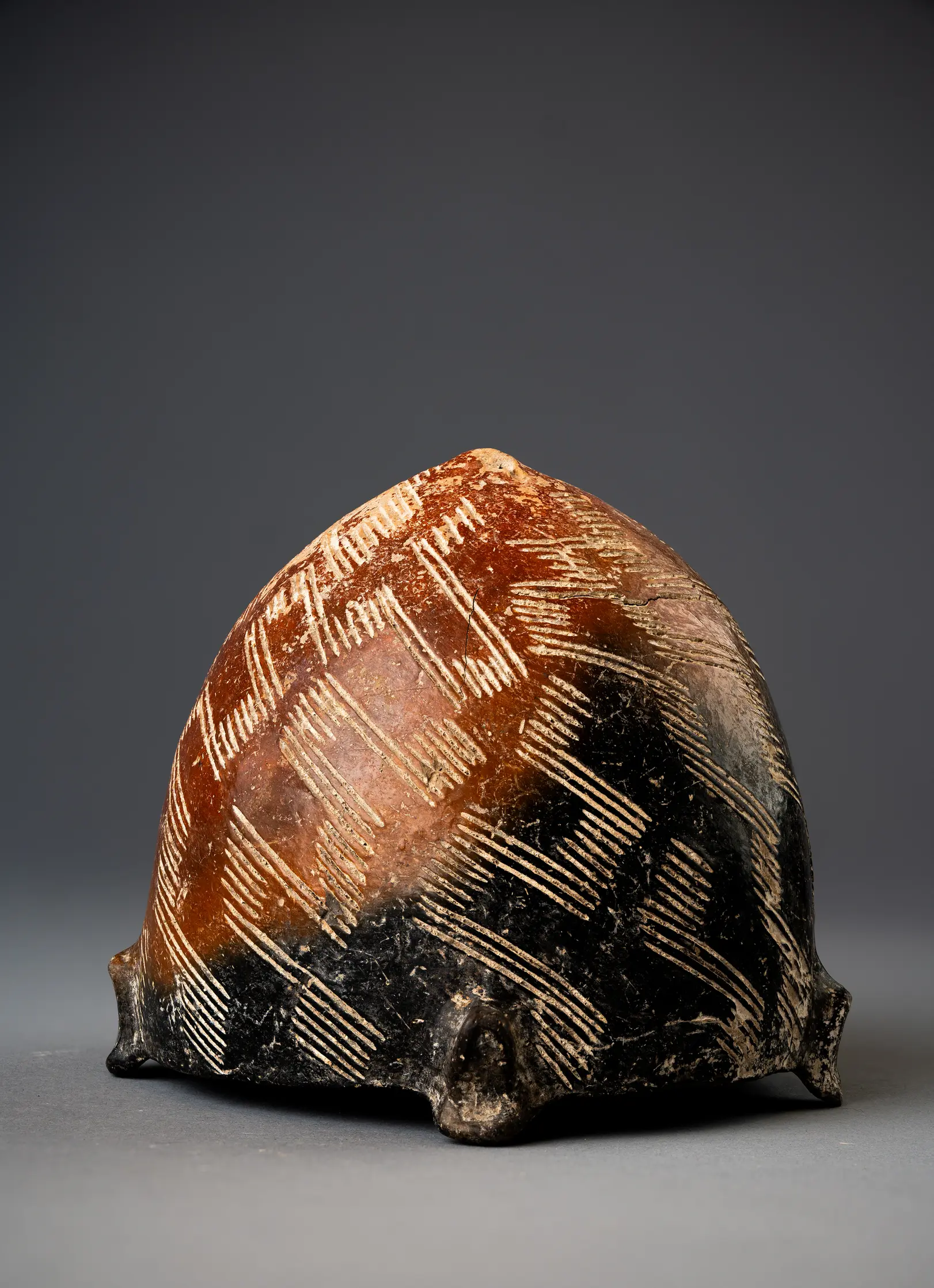
Early Bronze Age II
Black-topped Red Polished Tulip Bowl with Incised Hatched Lattice
Early Cypriot tulip-shaped drinking bowl in black-topped Red Polished ware. It has a pointed base, vertical rim lugs, and diagonal bands of white-filled incised hatching.
Date
2300 - 2000 BC
Accession No.
BWL-BA-001
Collection
Alexis Drakopoulos
Provenance
- 1960s–2025, The Goodman Collection (acquired 1965–1969; photographed on slides in 1969)
- 2025–present, Alexis Drakopoulos, London
Early Cypriot I–II, c. 2300–2000 BCE · Red Polished ware, black-topped · Hand-made, incised, lime-filled
A deep bowl of tulip form, its ovoid body drawing in to a small pointed base. The bowl is photographed resting on its rim, since it cannot stand on its base. Short vertical lugs with concave sides project from the rim; three are visible and a fourth is probably hidden at the back. The whole exterior is covered with bands of five to eight close parallel strokes, set diagonally and alternating in direction, so that the surface reads as a loose lattice or basketwork. The strokes are packed with white lime. The lower body is a burnished orange-red; the rim zone is fired black, and the black climbs unevenly up one side. The lug tips are chipped, and a fine crack runs near the base.
Commentary
The shape, the pointed base and the black-topped firing identify this as a Red Polished "tulip" bowl, Stewart's Class XIII B [1]. Among the bowls Dikaios published from Bellapais-Vounous, his Type VIIb is a small, deep, incised bowl with a horizontally pierced knob base and four projections on the rim, a close match for this shape [2]. The closest museum parallel for the lug scheme is British Museum 1939,0217.17 from Vounous, a tulip bowl with four vertical concave lugs, a pointed nipple base and white-filled incision over a surface that shades from red to black at the rim [3]. British Museum 1939,0217.3, also from Vounous, has chevrons built from incised parallel lines, the same unit that the potter here repeats across the whole body [4].
The black rim and interior were produced in the firing. The bowl was fired or cooled upside down, with the rim buried in ash or fuel, so that the top reduced to black while the exposed lower body stayed red. The lines were cut into the leather-hard clay before firing, and the white fill was pressed into the grooves afterwards; at Alambra, slip has been found lying inside the incisions, showing that on fine pieces the surface was slipped after cutting [5]. On this bowl the fill survives well across most of the hatching.
Tulip bowls of this kind belong to the north coast, above all to the cemeteries at Vounous and Lapithos, where dense white-filled incision is at home; contemporary assemblages from the south and centre of the island are largely plain [6]. The British Museum dates its Vounous examples to about 2300–2100 BCE. A date in Early Cypriot I–II, c. 2300–2000 BCE, fits the shape, the firing and the decoration. The find-place of this bowl is unrecorded.
Webb and Frankel describe tulip bowls as individual drinking cups, perhaps for a single draught [6]. The pointed base supports that reading: the bowl had to be held, passed from hand to hand, or set into a hollow. What it held is unknown; we know of no residue analyses of bowls of this type. Most complete examples come from multi-burial chamber tombs, where drinking and feasting formed part of the funeral [7].
The diagonal hatching gives the surface the look of basketry or of a gourd in a net. Such an origin for incised Red Polished patterns has often been suggested; it remains an inference from appearance. Several Vounous tulip bowls have a base pierced horizontally [3][4]; whether this one is pierced can only be seen in hand.
References
- 1.Stewart, J.R. (1962) The Early Cypriote Bronze Age. In The Swedish Cyprus Expedition IV.1A. Lund: Swedish Cyprus Expedition, Index of Types, pp. 303–348 (Class XIII B).
- 2.Dikaios, P. (1940) The Excavations at Vounous-Bellapais in Cyprus, 1931–2. Archaeologia 88, p. 86 (Type VIIb) and pp. 130–132 (incised patterns).
- 3.British Museum, London, 1939,0217.17. Red Polished tulip bowl, Bellapais-Vounous, Early Cypriot I. Collection record.
- 4.British Museum, London, 1939,0217.3. Red Polished tulip bowl, Bellapais-Vounous, Early Cypriot I. Collection record.
- 5.Coleman, J.E., Barlow, J.A., Mogelonsky, M.K. and Schaar, K.W. (1996) Alambra: A Middle Bronze Age Settlement in Cyprus. SIMA 118. Jonsered: Paul Åströms Förlag, p. 298.
- 6.Webb, J.M. and Frankel, D. (2013) Cultural Regionalism and Divergent Social Trajectories in Early Bronze Age Cyprus. American Journal of Archaeology 117, pp. 59–81 (p. 65 on tulip bowls).
- 7.Keswani, P. (2004) Mortuary Ritual and Society in Bronze Age Cyprus. London: Equinox.
More from the Catalogue
Browse related objects
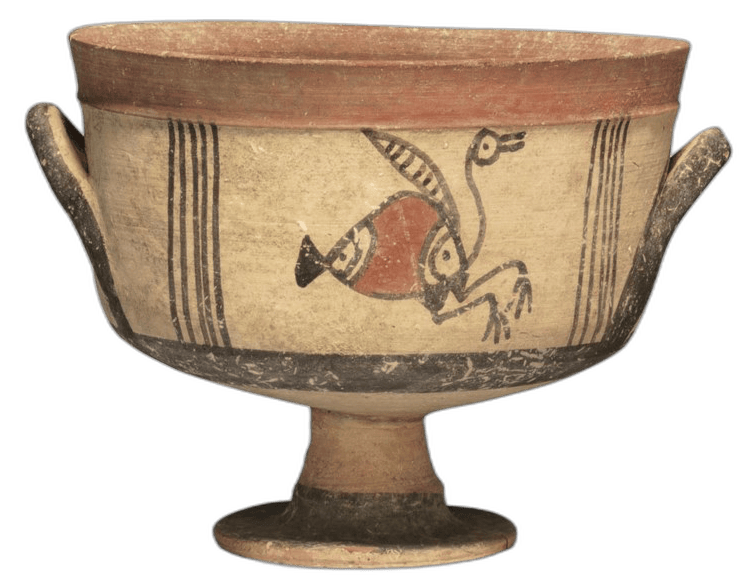
Bichrome Kylix with Bird Free Field Art
Geometric III
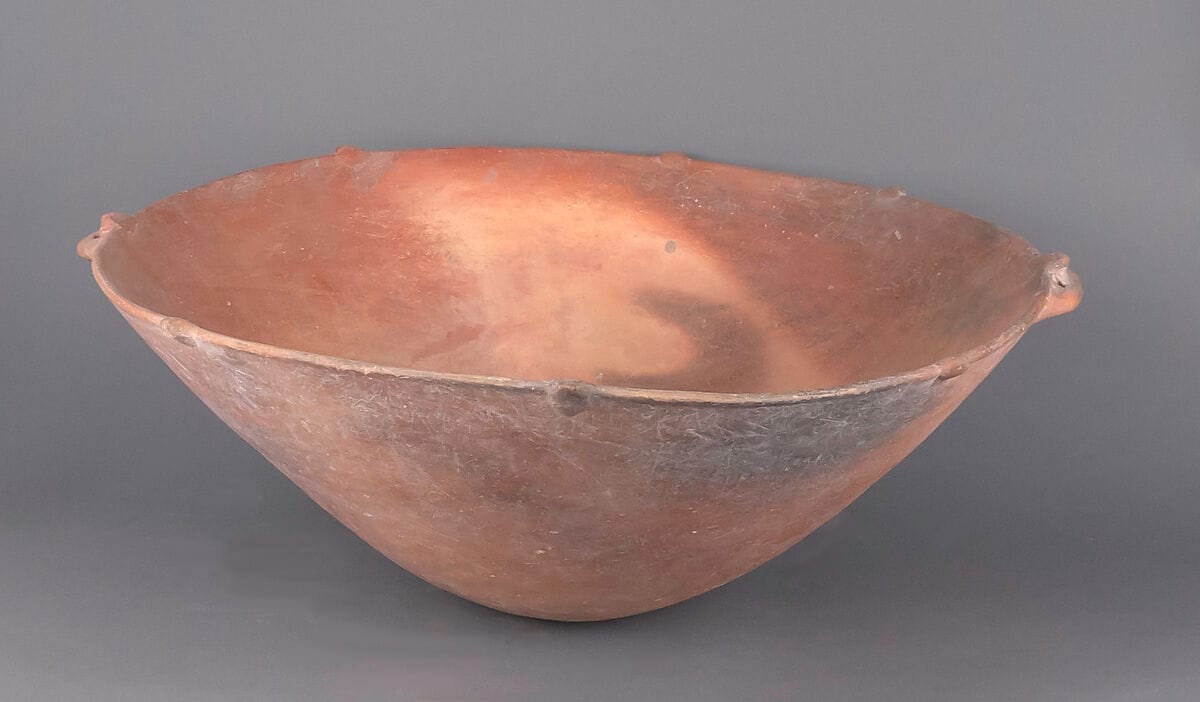
Milk bowl
Bronze Age
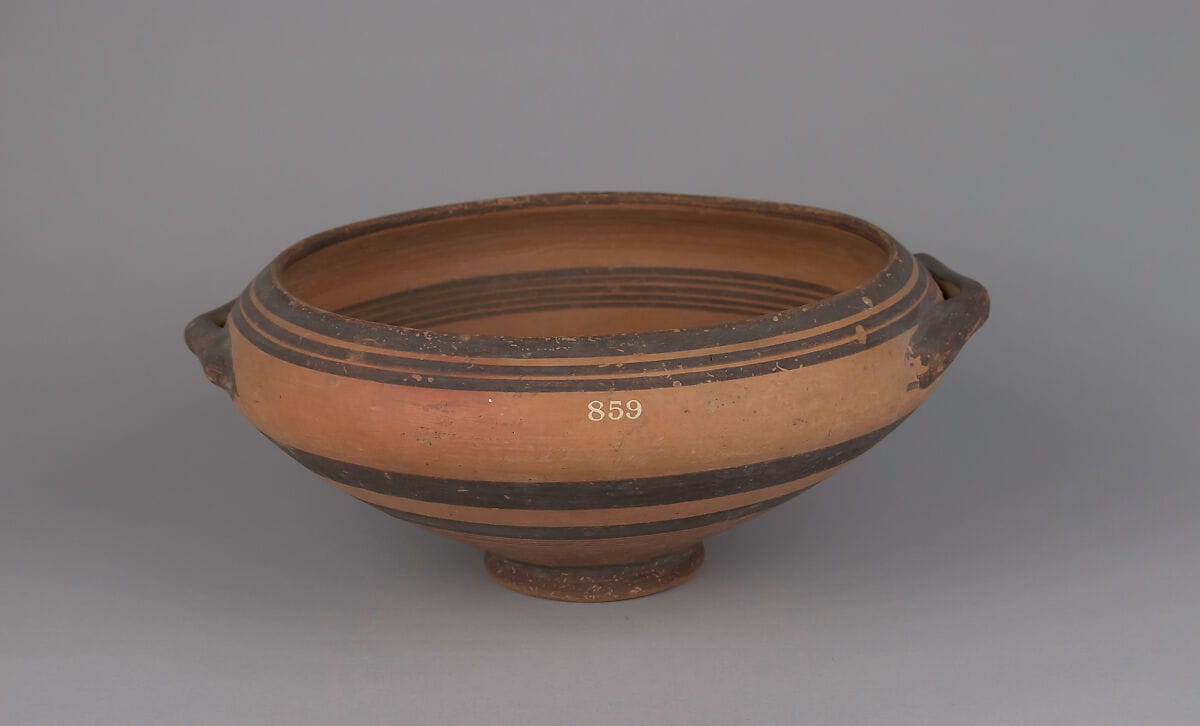
Bowl
Geometric III
Krater
Archaic I
Handle of a bowl
Bronze Age
Bowl
Geometric I
Bowl
Bronze Age
Terracotta bowl
Chalcolithic
Silver bowl
Archaic I
Alabaster bowl
Classical
Bronze phiale (libation bowl)
Archaic II
Bowl fragment, inscribed
Archaic II
Bowl
Bronze Age
Bowl
Archaic I
Bowl
Late Bronze Age II
Bowl
Geometric III
Terracotta footed bowl
Archaic I
Marble bowl fragment with Phoenician inscription
Classical