
Middle Bronze Age II
White Painted III-IV Juglet with Cut-away Neck
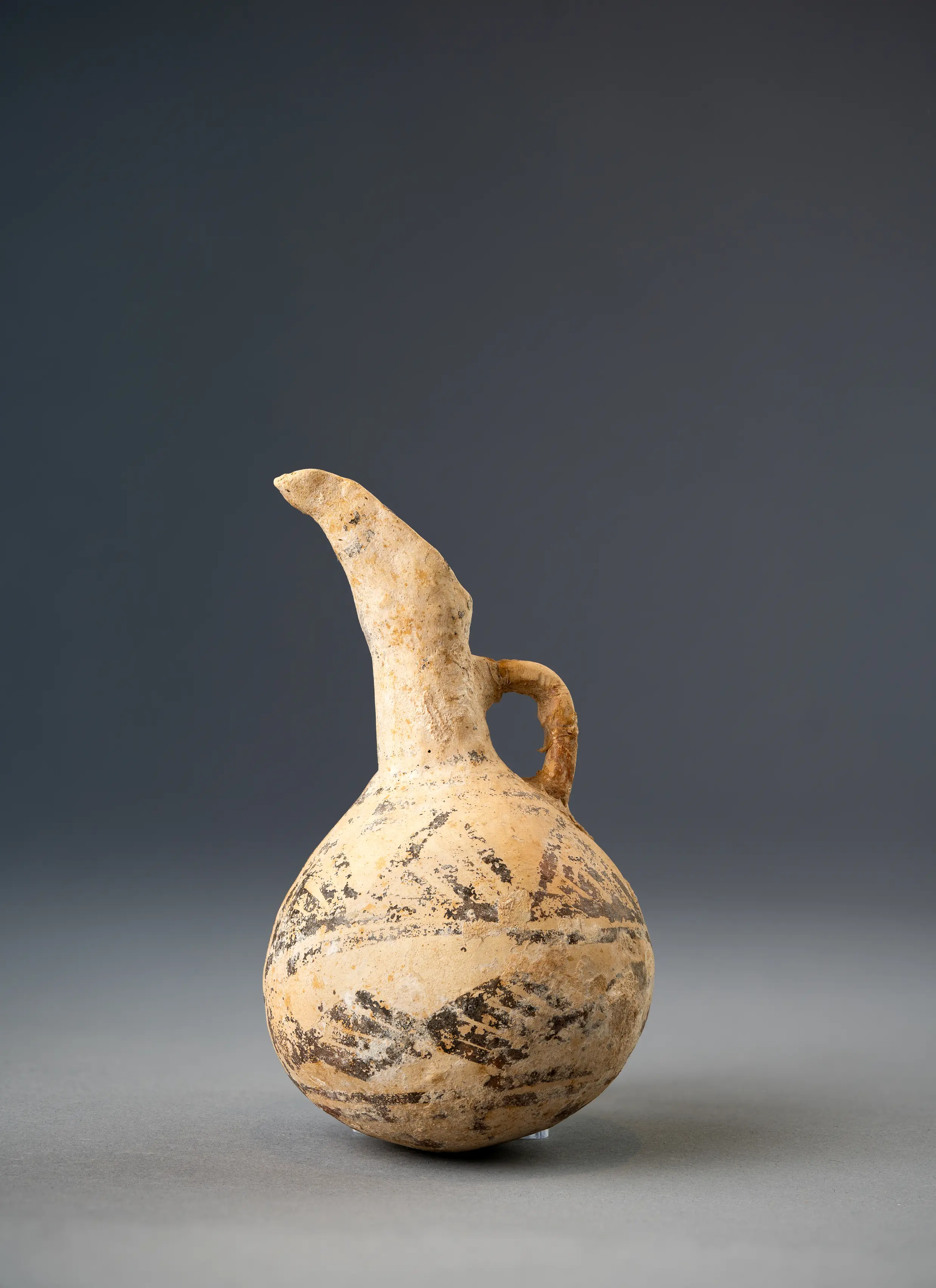
Small handmade White Painted juglet with a beaked cut-away spout and worn dark matt hatched-triangle zones on a pale buff body. Middle Cypriot II–III.
Date
1850 - 1650 BC
Accession No.
JUG-BA-015
Collection
Alexis Drakopoulos
Provenance
- 1965–1969, acquired by The Goodman Collection
- 2025–present, Alexis Drakopoulos, London
Middle Cypriot II–III, c. 1850–1650 BCE · White Painted III–IV ware · Handmade
A small handmade juglet with a near-spherical body on a rounded base. The neck is tall and tapering and leans forward, away from the handle, ending in a spout cut away obliquely into a pointed beak. A narrow strap handle runs from the lower neck to the shoulder. The pale buff surface is decorated in dark brown to black matt paint, now heavily worn: a ring of hatched triangles hangs from a line at the base of the neck, a double encircling band marks the widest point of the body, and a zone of hatched triangles or lozenges fills the lower body. Faint traces of lines survive on the neck. The neck surface is rough and pitted, and the handle is orange-brown, warmer in colour than the rest of the vessel.
Commentary
The shape is the cut-away-neck juglet, one of the defining closed forms of Middle Cypriot White Painted pottery [1]. The obliquely cut, beaked spout was inherited from the Red Polished jugs of the Early Bronze Age, and White Painted potters kept it through the whole Middle Cypriot sequence [2]. The juglet is handmade, like all Cypriot pottery of the period.
Its place within that sequence depends on the paint and the layout. The earliest White Painted cut-away jugs, such as the two large White Painted II examples of Middle Cypriot I in the National Archaeological Museum in Athens (cat. nos 40–41), are decorated in dark red glossy paint and carry plastic string-hole projections on the neck [3]. Here the paint is dark and matt and the ornament is arranged in simple horizontal zones of hatched triangles divided by encircling bands, with no plastic additions. That combination belongs to Åström's White Painted III and IV [4], whose boundaries are inconsistently applied from one catalogue to the next, so the range White Painted III–IV is used here. A date of Middle Cypriot II–III, c. 1850–1650 BCE, follows [5].
The closest parallel we know of is a White Painted III juglet in the British Museum (1982,0721.62), a globular vessel with rounded base, tubular neck and cutaway mouth, with a handle from mid-neck to shoulder and lattice panels between horizontal encircling lines, dated Middle Cypriot II–III and 12.8 cm high [6]. The Cesnola beaked jug in New York (Metropolitan Museum 74.51.1036) is of the same family, and a larger jug of the class with lattice bands is in Stockholm (Medelhavsmuseet MM Acc 0871), dated Middle Cypriot III.
Juglets of this size held small quantities of liquid for pouring. Most known examples come from chamber tombs, especially on the north coast at Lapithos and Vounous, where they were placed with bowls and amphorae among the grave goods. The find-spot of this juglet is not recorded.
The handle needs examination in hand. Its orange-brown colour and surface differ from the pale, worn body and neck, and it may be a restoration or a re-attached original. No painted decoration is visible on it, where transverse strokes would be usual.
References
- 1.Frankel, D. (1974) Middle Cypriot White Painted Pottery: An Analytical Study of the Decoration. Studies in Mediterranean Archaeology 42. Göteborg: Paul Åströms Förlag, pp. 32–36.
- 2.Karageorghis, V., Mertens, J.R. and Rose, M.E. (2000) Ancient Art from Cyprus: The Cesnola Collection in The Metropolitan Museum of Art. New York: The Metropolitan Museum of Art, p. 48.
- 3.Karageorghis, V. (2003) Ancient Cypriote Art in the National Archaeological Museum of Athens. Athens: A.G. Leventis Foundation, cat. nos 40–41.
- 4.Åström, P. (1972) The Swedish Cyprus Expedition IV:1B. The Middle Cypriote Bronze Age. Lund: The Swedish Cyprus Expedition.
- 5.Manning, S.W. (2013) 'Appendix: a new radiocarbon chronology for prehistoric and protohistoric Cyprus', in A.B. Knapp, The Archaeology of Cyprus: From Earliest Prehistory through the Bronze Age. Cambridge: Cambridge University Press.
- 6.British Museum, London, 1982,0721.62. White Painted III juglet, SCE type IV B 8 f, Middle Cypriot II–III, H. 12.8 cm. Collection online record.
More from the Catalogue
Browse related objects
Bichrome Oinochoe
Archaic I
Free-field bichrome jug with image of an Ibis bird and reeds
Archaic
Squat bichrome jug in free-field style with image of bird picking a lotus flower
Archaic
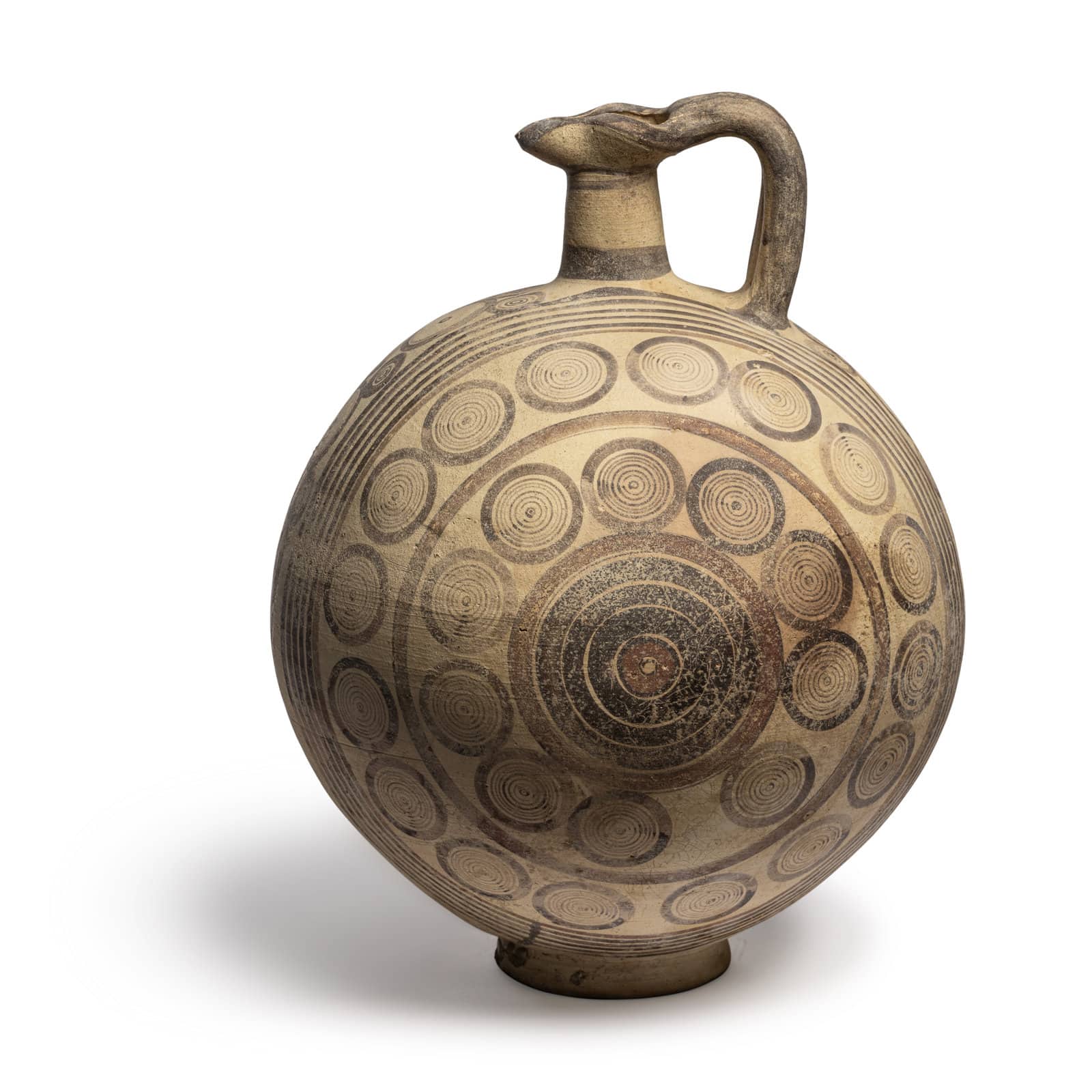
A Cypriot Bichrome-Ware Oinochoe Jug
Archaic I
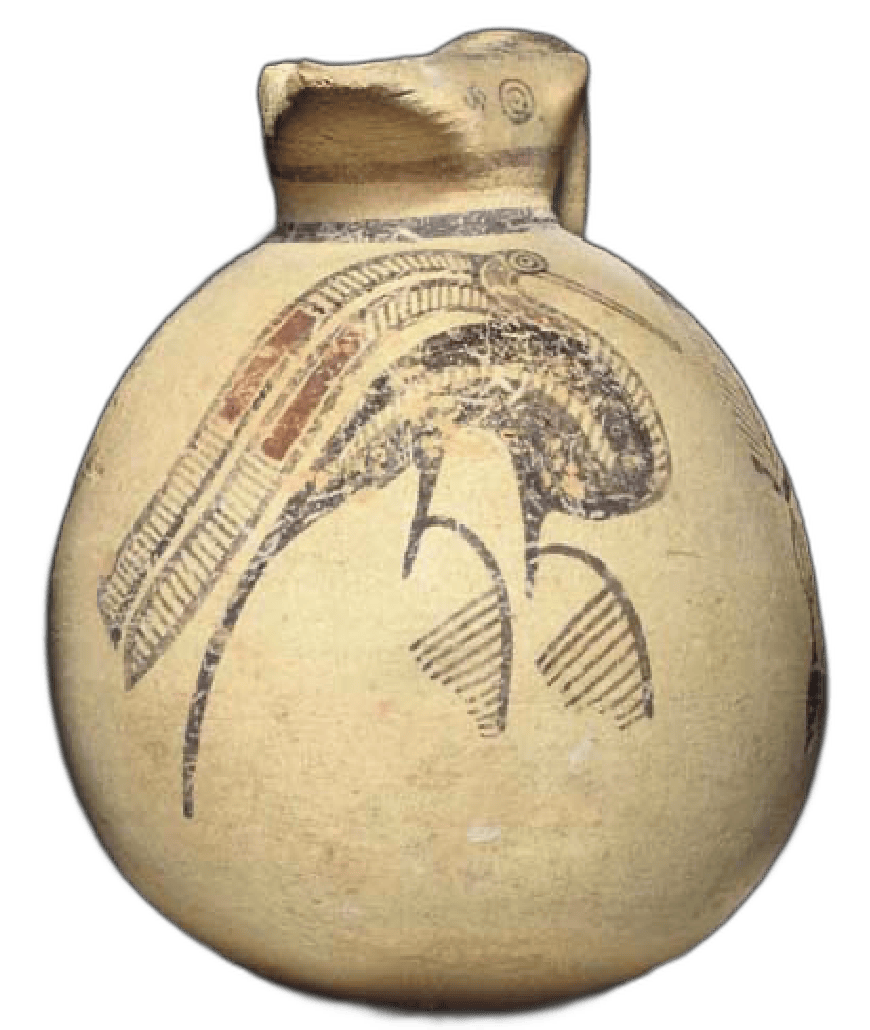
Oinochoe with Free Field Bird
Archaic I
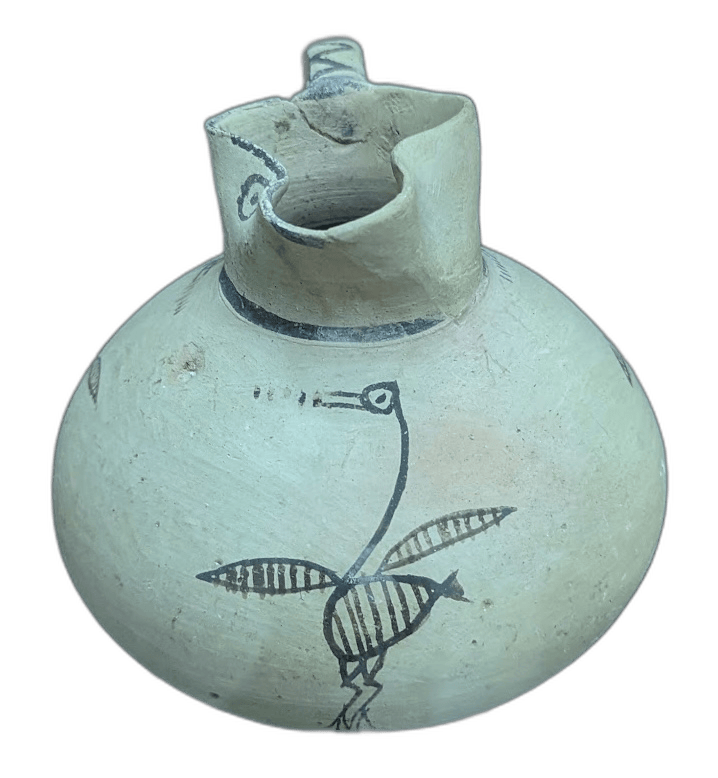
Small Oinochoe with Free Field Bird
Archaic I
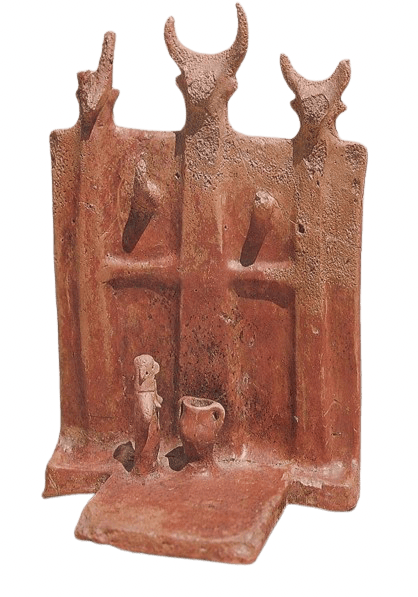
Red Polished Shrine
Middle Bronze Age I
Black-On-Red Geometric Jug Sherd
Geometric II
Bichrome Jug
Geometric
Bichrome Juglet
Geometric
Bichrome Oinochoe
Geometric
Juglet
Archaic II
Oinochoe
Geometric III
Jug
Archaic I
Juglet
Archaic I
Jug
Geometric I
Terracotta jug
Early Bronze Age I
Juglet
Geometric I