
Contents
Cyprus wrote with syllables for more than a thousand years. From about 1600 BCE, when the first signs were pressed into clay at Enkomi, to the early second century BCE, when potters at a rural sanctuary near Nicosia were still scratching dedications to a Nymph in the old script, the island kept a syllabic writing tradition of its own while its neighbours used cuneiform, hieroglyphs and, later, the alphabet [1, pp. 6, 235–240]. That tradition had two main phases: Cypro-Minoan in the Late Bronze Age, still undeciphered, and the Cypriot Syllabary of the Iron Age, which wrote both Greek and a non-Greek language called Eteocypriot. Beside it ran Phoenician from the ninth century and the Greek alphabet from the Classical period. This entry is an overview of who wrote what, on which objects, and how the scripts were deciphered. It belongs with the daily life hub and its companion entry on food and diet; the site's older article on the languages of Bronze Age Cyprus covers some of the same ground.
Cypro-Minoan: the Bronze Age script
The earliest writing on Cyprus is a fragmentary clay tablet from Enkomi, catalogued as ##001 in the modern corpora and dated probably to Late Cypriot IB, which on the conventional chronology falls in the late sixteenth or fifteenth century BCE. Two other Enkomi pieces may be slightly older: a clay label, sometimes called a weight, from an LC IA–B context, and a cylinder seal dated on style to LC IA. On Manning's revised radiocarbon scheme all three could go back to the seventeenth century [1, p. 6]. They appeared as Enkomi grew into a coastal town exporting copper, and Philippa Steele notes that all three can be linked to elite or administrative activity, the tablet having been found near evidence for copper working [1, pp. 8–16]. The wider economic setting is described in the entry on copper metallurgy.
Arthur Evans, relating the early Cypriot signs to the Cretan scripts he was studying, coined the name "Cypro-Minoan" in 1909. The characters are morphologically closest to Minoan Linear A, although the earliest tablet was written in a cuneiform manner, the signs punched and bent into the clay rather than drawn [2, pp. 373–374, 380]. Why Cypriots borrowed an Aegean script when Akkadian cuneiform was in use next door, and when the king of Alashiya was exchanging cuneiform letters with Egypt, Hatti and Ugarit by the fourteenth century, is an open question; Steele argues that from the start the island produced a writing system that was recognisably its own [1, pp. 39–41].
The corpus is small. Nicolle Hirschfeld counted about 200 inscriptions excluding potmarks, most of them one or two sign-groups of fewer than ten signs, and fewer than 3,000 signs in total; Steele gives nearly 250 [2, pp. 373, 381; 1, p. 77]. Cassandra Donnelly counts more than twenty find-sites over a span of more than six hundred years [4, p. 42]. Enkomi has produced over a hundred inscriptions, the Larnaca Bay towns of Kition and Hala Sultan Tekke about thirty between them, and inland sites usually one or two. Off the island, the script was certainly used at Ugarit on the Syrian coast, where one complete tablet and fragments of three others were found in residential archives; claims for Cypro-Minoan at Ashkelon in the twelfth and eleventh centuries remain unproven [2, pp. 377–379].
Nobody can read it. There is no bilingual, the texts are short, and the corpus is too small for the statistical methods that cracked Linear B [2, p. 381]. The most basic question, how many signs the script had, has no agreed answer: Émilia Masson's 1974 table listed 125, Silvia Ferrara's 2005 study 84, Miguel Valério between 57 and 70, and Martina Polig and Donnelly's 2022 shape-based signary 88 signs with 278 variants [2, p. 375; 4, pp. 24–25; 5]. Masson also divided the material into CM 1 (the common script), CM 2 (three long tablets from Enkomi, which she attributed to a newly settled group writing a different language) and CM 3 (the Ugarit texts). Palaima, Ferrara, Hirschfeld, and Polig and Donnelly all reject or doubt that division and treat Cypro-Minoan as a single script, while Steele thinks a real case can be made for two or three systems under the one name [2, p. 381; 5; 1, p. 76]. Whether the tablet ##001 is an early experimental form of the same script is also argued [1, pp. 20–31].
Clay balls, cylinders and potmarks
What Cypro-Minoan was used for is known mostly from the objects that carry it. The commonest inscribed object is a small clay ball about 2 cm across, inscribed before firing with two to eight signs. Some ninety are known, the great majority from Enkomi, a handful from Hala Sultan Tekke and Kition, and one from Tiryns on the Greek mainland; all date to LC IIC–IIIB, the last phases of the Bronze Age [3, pp. 71–72]. They have been read as weights, as gaming marbles (Porphyrios Dikaios, the excavator of Enkomi), as votives and as divination pieces. The current consensus, following Masson, is that the first sign-group is a personal name; Ferrara and Valério add that the balls may have been drawn as lots to call named individuals to tasks [3, pp. 71–73]. A terracotta ball from Enkomi in the British Museum, 1897,0401.766, is a typical example; the first five such balls were found at Enkomi and Hala Sultan Tekke by a British Museum expedition about thirty years after 1869 [2, p. 374]. Two balls of the same form from Ugarit are inscribed in the local cuneiform alphabet [3, p. 72].
The long texts are on eight tablets and six clay cylinders: one large cylinder from Enkomi (13 cm high) and five smaller ones from Kalavasos-Ayios Dhimitrios. Masson read the Kalavasos cylinders as foundation deposits because their first lines seemed to share a formula; Smith showed that some are palimpsests, rubbed down and rewritten, and argued for an administrative use [2, pp. 375, 381–382]. Short inscriptions also appear on bronze bowls, miniature ingots, pithos lids, spindle whorls, weights, a bull figurine, and more than two dozen stamp and cylinder seals [2, pp. 375–376].
Potmarks are the frontier of the corpus. Single signs were incised on the handles and shoulders of plain jugs and on pithos rims, sometimes matching signs in true inscriptions, and Hirschfeld has argued that most marks on the handles and bases of Mycenaean vases found around the eastern Mediterranean belong to a Cypriot marking system used by people handling the pots in trade [2, pp. 376–379]. If those marks count as writing, even rural manufacturing and farming sites took part in a literate system, since they almost always yield a few. Donnelly's reading of the evidence is that Cypro-Minoan was a script of merchants and mercantile objects, written outside scribal schools, which is one reason it survived the collapse of the palace scripts around 1200 BCE [4, abstract].
From Cypro-Minoan to the Syllabary: the Opheltas obelos
In 1979 Vassos Karageorghis excavated Tomb 49 in the Skales cemetery at Palaepaphos, a chamber tomb dated to Cypro-Geometric I (c. 1050–950 BCE) with about two hundred objects, including nine bronze bowls, two strainers, a tripod and three bronze spits [6, pp. 71–73; 1, pp. 57–58]. The three obeloi were found leaning upright against the dromos wall near the entrance. The longest, 87.2 cm, carries five incised signs, o-pe-le-ta-u, "of Opheltas", a Greek personal name in the genitive with the ending -āu that is typical of the later Cypriot dialect [6, pp. 71–72]. Apart from the Mycenaean Linear B archives, it is the earliest Greek text anywhere in the Mediterranean, and the earliest on Cyprus by perhaps two centuries [1, p. 56]. The other two spits carry a repeated sign with a divider and two isolated signs; a stone block in the rubble blocking the tomb carries two more signs [1, pp. 58–59]. The use of spits at funerary feasts is covered in the food and diet entry.
The script is disputed. Émilia and Olivier Masson, who published the text in 1983, took it as the earliest Cypriot Syllabary, ancestral to the later Paphian variant. Jean-Pierre Olivier argued that the signs are purely Cypro-Minoan used with values that later passed to the Syllabary; many scholars accept this and others do not [6, p. 73; 1, p. 57]. Bernard Knapp notes that the writer used a mixture of "Common" and local Paphian sign forms (for le and u), and that writing one's name on a possession is a Cypriot and Levantine habit unknown in Linear B [7]. Steele's own position is that the Cypro-Geometric inscriptions belong to one evolving syllabic tradition and that forcing them into one category or the other is anachronistic [1, pp. 57, 83].
The historical weight placed on the obelos is also contested. Maria Iacovou reads it as a chronological marker for the arrival of Greek speakers of the Arcado-Cypriot group and for the adoption of the syllabary to write their language by about 1000 BCE [8]. Knapp, following Susan Sherratt, stresses that it is "a thoroughly Cypriot artifact" in a Cypriot tomb, and that if Olivier is right about the script the object says nothing about a migration [7]. The broader argument about Greek settlement is set out in the entry on the Mycenaeans.
Fewer than twenty inscriptions can be dated with confidence to the whole Cypro-Geometric period [1, p. 55]. Steele reads this gap as a problem of survival, since writing on clay balls, tablets and cylinders ends by the eleventh century (the latest ball is mid-eleventh century), inscribed vase handles stop with one from Kition, and cylinder seals give way to stamp seals, while the syllabic tradition itself was plainly handed on from one generation to the next. Palaepaphos and Kition have syllabic writing in every period from the Late Bronze Age to the Hellenistic, close to a thousand years [1, pp. 84–85].
The Cypriot Syllabary and the Greek of Cyprus
The developed Cypriot Syllabary appears with certainty in eighth-century inscriptions. It had about 55 signs, each an open syllable (a vowel, or consonant plus vowel), and two standard varieties: the Paphian, used around Paphos and usually written left to right, and the Common, used elsewhere and usually written right to left. Some sign values have different shapes in the two, and the earliest syllabic texts show that the two varieties diverged over time [1, pp. 77–78]. The first surviving royal inscriptions are seventh-century texts naming Eteandros, king of Paphos, found at Kourion [1, p. 55].
The language written with it was the Cypriot dialect of Greek. Its closest relative is Arcadian, spoken in the Peloponnese, and the pair (Arcado-Cypriot) is the historic Greek dialect group closest to the Mycenaean Greek of Linear B. Iacovou, citing Anna Morpurgo Davies, explains the likeness by common descent from a Mycenaean-period dialect, fossilised on Cyprus by isolation from other Greek speakers until the end of the fourth century BCE and later [8].
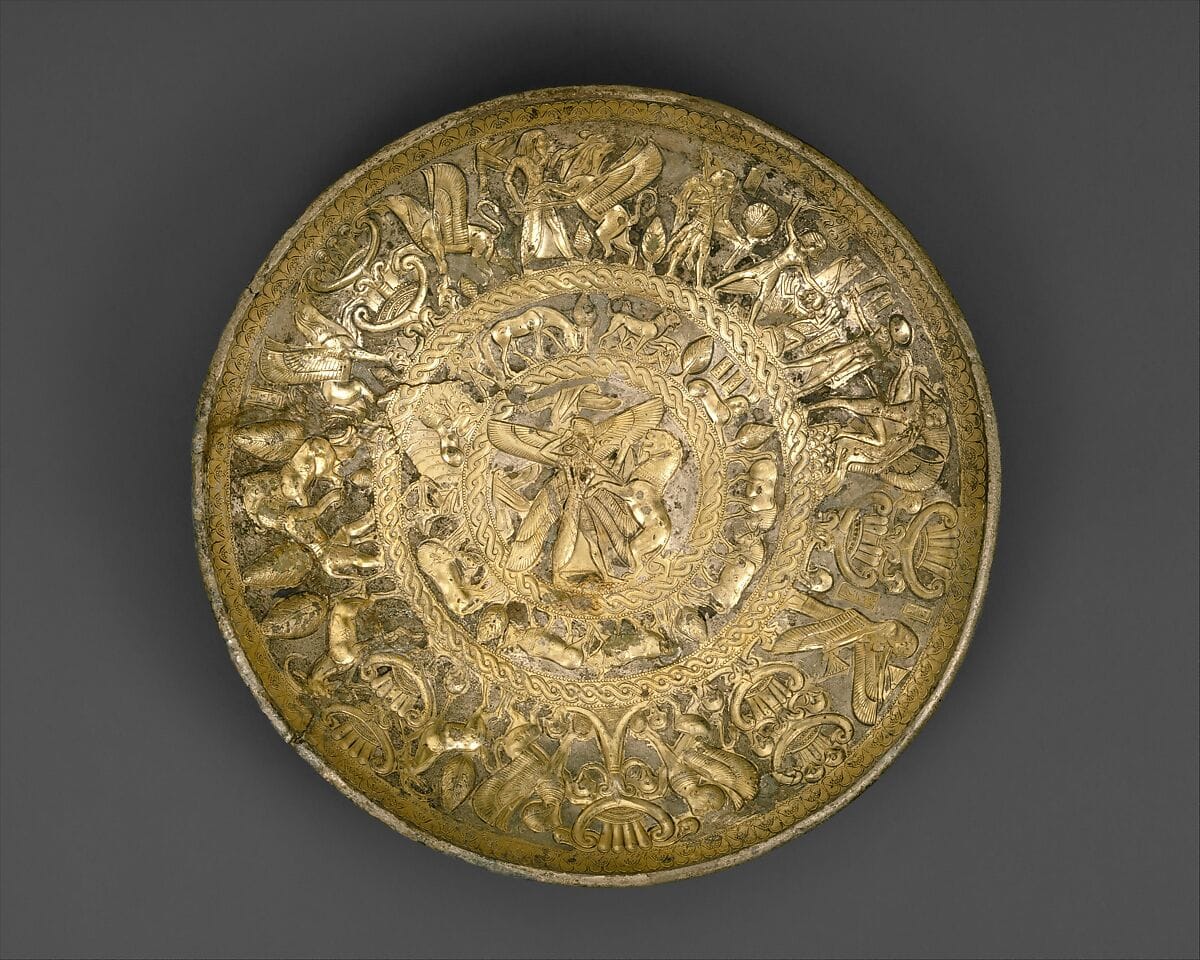
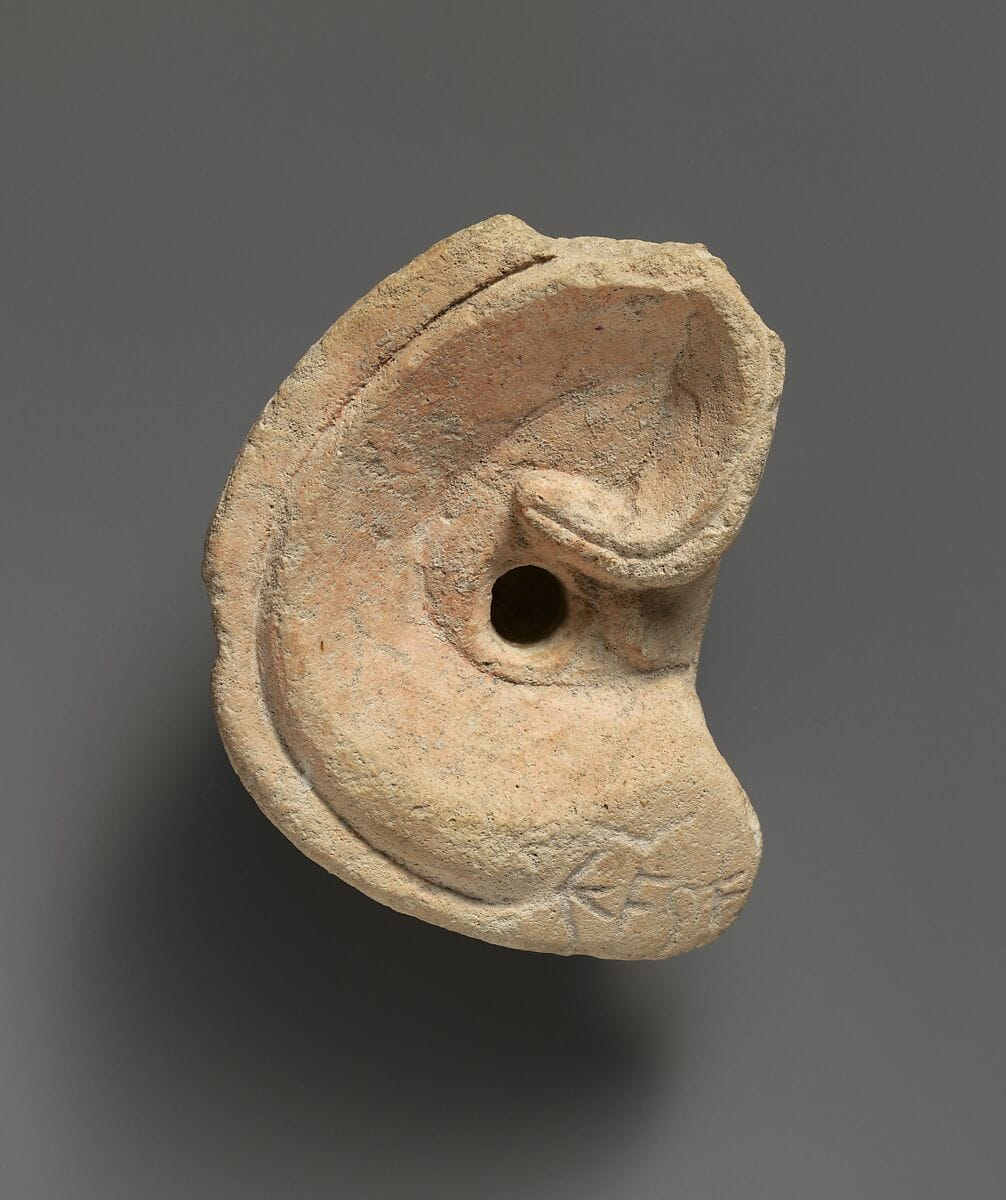
A syllabic text is usually short and practical. Karageorghis describes a silver-gilt bowl from Kourion in the Cesnola Collection, dated about 725–675 BCE, with thirteen syllabic signs reading "I am [the bowl] of Akestor, king of Paphos", partly erased and supplemented by a second inscription, "I am [the bowl] of Timokretes", presumably when the bowl changed owner [9, no. 299]. The bowl is on this site as a silver-gilt bowl and in the Met's record as 74.51.4554. Names on precious possessions, dedications in sanctuaries, epitaphs and coin legends make up most of the corpus. A small limestone votive ear from the sanctuary at Golgoi has four syllabic signs on the lobe, read tentatively as "I belong to a deaf person" [10, cat. 396]. Coins of Idalion carry the city name in syllabic signs, i-da-li, around a seated sphinx, as on a fifth-century tetrobol in the Berlin Münzkabinett [1, p. 166]. A Cypro-Classical limestone inscription in syllabic Greek from Marion, allocated by the Cyprus Exploration Fund in 1890, is in the Ashmolean as AN1890.707.
Eteocypriot: a readable script, an unread language
The Syllabary also wrote a language that is not Greek. Because each sign has a known sound value, these texts can be read aloud, but most of their words cannot be understood. Between 20 and 30 inscriptions show the features that define "Eteocypriot", and most come from Amathus [1, p. 134]. The anchor text is a black marble slab from Amathus of the late fourth century BCE, with an Eteocypriot text in the Syllabary above a Greek text in the alphabet. The Greek half is a standard honorific in Koine Greek: "The city of the Amathusians, [to] Ariston, son of Aristonax, well-born". The Eteocypriot half gives the same names with non-Greek endings (a-ri-si-to-no-se a-ra-to-wa-na-ka-so-ko-o-se) and is roughly twice as long, so it may say more [1, pp. 138, 176–179]. Three fragmentary bilinguals from Amathus include a statue dedication for the son of King Androcles and a dedication to Cypriot Aphrodite naming the same king [1, p. 179].
What can be recovered is a set of noun endings (-o-se, -i, -o, -o-ti), a handful of recurrent words such as a-na, and a phonology that kept /w/ and /y/ stable when Cypriot Greek was losing /w/. None of this matches a known language family. The usual assumption is that Eteocypriot continued a language spoken on the island in the second millennium BCE, and Steele points to Cypro-Minoan sign-groups ending in sign 023 (cognate with ti) as the best hint of a link with the Eteocypriot -o-ti ending [1, pp. 135–136]. Eteocypriot speakers also wrote outside Amathus: two Eteocypriot graffiti appear among the Greek syllabic graffiti at Abydos in Egypt [1, p. 142]. Pseudo-Skylax, a fourth-century geographer, called the people of Amathus "autochthonous", which Steele treats as an outsider's label that may reflect local language use [1, pp. 152–153]. The site article on the ancient city of Amathus gives the archaeological setting.
Phoenician at Kition and Idalion
The Phoenician alphabet arrived with the Phoenicians and was the first new script on the island since the Bronze Age. The oldest Phoenician text found in Cyprus is a gravestone of about 900 BCE, now in the Cyprus Museum, with a warning to passers-by that invokes Baal; it is also the earliest inscribed gravestone on the island, a type unknown in Cypro-Minoan [1, p. 72]. A Bichrome II sherd from Salamis with four letters belongs to the ninth century, and a Red Slip bowl of 800–750 BCE from the temple of Astarte at Kition-Kathari probably names the goddess [1, pp. 73–74]. Eighth-century bronze bowl fragments from the Limassol-Amathus area record a dedication to "Baal of Lebanon" by the governor of Qartihadasht, "servant of Hiram" king of Tyre; Qartihadasht has most often been identified with Kition, though the identification is inferred [1, p. 75].
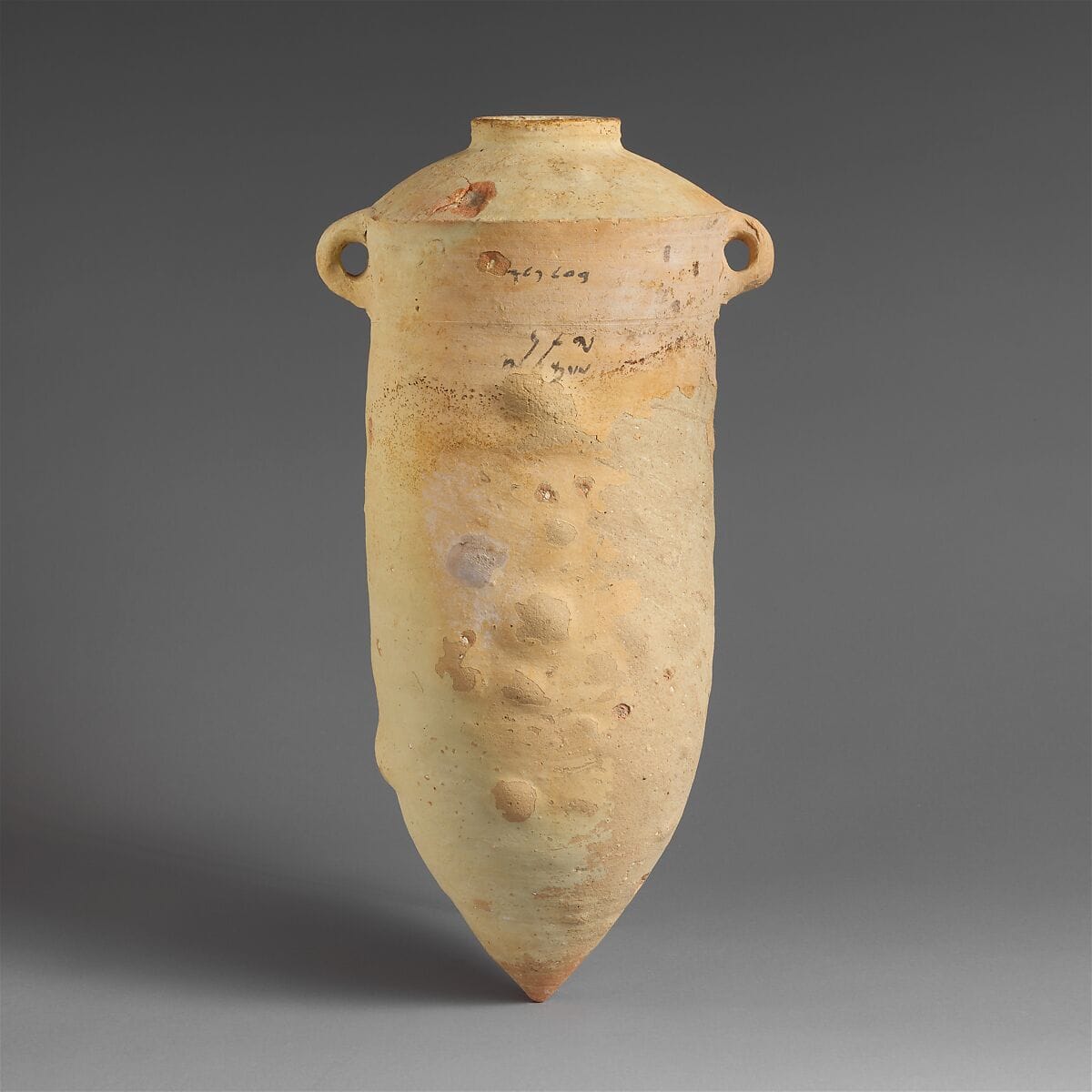
At Kition Phoenician became the language of the city and its kings. Steele counts 155 Phoenician inscriptions there, including religious and funerary texts, ostraca and accounts, against three Greek; amphora stamps reading ke-ti in the Syllabary may be the Phoenician city name KTY written syllabically [1, pp. 167–168]. When Kition annexed Idalion in the mid-fifth century, its kings styled themselves "king of Kition and Idalion" [1, p. 166]. Idalion is now the largest source of Phoenician texts on Cyprus, 733 inscriptions of which 716 are administrative documents from recent excavations that remain unpublished [1, p. 159]. The history of those excavations is told in the history of Idalion's expeditions. A Cesnola amphora with a painted Phoenician inscription, 74.51.2300, is on this site as a terracotta amphora with Phoenician inscription.
Bilinguals show the two communities writing side by side. A statuette base from the sanctuary of Apollo at Idalion, now in the British Museum, is dated to the fourth year of Milkyaton, king of Kition and Idalion, probably 388 BCE, and records in Phoenician and in syllabic Greek a statue given by Baalrom son of Abdimilk to Reshep Mikal, equated with Apollo [1, pp. 179–181]. Two further bilingual bases from the Apollo sanctuary at Tamassos-Phrangissa, dated in Milkyaton's reign, are in the British Museum as 1892,1213.11 and 1892,1213.12 [1, p. 189].
The Idalion bronze tablet
The longest text in syllabic Greek is a bronze tablet from Idalion, inscribed on both sides with 31 lines and fitted with a handle for display in the sanctuary of Athena [11; 14, p. 15]. It opens: "When the Medes and the Kitians besieged the city of Idalion". King Stasikypros and the city (ptolis) had asked the physician Onasilos, son of Onasikypros, and his brothers to treat the wounded without fee. In place of the promised silver talent from the treasury, they gave the brothers royal land in the district of Alampria, tax-exempt and saleable, and gave Onasilos alone a further plot; the tablet was deposited with Athena, and anyone who broke its terms was cursed [11]. Earlier scholars tied the siege to the Ionian Revolt; Steele and Catherine Kearns place the tablet somewhat later in the fifth century [1, p. 150; 11]. Steele notes that the text names the attackers only as "Medes" and "Kitians", never as Phoenicians, and the defenders only as Idalians: Cypriots in their inscriptions identify themselves by city [1, pp. 151–152]. The period is covered in the Cypro-Classical chronology entry.
The tablet was found in 1849, acquired by the Duc de Luynes in 1850, published by him in 1852 and given to the Bibliothèque nationale, where it is in the Cabinet des Médailles as bronzes inv. 2297 [13; 12]. It is often confused with the Idalion bilingual, a different object in London.
Who wrote and who read
No source says how many Cypriots could read. The evidence is the range of people and objects that carry writing. Kings wrote their names on silver bowls and coins and, from the fifth century, set up political and dedicatory inscriptions; Steele finds nothing of that monumental type on Cyprus before the fifth century [1, p. 84]. Sanctuaries collected written dedications, such as the Golgoi reliefs and eighteen inscribed stone drums from the Paphos area. Traders and potters marked vessels. Signs were scratched under the feet of cups: three syllabic signs are incised inside the foot of an imported Attic black-gloss bowl from Salamis in the British Museum, 1914,0307.5. Seals carried Cypro-Minoan in the Bronze Age and syllabic signs in the Iron Age [1, pp. 84–85; 2, p. 376].
Several details suggest literacy spread beyond officials. The syllabic tradition survived the end of Late Bronze Age administration, which Steele takes as a sign that writing was used outside elite and administrative circles [1, p. 85]. People occasionally put writing on object types that normally carry none, such as a figurine inscribed before firing [1, p. 127]. Abroad, Cypriot soldiers left syllabic graffiti in Egypt: the group at the temple of Achoris at Karnak, probably mercenaries of the fourth century, kept the Common and Paphian repertoires and writing directions distinct, which Steele reads as local pride [1, pp. 78, 214]. Writing also marked city identity. Iron Age inscriptions identify people by city, never as Cypriots, although Greek names such as Philokypros and Kuprophilos express attachment to Cyprus as a whole [1, p. 152].
| Script | Language(s) | Date range | Key documents |
|---|---|---|---|
| Cypro-Minoan | Unknown; possibly more than one | c. 1600–1050 BCE (LC IA to LC IIIB), perhaps into Cypro-Geometric I | Enkomi tablet ##001; Enkomi clay balls and cylinder; Kalavasos-Ayios Dhimitrios cylinders; Ugarit tablets ##212–215 |
| Akkadian cuneiform | Akkadian (diplomatic) | 14th–13th c. BCE | Letters of the king of Alashiya at Amarna, Hattusa and Ugarit |
| Cypriot Syllabary (Paphian and Common) | Arcado-Cypriot Greek | c. 1050 BCE (Opheltas obelos, script disputed); securely from 8th c.; to 2nd–1st c. BCE | Opheltas obelos; Akestor bowl; Idalion bronze tablet; Kafizin dedications; Nea Paphos sealings |
| Cypriot Syllabary | Eteocypriot (non-Greek) | Chiefly 4th c. BCE | Amathus bilingual; Androcles inscriptions; Abydos graffiti |
| Phoenician alphabet | Phoenician | c. 900 BCE to 3rd–2nd c. BCE | Gravestone of c. 900 BCE; Baal of Lebanon bowls; Kition archive; Idalion administrative texts; Milkyaton bilinguals |
| Greek alphabet | Koine and other Greek | Public use from the 4th c. BCE; standard after c. 200 BCE | Greek half of the Amathus bilingual; most Kafizin texts |
The long end of the Syllabary
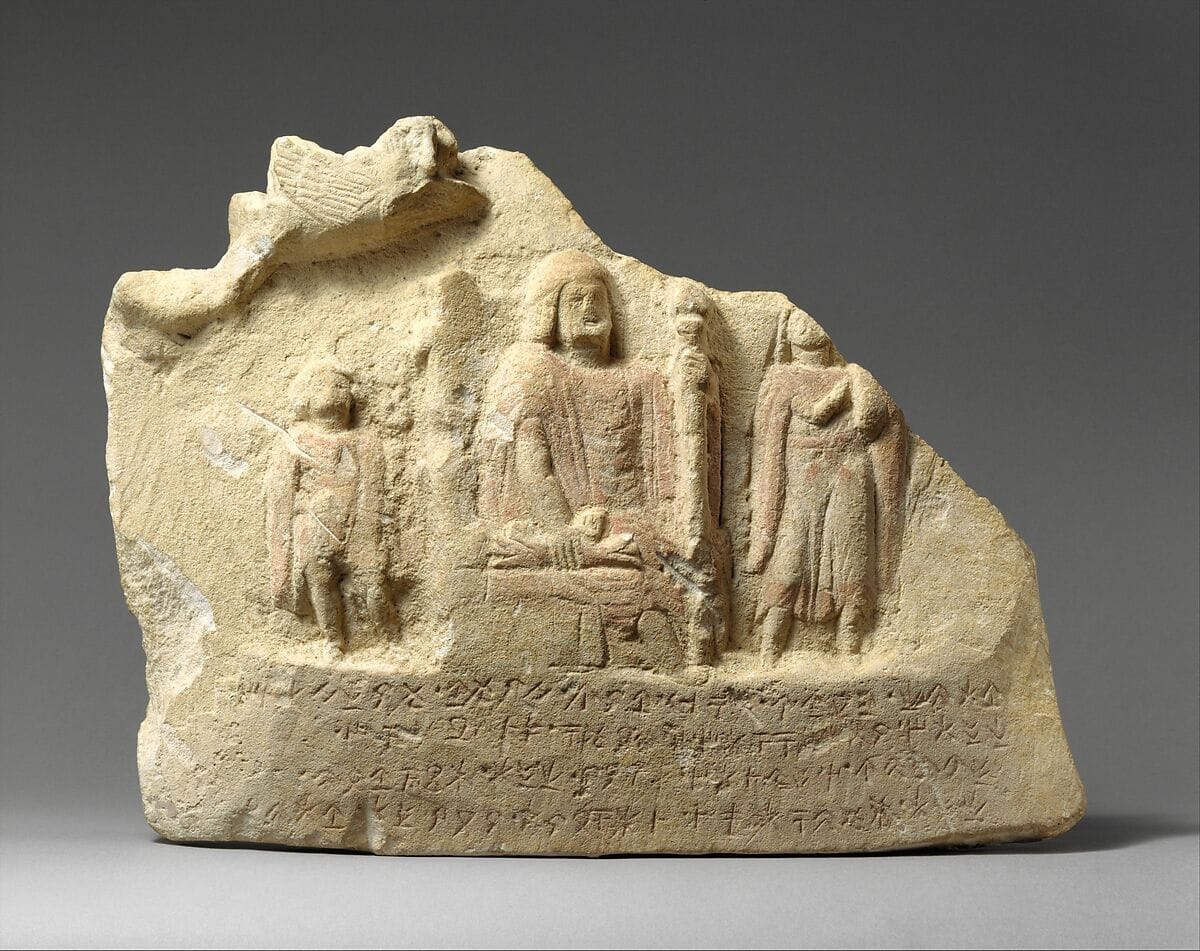
The alphabet did not replace the Syllabary on contact. In the late fourth century Amathus and its king Androcles used the Greek alphabet on official monuments, as the island was drawn into the Hellenistic world after Alexander [1, p. 229]. Steele compares the change to language death: Cypriots chose the international script for public texts first and kept the old one for private and votive uses, so the shift was gradual [1, p. 234]. Outside one site, the latest syllabic texts date to about 300 BCE: a dish from Chytroi dedicated to (Apollo) Hylates, a hydria near Marion marked "of Timokle(s)", and dedications at Golgoi [1, p. 235]. A Golgoi relief in the Met, with Zeus enthroned between Apollo and Hermes above four lines of syllabic text painted red, may be as late as the end of the Hellenistic period; Markus Egetmeyer translates its moralising verse as beginning "Greetings! Eat, Lord, and drink" [10, cat. 455]. It is the image at the head of this page and on this site as a limestone inscribed relief.
The last large group comes from the sanctuary of the Nymph at Kafizin, dated about 183–177 BCE and published by Terence Mitford in 1980. Of 310 inscribed pots, 32 or 33 use the Syllabary alone and 33 to 35 are digraphic; the rest, 242 to 245, are in the alphabet. The syllabic texts are almost all on plain utilitarian pots and the alphabetic ones on decorated wares, and the alphabetic spellings often betray writers trained in the Syllabary, who confused vowel length and dropped double consonants [1, pp. 235–240]. The final traces are clay sealings from the archives of Nea Paphos, mid-second to late first century BCE, stamped by seal rings bearing single syllabic signs or abbreviated names such as ti-mo and o-na [1, p. 240]. Phoenician writing disappears in the same horizon, the third or second century BCE [1, p. 154]. The political background is in the Hellenistic chronology entry.
Decipherment
European interest began with inscriptions. Josef von Hammer recorded the first syllabic inscription in 1800, and the Duc de Luynes's Numismatique et inscriptions cypriotes (1852) proposed a distinct Cypriot script on the evidence of coins and the Idalion tablet [13]. In 1855 Professor Röth published a "translation" of the tablet as a Semitic proclamation of the Egyptian king Amasis to the Cypriots [14, p. 15]. The key was a bilingual. The Comte de Vogüé found a Greek alphabetic and syllabic biscript at Golgoi in 1862, and in 1869 Robert Hamilton Lang found the Phoenician and syllabic statuette base at Idalion [13; 1, p. 179].
In 1871 Lang presented a paper on coin legends to the Society of Biblical Archaeology in London and identified the word for "king". George Smith, the British Museum's cuneiform specialist, used the Phoenician text of the bilingual to propose correct sign values and saw that the endings looked Greek; Luigi Palma di Cesnola's 1878 narrative credits Smith with the values of forty signs. Samuel Birch recognised the language as Greek and applied the key to the Idalion tablet in 1873 [13; 14, p. 15]. Johannes Brandis added values in 1873 before his early death; Moriz Schmidt, working from the assumption that the language was Greek, corrected readings in 1874 and published a collection in 1876; Wilhelm Deecke and Justus Siegismund reached similar results independently in 1874. Within five years of Lang's paper the script was deciphered [13; 14, p. 16].
Collecting the texts took longer. Deecke's 1883 volume and Otto Hoffmann's were the references until Olivier Masson's Les inscriptions chypriotes syllabiques (1961), still the standard edition. A new corpus in Inscriptiones Graecae XV, built on Jean-Pierre Olivier's database of 1,397 inscriptions scattered across 34 museums, is being prepared by Massimo Perna, Artemis Karnava and Markus Egetmeyer [13]. The Cypro-Minoan texts were assembled by Olivier in 2007 and by Ferrara in 2012–2013 [2, p. 375; 1, p. 6]. The online encyclopedia Kyprios Character hosts Perna's account of the syllabic corpus.
Summary
Writing on Cyprus began in the sixteenth century BCE as a local adaptation of a Cretan script, used by a copper-exporting town for names, labels and a few long texts that nobody can yet read. The script outlived the palaces of the Aegean and the Levant, was reshaped between the eleventh and eighth centuries to write Greek and Eteocypriot, and served the city-kingdoms for royal names, dedications and the contract of a besieged city. Phoenician and then the Greek alphabet joined it, often on the same stone, and the last syllabic signs were pressed into sealing clay at Nea Paphos in the first century BCE.
Objects on this page
References
- 1.Steele, P. M. (2019). Writing and society in ancient Cyprus (Cambridge Classical Studies). Cambridge University Press.
- 2.Hirschfeld, N. (2012). Cypro-Minoan. In E. H. Cline (Ed.), The Oxford handbook of the Bronze Age Aegean (pp. 373–384). Oxford University Press. https://doi.org/10.1093/oxfordhb/9780199873609.013.0028
- 3.Ferrara, S., & Valério, M. (2017). Contexts and repetitions of Cypro-Minoan inscriptions: Function and subject matter of clay balls. Bulletin of the American Schools of Oriental Research, 378. https://doi.org/10.5615/bullamerschoorie.378.0071
- 4.Donnelly, C. M. (2024). Cypro-Minoan and its writers: At home and overseas (Elements in Writing in the Ancient World). Cambridge University Press. https://doi.org/10.1017/9781009381840
- 5.Polig, M., & Donnelly, C. M. (2022). Between frustration and progress: An integrated Cypro-Minoan signary and its paleographic diversity. Studi Micenei ed Egeo-Anatolici, n.s. 8.
- 6.Duhoux, Y. (2012). The most ancient Cypriot text written in Greek: The Opheltas' spit. Kadmos, 51, 71–91. https://doi.org/10.1515/kadmos-2012-0005
- 7.Knapp, A. B. (2008). Prehistoric and protohistoric Cyprus: Identity, insularity, and connectivity. Oxford University Press.
- 8.Iacovou, M. (2008). Cultural and political configurations in Iron Age Cyprus: The sequel to a protohistoric episode. American Journal of Archaeology, 112(4). https://doi.org/10.2307/20627513
- 9.Karageorghis, V. (2000). Ancient art from Cyprus: The Cesnola Collection in The Metropolitan Museum of Art. The Metropolitan Museum of Art.
- 10.Hermary, A., & Mertens, J. R. (2014). The Cesnola Collection of Cypriot art: Stone sculpture. The Metropolitan Museum of Art.
- 11.Kearns, C. (2022). The rural landscapes of Archaic Cyprus: An archaeology of environmental and social change. Cambridge University Press.
- 12.Caubet, A. (1993). Les antiquités chypriotes au Musée du Louvre / Cypriote antiquities in the Louvre. In Kinyras: L'archéologie française à Chypre / French archaeology in Cyprus (Travaux de la Maison de l'Orient 22, pp. 23–37). Maison de l'Orient et de la Méditerranée Jean Pouilloux.
- 13.Perna, M. (2015). Corpus of Cypriote syllabic inscriptions of the 1st millennium BC. In Kyprios Character: History, Archaeology & Numismatics of Ancient Cyprus. http://kyprioscharacter.eie.gr/en/t/AS
- 14.Cesnola, L. P. di (1878). Cyprus: Its ancient cities, tombs, and temples. A narrative of researches and excavations during ten years' residence in that island. Harper & Brothers. https://archive.org/details/cyprusitsancient00cesniala