
Contents
Medicine in ancient Cyprus has to be assembled from three kinds of evidence that rarely overlap in time. Skeletons record disease but not treatment. Objects (a juglet shaped like a poppy head, a bronze spatula, a limestone ear dedicated to a god) record practice but seldom say what the practice was for. Texts name physicians and drugs, but the earliest Cypriot text that names a physician is a bronze tablet of the early fifth century BCE, and almost everything written about Cypriot drugs comes from Greek and Roman authors of the fourth century BCE onward [1, pp. 93–95]. The only full, modern study of disease in a Cypriot burial population is of Hellenistic and Roman Paphos [2, p. 17]. This entry works through what each kind of evidence supports from the Neolithic to the Cypro-Classical period, uses the Hellenistic and Roman material only as a later benchmark, and keeps the long-running argument over Base Ring juglets and opium open, since it is open. It belongs with the daily life hub and the entry on food and diet.
What the bones say: Neolithic villages
The largest Neolithic skeletal sample comes from Khirokitia, with around 250 individuals, most buried beneath house floors and with a distinct lack of grave goods; Sotira-Teppes produced only twelve poorly preserved burials, flexed in pits, again without offerings [2, p. 4]. The older material from both sites was studied by J. L. Angel in 1953 and 1961 [2, p. 4]. The burial customs themselves are covered under Neolithic and Chalcolithic burial.
The clearest evidence for everyday illness in these villages is parasitic. Harter-Lailheugue and colleagues (2005) sampled soil from the pelvic area of four individuals at Parekklisha-Shillourokambos and seven at Khirokitia. Five of the twelve samples contained parasite eggs: those of all four Shillourokambos individuals and of one Khirokitia adult. Four helminths were identified, a tapeworm (Taenia), the liver fluke (Fasciola), roundworm (Ascaris) and whipworm (Trichuris), and the authors concluded that poor sanitation within the village and contamination of food and water were present [2, p. 5]. Harper and Fox also stress that Neolithic Cypriots lived in close contact with their domesticated animals, which exposed them to zoonotic disease [2, p. 5].
The same Khirokitia adult with parasites also had diploic expansion of the skull vault and a parietal bone thickened to 9 mm. Cribra orbitalia and porotic hyperostosis, the pitting of the eye-orbit roofs and skull vault usually read as signs of anaemia, were otherwise not observed in the Khirokitia sample, perhaps because of taphonomic damage to the bone surfaces [2, p. 5]. A single case cannot say how common anaemia was in the village.
One practice visible on Neolithic skulls is body-shaping rather than medicine. Artificial cranial deformation, the deliberate reshaping of the skull in infancy, was practised across Cyprus from the earliest Neolithic. Occipital flattening dominates in the Neolithic; the "Cypriote" post-bregmatic flattening is most common in the Bronze Age, with one fourth-millennium example at Erimi recorded by Angel; and plagiocephaly (asymmetrical flattening) is found at Neolithic Karavas, Bronze Age Enkomi and Late Bronze Age Hala Sultan Tekke [3, p. 445]. It belongs to how communities wanted heads to look, and it should not be read as a treatment or as a sign of disease.
For the Chalcolithic (c. 4000–2500 BCE), the main recent cemetery samples are Souskiou-Vathrykakas, with 100 tombs, and Souskiou-Laona, with at least 137 tombs of which fifteen were intact [2, pp. 6–7]. Their health data are not reviewed here.
Health in the Bronze and Iron Ages
Bronze Age teeth are in comparatively good condition. At the Middle Bronze Age site of Episkopi-Phaneromeni, 21 individuals showed only one example of oral disease other than caries, and at Late Bronze Age Kourion-Bamboula Angel estimated that each mouth had only four lesions for its 28 tooth spaces [3, p. 444]. The contrast with the Hellenistic and Roman Paphos sample of 275 individuals, where ante-mortem tooth loss, caries and periodontal disease head the list of lesions alongside degenerative joint disease and porotic hyperostosis or cribra orbitalia, is sharp, though the later population lived in a different kind of town on a different diet [2, p. 17].
The Early Iron Age cemetery at Palaepaphos-Skales gives a small but well-described Cypro-Geometric sample. Its twenty individuals had an average age at death of 32.44 years for men and 28.5 for women. Two crania had cribra orbitalia. A child of about six (T.79:49.a) had marked lesions together with hyperostosis of the skull vault, which the report read as thalassaemia major and as most likely the cause of the child's early death; an adult (T.90:8.a) with moderate lesions was read as a probable heterozygote, a carrier. At the time of publication the only other recognised occurrence on the island was at Late Bronze Age Kourion-Bamboula, described by Angel in 1972 [3, p. 446]. Angel's model treated thalassaemia as a balanced polymorphism maintained by falciparum malaria, and noted that porotic hyperostosis occurs frequently in marshy areas and rarely in dry ones [3, p. 446].
That reading remains a hypothesis. Harper and Fox point out that anaemia of any sort can produce porotic hyperostosis and cribra orbitalia (Janssens 1981; Stuart-Macadam 1989), so the lesions alone cannot identify a genetic anaemia. They set the skeletal question beside modern genetics: about 16 percent of Cypriots today carry one thalassaemia mutation (Baysal et al. 1992), and work on the dating of a G6PD mutation points to two periods of mutation, one at the advent of agriculture and one around 500 BCE (Tishkoff et al. 2001) [2, p. 5]. Demetrios Michaelides, writing in 2011, still considers that "the leading role amongst hereditary diseases was clearly played by haemolytic anaemias, including most probably thalassaemia" [1, p. 103]. The genetics make an ancient history of thalassaemia on the island likely; the Skales child is a plausible early case, and it has not been confirmed by any test that separates thalassaemia from other anaemias.
Individual cases are few. A man of 30 to 35 from Amathus, who died about 2,700 years ago, has infection marks on the mastoid bone behind the ear that show advanced otitis media, an infection of the middle ear [1, p. 103]. No record survives of whether or how he was treated.
Surgery: what is and is not attested
Claims for prehistoric Cypriot surgery rest on very little. In their overview of trepanation (cutting or scraping an opening in the skull) in the ancient Greek world, Liston, Fox and Day write that a number of possible cases have been identified in recent years in the Balkan peninsula and Cyprus, but the Cypriot example they give is a caution: "A Roman period cranium from Paphos, exhibits a linear blade injury that resembles a scraped trepanation" [4, p. 153]. That skull records a blade wound, and it is Roman. We know of no confirmed pre-Roman trepanation from Cyprus, and "possible cases" is the most that can be said.
The one well-documented surgical kit from the island is also Roman, and it should not be projected back onto earlier periods. A tomb at Nea Paphos of the late second century CE held 25 surgical instruments in bronze, iron or both: a bronze étui (instrument case) with ear-scoops and probes, iron shears, a bronze bleeding cup, iron bone levers, a double blunt hook and a rare bronze syringe-like pyoulkos used for cleaning and drawing pus from wounds. The handles have no wood or bone fittings and some were covered in gold leaf, which Michaelides relates to the need to keep the instruments clean [1, pp. 96–97]. The same tomb held cylindrical containers filled with pills and powders made of copper salts (Foster and Kanada 1988), the only physical drugs in the Cypriot record discussed here [1, p. 99]. Clay "hot-water bottles" from Paphos, shaped to fit particular parts of the body and dated to the first century BCE or first century CE, have a parallel in the Casa del Chirurgo at Rimini, a house that produced some 150 instruments [1, pp. 97–98]. All of this is Hellenistic or Roman.
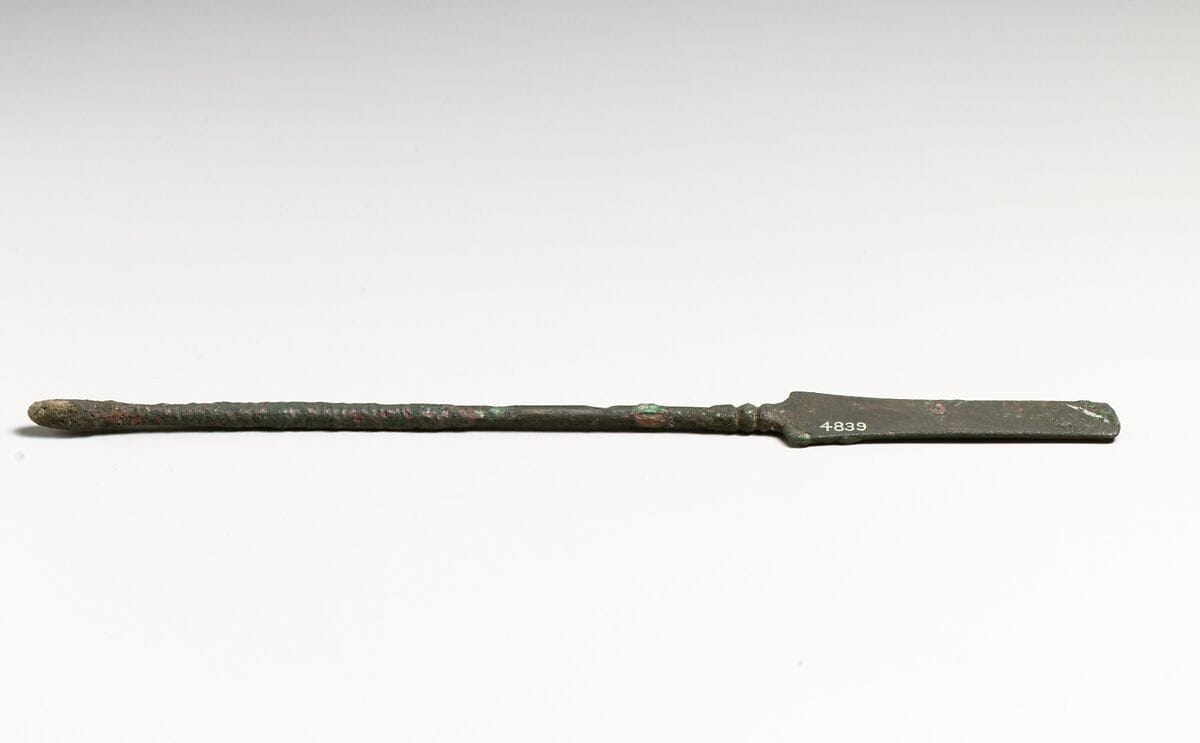
For the earlier periods there are instruments whose use is inferred from their shape. A bronze spatula from the Cesnola Collection, 18.3 cm long, with an olive-shaped point at one end and a blunt, oar-shaped blade at the other, is described in the Metropolitan Museum's catalogue as a pharmaceutical rather than strictly surgical instrument. The catalogue's date range for it runs from the fourth millennium BCE to the first century CE, which is too wide to place it in any one period, so it cannot be used as evidence for pre-Roman practice without a find context.
Minerals and plants: the island's pharmacy
Cyprus was famous in antiquity for medicinal minerals, most of them by-products of the copper mines described under copper metallurgy. The ancient descriptions are all late. A fragment attributed to Aristotle (fourth century BCE), discussed by Wallace and Orphanides in 1990, lists Cypriot mines of gold, silver and copper and of "styperia" (alum), "sory", "misy" and "khalkitis", and Michaelides observes that most of these substances are known to have been used in medicine [1, pp. 93–94]. The detailed recipes come from Roman-period writers: Dioscorides (active c. 40–90 CE), who lists many Cypriot vegetable and mineral drugs; Pliny the Elder (first century CE); and Galen, who visited Cyprus in 166 CE specifically for its medicines, collected substances from the mines and described the mines of Soloi [1, p. 94].
Misy, which Michaelides identifies as chalcopyrite, is discussed by Aristotle, by Dioscorides (Materia Medica 5.74, 5.100) and by Pliny (Natural History 34.121), who calls the Cypriot misy the best; Galen took enough of it from Soloi to last him the next thirty years [1, p. 98]. Chalcanthos, hydrated copper sulphate or blue vitriol, is described in the Souda as a water that solidifies in the mines of Cyprus, with generous styptic and calorific properties. Pliny (Natural History 34.127) calls the Cypriot kind the most highly approved for medical use and lists its applications: against intestinal worms (one dram taken with honey), for eye complaints, mouth ulcers, nosebleeds and haemorrhoidal bleeding, and for cleansing wounds [1, p. 98]. Salt from the lake at Kition, modern Larnaca, was recommended as medicine by Dioscorides (5.109) and Pliny (Natural History 31.74, 77, 79). Michaelides adds, as an inference, that Kition's marshes are likely to have been a source of illness, malaria above all [1, p. 98].
The most important medicinal plant of Cyprus, in Michaelides' assessment, was ladanum, the resin of the rock-rose (Cistus). Dioscorides (1.97) describes it being combed from the beards of goats that had browsed the shrub, or collected on ropes dragged over the plants, and says the Cypriot product is the best. It was used as a styptic and a diuretic, and its fumes were used for complaints of the womb. Ladanum was still produced on the island in the first half of the twentieth century, under the Cypriot name ξυσταράκα [1, pp. 99–100]. A Roman-period ostrakon from the Villa of Theseus at Nea Paphos is labelled "Υποκιστίδος χυλός", juice of hypocistis, the plant Cytinus hypocistis (Borkowski and Łajtar 1993) [1, p. 100].
The dating problem needs stating plainly. For the Bronze Age and the Iron Age kingdoms, the evidence is that these minerals and plants existed on the island and that copper ore was mined; the Aristotelian fragment is the earliest source that names the minerals, and the recipes that turn them into eye-salves, worm cures and wound-cleaners are written down by Dioscorides, Pliny and Galen in the first and second centuries CE. The copper-salt pills from the Paphos surgeon's tomb are of the same late date. Whether Bronze Age healers used chalcanthos in the ways Pliny describes is unknown.
The Base Ring juglet and the opium question
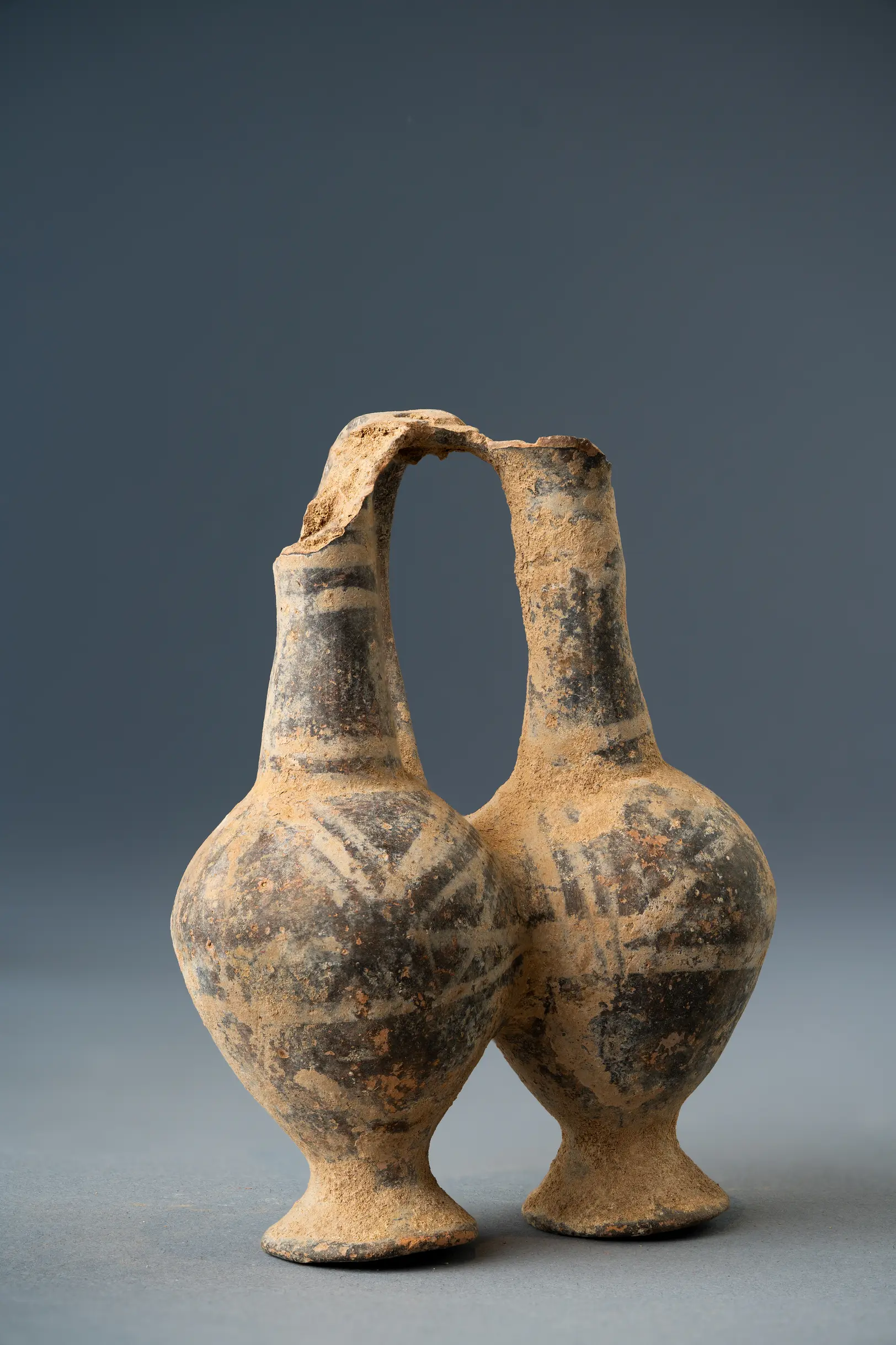
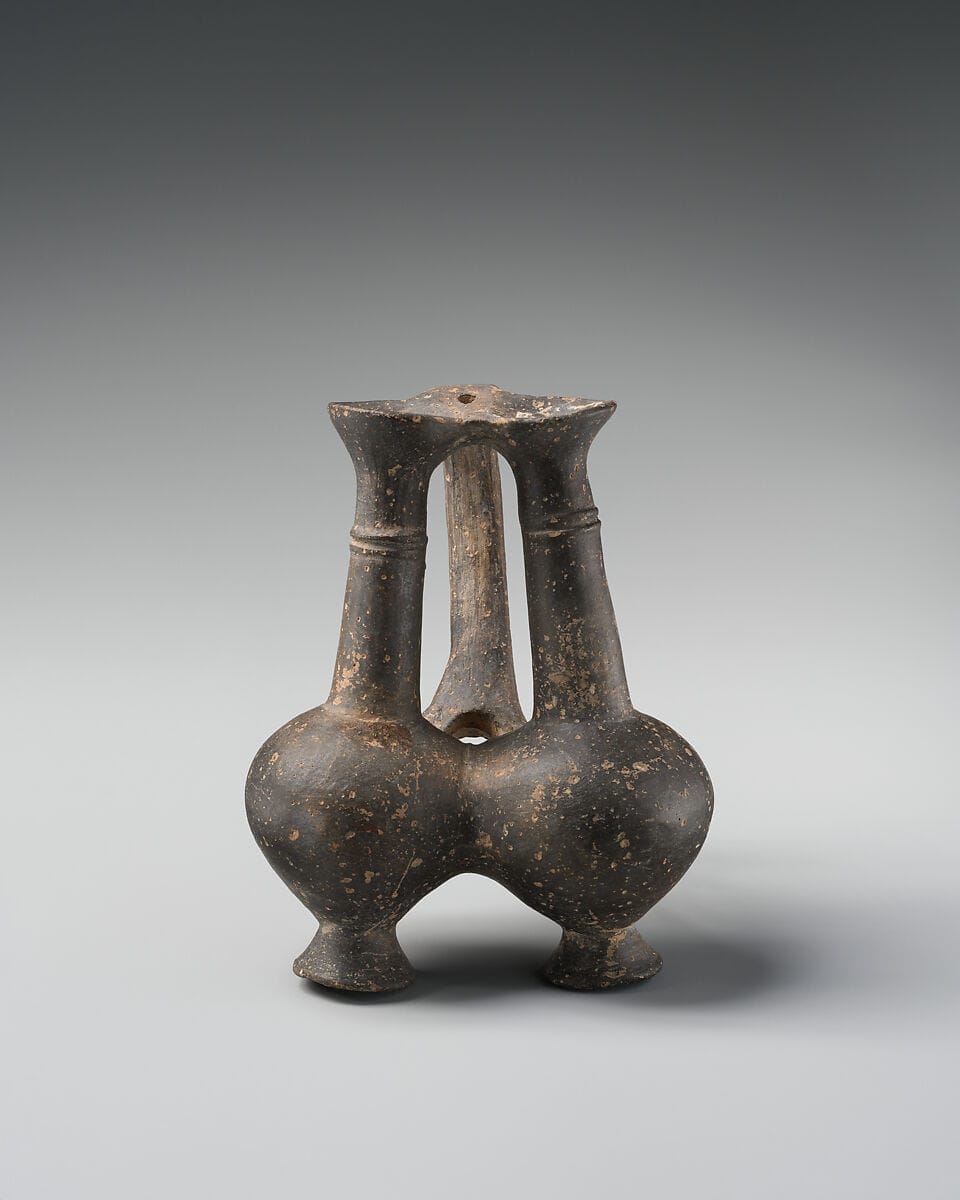
A long-running argument in the history of Cypriot medicine concerns a pot. Base Ring juglets were made on Cyprus in the Late Bronze Age and are found in Egypt and the Levant as well as on the island. In 1962 Robert Merrillees proposed that their shape imitated an inverted poppy head and that they had carried opium, and the idea became widely repeated [5, pp. 1552–1553]. A Brooklyn Museum Base Ring juglet of Late Cypriot IB, c. 1575–1475 BCE, is labelled with the statement that recent analyses show some of these vessels contained opium; that label summarises one side of a live dispute. The double juglet in the Drakopoulos collection (right), catalogued as Base Ring and dated c. 1600–1450 BCE, in the Goodman Collection from the 1960s, belongs to the class at the centre of the debate. No residue analysis has been made of it, and nothing is known about what it held. The Metropolitan Museum's terracotta double bil-bil from the Cesnola Collection, 10.6 cm high and of the same date, is labelled more cautiously: it "may have been used to contain opium or perfumed oils".
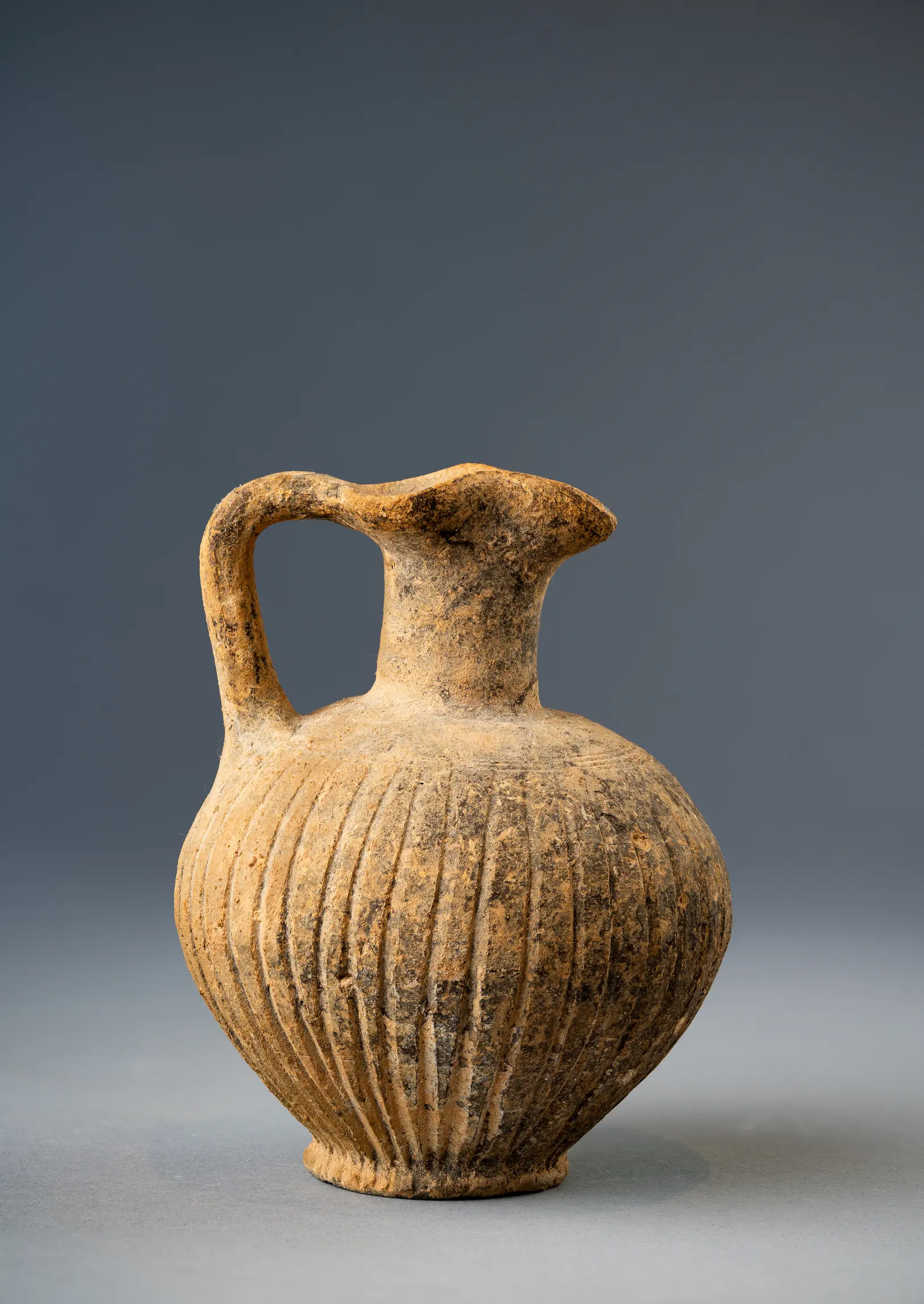
The hypothesis had critics from the start. Gittlen (1981) and James Muhly (1982) rejected it; Muhly later dismissed the picture of Cyprus as the "center of the drug world of the Late Bronze Age" (Muhly 1996: 50); and Knapp (1991) and Steel (2004) had grave reservations [5, p. 1553]. In 1967 Kritikos and Papadaki argued that Bucchero jugs also imitate poppy capsules, a suggestion Merrillees accepted in 1979 [5, p. 1553]; a ribbed Bucchero jug in the Drakopoulos collection, c. 1200–1050 BCE, illustrates the ribbed body that invited the comparison. In 2016 Shlomo Bunimovitz and Zvi Lederman reviewed the case. Merrillees, they note, offered no direct textual or archaeobotanical evidence, and they applied to Cypriot opium export a term Merrillees himself had used: a "factoid", something accepted as factual simply because it has repeatedly appeared in print [5, p. 1554].
The residue evidence is uneven. Early claims of opium in juglets from Egyptian contexts were never verified; analyses published by Evans in 1989 on vessels from Tell el-Ajjul and unprovenanced examples have been criticised as vague; and before 2016 the only viable result was Koschel's 1996 analysis of a single unprovenanced juglet said to come from Egypt, which Koschel himself warned should not be treated as proof [5, p. 1554]. Chovanec, Bunimovitz and Lederman then tested three Base Ring I juglets from a fourteenth-century BCE (Late Bronze IIA) "palace" at Tel Beth-Shemesh in Israel and fourteen Base Ring I and II jugs and juglets from Cyprus. None of the seventeen showed any sign of opium. The residues were aromatic oils: with mint and thujone at Beth-Shemesh; with mint, wood turpentine, wormwood, lavender, sage and rosemary in vessels from Episkopi; and unidentified oils in vessels from Enkomi and Dhali [5, pp. 1554–1555; 6, p. 185]. The authors suggest the oils were used for cosmetic or ritual anointing, and possibly taken internally for culinary or medicinal purposes [5, p. 1555]. The written record is also silent: there is not a single reference to opium in the cuneiform texts of the Near East or in Egyptian texts of the second millennium BCE, and opium is missing from Classical literature down to the beginning of the Christian era (Muhly 1996) [5, p. 1555].
Two later studies reopened the question for some vessels. A Base Ring juglet in the British Museum (1981,1218.53) was X-rayed, which showed that it still held sealed contents. Analysis found mainly degraded plant oil, and two opium alkaloids, papaverine and thebaine. The authors list several readings: the vessel may have been reused, the contents may not have been meant for drinking, or the alkaloids may come from poppy-seed oil rather than opium latex [7]. At Tel Yehud in Israel, residue analysis of vessels from fourteenth-century BCE burials detected opium alkaloids in Base Ring I jugs and juglets at higher concentrations than in dipper juglets and storage jars, and the authors conclude that opium storage was not limited to Base Ring juglets [8, pp. 1, 13].
| Study | Vessels | Result for opium |
|---|---|---|
| Koschel 1996 | One unprovenanced Base Ring juglet, said to be from Egypt | Positive; the author warned against treating it as proof |
| Chovanec, Bunimovitz and Lederman 2015 | 3 Base Ring I juglets from Tel Beth-Shemesh; 14 Base Ring I–II jugs and juglets from Cyprus | None detected; aromatic plant oils |
| Smith, Stacey, Bergström and Thomas-Oates 2018 | British Museum juglet 1981,1218.53, contents sealed | Papaverine and thebaine in degraded plant oil; possibly poppy-seed oil |
| Linares et al. 2022 | Base Ring I jugs and juglets, dipper juglets and storage jars from Tel Yehud burials | Opium alkaloids detected, highest in the Base Ring vessels |
Michaelides, writing before the negative Beth-Shemesh and Cypriot results were published, states that it is generally accepted that Cyprus produced and exported opium at least during the Late Bronze Age, while noting that neither the poppy nor opium is mentioned anywhere in relation to Cyprus in ancient texts [1, p. 99]. The position that fits all the published analyses is narrower than either the popular story or the "factoid" verdict. Base Ring juglets usually carried scented oils; opium alkaloids have been found in a few, at Tel Yehud and in the British Museum juglet, and not in most of those tested; and no text connects opium with Cyprus. Whether the island grew poppies and exported opium as a trade good, or whether poppy products were occasionally added to oils, sometimes after export, is unresolved.
Onasilos and the Idalion tablet
The earliest named physician on Cyprus appears in the longest surviving text in the Cypriot syllabary. The Idalion tablet is a bronze tabula ansata (a plaque with dovetail handles) about 21 by 14 cm, inscribed with 31 lines, sixteen on one face and fifteen on the other, and described by Pestarino as the most significant document of the Cypriot-syllabic corpus. It was found by local farmers on the Ampileri hill at Idalion, together with weapons and other bronzes, not in its original position [9, p. 48]. In its closing lines the king and the city state that they have deposited it with the goddess Athena, who protects the area around Idalion, and it was probably displayed in public [9, pp. 48, 219]. The script is discussed under writing and literacy, and the site's own article on the tablet is The Gift of Land in Reward for Medical Help.
The text records an emergency contract. In Pestarino's translation: "When the Medes (Persians) and Kitians besieged the city of Idalion in the year of Philokypros, son of Onasagoras, King Stasikypros, and the city ... called the physician Onasilos, son of Onasikypros, and his brothers, to treat people who were wounded in battle, without payment." The promised reward was a talent of silver, converted instead into royal land in the Alampria district, to be held forever and free of taxes, with a penalty for anyone who evicted the family. Onasilos alone received further land in the Malania valley, reaching the river Drymios, and a garden, and the text ends with a curse on anyone who breaks the agreement [9, p. 219]. "Without payment" means without fees from the wounded themselves: as Michaelides puts it, the king and the people paid the doctors in money or land instead [1, pp. 94–95]. The besiegers were the Achaemenid Persians, whom the text calls Medes, and the kingdom of Kition.
Onasilos is the earliest of nineteen named doctors whom Michaelides counts as either Cypriot or working on the island [1, p. 94]. The tablet shows that physicians could practise as a family group, that a king could summon them for war wounds, and that the city treated their care of the injured as a public service worth a royal estate. It does not describe any treatment.
The date is debated. Michaelides gives c. 478–470 BCE, following Yon (2004) [1, p. 94]. Georgiadou places the tablet in the first quarter of the fifth century BCE, with the Kitian conquest of Idalion under King Ozibaal as the latest possible date; the Swedish Cyprus Expedition dated the destruction of the Athena sanctuary to about 470 BCE, and Georgiadou and Hermary follow that date. Evangeline Markou's study of the coinage points later: Ozibaal's coins are overstruck on Athenian and Aeginetan coins of 457–446 BCE, which would lower the conquest and loosen the link to 470 [9, p. 49]. "Early fifth century BCE, probably before about 470" is the conventional formulation, and the numismatic evidence is the reason to hold it lightly.
Later Cypriot doctors fall outside this entry's range, though one shows where the tradition went: Apollonios of Kition, in the first century BCE, wrote Peri arthron (On Joints), dedicated to King Ptolemy of Cyprus (80–58 BCE), which survives with thirty illustrations of joint reduction [1, p. 95].
Gods, votives and amulets
Healing in Cyprus was also a religious matter, and Michaelides observes that almost every deity could take on healing powers. He cites images of Astarte shown as a pregnant woman holding her breasts (see Astarte figures), and the later cult of Asklepios and Hygieia, represented in the main centres by sanctuaries but mainly by statues [1, pp. 100–101]. Sanctuaries of unidentified healing deities have produced terracottas, mainly of childbirth, most of them dating to the Cypro-Archaic period (Hermary 1989, nos. 913–915, in the Louvre; Vandenabeele 1988) [1, p. 101]. A small handmade terracotta group in the Cesnola Collection, two figures in a scene of childbirth, 7.3 cm high and dated c. 600–480 BCE, belongs to this class. The theme continued into the Hellenistic period in limestone, as in the Metropolitan Museum's statuette of a childbirth scene (74.51.2698), dated c. 310–30 BCE, which also has an entry on this site.
In the later Hellenistic and Roman periods the votive changed form. Worshippers dedicated ex-votos in the shape of the ailing part of the body, or showing it: male genitals, eyes singly or in pairs, and ears, some inscribed in the syllabic script with the word κώφωσις, deafness. Michaelides compares them with the beeswax tamata offered in Cypriot churches today [1, pp. 101–102]. The Metropolitan Museum's limestone lower left leg, dated between the fourth and second centuries BCE, is catalogued as an anatomical votive, offered either to ask for a cure or to give thanks for one. A small limestone votive head, slightly swollen on one side, was found with a group of such body-part offerings placed together, as if before an altar or temple. The Cyprus Museum holds a limestone plaque painted with a face that shows a pathological condition [1, p. 102].
Magic ran alongside. Amulets against the evil eye, clenched-fist and phallus amulets, and a haematite amulet for digestion inscribed with a magic formula are known from the island, mostly of Roman date [1, p. 102].
Conclusion
The earliest Cypriot evidence for sickness is in the bodies of Neolithic villagers: worm eggs in the pelvic soil at Shillourokambos and Khirokitia, and a thickened skull that may reflect anaemia. By the Early Iron Age the Skales child with marked cribra orbitalia raises the question of thalassaemia, which modern genetics makes plausible and the bones alone cannot settle. The island's minerals, especially the copper salts misy and chalcanthos, and its ladanum were famous drugs, but the recipes that use them are Roman, as is the only securely documented surgical kit, from Nea Paphos. The Base Ring juglets, once confidently called opium flasks, usually held perfumed oils, and the handful of positive alkaloid results has reopened a question that the Beth-Shemesh and Cypriot analyses had seemed to close. The firmest single document is the Idalion tablet, where Onasilos and his brothers treated the wounded of a besieged city in the early fifth century BCE and were paid in land. For the vessels themselves, see the Base Ring ware entry and the Drakopoulos collection; for the tombs that preserved most of the skeletons, see Bronze Age chamber tombs.
Objects on this page
 SpatulaBronze Age · 3900 BC–100 AD
- Base Ring II Double Juglet with White-Painted DecorationLate Bronze Age II · 1450–1200 BC
 Terracotta double bil-bilLate Bronze Age I · 1600–1450 BC
 Black Slip Bucchero Jug with Trefoil Mouth and Fluted BodyGeometric I · 1050–850 BC
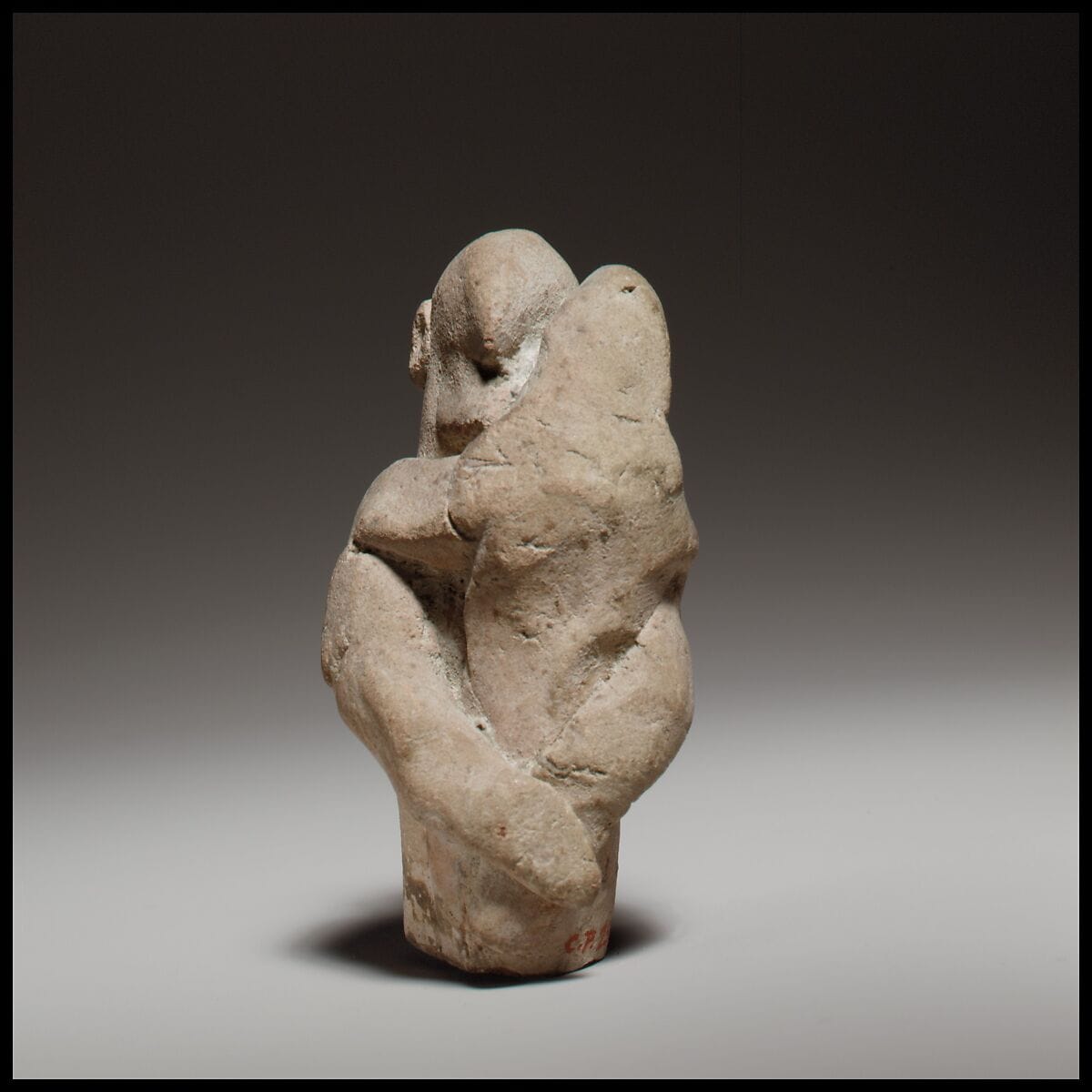 Two figures in a scene of childbirthArchaic II · 600–480 BC
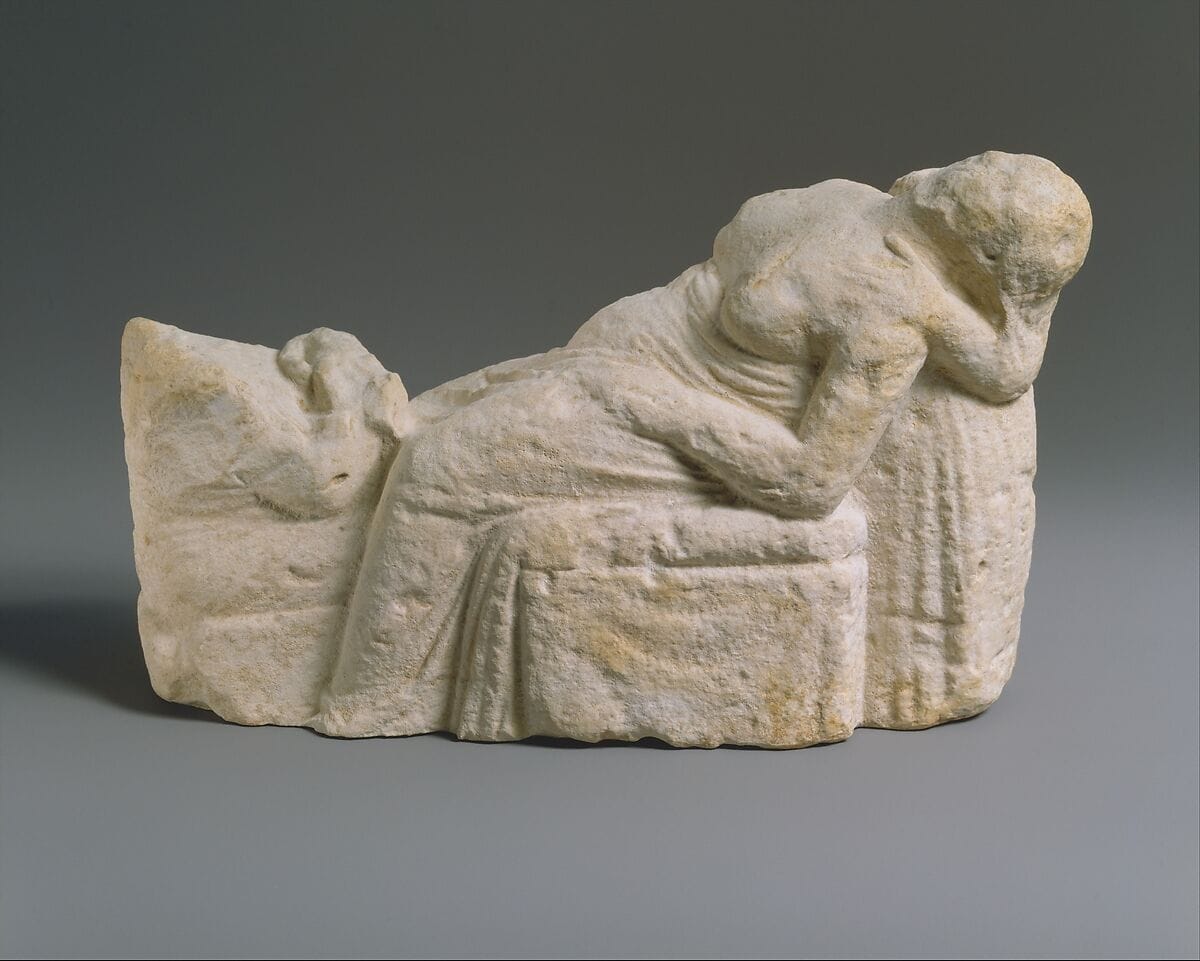 Limestone statuette of a childbirth sceneHellenistic · 310–30 BC
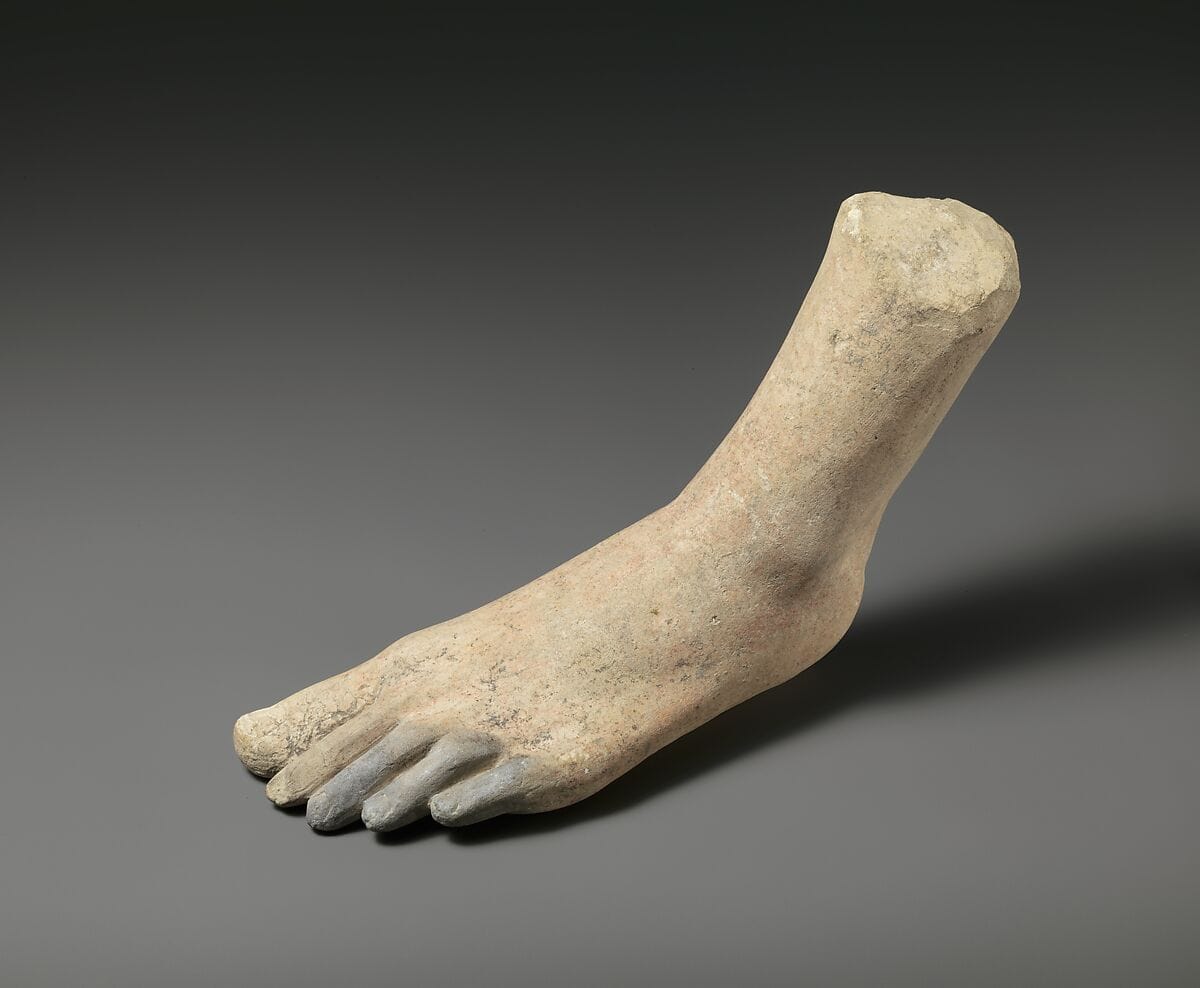 Limestone lower left legHellenistic · 399–200 BC
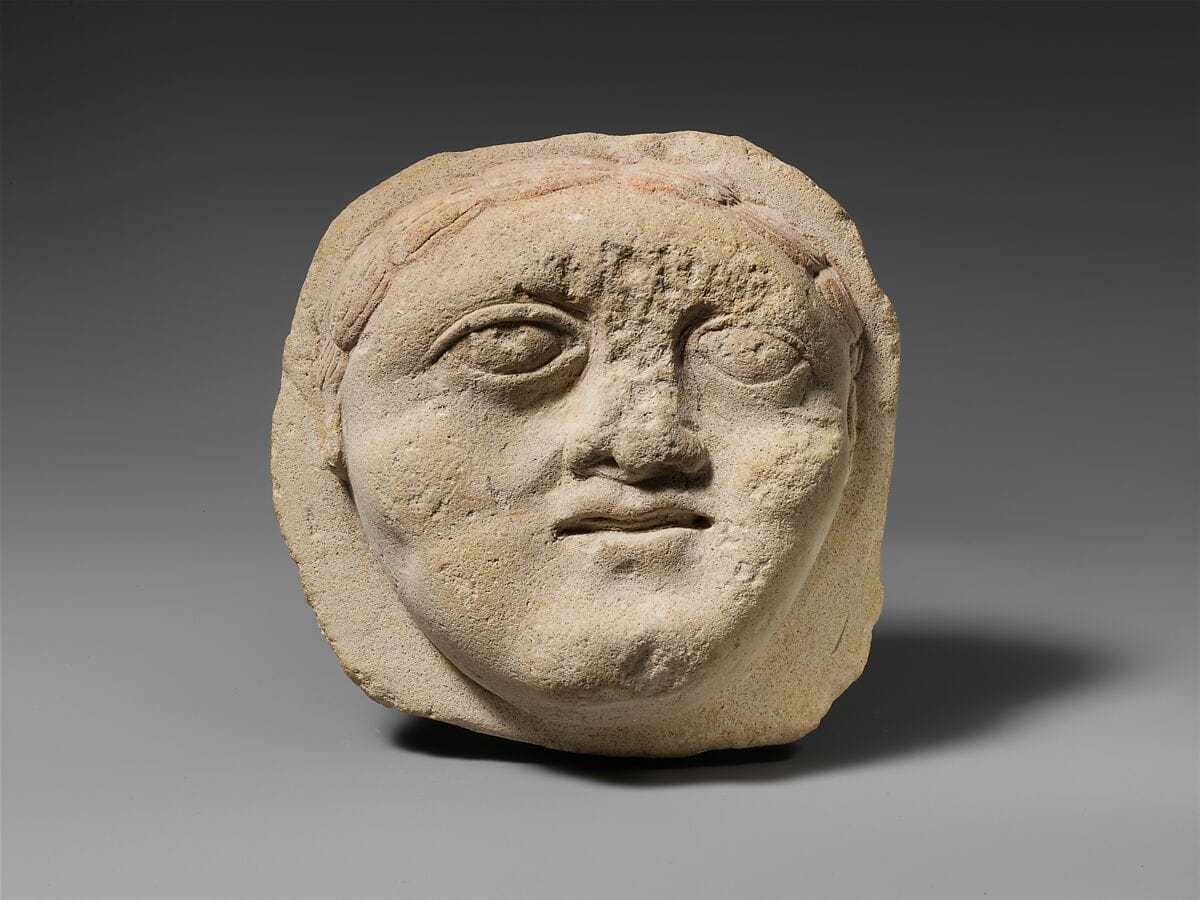 Limestone votive headHellenistic · 300–1 BC
References
- 1.Michaelides, D. (2011). Medicine in ancient Cyprus. In M. Rossetto, M. Tsianikas, G. Couvalis, & M. Palaktsoglou (Eds.), Greek research in Australia: Proceedings of the Eighth Biennial International Conference of Greek Studies, Flinders University, June 2009 (pp. 93–106). Flinders University.
- 2.Harper, N. K., & Fox, S. C. (2008). Recent research in Cypriot bioarchaeology. Bioarchaeology of the Near East, 2, 1–38.
- 3.Karageorghis, V. (1983). Palaepaphos-Skales: An Iron Age cemetery in Cyprus. Skeletal appendix.
- 4.Liston, M. A., Fox, S. C., & Day, L. P. (2016). An overview of trepanation in ancient Greece. In E. Papadopoulou-Chrysikopoulou, V. Chrysikopoulos, & G. Christakopoulou (Eds.), Achaios: Studies presented to Professor Thanasis I. Papadopoulos (pp. 153–158). Oxford.
- 5.Bunimovitz, S., & Lederman, Z. (2016). Opium or oil? Late Bronze Age Cypriot Base Ring juglets and international trade revisited. Antiquity, 90(354), 1552–1561. https://doi.org/10.15184/aqy.2016.177
- 6.Chovanec, Z., Bunimovitz, S., & Lederman, Z. (2015). Is there opium here? Analysis of Cypriot Base Ring juglets from Tel Beth-Shemesh, Israel. Mediterranean Archaeology and Archaeometry, 15(2), 175–189. https://doi.org/10.5281/zenodo.16609
- 7.Smith, R. K., Stacey, R. J., Bergström, E., & Thomas-Oates, J. (2018). Detection of opium alkaloids in a Cypriot base-ring juglet. Analyst, 143(21), 5127–5136. https://doi.org/10.1039/C8AN01040D
- 8.Linares, V., Jakoel, E., Be'eri, R., Lipschits, O., Neumann, R., & Gadot, Y. (2022). Opium trade and use during the Late Bronze Age: Organic residue analysis of ceramic vessels from the burials of Tel Yehud, Israel. Archaeometry. https://doi.org/10.1111/arcm.12806
- 9.Pestarino, B. (2022). Kyprion politeia: The political and administrative systems of the Classical Cypriot city-kingdoms (Mnemosyne Supplements). Brill.