
Contents
No garment survives from ancient Cyprus. For the nine thousand years between the first farming villages and the end of the Cypro-Classical kingdoms there is a single fossilised thread from Neolithic Khirokitia, a handful of Bronze Age fragments, mostly of linen, and impressions of purple-dyed cloth from Iron Age Salamis [1, p. 290; 2]. Everything else that can be said about Cypriot dress is reconstructed from other kinds of object: figurines and statues that show bodies clothed, painted or bare; spindle whorls and loom weights that record the weight of the thread and cloth; the metal pins and brooches that held garments shut; and, very late, a sentence of Herodotus. This entry follows those sources from the Neolithic to the Cypro-Classical period, sets out what each can and cannot show, and names the places where scholars disagree. Related entries: daily life, food and diet, spindle whorls and textile tools and jewellery.
The evidence and its limits
The most abundant evidence is also the most treacherous. Joanna Smith, whose studies of Cypriot textile tools underpin much of this entry, puts the rule plainly: dress in painted or sculpted human representations from Late Bronze Age Cyprus "may not always depict the dress of people who lived on the island." Nudity is common in images of women; even figurines painted so that they appear draped show their breasts clearly; and the women fully "encased in cloth" on cylinder seals and Mycenaean vase-painting may be goddesses or foreigners [3, p. 169]. The caution holds for every period: incised lines or painted bands on a figure can stand for a garment, a tattoo, body paint, jewellery or simply the ornament of the day.
The second source is the textile toolkit. Spindle whorls and loom weights survive because they are clay or stone, and when they are measured and weighed they become, in Smith's words, "indices of fibres and fabrics that no longer survive." A light whorl spins fine thread and a heavy one coarse; loom weights indicate lightweight or heavy cloth. The tools say nothing about the cut of a garment: "the specifics of clothing remain indistinct" [3, pp. 169–170]. The record is also lopsided: the warp-weighted loom leaves its weights, a loom made entirely of wood leaves nothing [1, p. 289; 2].
The third source is cloth itself, and it is almost nothing. The oldest textile on the island, from Khirokitia, is a fossilised fragment of a probably vegetable fibre; Bronze Age fragments are mainly flax, preserved as pseudomorphs, with possible evidence of wool from an Early Cypriot tomb at Lapithos [1, p. 290; 2]. Most come from tombs, so they say more about burial than about the clothes of the living.
The fourth source is the fastener. Pins, toggle-pins and fibulae were metal and survive when the garment has rotted, and a change in fastener implies a change in how cloth was worn. Earrings, beads and pendants belong with them, and on several figurine classes they are the only items of dress that can be matched to objects from the ground.
Fibres: flax, wool and the question of cotton
Two fibres clothed ancient Cyprus: flax and wool. Smith states that while cotton became a major crop on the island in the medieval period, "there is no evidence for its ancient growth and use"; silk was cultivated later still [1, p. 290].
Flax is the older of the two. Its seeds occur at Neolithic and early Chalcolithic sites (whether wild or cultivated is hard to tell) and then disappear from the Bronze and Iron Age record even though the cloth fragments of those periods are mostly linen [2]. Smith and Tzachili conclude that linen was made on Cyprus from the third millennium BC onward and that flax was plausibly a major crop in the Bronze Age. Linen is laborious: the stalks must be soaked and beaten to free the fibres, and the fibre takes dye poorly without a mordant such as alum [2]. By the third or second century BC it was a documented major crop: inscribed jugs from the sanctuary at Kafizin record the company of Zeno of Soli shipping flax products out of Salamis [2].
Wool came later than is often assumed. The earliest domestic sheep brought to Cyprus in the Neolithic were, like their feral descendant the Cypriot mouflon, animals without woolly fleeces; Paul Croft read the Neolithic cull profiles, with most males killed in infancy, as husbandry for meat [4, p. 5]. Kristiansen and Sørensen, closing a volume on Bronze Age textiles, describe Andrew Sherratt's 1981 "secondary products revolution" as a major contribution that was wrong on one point: Neolithic sheep had hair, and only the genetically changed Bronze Age sheep had wool [5]. On Cyprus, older animals appear in Bronze Age flocks, implying they were kept for milk and fleece, and the shift toward sheep and goat in the early Late Bronze Age coincides with a more diversified weaving toolkit [2]. Wool dyes more easily than linen [2]; impressions of purple-dyed fabric were found at Iron Age Salamis, and purple wool of the third to first centuries BC comes from the same area [1, p. 290].
Cotton has one claimed early appearance. The Italian excavations at Pyrgos-Mavroraki reported cotton fibres, some dyed, in Early Bronze Age contexts. Smith and Tzachili note that the final publication is not complete and that, if the identification held, it would be the earliest and only evidence for cotton in the Bronze Age Mediterranean [2, n. 25]. Until it is independently confirmed, cotton should be kept off the ancient Cypriot body.
Neolithic and Chalcolithic: ornament on the body
The Aceramic Neolithic evidence is a toolkit. Bone tools are abundant at Khirokitia: perforators with deer-antler handles, thin sewing needles, and a small perforated awl (KH 80/85) that may have served as a bobbin; the Cultures in Dialogue catalogue notes that the fibres seem to have come from plants, as flax at contemporary Apostolos Andreas-Kastros also suggests [6, cat. 32]. A 17 cm bone pin was found with others beneath the skull of a burial in Tholos XIX, and the larger needles could pierce skins or make baskets and nets [6, cat. 33]. Clothing of hide is plausible, but no hide garment survives. The stone figurines of the period are highly stylised and often sexually ambiguous; an andesite figure from Khirokitia has only chevrons on one shoulder blade and red pigment on the head [6, cat. 30].
The Chalcolithic supplies the first images that seem to show something worn. The picrolite cruciform found near Pomos, now in the Cyprus Museum, wears a necklace whose carved pendant is a miniature of the figurine itself, down to the bent legs [7, p. 303; 6, fig. 18.1]. The painted clay birth figures from the ceremonial deposit at Kissonerga-Mosphilia carry red-painted bands round the neck, some drooping at the front as if weighted by a pendant; Christine Winkelmann judges these "most likely" necklaces while admitting it "cannot be stated with certainty" [7, p. 229]. On the most detailed of them (KM 1451) each arm carries three curved rows of dots ending in a dotted circle on the back. Edgar Peltenburg read this as a shawl with sewn-on beads and two counterweights; Elizabeth Goring read the same marks as bracelets [7, p. 229]. Winkelmann's wider verdict is split. Where a painted body shows the pubic triangle or labia through its pattern, the figure is naked and the pattern more likely tattooing or body paint applied for special occasions; motifs that look like fringes should not be read as hems, since that "would imply the existence of trousers" [7, p. 206]. On the other hand, the oblique lattice on the arms of Kissonerga-variety cruciforms and of the "Getty Lady" evokes "a shawl draped around the shoulders", which she thinks the best interpretation, while declining Karageorghis's step to "official clothing" of a priestess or goddess [7, p. 314]. See Cruciform figurines, Neolithic and picrolite figurines, the article An Enduring Form and the site of Lemba-Lakkous.
Early and Middle Bronze Age: plank figures and pins
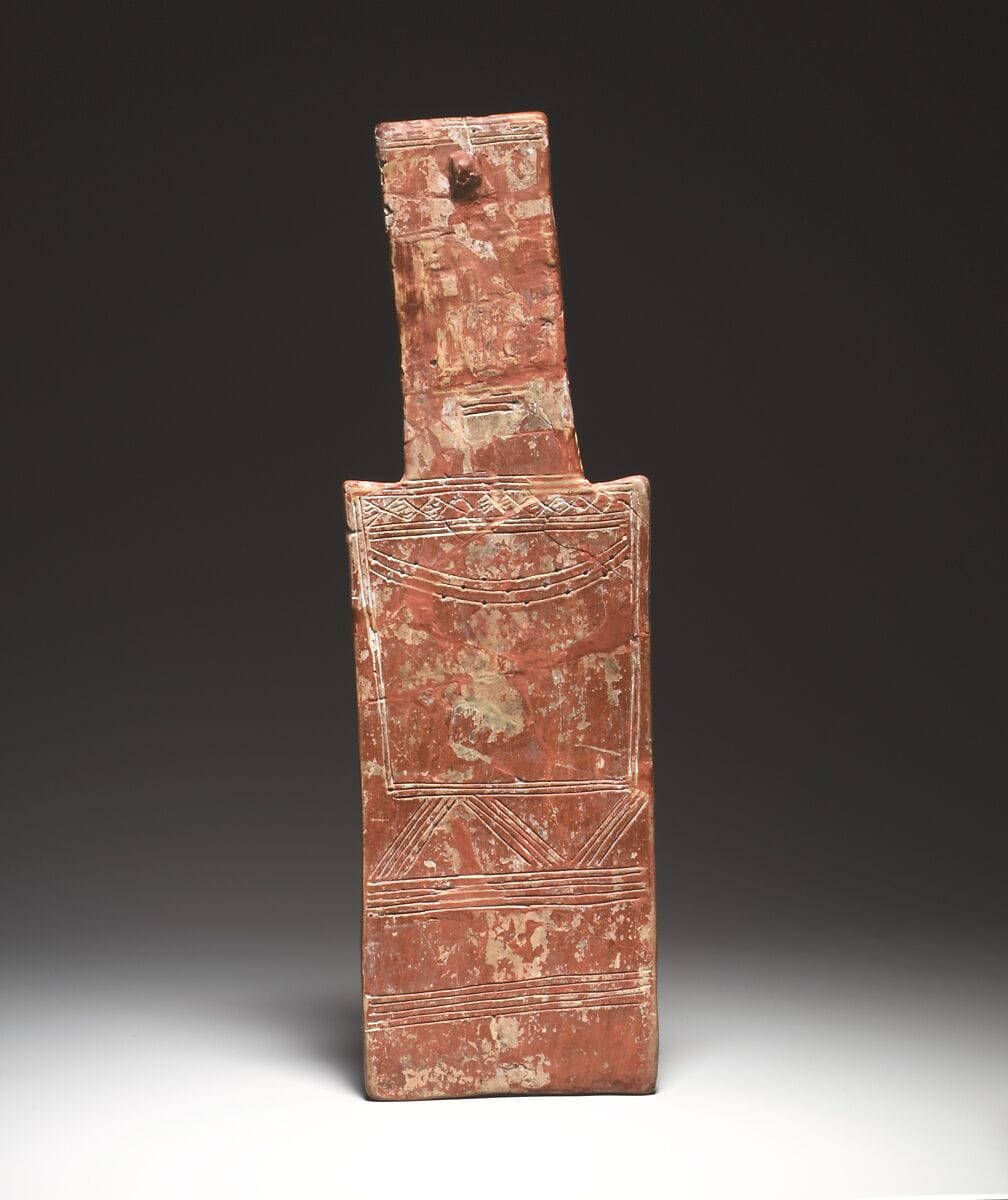
The Red Polished plank figures of the Early and Middle Cypriot periods (roughly 2000 to 1700 BC) are the first Cypriot images to cover the whole body with ornament. Lauren Talalay and Tracey Cullen list what the incisions seem to show: eyes, noses, mouths, hair and ears, and then "headbands, necklaces, scarfs or shawls, and waistbands, although these designs can also be read as tattoos, scarifications, or body paint." The patterns also match those of contemporary pottery [8, p. 183]. Breasts appear on about a third of the sample catalogued by a Campo and genitals almost never, which is the basis of Talalay and Cullen's argument that the figures were deliberately ambiguous in sex [8, pp. 183–184].
Two readings are better supported than the rest. Ears are pierced, and spiral earrings of arsenical copper, bronze and electrum have been excavated from Tomb 6 at Sotira-Kaminoudhia; the electrum pieces are the earliest gold on the island [6, p. 105]. The necklaces incised on the figures correspond to the picrolite and faience beads found in graves [6, p. 105]. The second reading concerns the two oblique lines on the upper body, usually taken as arms. Following R. Washbourne, the Cultures in Dialogue catalogue suggests they could be pins or toggle-pins fastening a long garment at the shoulders or chest. Toggle-pins were introduced in the Philia phase in the mid-third millennium, stayed in use through the Middle Cypriot period, and are often found in pairs, though "the archaeological record does not offer sufficient evidence as to the way they were worn" [6, cat. 197]. Some are far longer than any garment needed and may have been status objects, like the weapons buried with them [6, p. 105]. A bronze toggle-pin from the Cesnola Collection (Metropolitan Museum 74.51.5522) is catalogued among pins "used as dress fasteners" [9, no. 93]. At Lapithos every one of the 37 excavated plank figures came from a tomb that also held metal goods such as daggers, knives, pins, axes and rings [8, p. 185].
One figure preserves physical evidence of headgear. A Middle Cypriot plank figure said to come from a rock-cut tomb at Alambra, now in New York (Met 74.51.1537; on this site as Terracotta plank-shaped figurine), probably wore a separately made turban across the top of the head; it is lost, but it left a different coloration on the surface [9, no. 1]. A second Cesnola plank figure, 74.51.1534, is a useful comparison. The site's articles Plank-Shaped Figures and the Brew plank figures discuss the class and the Drakopoulos collection's two multi-headed examples.
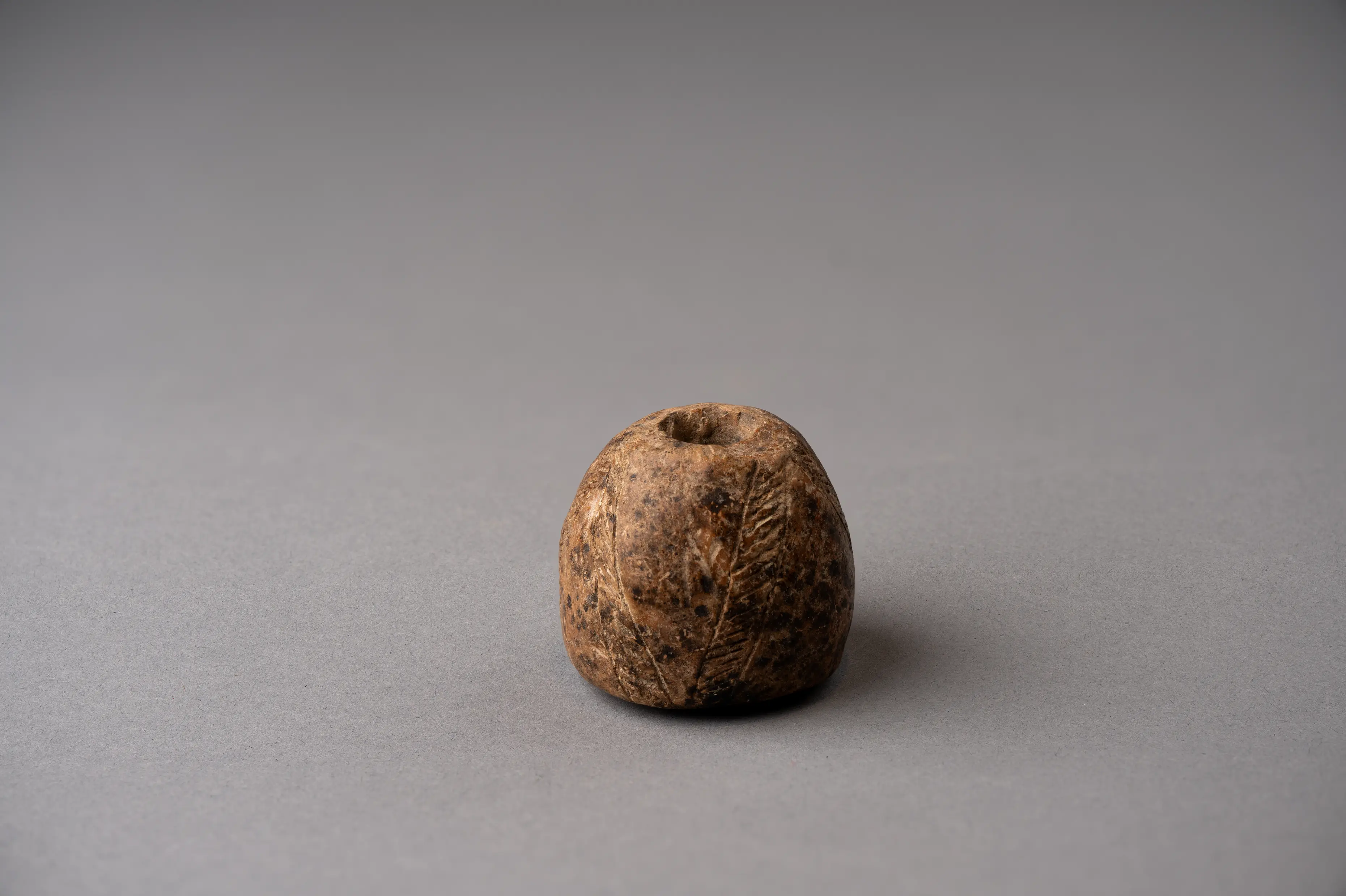
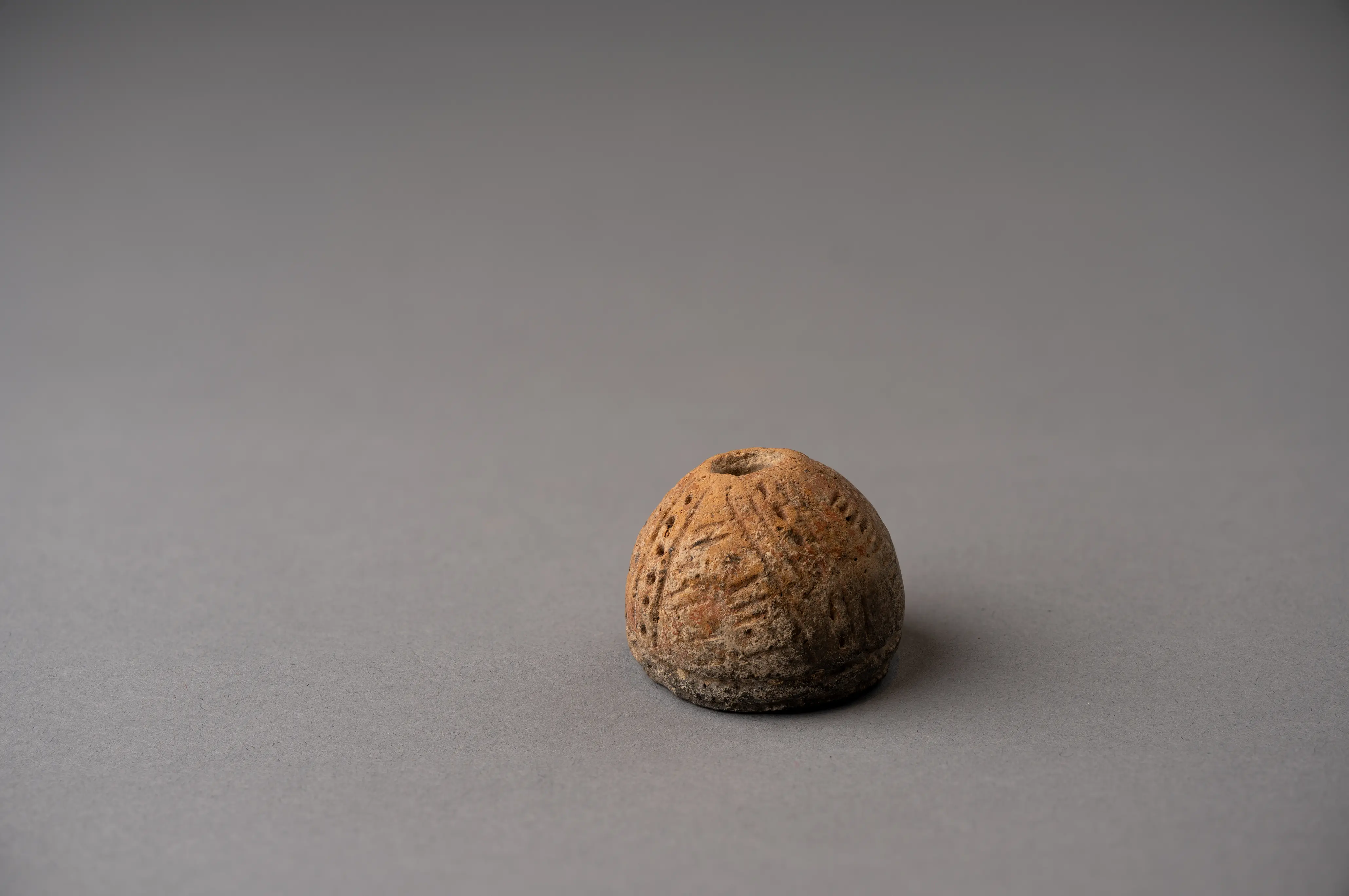
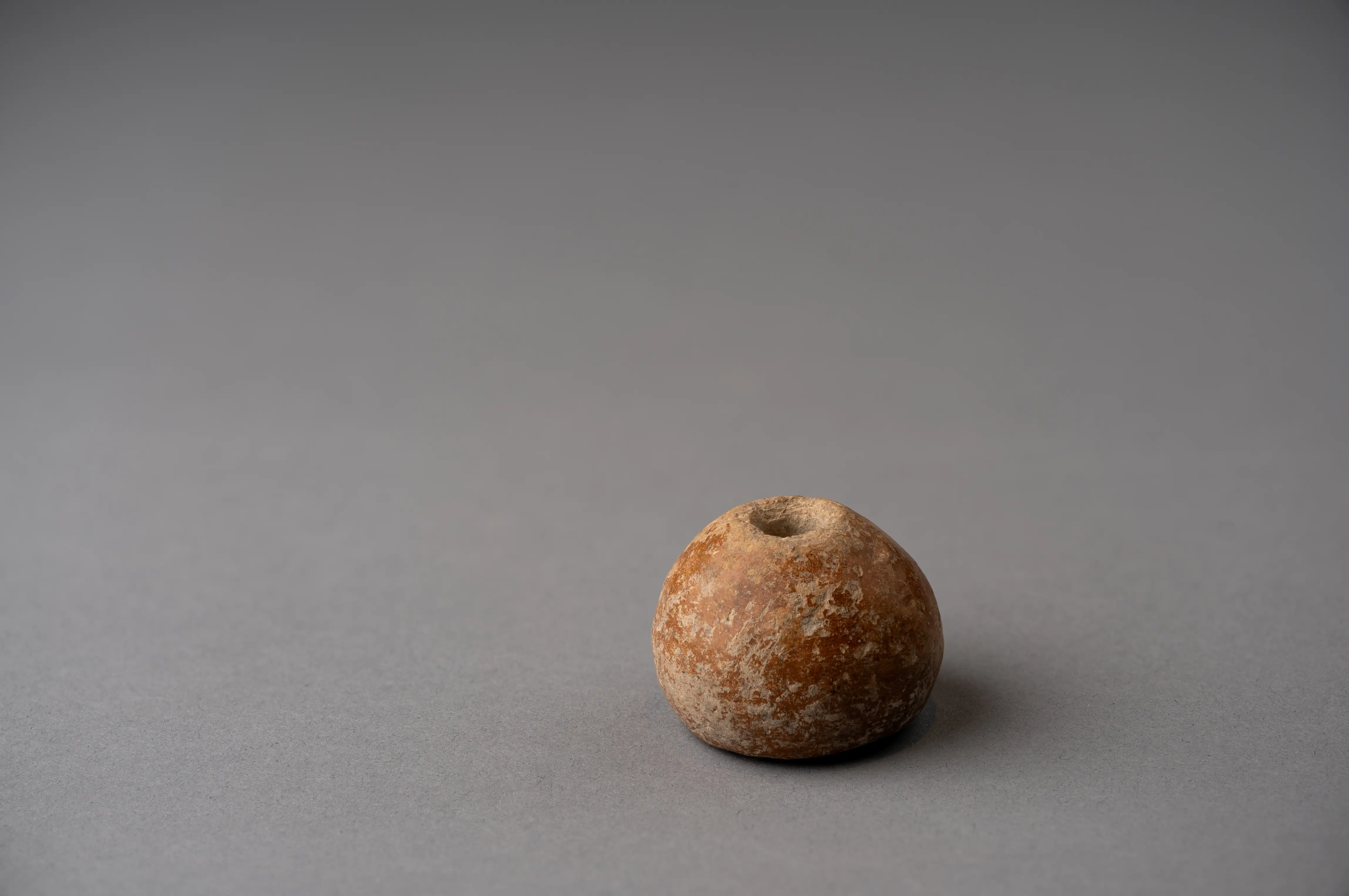
The tools of the period are more direct than the figures. The Drakopoulos collection holds three Middle Cypriot spindle whorls (whorl 1, whorl 2, whorl 3), small conical weights incised with branch-like patterns, of the decorated kind that Smith compares to Early and early Middle Cypriot whorls from Lapithos and Bellapais-Vounous [3, p. 171]. Use-wear on the whorls from Marki-Alonia shows that Bronze Age Cypriots used the low-whorl spindle of the Levant, Anatolia, the Aegean and Europe, not the high whorl of Egypt and Mesopotamia [1, p. 291].
Late Bronze Age: an international image repertoire
The Late Bronze Age (c. 1650 to 1050 BC) is rich in figures and poor in Cypriot clothing. When a male figure is visibly clothed, the garment is usually short. Women are usually nude, and the fully draped women of cylinder seals and imported Mycenaean pictorial pottery may be deities or foreigners. Some women wear clearly rendered jewellery, "either large hoop earrings or a long necklace with a pendant", and some men carry weapons such as a mace [3, p. 169]. The handmade Base Ring female figurines, discussed under Astarte figures, belong to the nude group. The seals and pictorial kraters share their imagery with the Levant and the Aegean and cannot be taken as a record of what a Cypriot wore; see the Mycenaean and Ugarit and the Levant entries for the contacts.
Cloth production, by contrast, is well attested. Weavers on Cyprus, as on Crete, used the warp-weighted loom; whether the ground loom and vertical loom of the Levant and Egypt were also used cannot be told from the surviving evidence [2]. Whorls, loom weights, bone weft-beaters, clay reels possibly for belt cords, and fulling and dyeing installations are all recorded [1, p. 289]. A large textile workshop stood next to Temple 1 at Kition, on a scale well beyond household production [2]. Crushed murex, the source of purple dye, occurs at Late Bronze Age Hala Sultan Tekke [2]. Written sources suggest that Alashiya, if it is Cyprus, supplied linen to its neighbours, and a possibly "Cypriot" type of wool appears in the Linear B texts [1, p. 290].
The end of the period brings the clearest change in fastening. The D-shaped fibula, a brooch with an asymmetric bow, appears in Cypriot tombs from the eleventh century BC and, in the words of the Smithsonian exhibition catalogue, "completely replaces the types of pins that were used for centuries during the Bronze Age"; the catalogue's example is a silver fibula with bronze beads sheathed in gold from Tomb 711 at Amathus [10, cat. 102]. The same entry argues that such items travelled with their wearers and that the new garments indicate newcomers from the Aegean [10, cat. 102]. That is an inference from fastener to garment to population, and it remains one side of the debate about Aegean migration at the end of the Bronze Age.
| Period | Main evidence | What it shows | What it does not show |
|---|---|---|---|
| Aceramic Neolithic (c. 9000–5200 BC) | Bone needles and awls, fossilised thread from Khirokitia, stone figurines | Sewing and working of plant fibre; ornament and pigment on figures | Any garment; wool (sheep were hair sheep) |
| Chalcolithic (c. 3900–2500 BC) | Picrolite cruciforms and pendants, painted birth figures from Kissonerga | Necklaces with pendants; possible shawls or bracelets; body paint | Whether patterns are cloth or skin |
| Early and Middle Bronze Age (c. 2500–1650 BC) | Plank figures, toggle-pins, earrings, beads, spindle whorls, linen fragments | Earrings, necklaces, headbands, pins; linen cloth; low-whorl spinning | The cut of garments; the meaning of body incision |
| Late Bronze Age (c. 1650–1050 BC) | Base Ring figurines, seals, ivories, loom weights, dye installations | Short male garments; nude women with jewellery; wool and purple dye in production | Local dress on imported or international imagery |
| Cypro-Geometric (c. 1050–750 BC) | D-shaped fibulae, tombs | Cloth pinned at the shoulder; new fastening fashion | Who wore it, or why it changed |
| Cypro-Archaic (c. 750–480 BC) | Limestone and terracotta votaries, painted snowman figurines | Tunic and mantle, 'Cypriot shorts', Egyptianizing kilt, pointed cap, turban, veil, jewellery | Everyday working dress; the ethnicity of wearers |
| Cypro-Classical (c. 480–310 BC) | Statues in chiton and himation, temple boys, Amathus sarcophagus, Herodotus 7.90 | Greek-style draped dress; royal turban; children's chiton and amulets | Colour, which is mostly lost |
Cypro-Geometric and Cypro-Archaic: the statues speak
For the Cypro-Geometric period the images are few and small, and the fibula is the main evidence for how cloth was worn. Einar Gjerstad dated the change from small "idol plastic" to monumental sculpture to around 650 BC [11, p. 269]; from then until the end of the Cypro-Archaic period the sanctuaries filled with limestone and terracotta votaries. In Gjerstad's summary, men wore a short tunic or a long chiton with overfold, both sleeved, with or without a girdle and sometimes with a fringed border, and a mantle over one or both shoulders; there was also a kilt and a loincloth or "bathing-trousers", usually with a short tunic. Women wore long sleeved chitons, sometimes girdled, with woollen mantles in winter, and a veil held by bands or a "turban". Footwear, where shown, was usually sandals, with blunt-toed shoes and boots with upturned toes [11, p. 270]. Gjerstad read these garments as evidence of Syro-Anatolian connections, part of his wider picture of an "Eteocyprian" culture [11, pp. 269–270].
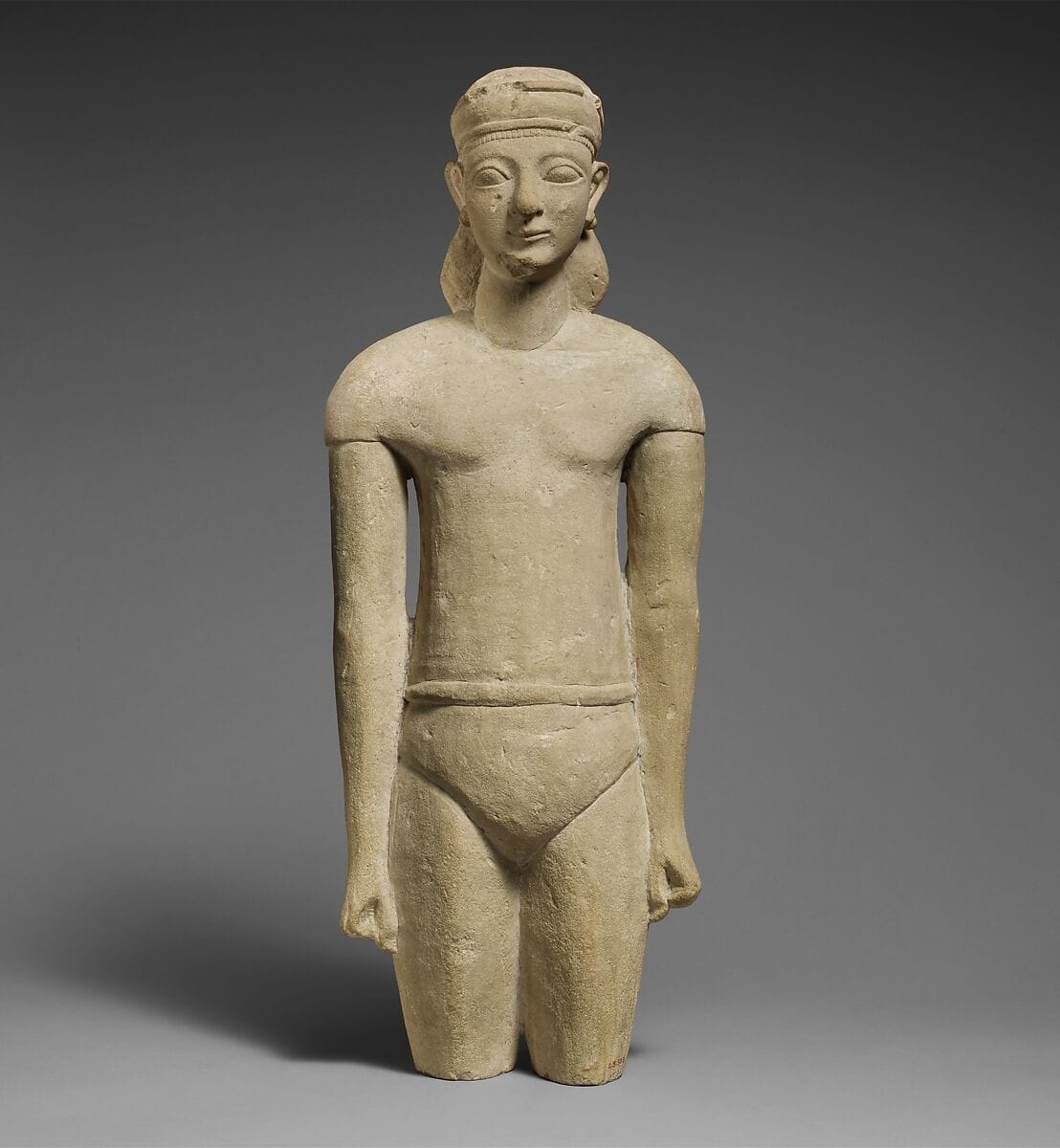
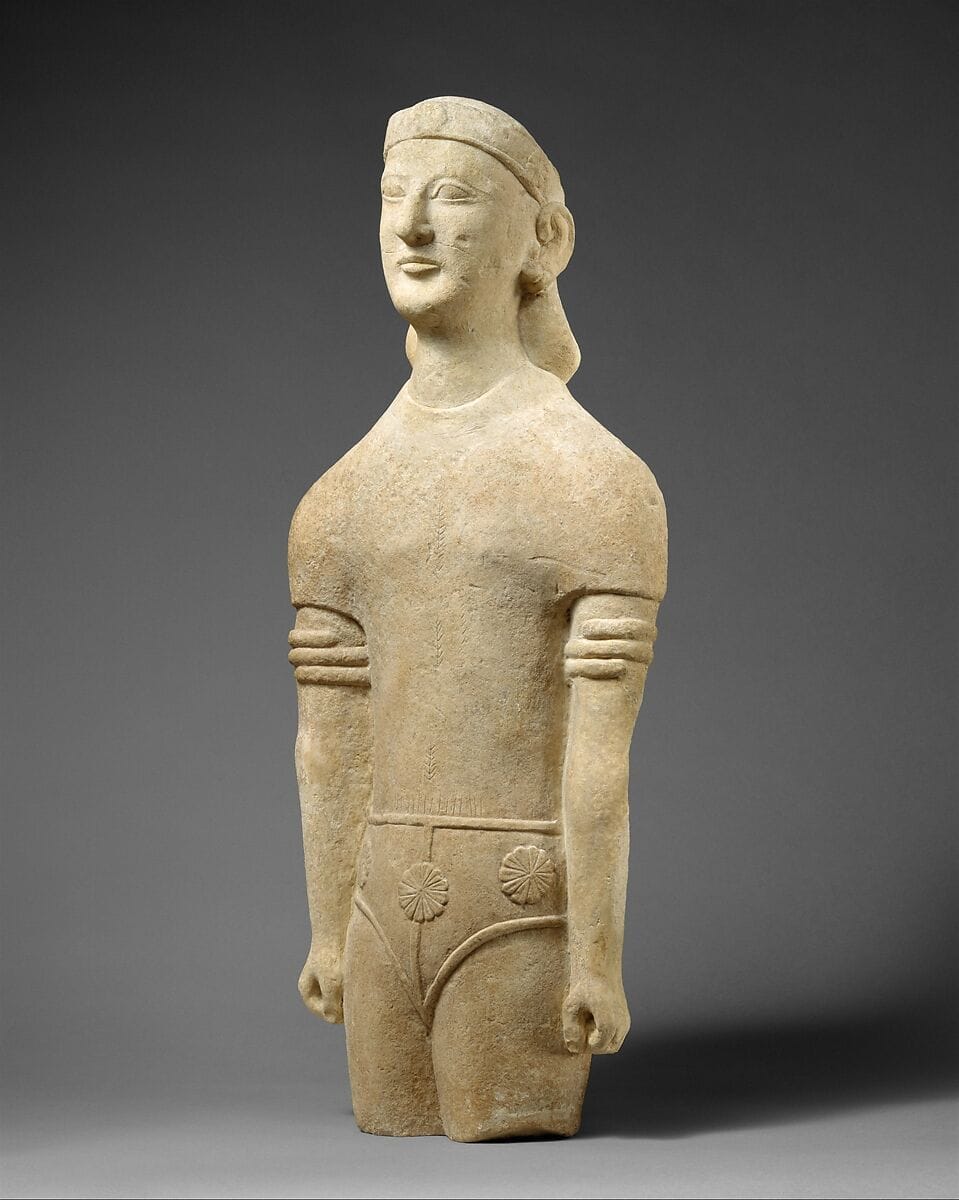
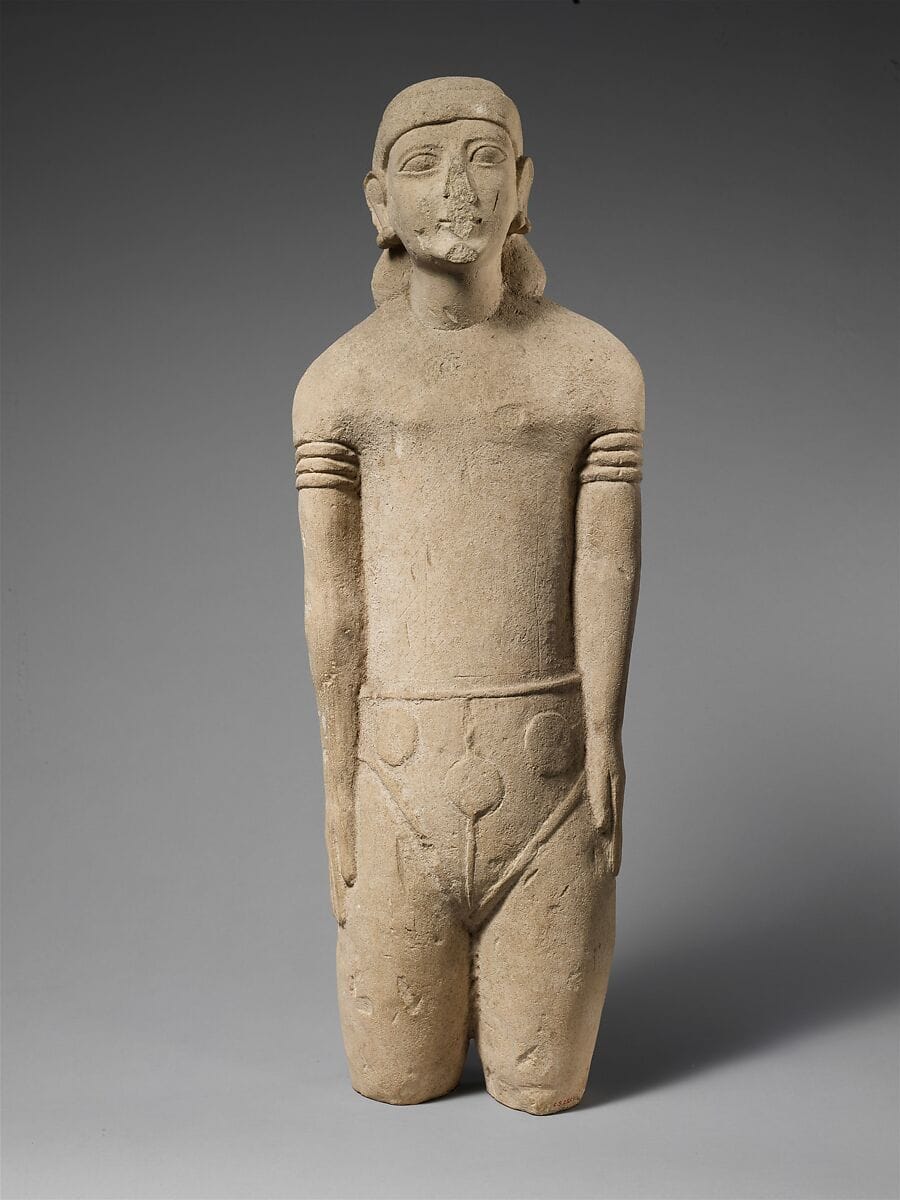
Lone Wriedt Sørensen's study of the male statues organises them by garment into three groups. The standard Cypro-Archaic statue, bearded or beardless, wears a long plain tunic and a tight mantle draped over the left shoulder and across the back to cover the right shoulder and arm, with a pointed cap over a bag-shaped hairdo; the vertical edge of the mantle is often incised or raised, probably to show fringes or a special fabric [12, p. 3]. Through the sixth century the mantle gains East Greek folds, though the tight version was never abandoned [12, pp. 4–5, 11]. The second group wears what the literature calls "Cypriot shorts" with a short-sleeved tunic and a rosette diadem. Antoine Hermary rejects "shorts", caleçon and Badehose alike and prefers the Greek word perizoma, noting that on Cyprus the garment is always worn with a thin tunic covering the torso and upper arms; on some statues a band of another material, perhaps leather, is tied over the fabric with a cord [13, pp. 48–49]. He derives the outfit from seventh-century Greek and Cretan images of gods, heroes and hunters; it vanishes in Greece after the mid-sixth century but lasts on Cyprus to the end of the Archaic period. Its wearers were young men of the upper classes, less senior than the bearded men in long garments and helmets with cheekpieces [13, pp. 48–49]. Two of Hermary's examples from the sanctuary at Golgoi-Ayios Photios are on this site: a statuette with plain shorts and earrings (Met 74.51.2622) and a figure whose shorts carry three relief rosettes and whose upper arms wear spiral bracelets (Met 74.51.2479) [13, p. 50]; a third, Met 74.51.2549, is catalogued as a votary with Cypriot shorts and a diadem.
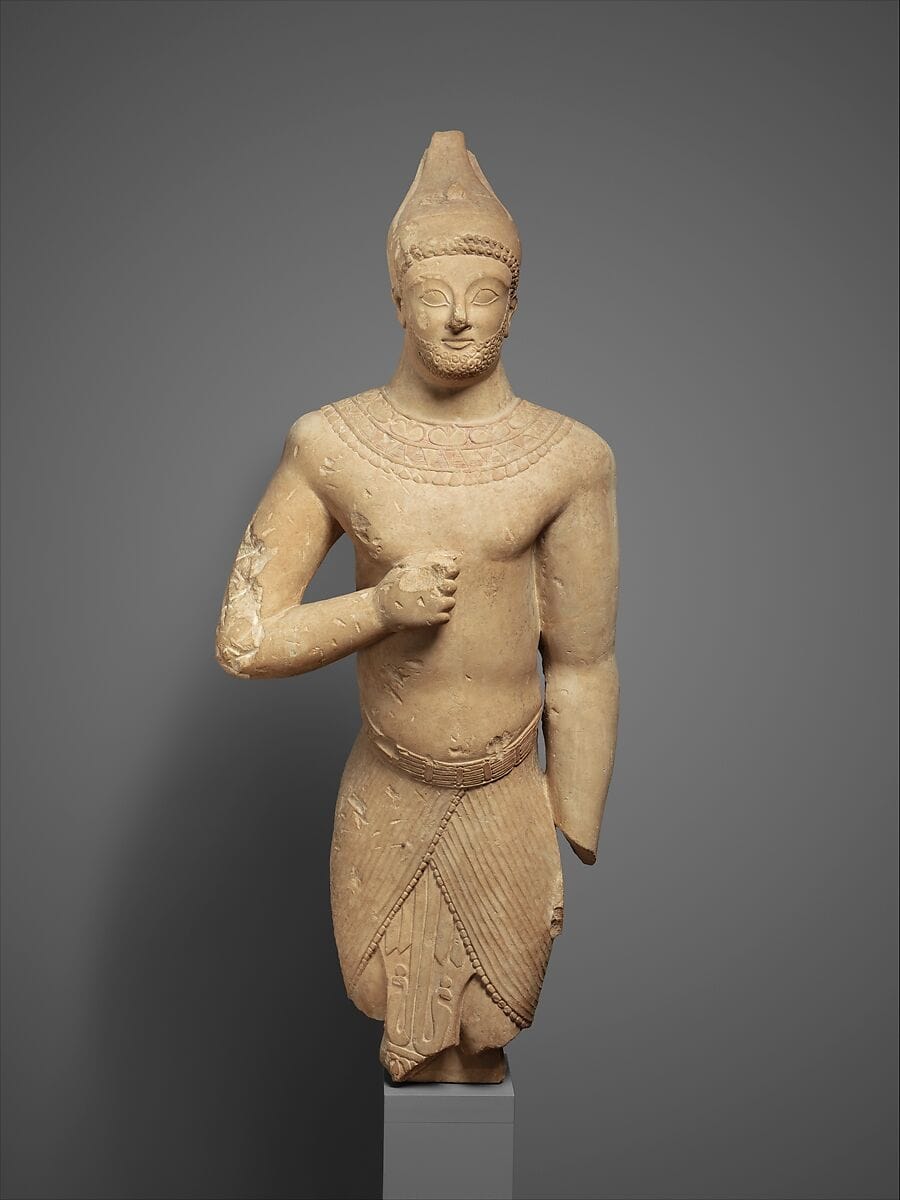
The third group wears an Egyptianizing kilt, often with a broad usekh collar and a local version of an Egyptian crown. Following Fanni Faegersten, Sørensen notes that only a couple of early sixth-century figures reproduce the Egyptian wrap-around shenti and only one the New Kingdom kilt with its front panel; the rest mix the two freely and decorate them with Hathor and Bes heads, gorgoneia and belts carrying sphinxes or a lion-slayer, a Cypriot invention with no Egyptian model. None wears the crown over an Egyptian-type headdress in the Egyptian manner [12, pp. 8–10]. Examples are the kilted statue from Golgoi, Met 74.51.2472, which Sørensen illustrates [12, p. 8], and the smaller bearded votary in Egyptianizing dress (Met 74.51.2478). Of a colossal Egyptianizing terracotta statue from Polis-Maratheri, the City of Gold catalogue notes that it was not meant to represent a pharaoh and reflects an island fashion for Egyptian motifs [14, cat. 71]. Sørensen's central finding is that headgear is not tied to one type of garment. Shorts are worn with a pointed cap or an Egyptian-looking double crown, and kilts with crowns, diadems, wreaths, helmets or bare heads [12, pp. 8, 10–11]. Red, Sørensen observes, is the colour that survives most often on garments, as whole mantles or as borders and fringes [12, p. 11]; much of the costume detail was painted and is now lost, a subject taken up under Archaic limestone sculpture.
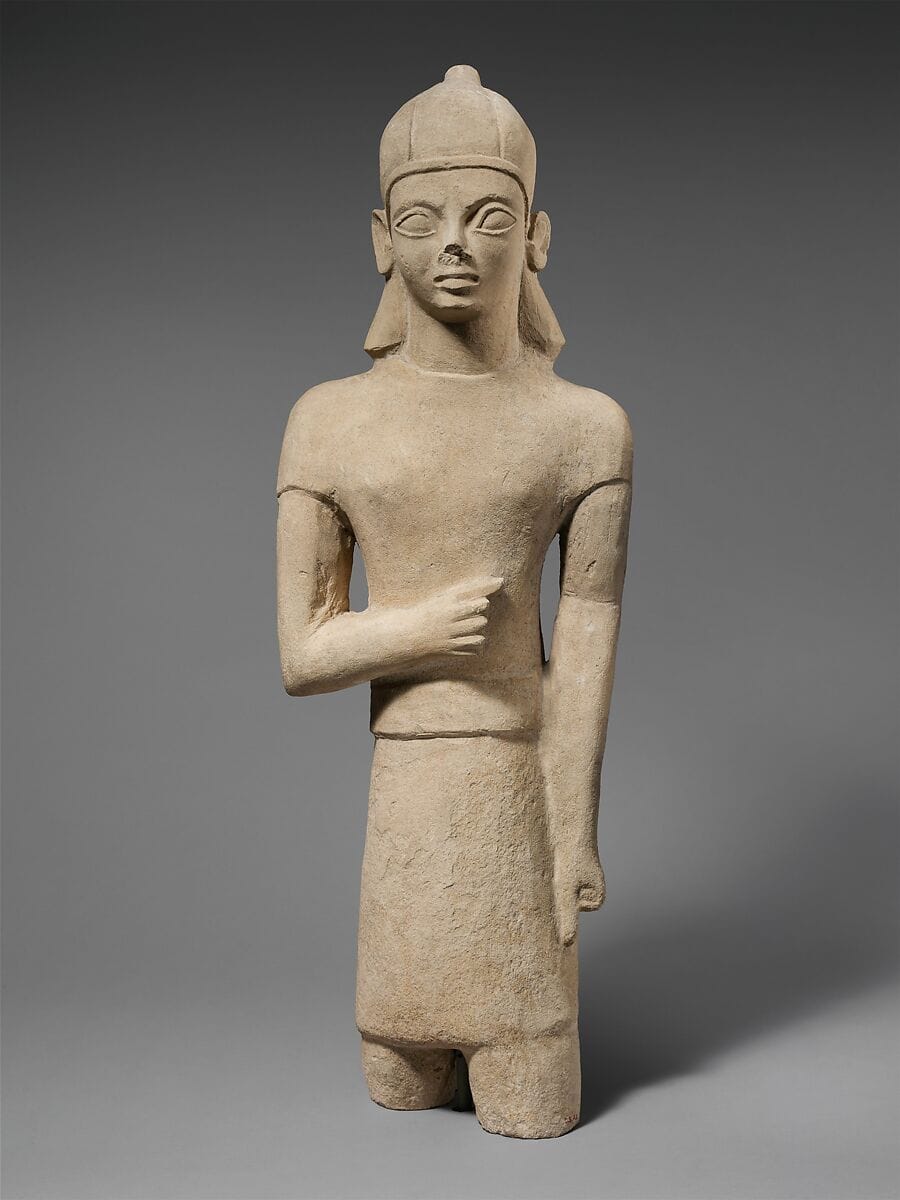
Headgear was the most varied part of dress. The pointed or conical cap "was exclusively worn by Cypriot men through most of the Archaic period"; in the second half of the sixth century a pointed cap with a wreath appears on both men and women [15, p. 125]. The bearded dignitaries of the stone series wear its stiffer form, the conical helmet with cheekpieces, the Cypriot helmet-cap; a Cesnola head of the middle or third quarter of the sixth century, Met 74.51.2851 (head wearing a conical helmet), is a typical example. Turbans are mostly worn by bearded men and are sometimes identified as the mitra that Herodotus says Cypriot kings wore, though some beardless men and even female musicians wear them in apparently later pieces, so the meaning may have changed [15, p. 125]. Early female statues wear a long sleeved garment, a veil or wig, and often "impressive jewelry": ear-caps, large necklaces and strings of scarab seals [15, pp. 123, 125]. In stone a beard or jewellery may be the only way to tell the sexes apart [15, p. 123].
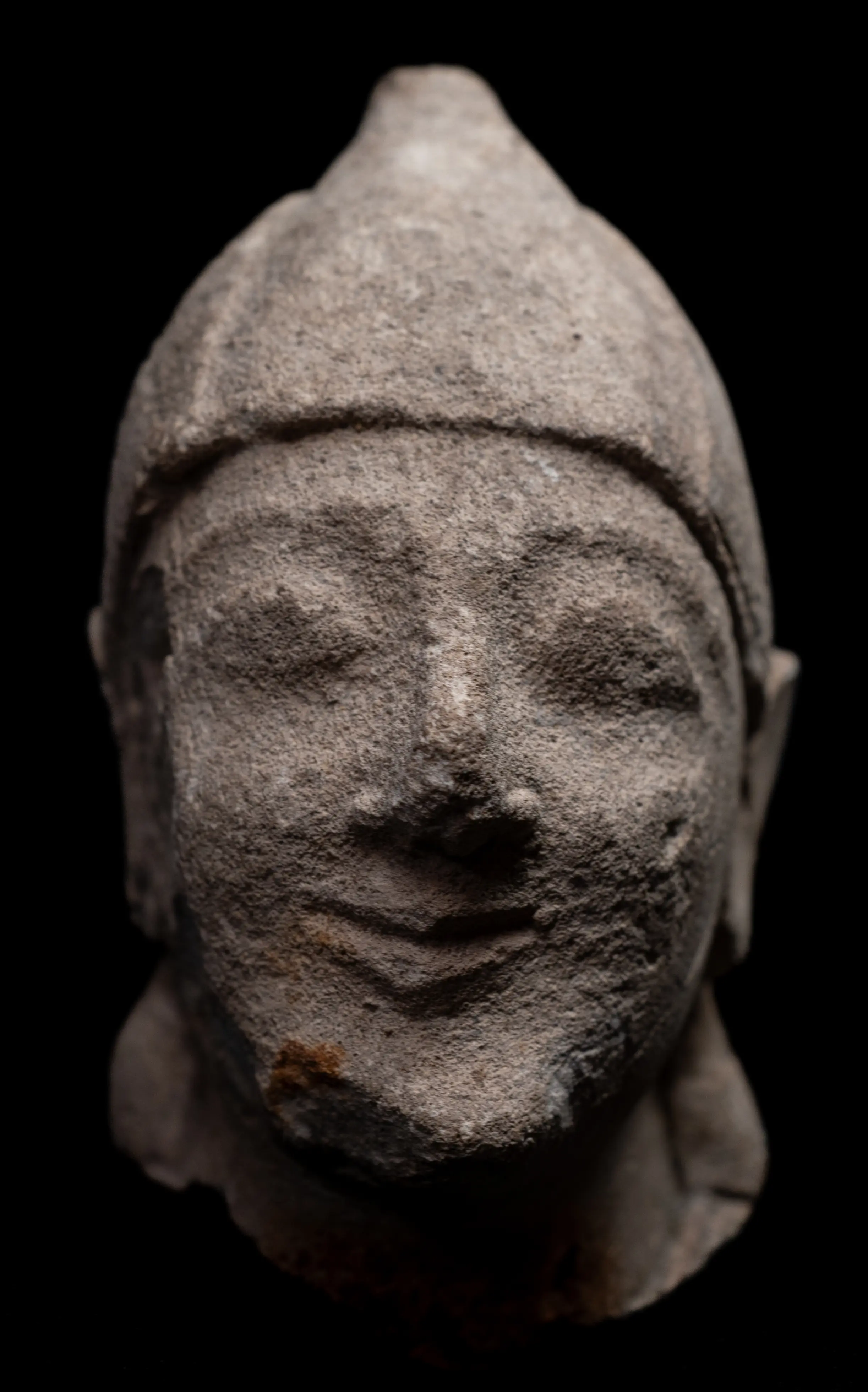
A small head in the Drakopoulos collection belongs to this male series. The Archaic limestone head, 10 cm high and formerly in the Chevallier-Verel collection in Paris, shows a smiling, apparently beardless man in a tall pointed cap whose lower edge forms a raised band across the brow, with flaps or locks falling at the sides of the face. Like most Cypriot votive heads it has lost its body, so whether it wore mantle, shorts or kilt cannot be known. For the larger Golgoi heads see Cesnola's colossal head.
The terracottas give the cheaper end of the same repertoire. A handmade "snowman" figurine from Polis-Maratheri, of the late seventh or early sixth century, wears a red-painted, brimmed pointed cap and a long red gown open at the front, held by three black bands that are probably a belt; black stripes at the ends of the short sleeves may be armbands, and a tunic edge shows at the neck. None of it is modelled; all of it is paint. The catalogue entry notes that the ultimate inspiration for the cap and gown was Assyrian art of the eighth and seventh centuries, but that by the time the figurine was made they belonged to a stock Cypriot repertoire found at many sanctuaries [14, cat. 70, p. 206]. The class is covered under snowman figurines, horse-and-rider figurines and Terracotta figurines of Cyprus.
Behind the statues stood a textile industry of real reputation. Gjerstad collected the literary evidence, including two named masters of the sixth century, Akesas and his son Helikon of Salamis: a textile by Helikon was dedicated at Delphi, and a girdle of his was later given to Alexander by the Rhodians. He added that the weaving of figured ornament reached Cyprus from the Asiatic mainland [11, p. 271].
Cypro-Classical: himation, turban and the temple boys
From about 500 BC, Sørensen notes, male statues adopt less flamboyant himatia over a Greek-looking chiton, covering most of the body in the manner of Greek sculpture, often with short hair and a wreath [12, p. 6]. Female statues had already begun to follow Greek korai late in the sixth century, with lighter jewellery and a diadem or fillet; the Vouni kore wears a mantle draped like those of Ionian male statues [15, p. 127]. In the muster of Xerxes' fleet in 480 BC the Cypriots furnished 150 ships: "Their kings had turbans bound about their heads, while the people wore tunics; in other respects they were clad like the Greeks" [16, 7.90]. On the Amathus sarcophagus of the second quarter of the fifth century (Met 74.51.2453), Hermary identifies the larger figure under the parasol in the leading chariot by his turban, which he takes to be that royal mitra, and reads the scene as a royal procession [13, p. 360].
The temple boys, crouching child votaries, many of them said by Cesnola to come from "the ruins of a temple at Curium" (Kourion), are the Cypro-Classical category most concerned with clothing, because their garment is arranged to reveal. In the Cesnola series a long pleated chiton "leaves the genitalia exposed" or is raised above them, the children wear bracelets at the wrist and rings in the ears, and a chain of amulets (rings, pendants, "double axes") hangs from one or both shoulders; red paint survives on several garments [13, pp. 203, 206, 211]. See Temple boys.
Debates and cautions
Four arguments recur. The first is whether costume records foreign rule. Gjerstad and Pryce tied the changing garments of Cypriot statues to successive foreign dominations, Assyrian, Egyptian and Persian, while Vermeule held that different garments did not reflect shifting political control [12, p. 2]. Sørensen's finding that garments and headgear combine freely, and her reading of the statues as vehicles of individual display, weigh against the political reading [12, pp. 5, 7, 11], as does the City of Gold judgement on the Maratheri colossus [14, cat. 71]. On this view a kilt or a Greek mantle records fashion and status in the sanctuary, and nothing secure about the origin of its dedicant. The Egypt, Neo-Assyrian, Phoenician and Achaemenid entries treat the contacts themselves.
The second is whether prehistoric figurines are clothed at all. The Kissonerga shawl-or-bracelet dispute, Winkelmann's body-paint reading [7, pp. 206, 229, 314] and the alternatives for the plank incisions [8, p. 183] leave the question open, and no proposed garment can be matched to a surviving textile. The third concerns sex and divinity. Talalay and Cullen argue that the plank figures were deliberately ambiguous in sex [8, p. 183], and Sørensen argues against reading the Archaic female statues with tall floral headdresses as goddesses rather than mortal women [15, pp. 122–123]. Dress read as a goddess's regalia depends on an identification that is itself disputed.
The fourth concerns fasteners and migration: the fibula's replacement of the pin is secure, and the claim that it marks Aegean settlers wearing new garments [10, cat. 102] remains an interpretation. Behind all four sits the funerary and votive bias of the record: cloth survives mostly in tombs, statues because they were dedicated in sanctuaries. Working clothes, the everyday dress of farmers and herders, are the least visible part of the subject.
Conclusion
The Cypriot wardrobe can be reconstructed only in outline. Linen was spun on low-whorl spindles and woven on warp-weighted and perhaps other looms from at least the third millennium; wool became important with woolly sheep in the Bronze Age, and purple dye was being made from murex by the Late Bronze Age; cotton and silk belong to later centuries. Earrings, necklaces and pins are the securest items of Bronze Age dress, and the fibula records a change in how cloth was pinned at the end of that age. From about 650 BC the sanctuary statues show a local repertoire of tunic and tight mantle, perizoma, Egyptianizing kilt, pointed cap and turban, mixed at will and painted red, until Herodotus, in 480 BC, saw Cypriots dressed much like Greeks except for their kings' turbans.
Objects on this page
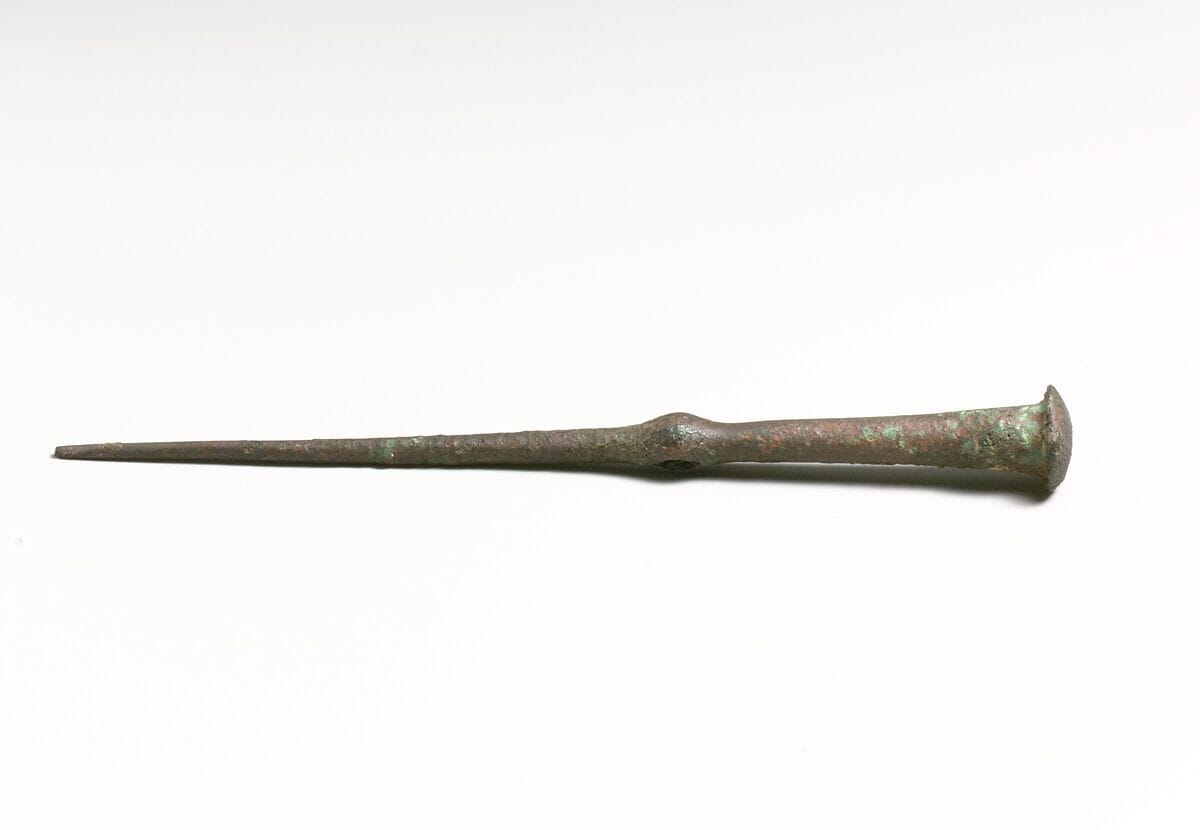 Bronze toggle pinMiddle Bronze Age II · 1900–1600 BC
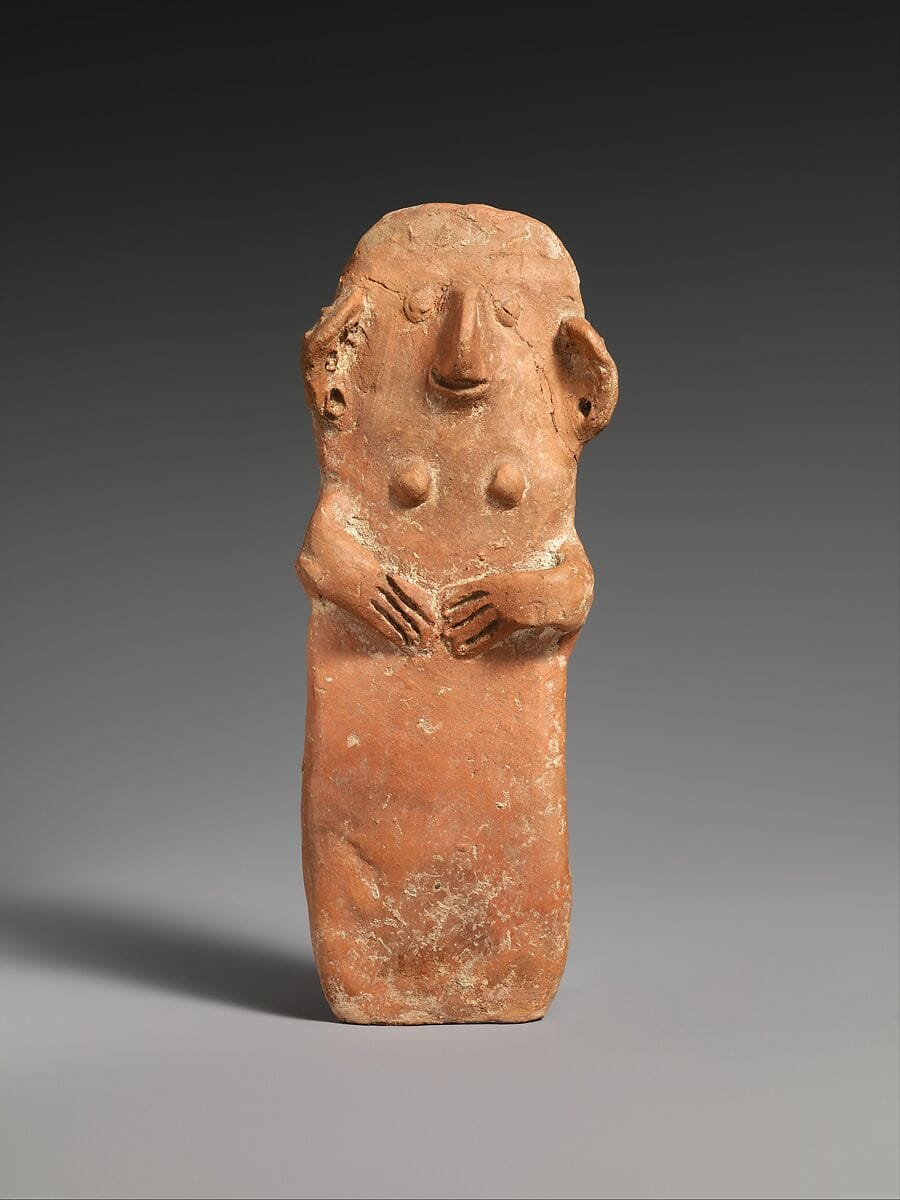 Terracotta plank-shaped figurineMiddle Bronze Age I · 1900–1800 BC
 Terracotta plank-shaped figurineMiddle Bronze Age I · 2000–1800 BC
- Spindle Whorl with Incised Herringbone BandsMiddle Bronze Age I · 2000–1725 BC
 Red Polished Spindle Whorl with Incised Lattice and Dotted BandsMiddle Bronze Age I · 2000–1725 BC
 Plain Red Polished Spindle WhorlMiddle Bronze Age I · 2000–1650 BC
 Limestone statuette of a male votary with Cypriot shorts and a diademArchaic II · 601–580 BC
 Limestone male figureArchaic II · 599–550 BC
 Limestone statuette of a male votary with Cypriot shorts and a diademArchaic II · 600–550 BC
 Limestone male figure in Egyptian dressArchaic II · 550–525 BC
 Limestone votary of a bearded male in Egyptianizing dressArchaic I · 650–600 BC
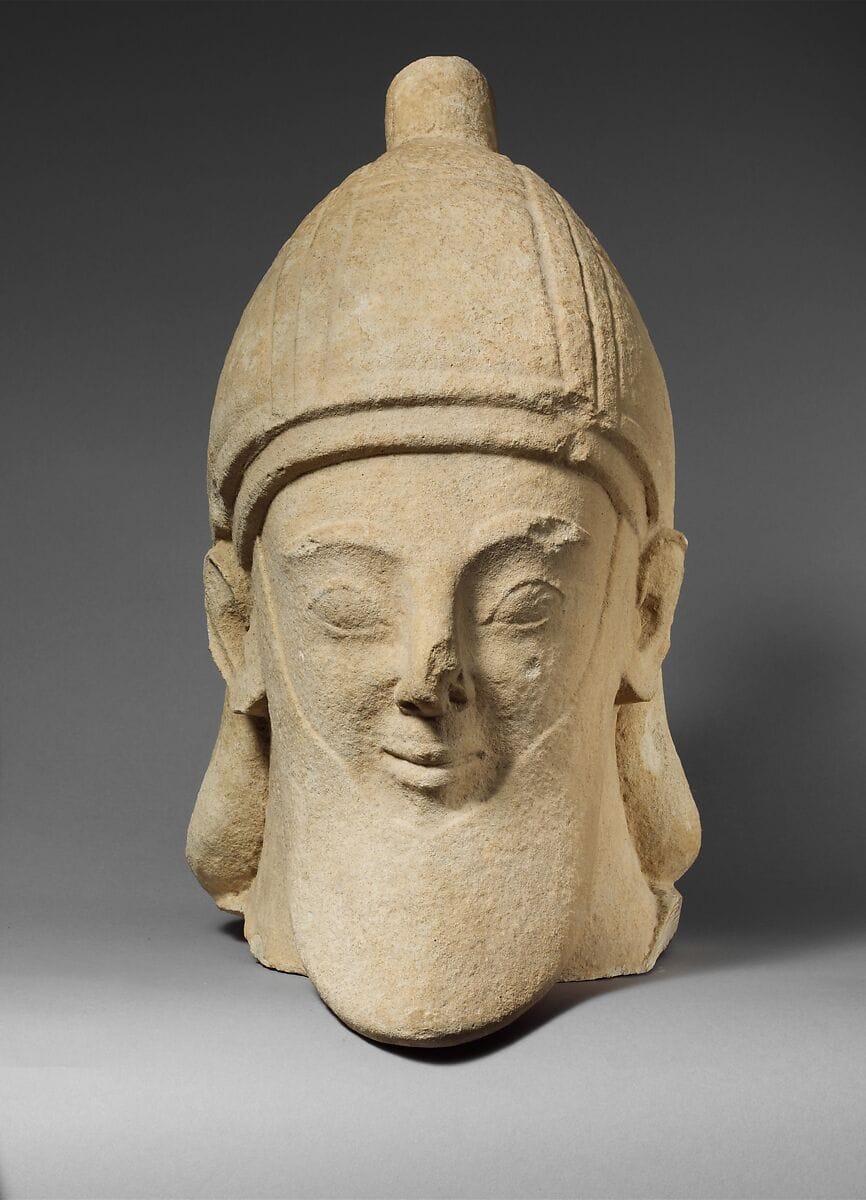 Limestone head of a bearded male wearing a conical helmetArchaic II · 560–525 BC
and 1 more object mentioned on this page
References
- 1.Smith, J. S. (2002). Changes in the workplace: Women and textile production on Late Bronze Age Cyprus. In D. Bolger & N. Serwint (Eds.), Engendering Aphrodite: Women and society in ancient Cyprus (CAARI Monographs 3, pp. 281–312). American Schools of Oriental Research.
- 2.Smith, J. S., & Tzachili, I. (2012). Cloth in Crete and Cyprus. In G. Cadogan, M. Iacovou, K. Kopaka & J. Whitley (Eds.), Parallel lives: Ancient island societies in Crete and Cyprus (British School at Athens Studies 20, ch. 9). British School at Athens.
- 3.Smith, J. S. (2017). Dress and the people of Flamoudi (Phlamoudhi) in the Bronze Age. In D. Pilides & M. Mina (Eds.), Four decades of hiatus in archaeological research in Cyprus: Towards restoring the balance (Studies on Ancient Cyprus 2, pp. 168 ff.). Holzhausen.
- 4.Croft, P. W. (2002). Game management in early prehistoric Cyprus. https://doi.org/10.1007/BF02192406
- 5.Kristiansen, K., & Sørensen, M. L. S. (2020). Wool in the Bronze Age: Concluding reflections. In S. Sabatini & S. Bergerbrant (Eds.), The textile revolution in Bronze Age Europe: Production, specialisation, consumption. Cambridge University Press. https://doi.org/10.1017/9781108656405.014
- 6.Pilides, D., & Papadimitriou, N. (Eds.). (2012). Ancient Cyprus: Cultures in dialogue. Department of Antiquities, Cyprus.
- 7.Winkelmann, C. (2020). The Neolithic and Chalcolithic figurines of Cyprus. Zaphon.
- 8.Talalay, L. E., & Cullen, T. (2002). Sexual ambiguity in plank figures from Bronze Age Cyprus. In D. Bolger & N. Serwint (Eds.), Engendering Aphrodite: Women and society in ancient Cyprus (CAARI Monographs 3, pp. 181–195). American Schools of Oriental Research.
- 9.Karageorghis, V. (2000). Ancient art from Cyprus: The Cesnola Collection in the Metropolitan Museum of Art. The Metropolitan Museum of Art.
- 10.Hadjisavvas, S. (Ed.). (2010). Cyprus: Crossroads of civilizations. Exhibition catalogue, National Museum of Natural History, Smithsonian Institution, Washington, DC.
- 11.Gjerstad, E. (1948). The Swedish Cyprus Expedition, Vol. IV, Part 2: The Cypro-Geometric, Cypro-Archaic and Cypro-Classical periods. The Swedish Cyprus Expedition.
- 12.Sørensen, L. W. (n.d.). True to type? Archaic Cypriot male statues made of limestone.
- 13.Hermary, A., & Mertens, J. R. (2014). The Cesnola Collection of Cypriot art: Stone sculpture. The Metropolitan Museum of Art.
- 14.Childs, W. A. P., Smith, J. S., & Padgett, J. M. (Eds.). (2012). City of gold: The archaeology of Polis Chrysochous, Cyprus. Princeton University Art Museum.
- 15.Sørensen, L. W. (2002). Cypriot women of the Archaic period: Evidence from sculpture. In D. Bolger & N. Serwint (Eds.), Engendering Aphrodite: Women and society in ancient Cyprus (CAARI Monographs 3, pp. 121–132). American Schools of Oriental Research.
- 16.Herodotus. (1909). The history of Herodotus (G. Rawlinson, Trans.; Vol. 3, Book 7.90). New York. https://archive.org/details/the-history-of-herodotus-george-rawalison-new-york-1909-volume-03