
Everything the first Cypriots ate, apart from shellfish, wild plants and a few native animals, had to be carried across at least 60 km of open sea. The island had no wild wheat, no wild sheep or goat, no cattle, no pig and no deer when the first farming villages were founded around 9000 BCE, so the Cypriot diet began as a deliberate, filtered selection of mainland species and stayed distinctive for the next eight thousand years [1, p. 236; 2]. This entry follows that diet from the Neolithic to the end of the Cypro-Archaic period (c. 480 BCE): the crops and animals available in each period, the technology used to turn them into meals, the drinks, the feasts, and the places where the popular story has run ahead of the evidence. It belongs with the wider daily life hub and the entries on clothing and dress and pottery.
The founder package and the Neolithic table (c. 9000–4000 BCE)
The founding crops of Cyprus are the Near Eastern founder crops: einkorn and emmer wheat, hulled barley, lentil, pea, grass pea, bitter vetch and flax, with chickpea rare. They arrived in stages rather than as a single bundle, and the earliest villages at Ayios Tychonas-Klimonas and Ayia Varvara-Asprokremnos were already cultivating imported cereals in the late tenth millennium [1, pp. 240–245]. The animal side of the package was ferried across in the same staggered way. Wild boar came first and was hunted; sheep, goat, pig and, briefly, cattle followed in the Cypro-PPNB, and Mesopotamian fallow deer (Dama mesopotamica) were released into a landscape that had held no mammal larger than a mouse since the extinction of the endemic pygmy hippopotamus and dwarf elephant [3; 4]. A cat buried beside a human at Parekklisha-Shillourokambos around 7500 BCE is the earliest evidence anywhere for a close relationship between people and cats, several millennia before Egypt; the animal was almost certainly brought over to protect stored grain from the mice that arrived with it [5] (see Ancient cats: first domesticated in Cyprus).
Deer are the peculiarity of Cypriot foodways. At most Neolithic and Chalcolithic sites fallow deer supplied more meat than any domestic animal, yet they were never domesticated, on Cyprus or anywhere else. Paul Croft's reading of the cull profiles, which favour young males and spare breeding females, is that the deer were hunted within a system of sustainable game management that lasted some six thousand years, from introduction until deer hunting faded out in the Late Bronze Age [3, pp. 65–70]. Older claims that the deer were herded or even milked (Zeuner in the 1950s, later Desmond Morris) are not accepted.
Cattle are the second peculiarity. Cattle bones make up a few percent of the earliest PPNB samples at Shillourokambos and persist a little longer at the upland site of Kritou Marottou-Ais Giorkis, then disappear entirely; every Khirokitia-culture, Ceramic Neolithic and Chalcolithic faunal sample is devoid of them. Croft put the puzzle exactly: the old enigma of cattle being absent before the Bronze Age has been replaced by the conundrum of their early disappearance and their absence for the following three or four thousand years [4]. Why the animals were lost is unknown. The consequence for diet is clear: Neolithic and Chalcolithic Cyprus had no ox, no ard plough drawn by oxen and no large dairy animal until cattle were reintroduced at the start of the Bronze Age [2].
The sea was largely ignored. The colonists had arrived by boat, but fish and shellfish are scarce in Neolithic middens; the tuna-fishing village at Cape Andreas-Kastros on the tip of the Karpas peninsula is the exception, not the rule [4]. Stable-isotope work on human bone from Neolithic to Middle Bronze Age skeletons confirms a terrestrial diet of C3 plants and animal protein with no detectable marine input, though the samples are small [8, pp. 118–121]. At the largest villages, Khirokitia and Kalavasos-Tenta, deer are under-represented relative to smaller sites, because populations that size could not be fed by hunting alone and leaned more on herded pig, sheep and goat [3].
Before pottery, food was processed with saddle querns and rubbers, stone bowls and trays, and cooked in pits and hearths. At Khirokitia querns were so bound up with daily life that they were laid on the chests of the dead, a rite Dikaios recorded repeatedly [7, pp. 200–210]. Whether the first Cypriots also ate the island's endemic pygmy hippos to extinction remains open. The bone bed at Akrotiri-Aetokremnos, dated to about 11,000 BCE, was read by its excavator as a kill site [6], but critics argue the bones are a natural accumulation that people later used for fuel, and the radiocarbon dates on the bone itself are unreliable; the question is genuinely unresolved.
The Chalcolithic shift (c. 4000–2500 BCE)
The Chalcolithic villages of the west, Lemba-Lakkous, Kissonerga-Mosphilia and Erimi, show the deer economy in slow decline and pig and caprines rising, until by the Late Chalcolithic domestic animals outnumber hunted ones in the bone counts [3, pp. 70–75]. Cereals did not march steadily upward; Lucas and Fuller's long-term analysis shows cereal proportions actually falling through the Chalcolithic and only modestly recovering in the Bronze Age, with glume wheats retained long after the mainland had moved to free-threshing forms, a choice tied to household-scale storage rather than technological lag [1, pp. 250–258]. Olive, grape, fig and pistachio are all present in the seed and charcoal record, but standard identification cannot separate wild from cultivated olive or vine, and their presence is not evidence of orchards or of oil and wine production [18]. Two innovations do belong to this period: the first pithos-scale storage jars, and the first built oven, the domed "tanour" at Kissonerga-Mosphilia [2; 9, pp. 100–105].
The Bronze Age: cattle return, the plough, and the first cooking pots
The Philia phase (c. 2500–2300 BCE) that opens the Early Bronze Age brought a package of domestic changes that Webb and Frankel attribute to settlers from south-west Anatolia or Cilicia: cattle and donkeys, the ox-drawn ard, backed sickle blades, rectilinear houses, and a new kitchen [10, pp. 29–32]. Purpose-made cooking pots appear for the first time at Marki-Alonia, in two forms, both in darker, coarser, harder-fired fabrics than the tableware; their makers plainly understood the thermal demands of a pot set on a fire [10, p. 33]. Petrography shows the same non-calcareous, pyroxene-rich igneous recipe still in use for cooking pots at Kalavasos and Pyla a thousand years later [12, pp. 460–463]. Marki also supplies the kitchen furniture: hearths set into wall benches, portable clay hobs that supported pots over the fire from Early Cypriot I, and built ovens, one of which had modified jug necks reused as flues [11, pp. 14–22]. Low-walled "pans" long identified as bread griddles turn out, at Ambelikou-Aletri, to carry carbon on the inside rather than the base, so they were braziers; flat trays at Marki with interior carbon are the better candidates for flatbread baking [11, p. 132].
The reintroduced ox changed farming. The Red Polished ploughing models from Bellapais-Vounous, with yoked pairs of oxen drawing an elbow-plough while figures carry grain, show an ard essentially identical to the traditional Cypriot plough of the twentieth century [9, pp. 150–152]. Cattle were kept to adulthood at Sotira-Kaminoudhia, Marki and Alambra, as draught animals must be, and although sheep and goat dominate the bone counts, cattle supply over half the meat by weight at Early Cypriot sites [1, pp. 246–250]. Whether the animals were reintroduced for traction and milk (Knapp's application of Sherratt's secondary-products model [13, pp. 147–155]) or first for prestige, feasting and bridewealth (Keswani's ethnographic critique, which notes that the caprine cull profiles do not fit a milk-and-wool strategy [14]) is still argued. Croft's Marki data lean toward Keswani: the sheep and goats there look kept for meat rather than for any living product, and full exploitation of wool and dairy intensified only in the Late Bronze Age [11, pp. 263–282; 1, p. 252].
Meat was eaten conspicuously at funerals. The Vounous tomb chambers held cuts of beef, sometimes whole sides, alongside the drinking gear, and Keswani reads Early and Middle Cypriot funerals as public arenas of hospitality and competitive display [15, pp. 37–83; 16]. The deep incised "tulip bowls" of Red Polished I ware, discussed in the bowl entry and in the Vounous article, were probably individual drinking cups, but what they held is unknown. Beer is possible, on the evidence of a drying kiln and vessel set at Kissonerga-Skalia, and wine becomes more likely later, but no residue analysis has settled it [17, pp. 205–210]. Steel's reconstruction of the Middle Bronze Age kitchen, from round-bottomed cooking jars, tripod pots and flat baking trays, is a cuisine of pulse and meat stews, cereal porridges and daily flatbread, eaten from the floor with the hands or with bread, since spoons are absent [22, pp. 80–84].
Olive and vine become economically visible in the Bronze Age, but the story needs discipline. Both species were on the island in wild form from the Neolithic; the novelty is management, cultivation and production, which Margaritis insists should be demonstrated by explicit criteria rather than assumed [18]. At Pyrgos-Mavroraki near Limassol an Early and Middle Cypriot industrial complex, destroyed by earthquake around 1850 BCE, contained an olive press and large storage jars in which gas chromatography confirmed olive oil; that part is secure. The claims that Pyrgos was the world's oldest perfume factory, operated distillation around 2000 BCE, or produced the oldest wine, circulate almost entirely in the excavator's own publications and are not corroborated in the peer-reviewed syntheses, where the site is cited only for its oil press [2; 17, p. 210].
| Period | Staple crops | Animals eaten | New arrivals and losses |
|---|---|---|---|
| Aceramic Neolithic (c. 9000–5200 BCE) | Einkorn, emmer, hulled barley, lentil, pea, vetch, flax; fig | Fallow deer, pig, sheep, goat; little fish | Cattle introduced then lost; cat and dog present |
| Ceramic Neolithic (c. 5200–4000 BCE) | Same suite; wild olive, grape, pistachio gathered | Deer still dominant; caprines and pig | First pottery, but no dedicated cooking pots |
| Chalcolithic (c. 4000–2500 BCE) | Cereals decline as a share; pulses; wild fruits | Pig and caprines overtake deer by the end | Pithos storage; first built oven; no cattle |
| Early and Middle Bronze Age (c. 2500–1650 BCE) | Barley and emmer workhorses; glume wheats retained; olive and vine cultivated | Sheep and goat by count, cattle by weight; deer still hunted | Cattle and donkey reintroduced; ox-drawn ard; first cooking pots, hobs and ovens |
| Late Bronze Age (c. 1650–1050 BCE) | Olive oil at industrial scale; grape; pomegranate arrives | Cattle and caprines; deer and pig recede; real coastal fishing | Pithos magazines; wine and oil traded in Canaanite jars; murex dye (not food) |
| Cypro-Geometric (c. 1050–750 BCE) | Cereal, pulse, oil and wine polyculture | Sheep and goat, cattle; pig avoided | Olive-oil industry contracts; spit-roasting in elite tombs |
| Cypro-Archaic (c. 750–480 BCE) | Polyculture; olive oil and perfumed oil re-expand | Sheep, goat, cattle; chicken arrives 8th–7th century | Terracotta bread-making models; royal murex works; funerary feasts at Salamis |
The Late Bronze Age: oil, storage and the table
The Late Bronze Age is the best-documented period for one commodity, olive oil, because the towns built rooms for it. Building X at Kalavasos-Ayios Dhimitrios, a thirteenth-century ashlar complex, had a pillared pithos hall 19.5 by 7.25 m holding about fifty jars up to 2 m tall, standing on stone blocks or sunk into pits, and a second magazine with as many again; preliminary estimates put the hall at roughly 33,500 litres and the building at about 50,000 [20, p. 77]. Gas chromatography detected olive-oil esters in fifteen of nineteen sampled pithoi, flotation produced olive and grape stones but almost no cereal, and a high-capacity press stood immediately to the west [20, p. 77; 19, pp. 21–26]. Comparable complexes with presses and rows of pithoi stood at Maroni-Vournes and Alassa-Paliotaverna, where some jars carry cylinder-seal friezes rolled onto the clay before firing (see the article on seal-impressed pithoi). A pithos of 1.5 m holds about 560 litres; one of 2 m holds nearly 1,200 [21]. Keswani's reading is a staple-finance economy in which oil was accumulated and redistributed, perhaps to those who mined and processed copper, since the big coastal towns of Enkomi and Kition have no such magazines at all [20, pp. 78–80]. Oil and wine also moved as commodities in Levantine Canaanite jars and in exported Cypriot pithoi, and the Uluburun wreck of about 1300 BCE carried roughly 150 such jars [2, pp. 186–190]. Oil fed lamps as well as people; the linen wicks recovered from a Bronze Age cemetery in Israel, discussed in this article, show what the lamp end of the oil economy looked like.
Dining changed with the towns. Steel argues that the round-bottomed Red Polished repertoire, which could not stand on a flat surface and implies eating from the floor, gave way to flat- and ring-based jugs, kraters and bowls suited to a table, and to a much wider range of tableware made by specialist, increasingly wheel-using potters [22, pp. 84–87]. White Slip hemispherical bowls became the personal eating and drinking vessel, Base Ring cups and jugs served wine, and wealthy households added imported Mycenaean kraters and their local imitations for hospitality [25, pp. 285–295]. Cooking, by contrast, stayed conservative: handmade, round-bottomed, two-handled pots set directly on the coals, 15 to 25 cm high, broken and replaced constantly; only at the very end of the period, in the twelfth century, did flat-based wheel-made cooking jugs of Aegean type appear beside them [12, pp. 459–464].
The White Slip bowl carries a lesson about names. It has been called the "milk bowl" since the 1970s purely for its milky surface, and a Drakopoulos-collection example, a White Slip milk bowl, still bears the label. The first organic-residue study of the ware found no dairy signature at all: the bowls had held hot cooked meals of roasted or stewed meat, animal fat, vegetable oil and pot-herbs, and on other occasions pine-resinated wine, which appeared in nine of ten sherds [23, pp. 13–20]. The same paper notes that its method cannot distinguish carcass fat from milk fat, and no compound-specific dairy-lipid study of any Cypriot vessel has since been published; the only organic-residue work on early Cypriot pottery found beeswax and mixed lipids in Neolithic and Chalcolithic sherds [24]. The Bronze Age dairy case therefore rests on animal cull profiles and vessel shape, and the one shape argument that was tested chemically failed. The contents of the small Base Ring juglets, such as this Base Ring jug, are likewise unresolved; the opium hypothesis is discussed under the ware itself.
Fish finally enter the diet in quantity at the coastal towns, and imported Nile perch reached Cyprus in this period. Shell middens need care: heaps of systematically crushed murex at Hala Sultan Tekke are the waste of purple-dye extraction, not of meals, and the food-versus-dye distinction has to be drawn at every occurrence [2]. Pomegranate is a Late Bronze Age arrival, attested at Hala Sultan Tekke around 1200 BCE and in the Uluburun cargo. Fig, by contrast, had been a staple since the Neolithic.
The Iron Age: spits, sanctuaries and the funerary record
The Iron Age table is known from the wrong end. Settlement excavation for the Cypro-Geometric and Archaic periods is minimal, so almost everything comes from tombs, sanctuaries and painted pots, and there is still no published stable-isotope study of any Iron Age Cypriot skeleton. Within those limits the city-kingdoms ran on a cereal, pulse, oil and wine polyculture. The olive-oil industry contracted sharply after the Bronze Age (a single known Cypro-Geometric press, at Palaepaphos-Skales) and re-expanded from the eighth century, partly under royal control, when perfumed oil in Black-on-Red and Bichrome juglets became a Mediterranean export [19, pp. 30–45]. Wine was poured from the oinochoe and mixed in kraters; the horizontal-handled transport amphorae that carried Cypriot wine and oil abroad are the period's bulk container, and a 42 cm Bichrome amphora in the Drakopoulos collection, sold from the Cyprus Museum saleroom in 1965, shows the domestic scale of the same shape.
The new culinary signal of the eleventh century onward is roasting on metal spits. Bronze obeloi, often in sets, appear in rich Cypro-Geometric I tombs at Palaepaphos-Skales, Palaepaphos-Plakes, Kition and Amathus; there is not one bronze obelos from a Cypro-Archaic context, after which iron spits take over and diversify [26, pp. 135–142]. Tomb 49 at Skales held three, of 87.2, 86.5 and 76.5 cm, all inscribed; the longest carries the five syllabic signs o-pe-le-ta-u, "of Opheltas", the earliest Greek written on Cyprus, treated in the writing and literacy entry [27, pp. 71–75]. Ship-shaped iron firedogs supported the spits over embers, and a unique obelos from Amathus Tomb 523 with a revolving fire-dog mechanism is a western import that reached Cyprus via Sardinia in the tenth century [26, pp. 138–140]. Hamilakis and Sherratt read the whole package, spits, hunting imagery and drinking sets, as a male-bonding mode of feasting that partly replaced the boiling of meat in cauldrons, reworked on Cyprus rather than simply imported from the Aegean or the Levant [28, pp. 195–200].
Royal funerals scaled this up. The built tombs of Salamis (eighth to early sixth century) received the deceased on a horse-drawn hearse, the horses slaughtered in the dromos, and were furnished with cauldrons, firedogs, spits, amphorae of olive oil and, in the dromos fill, eggs set in plain bowls as food offerings [29, pp. 25–90]. A sacrificial deposit in Royal Tomb 4 at Tamassos held an eighteen-month calf, a five-year-old goat, a lamb and a horse. Sanctuaries were the other arena of communal eating: at Ayia Irini the excavators found debris of sacred meals, mostly shellfish and fish with some animal bone, along the temenos wall, and at Kourion the burnt hind-limb bones of sheep and goat at the sanctuary of Apollo Hylates are the clearest Cypriot evidence for a Greek-style sacrifice in which the god received the thigh and the worshippers ate the rest [28]. Incised cattle scapulae found almost only in Iron Age sanctuaries belong to ritual, perhaps divination, rather than to diet.
The chicken is an Iron Age addition to the menu. The consensus date for its arrival on Cyprus and in Greece is the eighth to seventh century BCE, and by the fifth century it belonged to the standard stock of rural estates [30, p. 212]. The dating rests mostly on images (votive cocks in limestone and terracotta) and on the Greek name "Persian bird" rather than on stratified early bone, and the securely identified fowl bones from the Amathus palace and Kition are Cypro-Classical. The bird should stay off any Bronze Age menu.
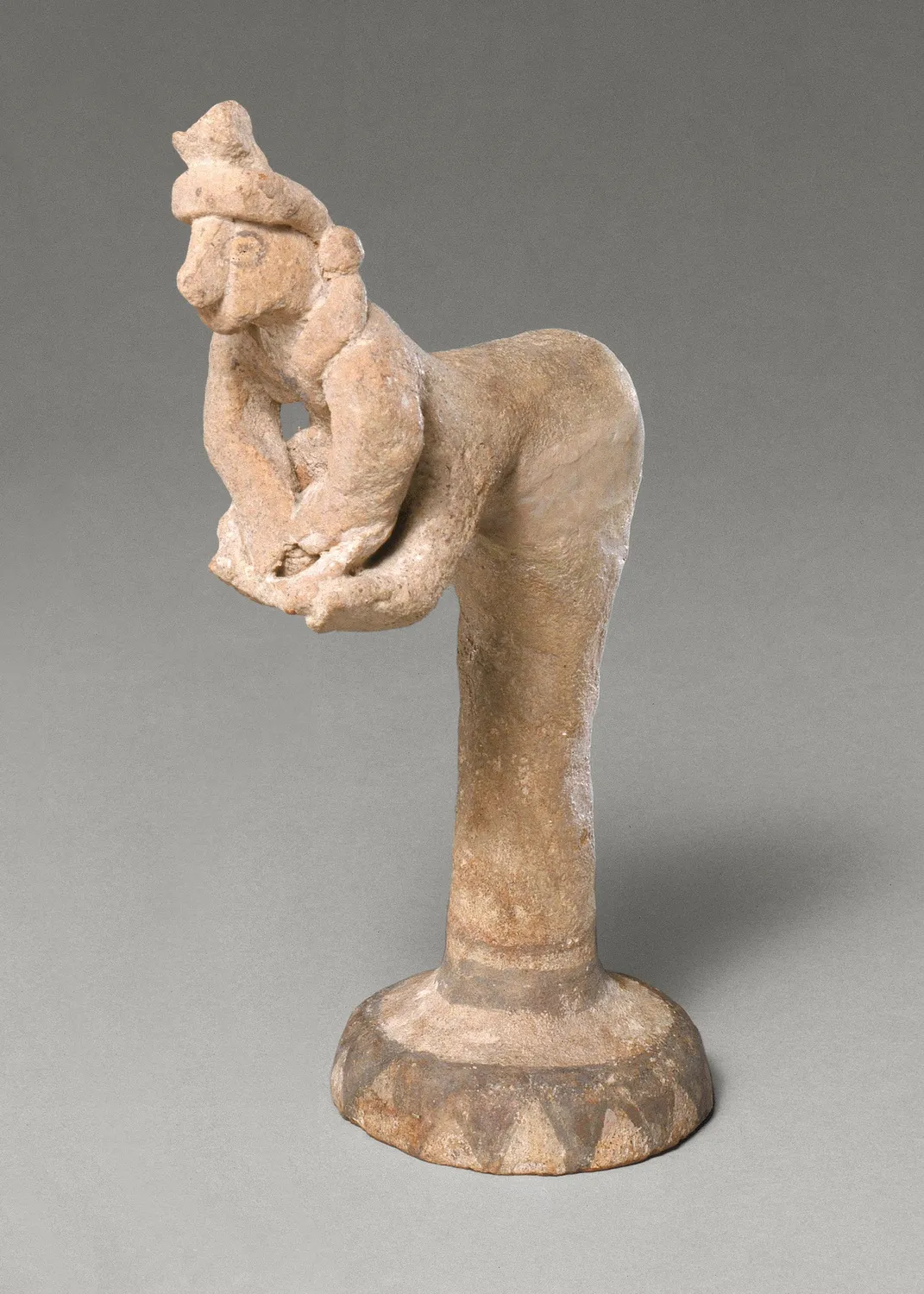
Bread-making, finally, becomes visible in clay. Cypro-Archaic II coroplasts modelled women grinding on saddle querns, sieving flour, kneading dough at three-legged troughs and slapping disks of dough onto the inner wall of a domed oven; the best examples, said to come from tombs at Idalion, Kourion and Amathus, are in the Cesnola Collection at the Metropolitan Museum [31, pp. 175–179], and a baker from Amathus Tomb 302 is in Limassol [32, no. 174]. These figures confirm that the saddle quern, the sieve, hand-kneading and wall-baked flatbread survived unchanged into the historic period (the rotary quern is Hellenistic), while reminding us that some of the "loaves" may be votive cakes. The site's own treatment of one such piece is the baker and her dog.
Corrections and open questions
Several popular claims about ancient Cypriot food do not survive contact with the evidence. Carob was not prehistoric "black gold": Ceratonia appears in the Neolithic and Chalcolithic record only as wild maquis vegetation, never as a food find, and the British Museum handbook states that the carob was probably introduced to Cyprus from the Yemen in the second century CE; the carob-syrup economy is medieval and modern [33, p. 11]. Commandaria is not the world's oldest wine: the name derives from the Grande Commanderie of the Knights Hospitaller around Kolossi in the twelfth and thirteenth centuries CE, and the sun-drying method is documented in early-modern travel accounts, not in Bronze Age archaeology. The chemical case for Bronze Age winemaking at Pyrgos and Erimi rests on tartaric-acid spot tests, which Crewe and Hill point out indicate grape-related products, not wine, since the modern standard requires tartaric plus syringic acid by mass spectrometry [17, p. 210]. Halloumi and Cypriot cheese are documented from the medieval period at the earliest, and beekeeping is unproven for the whole span; the attested sweeteners are dried fruit and grape syrup.
The larger gap is molecular. No published organic-residue analysis exists for any Cypriot Bronze or Iron Age cooking pot or transport amphora, dental-calculus starch work for Cyprus is essentially undone, and the human isotope datasets stop at the Middle Bronze Age [8; 12, p. 465]. What people actually ate, at the level of the individual meal, is still inferred from vessel shape, animal bone and seed, and the field's most careful voices, Lucas, Croft, Steel and Keswani among them, say so plainly.
Conclusion
The Cypriot diet was built by transport and then reshaped by three long changes: the loss and return of cattle, the turn from managed deer to herded sheep, goat and ox, and the rise of the olive and the vine from gathered wild fruit to stored and traded commodities. The kitchen changed more slowly than the table. A saddle quern from Khirokitia and one from an Archaic terracotta model do the same job, and the coarse igneous cooking-pot fabric of Philia Marki was still in use at Kalavasos a thousand years later, while the dishes set in front of the diner went from floor-standing Red Polished bowls to wheel-made tableware and metal feasting sets. For the reader who wants to see the objects, the pottery shapes entries and the bowls and plates article cover the vessels; the mortuary practices hub covers the funerals at which so much of this food was eaten.
References
- 1.Lucas, L., & Fuller, D. Q. (2020). Against the grain: Long-term patterns in agricultural production in prehistoric Cyprus. Journal of World Prehistory, 33, 233–266. https://doi.org/10.1007/s10963-020-09140-6
- 2.Knapp, A. B. (2013). The archaeology of Cyprus: From earliest prehistory through the Bronze Age. Cambridge University Press.
- 3.Croft, P. (1991). Man and beast in Chalcolithic Cyprus. Bulletin of the American Schools of Oriental Research, 282/283, 63–79.
- 4.Peltenburg, E. (Ed.). (2003). The colonisation and settlement of Cyprus: Investigations at Kissonerga-Mylouthkia, 1976–1996 (Studies in Mediterranean Archaeology, Vol. 70:4). Paul Åströms Förlag.
- 5.Vigne, J.-D., Guilaine, J., Debue, K., Haye, L., & Gérard, P. (2004). Early taming of the cat in Cyprus. Science, 304(5668), 259. https://doi.org/10.1126/science.1095335
- 6.Simmons, A. H. (1999). Faunal extinction in an island society: Pygmy hippopotamus hunters of Cyprus. Kluwer Academic/Plenum.
- 7.Dikaios, P. (1953). Khirokitia: Final report on the excavation of a Neolithic settlement in Cyprus on behalf of the Department of Antiquities, 1936–1946. Oxford University Press.
- 8.Goude, G., Clarke, J., Webb, J. M., Frankel, D., Georgiou, G., Herrscher, E., & Lorentz, K. O. (2018). Exploring the potential of human bone and teeth collagen from prehistoric Cyprus for isotopic analysis. Journal of Archaeological Science: Reports, 22, 115–122. https://doi.org/10.1016/j.jasrep.2018.09.018
- 9.Steel, L. (2004). Cyprus before history: From the earliest settlers to the end of the Bronze Age. Duckworth.
- 10.Webb, J. M., & Frankel, D. (2011). Hearth and home as identifiers of community in mid-third millennium Cyprus. In V. Karageorghis & O. Kouka (Eds.), On cooking pots, drinking cups, loomweights and ethnicity in Bronze Age Cyprus and neighbouring regions (pp. 29–42). A. G. Leventis Foundation.
- 11.Frankel, D., & Webb, J. M. (2006). Marki Alonia: An Early and Middle Bronze Age settlement in Cyprus. Excavations 1995–2000 (Studies in Mediterranean Archaeology, Vol. 123:2). Paul Åströms Förlag.
- 12.Dikomitou-Eliadou, M., Georgiou, A., & Vionis, A. K. (2016). Cooking fabric recipes: An interdisciplinary study of Cypriot cooking pots of the Late Bronze Age. Journal of Archaeological Science: Reports, 7, 458–466. https://doi.org/10.1016/j.jasrep.2015.12.016
- 13.Knapp, A. B. (1990). Production, location, and integration in Bronze Age Cyprus. Current Anthropology, 31(2), 147–176. https://doi.org/10.1086/203819
- 14.Keswani, P. S. (1994). The social context of animal husbandry in early agricultural societies: Ethnographic insights and an archaeological example from Cyprus. Journal of Anthropological Archaeology, 13(3), 255–277.
- 15.Keswani, P. (2004). Mortuary ritual and society in Bronze Age Cyprus. Equinox.
- 16.Webb, J. M., & Frankel, D. (2010). Social strategies, ritual and cosmology in Early Bronze Age Cyprus: An investigation of burial data from the north coast. Levant, 42(2), 185–209. https://doi.org/10.1179/175638010X12797237885776
- 17.Crewe, L., & Hill, I. (2012). Finding beer in the archaeological record: A case study from Kissonerga-Skalia on Bronze Age Cyprus. Levant, 44(2), 205–237. https://doi.org/10.1179/0075891412Z.0000000009
- 18.Margaritis, E. (2013). Distinguishing exploitation, domestication, cultivation and production: The olive in the third millennium Aegean. Antiquity, 87(337), 746–757.
- 19.Hadjisavvas, S. (1992). Olive oil processing in Cyprus: From the Bronze Age to the Byzantine period (Studies in Mediterranean Archaeology, Vol. 99). Paul Åströms Förlag.
- 20.Keswani, P. S. (1993). Models of local exchange in Late Bronze Age Cyprus. Bulletin of the American Schools of Oriental Research, 292, 73–83. https://doi.org/10.2307/1357249
- 21.Pilides, D. (2000). Pithoi of the Late Bronze Age in Cyprus: Types from the major sites of the period. Department of Antiquities, Cyprus.
- 22.Steel, L. (2016). Kitchenalia in Bronze Age Cyprus: Material habitus. Gastronomica, 16(3), 79–90. https://doi.org/10.1525/gfc.2016.16.3.79
- 23.Beck, C. W., Stout, E. C., Wovkulich, K. M., Karageorghis, V., & Aloupi, E. (2004). The uses of Cypriote White-Slip ware inferred from organic residue analysis. Ägypten und Levante, 14, 13–43.
- 24.Roumpou, M., Voskos, I., Kalogeropoulos, N., & Mantzourani, E. (2021). Unfolding beeswax use in Neolithic and Chalcolithic Cyprus through molecular analysis of lipids extracted from ceramic containers. Archaeological and Anthropological Sciences, 13, 73.
- 25.Steel, L. (2004). A goodly feast... a cup of mellow wine: Feasting in Bronze Age Cyprus. Hesperia, 73(2), 281–300.
- 26.Vonhoff, C. (2011). The phenomenon of feasting in Early Iron Age Cyprus: Bronze and iron obeloi from Cypriot tombs as evidence for elite self-conception, social networks and trans-Mediterranean cultural exchange. Cahiers du Centre d'Études Chypriotes, 41, 133–152. https://doi.org/10.3406/cchyp.2011.1103
- 27.Duhoux, Y. (2012). The most ancient Cypriot text written in Greek: The Opheltas' spit. Kadmos, 51, 71–91. https://doi.org/10.1515/kadmos-2012-0005
- 28.Hamilakis, Y., & Sherratt, S. (2012). Feasting and the consuming body in Bronze Age Crete and Early Iron Age Cyprus. In G. Cadogan, M. Iacovou, K. Kopaka, & J. Whitley (Eds.), Parallel lives: Ancient island societies in Crete and Cyprus (British School at Athens Studies 20, pp. 187–207). British School at Athens.
- 29.Karageorghis, V. (1969). Salamis: Recent discoveries in Cyprus. Thames and Hudson.
- 30.Bernhard-Walcher, A., Dembski, G., Gschwantler, K., & Karageorghis, V. (1999). Die Sammlung zyprischer Antiken im Kunsthistorischen Museum / The collection of Cypriote antiquities in the Kunsthistorisches Museum. Kunsthistorisches Museum Wien.
- 31.Karageorghis, V. (2000). Ancient art from Cyprus: The Cesnola Collection in The Metropolitan Museum of Art. The Metropolitan Museum of Art.
- 32.Pilides, D., & Papadimitriou, N. (Eds.). (2012). Ancient Cyprus: Cultures in dialogue. Department of Antiquities, Cyprus.
- 33.Tatton-Brown, V. (1997). Ancient Cyprus (2nd ed.). British Museum Press.