
Contents
The French excavators at Khirokitia photographed a typical grave: an oval pit 85 by 70 cm and only 16 cm deep, cut inside a house, holding an adult with the knees drawn up against the chest and a quern stone laid on the chest [1, p. 27]. From the first farming villages of the ninth millennium BC to the end of the Chalcolithic in the mid-third, most Cypriots were buried like this: close to home, in small pits, tightly flexed, with few possessions. The exceptions include a well at Kissonerga-Mylouthkia filled with human skulls and the carcasses of 23 goats and sheep, a pit at Shillourokambos with more than twenty skulls ranged along its wall, and a ridge above the Dhiarizos valley where one Chalcolithic community cut the island's first true cemeteries and stacked the bones of its dead into communal heaps. This entry follows burial from the Neolithic to the threshold of the Bronze Age, when the rock-cut tomb described in Bronze Age Chamber Tombs first appears. The wider survey is in the mortuary practices hub and the article on Cypriot burials over time.
The earliest dead: pits, wells and a cat
Burial evidence from the colonisation phases is thin and, in Christine Winkelmann's word, "quite variable" [2, p. 38]. Three sites carry almost all of it.
At Parekklisha-Shillourokambos, a plateau site about 10 km from the south coast, a bottle-shaped pit (St. 23) 4 to 5 m wide and 6 m deep was dug around 7500 cal BC [2, pp. 38, 43]. Its lowest layer held one person buried so tightly contracted that the body was probably wrapped in a bag or mat, with a small stone bowl. Above that lay more than twenty individuals whose skulls had been separated after decomposition and set along the wall of the pit, then a deposit of fallow deer, pig and sheep or goat bones. The last burial was a single body laid out straight along the side, with stones placed on its upper half [2, pp. 43-44]. The same site produced the best-known Neolithic grave on the island: an adult in a tightly contracted position with rich goods and, facing the body, the skeleton of a large cat [2, p. 44]. As reported when Vigne and Guilaine published it in 2004, the human was a man of about thirty with chipped flint and ground stone tools, marine shells and ochre, and the eight-month-old cat lay 30 cm away in the same sediment with no butchery marks [3, p. 7]. The excavators read it as a companion animal killed when its owner died [2, p. 44].
At Kissonerga-Mylouthkia, on the west coast, the dead went into abandoned wells. Well 133, dated to about 7300-6800 cal BC, held two deposits of detached human bones covering almost all age groups. The upper one contained a single artificially deformed male skull. Beneath it lay the complete skeletons of 23 caprines with no signs of butchering, and beneath those a group of crania with other loose bones and a stone macehead. The interpretation is intentional secondary burial of selected body parts, with the animals as sacrifices made during the rites [2, p. 45]. Clarke counts the Mylouthkia skulls among the signs that link the first Cypriot farmers to the skull-removal tradition of the mainland Pre-Pottery Neolithic [4]. At Kalavasos-Tenta, by contrast, burials of the same general period were ordinary pits scattered inside, outside and between buildings, with one or more bodies and usually no goods [2, p. 38].
Khirokitia and Tenta: the dead beneath the floor
The Late Aceramic Neolithic, the "Khirokitia culture" that ended around 5500 BC, supplies the one statistically usable Neolithic burial population [2, p. 51]. At Khirokitia 252 individuals have been excavated: 152 by Porphyrios Dikaios, nine in soundings by Stanley Price and Christou, and 91 by Alain Le Brun's French mission, though some skeletons recorded by Dikaios are now missing [5, p. 77]. Tenta, by comparison, has about 20 [5, p. 65].
The dead were placed in pits under the plastered floors of the round houses or just outside them [1, p. 27; 4]. Most were single primary burials; double burials, often a woman and a child, became more frequent in the later phases [1, p. 28]. Every body was contracted, and Le Mort found that the degree followed age: adults very tightly flexed, infants under a year with the legs at acute angles to the spine, older children more loosely. Most lay on the right side, though side and orientation were not tied to age or sex [5, p. 77]. Houses accumulated their dead over generations. Tholos XLVII held 29 burials, four adults and the rest newborns, and although figurines were found on its floors, no figurine at Khirokitia has come from inside a grave [5, p. 76].
About 20 per cent of the burials had a large stone set on the body, most often around the head, torso or pelvis and mostly in adult graves; the stones were either rough boulders or querns [5, p. 77]. Vassos Karageorghis gave the classic reading: "A quern was put on the chest to prevent the dead from returning and harming the living" [1, p. 27]. Jones notes that the custom also occurs at Jericho and Nahal Oren and as far back as the Natufian at el-Wad, and reads it as fixing the dead in their place, which implies that the dead were thought to keep some agency [5, p. 117].
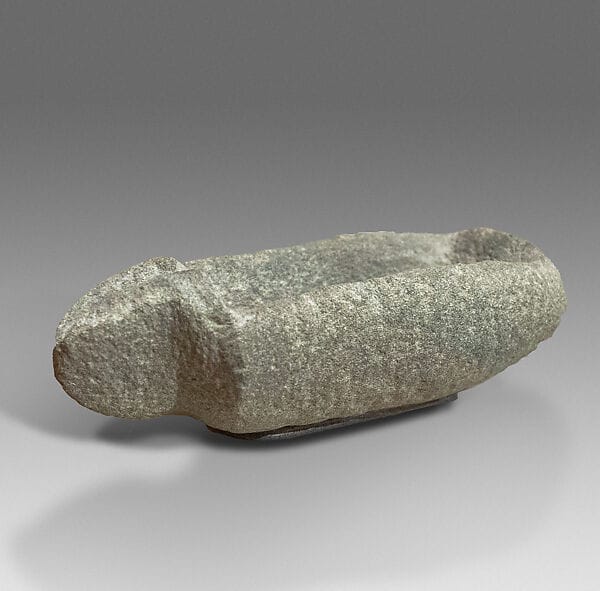
Stone vessels, habitually and deliberately broken before they went into the grave, occur in the great majority of burials, with necklaces of dentalium shell and carnelian, flints and bone tools [5, p. 77]. The diabase bowls of Khirokitia, such as the spouted bowl lent by the Cyprus Museum to the Metropolitan Museum, belong to this stone-vessel tradition. The graves divide into simple pits (88 per cent) and pits whose rims were lined with pisé and pebbles, a distinction that does not follow sex or wealth of goods [2, p. 52], and Clarke, following him, finds "no clear indication of social status" in elaboration, offerings or placement [4].
The dead were not simply covered and left. The skull was usually left uncovered by the grave fill, some heads were wedged with lumps of pisé or pebbles, and in Tholos XV, grave IV, the skull had been separated; Karageorghis thought libations were probably poured on the exposed head [1, p. 28]. Jones adds narrow channels left open into some graves, which would have allowed access to the body after burial [5, p. 117]. Karageorghis compared the whole package, single inhumation, broken bowls, stones over the body, attention to the head and artificial head moulding, with Levantine practice and took it as support for a northern Levantine origin for the first settlers [1, p. 28].
Tenta shows how far Khirokitia may distort the picture. Its fourteen graves held eight or nine adults, two children and eight or nine infants; seven graves were inside buildings, four immediately outside and three beyond the enclosure wall and ditch, and Niklasson suggested that more of the dead lay outside the excavated area [5, p. 65].
Infants, skulls and the Khirokitia population
The Khirokitia skeletons contain a statistical puzzle. In Le Mort's study 57 per cent of the individuals were subadults, and nearly all the infants had died perinatally: of 51 infants from the recent excavations, 50 died before six months. The ratio of perinatal to infant deaths is 98 per cent, where ancient populations usually sit near 50 per cent [5, p. 77]. Karageorghis read the many infant graves simply as very high infant mortality [1, p. 28]. A ratio so far out of line may say as much about which babies were buried inside the houses as about how many died, and it should be quoted with that caution.
The skulls carry a cultural mark. Artificial cranial deformation is a defining trait of the Khirokitia population and appears twice as often in women as in men [2, p. 52]; the deformed skull in the Mylouthkia well shows the practice was already present a millennium earlier [2, p. 45].
Whether Khirokitia was an ordinary village has been questioned repeatedly. Niklasson argued in 1991 that its hearths often sit directly above burials, that the number of floors in a house tracks the number of burials, and that the Tholos IA complex, with its masses of animal bone and human skulls, was a ritual complex that Dikaios himself once called a "sacrificial temple" [5, pp. 74-75]. Jones goes further and treats Khirokitia as a place set aside for the dead as well as the living [5, p. 126]. Le Brun, the site's current excavator, reads the burials inside dwellings as a sign of continuous occupation and, in some cases, of lineages [2, p. 52].
The Ceramic Neolithic: a burial ground at Sotira
After the Aceramic villages were abandoned the burial record almost disappears, and the fifth-millennium villages that brought pottery into general use around 4500 BC have left very few graves [4]. The most informative group is at Sotira-Teppes, excavated by Dikaios. On the lower eastern slope (Area I, an exposure of 20 by 12 m), twelve pit burials lay together, all single inhumations, mainly adults, crouched, and usually covered with stones or boulders [2, p. 57]. Clarke calls it an extramural cemetery [4]. Winkelmann is more careful: a sectional, perhaps separate burial ground that still lay near houses [2, p. 57]. Either way it is the first Cypriot case of the dead grouped away from the dwellings, and the stones on the bodies carry the Aceramic custom forward.
Chalcolithic villages: the dead among the houses
In the Chalcolithic, dated by Kirsi Lorentz to about 3800-2300 BC with the Middle phase at 3500-2800 BC [6, pp. 229-230], burials lay mainly within villages, inside or next to dwellings [2, p. 72]. The type-site, Erimi-Pamboula, excavated by Dikaios in 1933-1935, produced only four individuals. One adult lay flexed in a pit under the floor of Hut VI.A, covered with stones and with a large stone over the head, resting on deer antlers, with the sherds of a vessel as the only grave good recorded at the site [2, pp. 73-74].
The largest samples come from the Lemba Archaeological Project directed by Edgar Peltenburg in the Paphos district. Dental studies counted 52 individuals at Lemba-Lakkous and 89 at Kissonerga-Mosphilia, but only 14 and 23 of them were adults [6, p. 233]. Peltenburg used Lunt's observation of high infant mortality at both sites to explain two things at once: why the island's population stayed low for millennia, and why the figurines of the period dwell so heavily on birth [7, p. 27]. In Kissonerga Period 3 there were so few adult inhumations that "some of the dead must have been buried elsewhere"; small pits received infants, some wearing necklaces of a few beads and pendants; and one adult-sized grave cut through Building 2 held no body at all, only a displaced capstone and two Red-on-White flasks with a fine stone bowl set on its ledge [7, p. 23]. The prestigious High Sector has almost no child graves, and its adults may have been buried off-site, perhaps at Souskiou about 20 km east [2, p. 79; 8, p. 54].
Kissonerga Grave 563 shows an intact Middle Chalcolithic child burial. Under one capstone lay two crouched children of about three and a half and one and a half, both on the right side. The younger wore a dentalium necklace with a 10.1 cm greenish picrolite cruciform at the neck. Loose teeth in the fill belonged to at least two further children, whom Peltenburg reconstructs as earlier occupants exhumed to make room, their necklaces left on the ledge of the pit. He judged the necklace too long and heavy for a baby and probably worn first by an adult [9]. Diane Bolger collected the pattern in 1996: at Kissonerga all four graves with picrolites were single burials of infants or children, at Lemba four of five were children's burials, and at that date no picrolite had been found with an adult man anywhere in Chalcolithic Cyprus [10]. Keswani reads the secondary treatment of children at Lemba and Kissonerga, and the Lemba "libation hole graves" with infant burials, as possibly honorific [8, p. 56].
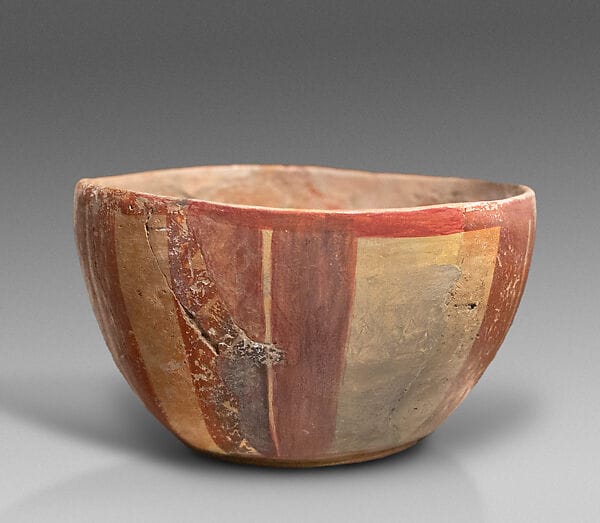
The Red-on-White pottery of these settlements is represented on the site by a bowl excavated at Kissonerga in 1984, and in Oxford by a bowl fragment from Kissonerga-Mylouthkia that Peltenburg gave to the Ashmolean Museum in 1978 (AN1978.39).
The famous Kissonerga "birth" deposit was not a burial. Unit 1015, a pit beneath Building 994, held a painted building model packed with and surrounded by 41 figurines and other objects, among them pottery women giving birth on stools. Peltenburg was explicit that "nowhere in the deposit was there evidence for a burial", and read it as a closure ceremony before that part of the village was abandoned [7, pp. 23-25].
Souskiou: the only Chalcolithic cemeteries
About 4 km inland and 2.5 km from Palaepaphos, two limestone spurs face each other across the Vathyrkakas ravine: the Vathyrkakas cemeteries on the south side, the Laona cemetery and its settlement on the north [2, p. 79]. They are, to date, the only known Chalcolithic extramural cemeteries on Cyprus [11, p. 468].
Vathyrkakas Cemetery 1 has about 100 rock-cut tombs over roughly 1,800 m², 82 of them Chalcolithic and dated by their contents to about 3200-2900 BC [2, p. 81]. The Laona outcrop, only about 600 m² of usable rock, held 142 Chalcolithic features, so densely cut that the excavators think it was "full" before extramural burial stopped; the pottery suggests Laona was used first and Vathyrkakas longer [11, pp. 468-469]. The typical Laona tomb is a shaft 1.5 to 2 m deep, widening to an oval base and closed with capstones [6, pp. 232-233].
Lorentz, the human-remains specialist at Laona, found two kinds of deposit in the intact tombs. The primary burials were whole bodies, hyperflexed and mostly on the right side. The bonestacks were secondary arrangements of bones from several people, with up to ten crania set on their bases along the tomb wall above the other bones and the long bones grouped along the wall [6, p. 233]. Partly decomposed sections, such as an articulated thorax in Tomb 192 and a shoulder still joined to its upper arm in Tomb 207, show that tombs stayed unfilled between burials and that intervals could be months rather than years [6, pp. 234-236]. Nothing comparable has been found in the settlement graves. Lorentz reads the bonestack as "the obliteration of the individual skeleton in favour of a communal reorganization" [6, p. 236]. Across Laona, articulated burials had their crania to the east-southeast and bonestacks to the north-northwest whatever the orientation of the tomb, and the rule holds in the few Vathyrkakas tombs where it can be checked [11, p. 471].
The minimum number of individuals is 117 in the intact deposits at Laona and 203 for the whole cemetery, a figure Lorentz regards as extremely conservative; the true number is likely about 400. Vathyrkakas has an estimated minimum of 200 [11, p. 471]. At Vathyrkakas infants and subadults had seemed under-represented, which was read as selective burial. At Laona the full age range is present, the shortfall of under-tens is put down to preservation, and the conclusion now is that "the entire population of Souskiou was accorded equal access to burial in the cemeteries" [11, p. 471]. Five Laona adults show external auditory exostoses, the bony growths called surfer's ear, in 15.1 per cent of assessable right ear canals (25 per cent of males, 14.2 per cent of females), which points to regular cold-water work by both sexes [12].
Grave goods were few per body but patterned. Of 14 articulated burials whose objects could be tied to them, half had a single pendant on the chest, worn at the neck by men and women alike. Half had something at the pelvis, and here the sexes diverge: figurative picrolite pendants or figurines at the pelvis occur only with women, chipped stone tools at the pelvis only with men [11, pp. 471-472]. A woman of 34-40 in Tomb 237 wore eight figurative picrolite pendants in sets at wrist, chest and pelvis. A man of 18-28 in Tomb 158 had figurative pendants strung with dentalia at his elbow and knee, faience beads at his torso, and probably a copper spiral pendant and pin [11, p. 472]. Bolger's 1996 observation about adult men no longer holds. The Laona faience beads, about thirty, date to the second half of the fourth millennium and are the earliest recorded in Cyprus; tin in their glazes marks them or their colourant as foreign [11, p. 479].
| Period (approx.) | Site | Burial mode | Typical goods |
|---|---|---|---|
| Cypro-PPNB, c. 7500-6800 BC | Shillourokambos, Kissonerga-Mylouthkia | deep pit with successive primary and multiple burials, skulls set apart; secondary deposits of skulls and bones in an abandoned well | stone bowl; tools, shells and ochre with the cat burial; macehead; animal deposits |
| Late Aceramic Neolithic, to c. 5500 BC | Khirokitia, Kalavasos-Tenta | single (later some double) contracted pit burials under house floors or just outside; stones on c. 20% of bodies | deliberately broken stone bowls, dentalium and carnelian necklaces, flints, bone tools |
| Ceramic Neolithic, 5th millennium BC | Sotira-Teppes | 12 single crouched pit burials grouped on a slope near houses, usually stone-covered | few recorded |
| Middle Chalcolithic, c. 3500-2800 BC | Erimi, Lemba, Kissonerga-Mosphilia | single contracted pit and capstone graves among houses; many infants; some exhumation | rare; picrolite pendants and dentalium necklaces mostly with children |
| Middle Chalcolithic, c. 3200-2900 BC | Souskiou-Laona and Vathyrkakas | extramural rock-cut shafts and pits; repeated primary burial with bonestacks | dentalia, figurative picrolite pendants, pottery sets, chipped stone, earliest faience and copper |
| Late Chalcolithic, c. 2800-2400 BC | Kissonerga-Mosphilia Period 4, Lemba Period 3 | pit graves continue; first chamber tombs with multiple burials; child urn burials at the transition | single vessel per burial; stone and faience disc beads; annular pendant and copper spiral ring |
Dates are approximate and follow Winkelmann [2], Lorentz [6] and Peltenburg [7]; authors draw the Chalcolithic subphases slightly differently.
Difference or disparity: the argument over Souskiou
Why one community alone buried its dead apart, and so richly, is the central question. The Souskiou excavators, Bolger, Lindy Crewe and Peltenburg, give a three-part answer. The cemeteries were facilities for communal integration, where household groups were aggregated into larger units in a ritual setting before any such coalescence shows in the houses [11, p. 477]. The Laona settlement was a production centre for picrolite cruciforms, and cemetery ritual created the demand its workshops met, a "ritual economic system" [11, pp. 468, 478]. And the handling of bodies required anatomical knowledge, so Lorentz proposed "mortuary specialists" who decided who entered a tomb, which bones stayed and when it was closed; these specialists "were among the earliest 'aggrandisers' in Cypriot prehistory (although that may not have been their conscious intent)" [11, p. 477].
They are careful about scale. Tomb sizes at Laona are standard, and the goods show "'difference' rather than 'disparity'" [11, p. 476]. The one clear exception is Vathyrkakas Tomb 73, a square pit-and-shaft tomb with a capstone perforated for handling and a stone kerb that Peltenburg interpreted as the base of a tumulus. It held two adult men, surpasses most tombs of the Early Bronze Age in size, and is called "the earliest unequivocal example of 'aggrandising behaviour' in Cypriot prehistory, although probably by a group rather than an individual" [11, p. 476]. Winkelmann, working from the published Vathyrkakas record, finds no correlation between the labour spent on a tomb, the number of people in it and the quantity of goods, and notes that whether Vathyrkakas was truly a segregated burial ground "still needs to be verified" [2, p. 81]. Keswani, following Peltenburg, allows that Kissonerga's missing adults may have been buried at Souskiou or at cemeteries not yet found [8, p. 54].
The system did not outlast the Middle Chalcolithic. In Laona's second settlement period burial returned inside the village without grave goods, cruciform production stopped, and the settlement was abandoned in the early centuries of the third millennium [11, pp. 478-479].
Late Chalcolithic: the first chamber tombs
When Kissonerga was reoccupied after a gap of up to two centuries [11, p. 478], "chamber graves with funerary furniture now appear alongside the traditional pit graves that normally lack offerings", and with them a shift from single to multiple interment [7, p. 30]. Grave 505 is a bilobate example: a 1.6 m shaft sealed beneath the hearth of Building 98, a stone pier dividing two chambers, at least two interlocked adults each with a spouted flask in one chamber and a single flexed body with a bowl in the other; the custom was a single vessel for each body and sometimes necklaces of stone and faience disc beads [7, p. 30]. Keswani counts thirteen such tombs at Kissonerga [8, p. 70]. Peltenburg read the adults and children together in these chambers as "a greater articulation of family identities, possibly with heritable property" [13, p. 15]. At Lemba, the main building of Period 3 was "uniquely located over a cluster of graves that have postinterment access or libation holes extending beneath the house floor", which he took as status claimed through closeness to the ancestors [13, pp. 15-16].
The transition to the Early Bronze Age is visible in single graves. Two urn burials, one holding a tightly crouched child, introduce what was the commonest burial type in Early Bronze I-II Anatolia. Grave 529 held a child with a miniature dentalium necklace, an annular shell pendant of a type made on the site, and a copper spiral ring, a mix of Chalcolithic and Bronze Age traits that Peltenburg called "conclusive evidence that there was no sharp break between the two periods" [7, p. 31]. Keswani refuses to make the chamber tomb a simple Philia import: the bottle-shaped shafts of Souskiou and the Kissonerga chambers were local precedents "amenable to revival, reinterpretation, and elaboration", alongside mainland shaft tombs at Halawa and Selenkahiye [8, p. 70]. The story continues with the cemeteries of the Philia phase.
Cruciforms in the grave: birth symbol or identity marker
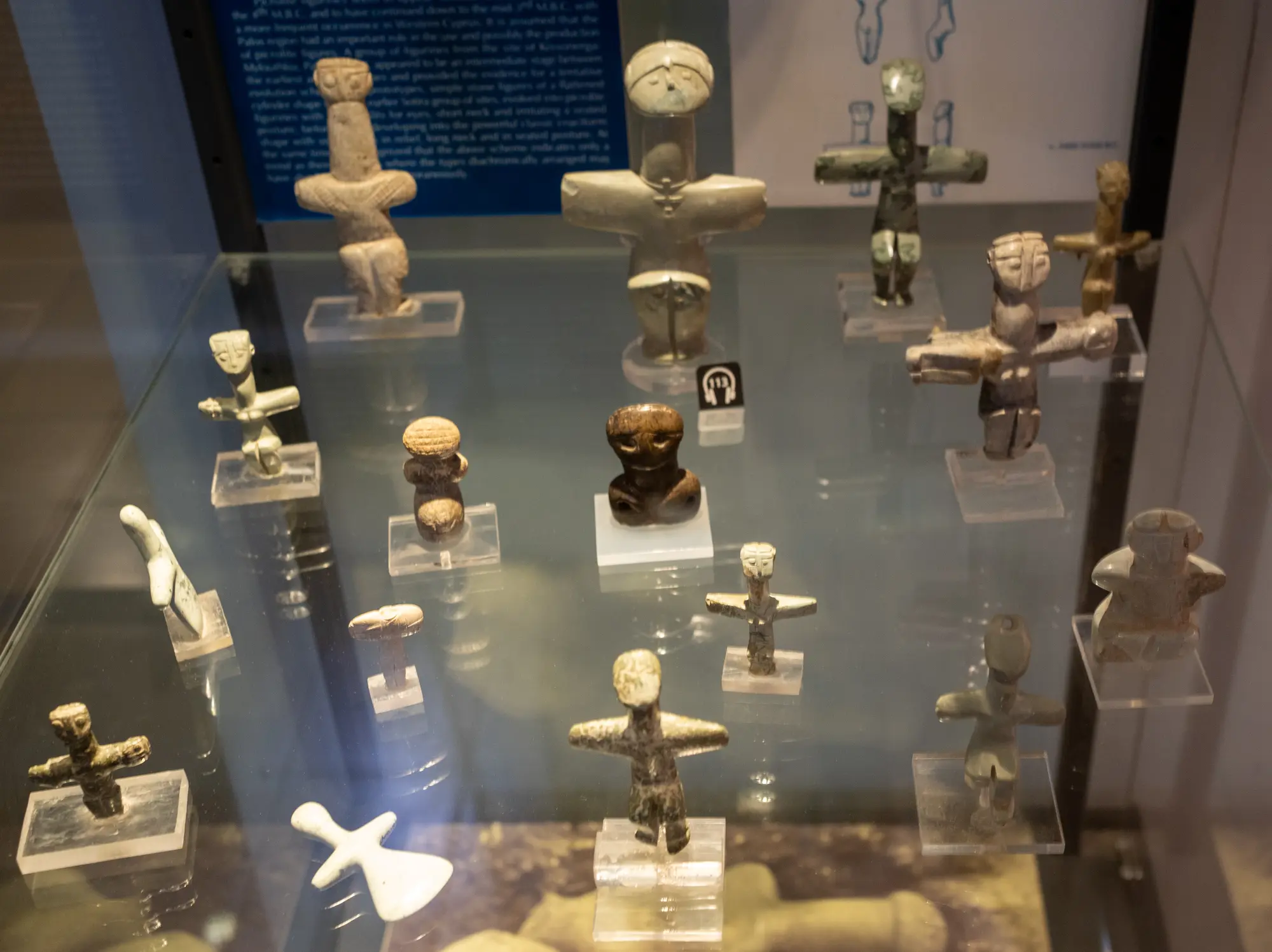
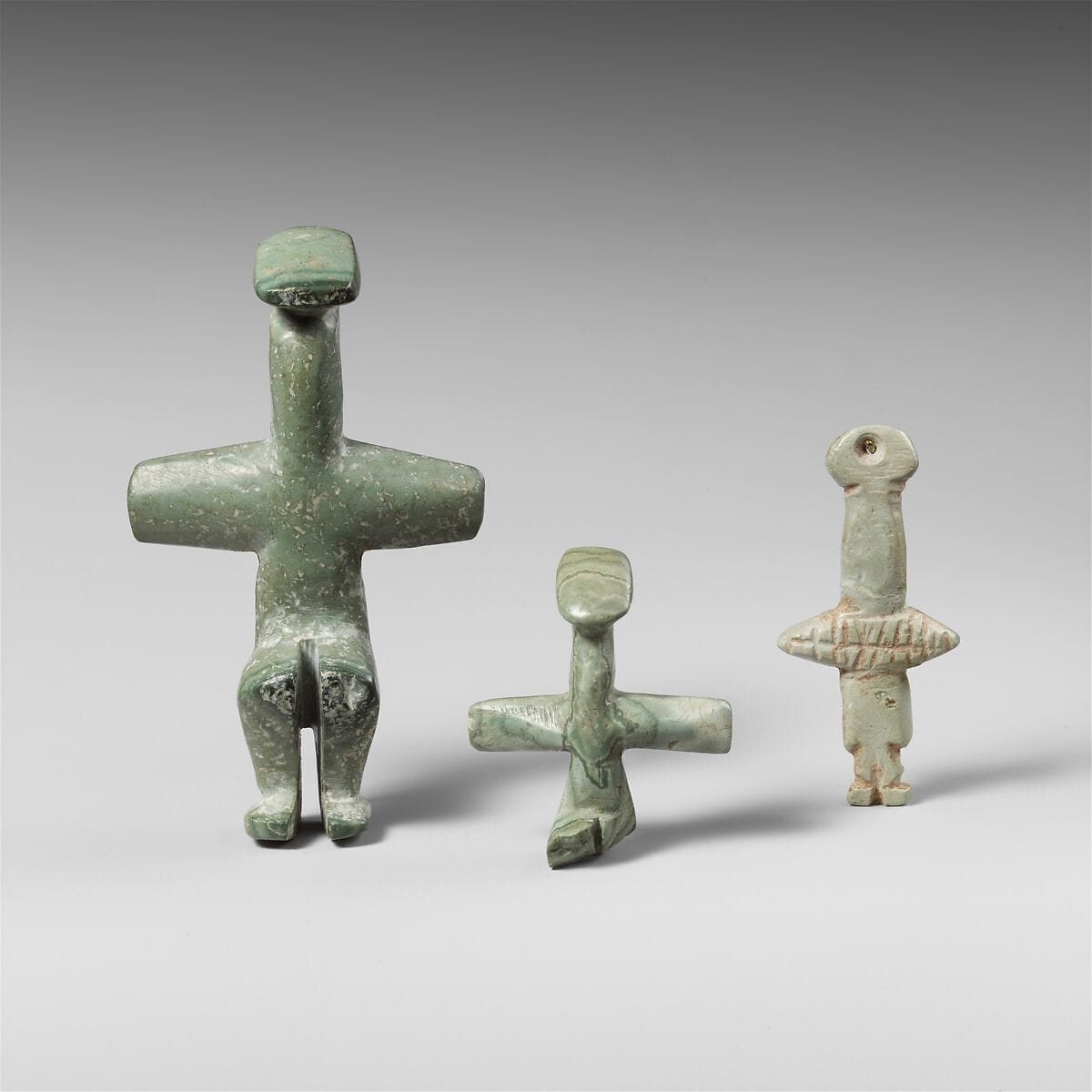
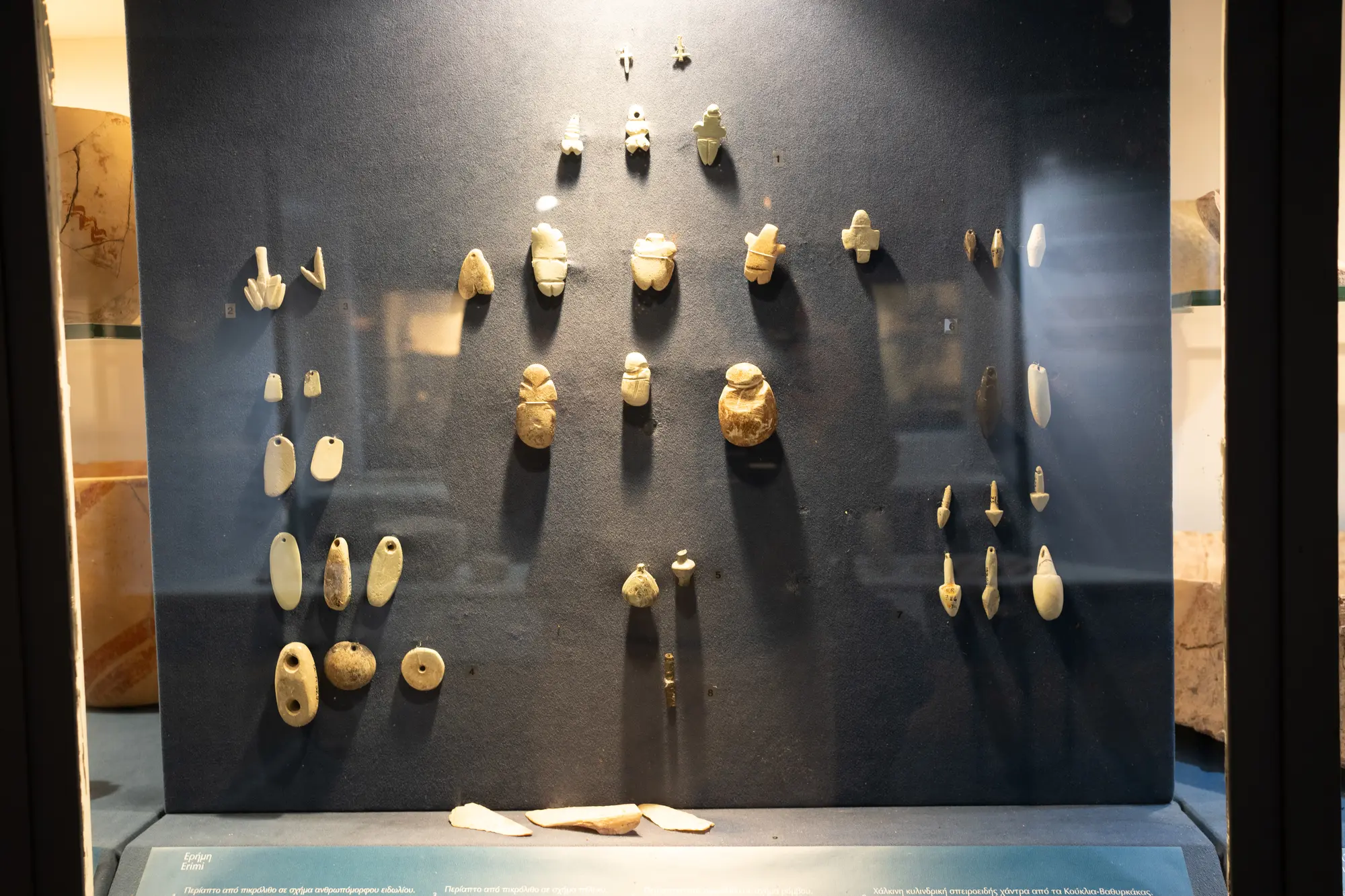
Picrolite cruciforms, the cross-shaped stone figures with outstretched arms and bent legs covered in Cruciform Figurines, Neolithic and Picrolite Figurines and the essay on the cruciform figures of Chalcolithic Cyprus, are the grave good most associated with the period, and many survivors have no context. The Metropolitan Museum's picrolite figure 51.11.5, 7.9 cm high, and the smaller 51.11.6 were bought in 1951 with no recorded find-spot; the first is catalogued here as Met 51.11.5 in the Metropolitan Museum collection. Excavated pieces in the Cyprus Museum, such as this group of picrolite figurines and a group of picrolite tools and figures, are where context survives.
Peltenburg's 1992 publication of Grave 563 stated the fertility reading directly: "the cruciformes are to be interpreted as birth symbols", their outstretched arms and drawn-up legs matching the Kissonerga pottery women seated on birth stools, with the arms showing, as Morris and Goring had argued, the assisted birth position. Yet a pendant on a baby of eighteen months told him the symbol was "more than a birth talisman" [9]. Bolger in 1996 treated cruciforms as birthing symbols on the strength of the Kissonerga figure KM 1451, a woman giving birth who wears a cruciform pendant, and of the picrolites in women's and children's graves [10].
Winkelmann's 2020 corpus moves away from that reading. In tombs, she writes, cruciforms "accompanied children as well as adults (of both sexes!)" and "are not exclusively associated with females as long suggested"; they were not regular burial equipment; the length of the reconstructible necklaces suggests adults wore them and passed them on to children at burial; and they were rarely broken on purpose [2, p. 352]. She concludes that they were "most probably general charms and 'identity markers'", distinct in meaning from the stone and clay figurines that do connect with fertility [2, p. 354]. Goring's wear study adds a chronological turn: pendants from Laona were generally worn before burial, those from Vathyrkakas show no wear, and the Souskiou team suggests that production became more mechanised as the pendants turned from things worn in life into objects made for the grave [11, pp. 470, 478].
What remains uncertain
The Neolithic record rests on one large sample, Khirokitia, whose infant figures are shaped by burial choice; the earliest phases are known from a handful of pits and wells, the Ceramic Neolithic from twelve graves at one site. At Souskiou only Laona was recorded bone by bone, so the bonestack and grave-goods arguments rest on one cemetery [6, pp. 231-232]. The adults missing from Kissonerga's settlement graves have not been found, and whether Souskiou was unique or simply the one cemetery of its kind yet discovered is still open.
Objects on this page
References
- 1.Karageorghis, V. (1982). Cyprus from the Stone Age to the Romans. Thames and Hudson.
- 2.Winkelmann, C. (2020). The Neolithic and Chalcolithic figurines of Cyprus. Zaphon.
- 3.That cat from Shillourokambos. (2004). CAARI News, 28, 7. Cyprus American Archaeological Research Institute.
- 4.Clarke, J. (2013). Cyprus during the Neolithic period. In M. L. Steiner & A. E. Killebrew (Eds.), The Oxford handbook of the archaeology of the Levant. Oxford University Press. https://doi.org/10.1093/oxfordhb/9780199212972.013.013
- 5.Jones, P. L. (2008). Moving heaven and earth: Landscape, death and memory in the Aceramic Neolithic of Cyprus (BAR International Series 1795). BAR Publishing. https://doi.org/10.30861/9781407302836
- 6.Lorentz, K. O. (2014). Bodies transformed: Negotiations of identity in Chalcolithic Cyprus. European Journal of Archaeology, 17(2), 229-247. https://doi.org/10.1179/1461957114Y.0000000056
- 7.Peltenburg, E. (1991). Kissonerga-Mosphilia: A major Chalcolithic site in Cyprus. Bulletin of the American Schools of Oriental Research, 282/283, 17-35. https://doi.org/10.2307/1357260
- 8.Keswani, P. S. (2004). Mortuary ritual and society in Bronze Age Cyprus (Monographs in Mediterranean Archaeology 9). Equinox.
- 9.Peltenburg, E. (1992). Birth pendants in life and death: Evidence from Kissonerga Grave 563. In Studies in honour of Vassos Karageorghis.
- 10.Bolger, D. (1996). Figurines, fertility, and the emergence of complex society in prehistoric Cyprus. Current Anthropology, 37(2). https://doi.org/10.1086/204500
- 11.Bolger, D., Crewe, L., & Peltenburg, E. (2019). Ritual, identity and community at Souskiou: Traditions and transformations. In E. Peltenburg, D. Bolger, & L. Crewe (Eds.), Figurine makers of prehistoric Cyprus: Settlement and cemeteries at Souskiou (chap. 21). Oxbow Books.
- 12.Lorentz, K. O., & Casa, B. (2021). External auditory exostoses, repetitive aquatic activity and increasing social complexity in Chalcolithic Cyprus: Specialists of the sea? International Journal of Osteoarchaeology. https://doi.org/10.1002/oa.2977
- 13.Peltenburg, E. (1993). Settlement discontinuity and resistance to complexity in Cyprus, ca. 4500-2500 B.C.E. Bulletin of the American Schools of Oriental Research, 292, 9-23. https://doi.org/10.2307/1357245