
Contents
Faience is a manufactured material: a body of crushed quartz or quartz sand covered with a soda-lime-silica glaze, produced in Egypt and elsewhere in the Near East from the fourth millennium BCE until the Roman period and used for bowls, tiles, beads, rings, amulets and scarabs [1, p. 282]. On Cyprus it appears in almost every period covered by this site. The earliest securely dated faience objects on the island are Chalcolithic beads from Souskiou; Middle Cypriot burials, some probably of women, included necklaces of hundreds of faience beads; Late Cypriot tombs at Enkomi and Kition held faience vessels decorated with Egyptian, Aegean and Levantine imagery; and Iron Age tombs and sanctuaries received Egyptian-style amulets and scarabs. The question that runs through all of it is whether any of this faience was made on Cyprus, and local production remains unresolved for every period. Glass, which shares raw materials and some of its history with faience, has its own entry under glass.
What faience is and how it was made
Christopher Parmenter's working definition is "a synthetic low-fired vitreous substance consisting of silica powder, mineral pigments, and alkali flux" [2, p. 1].
Vasiliki Kassianidou distinguishes three ways of putting the glaze on [1, p. 282]. In direct application, a glazing mixture is applied to the formed body. In efflorescence, the glaze components are mixed into the quartz paste itself and migrate to the surface as the object dries, forming a crust that vitrifies in the fire. In cementation, the object is fired buried in a glazing powder, a method also known as the Qom technique. Each method leaves a diagnostic microstructure that can be seen when a bead or vessel is cut and polished in section [1, p. 282]. This matters for the Cypriot material, because an unsectioned bead can be described as faience on appearance alone. Older reports sometimes hedge, as in the Ashmolean's description of a Middle Cypriot necklace of "faience or paste" beads [3, cat. 196].
Colour came from metal oxides. Early faience glazes were coloured with copper, for blue and blue-green, and manganese, for black. From about the middle of the second millennium BCE, when glass production began, the palette widened to cobalt blue, manganese purple and lead-antimonate yellow [1, p. 282]. All the Chalcolithic Cypriot beads have a copper-coloured blue or green glaze [1, p. 282].
Kassianidou ties faience to the island's metallurgy through temperature. Silicates begin to fuse above about 1000 °C and copper melts at 1083 °C, so "if there is evidence that Cypriot metalsmiths had achieved temperatures high enough to melt copper, they had also reached temperatures high enough to produce glazed materials such as the faience beads" [1, p. 281]. The pyrotechnology is covered under copper metallurgy and, for ceramics, pottery kilns and firing. Reaching the temperature does not by itself show that faience was made, and the debate about Cypriot faience turns on the objects themselves.
The earliest faience: Chalcolithic Souskiou and Kissonerga
The first vitreous beads reported from Chalcolithic Cyprus came from the Middle Chalcolithic cemetery of Souskiou-Vathyrkakas. Their date was doubted early on: Lucia Vagnetti questioned it in 1980, and when Andrew Shortland and Michael Tite found tin in the glaze of one bead, pointing to copper taken from a bronze of about 7 per cent tin, they dismissed it as an intrusive Late Bronze Age bead [1, p. 282]. Tin is "a metal which does not occur geologically in Cyprus" [1, p. 283].
The excavations at Souskiou-Laona changed the picture. Laona yielded 29 faience beads, which Kassianidou describes as "currently the earliest securely dated artefacts made of faience from Cyprus and perhaps the whole of the eastern Mediterranean region" [1, p. 282]. A portable X-ray fluorescence study by Kassianidou and Andreas Charalambous analysed 35 Chalcolithic faience beads together with 17 copper objects [1, p. 283]. Three segmented beads from Souskiou-Laona also contained tin, so that four beads with traces of tin are now known and the Vathyrkakas bead "is no longer anomalous" [1, ch. 16]. Either scale from an imported bronze was used to colour the glaze, or the beads themselves were imported.
The beads from Late Chalcolithic Kissonerga-Mosphilia, found in or near chamber tombs, were probably glazed by efflorescence, as were those from Souskiou-Vathyrkakas. The Kissonerga report called this "a considerable and unlikely achievement for Cypriots, but one well established on Mainland Asia and Egypt" [1, p. 282]. Edgar Peltenburg had set out in 1995 four criteria for recognising an "autonomous early faience industry": "(1) product uniqueness, (2) frequency of examples, (3) technological idiosyncracies, and (4) contemporary metalworking". Applied to Kissonerga, none of the four was met [1, p. 282].
The wider comparisons point east. Glazed beads appear in Mesopotamia in the fifth millennium BCE, in Egypt in the early fourth, and at Peqi'in in Galilee in the fifth; the Souskiou beads are "now some of the earliest known examples beyond the sphere of Egypt, the Levant and Mesopotamia" [1, ch. 16]. Because early Egypt had no bronzes to supply tin, Kassianidou looks to the Near East for their source, and concludes: "As for the beads, it seems most likely that they were imported goods rather than products of a local workshop" [1, ch. 16]. The burial contexts are described under Neolithic and Chalcolithic burial.
Middle Bronze Age: necklaces of hundreds of beads
In the Middle Bronze Age faience becomes common in north-coast tombs, almost entirely as beads. The fullest single example is Lapithos Tomb 201, excavated in 1913 by L. H. D. Buxton for J. L. Myres and published for the first time by Jennifer Webb in 2018. Chamber A held three or four burials, "one very probably that of a woman wearing a necklace of over 400 faience beads", dated to Middle Cypriot I [4, p. 35]. The necklace is exceptional only in size. At Lapithos necklaces or bracelets "with a total of over 1000 globular or, more rarely, cylindrical, biconical or disk-shaped faience beads were found in 29 other chambers", the next largest being about 150 beads from Tomb 322B. At Kalavasos about 432 beads came from 15 tombs, with no more than 108 in a single necklace [4, p. 47]. The Cyprus exhibition catalogue Cultures in dialogue gives a figure of "up to 900 individual faience beads" for Middle Cypriot necklaces from Dhenia, Lapithos and Kalavasos [3, cat. 196].
Webb notes that at Lapithos plank figures and faience necklaces were found close together in Tombs 201A, 306A and 313B, which suggests these were female burials [4, p. 48]. The beads belong to the wider Middle Cypriot practice of dressing the dead in ornaments, covered under jewellery and Bronze Age chamber tombs.
Where the beads were made is unsettled. "Faience beads from EC and MC Cyprus have long been identified as imports", Webb writes; Alison South questioned this in 1995, but recent studies "continue to assume that faience was not produced in Cyprus until the LBA" [4, p. 47]. Webb adds a third possibility: Panagiotaki has suggested that globular beads of similar date from Crete may be Minoan products, so such necklaces could have reached Cyprus from Crete. Other faience objects from Lapithos, two frog-shaped beads or amulets and a face pendant made by an Egyptian technique, are in her view certainly imports from Egypt or Syria [4, p. 47]. The Cultures in dialogue entry for a necklace from Kalopsidha in the Ashmolean Museum (AN1896-1908 C.339), 43 beads of which two are biconical, four segmented and 37 spherical, puts the other side: "Although often assumed to have been imported from Egypt or the Syro-Palestinian coast, their occurrence in some abundance in Cyprus has led to the hypothesis that they might have been manufactured in Cyprus" [3, cat. 196]. Its exact find-spot at Kalopsidha was not recorded. The Ashmolean's Cypriot holdings are listed under Ashmolean Museum.
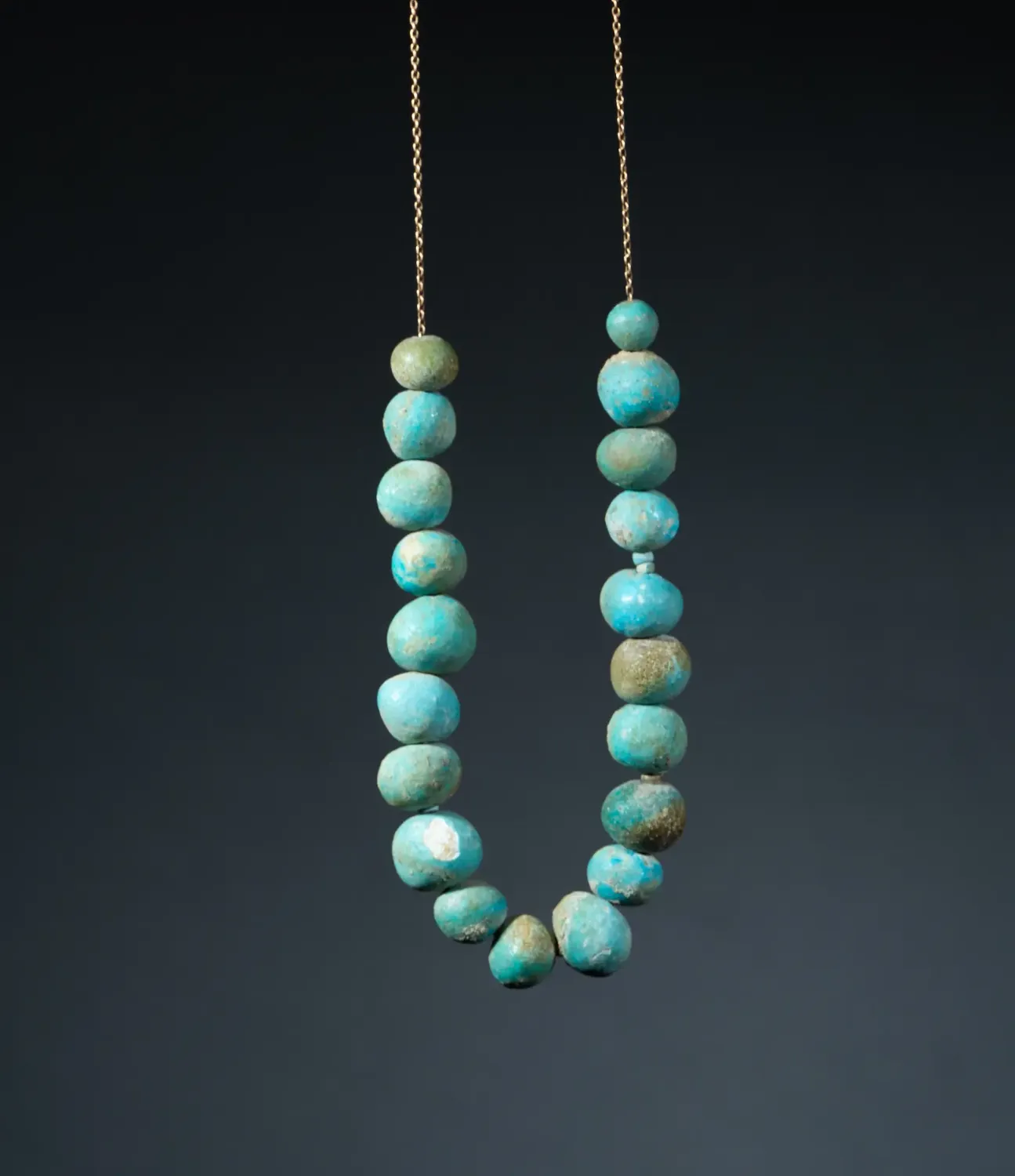
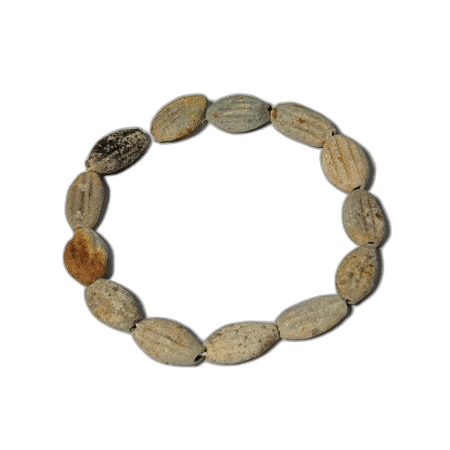
The Alexis Drakopoulos Collection holds a string of globular faience beads of the kind buried in Middle Cypriot tombs, illustrated here and at the head of this entry and published on this site as a Middle Bronze Age Cypriot faience necklace. Globular beads are the dominant type in the Lapithos necklaces and make up most of the Kalopsidha string, so the attribution to the Middle Cypriot period is reasonable on type. The find-spot is unknown, and without a cut section not every bead can be confirmed as faience. The glaze, originally turquoise, has gone matte and clouded with buff.
Late Bronze Age: vessels, head-cups and the Kition rhyton
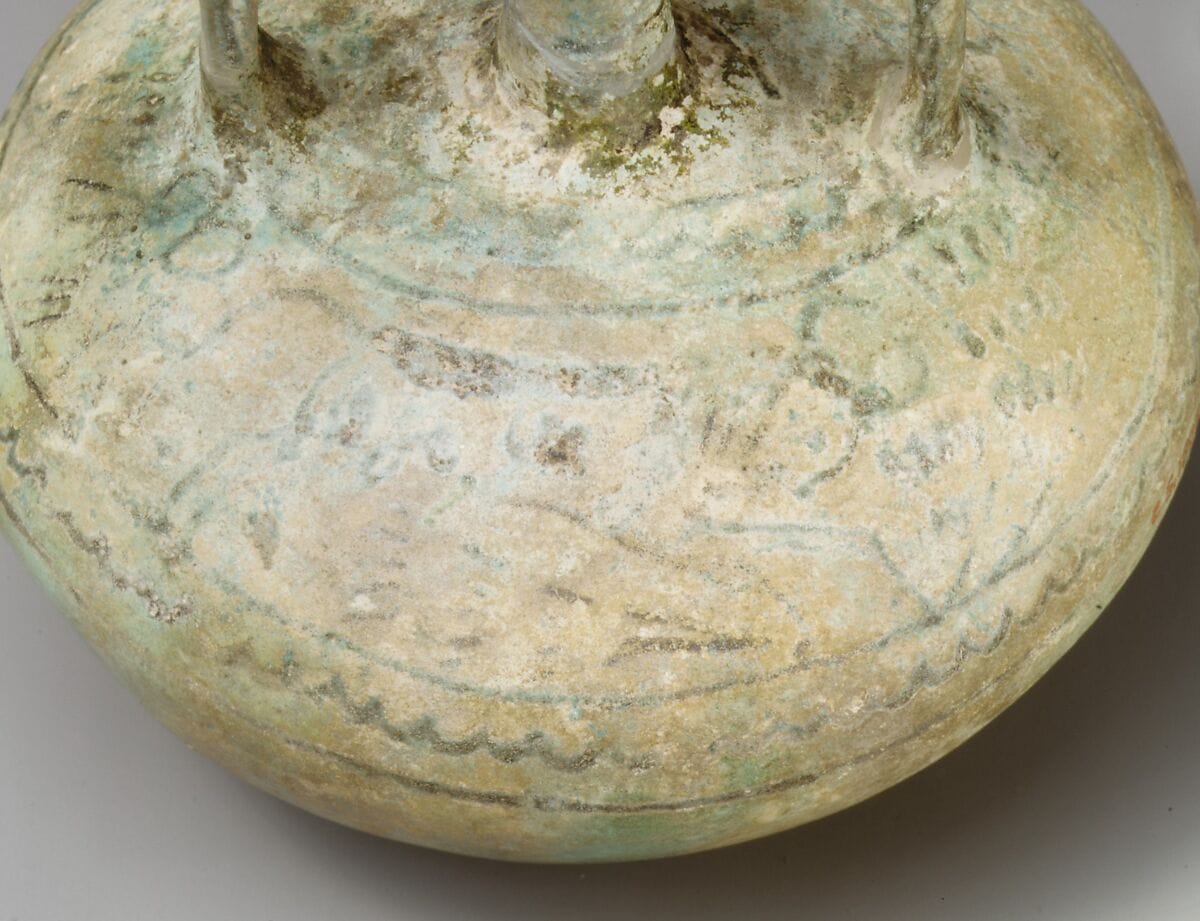
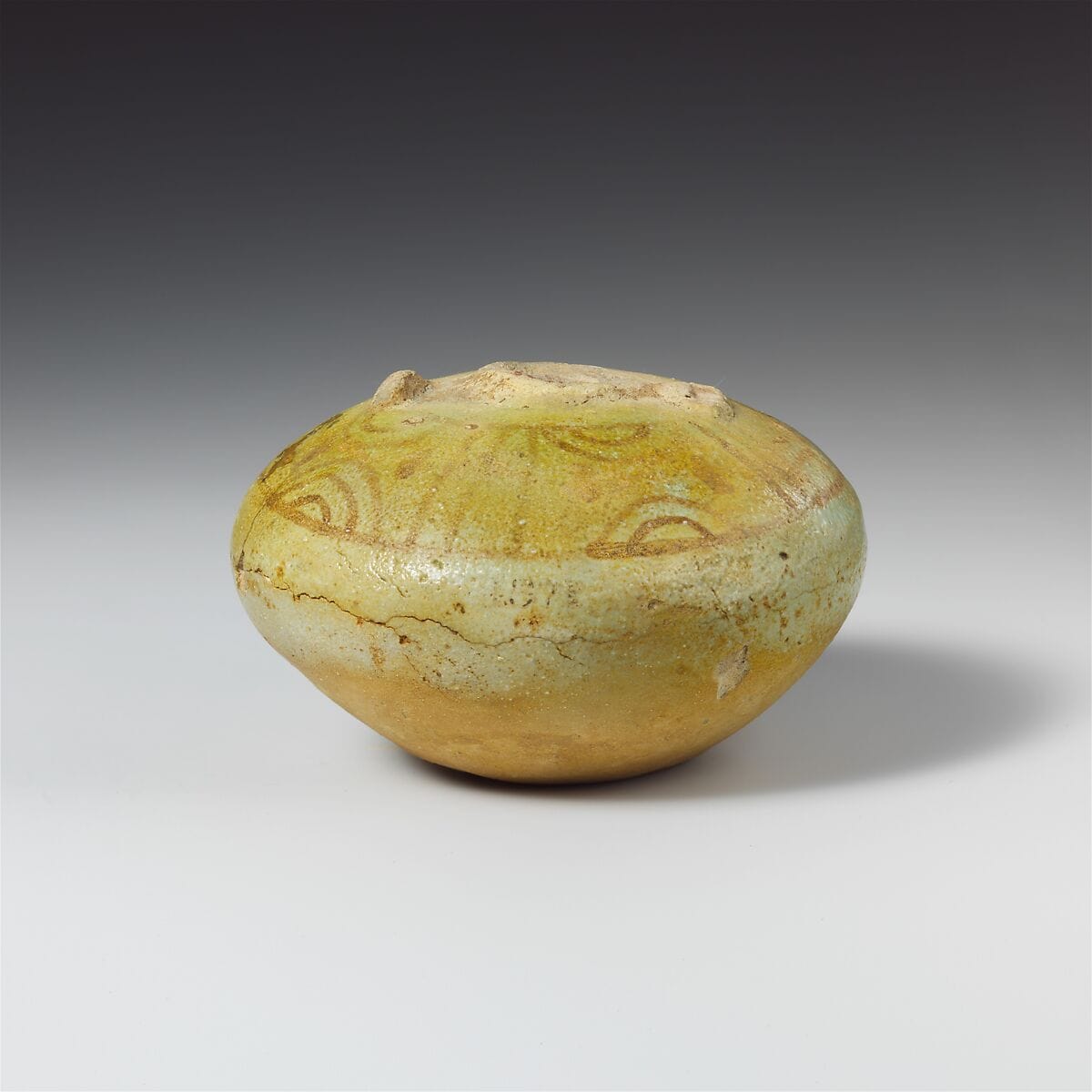
By Late Cypriot II Cyprus was in regular contact with Syro-Palestine, Egypt and the Aegean, and most of the imported exotica found on the island come from tombs [5, p. 102]. Faience vessels appear alongside beads. No surviving Late Bronze Age diplomatic text mentions faience, but faience stirrup jars are painted in the tomb of Ramesses III beside leopard skins, tusks, metal vases and copper ingots [5, p. 102]. The Metropolitan Museum's fragmentary faience stirrup jar, from the Cesnola collection, is a Cypriot example of the combination: a characteristically Mycenaean shape made in faience, which the museum attributes to Egyptian influence.
Peltenburg divided the Late Cypriot vessels into two classes, summarised by Louise Steel [5, p. 104]. Monochrome faience has black line decoration on a blue glaze and is Egyptian New Kingdom work: an ovoid beer jar with the god Heh between lotus flowers from Enkomi British Tomb 61, and a shallow lotus bowl with a Nilotic scene and a Nile perch from British Tomb 66. Steel judges that these imports "had no impact on local craft production". Polychrome faience uses several glazes side by side (blue, yellow, white, red and brown) in an inlay technique, and the thirteenth-century polychrome vessels were "plausibly manufactured in a Cypriot workshop" [5, p. 104].
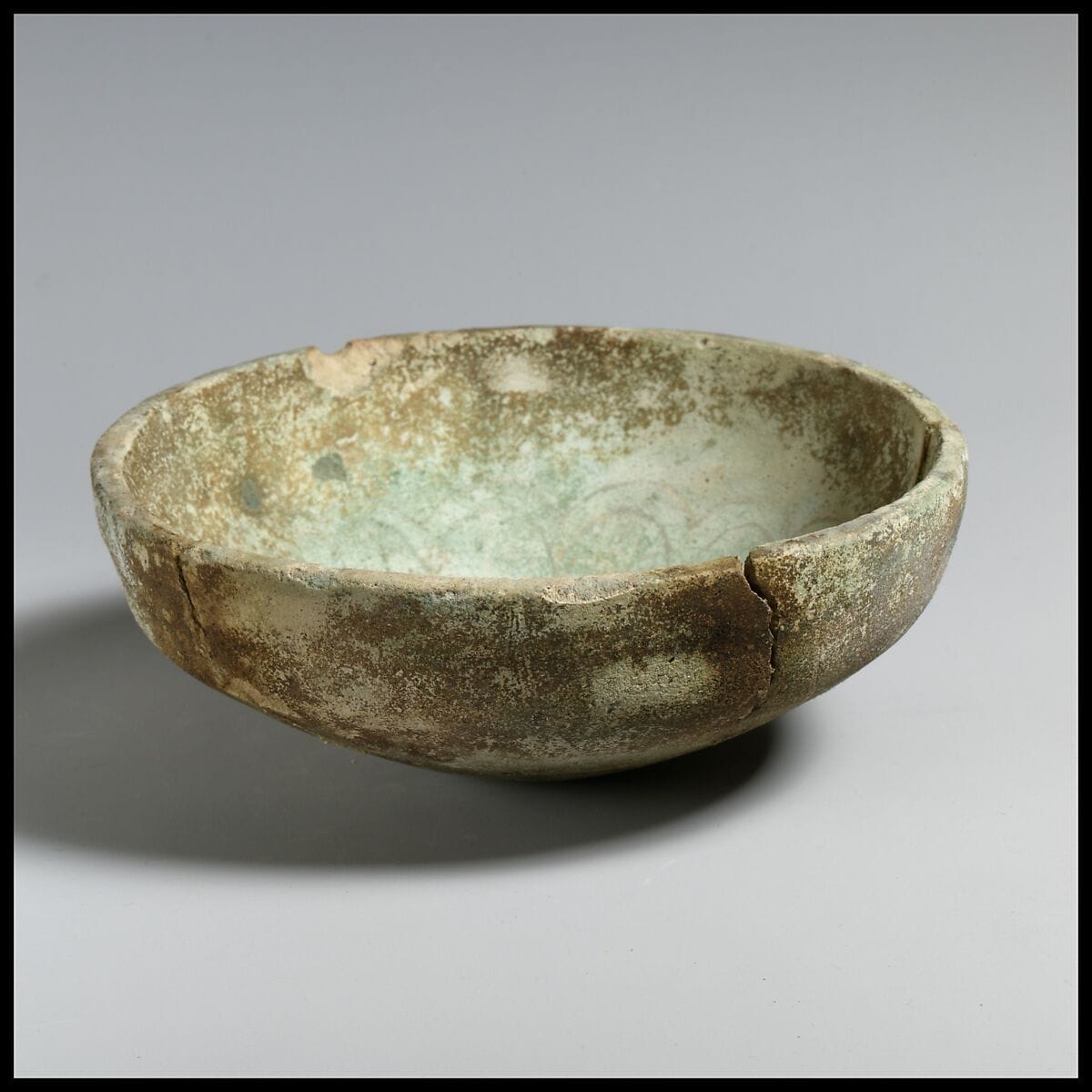
Bernard Knapp lists the main Enkomi groups. British Tomb 93 held an ousekh collar, a scarab of Queen Tiy and a ring of Amenophis IV; British Tomb 66 had "the most elaborate array of faience and glazed pottery" [6]. Faience tripod plates from British Tomb 66 and Cypriot Tomb 7 carry Egyptianizing scenes of bulls in a marsh and horned animals, but since "most known tripod plates stem from Cyprus", they were either made in Egypt for export or made locally [6]. Egyptian faience bowls also reached Hala Sultan Tekke, Klavdhia, Maroni, Kalavasos-Ayios Dhimitrios, Episkopi-Bamboula, Kouklia, Ayios Sozomenos and the neighbourhood of Idalion [6]. The Metropolitan Museum's faience bowl 74.51.5070 (museum record), from a tomb at Idalion, has a lotus flower in its interior; the museum describes it as probably a local Cypriot imitation of an Egyptian faience lotus bowl.
A distinctive Cypriot group is the head-shaped vase, a faience vessel moulded as a woman's or an animal's head. Enkomi has produced eight, two of them unprovenanced pieces in a private collection published by Zuckerman in 2008, which Steel calls the "greatest concentration of this vessel type, and greatest range of forms, anywhere in the East Mediterranean"; two more come from Minet el-Beidha Tomb VI on the Levantine coast and four from Tell Abu Hawam [5, pp. 104–105]. Yon pointed out in 1997 that they have no second opening, so they are cups or goblets rather than rhyta. Peltenburg linked them with the animal-headed bibru cups named in the texts, and Zuckerman with gift exchange among lesser rulers [5, pp. 104–105]. Medelhavsmuseet in Stockholm holds a Late Cypriot II faience vessel catalogued as a rhyton from Enkomi Swedish Tomb 11 (E. 011:038, 13.6 cm high), found by the Swedish Cyprus Expedition.
The conical rhyton from Kition is one of a polychrome trio in the "International Style" together with a jar and an amphoriskos from Kition-Bamboula [5, p. 106]. Its shape is Aegean, Minoan in origin and taken over by the Mycenaeans. The top register shows animals at the gallop; the second, two kilted men in Egyptian dress wearing the white crown, hunting or corralling a bull; the bottom, running spirals [5, p. 106]. Steel observes that the rhyton "is unusual, as most of the ceremonial vessels deposited in Cypriot tombs were ceramic" [5, p. 106]. Its find-spot is reported differently: Steel, following Feldman (2006), gives Tomb 9 [5, p. 106], while Knapp places it in the area outside Tombs 4 and 5 [6].
Its origin is disputed three ways. For Knapp it was "produced in a technical manner that is arguably Egyptian but inspired by an Aegean shape and decorated in a Levantine style", and "the combination of Egyptian technique and Levantine style makes it difficult to pinpoint its origin" [6]. A chapter in Cyprus: The Legacy treats it as a product of the blending of Aegean, Levantine and Egyptian elements "for which Cyprus may have been the chief instigator, although this rhyton itself may have been manufactured in the Levant" [7, p. 56]. Steel reports that Matoïan (2005) favoured a Cypriot workshop, given the larger number and variety of such vessels on Cyprus, while stating that the workshop's location "remains elusive" [5, p. 106]. The Aegean dimension is covered under Mycenaeans.
Kition's Chrysopolitissa Tombs 1 and 9 held twelve faience vessels (juglets, bowls, flasks and a pyxis), Egyptian or western Asiatic in origin. A blossom bowl with sharp relief imitates metal prototypes; a blue-glazed pyxis has a shape rare in Egypt and common in the Levant; a handleless juglet is closer to Levantine than to Egyptian work [6]. Half of the eighteen faience bowls from Kition come from what appear to be ceremonial contexts, whereas Enkomi's are mostly from tombs [6]. Knapp counts at least 28 faience vessels or fragments from thirteenth- and twelfth-century settlement contexts at Kition, Enkomi, Maa-Palaeokastro and Myrtou-Pigadhes; the thirteenth-century pieces come from domestic and industrial contexts, the twelfth-century ones from ceremonial ones [6].
Peltenburg's 2007 study of the Egyptian faience bowls starts from what he calls a marked Late Bronze Age taste for explicitly Egyptian-type objects, alongside the international style [8, p. 375]. He examined the bowls' concentration on Cyprus, their Hathoric symbolism and its connection with the copper trade, and noted that patrons might create exotic-looking goods locally by bringing in foreign specialists [8, p. 375]. The Cultures in dialogue catalogue makes the same link for a lotus-decorated faience flask from Enkomi British Tomb 45, now in the British Museum (GR 1897,4-1.959): an Egyptian New Kingdom import, originally turquoise-glazed, a colour associated with Hathor as patron of copper [3, cat. 108]. The Metropolitan Museum's faience flask 74.51.5073 (museum record), said to come from a tomb near Dali, has an Aegean shape and a bull motif that the museum compares with Egyptian representations. Egypt's contacts with the island are treated under Egypt.
Royal names and a shipwreck
A faience sceptre head with a pharaoh's name was found at Hala Sultan Tekke. It is papyriform, with the cartouche of Horemheb at the top and traces of its ivory staff, found in a building of Late Cypriot IIIA1, dated 1190 to 1175 BCE, about 150 years after the pharaoh's reign; the excavation report called it the first document of Horemheb found on Cyprus [9, p. 914]. Vassos Karageorghis gives the same identification, a sceptre head "found in a 12th-century BC context at Hala Sultan Tekké" bearing the cartouche of Horemheb (1348–1320 BC), and notes that the site also produced a jar handle stamped with the name of Seti I [10, p. 72]. Knapp adds faience plaques, a wine jar and a scarab carrying the names of Horemheb, Seti I and Ramesses II, and records that Paul Åström listed 36 Aegyptiaca from the site [6]. Whether it was kept as an heirloom or passed from hand to hand, the sceptre head was about a century and a half old when it was buried. The British Museum's set of thirteen glazed amygdaloid beads from Hala Sultan Tekke, probably mould-made and now without their glaze, shows the more ordinary faience of the same site.
The Uluburun shipwreck off southern Turkey, which is not a Cypriot site, shows faience beads moving as cargo. Cemal Pulak reports faience beads of red, yellow, green, black and blue dispersed throughout the wreck, together with an encrusted cluster estimated to contain seventy thousand beads [11, p. 868]. Published totals for all the beads on the ship vary between sources, and none is given here. The wreck's place in Late Bronze Age exchange is discussed in the search for Alashiya and under the Late Bronze Age.
The Iron Age: heirloom bowls, amulets and scarabs
Faience bowls stayed in use as tomb offerings after the end of the Bronze Age. A hemispherical bowl from Palaepaphos-Skales Tomb 58 (no. 5), of Cypro-Geometric I (1050–950 BCE), has a white core, a pale blue glaze and black dots on the rim with a small rosette [3, cat. 105]. Its Egyptian features suggest it may have been an heirloom, but "an origin on the Levantine coast, where an Egyptianizing faience industry was established in the 10th c. BC, cannot be excluded". The catalogue adds that faience bowls were luxury grave goods from the Late Bronze Age to the Archaic period but "not a very common grave gift" [3, cat. 105]. The site is described under Paphos and the period under Cypro-Geometric.
In the Cypro-Archaic period faience returns in quantity as small Egyptian-style objects. Between about 700 and 479 BCE "thousands of Egyptian-style scarabs, amulets, and figurines were deposited across the Mediterranean", most of them faience, and most mass-produced "at workshops in the Nile Delta, Rhodes, Cyprus, and the Levant" [2, p. 1]. In the Cypro-Phoenician world "scarabs and amulets were worn as adornment by women and placed in children's graves", and the fashion peaked in the first quarter of the sixth century BCE [2, p. 1]. The Phoenicians are the usual carriers in these accounts; see also early Iron Age trade networks.
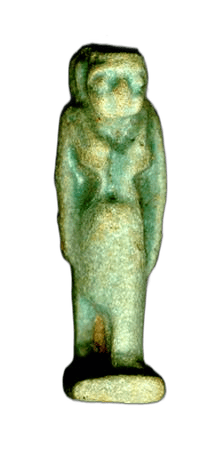
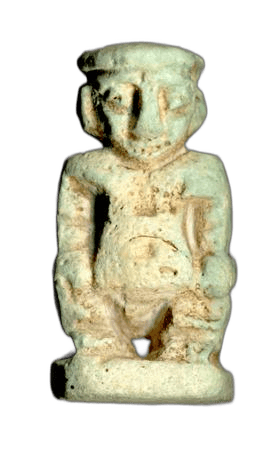
Parmenter's publication of 42 faience objects from the sanctuary of Apollo Hylates at Kourion, excavated by the University of Pennsylvania between 1936 and 1954, shows how mixed the sources could be. Nearly 80 per cent came from Greco-Egyptian workshops rarely encountered on the island, and they date to the first half of the sixth century BCE [2, p. 1]. Most are small closed vessels, among them 21 spherical aryballoi, with four head-shaped vessels, three hedgehogs and two falcons; faience aryballoi are rare on Cyprus and were produced mainly on Rhodes, with some at Naukratis [2, pp. 1–3]. Of the scarabs, some resemble Naukratis products, while others parallel "Levantine or Cypriot-made scarabs that circulated widely on the island"; three anthropomorphic and wedjat amulets resemble finds from tombs at Amathus [2, pp. 1–3]. Parmenter adds that head-shaped amulets were popular elsewhere on the south coast in the Cypro-Geometric and Cypro-Archaic periods [2, p. 5]. The British Museum's Amathus material includes a mould-made blue-green glazed amulet of a standing female, possibly Isis, 2.7 cm high, and a double-sided amulet of Pataikos, 2.3 cm high and pierced through the head for suspension.
| Period | Approx. date BCE | Main forms | Key contexts | Where made (as argued) |
|---|---|---|---|---|
| Chalcolithic | 4th millennium | Copper-glazed beads, some segmented | Souskiou-Laona (29 beads); Souskiou-Vathyrkakas; Kissonerga-Mosphilia | Probably imported from the Near East (Kassianidou) |
| Middle Cypriot | c. 2000–1650 | Globular beads in necklaces of up to several hundred; a few amulets | Lapithos T.201A (over 400 beads); 29 other Lapithos chambers; Kalavasos; Dhenia | Long assumed imported; Cretan source suggested; local manufacture hypothesised |
| Late Cypriot | c. 1650–1050 | Bowls, flasks, juglets, head-shaped cups, rhyta, tripod plates, beads, sceptre head | Enkomi British T.66 and T.93; Kition Tombs 1 and 9; Hala Sultan Tekke | Monochrome Egyptian; polychrome argued Cypriot or Levantine; unresolved |
| Cypro-Geometric | c. 1050–750 | Bowls, some possibly heirlooms | Palaepaphos-Skales T.58 | Egypt or Levantine coast |
| Cypro-Archaic | c. 750–480 | Scarabs, amulets, small vessels | Amathus tombs; Kourion, Apollo Hylates | Nile Delta, Rhodes, Naukratis, Levant and Cyprus |
Made in Cyprus?
For each period the case for local production rests on abundance and on stylistic features rather than on workshop debris. For the Chalcolithic, the tin in the glazes and the absence of Peltenburg's four criteria lead Kassianidou to conclude that the beads were most likely imported [1, ch. 16]. For the Middle Bronze Age, the number of beads in north-coast tombs has prompted the hypothesis of local manufacture [3, cat. 196], but the standing assumption, as Webb summarises it, is that faience was not made on the island before the Late Bronze Age [4, p. 47]. For the Late Bronze Age, the monochrome vessels are Egyptian imports, while the polychrome vessels, the tripod plates and the Kition rhyton have been assigned to Cypriot, Levantine or Egyptian makers by different scholars [5, pp. 104–106; 6; 7, p. 56]. For the Cypro-Archaic period, Parmenter lists Cyprus among the centres that mass-produced Egyptianizing faience [2, p. 1]. In none of these periods has a workshop on the island been identified, and local production remains unresolved in them. Steel's phrase for the Late Cypriot polychrome workshop, that its location "remains elusive" [5, p. 106], applies across the whole sequence.
Objects on this page
 Fragmentary faience stirrup jarLate Bronze Age II · 1600–1050 BC
 Faience bowlLate Bronze Age II · 1300–1200 BC
- Faience flaskLate Bronze Age III · 1250–1150 BC
 Glazed Amygdaloid Bead SetLate Bronze Age I · 1650–1200 BC
 Blue-Green Glazed Isis AmuletArchaic · 750–300 BC
 Blue Glazed Pataikos FigureArchaic · 750–300 BC
References
- 1.Kassianidou, V., & Charalambous, A. (2019). Chemical analyses of copper objects and faience beads using portable X-ray fluorescence. In E. Peltenburg, D. Bolger & L. Crewe (Eds.), Figurine makers of prehistoric Cyprus: Settlement and cemeteries at Souskiou (ch. 16). Oxbow Books.
- 2.Parmenter, C. S. (n.d.). Egyptianizing faience from the sanctuary of Apollo Hylates, Kourion, Cyprus. Journal article, New York University.
- 3.Pilides, D., & Papadimitriou, N. (Eds.). (2012). Ancient Cyprus: Cultures in dialogue. Department of Antiquities, Cyprus.
- 4.Webb, J. M. (2018). Lapithos Tomb 201: A singular Middle Bronze Age burial assemblage. In L. Hulin, L. Crewe & J. M. Webb (Eds.), Structures of inequality on Bronze Age Cyprus: Studies in honour of Alison K. South. Åström Editions.
- 5.Steel, L. (2013). Materiality and consumption in the Bronze Age Mediterranean. Routledge.
- 6.Knapp, A. B. (2013). Matter of fact: Transcultural contacts in the Late Bronze Age eastern Mediterranean. Journal of Ancient Egyptian Interconnections, 5(3). https://doi.org/10.2458/azu_jaei_v05i3_knapp
- 7.Koumoulides, J. A. (Ed.). (n.d.). Cyprus: The legacy. Historic landmarks that influenced the art of Cyprus, Late Bronze Age to A.D. 1600. University Press of Maryland.
- 8.Peltenburg, E. (2007). Hathor, faience and copper on Late Bronze Age Cyprus. Cahiers du Centre d'Études Chypriotes, 37, 375–394.
- 9.Karageorghis, V. (1978). Chronique des fouilles et découvertes archéologiques à Chypre en 1977. Bulletin de Correspondance Hellénique, 102(2).
- 10.Karageorghis, V. (1982). Cyprus: From the Stone Age to the Romans. Thames and Hudson.
- 11.Pulak, C. (2012). Uluburun shipwreck. In E. H. Cline (Ed.), The Oxford handbook of the Bronze Age Aegean. Oxford University Press. https://doi.org/10.1093/oxfordhb/9780199873609.013.0064