
Contents
Most of the pottery made in prehistoric Cyprus was fired without a kiln. The Kissonerga-Mylouthkia report states the position plainly: "there is at present no archaeological evidence for built kilns in Cyprus prior to the late Bronze Age", and pits, hearths and open fires are assumed for the Chalcolithic [1, p. 206]. For the whole of the Bronze Age the island has produced one excavated potter's workshop with its firing structure intact, at Ambelikou-Aletri [2, p. 116], and, on a 2024 count, only a single kiln for the Late Bronze Age as a whole [3, p. 12]. The history of Cypriot firing is therefore written mainly from the pots: from their cores, their surface colours, the black rims of Red Polished bowls, the hardness of their fabrics and the mineral changes that laboratory analysis can detect. This entry follows that evidence from the Chalcolithic to the Iron Age, alongside the arrival of the potter's wheel, which on Cyprus came late and was taken up unevenly. The metal industry that competed with potters for fuel, and sometimes shared their sites, is treated under copper metallurgy.
Reading firing from the pot
Specialists read three features of a fired pot. The first is the core. When a vessel is broken, a dark band in the middle of the wall, with diffuse margins, shows that carbon in the clay was not fully burnt out; Jennifer Webb notes that at Marki-Alonia this is commonest in thick-walled vessels and occurs in pottery fired below 1000°C [4, p. 18]. A "sharply laminated central grey core" in Chalcolithic fine ware is taken at Kissonerga-Mylouthkia as the sign of a short firing, in which the organic inclusions had too little time to burn away [1, p. 206].
The second is surface colour. Iron-rich clays fire red where air reaches them (oxidation) and grey to black where they are starved of oxygen (reduction). Uneven colour, the mottling or fire-clouding that shows as grey or black patches on a red surface, comes from "differential access to air during firing and cooling", whether because pots were stacked against each other or because smouldering fuel touched the vessel [4, p. 17]. About twenty per cent of the Marki Red Polished sherds show such variation [4, p. 17]. A black top on a red pot, by contrast, is too regular to be accidental, and is discussed below.
The third is what happened to particular minerals. Grains of limestone, shell or calcite in a calcareous clay decompose above about 750–800°C; once the pot cools, the lime takes up moisture from the air, swells, and blows cone-shaped flakes out of the surface, a defect called lime-spalling [4, p. 17 n. 12]. Its rarity at Marki led Webb to conclude that firing temperatures "probably did not normally exceed 750°", or that salt was added to the clay to raise the danger point [4, p. 17]. A burnished surface gives another ceiling: its gloss is lost if the firing goes much beyond 800°C [1, p. 205]. Petrographers add their own markers. In the Alambra analyses, calcite-filled microfossils showing thermal alteration indicate temperatures above 650°C and below 900°C [5, p. 494], and the birefringence of the calcareous clays was read as a sign of low firing temperature [5, p. 487].
The Alambra report also cites the working thresholds of Tite, Freestone, Meeks and Bimson: bonfire or clamp firing below 800–850°C, normal kiln firing at 800–1000°C, high-temperature kilns above 1000°C. Because open fires and kilns both vary widely, these divisions "must be regarded as suggestions rather than firm evidence" [5, p. 487]. A temperature alone cannot prove a kiln.
Neolithic and Chalcolithic: pits, hearths and open fires
No firing structure survives from the Neolithic or Chalcolithic, and what is known comes from experiment. The experimental programme of Edgar Peltenburg's Lemba Archaeological Project at Kissonerga-Mylouthkia fired replicas of the site's red burnished Chalcolithic fine ware in small bonfires and shallow pit fires, one of them stone-lined, with charcoal, dried vegetation, wood and dung as fuel [1, p. 206]. Thermocouples in the stone-lined pit recorded 700–800°C, and the temperature went on rising for two hours after stoking stopped, helped by wind and by heat radiating from the stones. A second firing in an open bonfire of only about 3 kg of sheep dung burned for forty-five minutes to a cherry-red heat, about 700°C on the visual scale [1, p. 206]. No vessel was lost in any of the experimental firings, even where pots sat directly in the flames [1, p. 206].
The experiments also showed how little a potter's pre-firing surface fixes the final colour. A pot painted a uniform deep red with ochre and burnished to a high gloss was fired in a bonfire for about thirty minutes. In the fire it looked uniformly brown; as the ash blew away and air reached the surface, the red returned, and the finished pot showed "a variety of reds, oranges and blacks" [1, p. 205]. The same mottling appears on much of the excavated pottery [1, p. 205]. The report warns that these fires were small (1–2 m across) and short, and that larger prehistoric firings of stacked pots may have lost more [1, p. 206].
The Mylouthkia authors also question the idea of the kiln as progress. Pottery has been fired successfully without kilns across much of the world to the present day, kilns bring problems of their own, and their adoption "need not imply an evolutionary step towards a superior technology but may simply represent a response to fuel shortages and the need for increased production" [1, p. 206]. The same argument returns at Ambelikou.
Deliberate red-and-black effects already appear in this period. Webb notes that black-topped wares occur in Chalcolithic Cyprus, citing studies of the pottery of Lemba-Lakkous and Erimi, and concludes that "the associated firing techniques were clearly widespread and well-known" before the Bronze Age [4, p. 17 n. 15].
Early and Middle Bronze Age: Red Polished and black-topping
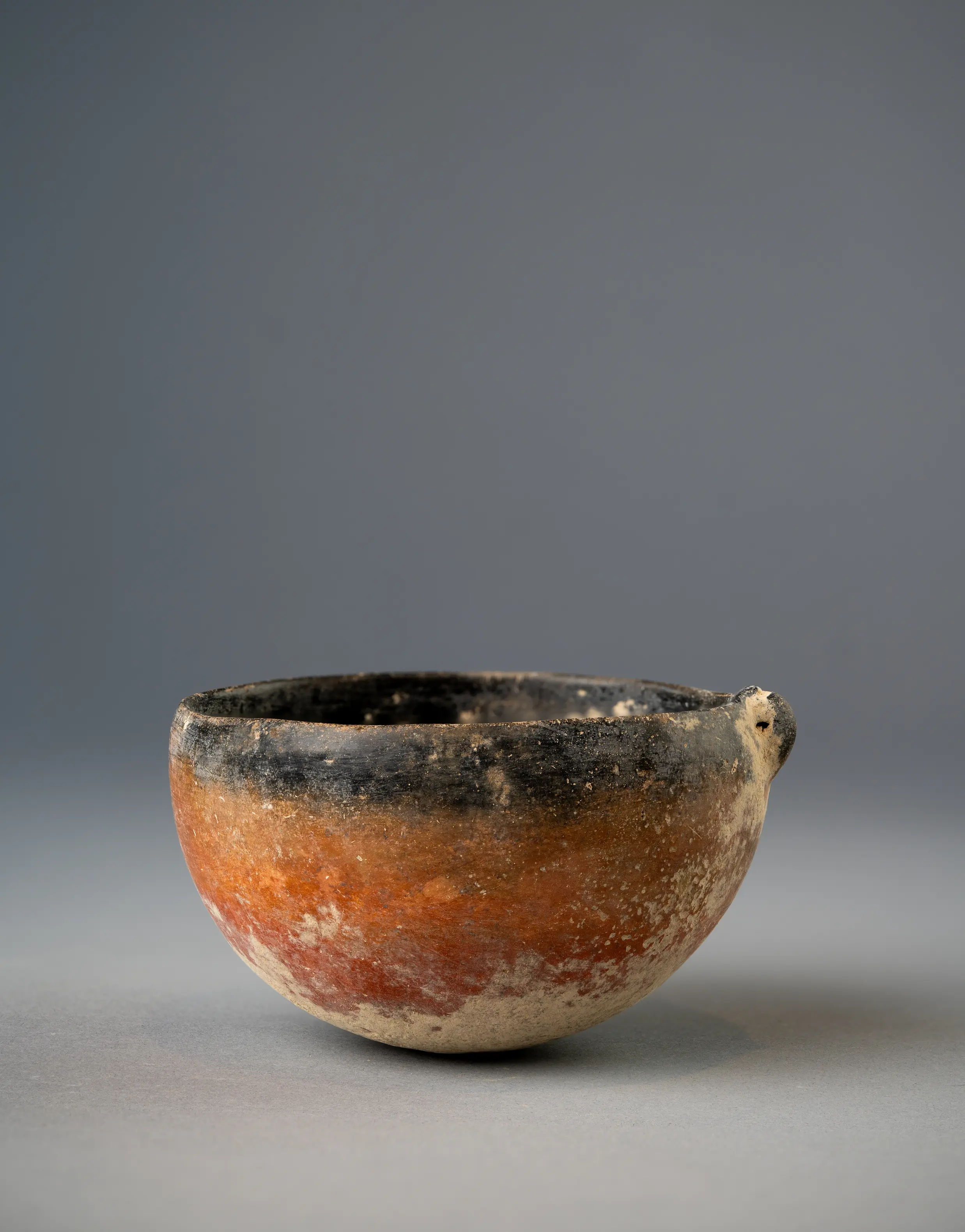
Red Polished ware, the dominant fine ware of the Early Bronze Age and much of the Middle Bronze Age, was fired in the same way. Webb's study of the Marki-Alonia settlement pottery found "little direct evidence" for the method, and proposed that vessels were "fired individually or in small batches in fire-pits or open-air hearths", starting at a low heat to drive out residual water so that the pots would not crack or burst [4, p. 17]. Despite the mottling on a fifth of the sherds, she judged that "the uniformity of surface colour and appearance in Red Polished Ware across the island suggests reasonably good control of firing conditions" [4, p. 17]. At Alambra, too, the excavators found "no evidence for kilns" [5, p. 299].
The clearest proof of that control is the black-topped bowl. Small hemispherical bowls with black interiors and a black band below the rim, which Webb calls Red Polished III Black-Topped bowls, occur at Marki and throughout the Red Polished tradition [4, p. 17]. At Alambra they match the site's Red Polished fine ware "in all respects except that of color" [5, p. 299]. The black does not stop at the surface: it penetrates into the core, and the boundary between black and red is not as straight as a painter's brush would leave it, so the colour was produced in the fire [6, p. 1]. Webb and the Alambra authors list the same practical methods. The bowl could be set rim-down in ash, so that the rim and interior were reduced while the exterior was oxidised; it could be covered with wet leaves in the last stage of firing; or it could be fired normally, pulled out red-hot and inverted into a carbonising material such as dung or damp chaff, which smudged the rim and interior while the exterior cooled red in the air [4, p. 17; 5, p. 299]. Smothering a pot entirely under another vessel would blacken it all over [5, p. 299], which is one route to Black Polished ware; the Alambra report accounts for the black surfaces of both black-topped and Black Polished pottery "by variations in firing" [5, p. 310].
A Mössbauer study at Uppsala in 1989 examined two rim sherds of Red Polished II bowls from Lapithos Tomb 313, dated Early Cypriot III to Middle Cypriot I [6, p. 2]. Red or pink areas coincided with ferric iron (Fe³⁺) and black or grey areas with ferrous iron (Fe²⁺), which indicated that iron, and not carbon alone, may be responsible for the black [6, p. 1]. One of the sherds was very soft (1 on Mohs' scale) with no vitrification, and the firing temperature of the Cypriot ware was estimated at about 600°C [6, pp. 2, 10]. The comparison group of Nubian C-Group black-topped pottery was estimated at about 700°C, and the authors noted that both temperatures "could have been achieved both in open fires and in kilns" [6, p. 10]. Nubian potters used the same red-and-black scheme; an Early Kerma bowl in Boston from Kerma Cemetery N, Tomb K 133, has an incised black rim over a red polished body (MFA 21.11907).
The Drakopoulos collection has several Red Polished bowls that show these effects. One bowl (illustrated) has a clear black band at the rim and a black interior over a red body, the deliberate black-topped scheme. A second has a blackened rim band and a mottled lower body, where the reduction was less evenly controlled. The collection's Black Polished juglet was fired in reducing conditions throughout. In the Cyprus Museum, Nicosia, two large black-topped Red Polished bowls with animal decoration and complex incision (inv. 7834 and 7835, each 19 cm high) show that the same firing effect was used on elaborate pieces; the museum records give no find-spot or date for either bowl.
The hardness of some Middle Cypriot fabrics points to hotter firings. At Alambra, White Painted B has a Mohs hardness of 3, a full point higher on average than the site's Red Polished or White Painted A, which suggests "a relatively high firing temperature"; the greenish colour of some of this fabric may come from salt in the paste combined with a temperature approaching 1000°C [5, p. 289]. The report does not claim a kiln for it. Webb noted from Marki that mottling tends to go with harder fabrics, and cited Ellen Herscher's suggestion that it may reflect attempts at technically superior pottery fired at higher temperatures [4, p. 17 n. 13].
Ambelikou-Aletri: the one prehistoric workshop
The single excavated potter's workshop of prehistoric Bronze Age Cyprus lies at Ambelikou-Aletri, a Middle Bronze Age site where metallurgy and pottery production were both practised. Jennifer Webb and David Frankel published the full record of the old excavations in 2013 [2]. The workshop, in Area 2, comprises Units I–III. It was destroyed suddenly, and the objects were left where they stood [2, p. 116].
Unit II is the structure the excavator, Porphyrios Dikaios, called a "primitive kiln". Two of its walls stood to 85 cm, and fired mudbricks from the interior and the superstructure were recovered; the chamber was empty apart from an intrusive spindle whorl [2, p. 116]. The potter Owen Rye, consulted by the authors in 2013, observed that the walls had no buttressing and so could not have carried a roof. He read Unit II as "probably an open structure with walls on three sides", comparable to ancient Egyptian examples and to kilns recorded among modern Pakistani potters, loaded with fuel and pots in alternating layers, fired from front to back, with mudbricks used as fire-dogs. Such a structure could reach 800°C, but its walls offered little advantage over open or pit firing beyond a fixed location [2, pp. 116–118].
Webb and Frankel conclude that structures of this kind "should not ... be seen simply as a transitional stage between open firing and more sophisticated updraft kilns, but are a viable technique in their own right" [2, pp. 116–118]. They weigh the trade-off: a kiln gives better control, higher temperatures and fewer losses, but costs more labour and far more hardwood fuel, while open firing uses fuel more efficiently and can run on dung or straw. The last load in Unit I comprised 39 medium-sized cutaway-mouthed jugs, one of which (no. 431) had split at the rim in firing, and a bowl (no. 467) was distorted by damage at the leather-hard stage, which confirms that pots were both made and fired on the spot. Batches of 30 to 40 pots are typical of such firings in Rye's ethnographic work [2, pp. 116–118].
Ambelikou also answered an older argument. Stuart Swiny had inferred kiln-level control from the uniform surfaces of Red Polished ware; Webb and Frankel reply with Unit II, which shows that such uniformity was achievable in a walled open firing. They also explain why workshops are so rarely found: wasters are scarce even at a known production site such as Sanidha, kilns are easily confused with ovens, metalworking installations and lime or brick kilns, and seasonal production leaves little behind. Nothing on Cyprus resembles the more complex channel kilns of Middle Bronze Age Phaistos and Miletus [2, pp. 116–118].
Late Bronze Age: the wheel, White Slip and the first kilns
The potter's wheel reached Cyprus at the start of the Late Bronze Age, around 1650 BC, much later than in neighbouring regions. The first wheel-thrown vessels made on the island were Levantine-inspired Plain White pieces used in communal feasting, and Lindy Crewe has linked the wheel's introduction to the emerging elites' contacts with Levantine customs [7, p. 185]. Crewe also found no sign of any rotational device in forming or finishing Cypriot pots before the first wheel-made pottery, and no progression from small to large vessels [7, p. 186]. In Late Cypriot I (c. 1650–1450 BC) the wheel was used only for a few wares (Plain White, Bichrome, White Painted and Red and Black Slip), most of which were also still made by hand, so that vessels of identical shape and fabric occur in both techniques [7, p. 186].
The use of the wheel then shrank. From Late Cypriot IIA (c. 1450 BC) the feasting set was made up of handmade Base Ring and White Slip bowls, and even in Late Cypriot IIC (c. 1325/1300–1200 BC) wheel-made vessels were few beside the handmade Base Ring and White Slip wares. Only at the end of the 13th century and through the 12th century BC did Cypriot potters adopt the wheel wholesale, with the locally made Aegean-style fine wares [7, p. 186]. The wheel is a forming tool, and this sequence shows that it did not bring a new firing technology with it: the Late Bronze Age wares that were fired hottest were handmade.
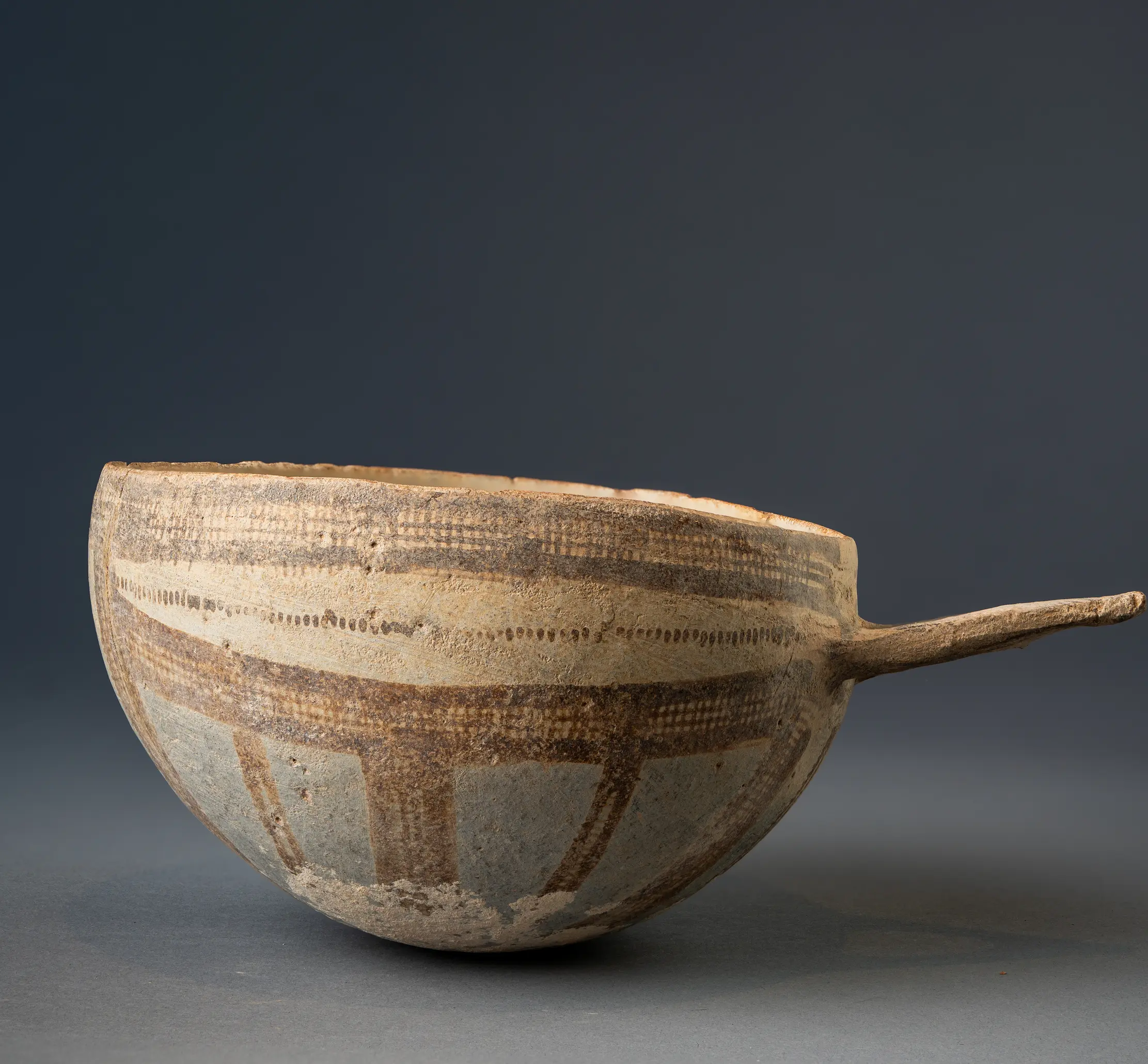
White Slip is the best-studied case. Braden Cordivari and Marie-Claude Boileau's 2024 study of White Slip vessels from the Bamboula-Kourion tombs combined petrography, x-radiography, infrared spectroscopy and electron microscopy [3, p. 1]. Extensive vitrification in one group, and the presence in at least one White Slip I, White Slip II and White Slip IIA vessel of tridymite, a form of silica that develops from quartz above about 800°C, point to prolonged, steady high temperatures. The authors conclude that "the control of temperature, soaking times, and firing and cooling atmospheres, particularly for White Slip II, was achieved via a kiln" [3, p. 12]. In several vessels the slip shows lower temperatures than the body, which suggests a two-stage firing: the pot was fired once above about 800°C and again, after slipping, below it [3, p. 12]. Excavations at the production site of Sanidha found unslipped pots matching White Slip in shape and fabric, which supports the idea that some vessels were fired twice there [3, p. 12]. Temperatures were consistently higher in Late Cypriot IB than before, and in White Slip II than White Slip I, "which may suggest the introduction of kiln technology at this time" [3, p. 13]. The Drakopoulos White Slip bowl belongs to this handmade tradition. The Ashmolean has a White Slip II wishbone-handle fragment from Aradippou presented by Hector Catling in 1953 (AN1953.1291.j).
The structures themselves remain elusive. Sanidha, in the Troodos foothills, is the best-known White Slip production centre, and it produced ceramic "firebars" that may have belonged to a kiln, but no kiln was found [3, pp. 1, 12]. Cordivari and Boileau count "only a single kiln" for Late Bronze Age Cyprus, recently found at Tochni-Lakkia [3, p. 12]. Other authors cite an earlier candidate: at Morphou-Toumba tou Skourou, on Morphou Bay, a Late Bronze Age "structure interpreted as a kiln" was reported by Vermeule and Wolsky, and the site's range of shapes and wares has been read as the output of a large production area [8, p. 24]. Burnt bone and bone ash were found there in Late Cypriot I contexts connected with both pot-making and smelting [2, p. 115]. Georgia-Marina Andreou, by contrast, notes that despite clear evidence for pottery production at both Sanidha and Toumba tou Skourou, "no associated kiln feature has been identified with the pottery wasters and the enigmatic 'fire bars'" at either site [11, p. 228]. The difference between one kiln and two therefore turns on whether the Toumba tou Skourou structure is accepted as a kiln.
Base Ring was the other main handmade fine ware of the period. The Drakopoulos Base Ring jug has a dark mottled surface with white-painted bands. No analysis of this jug's firing has been published. For the ware in general, Vaughan's petrographic study, as summarised by Lisa Graham, read the uneven surface colours and cores of Base Ring as signs of a pit fire or something similar, and its hard, fine, dark fabric as the result of "a hot, rapid firing, at temperatures of between 700-900°C"; her experimental bowls fired in a reducing atmosphere did not reproduce a Base Ring fabric [10, p. 92]. A Base Ring II bowl with a wishbone handle in Leiden (RMO I 1960/12.1) shows the shape that, with the White Slip bowl, made up the Late Cypriot II feasting set.
The Iron Age: wheel-made painted wares without workshops
The painted fine wares of the Cypro-Geometric and Cypro-Archaic periods, White Painted, Bichrome and Black-on-Red, were made after the wholesale adoption of the wheel in the 12th century BC [7, p. 186]. We know of no Iron Age pottery kiln excavated on Cyprus itself, so their firing is known only from the finished pots. The clearest Iron Age kiln with Cypriot-style pottery lies in Cilicia, in southern Turkey. At Tarsus-Gözlükule excavators found "stylistically clear unbaked Cypro-Geometric pottery inside of a pottery kiln" [9, p. 4]. Chemical analysis of White Painted and Bichrome from the Amuq Valley has since separated imports made from Circum-Troodos clays from local imitations: the smaller settlements received only imports, while the capital at Tell Tayinat used both [9, p. 1]. Steven Karacic and James Osborne suggest that elite feasting drove the demand, leading either local potters to make Cypriot-style wares or Cypriot potters to settle near Tayinat [9, p. 1]. Cypriot shapes and decoration therefore cannot be used as proof of Cypriot firing.
The Drakopoulos collection's Black-on-Red juglets belong to this Iron Age production, although where and how they were fired has not been analysed.
Evidence by period
| Period | Firing method (evidence) | Temperatures reported | Key sites and sources |
|---|---|---|---|
| Chalcolithic | Pits, hearths and open fires assumed; no built kilns | 700–800°C in an experimental stone-lined pit; c. 700°C in a dung bonfire; burnish lost above c. 800°C | Kissonerga-Mylouthkia experiments [1] |
| Early Cypriot (Red Polished, Black Polished) | Fire-pits or open hearths, single vessels or small batches; black tops by selective reduction | Normally below c. 750°C at Marki; c. 600°C for a black-topped bowl from Lapithos T. 313 | Marki-Alonia [4]; Alambra [5]; Lapithos [6] |
| Middle Cypriot | Open firing; a three-walled, unroofed firing structure at Ambelikou | c. 800°C possible in the Ambelikou structure; harder White Painted B at Alambra, perhaps near 1000°C | Ambelikou-Aletri [2]; Alambra [5] |
| Late Cypriot I–II | Handmade White Slip and Base Ring; kilns inferred for White Slip II; two-stage firing; first wheel c. 1650 BC | White Slip bodies above c. 800°C, slips below | Sanidha firebars; Tochni-Lakkia kiln; Toumba tou Skourou structure [3, 8, 11] |
| Late Cypriot IIC–III and Iron Age | Wheel adopted wholesale from the late 13th century BC; no installation known on Cyprus itself | Not measured for Cyprus | Tarsus-Gözlükule kiln with unfired Cypro-Geometric-style pottery [7, 9] |
Open questions
The central problem is the gap between inference and structure. High temperatures and uniform surfaces have repeatedly been read as signs of kilns, from Swiny's view of Red Polished to the 2024 White Slip analyses, while the excavated Bronze Age record consists of the walled, roofless structure at Ambelikou, a probable kiln at Tochni-Lakkia and a disputed structure at Toumba tou Skourou. The Mylouthkia experiments and Rye's comments on Ambelikou both show that open and semi-enclosed firings could reach 700–800°C, which overlaps the lower range claimed for kilns [1, p. 206; 2, pp. 116–118]. The Alambra authors' warning that the temperature bands are "suggestions rather than firm evidence" applies to the whole debate [5, p. 487].
Workshops are hard to find because firing leaves so little behind [2, pp. 116–118]. The relation between wheel and kiln also runs against the usual sequence, since the hottest-fired Late Bronze Age ware, White Slip, was never thrown on the wheel. The wares themselves are described in the pottery hub, including Red Polished Philia and Drab Polished; the Early Bronze Age cemetery at Vounous is the subject of a separate article; and the textile tools of the same households, including the whorl found in the Ambelikou kiln, are covered under spindle whorls and textile tools.
Objects on this page
- Black-topped Red Polished Bowl with Pierced Knob LugEarly Bronze Age II · 2200–1900 BC
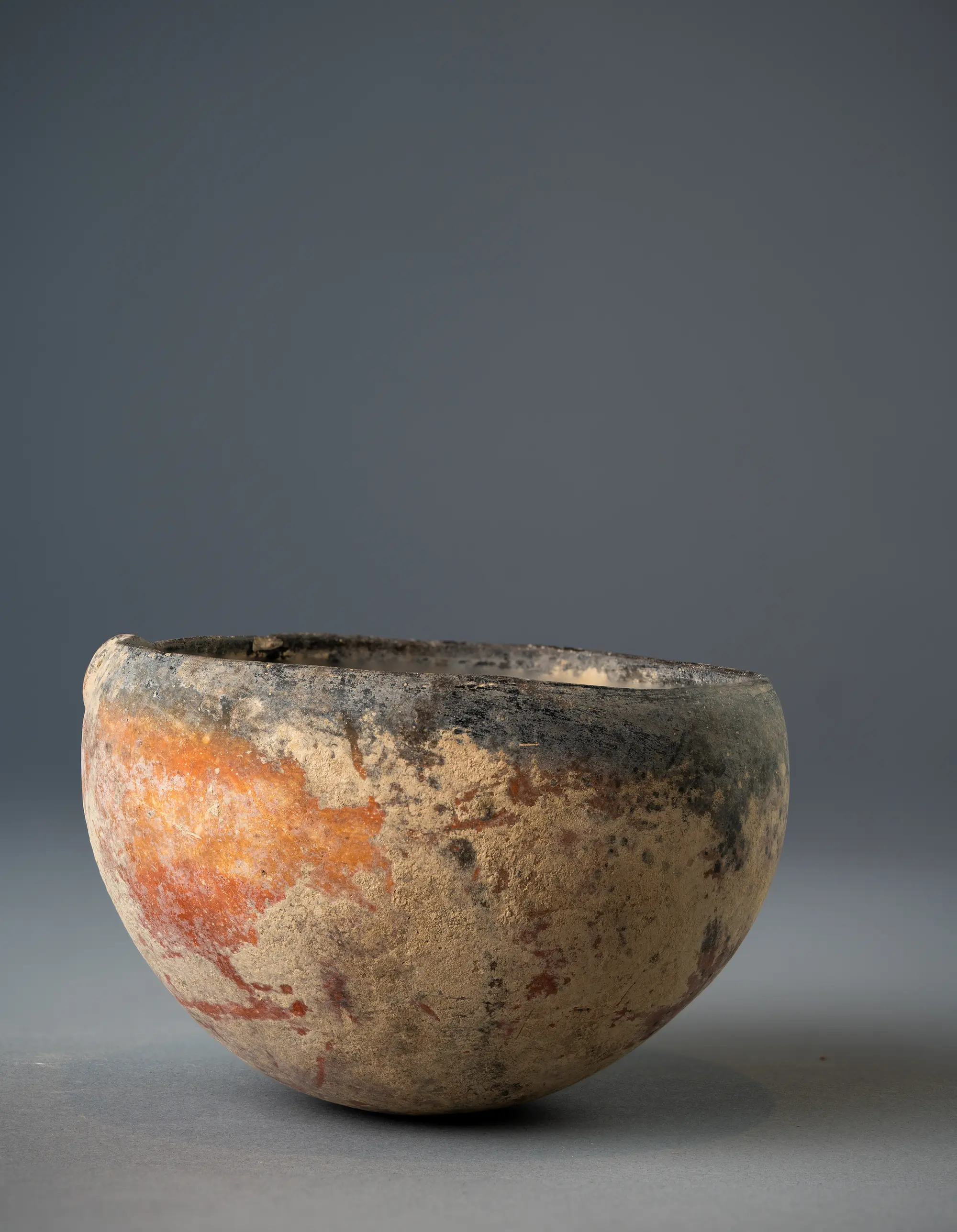 Black-topped Red Polished Hemispherical BowlEarly Bronze Age II · 2200–1900 BC
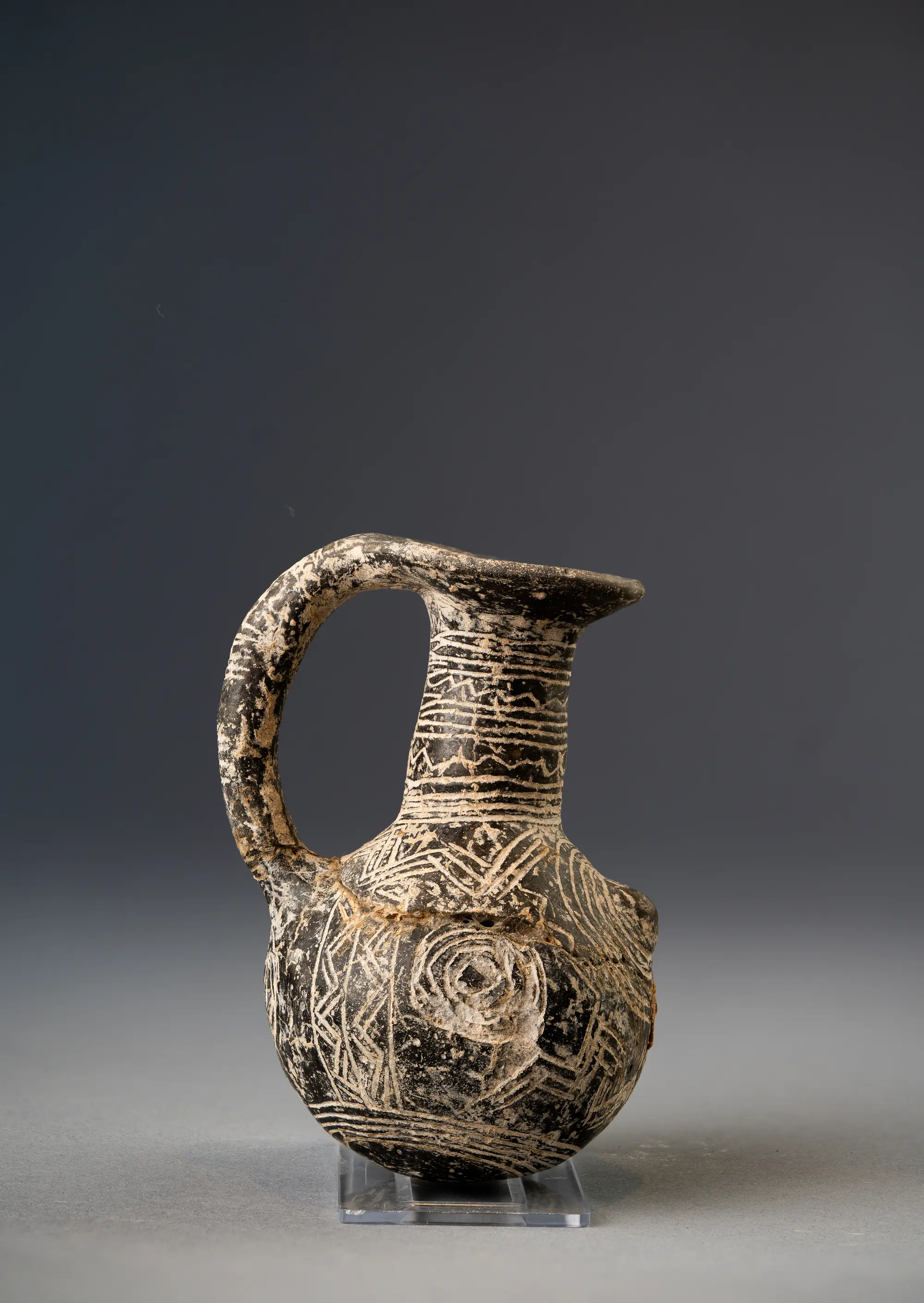 Black Polished Juglet with Incised Decoration and Circled BossesEarly Bronze Age III · 2100–1850 BC
- White Slip II Hemispherical Bowl with Wishbone HandleLate Bronze Age II · 1450–1200 BC
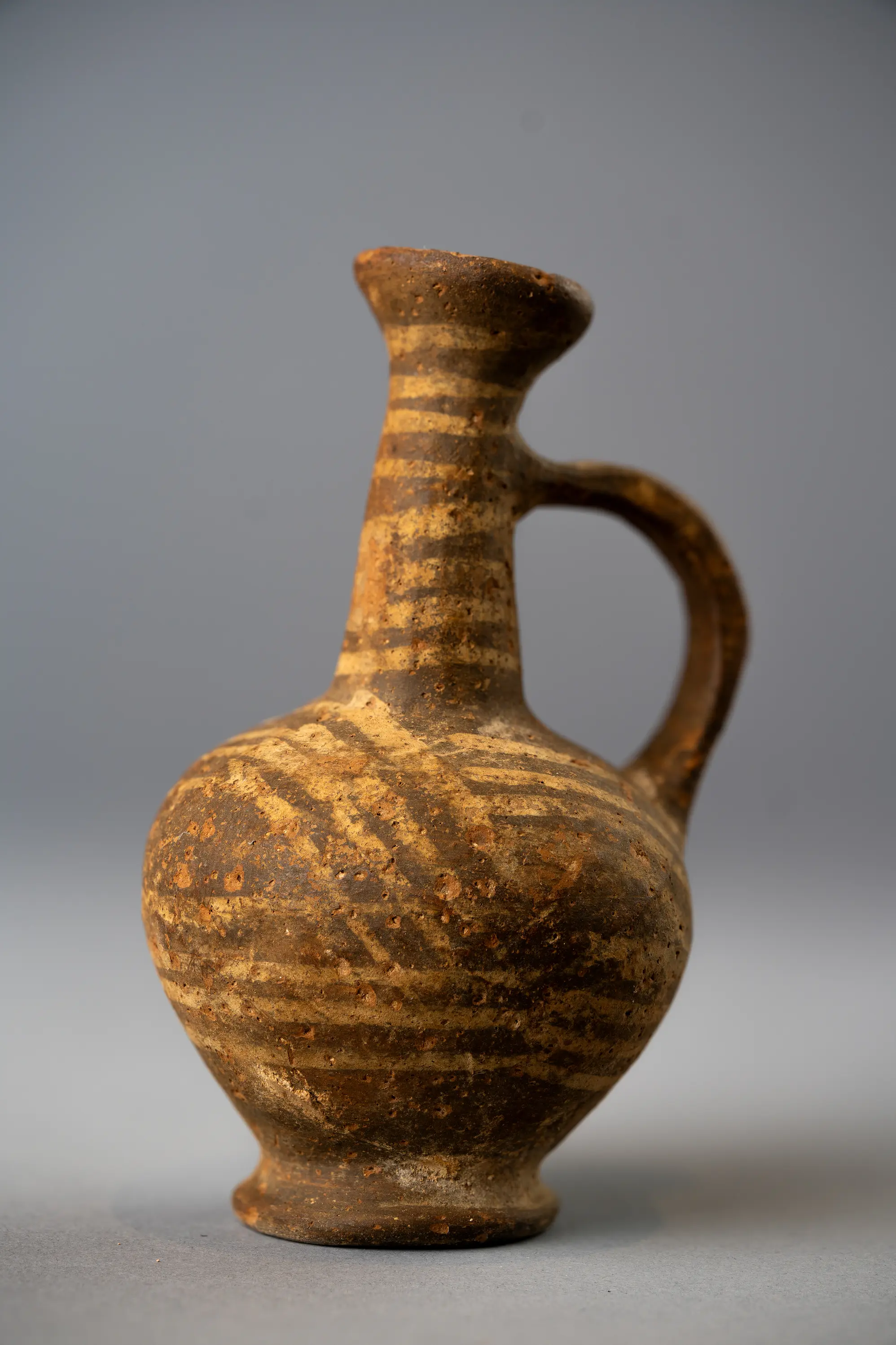 Base Ring II Bilbil Juglet with White-Painted BandsLate Bronze Age II · 1450–1200 BC
References
- 1.Peltenburg, E., et al. (2003). The colonisation and settlement of Cyprus: Investigations at Kissonerga-Mylouthkia, 1976–1996 (Lemba Archaeological Project III.1; Studies in Mediterranean Archaeology 70:4). Paul Åströms Förlag.
- 2.Webb, J. M., & Frankel, D. (2013). Ambelikou Aletri: Metallurgy and pottery production in Middle Bronze Age Cyprus (Studies in Mediterranean Archaeology 138). Åströms Förlag.
- 3.Cordivari, B. W., & Boileau, M.-C. (2024). Characterizing the manufacturing practices of Late Bronze Age White Slip ware from Bamboula-Kourion, Cyprus. Journal of Archaeological Science: Reports, 53, 104380. https://doi.org/10.1016/j.jasrep.2024.104380
- 4.Webb, J. M. (1994). Techniques of pottery manufacture at Marki, Cyprus. Archaeologia Cypria, 3, 12–21.
- 5.Coleman, J. E., Barlow, J. A., Mogelonsky, M. K., & Schaar, K. W. (1996). Alambra: A Middle Bronze Age settlement in Cyprus. Archaeological investigations by Cornell University 1974–1985 (Studies in Mediterranean Archaeology 118). Jonsered: Paul Åströms Förlag.
- 6.Makundi, I. N., Waern-Sperber, A., & Ericsson, T. (1989). A Mössbauer study of the black colour in Early Cypriote and Nubian C-Group black-topped pottery. Archaeometry. https://doi.org/10.1111/j.1475-4754.1989.tb01056.x
- 7.Georgiou, A. (2018). From the hand to the wheel: Revisiting the transformations of the Late Cypriot ceramic industry of finewares during the 13th-to-12th c. BC transition. In I. Caloi & C. Langohr (Eds.), Technology in crisis: Technological changes in ceramic production during periods of trouble (Aegis 16, pp. 177–200). Presses universitaires de Louvain.
- 8.Gagné, L. A. (2014). Learning to make pottery: A look at how novices became potters in Middle Bronze Age Cyprus. Bulletin of the American Schools of Oriental Research, 372, 19–33. https://doi.org/10.5615/bullamerschoorie.372.0019
- 9.Karacic, S., & Osborne, J. F. (2016). Eastern Mediterranean economic exchange during the Iron Age: Portable X-ray fluorescence and neutron activation analysis of Cypriot-style pottery in the Amuq Valley, Turkey. PLoS ONE, 11(11), e0166399. https://doi.org/10.1371/journal.pone.0166399
- 10.Graham, L. (2013). The necropolis of Kissonerga-Ammoudhia: Techniques of ceramic production in Early-Middle Bronze Age western Cyprus (PhD thesis). University of Edinburgh.
- 11.Andreou, G.-M. (2014). Traversing space: Landscape and identity in Bronze Age Cyprus (PhD thesis). University of Edinburgh.