
Contents
Cyprus had copper in abundance and very little else. The other metals that Cypriot smiths used in the Bronze Age and the early Iron Age (arsenic, tin, gold, silver, lead and finally iron) each arrived by a different route, and for most of them the route was the sea. Tin and gold had to be imported; arsenic probably came from the island's own polymetallic ores; iron, which appears in twelfth-century tombs in larger numbers than anywhere else in the eastern Mediterranean, was most likely smelted from Cypriot ores. This entry follows these metals from the first alloys of the Philia facies to the iron knives of the twelfth century BCE. Mining and smelting copper, the Alashiya trade and the workshops of Enkomi and Kition are treated under copper metallurgy; the blades themselves are covered under Bronze Age weapons; gold ornaments as a class are treated in the jewellery section.
| Metal | First attested | Key finds | Source |
|---|---|---|---|
| Arsenical copper | Philia (ECY 3) | Most Early Bronze Age objects; arsenic mostly 0.1 to 2.8% | [1] |
| Tin bronze | Philia (ECY 3) | Spearhead and sword (imported), axe of local type; four spiral rings, Sotira-Kaminoudhia Tomb 6 | [1] |
| Electrum | Philia (ECY 3) | Two spiral earrings, Sotira-Kaminoudhia Tomb 6 | [1], [4] |
| Sheet gold | Early Cypriot | Four fragments, Bellapais-Vounous Tomb 164B | [1], [3] |
| Silver or lead | Early to Middle Cypriot | Rings at Lapithos Tombs 316 and 320; lead spiral fragments, Ayia Paraskevi Tomb 8 | [3] |
| Gold (Late Bronze Age) | LC IB to IIA onward | Diadem, Enkomi British Tomb 19; sphinx diadem, Enkomi Tomb 93 | [5] |
| Iron | LC IIIA (12th century BCE) | About 15 one-edged knives, cosmetic spatulae, gold ring with iron band from Kition Tomb 9 | [2] |
| Iron dagger | Late LC IIIB | Kourion-Kaloriziki Tomb 40 | [2] |
An island with copper and little else
The ore bodies of the Troodos are massive sulphides. Vasiliki Kassianidou describes the Cypriot copper ores as having "a rather simple chemical composition", with arsenic, antimony and lead present only as trace elements [1]. The same deposits carry gold and silver, but "in extremely low concentrations that do not render them economically profitable even by modern standards". Modern mining did take 4.6 tonnes of gold and 26.3 tonnes of silver out of Cyprus in the twentieth century; Kassianidou nonetheless judges it "highly unlikely that precious metals were ever extracted in antiquity on the island" [1]. The gold and silver discussed below should therefore be imported metal, or metal recycled from earlier imports.
Iron was long thought to be missing too. Christopher Pare summarises the older view, which went as far as Vassos Karageorghis's suggestion that iron ore was imported from Italy or Sardinia in exchange for oxhide ingots. Kassianidou's work answered it: iron ores exist in Cyprus, "mainly in the form of ochres and umbers", in sufficient quantities, and disused iron mines have been described in the west of the island [2, p. 55]. Two of the metals that concern this entry, arsenic and iron, could thus be found locally. Tin, gold and silver could not. Whether Bronze Age lead was locally sourced or imported is still an open question.
Arsenical copper
The metal objects of the Chalcolithic (ECY 1 and 2 in the ARCANE scheme) are "unalloyed, most likely native copper". From ECY 3, the Philia facies, through Early Cypriot III, smiths used both copper and copper alloys, and "arsenical copper is the most common alloy" [1]. Summarising Weinstein Balthazar's analyses of 1990, Kassianidou gives arsenic contents usually between 0.1 and 4.2 percent, a few objects above 4.6 percent, and a "vast majority" between 0.1 and 2.8 percent [1].
Those figures are low, and a reader might take them for impurities carried over from the ore. Kassianidou argues otherwise. Because Cypriot sulphide ores carry arsenic only in traces, even a content of one or two percent indicates "the intentional preparation of an arsenical copper alloy". Arsenic-bearing minerals, such as "the complex polymetallic ores of the Limassol Forest which include arsenides", must have been added either to the smelting charge or to molten copper. Whether the smiths co-smelted the two ores or introduced the arsenic by cementation is a debate she describes as "still ongoing" [1].
The alloy arrived together with a new way of working metal. Chalcolithic objects were hammered and annealed from native copper; from ECY 3 onward, objects were cast in simple open moulds, the main exception being the tin-bronze shaft-hole axes of the Middle Cypriot period [1]. Several scholars, among them Jennifer Webb with David Frankel and later Edgar Peltenburg, have tied this shift to migrants from south-west Anatolia in the middle of the third millennium [1]. The casting technology itself is described in the copper metallurgy entry, and the arsenical and tin-bronze blades in the weapons entry.
Tin and the first tin bronze
Any tin bronze made in Cyprus implies imported tin. Weinstein Balthazar placed the first local tin bronze in the Middle Bronze Age, treating the two earlier examples, both daggers, as imports. Later analyses showed tin bronze "already during the Philia facies" [1]. Kassianidou reports the study by Webb and colleagues (2006) of three Philia tin-bronze objects. Typology and lead isotopes suggested that a spearhead and a sword arrived finished; the third object, an axe, is "of a local type" and its composition is "consistent with a Cypriot provenance". The conclusion follows that "tin, either in metallic or in mineral form, was imported to the island" [1]. The same lead-isotope group of Philia objects was made mostly of Cypriot metal, with a few pieces consistent with Anatolian and Cycladic ore fields [1].
The earliest tin bronze from a secure Cypriot burial may have been chosen for its colour. Sotira-Kaminoudhia Tomb 6, of the Philia phase, contained four tin-bronze spiral rings, and Kassianidou reports the argument that the alloy was used "for its colour which simulates gold" [1]. The same tomb held the electrum spirals discussed below, so the bronze rings lay beside the metal they may have imitated.
Tin bronze stayed rare for several centuries after Philia. In the ARCANE database only two of 22 analysed objects are tin bronze, both of ECY 5: a pin from Kalavasos-Panayia Church and a Minoan dagger, imported, from Bellapais-Vounous [1]. Where the tin came from is "hotly debated". Kassianidou sets out the case made by Yener and Vandiver for tin in the Taurus mountains of Anatolia against its sceptics, without resolving it [1]. The origin of Late Bronze Age tin is a separate question, not treated here.
By the end of the Bronze Age tin was plentiful. Pare notes that bronzes of the twelfth to tenth centuries "continued to be alloyed with relatively large amounts of tin", and that bronze production remained high [2, p. 56]. That observation matters for the iron debate below.
Gold and electrum before the Late Bronze Age
"From ECY 3 onwards, precious metals, namely gold and much more rarely silver, also begin to be used by the local smiths" [1]. The first of them is electrum, the natural alloy of gold and silver. Sotira-Kaminoudhia Tomb 6 produced two electrum spiral earrings [1]. In Priscilla Keswani's tabulation of precious-metal finds from Bronze Age tombs the entry reads "T6: 2 electrum earrings" [3, p. 388]. The exhibition catalogue Ancient Cyprus: Cultures in Dialogue lists arsenical copper, bronze and electrum spiral earrings from the tomb and draws the consequence: "since electrum is a natural alloy of gold and silver, these items should be considered as the earliest examples of gold in Cyprus so far" [4, p. 105].
Kassianidou suggests that the electrum points towards Anatolia. The Pactolus river at Sardis was "extremely rich in electrum", and third-millennium precious metal in Cyprus was "most likely imported either from Egypt or from Anatolia" [1]. The same reasoning covers the Philia tin, and both metals belong to the Anatolian connections traced in the Early Bronze Age entry.
Sheet gold follows in the Early Cypriot cemeteries of the north coast. At Bellapais-Vounous four fragments of sheet gold with a relief pattern were first read as the mount of a whip or stick; James Stewart later re-identified them as a hair ornament [1]. Keswani lists them under Vounous Tomb 164B, with a single gold earring from Tomb 59 [3, p. 388]. Her table adds finds from other Early and Middle Cypriot cemeteries:
| Cemetery and tomb | Gold listed by Keswani |
|---|---|
| Bellapais-Vounous T. 164B | 4 fragments of sheet gold |
| Bellapais-Vounous T. 59 | 1 earring |
| Lapithos-Vrysi tou Barba T. 806A | 3 sheet-gold ornaments |
| Lapithos-Vrysi tou Barba T. 322A | 3 spirals |
| Lapithos-Vrysi tou Barba T. 204 | Twisted bands and spiral bands |
| Politiko-Lambertis T. 16 and T. 21 | Thin bands; 2 rings |
| Nicosia-Ayia Paraskevi T. 22 | Beads |
| Vasilia-Kafkallia | Earrings reported from the site |
The quantities are small, a few spirals, bands, rings or beads per tomb. The burial customs behind these deposits are discussed in the entry on Vounous and Early Bronze Age burial.
Electrum reappears more than 1,500 years later in a quite different form. The Metropolitan Museum's electrum earring with lobes and rosettes, from the Cesnola collection, is dated to the sixth century BCE and measures 1.5 by 1.8 cm. It belongs to the Cypro-Archaic period, whose goldsmithing tradition falls outside the scope of this entry.
Silver and lead: the Lapithos cemetery
Silver appears "much more rarely" than gold from ECY 3 [1], and it is hard to isolate in the published record. Keswani's column for the white metals is headed "Silver, Lead, or Silver/Lead", and many entries are marked simply "s/l" [3, p. 388]. Without analyses, a corroded grey ring can be either metal. The entries below are therefore described as silver or lead throughout, and no single ring is named as silver here.
Even with that caveat the distribution is lopsided. Lapithos, at the Vrysi tou Barba cemetery on the north coast, dominates Keswani's list: silver or lead rings in Tombs 307A, 311A, 316 (seven rings) and 320 (eight); rings, bracelets, a clasp, pins and a band in Tombs 313A/B, 322B, 802A, 805, 806A and 828A; and "small silver ornaments" with vessel fragments in Tombs 50 and 204 [3, p. 388]. Elsewhere the white metals are thin on the ground: twenty lead spiral fragments in Nicosia-Ayia Paraskevi Tomb 8, and a silver spiral and bead in Tomb 22 of the same cemetery; a lead whorl in Korovia-Paleoskoutella Tomb 7; a possible vessel fragment and silver or lead rings in Laxia tou Riou Tomb 1; a ring at Kalopsidha Tomb 11; bracelet fragments at Politiko-Lambertis Tombs 16 and 18 [3, p. 388]. Before the Late Bronze Age, the cemetery with the most silver and lead on the island is Lapithos in Keswani's table, and Lapithos tombs also appear three times in her gold column.
For the Late Bronze Age, the Metropolitan Museum holds a small silver spiral of plain wire, one turn, 3 cm long, catalogued as Late Bronze Age and without find-spot. The sources of Cypriot silver and lead, and the lead-isotope work on them, fall outside the scope of this entry.
Much later, silver was worked into the decorated bowls of the Cypro-Archaic period. The Met's silver bowl 74.51.4555 (site record), 15.3 cm across, has a central medallion of Isis suckling Horus and friezes of animals, banqueters and carts; the museum dates it to about 675 to 625 BCE. A plain silver bowl, 74.51.4552, 15.7 cm across, carries the same date. Both came from the Cesnola collection. The article The Price of Rough Metal follows a Phoenician silver bowl that was sold as scrap.
Late Bronze Age gold
Late Bronze Age gold in Cyprus is known above all from the tombs of Enkomi. Giampaolo Graziadio places the Cypriot diadems and mouthpieces in "a distinct Syro-Palestinian group of strips" [5, p. 309]. Within that tradition, some pieces take up Aegean motifs. In British Tomb 19 at Enkomi, used in LC IB to IIA, a gold diadem found with gold beads has "a local tradition and locally produced strip" decorated with the Aegean "grain of wheat" motif. A stone mould from Idalion has matrices for three grain-of-wheat beads, which suggests that such beads were made on the island [5, p. 309].
Graziadio describes S-spirals as "rather common on diadems and mouthpieces from Enkomi tombs", probably adopted from the Aegean. Porphyrios Dikaios recovered two gold strips with S-spirals from an LC IIB context in Enkomi Tomb 10; a diadem from Enkomi Tomb 93, now in the British Museum, combines the spirals with seated sphinxes. The tomb was in use from LC I–IIA to LC IIC. At Hala Sultan Tekke, Chamber Tomb RR has yielded another diadem with S-spirals [5, p. 309]. He also identifies local imitations of Aegean gold beads and of figure-of-eight-shield necklace spacers [5, p. 309].
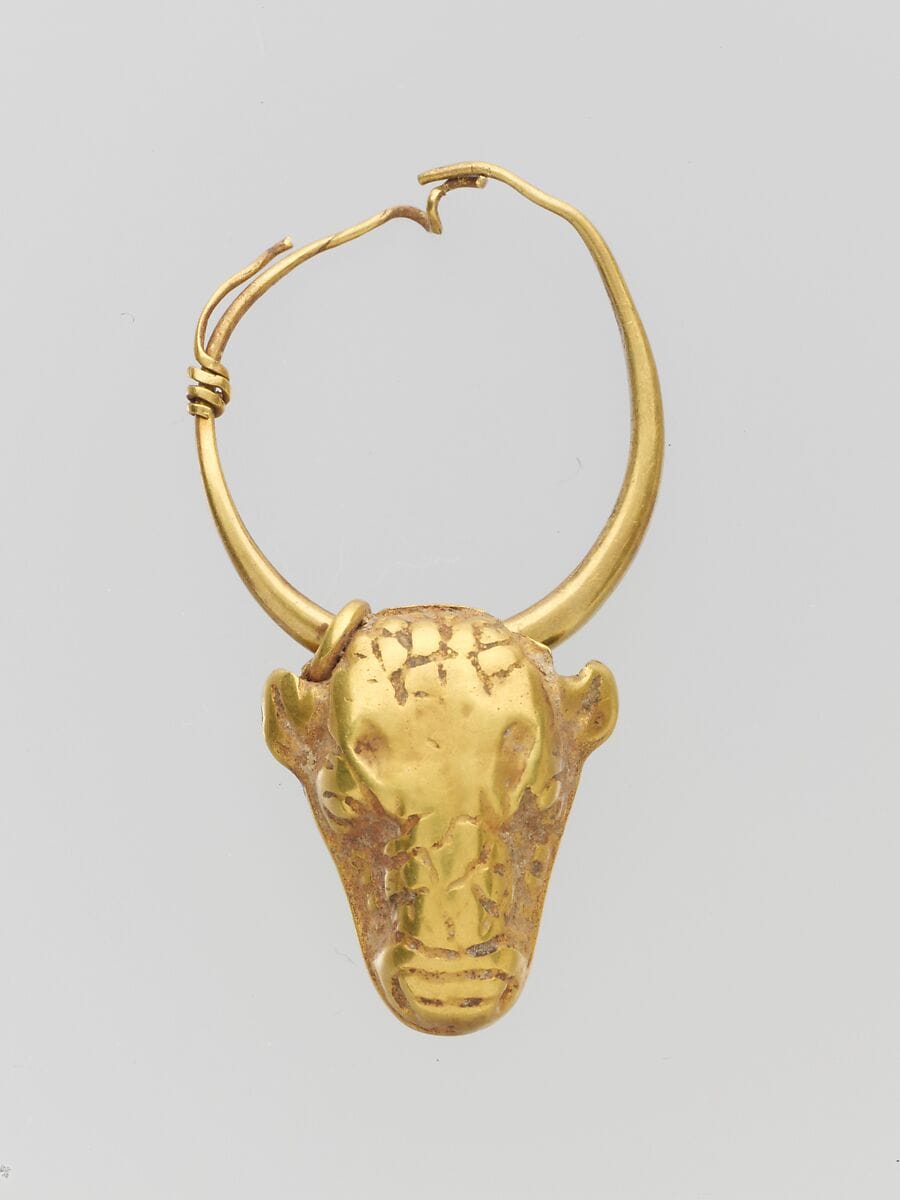
Museum collections outside Cyprus hold examples of both the strips and the smaller ornaments. The Swedish Cyprus Expedition excavated Enkomi Tomb 11 in 1930, and a gold diadem from that tomb, E. 011:036, 15.3 cm long and dated LC II, is now in the Medelhavsmuseet in Stockholm. The Metropolitan Museum's Cesnola material includes a gold pendant in the form of a bull's head, 1.8 cm long, and a gold spiral of plain wire with two turns, 2.4 cm long; both are catalogued as Late Bronze Age but have no recorded find-spot. Gold jewellery continued into the twelfth and eleventh centuries: the Ashmolean Museum's gold hoop earring AN1888.1200, from Palaepaphos, is dated LC IIIB and came from the Cyprus Exploration Fund's excavations of 1888. The tomb contexts of this jewellery are discussed under Bronze Age chamber tombs.
Iron in the twelfth century
Cyprus "has a prominent place in the introduction of iron for the manufacture of utilitarian implements", as Pare puts it, following Snodgrass, Waldbaum and Sherratt [2, p. 55]. In Pare's account iron "has never been found in archaeological contexts before the 12th century BC" on the island, and the number of pieces from LC IIIA is "impressive" [2, p. 57].
The tomb evidence of LC IIIA comprises ten one-edged knives, two two-edged knives, six spatulae, a "chisel", a pin, a tang, and iron wire set into a gold ring. The finds come from Enkomi British Tombs 58 and 74, Kition Tomb 9, several cemeteries at Kouklia (Asproyi Tombs IV and V, Evreti Tombs IIIA, IV and VIII, Eliomylia Tomb 119 and Teratsoudhia Tombs 104 and 105), Kourion-Bamboula Tombs 16, 19, 25 and 32, and Lapithos-Ayia Anastasia Tomb 501. Enkomi Tomb 58 produced an ivory handle in the form of a bull's leg, 7.5 cm long, with an iron tang; Tomb 74 produced the "chisel" [2, p. 57]. Settlement finds from Enkomi, Hala Sultan Tekke (including a bimetallic fragment), Idalion and Kourion-Bamboula raise the LC IIIA total to about fifteen one-edged knives, two two-edged knives, six spatulae, one chisel-like tool and one pin, with further, less securely dated pieces of the same types [2, p. 61]. The Enkomi iron from Schaeffer's excavations lacks reliable stratigraphy [2, p. 61].
The knives typically have bronze rivets [2, p. 57]. Their shapes follow bronze models: one-edged bronze knives had reached Cyprus from the Aegean in the thirteenth century, while two-edged knives remained customary, in bronze or in iron, until the beginning of the Iron Age [2, p. 57]. The spatulae were probably cosmetic, and several have ivory handles. Pare counts "as many as nine iron cosmetic spatulae" in LC IIIA, and reads the pairing of iron and ivory as a sign that the new metal first served for "small, prestigious implements for personal use" [2, p. 59].
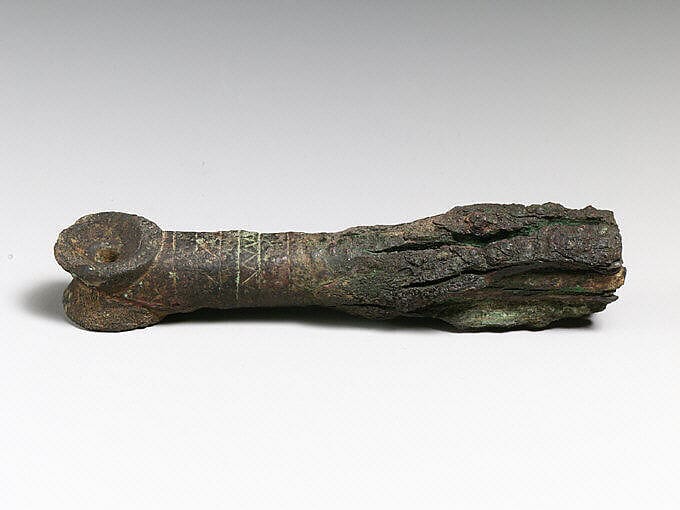
The Metropolitan Museum's bronze and iron knife 74.51.5356, 9.5 cm long, is dated by the museum to about 1150 to 1100 BCE and recorded only as "From Cyprus". The record gives no find-spot or construction details. Its combination of the two metals corresponds to the knives in Pare's list, which usually pair iron blades with bronze rivets. A larger piece of the same family is the British Museum's iron curved knife-blade from Enkomi, 1897,0401.994, 28 cm long, with an ivory haft attached by bronze rivets, dated LC III (1200 to 1050 BCE).
LC IIIB produced fewer iron pieces but larger forms. Pare lists about nine knives; a "carving knife" 28 cm long from Room 8 of the Ashlar Building at Enkomi, which Dikaios called a "sickle" and which Pare compares with a knife in the Tiryns Treasure; and one or two daggers, among them a "dagger" over 25 cm long with three bronze rivets from Floor II, Room 115, at Kition. The drop in numbers he attributes to the abandonment of the large settlements at the end of LC IIIA [2, p. 63]. The earliest "true" iron dagger comes from Kourion-Kaloriziki Tomb 40, dated by Louise Steel to a late stage of LC IIIB. Its hilt, with a rounded shoulder, fish-tail finials and bone hilt-plates once fixed by four iron rivets, derives from bronze swords of the post-Naue II tradition. It was probably no longer than 26 to 27 cm; longer iron daggers of about 30 to 33 cm became more common in the later eleventh and tenth centuries, at Kouklia-Plakes and Kouklia-Skales among other sites [2, p. 95]. These belong to the Cypro-Geometric period and to the weapon series described elsewhere.
Where the iron came from, and why
Three explanations have been offered for Cyprus's early iron, and Pare rejects two of them.
The first held that iron was a by-product of copper smelting. It was popular while Cyprus was thought to lack iron ores. Experimental smelting of chalcopyrite at Agia Varvara did produce visible metallic iron, "but it has never been proven that malleable iron can be produced by these methods" [2, p. 55].
The second was the "bronze shortage". Snodgrass proposed that a shortage of bronze drove the adoption of iron in central Greece around 1025 to 950 BCE, and Waldbaum extended the idea to the eastern Mediterranean of the twelfth and eleventh centuries [2, pp. 55–56]. The evidence has turned against it. Bronze of the period still contained plenty of tin and bronze production stayed high, so the theory "has fallen out of favour" since the late 1980s [2, p. 56].
The third explanation, the one Pare accepts, starts from quantity. Cyprus has "the largest quantity of smelted iron artefacts in the East Mediterranean area in the 12th century BC", and "there is no conceivable source from which iron could have been imported at this time". He concludes that "there can hardly be any doubt that Cypriot ironworking relied on local ores" [2, p. 56], the ochres and umbers identified by Kassianidou.
Where the knowledge came from is a separate question. The gold finger ring from the upper burial of Kition Tomb 9, at the transition from LC IIC to IIIA, has a central iron band flanked by twisted gold wire. Pare cites a parallel from Megiddo Tomb 39, of Iron IA, and suggests that "this could point to a Levantine origin for the new metal", which "may first have arrived on the island in the form of this kind of ring jewellery" [2, p. 59]. If he is right, some of the first iron to reach Cyprus came as an inlay in gold jewellery. The Levantine connections of the period are outlined under Ugarit and the Levant and the Phoenicians.
The claim that Cypriot smiths also made steel rests on a single object. Valerie Cook, following Waldbaum's study of 1980, writes that "the earliest known application of the carburization and tempering method of treating iron is a knife from Idalion" [6, p. 193]. Pare's review of the Idalion finds is more cautious: the upper levels of the settlement ("Period 3") "seem to have been mixed with later material derived from Iron Age activity", so the Idalion iron, two knives, four two-edged knives and two fragments, "can only tentatively be assigned to LC III(A?)" [2, p. 61]. A quenched-steel knife from those levels may be a twelfth-century object or a later one, and the claim should be treated as open. The wider question of whether Cyprus led the eastern Mediterranean into iron, and the dissenting views, is summarised in the copper metallurgy entry under its section on iron.
What remains open
Several questions in this entry remain unresolved. The source of Philia tin is disputed between the Taurus and other candidates [1]. Whether arsenic was co-smelted or added by cementation has not been settled [1]. Keswani's "silver/lead" column cannot be divided without new analyses of the rings themselves [3, p. 388]. The Vounous gold has already been reinterpreted once, from whip mount to hair ornament [1]. For iron, the dating of the Enkomi and Idalion settlement finds depends on stratigraphy that Pare regards as unreliable or mixed [2, p. 61], and the Idalion steel knife stands or falls with it. The broader story of Cypriot metal, from ore to ingot to grave, is told in the site's articles Under a Kilogram, the copper kingdoms of ancient Cyprus and Early Iron Age trade networks, and many of the Cesnola metal objects cited here can be browsed in the Metropolitan Museum collection.
Objects on this page
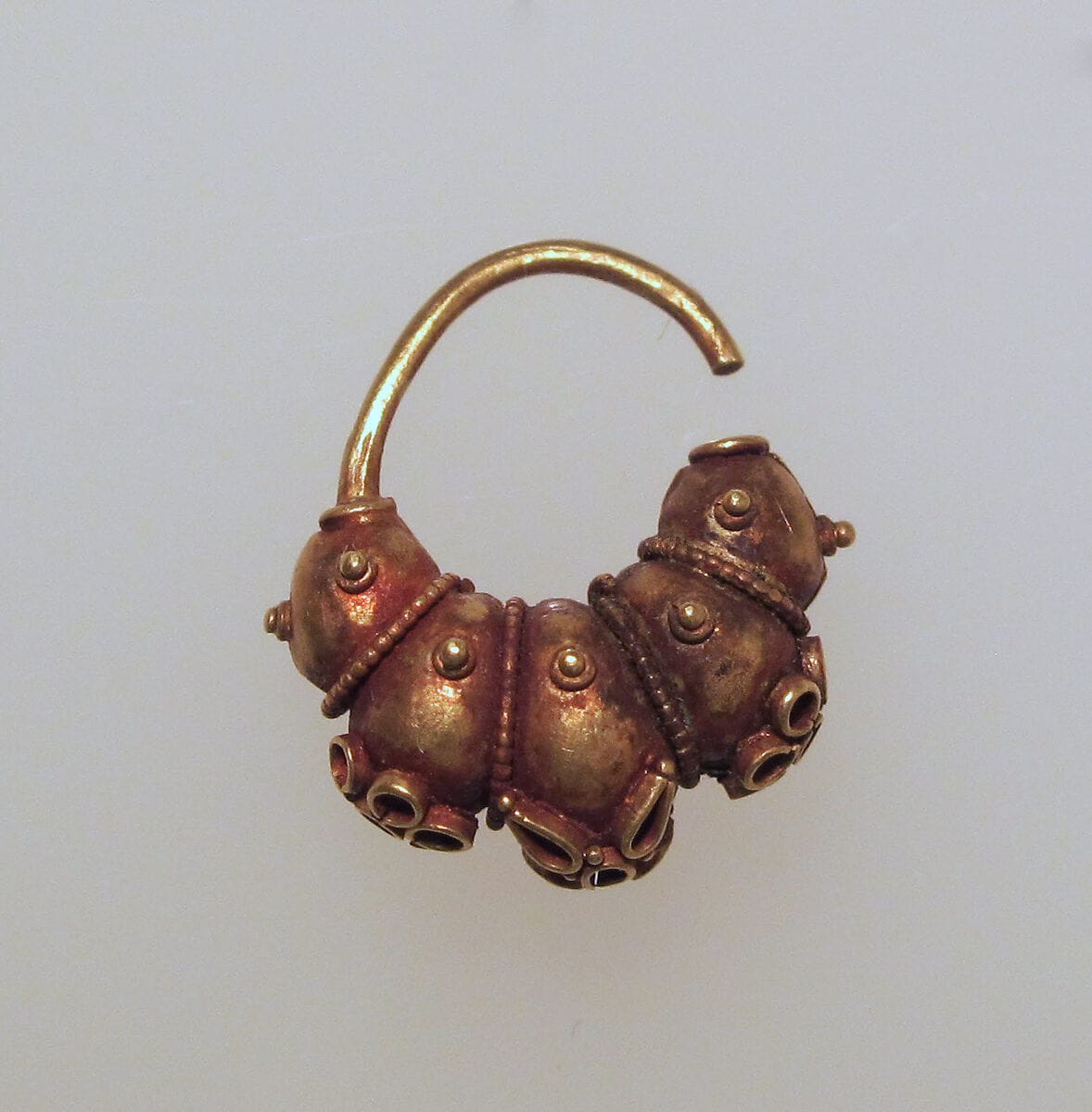 Electrum earring with lobes and rosettesArchaic II · 599–500 BC
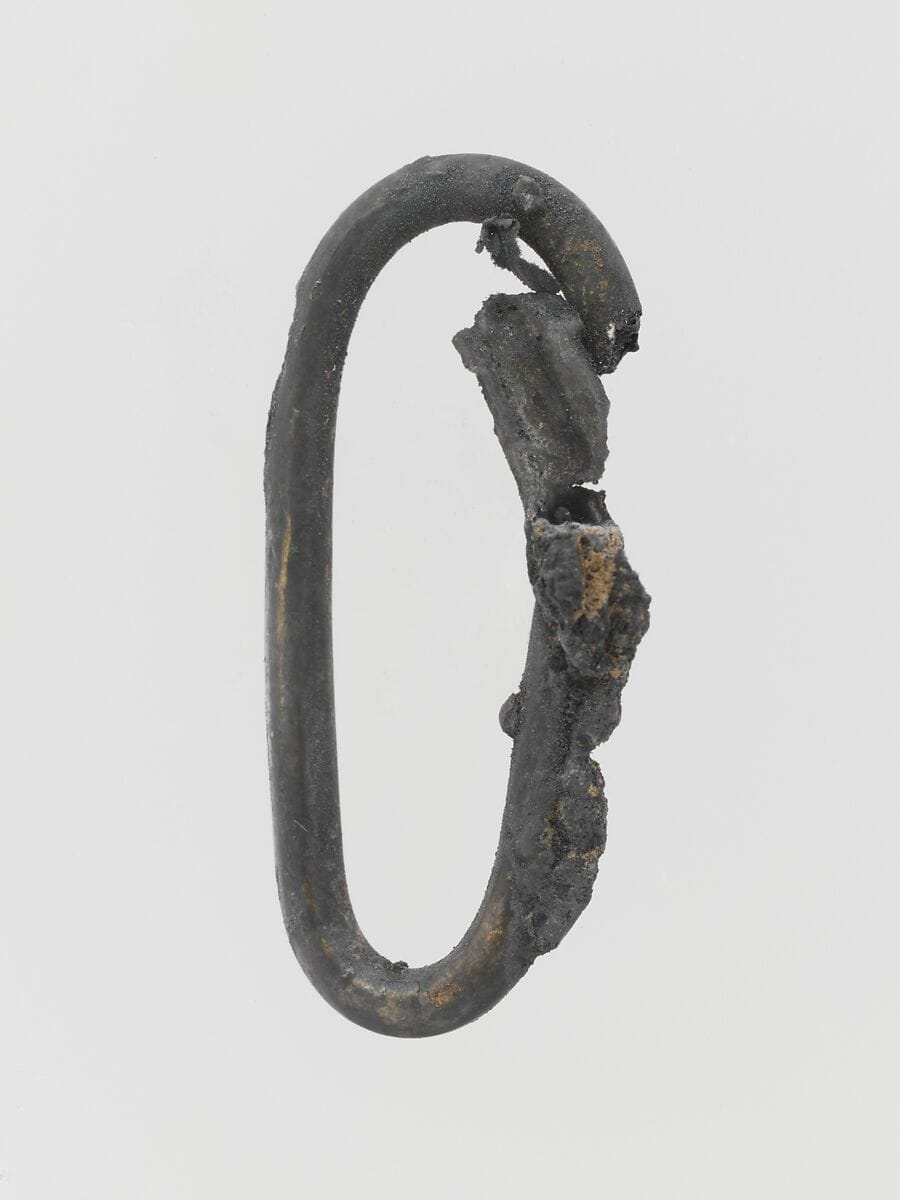 Silver spiralLate Bronze Age II · 1600–1050 BC
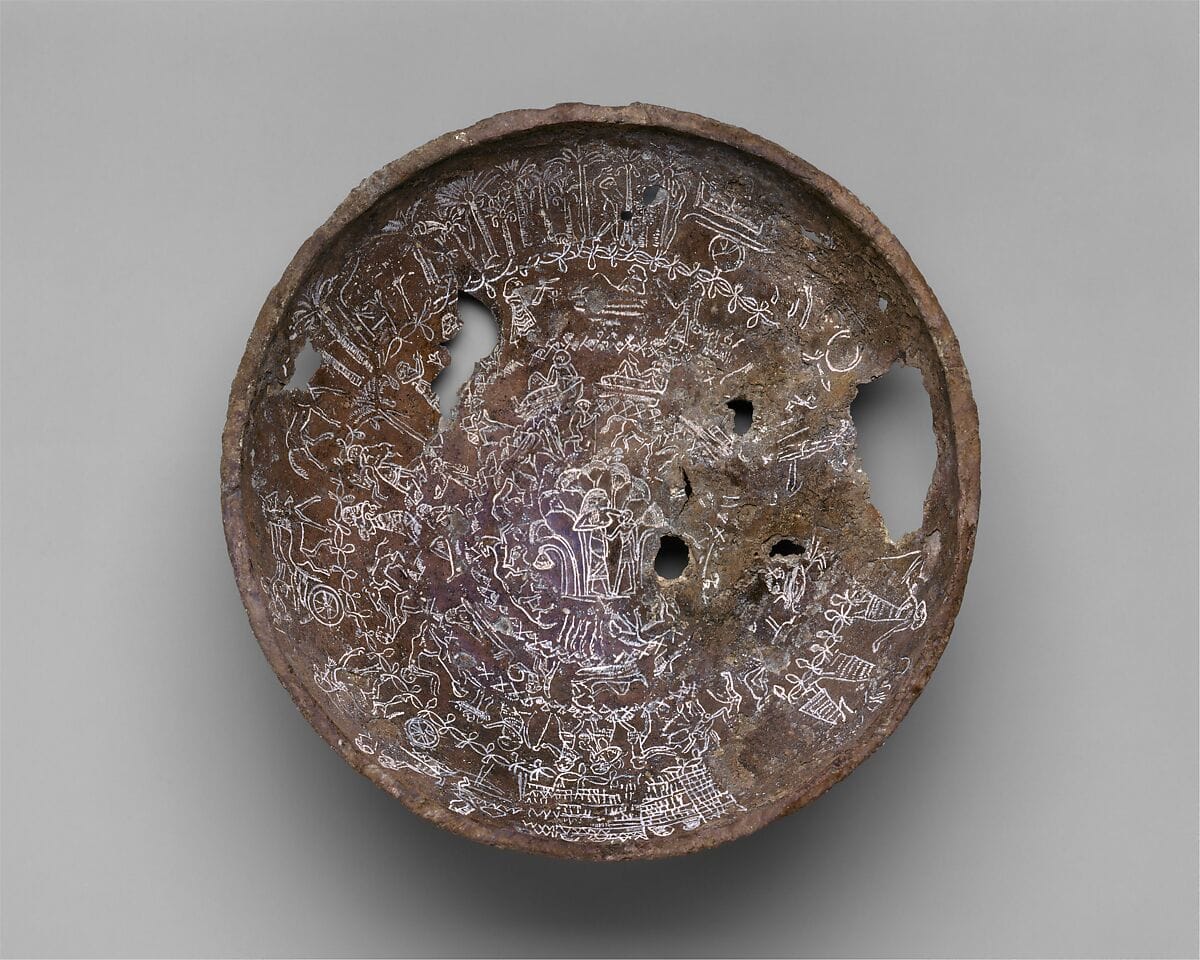 Silver bowlArchaic I · 675–625 BC
- Gold pendant in the form of a bull's headLate Bronze Age II · 1600–1050 BC
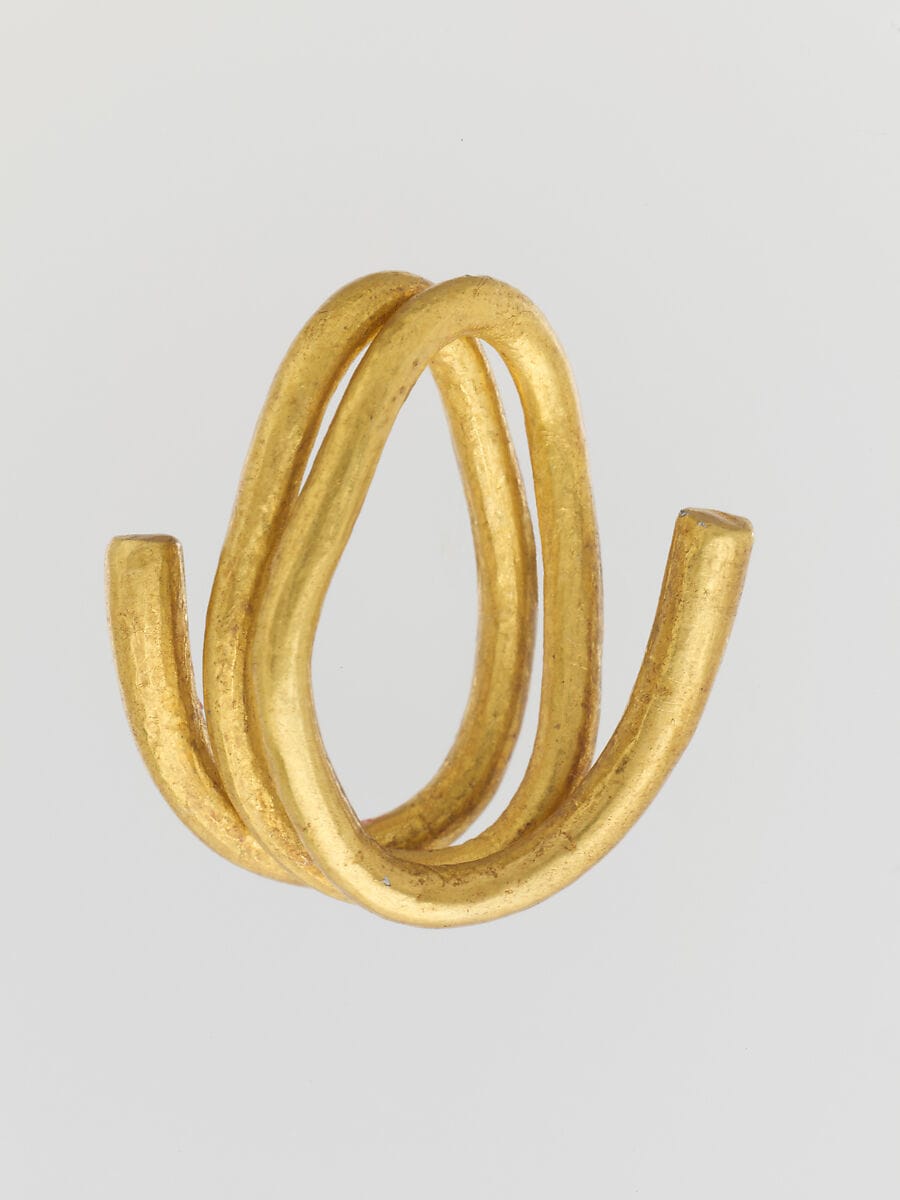 Gold spiralLate Bronze Age II · 1600–1100 BC
- Bronze and iron knifeLate Bronze Age III · 1150–1100 BC
References
- 1.Kassianidou, V. (2013). Metals. In E. Peltenburg (Ed.), ARCANE II: Cyprus (Associated Regional Chronologies for the Ancient Near East and the Eastern Mediterranean). Brepols.
- 2.Pare, C. (2025). Iron and the Iron Age: The introduction of iron in Europe and Western Asia. Archaeopress.
- 3.Keswani, P. S. (2005). Death, prestige, and copper in Bronze Age Cyprus. American Journal of Archaeology, 109(3), 341–401. https://www.jstor.org/stable/40026118
- 4.Pilides, D., & Papadimitriou, N. (Eds.). (2012). Ancient Cyprus: Cultures in dialogue. Department of Antiquities, Cyprus.
- 5.Graziadio, G. (2025). The Aegean and Cyprus: Interaction between two distinct cultural Mediterranean areas from the third millennium to ca 1200 BC (Studi ciprioti 4). Edizioni Ca' Foscari.
- 6.Cook, V. (2010). Cyprus during the transition from the Bronze to the Iron Age: The evidence of foreign contacts in Proto White Painted/White Painted I pottery contexts. Paris.