
Contents
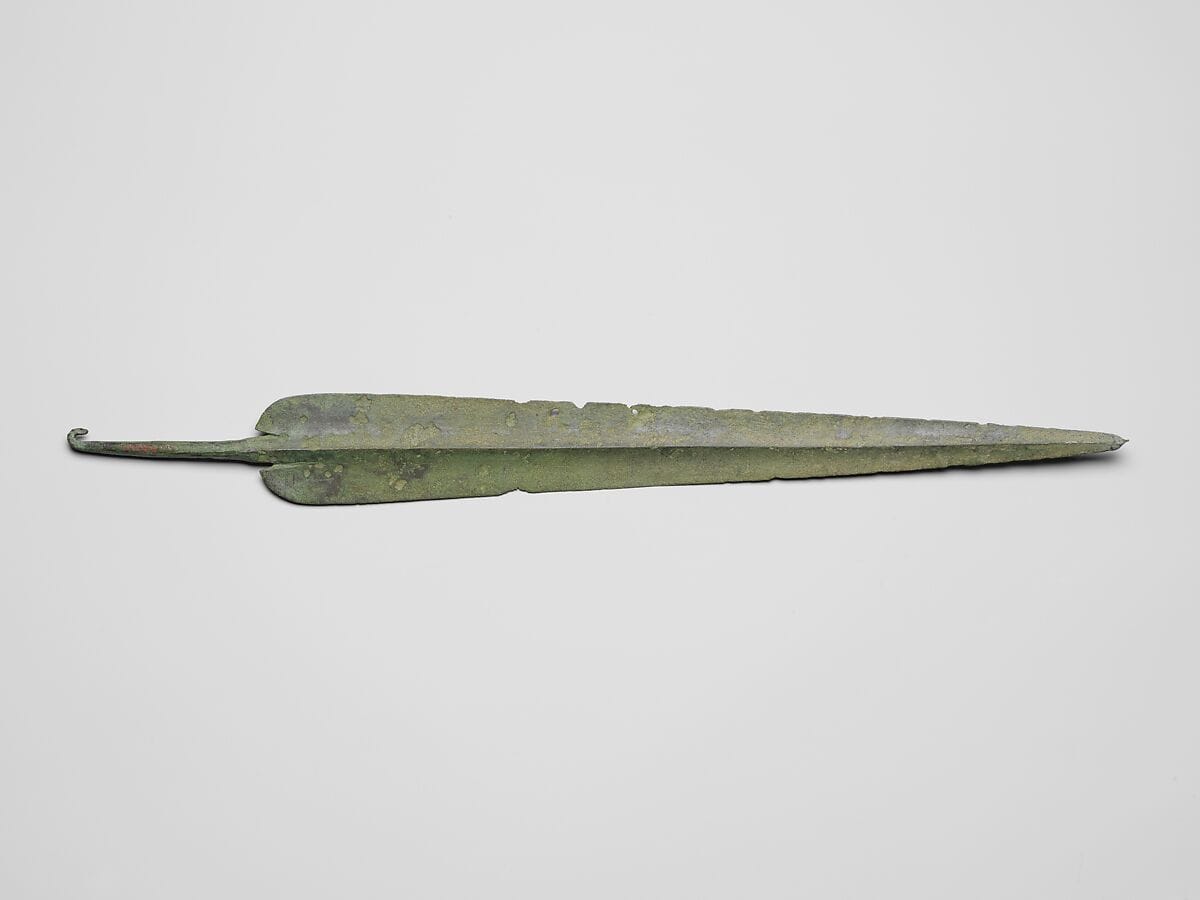
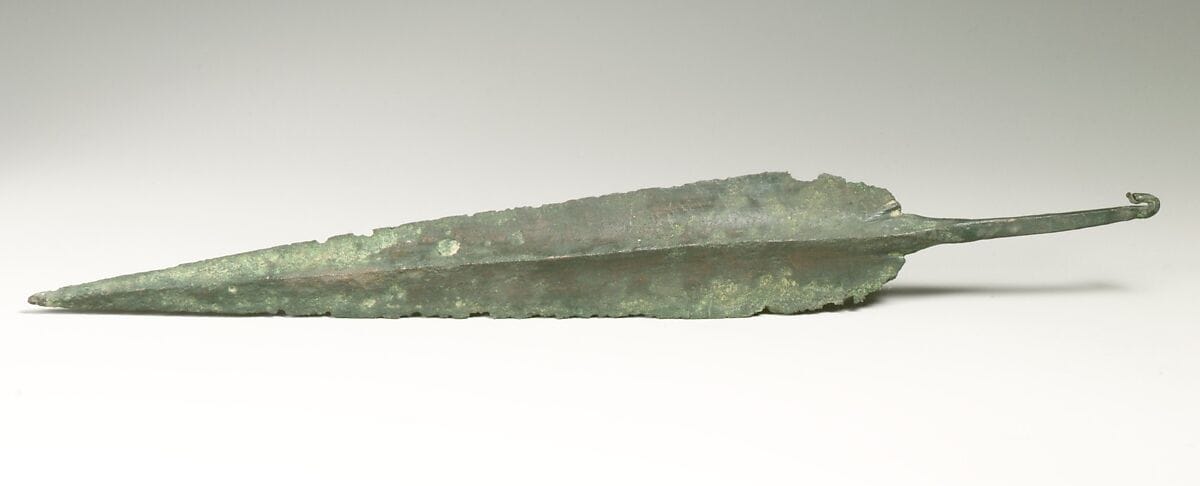
For most of the Bronze Age the characteristic Cypriot weapon was a leaf-shaped copper blade on a long tang whose end was bent over into a hook. It was made on the island for close to a thousand years with little change, buried in hundreds, and almost never sent abroad. The riveted daggers of the Early and Middle Bronze Age and the Aegean-style swords and greaves buried at Enkomi around 1200 BCE are best read against that conservative tradition. Nearly all the evidence comes from tombs, so what survives is what people chose to bury. This entry covers the Philia facies and the Early and Middle Bronze Age (about 2500/2400 to 1700/1650 BCE) and the Late Bronze Age to about 1125/1100 BCE, the bracket Jennifer Webb uses [1, pp. 371–372]. How the metal was mined and smelted is covered under copper metallurgy; the iron weapons that followed belong to the weapons and armour hub.
What the objects are called
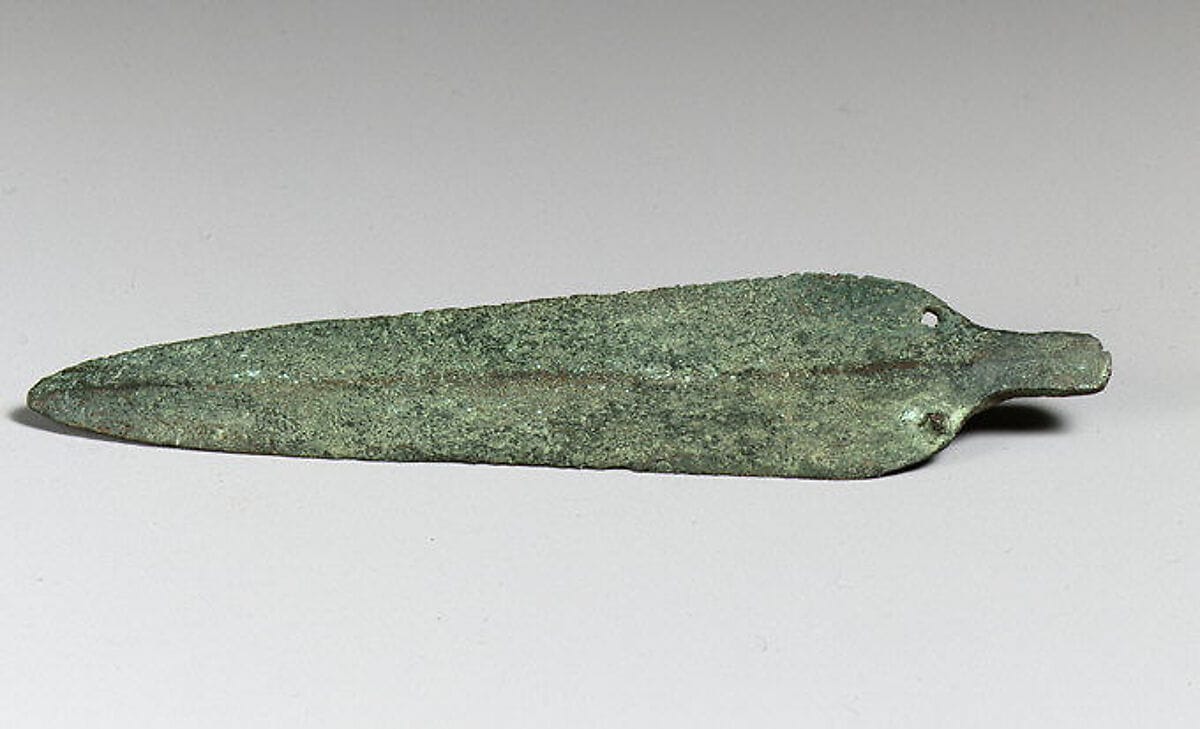
The older literature called the Cypriot hook-tang blade a dagger, dirk, sword or spearhead, depending on its length and on the author. Trevor Watkins proposed the neutral term "hook-tang weapon" in 1976 because "scholars argue whether they are daggers, swords, spears or dirks" [2, p. 121]. The Swedish Cyprus Expedition volumes of James R. Stewart (1962) and Paul Åström (1972), and Hector Catling's Cypriot Bronzework in the Mycenaean World (1964), classed hook-tang and riveted blades together as hand-held thrusting weapons [3].
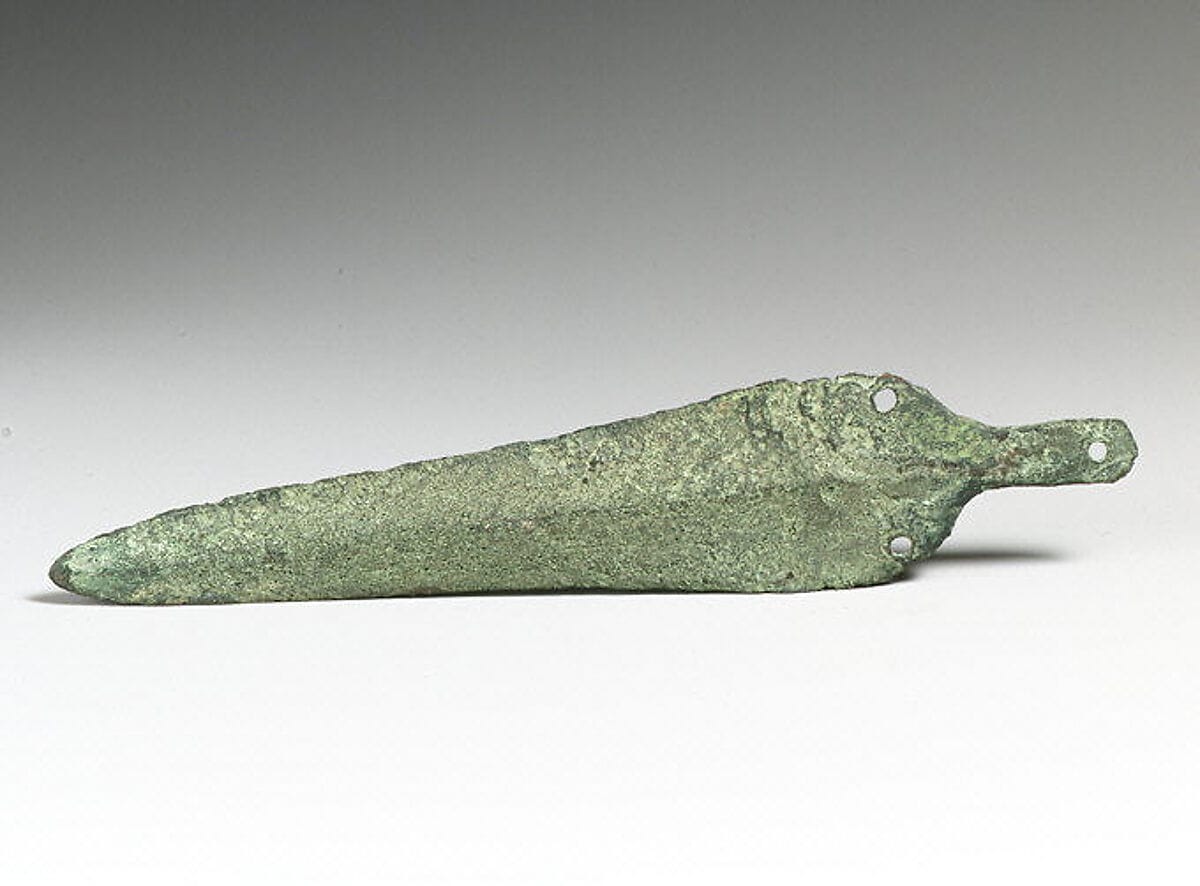
Judy Weinstein Balthazar separated them in a study presented to the Archaeological Institute of America and published as an abstract in 1987. Remains of hafting on the metal showed that the hook-tang weapons were mounted as spearheads, as Schaeffer had proposed in 1936, and that the riveted blades were the true daggers; the clay model daggers from Vounous, long thought to copy hook-tang "swords", reproduce the riveted form [3]. Webb's 2022 review holds the same position: spears were the only specialised metal weapons of the Early and Middle Bronze Age, long blades catalogued as "swords" were all shafted, and swords proper do not appear on the island until the Late Bronze Age. Two-edged blades with flat, usually riveted tangs are "more correctly identified as daggers", and single-edged knives also begin only in the Late Bronze Age [1, pp. 376–377].
Philia and the Early Bronze Age: the first blades
Metal weapons arrive with the Philia facies, dated by Webb and her co-authors to about 2400–2300 BCE [4, pp. 263–264]. Its repertoire includes flat-tanged knives with wide midribs and hook-tang weapons; the Ashmolean holds a copper tanged mid-ribbed dagger (AN1957.21), 21.3 cm long, given by the Sydney University excavation at Vasilia in 1955. The best-studied Philia group, however, came through the trade. In December 1959 the Nicosia dealer Petros Colocassides (the subject of the site's article on Kolokasides) offered 26 objects, 13 of them metal, which Stewart believed came from a looted tomb at Vasilia. Stewart acquired nine of the metal pieces, now at the University of New England, Armidale, and the Cyprus Museum four (CM 1959/IV-20/1–4) [4, pp. 261, 263–264]. One of the Cyprus Museum pieces is a willow-leaf blade with medial rib and a long hooked tang ending in a button, 36.5 cm long, published by Buchholz and Karageorghis [5, no. 1870].
The two spearheads in the group are of a tripartite "poker-butt" type, unique in Cypriot metalwork, with a ridged butt and a heavy hooked tang. Their parallels are in Cilicia and north Syria, their profiles imply two-piece moulds otherwise unattested in Cyprus at this date, and the Armidale example is a tin bronze of Anatolian copper, so Webb, Frankel, Stos and Gale (2006) identified them as imports, probably Cilician. A bent "rat-tang sword" of 54 cm in the same group is also tin bronze, with copper probably from Bolkardağ in the central Taurus, and likely arrived finished. Every other analysed Early Bronze Age hook-tang weapon, two of them Philia, is unalloyed or arsenical copper [4, pp. 264–265]. The first tin bronze weapons on the island were therefore imports, part of a network that on the 2006 reading linked the Aegean, coastal Anatolia and Cyprus [4, p. 283]. The pottery of these tombs is described under Red Polished Philia ware.
Through the Early Cypriot period the local type settled into a long-lived form: a willow-leaf blade with strong midrib and angular shoulders on a square tang with a bent button terminal, 30.2 cm in an example from Vasilia (Cyprus Museum 1937.III-31.2) and 45 cm in an unprovenanced one (1946.XI-30.4) [5, nos. 1872–1873]. Riveted daggers ran alongside. The Fitzwilliam Museum holds daggers from Stewart's Vounous excavations, one 18.5 cm long (GR.5r.1939), and a clay model of a dagger scabbard from the same cemetery (GR.5u.1939). From Vounous Tomb 45, excavated by Porphyrios Dikaios, come a Red Polished model dagger with a flat triangular haft and ribbed blade (22 cm) and its sheath (29 cm) [5, nos. 1706–1707].
Arsenical copper and tin bronze
Most analysed Early and Middle Cypriot spearheads are unalloyed or arsenical copper [1, p. 373]. The disagreement is over intention. Balthazar held that Middle Cypriot smiths learned to cast riveted daggers in tin bronze while keeping hook-tang spearheads in unalloyed or arsenical copper "in a more traditional manner", perhaps for cultural as much as technical reasons [3]. Noël Gale and Zofia Stos-Gale, publishing the metal from Alambra in 1996, read the data differently. Arsenic in the Alambra coppers varies continuously from about 0.2 to 1.9 per cent, as at Lapithos, which suggested to them that it came in with the ore rather than being added. In their early Middle Cypriot sample eleven hook-tang weapons were arsenical copper without tin and four contained a little tin, and they found "very little correlation between alloy composition and function or type of artefact" [6]. They also noted that no reliable analysis had found tin bronze (over 2 per cent tin) at any Philia or Early Cypriot site, and that it appears early in the Middle Cypriot period: three pieces at Alambra, three Middle Cypriot I pieces at Vounous (one a dagger said to be Minoan), and four at Lapithos. The island has no tin ore, so this marks a new dependence on imported metal [6]. The Vasilia imports push tin bronze back to Philia, but only as finished foreign objects [4, p. 265].
Late Bronze Age weapon metal is more uniform. Kopanias, Vemou and Sidiropoulou, reviewing 54 analyses of eastern Mediterranean swords, found about 85–90 per cent copper and 9–11 per cent tin with very low impurities [7]. The wider sequence is followed in the article on metal in ancient Cyprus.
Weapons in the grave: Vounous and Lapithos
On Webb's count, Bellapais-Vounous and Lapithos account for more than 80 per cent of the 300-plus spearheads from Early and Middle Bronze Age tombs; the only other site with more than a handful is Kalavasos, with 13. At Vounous most were deposited in late Early Cypriot III and Middle Cypriot I; at Lapithos they occur in high numbers through the Middle Bronze Age and make up about 40 per cent by weight of the metal in the tombs [1, pp. 372–373]. Webb's 2015 study puts metal at 25.6 per cent of combined Lapithos tomb assemblages in Middle Cypriot I–II and 36 per cent in II–III, with bladed weapons growing in number and size [8, p. 249]. The tombs themselves are described under Bronze Age chamber tombs and in the article on Vounous.
Where skeletal data are reliable, spearheads lay with adult males, alongside the upper torso with the point toward the skull, often with knives, razors and tweezers [1, p. 373]. The 210 measured Lapithos spearheads run from 9.3 to 66.2 cm, three quarters between 20 and 40 cm. More than half of the 21 examples over 50 cm, including the two longest, came from two of the largest and richest tomb complexes, and the three tombs with gold also held large spearheads; the 42 weighed examples total 9.971 kg of metal [1, pp. 373, 376]. The Metropolitan Museum's 48.9 cm hook-tang spearhead, a Cesnola Collection piece recorded only as "from Cyprus", falls in a length range that among excavated finds Webb reports only from Lapithos.
What these burials mean has been argued in several directions. Stewart suggested "frontier feuds" on the north coast and a rise of Lapithos that required men who "could defend themselves and, if need be, attack others". Manning and Edgar Peltenburg read the spears as symbols of an emerging hereditary elite; Priscilla Keswani saw prestige competition and a widely shared status insignia; Andrew Sneddon (2014) argued that the weapons "were never intended for use against other humans" [1, pp. 371–372]. Philip, as cited by Bernard Knapp, argued by Levantine analogy that the larger hook-tang weapons were almost certainly status symbols, not least because their shape and manufacture changed so little [9]. The preface to the 1996 Alambra report proposed that Early and Middle Cypriot society "came close to being an ideal society", with no evidence of warfare, and its hook-tang weapons probably spear points "as likely used in hunting as in war" [6].
Webb's 2022 paper challenges the display reading. She compares the Lapithos lengths and weights with spearheads from Bulgaria, Ireland and a La Tène battle deposit in Denmark, and reports preliminary macroscopic signs of use: tips narrowed by reworking, a blow-mark across a midrib, compressed and broken points, and edge notches and fissures she attributes to blade-on-blade contact. She concludes that they were thrusting and slashing weapons on short shafts, used at close quarters [1, pp. 373, 376]. Strongly bent blades were probably decommissioned for burial, but slight bends near the point may come from use [1, p. 376]. Riveted daggers at Lapithos run from 4.5 to 31.8 cm; those over 20 cm were likely made as weapons [1, p. 377].
Her figures also cut against a "warrior elite". No juveniles were buried with weapons, which suggests the status was achieved. At Lapithos 41 per cent of Early Cypriot III to Middle Cypriot I tombs held a spearhead, rising to 69.8 per cent in Middle Cypriot I–III, while the ratio of spearheads to adult burials fell from 1:4 to 1:1.24. The term "warrior elite" is, she concludes, "invalid in the Cypriot context": many if not most adult men at Lapithos were weapon-bearers, "fighters and showmen" at once [1, pp. 377–379]. Lindy Crewe, summarising Keswani, notes that the Middle Cypriot tombs with the most swords, daggers and axes were also the richest, and reads this as metal and weaponry becoming expressions of status "rather than a simple equation with a warlike climate" [10, p. 65].
Almost never exported
Cyprus produced copper for export but very few finished weapons left the island. Watkins noted in 1981 that the only pre-Late Bronze Age Cypriot tool or weapon found abroad in a controlled excavation was one hook-tang weapon from Ras Shamra (Ugarit), published by Schaeffer in 1938. Mainland smiths were already casting more sophisticated daggers and spearheads, while Cyprus "continued until LB II making archaic types of weapon by archaic techniques" [2, p. 122]. Hook-tang weapons were made in the southern Levant too, but with the hook turned at right angles to the blade, which separates them from the Cypriot series [2, p. 121]. The setting of these contacts is treated under Ugarit and the Levant.
Watkins wrote to test a set of apparent exceptions. Of 22 Cypriot hook-tang weapons with supposed Levantine findspots, 21 were in the collection of the Rev. William Greenwell, which reached the British Museum in 1908; twelve were labelled as from Gezer, and Macalister, who had dug there, told the museum they were "not from his diggings" and that "dealers assign objects to any well-known excavation". Watkins concluded the labels were spurious, and noted that none of the many Cypriot hook-tang weapons in European museums can be shown to have arrived before the late nineteenth century AD [2, p. 122]. The British Museum's Cypriot dagger with a bent tang, recorded as found or acquired at Brentwood in Essex, belongs to that category, and the Cesnola weapons in the Metropolitan Museum, such as a 26.5 cm hook-tang spearhead, are recorded only as "from Cyprus".
Forts and the question of conflict
The weapon-rich tombs coincide with other signs of stress. Webb lists the abandonment of the Karmi cemeteries and of the settlements at Marki, Alambra, Pyrgos and Ambelikou by the end of Middle Cypriot II, burnt final deposits at several, and 22 unfinished tombs at Deneia in Middle Cypriot III. Three of the four forts at the Agirda Pass, 12 km east of Lapithos and the only route through the central Kyrenia Range, have Middle Cypriot surface material and may have been guard posts; she links the Lapithos weapons to defending a copper route running 35–40 km south to the Troodos foothills [1, pp. 378–379].
Most forts belong to the Middle Cypriot III to Late Cypriot I transition. Michel Fortin counted 21 fortified settlements, but Martin Bartelheim, Bülent Kizilduman and Uwe Müller stress that none has been securely dated, fully planned or extensively excavated [11]. Crewe lists the explanations: drought and population pressure (Catling 1962), attack from Syria-Palestine or Egypt tied to the expulsion of the Hyksos (Sjöqvist 1940), east-west competition for trade (Merrillees 1971), and local elites (Philip 1991). Fortin saw local wariness of mainland visitors seeking copper; Peltenburg (1996) saw instruments by which Enkomi, perhaps with Toumba tou Skourou, controlled copper routes [10, p. 65]. Crewe preferred "a series of regional responses to both internal and external pressures", with the forts abandoned as Enkomi became a regional centre by Late Cypriot IIA [10, pp. 66, 159], and she judged the supposed mass burials of Late Cypriot I too poorly preserved to show war or disease [10, p. 65].
Korovia-Nitovikla in the Karpas shows how unstable the dating is. Erik Sjöqvist excavated it in 1929 and placed its phases in Middle Cypriot III and Late Cypriot I; Åström lowered them; Hult put its construction in Late Cypriot IB; Merrillees argued it was built in IA, destroyed in IB and abandoned in IIA; Crewe favours construction in IA2. The fort measures about 40 by 36 m, and its tower-flanked gateway has the earliest known ashlar masonry on the island, similar to Syrian Middle Bronze Age work [10, p. 53]. Bartelheim and colleagues reject the old reading as a refuge, since the plateau is only about 30 m high and flanked by landing places, and treat it as a fortified settlement with maritime connections. On the Ayios Sozomenos plateau, forts at Barsak, Nikolidhes and Kafkallia with few finds stand above open settlements in the Gialias valley, which they probably protected; Fortin removed the so-called fortresses at Glyka Vrysis and Enkomi from the defensive group altogether [11].
However the forts are read, the phase ended quietly. George Papasavvas notes that weapons "disappear almost completely before the beginning of the Late Cypriot period" and that the forts were all abandoned at the same time [12, p. 155].
| Type | Period | Form and hafting | Metal | Key examples |
|---|---|---|---|---|
| Hook-tang spearhead | Philia to Middle Cypriot | Leaf blade with midrib; square tang bent into a hook over the shaft | Unalloyed or arsenical copper; a few with some tin | Lapithos, 210 measured, 9.3–66.2 cm; Vasilia, 36.5 cm |
| Poker-butt spearhead | Philia | Leaf blade, ridged butt, hooked tang; two-piece mould | Tin bronze, Anatolian copper | Vasilia group; probably Cilician imports |
| Rat-tang sword | Philia | Long blade on hooked tang | Tin bronze, Taurus copper | Vasilia group, 54 cm; probably imported |
| Riveted dagger | Philia to Late Cypriot | Two-edged blade; flat tang or butt with rivets | Arsenical copper; tin bronze from Middle Cypriot | Lapithos, 4.5–31.8 cm; Vounous Tomb 45 clay model |
| Byblite and Syrian daggers | Middle Cypriot to Late Cypriot I | Converging grooves or cast hilt tongue; rivets | Bronze | Lapithos Tomb 18B; Katydhata, 27 and 30.5 cm |
| Slit-socket spearhead | From Late Cypriot I | Willow-leaf blade on cast slit socket | Bronze | Socket introduced from the Aegean |
| Bayonet-shaped spearhead | From Late Cypriot IIC/IIIA | Very narrow blade, midrib to tip, tubular socket | Bronze, later iron | Kition Tomb 9 |
| Naue II sword | Late Cypriot IIIA | Cut-and-thrust blade cast with flanged hilt | Tin bronze | Enkomi Well 212 and Swedish Tomb 18 |
| Greave | Late Cypriot II to III | Sheet bronze laced to an organic backing | Bronze | Enkomi Swedish Tomb 18 and British Tomb 15 |
The Late Bronze Age: new types and a long gap
The Late Bronze Age begins with changes in form. The cast slit socket was introduced from the Aegean in Late Cypriot I and replaced the hooked tang; local spearheads with conical slit sockets and narrow blades followed from Late Cypriot IA [13, p. 185]. Buchholz and Karageorghis catalogue Late Cypriot slit-socket lance-heads with willow-leaf blades and marked midribs, one of 25.7 cm from Lythrangomi [5, nos. 1885–1891]. Daggers of Syrian type appear beside the older riveted forms: two from one Late Cypriot I tomb at Katydhata have a cast hilt tongue with a rim for a riveted guard (27 cm) and twelve rivets (30.5 cm). A "Byblite" or Middle Minoan blade with converging grooves from Lapithos Tomb 18 is an earlier import of the same eastern family [5, nos. 1874–1877].
After that, weapons are scarce for most of the period, and the Late Cypriot centuries have no images of warriors. Papasavvas links this to the new centralised political and economic structures, which may have damped local conflict; the raids on Alashiya recorded in the fourteenth-century Amarna letters seem to have had little effect [12, pp. 155–156]. Weapons resurface toward the end of Late Cypriot IIC, in the turbulent last years of the thirteenth century, and the scenes on ivories and bronzes of the time show hunting and fights with griffins and lions rather than men fighting men [12, p. 156].
Two developments mark that horizon. The bayonet-shaped spearhead, a very narrow blade with its midrib running to the tip and a tubular socket, first appears in three securely dated examples from the uppermost burial layer of Kition Tomb 9 (Late Cypriot IIC/IIIA). Christian Vonhoff argues that the lack of Aegean or Levantine parallels points to a native Cypriot development; the type reaches the Near East from the twelfth century and runs on in Iron Age tombs at Kition, Enkomi and elsewhere [13, pp. 184–185].
The second is the Naue II sword, with blade and flanged hilt cast in one piece. Two variants occur in Cyprus: Naue II type A (Catling's group I), which reached Mycenaean Greece from the Urnfield world during Late Helladic IIIB and "was transferred to Cyprus shortly afterwards", and an eastern Mediterranean variant of type C (Catling's group IV). The earliest securely dated type A swords are four from Well 212 at Enkomi, of Late Cypriot IIIA, and one from the uppermost burial level of Swedish Tomb 18 [13, p. 183]. Buchholz and Karageorghis add an Enkomi sword with eight rivets and a fishtail pommel, 47 cm long (Famagusta District Museum) [5, no. 1883]. The British Museum's Naue II sword from Enkomi, 42.7 cm and dated Late Cypriot III, is catalogued by the museum as made in Cyprus.
Kopanias, Vemou and Sidiropoulou tested whether such swords were usable by modelling five Cypriot bronze examples (Enkomi Tomb 18 at 75 cm, the two Well 212 swords at 60.9 and 59.2 cm, a Loizou Collection sword at 55 cm, and Enkomi Tomb 47 at 42.5 cm) under simulated blows. All could thrust and cut, though all withstood far more force in the thrust; the high-midribbed Tomb 18 and Well 212a swords were weaker cutters [7]. Who carried them is more disputed. Naue II swords have been taken as evidence of Aegeans, "northerners" or Sea Peoples in Cyprus and the Levant, as mercenaries or metalsmiths, one of several contested identifications reviewed by Assaf Yasur-Landau [14]. The debate is followed under the Mycenaeans and the Philistines.
Armour: the Enkomi greaves and a helmet
The surviving Bronze Age armour from Cyprus comes from Enkomi. The earliest piece is the lower part of a bronze greave from Swedish Tomb 18, 22.5 cm high as preserved [5, no. 1881], which Diane Fortenberry dates to Late Helladic IIIB:2; its edges are thickened into a lip wrapped with bronze coils for lacing wire [15, p. 625]. From British Museum Tomb 15 come two more, dated by Catling to the start of Late Helladic IIIC, with double relief ridges along the edge; the better preserved has a repoussé dot-in-circle pattern [15, pp. 625–626]. The British Museum records them as 1897,0401.1531 (26.8 cm) and 1897,0401.1532 (17.6 cm), each "one of a pair" with the other and each probably for the left leg.
Three things about them are disputed. According to Fortenberry, Catling showed "conclusively" that they were made in the Aegean: Tomb 18 also held a Naue II sword, Near Eastern peoples and Cypriots did not use greaves at this time, and an influx of mainlanders is visible early in the twelfth century, so the greaves were "in all likelihood brought to Cyprus by a mainlander" [15, p. 626]. Robert Drews, two years later, judged all the twelfth-century Greek and Cypriot greaves "evidently locally made", perhaps improvised by local smiths [16, p. 177]. Catling assumed the Enkomi pieces had lost their partners; Fortenberry found no evidence for matching greaves and argued that a single greave on the right leg may have marked rank [15, pp. 626–627], a reading the museum's "pair" for the left leg does not easily fit. And their protective value was low: the Enkomi greaves are about two millimetres thick, and Drews cites experiments in which a slashing sword cut through three [16, p. 177]. Head protection survives as part of a conical bronze helmet from Enkomi Tomb 10, of Late Cypriot IIb date, 42.5 cm high, with a tube at the tip for a plume [5, no. 1882].
What remains open
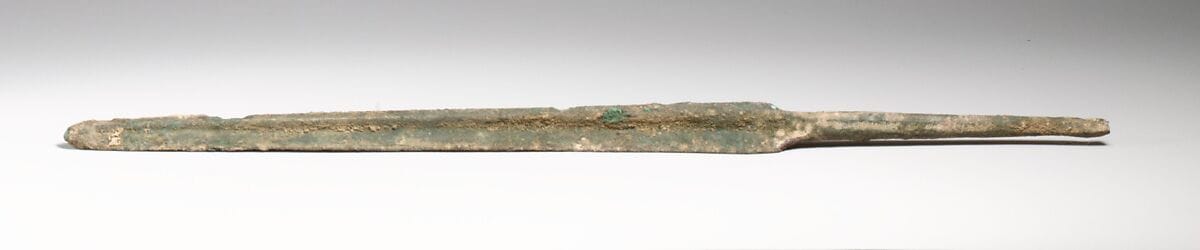
Webb's use-wear observations on the Lapithos spearheads are macroscopic and, in her words, preliminary [1, p. 373], and the settlement their owners lived in has never been located [1, p. 377]. The forts remain mostly unexcavated and poorly dated [11], and none of the sources used here reports a Bronze Age skeleton with a weapon injury. Around 1200 BCE the record turns suddenly rich at Enkomi, and whether the men buried with Aegean-type swords and greaves were incomers, mercenaries or Cypriots who adopted a foreign way of fighting has not been settled by the metal [14; 15; 16]. Many surviving blades have no context at all: the Cesnola Collection's 15.9 cm Middle Cypriot dagger blade with three rivet holes, a 35.6 cm Early Bronze Age dagger blade and a 10.6 cm blade that still holds one rivet can be classified by type, but not placed in a tomb.
Objects on this page
References
- 1.Webb, J. M. (2022). Weapon-bearers at Middle Bronze Age Lapithos, Cyprus. In G. Vavouranakis & I. Voskos (Eds.), Metioessa: Studies in honor of Eleni Mantzourani (AURA Supplement 10, pp. 371 ff.). Athens.
- 2.Watkins, T. (1981). Levantine bronzes from the collection of the Rev. William Greenwell, now in the British Museum. Levant, 13(1), 119 ff. https://doi.org/10.1179/lev.1981.13.1.119
- 3.Balthazar, J. W. (1987). Cypriot hook-tang spearheads and riveted daggers: Manufacture and use [Abstract of paper, 88th General Meeting of the Archaeological Institute of America]. American Journal of Archaeology, 91(2), 267–328. http://www.jstor.org/stable/505221
- 4.Webb, J. M., Frankel, D., Stos, Z. A., & Gale, N. (2006). Early Bronze Age metal trade in the eastern Mediterranean: New compositional and lead isotope evidence from Cyprus. Oxford Journal of Archaeology, 25(3), 261–288. https://doi.org/10.1111/j.1468-0092.2006.00261.x
- 5.Buchholz, H.-G., & Karageorghis, V. (1973). Prehistoric Greece and Cyprus: An archaeological handbook (F. Garvie, Trans.). Phaidon.
- 6.Coleman, J. E., Barlow, J. A., Mogelonsky, M. K., & Schaar, K. W. (1996). Alambra: A Middle Bronze Age settlement in Cyprus. Archaeological investigations by Cornell University 1974–1985 (with contributions by N. H. Gale, Z. A. Stos-Gale and others). Studies in Mediterranean Archaeology. Paul Åströms Förlag.
- 7.Kopanias, K., Vemou, E., & Sidiropoulou, K. (2022). 3D model analysis of some Late Bronze Age and Early Iron Age swords from Cyprus. In G. Bourogiannis (Ed.), Beyond Cyprus: Investigating Cypriot connectivity in the Mediterranean from the Late Bronze Age to the end of the Classical period (AURA Supplement 9). Athens.
- 8.Webb, J. M. (2015). The production and distribution of plank-shaped figurines in Middle Bronze Age Cyprus: The role of Lapithos. Cahiers du Centre d'Études Chypriotes, 45, 241–254. https://www.persee.fr/doc/cchyp_0761-8271_2015_num_45_1_1638
- 9.Knapp, A. B. (2008). Prehistoric and protohistoric Cyprus: Identity, insularity, and connectivity. Oxford University Press.
- 10.Crewe, L. (2007). Early Enkomi: Regionalism, trade and society at the beginning of the Late Bronze Age on Cyprus (BAR International Series 1706). Archaeopress.
- 11.Bartelheim, M., Kizilduman, B., & Müller, U. (2019). Bronze Age fortifications on Cyprus. In S. Hansen & R. Krause (Eds.), Bronze Age fortresses in Europe (Universitätsforschungen zur prähistorischen Archäologie 335). Habelt.
- 12.Papasavvas, G. (2014). Warfare and the Cypriot kingdoms: Military ideology and the Cypriot monarch. Cahiers du Centre d'Études Chypriotes, 44, 153–190. https://doi.org/10.3406/cchyp.2014.1546
- 13.Vonhoff, C. (2019). Iron weapons from the Archaic royal tombs at Salamis. In Salamis of Cyprus: History and archaeology from the earliest times to late antiquity. Conference in Nicosia, 21–23 May 2015 (pp. 177–194). Waxmann.
- 14.Yasur-Landau, A. (2010). The Philistines and Aegean migration at the end of the Late Bronze Age. Cambridge University Press.
- 15.Fortenberry, D. (1991). Single greaves in the Late Helladic period. American Journal of Archaeology, 95(4), 623–627. http://www.jstor.org/stable/505895
- 16.Drews, R. (1993). The end of the Bronze Age: Changes in warfare and the catastrophe ca. 1200 B.C. Princeton University Press.