
Contents
The Middle Bronze Age of Cyprus, the Middle Cypriot period, ran from about 2000/1900 to 1650 BCE, and for most of the twentieth century it was known almost entirely from its tombs. The houses came later. Falconer and Fall note that the culture history of the Early and Middle Cypriot periods "derives largely from mortuary assemblages", many of them dug in the early twentieth century, while the domestic evidence comes from "relatively few communities excavated more recently" [1, p. 102]. This entry uses those few villages, above all Marki-Alonia, Alambra-Mouttes, Politiko-Troullia and Erimi-Laonin tou Porakou, to describe how Middle Cypriot people built their houses, fed themselves, worked copper and wool, and organised their communities, and then sets that picture beside the very different one drawn from the cemeteries. The preceding period is covered in village life in Early Bronze Age Cyprus; food is treated in detail under food and diet.
Evidence and dates
The chronological schemes do not quite agree. Falconer and Fall use Early Cypriot III for 2000–1900 BCE, Middle Cypriot I for 1900–1800, MC II for 1800–1700 and MC III for 1700–1600, and they group MC III with Late Cypriot I as the opening of a transitional "Protohistoric Bronze Age" [1, p. 102]. The excavators of Erimi place MC I–III at "c. 2000/1950–1650 BC" [2, p. 27]. The difference of up to a century at the start of the period matters for sites that sit on the boundary, and Marki is one of them.
Marki-Alonia in central Cyprus was occupied from about 2400 to 1900 BCE, so its last phases fall in Early Cypriot III and Middle Cypriot I and it was abandoned early in the period this entry covers [3, p. 123]. It is used here because it is the most fully published Bronze Age village on the island and shows the household pattern that the Middle Cypriot sites continued; it is not a village that spans the whole Middle Bronze Age. Sotira-Kaminoudhia, the other well-published stratified village, is Early Bronze Age and appears below only as a baseline. Alambra, Politiko-Troullia, Erimi, Kalopsidha and Episkopi-Phaneromeni are the Middle Cypriot settlements proper.
Villages and houses
Frankel and Webb modelled Marki's population from the house plans and the pottery. On their reconstruction the village was founded around 2400 BCE by 40 to 50 settlers and grew to a maximum of some 400 people in EC III/MC I, "a few generations before the site was finally abandoned". Households of seven to ten people rose from about half a dozen at the start to three or four dozen at the peak [3, p. 123]. Why Marki was given up is unclear. Frankel and Webb suggest that centuries of farming and clearance may have reduced the land's carrying capacity, and that "a more specific cause may have been a prolonged period of drought in an area of marginal rainfall" [3, p. 123]; this is their hypothesis, not a demonstrated cause.
The village plan, as summarised by Fagan and Durrani from Frankel and Webb's final report, grew without any overall design. The site has nine phases, each a palimpsest of perhaps three generations. Each household lived in a rectangular courtyard with covered rooms at the back, and new compounds were added "haphazardly and cumulatively" until a hamlet of freestanding buildings had become "a tightly packed built-up area". Houses were inherited, and the trend over time was toward greater privacy. Nothing in the houses or their contents hinted at differences in wealth between households, although two compounds kept their boundaries for three or four centuries "and may have exercised considerable authority as a result" [4, p. 288].
Alambra-Mouttes, south of Nicosia, was excavated by Cornell University between 1974 and 1985. Its rooms were multi-purpose, and mud-plastered benches and platforms may have been used for sleeping. The excavators saw two plan types, long narrow houses entered from one end and broader houses with rooms opening off a central corridor, but preferred "to leave the question of architectural types open" [5, p. 328]. The houses stood along what was probably a common street and shared party walls, and the several building stages in those walls show that neighbours cooperated in periodic renovation and rebuilding [5, p. 328]. Karageorghis records one Alambra room with very thick walls measuring 7.5 by 6 m [6]. In Building IV Room 8 the finds suggest that groups larger than a family "congregated and ... drank a liquid, probably wine" [5, p. 328].
Politiko-Troullia, in the Troodos foothills, was divided into compounds. The western compound had an alley choked with refuse and a southern courtyard, the settlement's "largest architecturally defined space"; the eastern compound had an open-air workspace [1, pp. 110–112]. At Erimi-Laonin tou Porakou, on a plateau east of the Kouris river on the south coast, occupation runs through MC I–III. A workshop complex stood on the hilltop, household complexes on a lower terrace, and burial clusters on terraces to the south and at Ypsonas-Vounaros to the east. A wall foundation 1.6 to 1.7 m wide, found in 2016, is read by the excavators as a possible circuit wall dividing settlement from cemetery, and they describe the site as "proto-urban" [2, p. 27]. Both the wall's function and the label are the excavators' interpretation.
Two older excavations fill out the range. At Kalopsidha in the east, Gjerstad cleared an MC III house of ten rooms, eight of them rectangular, set around three sides of an open courtyard in an area of about 15 by 12 m, under a flat roof. At Episkopi-Phaneromeni near the mouth of the Kouris, occupied from the Middle Cypriot into Late Cypriot IA, multi-roomed buildings stood on either side of a street, with rubble foundations carrying "flat-roofed mudbrick and pisé superstructures", perhaps a second storey, lime-plastered bins, pounders and querns; Karageorghis called it "a well-organized, self-sufficient agrarian community" [6]. The architecture hub places these houses in the longer sequence.
Frankel and Webb's comparison of household floor areas shows how little the basic unit changed from the Early into the Middle Bronze Age [3, p. 123]:
| Site | Period | Floor area per household |
|---|---|---|
| Sotira-Kaminoudhia | Early Cypriot (baseline) | 60–80 m² |
| Marki-Alonia | Philia to EC III/MC I | 70–100 m² |
| Alambra-Mouttes | Middle Cypriot | 70–100 m² |
| Kalopsidha | Middle Cypriot | 50–100 m² |
Fields, flocks and the kitchen
The household economy was mixed farming, and the food and diet entry treats it in full. At Alambra the excavators describe an economy "based largely on agriculture, herding of sheep, goats and cattle and utilization of fallow deer"; olive and grape leaves left impressions on pots, grinding tools are abundant, and cattle gave milk and meat and could have pulled the plough. Alambra is far enough from the sea that fish and shellfish are absent [5, pp. 329–330]. Politiko-Troullia adds orchard crops, olive and grape, and the same herd of sheep, goat, pig and cattle alongside hunted Mesopotamian fallow deer [1, p. 101]. Karageorghis's older account speaks of red deer at Kalopsidha and Episkopi [6]; the faunal work at Alambra and Politiko identifies the hunted animal as fallow deer. In the Politiko seed sample cereals are "very infrequent and pulses are absent", which the excavators take to raise the possibility that meat supplied much of the protein [1, p. 111]. Sixteen shallow ground-stone troughs, together with olive remains and local terracing, point to "household-scale olive oil production" [1, p. 112]. The high density of charcoal shows that wood remained the fuel and that woodland persisted around the village, unlike contemporary Levantine sites that burned dung [1, p. 111].
The pottery was local and plentiful. Over 90% of the pottery at Marki is Red Polished ware, with a separate cooking-pot fabric, and eight seasons there produced 309,501 Bronze Age ceramic items [3, p. 123]. At Alambra the pots were made "primarily from local clay" and no kilns were found; two features were popular there, "low cutaway spouts on juglets and high-swung horizontal handles on small bowls" [5, p. 330]. Both appear on Middle Cypriot White Painted vessels in the Drakopoulos collection.
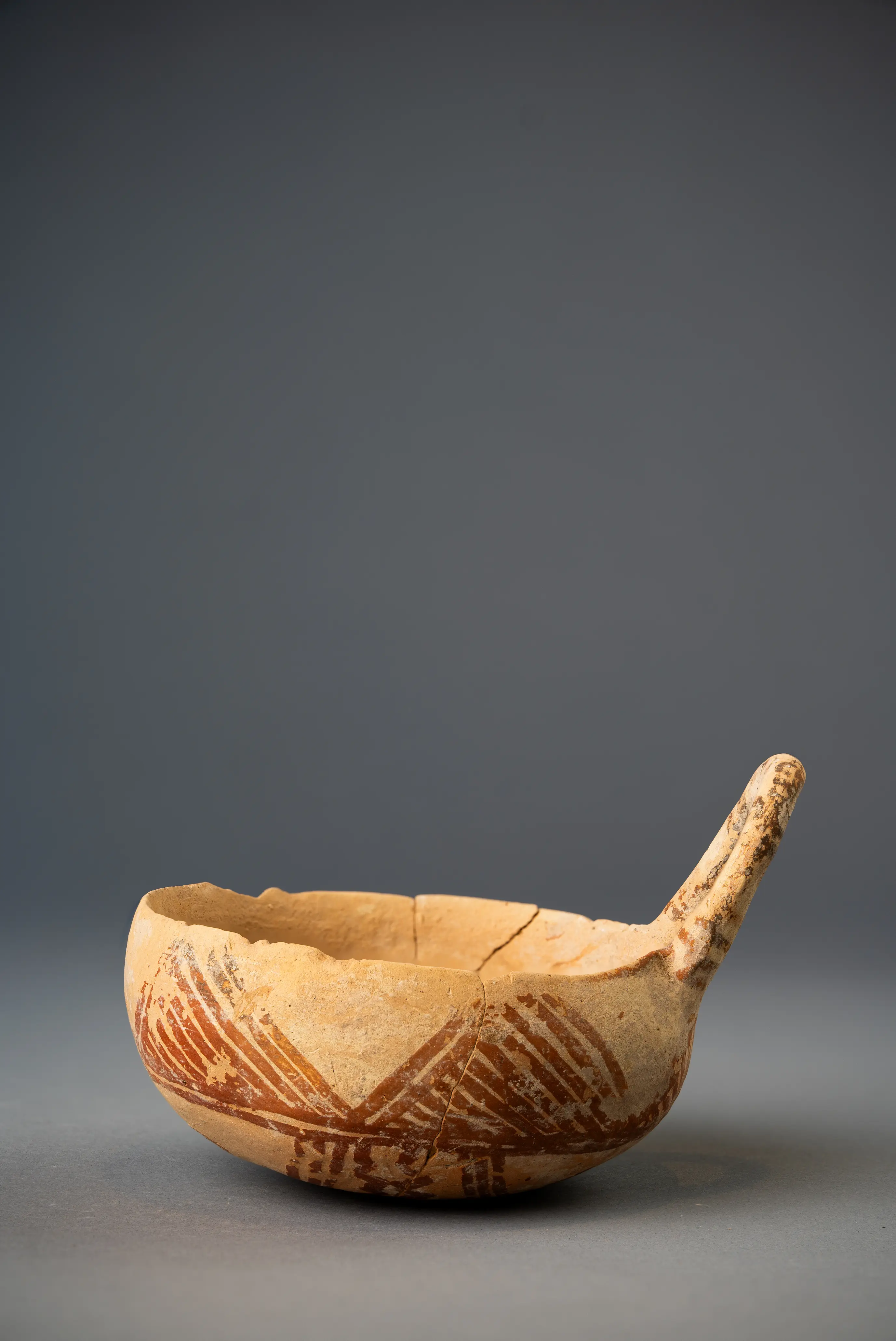
The juglet shown at the head of this entry, a White Painted jug, is a small round-bodied vessel with a long neck and a cut-away beak spout, painted in dark matt bands and hatched triangles on a pale ground. The White Painted bowl illustrated here is a hemispherical bowl with a single raised handle and a band of red-brown hatched triangles. Neither has a known find-spot, and neither is claimed for Alambra; they show the shapes Coleman and his colleagues describe as characteristic of the village's pottery. The Ashmolean's White Painted jug AN1968.1171, from Makounta in the Paphos district and dated MC III to LC I, is a later relative with a documented provenance.
Some villages specialised. Monahan and Spigelman read Ambelikou-Aletri, on the northern slopes of the Troodos, as "a community built around multi-crafting, with both copper extraction and ceramic production", and place Pyrgos-Mavroraki in the same category [7].
Copper and cloth at village scale
Copper was worked in ordinary villages, on a small scale. At Alambra it was smelted from "high-yield oxidized ores like azurite and malachite" in crucibles rather than furnaces, probably in the open air, with ore brought from the pillow lavas a few miles away; a ring of Laurion lead is the one exotic metal find. The excavators saw "no reason to think that copper working was practiced on a large scale": crucible fragments run at about one to every 10,000 sherds, and copper was produced "primarily to supply the immediate needs of Alambra itself rather than for export" [5, p. 330].
Politiko-Troullia gives the clearest picture of a household workshop. Tongs, crucibles, a mould and slag are concentrated in the eastern compound's open workspace, where the charcoal (identified as Pinus cf. brutia) is densest. A limestone mould combines an axe head, a dagger and a chisel, all utilitarian tools. The slag retains a great deal of unextracted copper, a sign of "relatively simple pyrotechnology", and tuyère fragments, abundant at the Late Cypriot smelting sites of Apliki and Enkomi, are absent, which the excavators take as further evidence of household or small-workshop production. The fine cut marks on the animal bones are those of metal knives [1, p. 112]. A few kilometres to the west, Politiko-Phorades shows intensive smelting but little casting in MC III/LC I [1, p. 112]. The copper metallurgy entry follows the industry into the Late Bronze Age.
Cloth was the other household craft. Spindle whorls and the warp-weighted loom both first appear on Cyprus in the Bronze Age [1, p. 110]. At Politiko-Troullia incised whorls cluster in the southern courtyard together with plank figurines and deer bones, which suggests spinning as a shared activity in the largest open space [1, p. 110]. At Erimi four whorls from a domestic trench show spinning in the houses, while the hilltop workshop was used for something larger [2, p. 27]. In workshop unit SA I, a hearth and a multiple basin of the earlier phase held more than a hundred nutlets of plants of the borage family (Echium, Lithospermum/Buglossoides), some of which yield a red or purple dye from their roots. In the later phase the room was subdivided and fitted with eight large pithoi and a double-chambered hearth, which the excavators read as dyeing "on a larger scale in the later phase of the Middle Cypriot" [2, pp. 27–28]. They also state that there is no evidence for the use of these plants as dyes anywhere in the prehistoric Mediterranean [2, p. 28], so the dye-works reading is a hypothesis.
A polished and incised spindle whorl in the Drakopoulos collection, dark, biconical and decorated with incised herringbone, belongs to this Early or Middle Cypriot tradition. The Ashmolean's incised Black Polished whorl AN1989.500, 4.2 cm high and dated Middle Cypriot, is a close comparison, and the Met holds a conical whorl with a flat base dated EC III to MC II. The whorls and looms are covered in spindle whorls and textile tools.
Community, figurines and ritual
No Middle Cypriot village has produced a temple. At Alambra there are "no indications ... of a temple or domestic shrine", and ten fragmentary figurines were scattered through the houses without any clear religious setting [5, p. 329]. The Red Polished scenic compositions from the cemeteries show people ploughing, tending animals, preparing food and rearing children; Coleman and his colleagues leave open whether they depict group labour or "a sort of prehistoric 'Works and Days'" [5, pp. 328–329].
At Politiko-Troullia the figurines are mostly fragmentary Red Polished plank figures. One is of carved stone, 38 cm tall, from the southern courtyard, and one White Painted example resembles later Late Cypriot figurines. Falconer and Fall suggest that the uniformity of Bronze Age figurines, against the individuality of Chalcolithic ones, may express a "collective group identity" [1, p. 110]. They read the deposit of figurines, spinning and weaving equipment and deer bones in the open courtyard as the trace of group activities [1, p. 101]. The Met's plank-shaped figurine 74.51.1537, said to come from a rock-cut tomb at Alambra and dated MC I, is the funerary counterpart. The site's article on plank-shaped figures discusses the type.
Equal houses, unequal tombs
The settlements and the cemeteries give two different accounts of Middle Cypriot society. From the village side, Coleman and his colleagues concluded that at Alambra "the absence of public or private buildings significantly larger than the norm and of any particular focus or authority or wealth in the village layout suggests that the society ... was in some sense an egalitarian one". People surely held authority, like the enthroned figure on the Vounous bowl from Bellapais-Vounous, but there is no need to see "a larger unit of society than an extended household" [5, p. 329]. David Frankel and Jennifer Webb found the same at Marki, where nothing in the houses hinted at differences of wealth [4, p. 288]. Falconer and Fall disagree for Politiko-Troullia: they describe a "modestly differentiated society" and see "household and supra-household social differentiation" emerging in its compounds [1, pp. 101–102].
The tombs tell the other story. Priscilla Keswani, working through the cemeteries of Vounous and Lapithos, concluded that "there can be no doubt that differences in wealth and social status developed". The means for tomb floor area, pots per burial and copper items per burial "rose dramatically" at both cemeteries, and the medians and interquartile ranges rose too, showing that "a large number of kin groups were expending more over time", which she reads as "rising levels of prestige competition" [8, p. 77]. The richest assemblages differed mainly by "numerical replication of metal types" and by variety, "rather than by the presence of objects that were unattainable by other members of the community" [8, p. 77].
Weapons carry most of this competition. Hook-tang weapons are the most common and heaviest copper objects in the tombs, and their number, size and range of sizes all increased, reaching "up to 66 cm in length at Lapithos", effectively "baroque" in Philip's term; Keswani treats them as "the basic prestige symbols to which most (presumably male) adults aspired", not as the insignia of an elite [8, p. 77]. Karageorghis had read the same Lapithos daggers as a sign that "the male population had to be ready for any eventuality" [6]. The Bronze Age weapons entry describes the types.
Keswani's own conclusion joins the two records. The settlements offer "little or no corroborating evidence for sociopolitical hierarchy": no settlement hierarchy, no elite residences, no monumental public buildings. Status differences "had not yet become institutionalized", but mortuary competition, the demand it created for copper and for exotic goods "may well have set the stage" for the changes of the Late Bronze Age [8, p. 78]. The opposing reading, that the Early Bronze Age differences already mark the emergence of hereditary elites, belongs to Sturt Manning (1993), Manning and Swiny (1994) and Edgar Peltenburg (1994), as summarised by Monahan and Spigelman, who call those differences "slight when compared with the dramatic changes that followed" [7]. The Bronze Age chamber tombs entry and the review of mortuary society in Bronze Age Cyprus set out the burial evidence.
Burning, forts and abandonment (MC II–III)
The later Middle Cypriot villages burned. Monahan and Spigelman list destructions by fire at Marki (Areas I–IV, MC II), Alambra (MC I–II), Ambelikou-Aletri (MC I), Kalavasos-Laroumena (MC II–III) and Episkopi-Phaneromeni Area A (LC IA). These were once put down to accidents or earthquakes; radiocarbon dates from three of the sites fall between about 1950 and 1700 BCE. Monahan and Spigelman argue that "the prevalence, even ubiquity, of destructions ... is strong evidence that violence was an increasing component of Middle Bronze Age society" [7].
The contrast with the Early Bronze Age is sharp. No Early Cypriot village had a fortification wall or ditch, there were few coastal villages, and foreign objects were practically unknown. In the Middle Cypriot period foreign objects appear in very small numbers, and only at funerary sites on the north coast [7]. Fortified sites with destruction levels include Glykia Vrysi, Nitovikla and Enkomi, and Vounari shows ash and rebuilding [7]. In MC III and LC I forts were built "along the length of the Karpas Peninsula, along the major passes through the Kyrenia Mountains, and on the plateaus of the central and western Mesaoria" [7].
Why they were built is disputed. Peltenburg (1996) and Keswani and Bernard Knapp (2003) proposed that the forts guarded the routes by which copper travelled from the Troodos to the coast. Monahan and Spigelman object that many forts lie away from those routes, that "there are no known fortifications from this period in close proximity to the copper sources", and that the smelting site of Politiko-Phorades was unfortified. They see the forts as highly variable local responses "rather than a top-down, centralized response to foreign demand for copper" [7]. They also note that villages in the Troodos foothills and on the northern slopes of the Kyrenia range were abandoned at this time: "As fortresses were constructed elsewhere, the people of these villages chose to move rather than to encircle themselves with defensive walls" [7]. Karageorghis's older account stressed regional difference instead, with no fortified settlements in the south, which "continued to prosper", and forts in the north that he read as a sign of tension between two northern regions, "not one of war" [6]. The Late Bronze Age entry continues the story into the first towns.
Conclusion
The domestic record of Middle Bronze Age Cyprus, drawn from a handful of excavated villages, is of cooperating households of seven to ten people in courtyard compounds of 70 to 100 m², farming cereals, olives and vines, herding sheep, goats, pigs and cattle, hunting fallow deer, and making their own pots, copper tools and thread. The cemeteries of the north coast show the same society competing, generation by generation, in tomb size, pottery and copper weapons, without any single group pulling clear. By MC II and III the picture changes: villages burn, forts go up in the Karpas, the Kyrenia passes and the Mesaoria, foothill villages are abandoned, and sites such as Ambelikou, Politiko and the Erimi workshop specialise in copper, pottery or cloth. How far those changes reflect rising violence, copper demand or purely local choices remains disputed. The Middle Bronze Age period entry and the Alexis Drakopoulos collection page give the wider context and more objects of the period.
Objects on this page
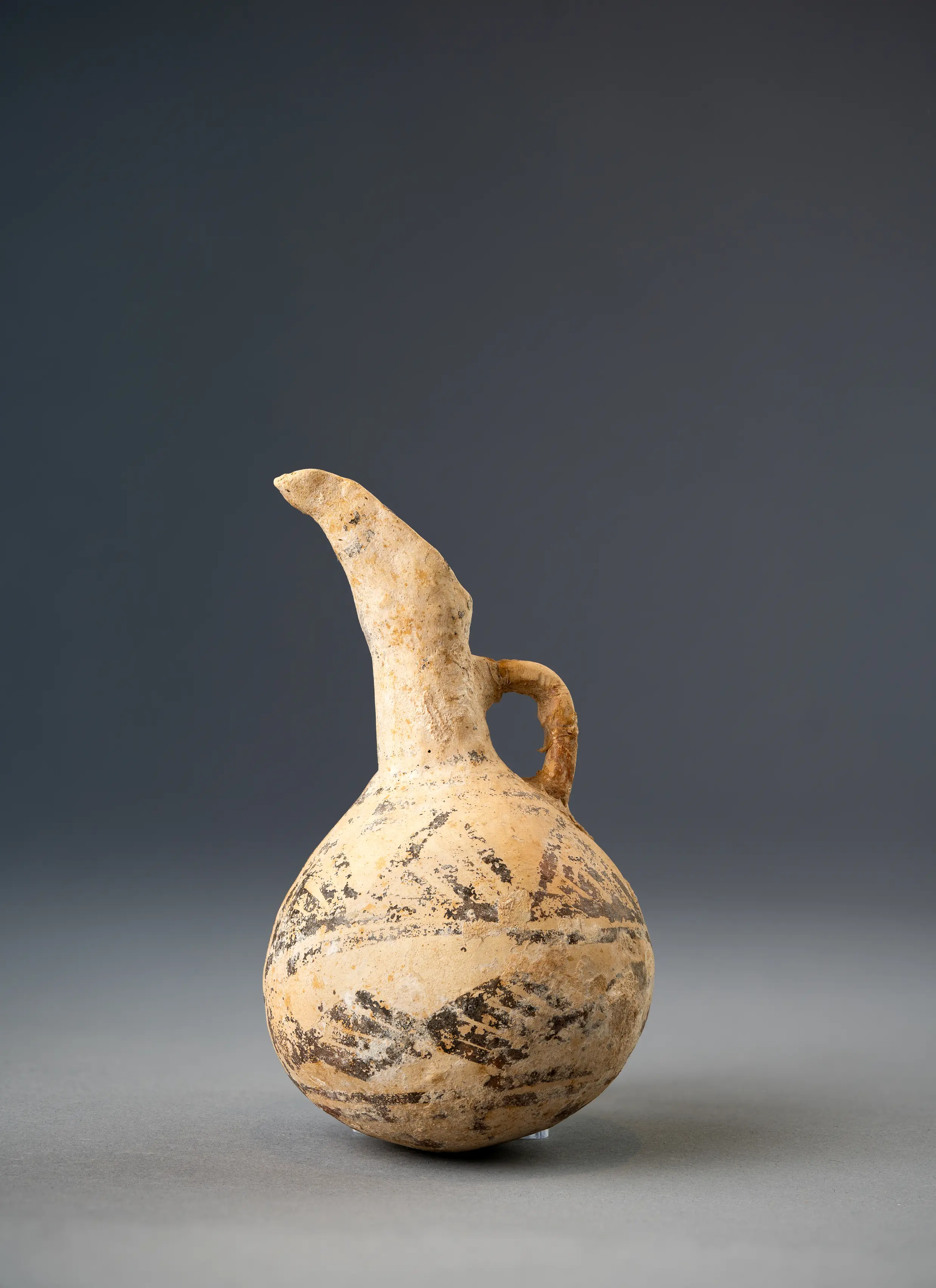 White Painted III-IV Juglet with Cut-away NeckMiddle Bronze Age II · 1850–1650 BC
- White Painted III-IV Bowl with Rising Handle and Hatched TrianglesMiddle Bronze Age II · 1850–1650 BC
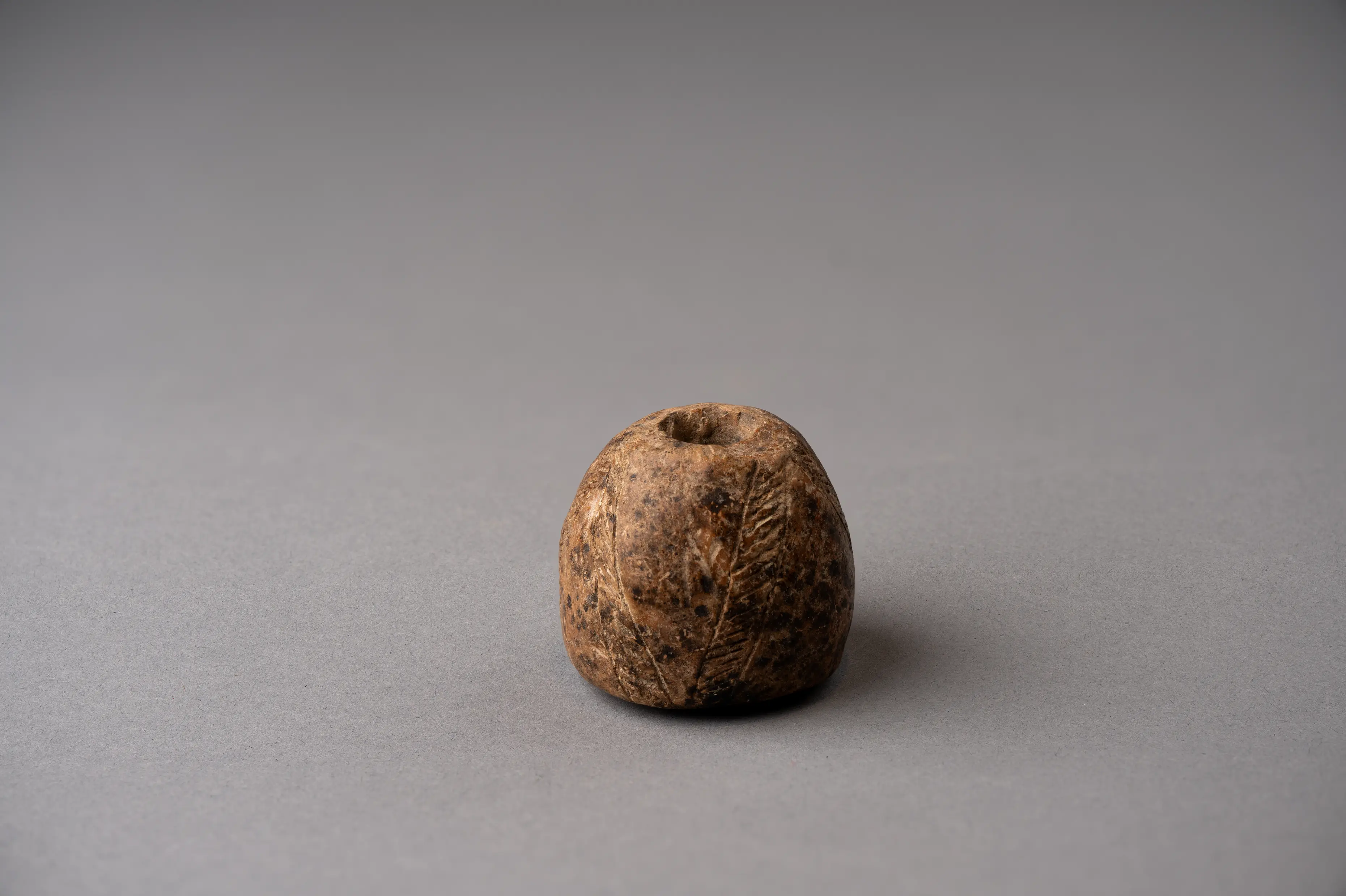 Spindle Whorl with Incised Herringbone BandsMiddle Bronze Age I · 2000–1725 BC
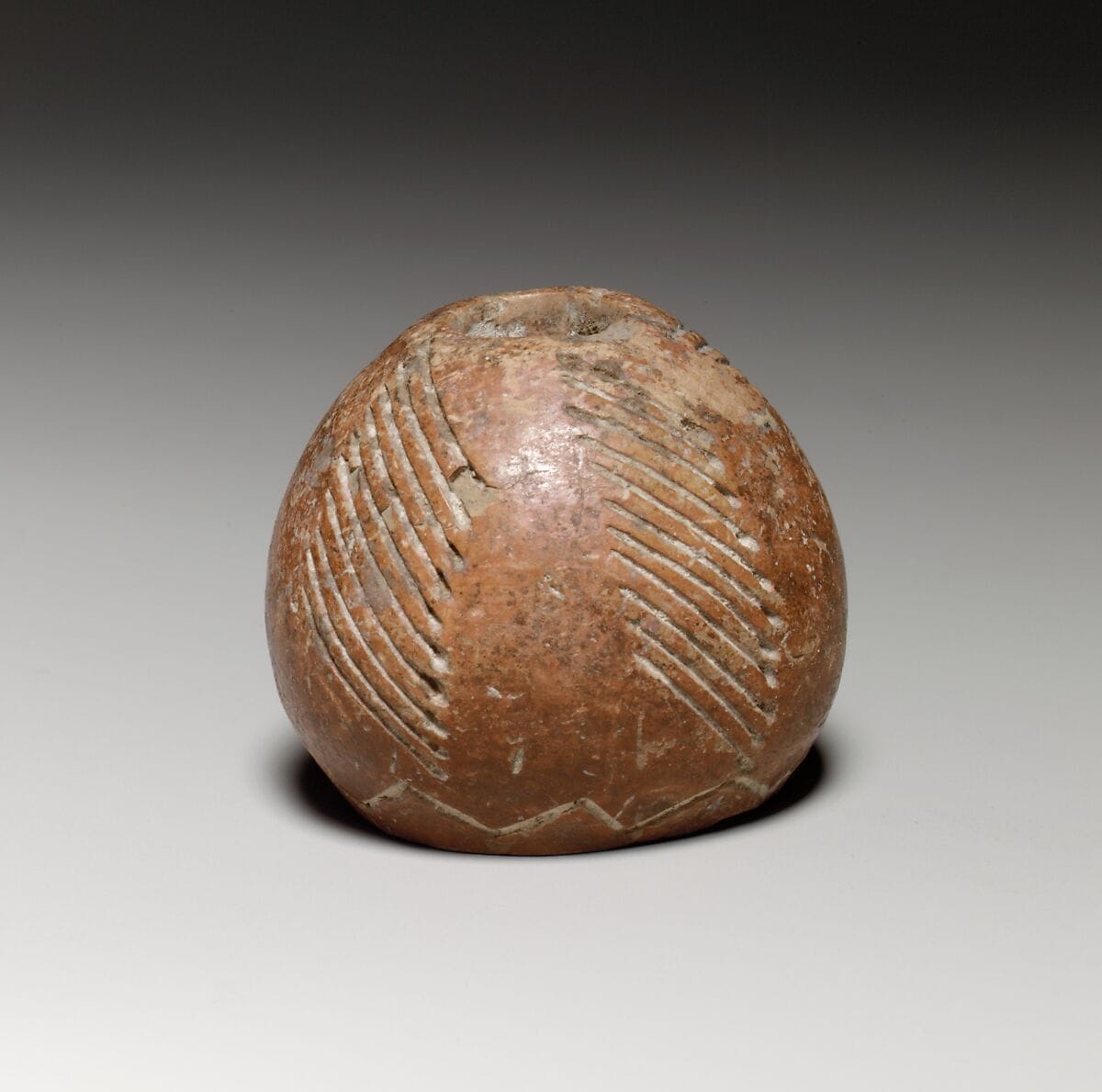 Terracotta conical-hemispherical spindle-whorl with flat baseMiddle Bronze Age I · 2000–1725 BC
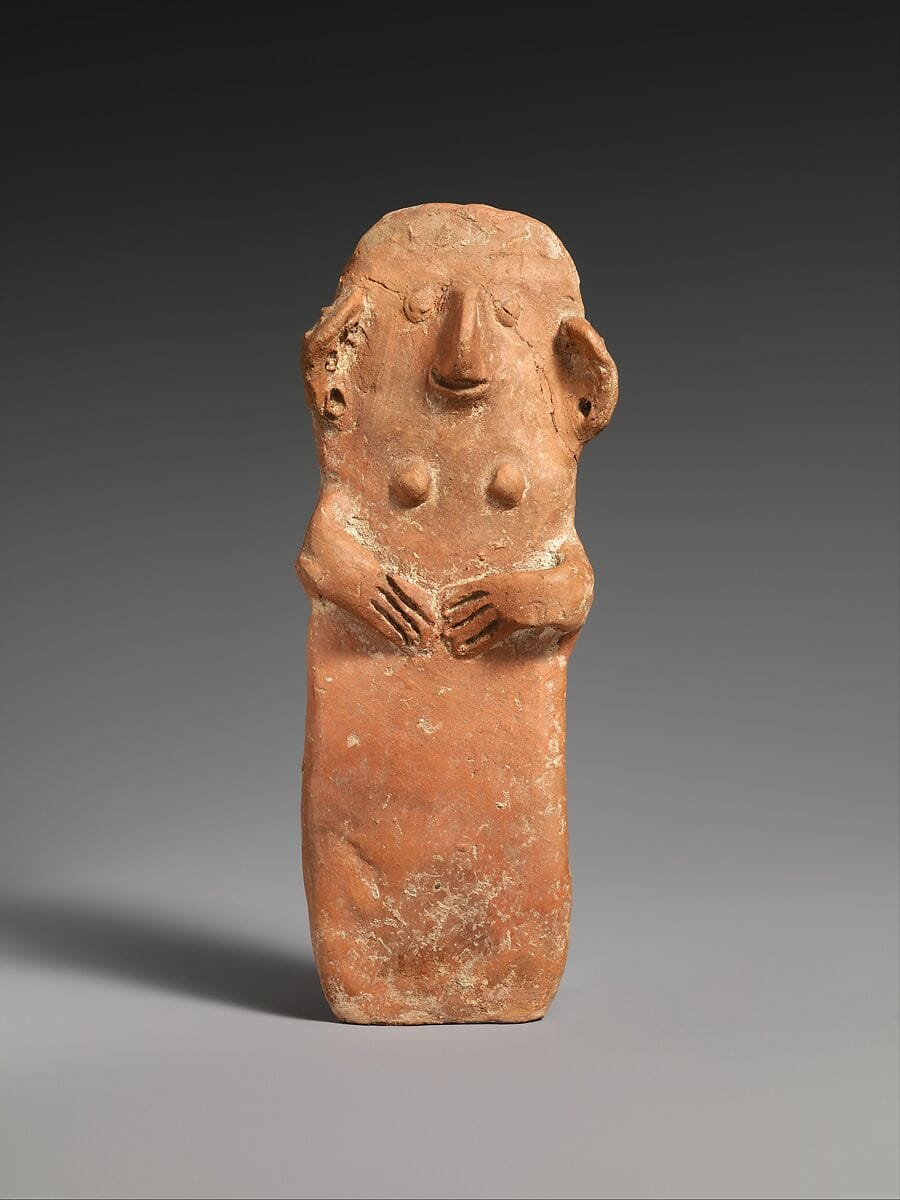 Terracotta plank-shaped figurineMiddle Bronze Age I · 1900–1800 BC
References
- 1.Falconer, S. E., & Fall, P. L. (2013). Household and community behavior at Bronze Age Politiko-Troullia, Cyprus. Journal of Field Archaeology, 38(2), 101–119. https://doi.org/10.1179/0093469013Z.00000000041
- 2.Bombardieri, L., & Muti, G. (2018). Erimi Laonin tou Porakou: A textile community of practice in Middle Bronze Age Cyprus. Fasciculi Archaeologiae Historicae, 31, 25–38.
- 3.Frankel, D., & Webb, J. M. (2001). Population, households, and ceramic consumption in a prehistoric Cypriot village. Journal of Field Archaeology, 28(1–2), 115–129. https://doi.org/10.1179/jfa.2001.28.1-2.115
- 4.Fagan, B. M., & Durrani, N. (n.d.). Archaeology: A brief introduction (12th ed.). Routledge. https://doi.org/10.4324/9781315641140
- 5.Coleman, J. E., Barlow, J. A., Mogelonsky, M. K., & Schaar, K. W. (1996). Alambra: A Middle Bronze Age settlement in Cyprus. Archaeological investigations by Cornell University 1974–1985 (Studies in Mediterranean Archaeology, Vol. 118). Paul Åströms Förlag.
- 6.Karageorghis, V. (1982). Cyprus: From the Stone Age to the Romans. Thames and Hudson.
- 7.Monahan, E., & Spigelman, M. (2019). Negotiating a new landscape: Middle Bronze Age fortresses as a component of the Cypriot political assemblage. In C. Kearns & S. W. Manning (Eds.), New directions in Cypriot archaeology (pp. 133–159). Cornell University Press.
- 8.Keswani, P. (2004). Mortuary ritual and society in Bronze Age Cyprus (Monographs in Mediterranean Archaeology, Vol. 9). Equinox.