
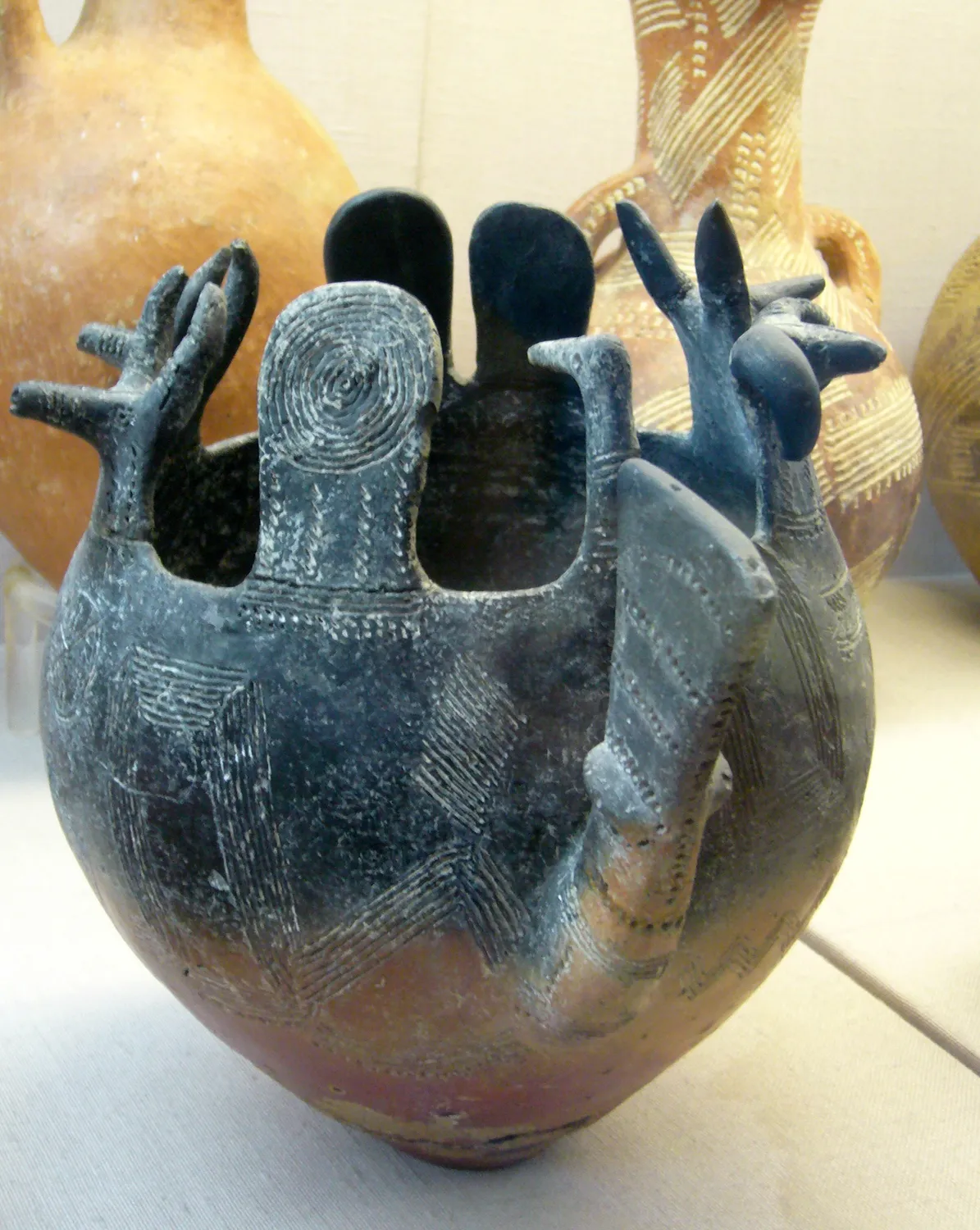
For roughly fourteen centuries, from the Philia phase around 2500 BCE to the end of the Late Bronze Age, the standard Cypriot grave was a chamber cut into soft rock, entered through a passage, closed with a slab, and reopened again and again. The island is riddled with them. Single settlements used several burial grounds at once: the village at Marki overlooked five separate cemeteries with an estimated 786 tombs within 800 m of the houses [7], and surveys at Erimi-Kafkalla and Evdhimou-Amolo counted dromoi in the hundreds [1, p. 66]. Because the villages themselves were flimsy and are rarely excavated, these tombs carry most of what is known about the Early and Middle Bronze Age on Cyprus, and they remain the principal evidence for the growth of social differentiation into the Late Bronze Age. This entry sets out how the tombs were built, how bodies were treated inside them, what the animal bones and pottery say about the funeral, and where the arguments over meaning now stand. It is a companion to the hub on mortuary practice and to the site pages for Bellapais-Vounous, Lapithos and Enkomi.
Anatomy of the tomb
The form is constant across the island, with variation in scale and finish. A dromos was cut down into a slope or plateau edge: at Vounous a short passage with roughly parallel sides, at other sites a long stepped trench or, at Dhenia, a deep cylindrical shaft. At the inner end a low doorway, the stomion, opened onto a rounded or ovoid chamber with a flat or slightly domed roof. The stomion was blocked with a limestone slab wedged with small stones, a closure designed to be broken and remade each time the tomb was reopened [2, pp. 96-97]. Dikaios sorted the Vounous dromoi into two classes, the short and the longer narrowing type, and noted that most descended by a rough step to an abrupt drop at the doorway [2, p. 96]. One dromos might serve one, two, or occasionally three chambers, and at Vounous Site B the passages of Tombs 78, 75, 70, 70a, 70b and 73 were joined into a single complex [1, p. 71].
The chambers were furnished. Niches were cut into the walls, most often to the right of the entrance, and in Tombs 5 and 17 at Vounous well-preserved skeletons lying in them settled the question of their use [2, p. 97]. Tomb 37 had a continuous bench 50 cm to 1 m wide running along two sides of the chamber, raised 25 cm above the floor [2, p. 98]. There was a rule about sides: in the earlier tombs the right-hand part of the chamber received the bodies, the pottery was piled to the left, and the head lay towards the doorway [2, pp. 98-99]. Webb and Frankel found the same right-hand bias across the north-coast cemeteries, extending to the small bowl or juglet routinely left just inside the door within reach of the stomion [4].
A few tombs made the doorway itself into architecture. At Vounous Site A, Tombs 114, 116 and 117 had stomion façades carved to imitate a timber door frame with uprights and lintel; on Tomb 117 the uprights continue above the lintel and were read by the excavators as an upper storey with a window and a bolt slot [3, pp. 152-163]. Stewart took these literally as houses for the dead. Keswani suggested instead that the carved doorways marked the tombs as shrines, comparing them to the terracotta models from Kotchati and Kalopsidha in which a figure stands before a façade hung with bulls' heads [1, p. 71]. The most elaborate case lies west along the coast at Karmi-Palealona, where Tomb 6 carries a carved tripartite façade and, on the dromos wall, a standing relief figure 116 cm high, the only relief human figure known from Early Bronze Age Cyprus [8]. None of the three carved Vounous tombs was conspicuously rich in metal, so the carving cannot be read as a badge of wealth [1, pp. 72-73].
Whether the dromos stood open between burials was argued over from the start. Gjerstad thought it stayed open until the last interment; Wace, working at Mycenae, thought each burial was followed by backfilling and a surface marker. Dikaios settled the matter for Vounous with Tomb 10, an empty chamber whose door slab was still in place and whose dromos had already been filled: a tomb prepared, sealed and backfilled before anyone was ever put in it, and therefore proof that dromoi were refilled and re-excavated for each death [2, pp. 24, 102]. That does not mean the passage was inert. Jars stood to the right of the entrance in the dromoi of Tombs 87, 111 and 152, and a pit with an ox bone lay by the stomion of Tomb 101, which Webb and Frankel take as evidence for washing, libation or offering in the dromos after the chamber had been closed [4].
Chronology and regional character
The chamber tomb did not arrive fully formed. Keswani is explicit that its spread with the Philia phase "cannot be simplistically characterized as a 'Philia' innovation": there are local antecedents in the bottle-shaped shaft tombs of Middle Chalcolithic Souskiou and the Period 4 chamber tombs of Kissonerga-Mosphilia, while rock-cut shaft tombs of similar principle were in use at Halawa and other Middle Euphrates sites between 2450 and 2350 BCE, at the same moment they became common on Cyprus [1, p. 70]. The Halawa chambers, with vaulted roofs, wall niches, window-like cuttings and benches with built-in pillows, look like "underground bedrooms or houses", which returns the argument to Stewart's reading of the Vounous façades. Her conclusion is a fusion of mainland and local practice, worked out on Cyprus during a period of social change [1, pp. 70, 73]. The Neolithic and Chalcolithic background is treated in its own entry.
The best-measured sequence is Vounous, where Stewart's Site A is overwhelmingly Early Cypriot I and Dikaios's and Schaeffer's Site B runs from Early Cypriot II into the Middle Cypriot period. Keswani's tables show the tomb growing in plan over that span: mean chamber floor area rises from 3.68 m² at Site A to 7.16 m² at Site B, a statistically significant near-doubling, while headroom barely changes [1, p. 76]. More than a third of Site B tombs are dual- or multi-chambered complexes, against mostly single chambers at Site A [1, p. 71]. At Lapithos-Vrysi tou Barba the same curve runs steeper, from a mean of 5.25 m² in tombs of Early Cypriot II-IIIA to 11.18 m² in Middle Cypriot I-III, with the largest chamber, Swedish Tomb 322A, exceeding 20 m² [1, pp. 60, 76].
| Cemetery / phase | Mean chamber floor area | Mean burials per chamber | Notes |
|---|---|---|---|
| Vounous Site A (EC I) | 3.68 m² | 1.59 (range 1-6) | single ovoid chambers, short dromoi; carved façades on Tombs 114, 116, 117 |
| Vounous Site B (EC II-MC II) | 7.16 m² | 2.68 (range 1-9) | over one third dual- or multi-chambered; niches to the right of the entrance |
| Lapithos, EC II-IIIA tombs | 5.25 m² | c. 2.2 | multi-chamber complexes off a common dromos |
| Lapithos, MC I-III tombs | 11.18 m² | 4.19 (up to 15) | Tomb 313A: 15 burials in one chamber; Tomb 322A over 20 m² |
Figures after Keswani [1, pp. 67, 76]. Absolute dates follow her frame: Philia c. 2500-2350, Early Cypriot I-III c. 2300-1950, Middle Cypriot I-III c. 1950-1650 BCE; Dikaios's own dates of 2600-2100 for the Vounous sequence run two or three centuries too high and should not be reused.
Regional accents are strong. The north-east complexes at Ayios Iakovos-Melia and Korovia-Paleoskoutella have long tapering dromoi, sometimes stepped, and large chambers with raised angular niches; Paleoskoutella Tomb 7 lay under a tumulus measuring 22 by 17.5 by 3.1 m [1, pp. 73, 75]. Vasilia-Kafkallia has rectangular chambers, pillar-like buttresses, lime-plastered dromoi up to 8 m long and stone cross-walls built to impede access, a monumentality whose date is disputed: Stewart and later Hennessy placed the tombs in Early Cypriot III, Webb and Frankel in the Philia phase on ceramic grounds, and the choice decides whether elaborate copper-rich burial was a late escalation or present from the outset [1, p. 71]. The south is more muted. Kalavasos-Village, Episkopi-Phaneromeni and Sotira-Kaminoudhia used smaller multi-chambered tombs with more modest assemblages, and at Phaneromeni one trench-type dromos 7 to 8 m long opened onto at least nine chambers, none of them ever excavated [1, p. 76].
Bodies, clearing aside, and the curated skull
Bodies were laid in the chamber whole. At Vounous A roughly two-thirds of the burials found in position lay on the left side with the legs flexed and the arms folded towards the face; at Vounous B almost all articulated burials lay on the back, legs flexed or extended [1, p. 57]. Cloth survived where it had adhered to daggers, so the dead went in clothed [2]. Small intimacies were recorded: bowls placed in the hands of the dead in Tombs 17 and 19, and in Tomb 19 a pair arranged as if holding hands [1, p. 57]. Such details are rare and should be quoted as rarities.
What happened next is the hinge of the whole subject. When a chamber filled, earlier occupants were moved. Dikaios described the remains of the first buried as "removed from their places and grouped anyhow along the sides", the right-hand part of the chamber left clean for the newest body [2, pp. 98-100]. Much disarticulation is nothing more than this, compounded by the flooding to which the soft havara chambers were prone. Keswani's contribution was to isolate a residue that clearing aside cannot explain and to argue from it for a deliberate programme of secondary treatment "placing special emphasis on the manipulation and curation of the skull" for at least some adults [1, p. 58]. Her categories are precise. Burials represented only by skulls occur in Vounous A Tombs 82B, 118 and 153 and in Vounous B Tombs 44, 50A, 125, 141, 143, 146 and 156; Tomb 143 held eight skulls with almost no postcranial bone, eleven copper objects and a stone axe amulet [1, p. 58]. In Tomb 31 the long bones of three decomposed skeletons had been gathered into a group [1, p. 58, citing 2, p. 65]. Tomb 36, with at least nine individuals, the most in any Vounous tomb, had a heap of bones in the foreground and not one articulated skeleton in its upper level; Dikaios called the single articulated body beneath the pots the last burial, and Keswani suggests instead that several secondary burials went in together [1, p. 58].
The type case is Tomb 164A at Site A, the largest chamber on that site. Two more or less complete skeletons lay without their skulls, which had been placed some distance away in front of both bodies, as symmetrically as the corpses. The Stewarts' anatomist, Rix, examined the bones for signs of decapitation and found none [3, pp. 226-227]. Either the tomb was reopened after decay and the skulls detached, or the bodies were defleshed and the heads separated before interment [1, pp. 57-58]. Keswani reads the pattern as reverential rather than violent, and she refuses to make it a marker of rank: skull-only burials occur in modest tombs as well as in rich ones, so the rite "involved extended 'reverential' treatment for important kin group members, regardless of their wealth or prestige" [1, p. 58]. In her later synthesis she generalises skull curation and reburial as a north-Cypriot signature, most apparent at Vounous and at Kalavasos [5].
The clearest collective reburials come from Lapithos and the north-east. Swedish Tomb 313 at Lapithos yielded 134 copper-based objects, 80 of them from Chamber A, and an estimated 26 burials, the largest number documented for a single complex. The 15 burials in Chamber 313A were "very carefully arranged in the niches and in a circle upon the floor" with no stratigraphic separation, which Keswani reads as one or two ostentatious events in which several individuals were exhumed and reburied together "in a celebration staged to demonstrate the wealth and prestige of the kin group while honoring its ancestors" [1, p. 60]. The same circle-and-niche arrangement of fourteen or fifteen carefully spaced bodies recurs in Ayios Iakovos Tomb 6 and Paleoskoutella Tomb 7, and at Paleoskoutella a sherd from an emptied small tomb joined a sherd from the trench through the central tumulus, physically linking the emptying of the one to the filling of the other [1, pp. 59-60]. At Lapithos, rows of shallow rectangular cuttings across the bedrock, all found empty and cut by the later dromoi, may have been primary graves from which bodies were later moved into the chamber tombs [1, p. 60].
The theoretical frame Keswani brings to this is Hertz's secondary funeral: a first burial that deals with the polluting corpse, a period of decay, and a terminal celebration that turns the cleaned bones into an ancestor. Because the second event can be scheduled, it lets survivors gather food, guests and gifts on a scale that a sudden death never allows, and it shifts the emphasis from mourning to the interests of the living [1, pp. 28-35]. Two cautions travel with the model. Secondary treatment was never universal, and tombs with plain sequential burial far outnumber those with evidence of collective reburial [1, p. 65]. And the old excavations, digging for pottery before modern osteology, left much of the bone uncollected, so the boundary between ritual disarticulation and water damage is genuinely blurred.
Who was in the tombs is a distorted sample. At Vounous the only infant is a neonate's rib in a pot in Site B Tomb 121; children of any age amount to roughly 6 per cent of the minimum number of burials, against the 30 to 50 per cent of deaths that a pre-industrial population would produce [1, pp. 66-67]. Most children were disposed of elsewhere, in ways the record does not show, and only gradually admitted to chamber burial, somewhat more often at Lapithos with its dromos "cupboards". Sex is thinner still: sixteen crania examined by Rix and four restudied later lean male, but the sample is tiny, the identifications uncorroborated, and at Kalavasos a modern study found more women than men, so any claim that women were excluded "must be regarded with caution" [1, pp. 67-68]. The assumption that each tomb held a biological family, made flatly by Dikaios and repeated in every modern account, has never been tested by biodistance, isotopes or ancient DNA; Sneddon flagged the same unproven equation for the Marki tomb clusters [7].
Oxen at the graveside
The animal bones are the most direct trace of the funeral itself, and they rest on a very thin evidential base. No campaign at Vounous set out to collect fauna. The only hands-on study is Stubbings's short appendix to the Stewarts' report, written on whatever bone happened to be kept from Site A [3, pp. 374-380]. Every frequency below is therefore a floor.
Cattle, sheep and goat bones were recorded in roughly one-third of the tombs at both Vounous sites, with cattle predominating and, in Tombs 13 and 36 at Site B, substantial portions of an ox or calf [1, p. 82; 2, pp. 30, 72-76]. Stubbings found the cattle to be largely adult animals, and he saw both meat-bearing joints and the cranial bones, mandibles, wrist and foot bones that carry almost no meat [4]. Those waste parts are what a butcher leaves where the animal is killed. Webb and Frankel draw the conclusion: the animals "are likely to have been killed and butchered on site", the dead were given joints as well as heads and feet, and the living ate the rest [4]. Stubbings also noted cut marks on the humeri and marrow left inside the shafts, so the joints went into the tomb with flesh and marrow intact, a conspicuously wasteful form of consumption that marks the funerary deposit as different from domestic butchery [4]. Slaughtering a mature ox, the plough animal rather than surplus stock, "bears witness to sustained levels of economic surplus" [4]. Pig, common in settlement middens, is absent from the tombs; whether that is a taboo or simply low frequency in the diet is left open.
The feast did not happen inside the tomb. Lapithos chambers average around 7.5 m² of floor with a ceiling near 1.1 m, and even the largest and richest chambers do not contain the smashed drinking sets a crowd would leave [13]. The eating and drinking took place outside, in and around the dromos and the open cemetery, and what went into the chamber was a selection placed with the dead. That is also the frame in which the pottery should be read. Tomb pots are household pots: Dugay's use-wear study found no significant difference between tomb and settlement assemblages in shape or in the proportion of used vessels, so the grave groups were not commissioned for burial [1, p. 89]. The equipment is overwhelmingly for liquids, jugs and spouted bowls and the tulip-shaped cups that Webb and Frankel read as individual drinking vessels whose "additive variability" of form and ornament focused attention on particular drinkers at a competitive feast [4]. The Red Polished bowls and jugs of the Drakopoulos collection, such as this hemispherical bowl and this cutaway-spouted jug, are the ordinary end of that repertoire, the kind of vessel that fills these chambers by the dozen; the figured "cult vessels" and the double-necked jug discussed in the Vounous bird-jug article are the exceptional end.
Keswani's terminological point deserves repeating. Ritual is a solemn ceremony performed in a set order, and Early Cypriot Cyprus plainly had it. Cult is worship directed at the dead outside the funeral, and for that the evidence is slight: the pots left in dromoi are few, better described as occasional tendance than as regular devotion. Dikaios's confident "cult of the dead" is an over-reading by modern standards, and the "snake" reliefs on which so much of his chthonic reading rested have no heads and may be rope ends [2, pp. 120-125; 13].
Grave goods and the argument over rank
Almost every intact tomb had some goods, so provision was not confined to a privileged few [1, p. 89]. Pottery is the bulk and it rises over time: mean pots per burial climb from 14.4 at Vounous A to 18.7 at Vounous B [1, p. 79]. Metal is the currency of competition, and its curve is not smooth. Copper occurs in 49 per cent of intact Site A tombs but in small amounts, mostly knives, axes and the long hook-tang weapons; only Tombs 164A, 161 and 105 are notably metal-rich [1, p. 79]. In the earlier Site B tombs metal collapses to 27 per cent of chambers, and in five tombs of that phase ceramic models of daggers, some with sheaths, stand in for scarce originals [1, p. 81]. The latest Site B tombs reverse it: 75 per cent contain metal, the hook-tang weapon appears in 23 of 39 metal-bearing tombs, and pins become the commonest type [1, p. 81]. At Lapithos the climb is steeper, to 96 per cent of chambers in the latest Middle Cypriot phase, with copper per burial reaching a mean of 4.92 [1, pp. 82-83]. The hook-tang weapon grew as it spread: lengths at Vounous B run from 12 to 47.5 cm, and at Lapithos reach 66 cm, too long to haft, what Philip called "baroque" [1, pp. 81, 91]. Vounous channelled its display into figured pottery, feasting and slaughter; Lapithos, better placed for the renewed sea trade, channelled it into metal and the rare imports, gold, faience, Minoan-type daggers, a Kamares cup in the cramped "Tomb of the Seafarer" at Karmi [1, pp. 82-86; 8]. The weapons and plank figures that accompany these burials have their own entries.
Two readings of these numbers compete, and the disagreement is live. Manning read the metal-rich, architecturally monumental tombs of Vasilia and Lapithos, set against a nearby cemetery of plain pit graves, as "the burial places of the few elite families or lineages", evidence of sustained and heritable power, with a "drinking complex" of elaborate serving vessels as the medium of elite hospitality and the Vounous enclosure model as a picture of institutionalised authority [6]. Peltenburg's 1994 reading of the same model as a hierarchical cosmology belongs with it. Keswani accepts the funeral as the premier arena of prestige competition and denies that it shows a fixed elite. Her decisive move is statistical: not only the means but the medians of chamber area, pots per burial and copper per burial rose at both sites, "indicating a trend towards increasing energy expenditure that was broadly based within the community, not merely skewed by the ostentation of a few very high status tomb groups" [1, pp. 76-77]. The richest tombs differ in the number and diversity of metal types, not in possessing anything unavailable to others; the figured "cult vessels" occur in nearly half of Site A tombs and over two-thirds of the latest Site B tombs, and the enclosure model itself came from an otherwise unimpressive chamber [1, pp. 79, 91-92]. She adds that the settlement record offers no corroboration for hierarchy, no elite residences, no monumental public buildings [1, pp. 92-93], and that the most lavish celebrations were "invariably focused on groups of burials rather than on individuals" [1, p. 69]. The Vasilia pit graves, on her reading, may represent a stage of processing rather than a class [1, p. 76]. Webb and Frankel's ceramic sequence supports her: promotional feasting with individualised cups in Early Cypriot I-II gives way in Early Cypriot III to more and smaller bowls, composite vessels and a focus on sub-groups and lineage position [4].
Keswani's larger thesis, set out in the 2005 paper whose title names it, is that death drove copper. Periodic removal of metal from circulation in funerals forced up production, raised the visibility of Cypriot copper abroad and drew in the traders and exotica that ambitious groups later parlayed into the coastal towns of the Late Bronze Age [5; 1, pp. 96-97]. The review of her book on this site and the longer essay on Vounous as a society known only from its dead follow that argument further.
Late Bronze Age: the tomb moves into town
With the growth of the coastal towns after about 1650 BCE, burial moved back inside the settlement. At Enkomi, Kition and Hala Sultan Tekke the chamber tombs lie beneath streets and in the courtyards of houses and workshops, a reversal of the extramural cemeteries of the preceding thousand years [1, pp. 105-109]. The chambers grew smaller on average than their Middle Cypriot predecessors, and the investment shifted from rock-cutting to contents: Mycenaean pictorial kraters, gold, ivory, faience, glass and cylinder seals cluster in the wealthiest tombs, while plain Mycenaean cups, bronze mirrors and beads are spread widely [1, pp. 128, 141-142]. Ordinary Late Cypriot table wares of the kinds found in these tombs are represented in the Drakopoulos collection by a White Slip bowl, a Base Ring jug and an Aegean-style jar said to have been found on the island; the wares are treated under White Slip, Base Ring and the Mycenaean contacts.
Enkomi also produced new tomb types. Of some 185 tombs excavated there by all missions, the great majority were rock-cut chambers, but the British Museum in 1896 also opened one tholos (Tomb 71) and four built tombs (Tombs 1, 11, 12 and 66) constructed of finely cut ashlar blocks and roofed with rough slabs, forms generally thought to reflect Near Eastern or Aegean models and, for the built tombs, the house tombs of Ugarit [9]. Tomb 66, the only built or tholos tomb found intact, measured 2.9 by 2.5 m inside, with a stone platform along one end and one side; five bronze nails had been driven into the joints of its walls, a ceramic lamp hung from two of them on one side of the door and a copper lamp was pushed into the wall by its handle on the other, and the excavators recorded pins "for the suspension of objects, including the silver bowl" [9, p. 30]. Crewe reads the permanent lighting, the hanging bowl and a doorway easier to open than a slab blocking as signs that the tomb was visited regularly and that some of its contents were furnishings rather than offerings to any one corpse [9, p. 31]. She dates the construction of the built tombs to Late Cypriot II, probably IIB or early IIC, with use continuing briefly into IIIA, and suggests they may show ashlar masonry used for tombs before it was used for buildings [9, p. 31]. The Tomb 66 article describes its gold, faience and glass.
The intact tomb at Kalavasos-Ayios Dhimitrios shows how far the display had moved from the collective idiom of Vounous. Tomb 11, a bilobate chamber beneath the street west of the ashlar Building X and dated to Late Cypriot IIA:2, around 1375 BCE, held three young women aged about 17, 19-20 and 21-24 on two rock-cut benches, with a three-year-old and three newborns on the floor [1, p. 114; 10]. The 19-20-year-old lay fully articulated on the wider western bench, dressed in gold, silver and glass jewellery; the other two were disarticulated and incomplete but likewise adorned. Among 177 registered objects were paired Mycenaean kraters and piriform jars, two nearly identical Base Ring bull-shaped vessels, Egyptian glass jars, ivory duck-shaped boxes, twelve gold earrings of almost standard weight, two gold rings with Cypro-Minoan signs and 432 g of gold in all [10; 11]. Goring noted that the earrings weigh about 10.8 g each and might have functioned as a convertible store of value, perhaps dowry [11]. The point that matters for mortuary history is that the jewellery belonged specifically to the women, and that a tomb of the highest rank contained only young women and children.
The chamber tomb tradition ended with the Bronze Age. Iacovou's judgement is blunt: "Not one site shows Late Bronze to Early Iron Age continuity in tomb use, tomb architecture, or burial practices", even at Kition and Paphos where the settlements themselves did not move. From the eleventh century the island adopted the chamber tomb with a long dromos, a form well attested in Late Helladic Greece and previously unknown on Cyprus, set in new extramural cemeteries [12, p. 635]. The multi-stage handling of bone that had defined burial since the Chalcolithic stopped with it. The sequel belongs to the Cypro-Geometric period and to the broader survey of Cypriot burials over time.
What remains unknown
The record is old and partial. Vounous has never had a modern osteological study; Rix's sixteen crania and Fischer's four are the whole sexed sample, the bones may no longer be accessible since 1974, and the cemetery has been looted repeatedly since. No settlement contemporary with the Vounous tombs has been found despite survey, so every social claim about the community is an inference from its graves. Lapithos, with roughly 136 excavated tombs, is only a fifth published. The "family tomb" is an assumption. The fate of the excluded children is undocumented. The date of Vasilia swings the whole history of early monumental burial and is unresolved. What the evidence does support is narrower and firmer: reusable rock-cut chambers in extramural cemeteries from the Philia phase; bodies laid whole and later moved, and for some adults the skull handled apart; cattle killed and eaten at the graveside with joints given to the dead; pottery and copper rising in quantity across the whole community through the Early and Middle Bronze Age; and, in the towns of the Late Bronze Age, a shift to smaller intramural chambers, built ashlar tombs, and imported wealth concentrated on the few.
References
- 1.Keswani, P. S. (2004). *Mortuary ritual and society in Bronze Age Cyprus* (Monographs in Mediterranean Archaeology 9). Equinox.
- 2.Dikaios, P. (1940). The excavations at Vounous-Bellapais in Cyprus, 1931-2. *Archaeologia*, 88, 1-174. https://doi.org/10.1017/S0261340900014557
- 3.Stewart, E., & Stewart, J. R. (1950). *Vounous 1937-38: Field-report on the excavations of the Stewart Expedition* (Skrifter utgivna av Svenska Institutet i Rom 14). Gleerup.
- 4.Webb, J. M., & Frankel, D. (2010). Social strategies, ritual and cosmology in Early Bronze Age Cyprus: An investigation of burial data from the north coast. *Levant*, 42(2), 185-209. https://doi.org/10.1179/175638010X12797237885776
- 5.Keswani, P. S. (2005). Death, prestige, and copper in Bronze Age Cyprus. *American Journal of Archaeology*, 109(3), 341-401.
- 6.Manning, S. W. (1993). Prestige, distinction, and competition: The anatomy of socioeconomic complexity in fourth to second millennium B.C.E. Cyprus. *Bulletin of the American Schools of Oriental Research*, 292, 35-58.
- 7.Sneddon, A. C. (2002). *The cemeteries at Marki: Using a looted landscape to investigate prehistoric Bronze Age Cyprus* (BAR International Series 1028). Archaeopress.
- 8.Webb, J. M., Frankel, D., Eriksson, K. O., & Hennessy, J. B. (2009). *The Bronze Age cemeteries at Karmi Palealona and Lapatsa in Cyprus: Excavations by J. R. B. Stewart* (Studies in Mediterranean Archaeology 136). Åströms Förlag.
- 9.Crewe, L. (2009). Feasting with the dead? Tomb 66 at Enkomi. In T. Kiely (Ed.), *Ancient Cyprus in the British Museum: Essays in honour of Dr Veronica Tatton-Brown* (British Museum Research Publication 180, pp. 27-48). British Museum Press.
- 10.Knapp, A. B. (2008). *Prehistoric and protohistoric Cyprus: Identity, insularity, and connectivity*. Oxford University Press.
- 11.Goring, E. (1989). Death in everyday life: Aspects of burial practices in the Late Bronze Age. In E. Peltenburg (Ed.), *Early society in Cyprus* (pp. 95-105). Edinburgh University Press.
- 12.Iacovou, M. (2008). Cultural and political configurations in Iron Age Cyprus: The sequel to a protohistoric episode. *American Journal of Archaeology*, 112(4), 625-657.
- 13.Keswani, P. S. (2012). Mortuary practices and burial cults in Cyprus from the Bronze Age through the Early Iron Age. In G. Cadogan, M. Iacovou, K. Kopaka, & J. Whitley (Eds.), *Parallel lives: Ancient island societies in Crete and Cyprus* (British School at Athens Studies 20). British School at Athens.