
Late Bronze Age II
Base Ring II Double Juglet with White-Painted Decoration
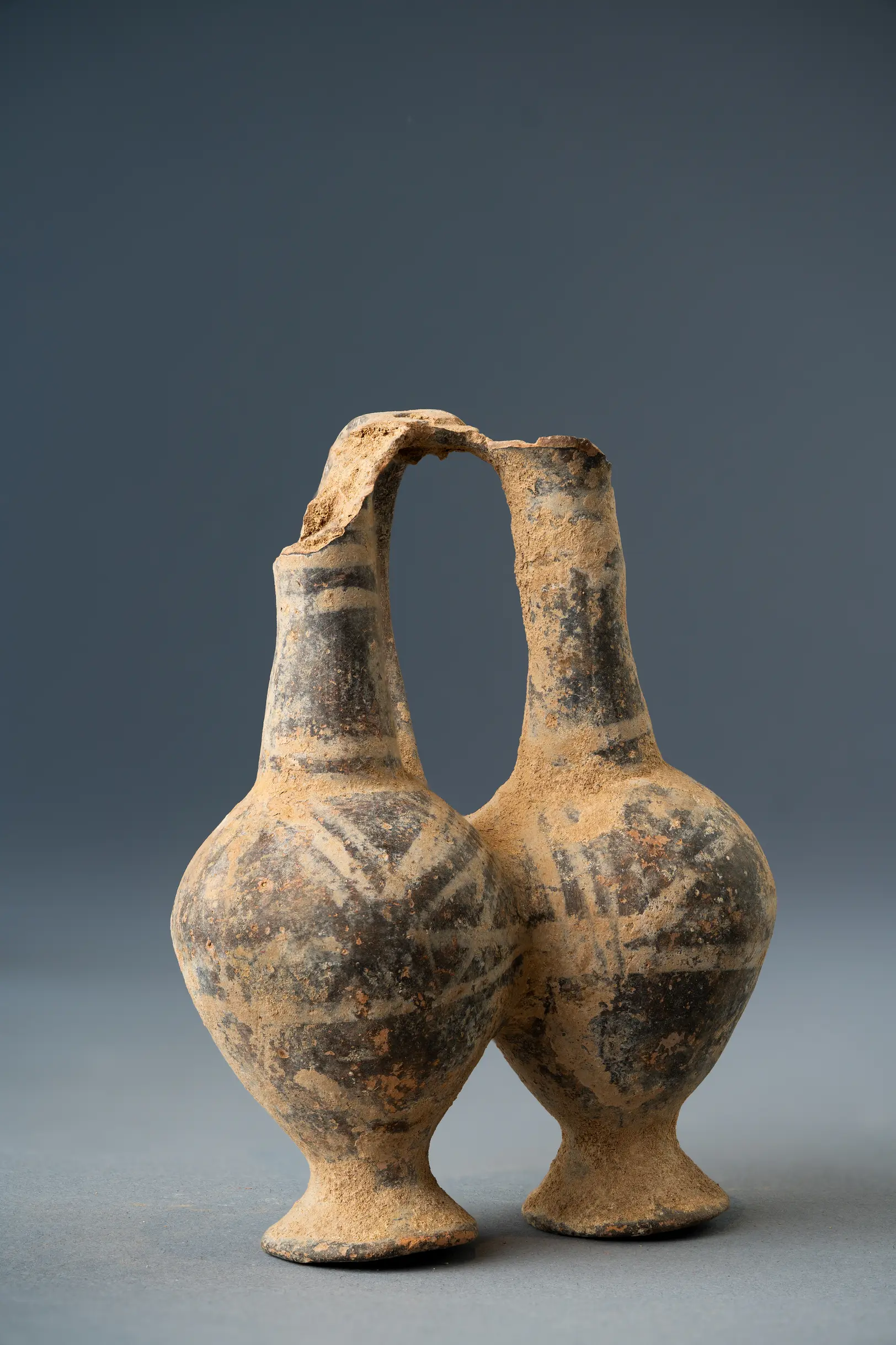
A Late Bronze Age Base Ring II double juglet: two white-painted dark juglets on separate feet, with necks joined by an arching bridge that is now broken.
Date
1450 - 1200 BC
Accession No.
JUG-BA-018
Collection
Alexis Drakopoulos
Provenance
- 1965–1969, The Goodman Collection
- 2025–present, Alexis Drakopoulos, London
Late Cypriot IIA–IIC, c. 1450–1200 BCE · Base Ring II ware · Handmade
Two juglets made as one vessel. Each has its own globular body and its own splaying ring foot, and the two bodies are pressed together at the shoulder and belly. The long necks lean toward each other and are joined at the top by an arching bridge, so the necks and bridge form a closed loop. That upper part is broken. The left neck ends in a jagged break, the bridge survives only as a damaged strip, and neither mouth is preserved. The surface is dark grey to black with patches of brown. White paint, applied in quick parallel strokes, rings each neck with bands. On the bodies, groups of lines slant in from both sides to meet in chevrons and cross in open lattices above a horizontal belly band. A pale crust of burial soil covers much of the surface, especially on the bridge and feet.
Commentary
The dark matt surface and the white-painted linear ornament identify the ware as Base Ring II, in the classification set out by Åström [1]. Base Ring II painters worked in groups of roughly parallel lines, bands and oblique strokes, sometimes crossing to form chevrons and lattices, as on this piece [2]. The style is conventionally dated c. 1450–1200 BCE (Late Cypriot IIA–IIC). Relief-decorated Base Ring I twins belong earlier. The two styles overlap, so the date given here is an approximate range [3].
Double juglets are a small but established sub-group of the bilbil. An earlier example, dated to the Base Ring I phase, is in the Metropolitan Museum's Cesnola Collection (74.51.1185, H. 10.6 cm). The Ashmolean Museum's Base Ring II double juglet (AN1966.236, H. 10.6 cm) has two juglets on separate feet with the necks joined at their open mouths. A second double bilbil from the Cesnola Collection (Met 74.51.1184, H. 10 cm) has its two necks joined near the top and a single loop handle rising from them. Because of the damage, it is uncertain which arrangement this vessel had: two open mouths joined by the bridge, or a loop handle spanning the necks.
Each half of a double juglet is a separate container, and each could be filled with a different oil or unguent. Single bilbils were exported in great numbers to the Levant and Egypt [4]. Composite forms like this one are much rarer and are known mostly from tombs. The doubled form may have been meant for a funeral or a special occasion, but we know of no evidence that identifies its use more closely.
The black-to-brown mottling is typical of Base Ring firing, where the atmosphere in an open or simple kiln varied around the pot [3][5]. The white paint survives best where the soil crust has protected it.
The height is not recorded, and the find-spot is unknown.
References
- 1.Åström, P. (1972) The Swedish Cyprus Expedition IV:1C. The Late Cypriote Bronze Age: Architecture and Pottery. Lund: Swedish Cyprus Expedition, pp. 137–198.
- 2.Karageorghis, V. (2000) Ancient Art from Cyprus: The Cesnola Collection in The Metropolitan Museum of Art. New York: The Metropolitan Museum of Art, p. 54.
- 3.Vaughan, S.J. (1991) Material and technical characterization of Base Ring ware. In Barlow, J.A., Bolger, D.L. and Kling, B. (eds) Cypriot Ceramics: Reading the Prehistoric Record. Philadelphia: University Museum.
- 4.Merrillees, R.S. (1968) The Cypriote Bronze Age Pottery Found in Egypt (SIMA 18). Lund: Paul Åströms Förlag.
- 5.Morris, D. (1985) The Art of Ancient Cyprus. Oxford: Phaidon, p. 31.
More from the Catalogue
Browse related objects
Amphoriskos
Archaic I
Askos in the form of a bird
Middle Bronze Age II
Askos
Middle Bronze Age II
Limestone votive vase fragment
Classical
Terracotta bil-bil
Late Bronze Age II
Terracotta zoomorphic askos (vessel)
Middle Bronze Age II
Amphoriskos
Archaic II
Model of a chariot with driver
Geometric II
Horse and rider
Archaic I
Terracotta zoomorphic askos (vessel)
Middle Bronze Age III
Terracotta trick vase
Geometric I
Terracotta zoomorphic askos (vessel) with antlers
Middle Bronze Age III
Ring-kernos
Archaic II
Terracotta vase on a high foot with two goats' heads in relief
Geometric I
Terracotta vase in the shape of a horn
Geometric I
Askos in the form of an animal
Middle Bronze Age II
Terracotta double bil-bil
Late Bronze Age I
Limestone thymiaterion (incense burner)
Classical