
Contents
A Cypriot figurine in a museum case usually carries several classifications at once: a ware name, a period, a catalogue number from a corpus, sometimes a stylistic label invented in the 1940s, and a museum inventory number that has nothing to do with any of these. Each comes from a different system, built by a different scholar for a different body of material, and none of them covers every period from the Neolithic to the Cypro-Classical. This page explains the main systems in the order a reader meets them, what their codes mean, where their authors said they stop, and what later scholars have found wrong with them. It then routes to the compendium's entries on individual figurine classes, from Neolithic and picrolite figurines to temple boys.
What a "type" is
Most classifications of Cypriot figurines borrow their logic from pottery. Andreas Orphanides observed that the Bronze Age schemes "mainly use the type of ware and style as basic attributes", and that "this has been the typical approach for the classification of pottery in the archaeology of Cyprus" [1]. In such schemes a figurine is first a piece of Red Polished, White Painted or Base Ring clay, and only second a woman, a bull or a rider. Orphanides accepted that this helps with chronology but argued that it contributes "almost nothing towards their interpretation", and built his own scheme on form instead [1].
That tension runs through everything below. A "type" in the Cypriot literature can mean a group sharing a ware (Red Polished free-standing animals), a shape (the flat plank figures), a pose (the figure holding an infant), a technique (the handmade "snowman"), or a style of carving (Gjerstad's "Neo-Cypriote"). One object can belong to several such types at once, and different catalogues file it under different ones.
The systems also divide the island's past between them. Christine Winkelmann's catalogue covers the Neolithic and Chalcolithic. Vassos Karageorghis's The Coroplastic Art of Ancient Cyprus runs "from the Chalcolithic to the end of the Cypro-Archaic period" [2, p. ix]; he left out Cypro-Classical and later terracottas "as typologically figurine production at that time was influenced from abroad, mainly by Greek art" [2, p. ix]. Ellen Herscher put the cut-off at c. 475 BC, "when local production becomes strongly derivative of Greek styles" [3, p. 81]. Stone sculpture of the Cypro-Archaic and Cypro-Classical periods has its own vocabulary, inherited from Einar Gjerstad.
| System | Author, date | Covers | How references look |
|---|---|---|---|
| N and C catalogue numbers | C. Winkelmann, 2020 | Neolithic and Chalcolithic figurines in all materials; aims to include every published piece | N 11/FN 1554; C 438/CM 1947/XII-1/2 |
| The Coroplastic Art of Ancient Cyprus I–VI | V. Karageorghis, 1991–1998; V-B by J. Karageorghis, 1999 | Terracottas, Chalcolithic to end of Cypro-Archaic; a selection, not a corpus | Vol. I groups B (Red Polished plank-shaped), G, WHP.G, SC; later volumes thematic |
| Form-first Bronze Age scheme | A. G. Orphanides | Bronze Age anthropomorphic terracottas | Types I–IV, e.g. IVB (ploughing scene) |
| Sculptural styles | E. Gjerstad, 1948 | Archaic and Classical terracotta and limestone sculpture | Proto-Cypriote, Cypro-Egyptian, Neo-Cypriote, Archaic Cypro-Greek |
| Technique terms | Catalogue and museum usage | Iron Age terracottas | snowman (handmade), wheel-made body, mould-made |
Neolithic and Chalcolithic: Winkelmann's N and C numbers
For the earliest figures the standard reference is now Winkelmann's The Neolithic and Chalcolithic Figurines of Cyprus (2020). Its catalogue numbers are the easiest codes in the field to read. Neolithic entries begin with an "N" and Chalcolithic entries with a "C" (for Chalcolithic), and each series starts again at 1 [4, p. 26]. A reference such as "N 11" is therefore a Neolithic piece and "C 438" a Chalcolithic one, and the letter alone tells the reader which of the compendium's entries to open: Neolithic and picrolite figurines for the Neolithic stone and clay figures, and cruciform figurines for the Chalcolithic picrolite series.
Winkelmann supplemented her number, "as far as possible", with the reference number of the museum or excavation [4, pp. 26–27]. Excavated finds carry a site abbreviation, such as "ER for Erimi" or "KM for Kissonerga Mosphilia", plus the excavator's registration number; "FN" stands for find number, as in "cat. no. N 11/FN 1554" [4, pp. 26–27]. Pieces handed in by local people take the prefix of the museum that registered them, "CM for Cyprus Museum [Nicosia] or LM for Limassol District Museum", followed by an identifier "usually including the year of its registration" [4, pp. 26–27]. A full double label reads like this: "C 438/CM 1947/XII-1/2", a picrolite figure of the "Type with hands holding the breasts", attributed only in general terms to the Paphos District [4, p. 350]. The first half places it in Winkelmann's typology; the second says it entered the Cyprus Museum register in 1947, without an excavated context. Erimi and Kissonerga have their own site pages.
Unlike Karageorghis's series, Winkelmann's catalogue aims at completeness: it "comprises all yet published objects" classified as Neolithic or Chalcolithic figurines "found in or ascribed to Cyprus" [4, p. 27]. Entries are arranged by the groups or types proposed in the study, then alphabetically by find-spot, then by registration number, with indeterminable pieces and "possible figurines" listed separately at the end [4, p. 27]. The Chalcolithic picrolite chapter shows the method at work. The cruciform figurines are "a distinct group of picrolite figurines" whose "great uniformity" allows their "denomination as a 'canonical' type" [4, p. 290]; alongside them sit other anthropomorphic picrolite figurines, some singular pebble-shaped examples and "two groups" [4, p. 353].
Winkelmann is explicit about dates. For excavated pieces she accepts the excavator's date, but quotes Elizabeth Goring's warning that such a date "refers to the context rather than to the figurine" [4, p. 25]. Pieces from the market or the surface are "usually dated on the basis of typological and stylistic comparability" and treated with caution; unverified find-spots appear as "said to be from" or "allegedly from", and pieces attributed to Souskiou-Vathyrkakas without a recorded context are marked "probably from Souskiou Vathyrkakas" [4, p. 25].
Karageorghis's Coroplastic Art of Ancient Cyprus
The terracottas from the Chalcolithic to about 475 BC are organised by the six-part series by Vassos Karageorghis, which he described as a "Catalogue raisonné" of material "dispersed in museums and private collections in many countries", some of it known "only in antiquities auction catalogues" [2, p. ix]. Museum labels and catalogue entries cite it constantly, usually as "Karageorghis 1991" or "CAAC I".
| Volume | Subject | Date |
|---|---|---|
| I | Chalcolithic–Late Cypriote I | 1991 |
| II | Late Cypriote II–Cypro-Geometric III | 1993 |
| III | The Cypro-Archaic period: large and medium size sculpture | 1993 |
| IV | The Cypro-Archaic period: small male figurines | 1995 |
| V-A | Small female figurines: handmade and wheelmade figurines | 1998 |
| V-B | Small female figurines: figurines moulées (by J. Karageorghis) | 1999 |
| VI | Monsters, animals and miscellanea | 1996 |
The titles and dates follow Sabine Fourrier's list of abbreviations and Herscher's review [5, p. 169; 3, p. 81]. Volume V-B is by Jacqueline Karageorghis, not Vassos, and appeared in 1999 [5, p. 169]. A 2012 Cyprus Museum catalogue cites it in exactly that form, "Karageorghis J. 1999", for a mould-made Cypro-Archaic I female figurine from Tamassos-Chromatouthkia Tomb II [6, cat. no. 255].
Volume I uses letter codes that appear in later citations, and it is the one volume whose codes this page can report from the text itself. The Chalcolithic material is left unclassified "owing to its fragmentary condition" [2, p. x]. The Early and Middle Cypriot Red and Black Polished material is sorted into lettered groups: "A. 'Comb' Figurines; B. Red Polished Plank-shaped Figurines; C. Cradle Figurines; D. Flat Figurines with Legs", then G for free-standing animal figurines and Ha to Hd for models such as furniture, knives, sheaths and horns [2, pp. vii–viii]. A separate chapter on scenic compositions and figures attached to vases uses "SC" for large vases with scenic compositions and Roman numerals I to XIV for applied figures, among them "I. Plank-shaped Figures Attached to Jugs", "VIII. Bull and Ox Figures Attached to Vases" and "XII. Bird Figures Attached to Vases" [2, pp. vii–viii]. White Painted pieces carry the prefix "WHP." (for example "WHP.Bd. Plank-shaped Shoulder Figurines with Two Necks" and "WHP.G. Free-standing Animal Figurines"), and other fabrics have their own prefixes, such as RS for Red Slip and BS for Black Slip [2, pp. vii–viii]. Karageorghis spelled out the logic: "group G includes the Red Polished or Red Slip free-standing animal figurines, and WHP.G all the White Painted free-standing animal figurines" [2, p. x]. Within groups the pieces are arranged "approximately chronologically ... without any systematic order" [2, p. x].
So "CAAC I, group B" sends a reader to the terracotta plank figures, and "WHP.G" to a White Painted animal of the Middle Bronze Age. The Cyprus Museum's Red Polished kourotrophos 1970/VI-26/6 cites "Karageorghis 1991a, 121-122, pl. LXXXIV:1" in its references, which is how such labels normally point into the series [6, cat. no. 253]. Volume I also notes that the "vast majority" of free-standing plank figurines are terracotta and that "a few plain ones are made of limestone or gypsum", one of them 60.3 cm high, "the largest figurine in this category published so far" [2, p. 49]; the stone examples are treated in stone plank figures.
Three limits of the series matter to anyone reading a label that cites it.
First, it leaves whole classes out. "Anthropomorphic and zoomorphic vases of the Early and Middle Bronze Ages have been omitted", Karageorghis wrote, because they were "considered to be receptacles rather than coroplastic art", and "askoi are also considered to be ceramic material" [2, p. x]. Plastic decoration applied to vases is included; vessels in the shape of a figure are not.
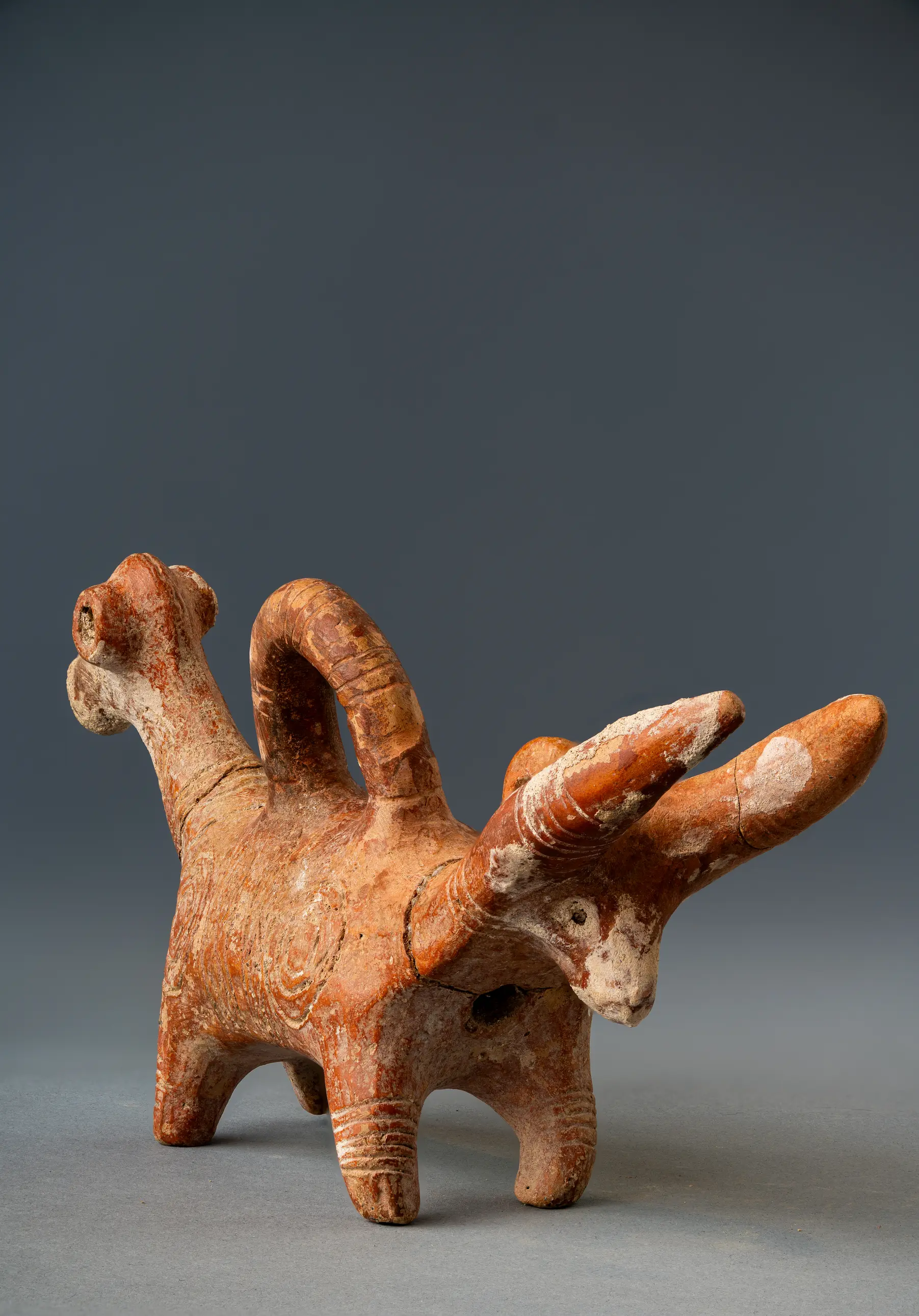
The collection's Red Polished two-headed animal askos shows where that line falls. It is catalogued on this site as a figurine, and to the eye it is one: a quadruped on four legs with a head at each end, one of them horned. It is also a vessel with a basket handle on its back, and by Karageorghis's rule a zoomorphic askos of the Early or Middle Bronze Age is ceramic material, outside his figurine groups [2, p. x]. Its comparanda and the argument about its second head are in Red Polished zoomorphic vessels and in the article The Bull Was a Newcomer.
Second, the series is a selection. Karageorghis said so in his preface: "This series is not a complete corpus, though all types and groups from known sanctuaries are included" [2, p. ix]. Herscher went further: the volumes are "in no sense a corpus but rather a selection", with "the grounds for inclusion" apparently "defined by the taste and experience of the author" [3, p. 81]. The absence of a piece from CAAC says nothing about whether it is typical.
Third, the later volumes change the sorting principle. Volumes IV to VI use "broad 'thematic' criteria: typological factors such as pose and associated attributes", and Volume VI follows "zoological or inanimate prototypes" [3, p. 81]. Volume V-A is organised in three chapters by manufacturing technique, Volume VI in four chapters by kind of creature [3, p. 82]. Herscher pointed out the boundary problems this creates: the male and female split sometimes rests on "the amount of jewelry worn, red spots on cheeks"; carts, ships and horses with riders are in Volume IV while those without riders are in Volume VI; the size line between Volume III and Volumes IV to VI is "not always hard and fast"; and the figurines from the single sanctuary of Ayia Irini are spread across Volumes II, III, IV and V [3, pp. 81–82]. A horse-and-rider figurine and a riderless horse of the same date and workshop will therefore be found in different books. The Late Bronze Age Base Ring bulls and nude female Astarte figures belong to the Volume II span.
Gjerstad's styles and why they no longer date anything
For Archaic and Classical sculpture, in terracotta and in limestone, the older vocabulary comes from the Swedish Cyprus Expedition. In his 1948 synthesis Einar Gjerstad used the terracottas from Ayia Irini as "the essential starting point for a new chronology, divided into 'styles' called 'Proto-Cypriote,' 'Neo-Cypriote,' and 'Archaic Cypro-Greek'"; for stone he added "Cypro-Egyptian" and, for the fifth and fourth centuries, "Sub-Archaic Cypro-Greek" and "Classical Cypro-Greek" [7, p. 23]. He described the Cypro-Egyptian style as "a pure imitative art, a Cypriote imitation of Egyptian prototypes", which "in consequence ... lacks a stylistic development" [8, p. 275].
The style names came with dates, and the published tables of those dates do not agree. Cornelius Vermeule tabulated Gjerstad's system as First Proto-Cypriote 620–560 BC, Second Proto-Cypriote 560–540, Cypro-Egyptian 570–545, Eastern and Western Neo-Cypriote 560–520, Archaic Cypro-Greek 540–480, and Sub-Archaic Cypro-Greek 500–450 [9, p. 287]. Derek Counts's 2001 table gives First Proto-Cypriote c. 620–560, Second Proto-Cypriote c. 560–540, Neo-Cypriote c. 550–520, a "Cypro-Archaic Style" c. 520–480, and Sub-Archaic c. 500–450 [10, p. 170]. The Neo-Cypriote start differs by a decade, and the 540–480 "Archaic Cypro-Greek" of one table has become a 520–480 "Cypro-Archaic Style" in the other.
The system itself has since been taken apart. Vermeule already argued in 1974 that Cypro-Egyptian was "more of an ethnic or social fashion than a chronological period", that the Cypro-Egyptian and Neo-Cypriote styles "might virtually disappear, mainly into the Archaic Cypro-Greek style", and that the bulk of the limestone from Golgoi and Idalion falls "around 520 to 480 B.C." [9, p. 287]. In their 2014 catalogue of the Met's Cesnola stone sculpture, Antoine Hermary and Joan Mertens concluded that "the categories proposed by Gjerstad for the Archaic period cannot be sustained" [7, p. 23]. They noted that the Egyptianizing features are, "at least partially, 'Phoenicianizing'", that Gjerstad's notion of style rested "on aesthetic presuppositions that exclude a large amount of material", and that Sabine Fourrier had shown the Ayia Irini "Proto-Cypriote" and "Neo-Cypriote" works "were actually contemporaneous. The first represent a local production of the kingdom of Soloi, the second are imports from Idalion or Salamis" [7, p. 23]. Finds from the Heraion on Samos, "in often well-defined stratigraphic contexts", led Gerhard Schmidt and others to new dates [7, p. 23].
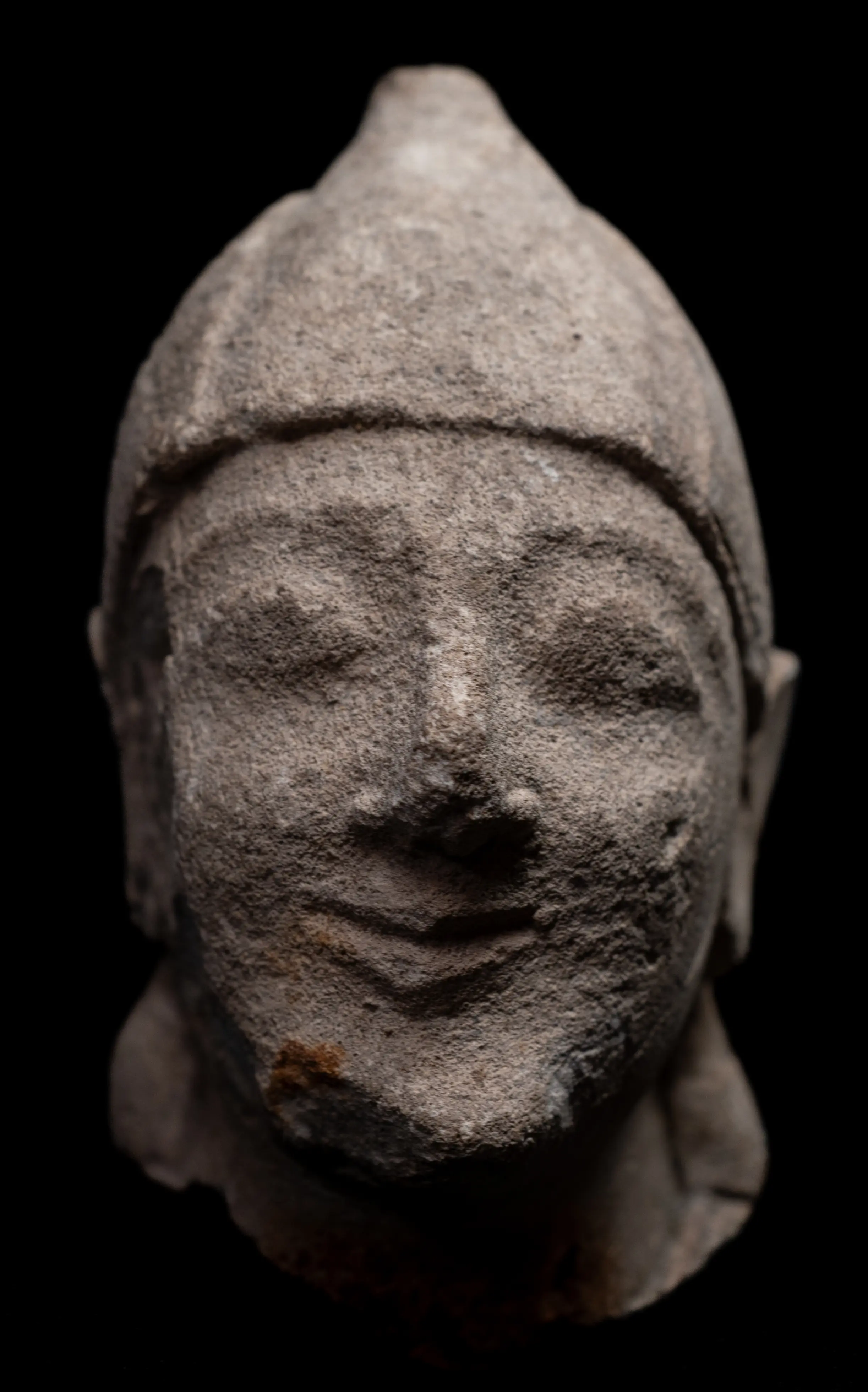
In practice, a Gjerstad style name on an older label is best read as a description of a workshop manner or a regional production, and its date range as a hypothesis that later work has revised. The hero image of this page, a 10 cm Archaic limestone votive head from the Chevallier-Verel collection, belongs to the class of material those names were built to sort. No published study has assigned it a Gjerstad style, and this page does not assign one. The limestone series is treated in Archaic limestone sculpture, with the Herakles-Melqart type and the temple boys under their own headings.
Technique terms: snowman, wheel-made, mould-made
Many Iron Age labels classify a terracotta by how it was made. Porphyrios Dikaios's guide to the Cyprus Museum explains the term "snowman": it describes Geometric figurines "modelled in the most elementary and childish manner which has earned them the label of 'snowman' technique", either solid or with "a tubular body on which the head, modelled by hand, is placed", found in tombs and shrines [11, p. 195]. The same guide places one group of "snow-man" figures in "the seventh or sixth century B.C." [11, p. 199]. The technique therefore spans the Cypro-Geometric and Cypro-Archaic periods, and the term describes a method rather than a date.
Handmade and wheel-made figures existed side by side. One survey describes Archaic small terracottas that were "still entirely hand-made by the 'snowman' technique", and others with "trumpet-shaped or conical bodies either solid and formed by hand or hollow and thrown on a fast wheel with a hand-made or moulded head" [12, p. 95]. The mould, according to Herscher's summary of Volume V-A, arrived "around the middle of the seventh century" and "led to a dramatic increase in the number of figurines, as mass production replaced small workshops" [3, p. 82]. The split between Karageorghis's Volumes V-A and V-B follows this line exactly: handmade and wheel-made females in one, mould-made in the other.
Three museum records show the terms in use. The British Museum's horse head 1884,1210.293, found at Goshi and dated Cypro-Archaic II, is described as "handmade in the 'snowman' technique". The Ashmolean's AN1989.508 is catalogued as a "mould-made terracotta figurine of a female" of the Cypro-Archaic period, presented by Major G. Williams in 1989, and falls in the territory of Volume V-B. The Met's horse and rider 74.51.1771, dated Cypro-Archaic I, c. 750–600 BCE, is a rider group of the kind Volume IV collects. The compendium's entry on snowman figurines covers the handmade votaries and musicians.
Orphanides: sorting by form
Orphanides's alternative for the Bronze Age takes form as the primary attribute and ware and style as secondary ones [1]. He recognises four major types: "(i) Inactive figurines (ii) Figurines of individuals holding infants (iii) ... in beds or cradles (iv) Active figurines", the last being figures engaged in scenes of daily life [1]. Each type is subdivided with letter and number codes. IA1 and IA3 include figures "with two or more heads"; IVA is bread-making, IVB ploughing, IVC transport, IVD riding horses (a Base Ring II type of Late Cypriot II), and IVF a gathering in an enclosure, with the Vounous Tomb 22 model no. 26 as its example [1]. The enclosure model is discussed under Bellapais-Vounous.
The scheme has one practical merit worth copying. Under each type Orphanides lists "Figurines of Known Provenance" separately from other references and figurines of uncertain provenance [1]. A reader can see at once which part of the type rests on excavation and which on the market.
How to read a museum label
A well-made label lists name, material with ware, dimensions, period with date range, context, and collection with inventory number. The 2012 Cyprus Museum exhibition catalogue Ancient Cyprus: Cultures in Dialogue gives clean examples. One reads: "Female bird-faced figurine holding an infant / Clay (Base Ring II ware) / H. 20.5 cm / Late Cypriot II period (15th–14th c. BC) / Cyprus, archaeological context unknown / Cyprus Museum, 1934/IV-27/23" [6, cat. no. 254]. The ware name is the first classification, the period with its date range the second, and "archaeological context unknown" states plainly that the date is typological. The next entry, a mould-made female figurine, gives its context as "Tamassos-Chromatouthkia, Tomb II" and its number as "Cyprus Museum, 1935/C 416" [6, cat. no. 255]. Cyprus Museum numbers usually include the year of registration, as Winkelmann notes [4, pp. 26–27]; the rest of the number is the museum's own register reference and does not encode a type.
The Metropolitan Museum gives period and date span in its online records, for example "Cypro-Archaic I, ca. 750–600 BCE" for the horse and rider 74.51.1771, with the credit line "The Cesnola Collection, Purchased by subscription, 1874–76". That credit line matters for the find-spot: John Myres "considered the information about findspots provided by Cesnola unreliable" [7, p. 22]. A Cesnola label naming Golgoi or Idalion is the collector's attribution, not an excavation record; Luigi Palma di Cesnola has his own page.
Names can mislead too. One dealer's inventory traded under the name "Cyprus Museum (Jacksonville)", and at least one listing offered a Cypro-Archaic terracotta described as coming "from the Turkish-controlled area of northern Cyprus". A label or invoice that says "Cyprus Museum" needs checking against the inventory format above; a Nicosia register number such as 1934/IV-27/23 is a different thing from a dealer's stock number. The legal background is covered in collecting Cypriot antiquities today and looting in occupied northern Cyprus.
Standing cautions
Four problems recur across all the systems.
The first is authenticity. Winkelmann warns that illicit digging "opens the door to art forgeries", that "all objects of uncertain or unknown origin are treated with caution", and that "some forgeries might be included in the corpus" because "it is not always possible to identify fakes with absolute certainty" [4, pp. 26–27]. Ellen Herscher made the same point about the Karageorghis series: publishing so much material without provenience "raises difficult issues of authenticity and/or Cypriot origin", and Karageorghis himself conceded that a group he had earlier published as Cypriot was doubtful [3, pp. 83–84]. She also criticised the loose use of "provenance uncertain" beside "provenance unknown" [3, pp. 83–84].
The second is stylistic dating. "Few pieces were found during controlled excavations", Herscher wrote, "so most of his attributions are based on stylistic assumptions"; ship models had been dated to the Late Cypriot, Cypro-Geometric or Cypro-Archaic periods by different authorities [3, p. 83]. Her example is a pair of bull figurines, one from Skales Tomb 81 no later than Cypro-Archaic I and a similar one from Amathus no earlier than Cypro-Archaic II: "this simple style does not change drastically from the CA I to the CA II" [3, p. 83].
The third is the difference between the date of a context and the date of an object. Goring's point, quoted by Winkelmann, that an excavated date "refers to the context rather than to the figurine" applies to every period [4, p. 25]. A figurine can be older than the tomb or deposit it came from.
The fourth is fragmentation of excavated groups. Thematic sorting breaks up assemblages: the Ayia Irini figurines, found together, are divided across four volumes, which makes it hard to see a sanctuary deposit as a whole [3, p. 82].
Where to go next
The compendium's figurine entries follow the chronology. For the Neolithic and Chalcolithic, with Winkelmann's N and C numbers, start with Neolithic and picrolite figurines and cruciform figurines. For the Early Bronze Age and Middle Bronze Age, CAAC I and Orphanides, read plank figures, stone plank figures and Red Polished zoomorphic vessels. The Late Bronze Age, CAAC II territory, has Astarte figures and Base Ring bulls. The Iron Age terracottas of CAAC IV to VI are in snowman figurines and horse-and-rider figurines, and the stone sculpture once sorted by Gjerstad's styles is in Archaic limestone sculpture, Herakles-Melqart and temple boys. The full list is on the statues hub.
Objects on this page
References
- 1.Orphanides, A. G. (n.d.). A classification of the Bronze Age terracotta anthropomorphic figurines from Cyprus.
- 2.Karageorghis, V. (1991). The coroplastic art of ancient Cyprus: I. Chalcolithic–Late Cypriote I. A. G. Leventis Foundation.
- 3.Herscher, E. (2000). [Review of the books The coroplastic art of ancient Cyprus V(A) and VI, by V. Karageorghis]. Bulletin of the American Schools of Oriental Research, 317, 81–84. https://www.jstor.org/stable/1357489
- 4.Winkelmann, C. (2020). The Neolithic and Chalcolithic figurines of Cyprus. Zaphon.
- 5.Fourrier, S. (2007). La coroplastie chypriote archaïque: Identités culturelles et politiques à l'époque des royaumes. Lyon. https://www.persee.fr/doc/mom_1955-4982_2007_mon_46_1
- 6.Pilides, D., & Papadimitriou, N. (Eds.). (2012). Ancient Cyprus: Cultures in dialogue. Department of Antiquities, Cyprus.
- 7.Hermary, A., & Mertens, J. R. (2014). The Cesnola Collection of Cypriot art: Stone sculpture. The Metropolitan Museum of Art.
- 8.Gjerstad, E. (1948). The Swedish Cyprus Expedition, Vol. IV, Part 2: The Cypro-Geometric, Cypro-Archaic and Cypro-Classical periods. The Swedish Cyprus Expedition.
- 9.Vermeule, C. (1974). Cypriote sculpture, the Late Archaic and Early Classical periods: Towards a more precise understanding. American Journal of Archaeology, 78(3), 287–290. https://www.jstor.org/stable/503149
- 10.Counts, D. (2001). Prolegomena to the study of Cypriote sculpture. Cahiers du Centre d'Études Chypriotes, 31.
- 11.Dikaios, P. (n.d.). A guide to the Cyprus Museum. Department of Antiquities, Cyprus.
- 12.Footprints in Cyprus: An illustrated history (n.d.).