
The Bull Was a Newcomer: A Two-Headed Bronze Age Vase from Cyprus
A handmade clay animal from around 2000 BC carries a bull's head at one end and a long-eared head at the other. Both beasts had reached Cyprus only a few generations earlier, and the vase records the new world they made far more clearly than it explains why its potter gave it two heads.
Alexis Drakopoulos
June 10, 2026·Artifact · Ceramics · Archeology·15 min read


Share


Alexis Drakopoulos is a Greek Cypriot Machine Learning Engineer working in Financial Crimes. He is passionate about Archeology and making it accessible to everyone. About Me.
A head at each end
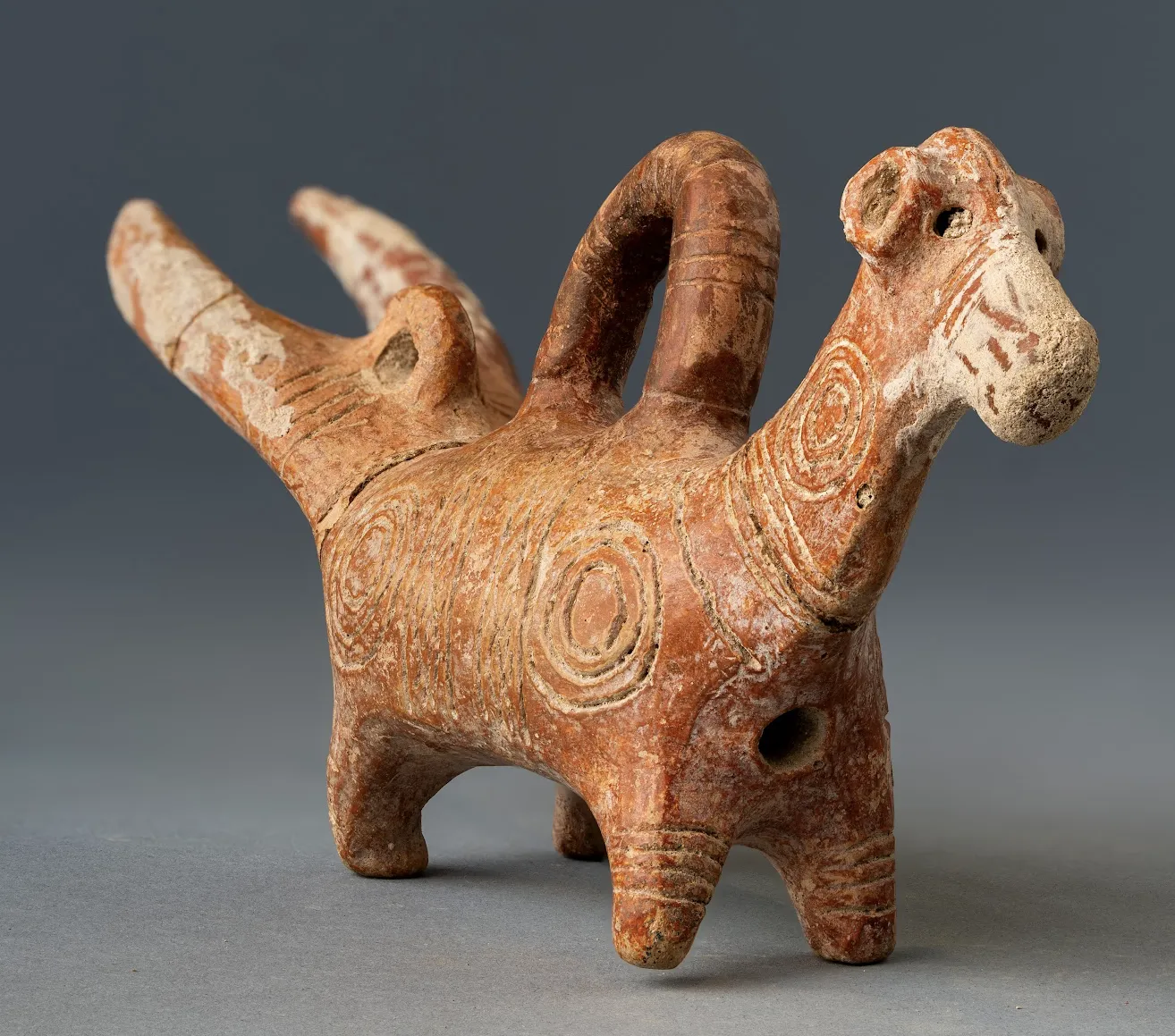
The animal is about the length of a forearm, and which animal it is depends on which end you pick up. One end is a bull: a broad long muzzle, two long horns, drilled eyes and a long neck. The other end of the same body is longer and narrower, with two diminutive ears represented by drilled holes. A single loop handle arches over the spine, four stub legs hold the belly off the table, and the red burnished skin is cut all over with concentric circles and bands of hatching, every groove packed with a chalk-white paste so the design reads cream against rust. Each of the two necks carries an old, crude repair, the place where a head was broken from the body and joined back on long before the vase reached me.
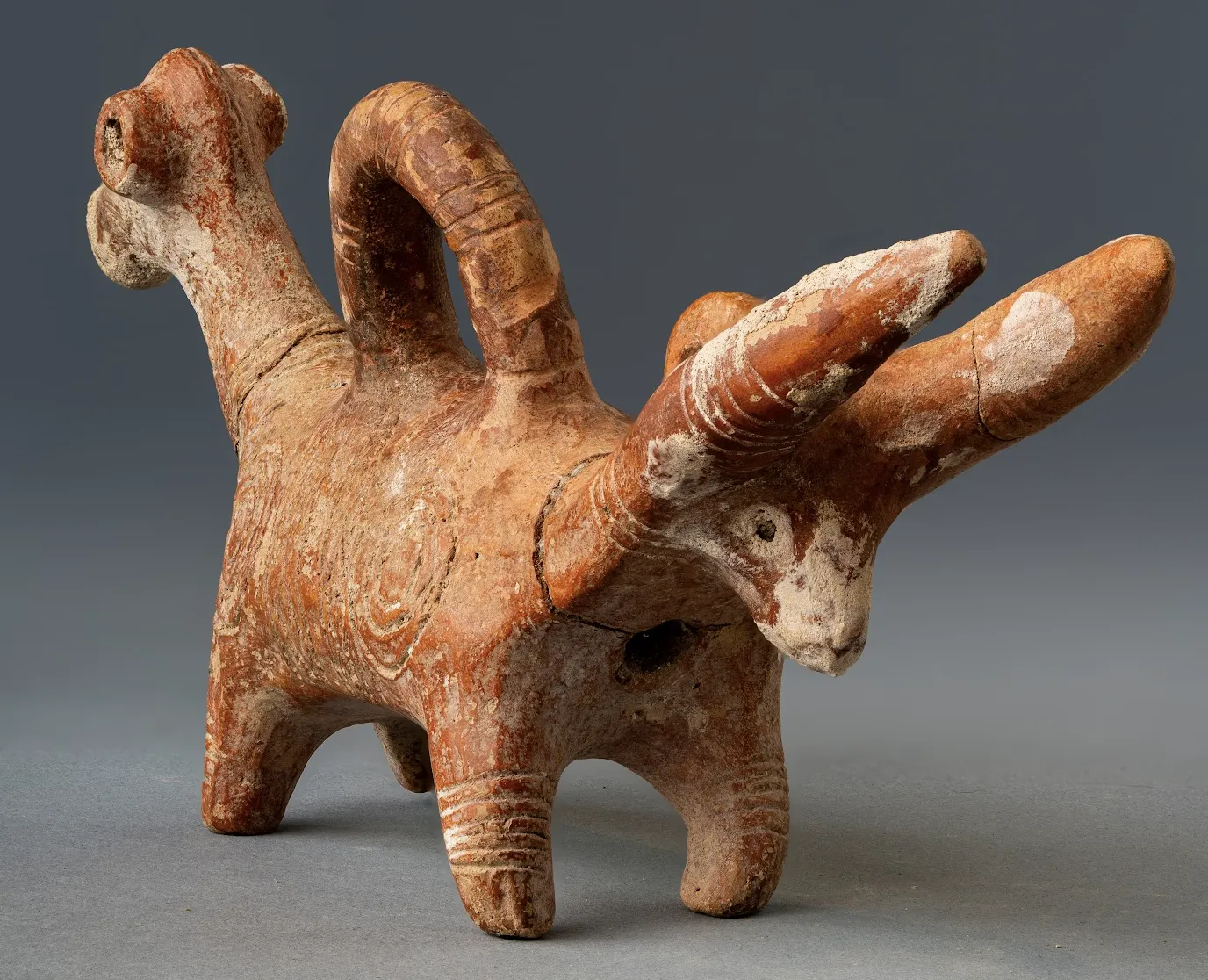
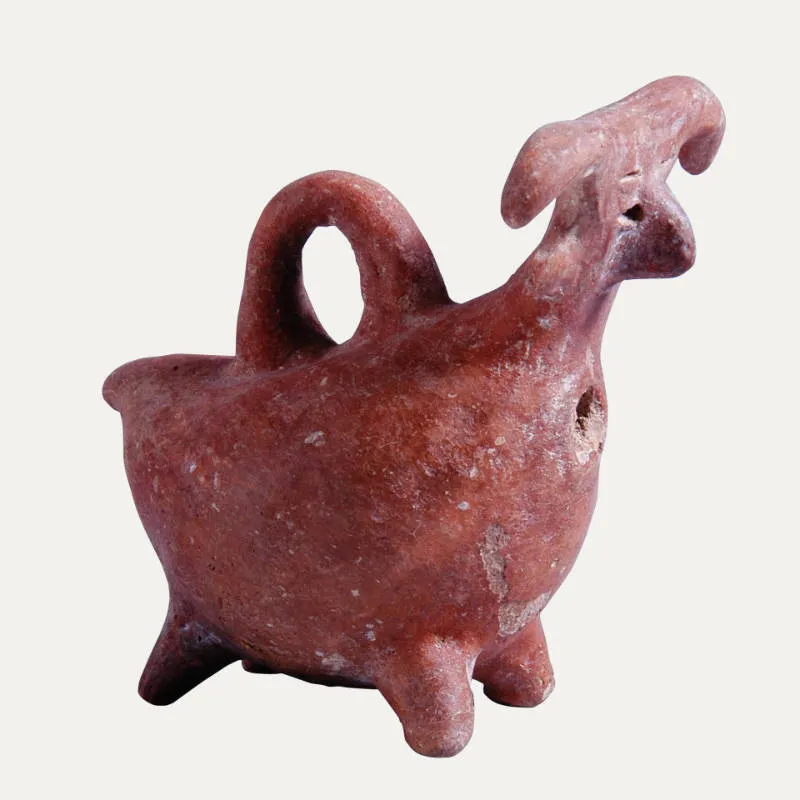
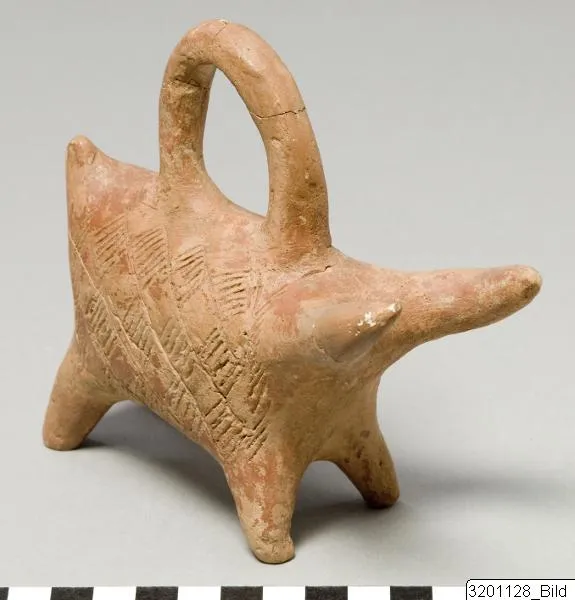
The body is hollow and the handle is made to be lifted, and a hole is pierced through each neck, one at the mouth of each head. A pourer usually has a single spout; two open holes make an awkward container, harder to fill without spilling and impossible to stop, which is the first sign that holding liquid was never quite the point. Cypriot potters of the Early and Middle Bronze Age made a great many such animal-shaped pourers, and modern scholars borrowed the Greek word for a leather wineskin, askos, to name them. [2] The single-headed kind, almost always a bull, is common enough to stand in most museum cases of Cypriot pottery. The kind with a different animal at each end is rare. This is the rare kind: handmade, made somewhere around 2000 BC, sold by an antiquities dealer in Cyprus as a Red Polished animal askos of about 2100 to 1850 BC, and now sitting in our collection.
The twin in Oxford
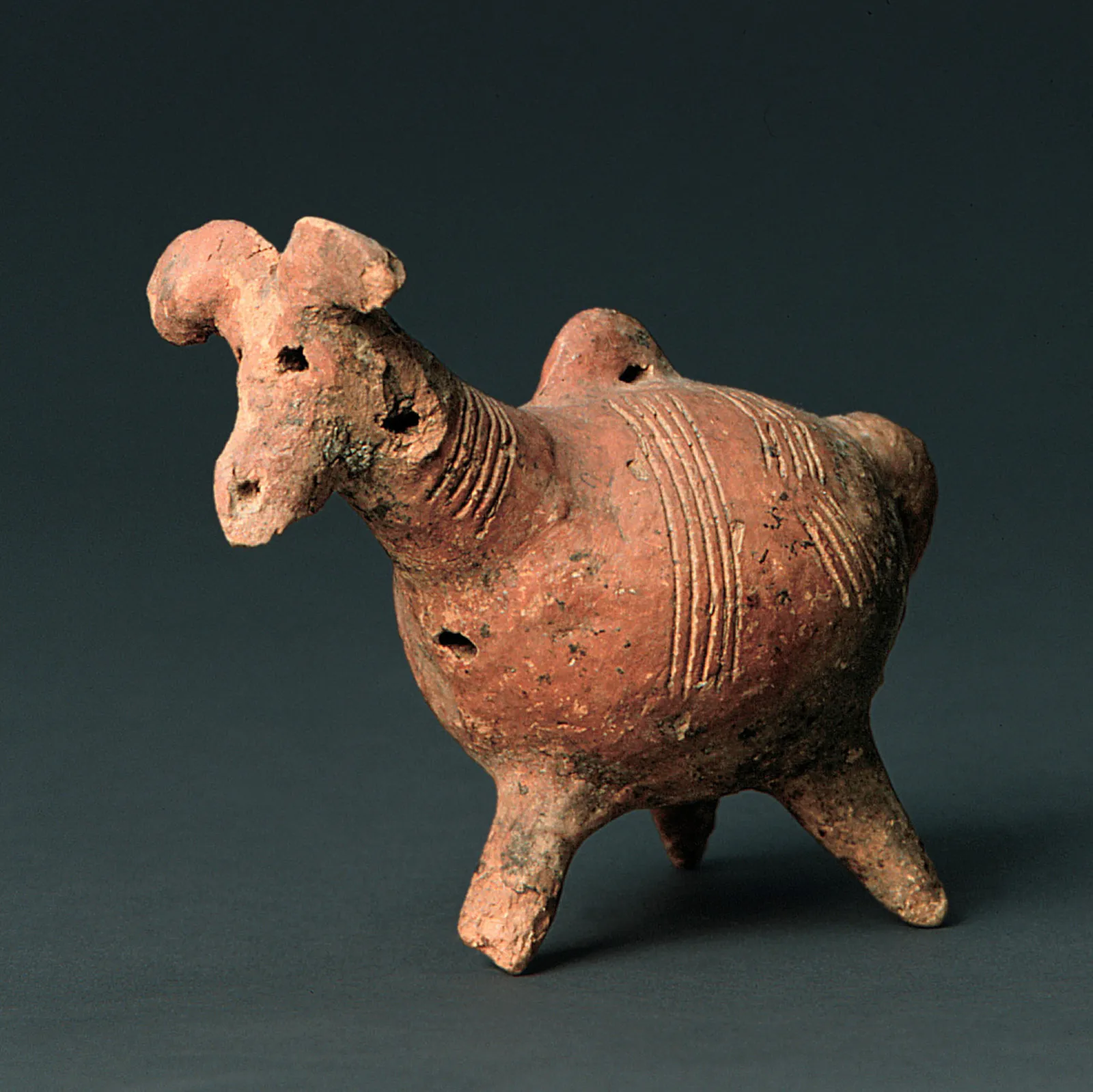
It is not unique, which is the first useful thing to know about it. The Ashmolean Museum in Oxford holds a near twin, catalogued as AN1971.856 and dated, on its own evidence, to the same window of about 2100 to 1850 BC. [15] The Oxford vessel has the same barrel body on short legs, the same loop handle, the same flanks studded with white-filled concentric circles. It too carries two different heads. At one end a bull; at the other, a stag.
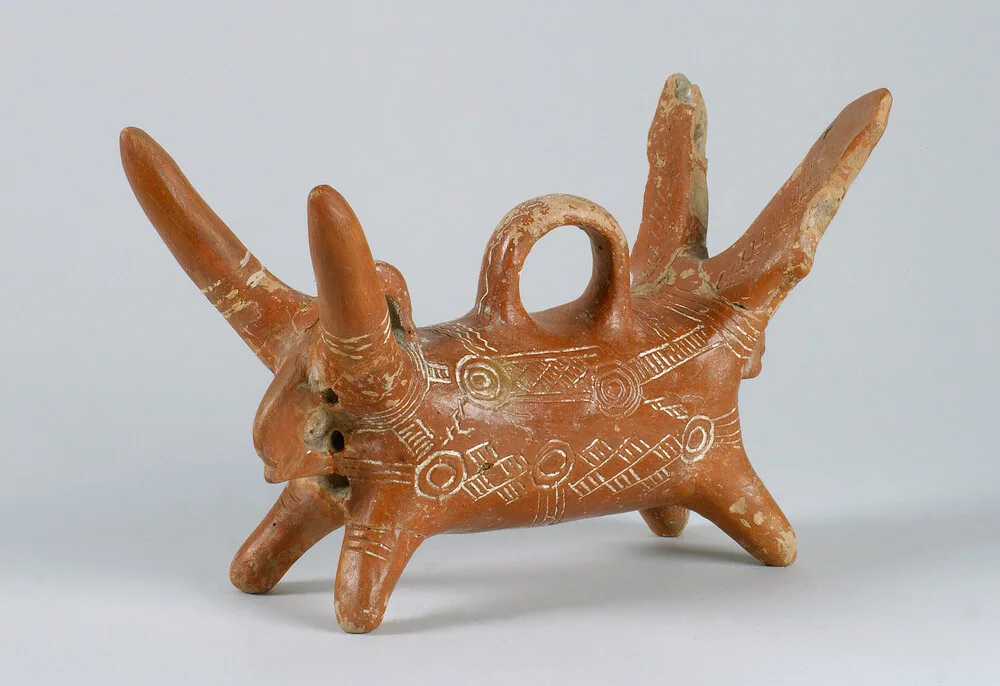
When Ann Brown and Hector Catling published the Oxford piece in 1980 they offered one sentence of interpretation that has shadowed the whole class ever since. The combination of bull and stag, they wrote, suggests "an exceptional interest in potency." [1] Two large horned animals, doubled on one body, read as a sign of strength and increase. It is a tidy reading, and almost everything else about the object works to complicate it. The complications begin with the animals.
Both animals were newcomers
The bull is the easiest head to name and the strangest to find here, because for most of the island's past there were no cattle on Cyprus at all. The first farmers reached the island by sea around 8000 BC and brought cattle with the rest of their livestock; then, within a thousand years or so, the cattle vanished. Through the long Neolithic and the Chalcolithic that followed, Cyprus had pigs, sheep, goats and fallow deer, and no cattle. [5] They returned only at the threshold of the Bronze Age, a few centuries before this vase was made. At Sotira-Kaminoudhia, a south-coast settlement of the late third millennium, cattle bones are abundant, by one count more than half of the identified animal bone in the deposit. [5]
They came back as working animals. With the cattle came the ox-drawn plough, the most consequential tool of the new age, and with it the wider change the archaeologist Andrew Sherratt named the secondary-products revolution: animals kept alive for their traction, milk and wool rather than killed for meat. Bernard Knapp argued that Cyprus, long bypassed by these innovations, took up the whole interlocking change at the Chalcolithic-to-Bronze-Age transition, when the cattle-and-plough complex opened the heavier soils of the central plain to farming. [4] A plough-ox was the most expensive single animal a household could own, a piece of capital as much as a beast. The image of a bull, in a society that had owned no cattle within living memory of its grandparents, was the image of new wealth and new power.
The donkey arrived in the same horizon and for the same kind of practical reason. It was a pack animal, suited to carrying loads over rough ground, and its first appearance tracks the intensifying extraction of copper from the Troodos mountains, where ore had to be hauled across awkward country. [6] One point of chronology matters here and rules out a tempting mistake. There were no horses on Cyprus this early. Secure evidence for the horse does not appear until the Late Bronze Age, centuries after this vase. [6] So the long-eared head, if it is an equid at all, is a donkey and never a horse, and a donkey would make the object a portrait of the two beasts that did the heavy new work of the island: the plough-ox and the pack-ass.
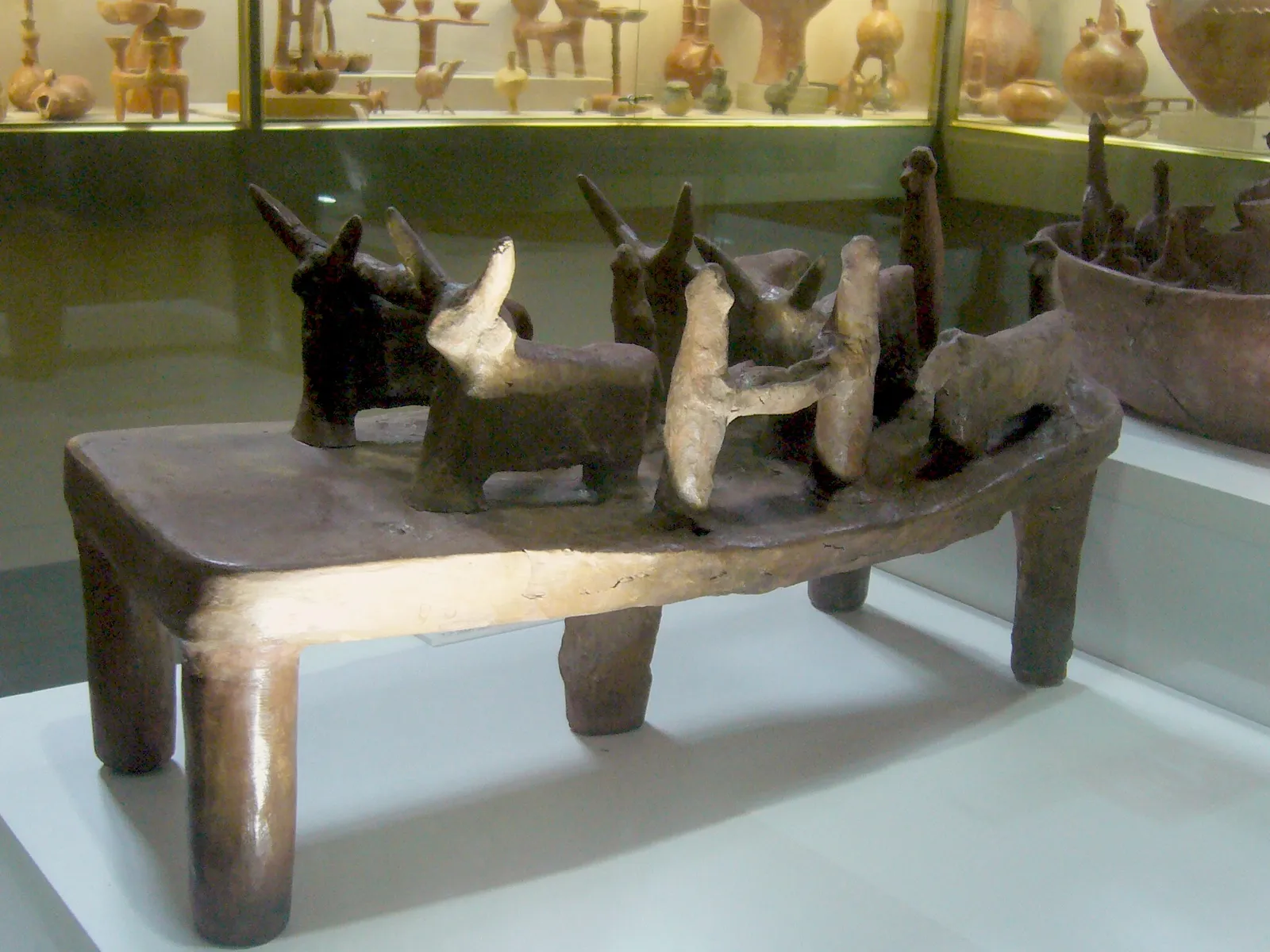
The clay record shows them side by side. The most famous Cypriot object of the period is a model from a tomb at Bellapais-Vounous, on the north coast, of two pairs of oxen drawing hook-ploughs, a man walking behind each, two more figures carrying seed for sowing, and a loaded pack animal bringing up provisions. [8] The bull and the donkey of this vase are the two ends of that scene, compressed into one body.
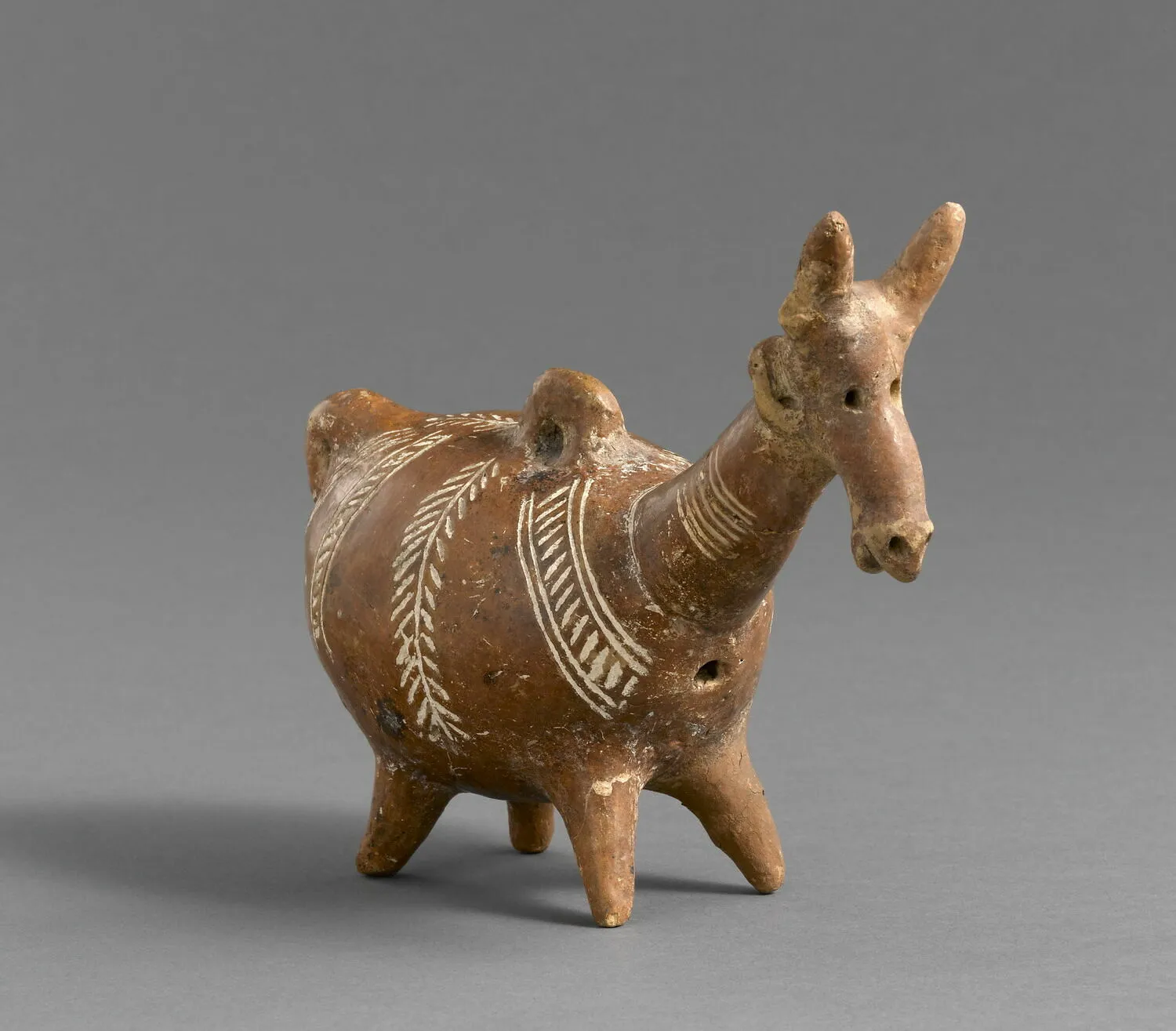
The second head, though, may not be a donkey, and the people who catalogue these vases are honest about why. The modelling is too rough for certainty. Bull, stag, goat, donkey and "unidentifiable quadruped" trade places on near-identical bodies, with only the head changing, and Desmond Morris, who assembled the largest private study of this material, warned that the diagnostic features, the ears and the tail, are usually lost or so reduced that they cannot be trusted. [3] The Ashmolean settled the same ambiguity by calling its second head a stag. On my piece the ears lean toward a donkey and the published parallels lean toward a deer, and the defensible answer is that it is a bull paired with one or the other. That ambiguity is itself worth holding onto. The maker was emphatic about giving the animal two heads and careless about which second animal it was.
Made for the grave
This vase has no find-spot. Like almost the entire class, it surfaced on the market without a record of where it came out of the ground, which means everything said about it is an argument from comparison rather than a fact from a tomb. But the comparison is consistent: where these objects do have a context, it is nearly always a tomb. The figurative Red Polished vases cluster in the rock-cut chamber cemeteries of the north coast, at Vounous and Lapithos, set a few hundred metres from the settlements of the living. [11]
What happened at those graves was not a quiet burial. Priscilla Keswani's study of Bronze Age Cypriot mortuary practice describes a long, escalating programme of funerary display: collective tombs reopened and rearranged over generations, the dead given more and richer goods as the stakes rose between families. [7] Animals were central to it. Cattle, sheep and goat bones turn up in roughly a third of the Vounous tombs, some carrying butchery marks and unextracted marrow, meaning joints of meat were offered with the flesh still on and the rest of the sacrificed animal eaten by the mourners at the graveside. [7] The most expensive animal a household owned was killed and partly consumed to bury its dead.
Against that background the vases behave oddly. They show almost no wear. Studies of the figurative pottery found that many elaborate pieces have little or no use-damage and shapes too awkward for everyday handling, which points to objects made for the funeral rather than used in life. [10] [11] This one argues against its own usefulness: pierced at both ends, it would weep from one hole while being tipped to pour from the other, a poor way to carry oil or water. What they were meant to hold, if anything, remains unknown. A hollow askos with a working spout could pour a libation slowly, which is the function most often proposed; whether any individual example was ever filled is another matter, because no one has yet run a residue analysis on a Cypriot animal askos to find out what, if anything, was inside. [10] The single test that could settle the question has never been done.
The doubling habit
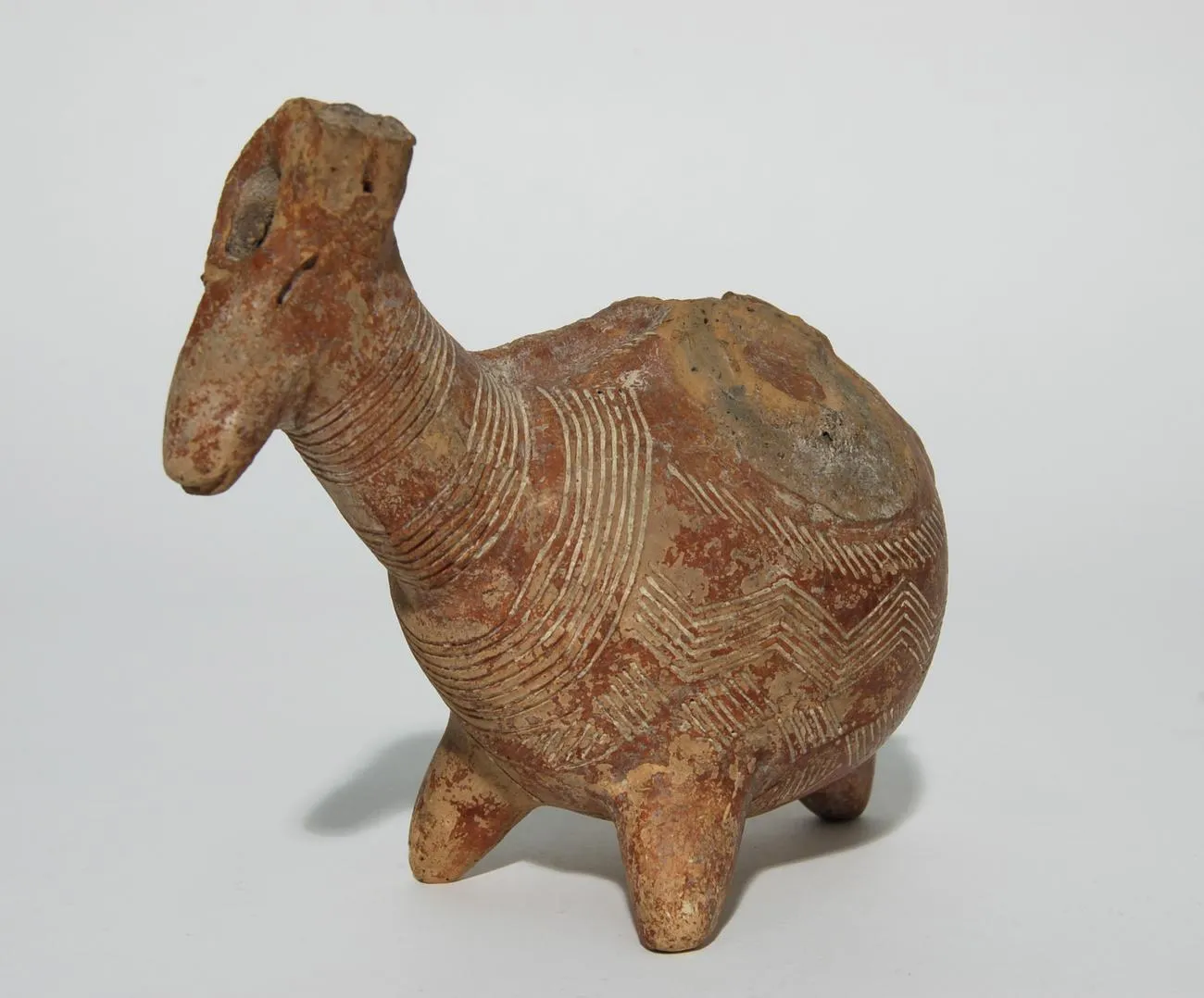
So why two heads. The least mystical answer is that doubling was a habit of these potters, not a special event. Diane Bolger calls the tendency a kind of "visual stammer," a reflex for duplicating things, that runs across the period's pottery and figurines. [9] The same workshops made jugs with two and three necks, jugs with a neck rising from each end of a horizontal body, and flat human "plank" figures with two or three heads on one slab; among the surviving planks, nearly a third are multi-headed. [3] [9] A quadruped with a head at each end is the animal version of the same move.
The proposed meanings are many, and that is the problem. The two heads have been read as a doubling of potency, as a guard against the evil eye, as a sign of completeness or all-seeing power, as a charm for twins, and as a divine couple in a sacred marriage. [3] [9] Every one of these is a proposal and none is demonstrated, and the strongest single observation in the literature dissolves most of them at once. Morris, looking at vessels that carry goats mixed with deer and bulls mixed with both, concluded that "almost any powerful horned head will do and that the specific type of ungulate involved is almost irrelevant." [3] If the species barely matters, the object is unlikely to be encoding two named gods. The message, if there is one, is closer to "powerful animals, doubled" than to a sentence we could translate.
The grander readings still circulate, and it helps to see where they came from. Porphyrios Dikaios, who excavated Vounous in the 1930s, read the great scenic vessels of the cemetery as proof of a developed Early Bronze Age religion: a Mother Goddess, a Snake God, a Divine Bull, with temples and organised rites. [8] That framework, fused later with Jacqueline Karageorghis's project to trace the prehistory of Aphrodite, became the standard way of talking about Cypriot figurines for half a century. The modern literature has largely taken it apart. Daisy Knox notes that the field still works "in the shadow of Aphrodite," and points out that one influential book in the Goddess tradition was partly sponsored by the Cypriot Tourism Organisation. [10] No sanctuary of this period has ever been excavated on Cyprus; there is no site, no text, no securely identified deity to attach the bull or the doubling to. [11] The honest position is that the meaning was real to the people who made and buried these things, instantly legible to them, and is now out of reach.
A skin of circles
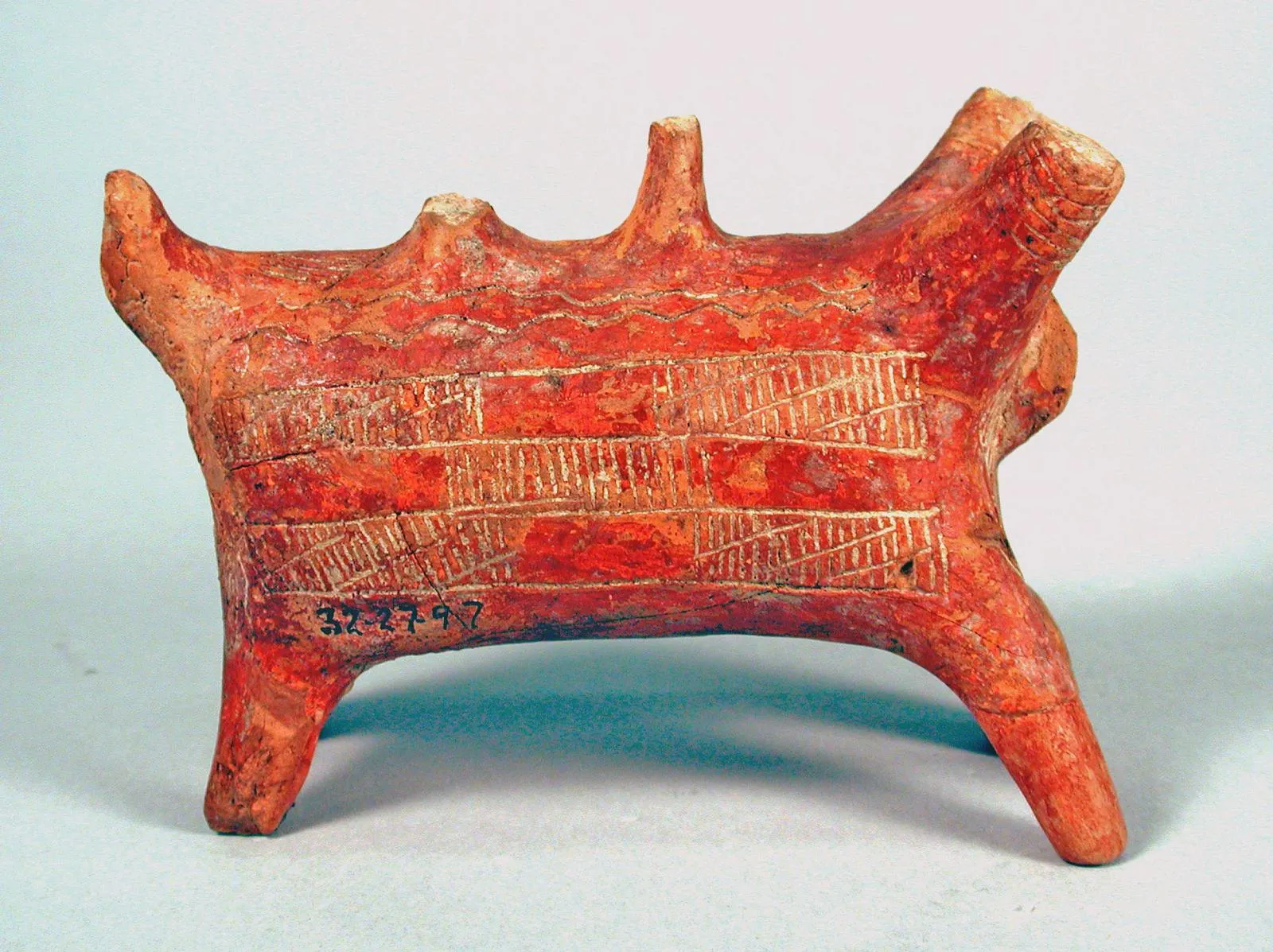
The decoration carries more certain information than the heads do. Fine, white-filled incision over a red burnished slip is a north-coast speciality, the signature of the Vounous and Lapithos workshops, and it dates the object as firmly as anything can: the dense, all-over incised style belongs to the end of the Early Cypriot and the start of the Middle, around 2100 to 1750 BC in calibrated terms, which is exactly where the dealer and the Ashmolean both placed their pieces. [12] The white in the grooves is not paint but a paste of chalk and limestone, sometimes with burnt bone ground into it, rubbed in after the pot was fired so the lines stood out against the dark ground. [13]
The lead motif, here as across the ware, is the concentric circle, drawn freehand. Morris found that telling: the circle is the hardest of all these patterns to draw cleanly by hand, yet it is the one the potters used most, which made him suspect it carried some weight beyond decoration, perhaps solar, perhaps an eye set there to outstare the evil eye. He then talked himself out of it, since the Cypriot circles do not keep the paired "eyeness" that a real eye-motif needs. [3] One older idea has held up better as analogy: that the banded, zig-zag, white-filled patterns imitate the stitched seams of leather originals, the pots standing in for skin bags. A Vounous flask in the Harvard collections is labelled exactly this way, its white zig-zags read as the seams of a leather flask formed over a gourd. The circles on my animal's flanks may be a potter's freehand bravura, or an old protective sign, or the ghost of stitching. The grooves are deep and certain; what they meant is not.
The breaks at the necks
Which returns to the two repairs. The necks are the weak point of an animal like this, the thin bridges between a heavy body and a projecting head, and on this vase both of them have been broken and mended. The mends are crude, and they are old: they were already on the piece when it entered the Drakopoulos collection. Breaks in exactly these places are what a genuine, fragile figurine suffers first, when a head knocks against the wall of a tomb or the side of a crate. They are also, awkwardly, where a forger would work. A two-headed animal is precisely the object someone would want to manufacture, and the method is plain once stated: take an ancient body and an old loose head, or two ancient ends, and join them at the neck with the repair dressed to look old. [14] Red Polished zoomorphic vessels are, by repeated expert testimony, among the most faked and "improved" categories of Cypriot antiquity, partly because every genuine one is handmade and slightly different, so a one-off form raises no alarm. [14] The two restored necks are where any examination would have to start.
That is not an accusation against the object, which is typologically at home in every respect that can be checked from a photograph: the form, the two-animal scheme, the decoration and the date all have well-published parallels, the Oxford twin chief among them. It is a statement of what is not yet known. Thermoluminescence could test when the clay was last fired; it cannot catch an old head married to an old body, or a modern surface worked over ancient clay. The questions that would settle the matter, a specialist's look at the fabric inside each neck break and a firing date, remain open, as they do for most of this class.
So the animal sits on the desk with its two faces turned away from each other, a bull that reached the island a few generations before it was made and a long-eared beast that came with the copper trade, both rendered with care and neither quite saying why they share a body. The two most informative points on it are the two least settled: the broken necks, mended by some earlier hand, where each head meets the body they share.
References
- 1.Brown, A. C. & Catling, H. W. (1980) Ancient Cyprus. Oxford: Ashmolean Museum (no. 22, the bull-and-stag zoomorphic vessel AN1971.856).
- 2.Karageorghis, V. (1991) The Coroplastic Art of Ancient Cyprus I: Chalcolithic – Late Cypriote I. Nicosia: A. G. Leventis Foundation.
- 3.Morris, D. (1985) The Art of Ancient Cyprus, with a Check-list of the Author's Collection. Oxford: Phaidon.
- 4.Knapp, A. B. (1990) 'The Prehistoric and Protohistoric Cypriote Bronze Age: A Review,' Current Anthropology 31(2): 147–176.
- 5.Steel, L. (2004) Cyprus Before History: From the Earliest Settlers to the End of the Bronze Age. London: Duckworth (faunal data after Croft and Swiny).
- 6.Recht, L. 'Equids at the End of the Bronze Age on Cyprus' (donkey introduced in the Philia phase; horse not securely attested until Late Cypriot II).
- 7.Keswani, P. S. (2004) Mortuary Ritual and Society in Bronze Age Cyprus. London: Equinox; and (2005) 'Death, Prestige, and Copper in Bronze Age Cyprus,' American Journal of Archaeology 109: 341–401.
- 8.Dikaios, P. (1940) The Excavations at Vounous-Bellapais in Cyprus 1931–1932. Archaeologia 88.
- 9.Bolger, D. (2003) Engendering Aphrodite: Women and Society in Ancient Cyprus; and 'Sexual Ambiguity in Plank Figures from Bronze Age Cyprus.'
- 10.Knox, D.-K. (2012) Making Sense of Figurines in Bronze Age Cyprus, PhD thesis, University of Manchester; and (2017) 'Mediterranean — Cyprus,' in The Oxford Handbook of Prehistoric Figurines.
- 11.Steel, L. (2013) 'The Social World of Early-Middle Bronze Age Cyprus: Rethinking the Vounous Bowl,' Journal of Mediterranean Archaeology 26(1): 1–22.
- 12.Manning, S. W. (2014) 'A New Radiocarbon Chronology for Prehistoric and Protohistoric Cyprus, ca. 11,000–1050 Cal BC,' in A. B. Knapp (ed.), The Archaeology of Cyprus. Cambridge: Cambridge University Press, 477–533.
- 13.Coleman, J. E. et al. (1996) Alambra: A Middle Bronze Age Settlement in Cyprus, 298 (white fill of chalk, limestone and calcined bone, after Barlow 1994).
- 14.Gill, D. W. J. & Chippindale, C. (1993) 'Material and Intellectual Consequences of Esteem for Cycladic Figurines,' American Journal of Archaeology 97: 601–659; Herscher, E. (1998) review of Karageorghis, The Coroplastic Art of Ancient Cyprus, AJA 102.
- 15.Ashmolean Museum, Oxford, AN1971.856 — 'Zoomorphic vessel with stag-head on one end and bull head on opposite end,' Early Cypriot III – Middle Cypriot I, c. 2100 – c. 1850 BCE.