
Contents
Most plank figures of Early and Middle Bronze Age Cyprus are clay, made "from the same wares used for ceramic vessels", chiefly Red Polished [1, p. 8]. A small group was carved in stone. The Museum of Cycladic Art in Athens, which holds the largest set, calls plank figures "of whitish chalk (or other stones, such as limestone or gypsum)" "very rare", and puts them in "the same category as the clay plank figurines of Red-Polished Ware" [2]. The stone figures are larger: Knox gives stone heights of 22 to 81 cm with a mean of 53 cm, and Falconer, Monahan and Fall set that against a ceramic mean of 22 cm [3, p. 251; 1, p. 9]. The published corpus stands at fourteen: four from recorded excavations of the 1930s (two of them lost), one excavated in a settlement in 2011, and nine with no recorded find-spot. Clay typology, decoration, contexts and meaning are in the main plank figures entry.
Material, size and form
The sources name three stones, gypsum, whitish chalk and limestone, and often disagree about which one a given figure is made of. Jennifer Webb points out that "Gypsum is a relatively fragile material and such figures may have been more common" than the surviving count suggests [4, p. 249].
Size affected how the figures were used. Christou notes that the large stone planks "are not self-supporting: this suggests they were placed against a wall or pillar for support, or perhaps embedded in the ground" [5, p. 46].
Falconer and colleagues sorted the stone figures using two of Desmond Morris's form types. A "Shoulder Figure" has its head and neck as a small rectangle set on a broader body. A "Slab Figure" has arm stumps, and its head, neck and body are all the same width [1, p. 10]. The two figures from Vounous "accord with" the Shoulder type "but lack ear protrusions", and the plans of the Lapithos figure also point to a Shoulder type. Six of the seven figures in the Zintilis Collection are Slab Figures [1, p. 10]. Most stone planks are plain or painted. The small clay planks, in Christou's words, are "usually heavily incised" [5, p. 47].
How many are there?
Only one published count exists, in the 2014 paper that announced the Politiko figure: "Prior to the excavation of the Politiko-Troullia limestone figure, only 13 stone plank figures had been reported from Cyprus, of which only 4 are associated with established excavation contexts" [1, p. 9]. The breakdown is two from Vounous Tomb 2, two from Lapithos Tomb 322 Chamber D (both lost), seven in the Zintilis Collection, and two in private collections [1, p. 9]. Adding the Politiko-Troullia figure gives fourteen.
Earlier writers give lower numbers. Morris in 1985 gave no total, saying only that "A few other stone-carved Plank Figures do exist", and that the Vounous pair were "the only two in the classic 'shoulder' shape" [6, p. 138]. Vassos Karageorghis, in the first volume of his corpus of Cypriot coroplastic art (1991), knew of one stone example in a private collection and "two more stone examples in the Zindilis Collection, Amsterdam, 81cm. and 51.5cm. high respectively" [7, p. 58]. By 2012 Knox was writing of "The seven chalk Plank Figurines from the Zintilis collection" [3, p. 86]. So the Zintilis group grew in the literature from two published pieces to seven in about twenty years. The Lapithos pieces survive only in an excavation list and on a tomb plan. Whether the second Lapithos stone counts as a plank figure at all is open to question (see below). Surface fragments from Kidasi have been proposed as planks and disputed [1, p. 9]. Finally, no study has published a list of the class with one entry per object, so every total depends on which borderline pieces a writer includes.
Talalay and Cullen's summary of a Campo's corpus of 40 complete or nearly complete planks shows how. It includes "the 0.70 m figure, an undecorated stone example from an unusually large and richly provided tomb at Lapithos-Vrysi tou Barba" [8, p. 184]. That size matches the 70.4 cm "oblong menhir" from Lapithos Tomb 322D, which the excavator listed separately from the "plank-shaped idol" in the same chamber [9, p. 150]. The match between the two is this entry's inference. We know of no source that equates them.
The table lists the figures described individually in the literature. Four more Zintilis figures and the two pieces in private collections are counted in the total but not itemised.
| Figure | Material (as reported) | Size | Find-spot | Present location |
|---|---|---|---|---|
| Vounous Tomb 2, nos. 14 and 15 | Gypsum (Dikaios, Morris, Webb); limestone (Falconer et al.) | L. 0.25 and 0.22 m | Bellapais-Vounous, Tomb 2 | Not established in published accounts |
| Lapithos Tomb 322D, no. 2, 'plank-shaped idol' | Local marble (Sjöqvist); gypsum (Webb) | c. 35 cm, estimated from the plan | Lapithos-Vrysi tou Barba, Tomb 322, Chamber D, floor | Lost (SCE); reported stolen (Falconer et al.) |
| Lapithos Tomb 322D, no. 4, 'oblong menhir' (status as a plank doubtful) | Local stone | L. 70.4 cm | Same chamber, floor | Not known to survive |
| Zintilis Ζ0576 | Whitish chalk (MCA, Knox); limestone (Webb, Falconer et al.) | H. 81 cm | None recorded; said to be Kidasi | Museum of Cycladic Art, Athens |
| Zintilis Ζ0577 | Whitish chalk (MCA) | H. 51.3 cm (MCA); 51.5 cm (Karageorghis) | None recorded; said to be Kidasi | Museum of Cycladic Art, Athens |
| Zintilis Ζ0726 (fragment) | Whitish chalk (MCA) | H. 16 cm | None recorded | Museum of Cycladic Art, Athens |
| Politiko-Troullia West, 2011 | Carved limestone | H. 38 cm | Settlement, Phase W4 southern courtyard | Excavation find |
Table sources: [10, p. 8; 4, p. 249; 9, pp. 147, 150; 11, p. 6; 2; 7, p. 58; 1, pp. 8–10]. The 16 cm fragment falls below Knox's 22 cm minimum because it is broken [3, p. 251].
The excavated four: Vounous Tomb 2 and Lapithos Tomb 322
Porphyrios Dikaios found the first pair at Bellapais-Vounous in 1931–2. In Tomb 2, "Immediately to the west were two gypsum plank-shaped idols (14, 15)" [10, p. 5]. His catalogue describes them as "Two plank-shaped idols of gypsum of the type usually occurring in Red Polished ware. Length 0.25 m. and 0.22 m." [10, p. 8], and illustrates them on plate XXXIIa and in figure 27 [10, pp. 8, 137]. Morris called the two figures "oddities": "carved from stone", with "plain surfaces with no facial or other details", and he noted that "A vessel with typical terracotta Plank Figures attached to it was discovered in the same tomb" [6, p. 138]. Webb calls them "two fragmentary gypsum plank-shaped figures from Vounous Tomb 2" [4, p. 249].
The sources disagree about both material and size. Dikaios, Morris and Webb say gypsum. Falconer and colleagues refer to "the two limestone figures from Vounous" [1, p. 10]. Monahan gives lengths of 15 and 22 cm [12, p. 158], but Dikaios's catalogue, the primary record, gives 0.25 and 0.22 m. On the cemetery itself, see Vounous: a Bronze Age society known only from its dead.
The Swedish Cyprus Expedition excavated the second pair at Lapithos-Vrysi tou Barba. Sjöqvist dug Tomb 322. He wrote that "the fetish-stone and the marble idol, Nos. 4 and 2" in Chamber D "bear eloquent witness of the cult of the deceased", and that the idol was "unfortunately lost in the store house" [9, p. 147]. His catalogue lists "2. Fragments of a large, plank-shaped idol of local marble. Floor." and "4. Oblong menhir of local stone, tapering at one end. Length 70.4. Floor." [9, p. 150]. Webb, returning to the tomb in 2017, calls the idol "a large, anthropomorphic figure of gypsum, which was subsequently 'lost in the store house'", and adds that "This figure appears on the plan, where the scale suggests a height of ca 35cm" [11, p. 6]. She considers that the plan "clearly suggests" it was plank-shaped [11, p. 8].
So the sources differ on this figure too. Sjöqvist says local marble and Webb says gypsum. The excavation report says the idol was "lost in the store house", while Falconer and colleagues say the Lapithos pair "were reported stolen from the excavation storehouse" [9, p. 147; 1, p. 9]. The menhir raises a separate question. Falconer and colleagues include it in their thirteen, but Monahan thought it "does not sound like it resembles the plank idols" [1, p. 9; 12, p. 158].
Chamber D gives the fullest record of how a stone plank was placed. Besides 85 pots and small finds, it held only "tiny fragments of a human skeleton" and "the almost complete skeleton of a dog" [11, p. 6]. The menhir stood "in the centre of the chamber immediately in front of the double entrance but not visible from either opening; with the gypsum figure directly behind it", and two composite vessels (38.1 and 40.3 cm) and a tripod ring vase stood around them [11, p. 6]. Webb concludes that Chamber D "was, at least in its final phase, not a burial space at all but given over to associated ritual activities", and that the tomb shows plank images "were deployed, at least on occasion, as ritual devices within mortuary spaces" [11, pp. 6, 8]. For the tomb type itself, see Bronze Age chamber tombs.
The Zintilis figures and the Kidasi question
Seven stone planks are in the Zintilis Collection, now in the Museum of Cycladic Art. Falconer and colleagues describe them as "purported to have come from a Bronze Age cemetery at Kidasi-Foutsi in the Paphos district" [1, p. 9]. Three have published museum records. The tallest, Ζ0576 (81 cm), is a "Tall plank-shaped figurine with rectangular body and schematic, bended downwards, arms"; according to the record, "The surface was covered by paint but no traces are visible anymore" [2]. Ζ0577 (51.3 cm) has "very small projections without 'arms'", and a pair of holes at ear height "probably used for hanging earrings" [2]. Ζ0726 is a 16 cm fragment with downward arm projections and "traces of relief and incised decoration, probably indicating clothing or jewellery" [2]. The museum's general text says that some of the group "bear incisions, pierced 'ears'" and "traces of black and red colour", and dates the records to 2000–1800 and 1900–1800 BC [2]. Nothing independent of the objects dates them.
The sources disagree on several points about this group. The museum and Knox call the stone whitish chalk. Webb and Falconer and colleagues call it limestone [2; 3, p. 86; 4, p. 250; 1, p. 9]. Karageorghis placed the collection in Amsterdam in 1991, and it is now in Athens [7, p. 58; 1, p. 9]. The find-spot name also varies. Falconer and colleagues and Knox write Kidasi-Foutsi. Christou, citing Lubsen-Admiraal (1994), gives the 81 cm figure's origin as "Kidasi-Proou" and reports possible facial incisions and "traces of black paint on the left shoulder" [5, p. 47]. Published sources do not show whether these are two names for one place or two places.
Webb and Knox accept the Kidasi attribution. Knox argues that "the majority of known stone Plank Figurines come from Kidasi-Foutsi in the South West, an area intimately connected with the Chalcolithic manufacture of stone figurines and pendants and the only area of the island to continue using this material into the Bronze Age" [3, p. 139]. Webb writes of "highly stylised limestone figures with engraved and possibly painted decoration, one as tall as 81cm", from "a [...] Middle Bronze Age cemetery at Kidasi", and concludes that "a second, as yet poorly known centre of anthropomorphic production was located in the southwest of the island" [4, p. 250]. The earlier stone tradition they have in mind is covered in cruciform figurines and Neolithic and picrolite figurines, both from the Chalcolithic south-west.
Falconer, Monahan and Fall disagree. They note that "there are no other recorded finds of plank figures, either in ceramic or stone, from the Paphos district, and only one known example of a ceramic plank figurine from the Limassol district", and conclude that "there is very little corroborating evidence for a plank figure tradition in southwestern Cyprus" [1, p. 9]. Lubsen-Admiraal identified stone fragments on the surface of the Kidasi-Foutsi cemetery as possible planks. Falconer and colleagues answer that these "lack appendages and bear little stylistic resemblance to the plank figures in the Zinitilis Collection" [1, p. 9]. They do allow that if the attribution is right, the figures could be "late examples of a long tradition of stone figure production in southwestern Cyprus dating back to the early Chalcolithic" [1, p. 9]. Their objection concerns the find-spot; they do not discuss whether the objects are genuine.
Politiko-Troullia: the one from a settlement
In 2011 excavators at Politiko-Troullia West found a stone plank in the southern courtyard. It "lay face down, with no immediately associated artifacts, on an earthen surface near a possible entryway in the northwest corner of the Phase W4 southern courtyard". It stood out for its "greater height (38 cm) and its carved limestone manufacture" [1, p. 8]. The back is the natural surface of a limestone slab. At the top are "two slightly asymmetrical appendages representing arms or shoulders", and the front was "scraped flat, as indicated by longitudinal striations". Horizontal incised lines "may form a pubic triangle about 10 cm from the bottom", a detail "not paralleled on other stone plank figures", and "punctate marks near the top may indicate eyes" [1, p. 9]. In form it is a Slab Figure, "though more roughly shaped and without the squared-off corners of the Zintilis examples" [1, p. 10]. Webb calls it "a relatively crude limestone figure" [4, p. 250].
The figure matters mainly because of its context. It is "the only fully documented stone plank figure excavated from a Bronze Age settlement on Cyprus" [1, pp. 9–10]. The courtyard where it lay also produced deer bones and 20 of the site's 35 spindle whorls, and the ground-stone finds suggested people working together. The excavators read the space as a place of communal activity, including feasting [1, p. 7]. Nine radiocarbon dates from the site span 2198–1771 cal BC at 95% probability [1, p. 7]. That is a date range for the site, not for Phase W4 or the figure itself. Clay planks also occur as fragments in settlements at Marki, Alambra and Troullia, and complete at Ambelikou-Aletri [4, p. 242]. The period background is in the Early Bronze Age and Middle Bronze Age entries.
Stone, clay and wood
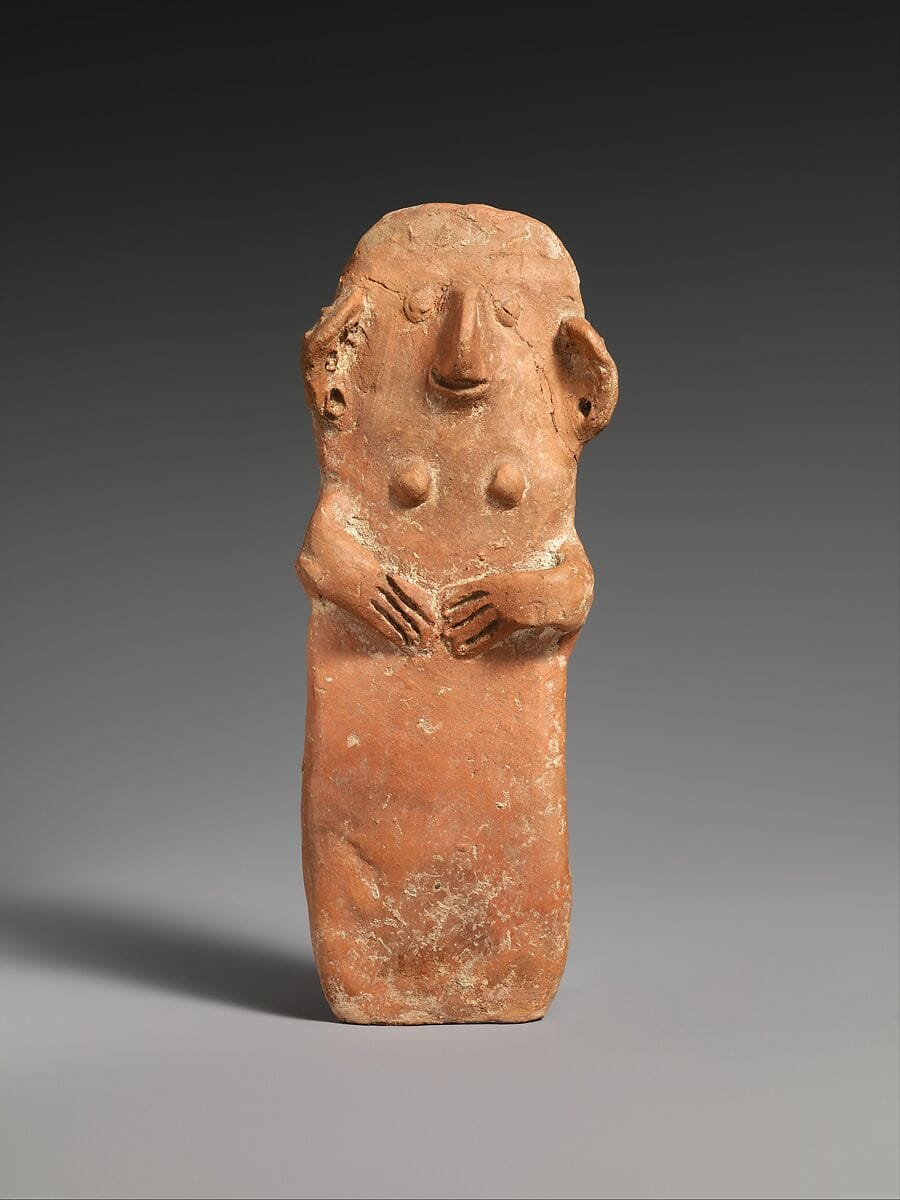
Stone and clay planks share the same flat, rectangular body [2; 1, p. 8]. They differ in size, surface and number: about fourteen stone figures are known, and the clay figures are far more numerous, smaller and densely incised. The three-necked Red Polished figure in the Drakopoulos collection, long on loan to the Ashmolean, shows what the clay class does and the stone class does not: bands of incised pattern, pierced ears, and several necks.
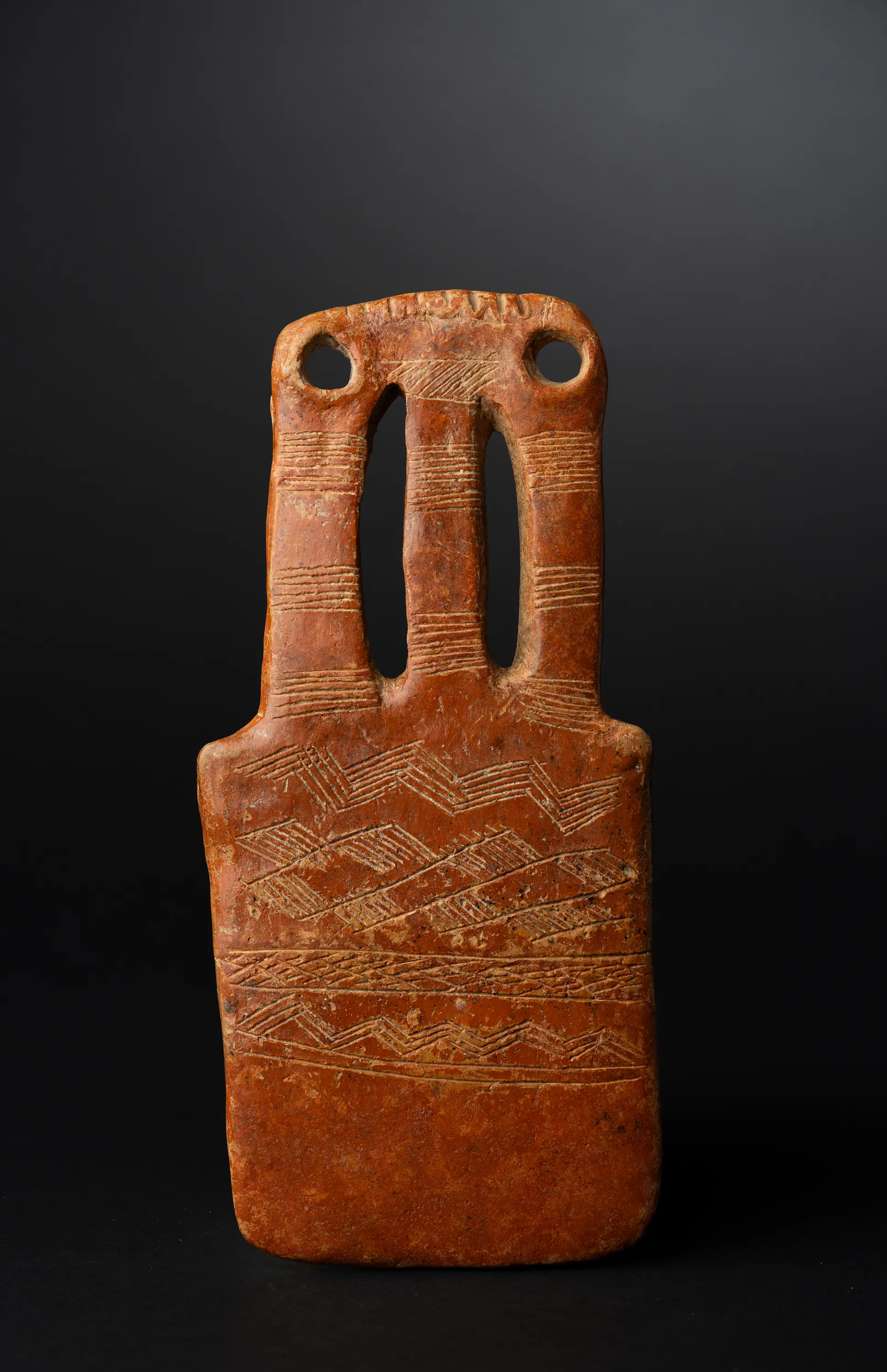
A clay plank figure from the Drakopoulos collection, shown for comparison with the stone class. Its history is in Cypriot Plank Figures: Three Necks, or One Neck and Two Locks of Hair.
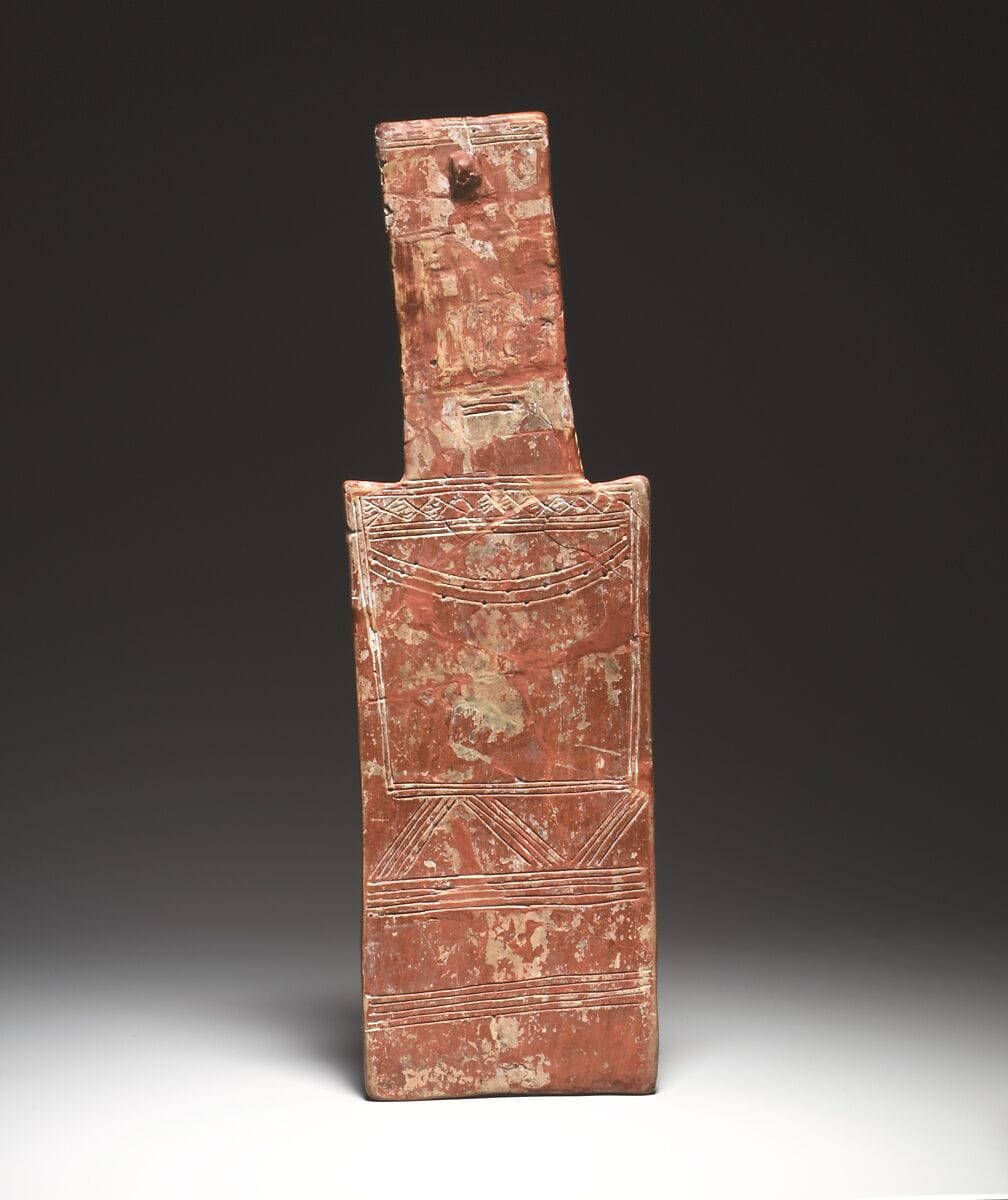
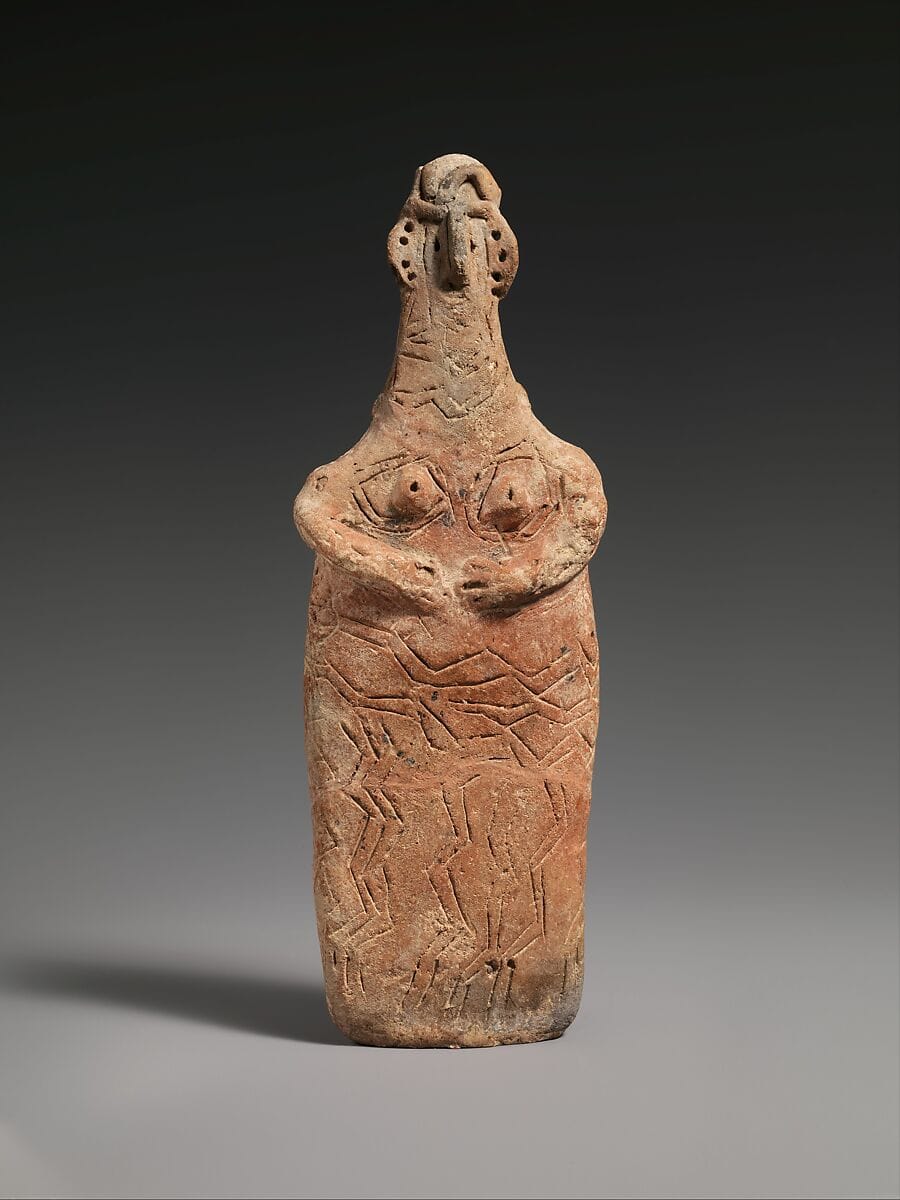
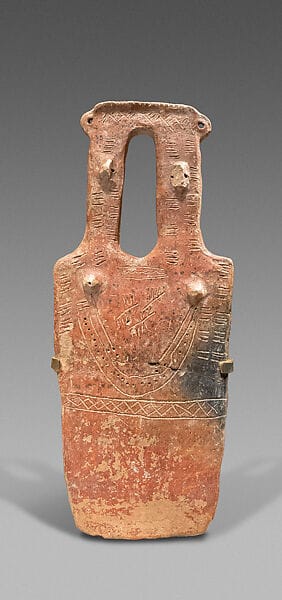
Several scholars have suggested that small plank figures copy larger images in some other material. Christou cites Thimme (1977) for Anatolian clay planks modelled on wooden images, and reports that Karageorghis "agrees that the smaller plank representations may be based upon larger versions" [5, p. 46]. Webb notes that "Similar images (or their prototypes) may also have existed in wood or other perishable materials" [4, p. 249]. The Museum of Cycladic Art records that "Other scholars suggest that they imitate large wooden cult statues ('xoana'), kept in Prehistoric shrines" [2]. The Metropolitan Museum's label for an early clay plank said to be from Alambra says the same: "Such figurines may recall cult statues of stone or wood that were placed in sanctuaries" (Met 74.51.1534). The Met's other planks on this site include a developed type, a two-headed figure of the kind associated with Lapithos, and a further single-headed example. The evidence does not settle which came first, the large figure or the small one.
Authenticity and the unprovenanced majority
Nine of the thirteen stone planks reported before 2011 have no recorded find-spot [1, p. 9]. Knox wrote that the Zintilis figures "did not originate from a controlled excavation and are therefore difficult to authenticate. Although their shape is similar to the clay examples... their size and material is not directly paralleled amongst those objects with verified provenances" [3, p. 86]. The surviving excavated comparisons are the plain Vounous pair and the rough Politiko figure, all smaller than the largest Zintilis pieces; the Lapithos pair is known only from a list and a plan.
Scientific testing cannot settle the question as it can for pottery. Polikreti, writing about marble, says that thermoluminescence and radiocarbon dating freed the study of ceramics and organic materials from "the fear of forgers". She adds that "no marble authenticating technique is yet available" and that "there is no archaeometric technique to ensure reliable answers to marble (or stone in general) authenticity problems" [13, p. 42]. The question is the age of the worked surface ("we are interested in the age of the marble surface"), which no current method measures reliably [13, p. 42]. Winkelmann's caution about the earlier figurine corpus applies here by analogy: "some forgeries might be included in the corpus due to the fact that a certain quantity of figurines comes from the art market and it is not always possible to identify fakes with absolute certainty" [14, p. 27]. We know of no published source that declares any stone plank a forgery or proves that any one is genuine. On unprovenanced material in general, see the antiquities trade section.
Where the class stands
Four stone plank figures come from recorded Bronze Age tombs at Vounous and Lapithos. Two of them are lost, and the material of three is disputed. One comes from a recorded settlement context at Politiko-Troullia. The seven Zintilis figures, the tallest of the class among them, rest on an unconfirmed attribution to a cemetery in the Paphos district, and two more in private collections have no find-spot at all. The questions still open are whether there was a south-western workshop, what stone the Zintilis figures are made of, and whether a figure as tall as 81 cm has any excavated parallel. Settling them will need either a controlled excavation at Kidasi or a published study of the Zintilis figures that includes material analysis.
Objects on this page
References
- 1.Falconer, S. E., Monahan, E. M., & Fall, P. L. (2014). A stone plank figure from Politiko-Troullia, Cyprus: Potential implications for inferring Bronze Age communal behavior. Bulletin of the American Schools of Oriental Research, 371, 3–16. https://doi.org/10.5615/bullamerschoorie.371.0003
- 2.Museum of Cycladic Art, Athens, Zintilis Collection. Object records Ζ0576 (https://collections.cycladic.gr/en/objects/1480/-), Ζ0577 (https://collections.cycladic.gr/en/objects/1482/-) and Ζ0726 (https://collections.cycladic.gr/en/objects/1540/-).
- 3.Knox, D.-K. (2012). Making sense of figurines in Bronze Age Cyprus: A comprehensive analysis of Cypriot ceramic figurative material from EC I–LC IIIA (c. 2300 BC–c. 1100 BC) [Doctoral dissertation, The University of Manchester].
- 4.Webb, J. M. (2015). The production and distribution of plank-shaped figurines in Middle Bronze Age Cyprus: The role of Lapithos. In Kypromedousa: Hommage à Jacqueline Karageorghis (Cahiers du Centre d'Études Chypriotes, 45, pp. 241–254). https://doi.org/10.3406/cchyp.2015.1638
- 5.Christou, S. (2012). Sexually ambiguous imagery in Cyprus from the Neolithic to the Cypro-Archaic period (BAR International Series 2329). BAR Publishing. https://doi.org/10.30861/9781407309125
- 6.Morris, D. (1985). The art of ancient Cyprus. Phaidon.
- 7.Karageorghis, V. (1991). The coroplastic art of ancient Cyprus I: Chalcolithic–Late Cypriote I. A. G. Leventis Foundation.
- 8.Talalay, L. E., & Cullen, T. (2002). Sexual ambiguity in plank figures from Bronze Age Cyprus. In D. Bolger & N. Serwint (Eds.), Engendering Aphrodite: Women and society in ancient Cyprus (ASOR Archaeological Reports 7, pp. 181–195). American Schools of Oriental Research.
- 9.Gjerstad, E., Lindros, J., Sjöqvist, E., & Westholm, A. (1934). The Swedish Cyprus Expedition: Finds and results of the excavations in Cyprus 1927–1931 (Vol. 1). The Swedish Cyprus Expedition. Lapithos section by E. Sjöqvist.
- 10.Dikaios, P. (1940). The excavations at Vounous-Bellapais in Cyprus, 1931–2. Archaeologia, 88.
- 11.Webb, J. M. (2017). Lapithos Tomb 322: Voice, context and the archaeological record. In E. Minchin & H. Jackson (Eds.), Text and the material world: Essays in honour of Graeme Clarke (SIMA Pocket-Book 185, pp. 1–12). Åströms Förlag.
- 12.Monahan, E. M. (2010). Dwelling with the dead: Mortuary landscapes and the production of community during the prehistoric Bronze Age on Cyprus [Master's thesis, Cornell University].
- 13.Polikreti, K. (n.d.). Hunting out forgers of archaeological marble objects: Reviewing the archaeometrist's role as a detective. In Proceedings of the 4th Symposium of the Hellenic Society for Archaeometry (p. 42). National Hellenic Research Foundation.
- 14.Winkelmann, C. (2020). The Neolithic and Chalcolithic figurines of Cyprus (Marru). Zaphon.