
Contents
Bichrome Red is the name Einar Gjerstad gave to Cypriot wheel-made pottery with a red slip painted in black and a supplementary white [1]. It sits beside Black-on-Red in the same way that Bichrome sits beside White Painted: Gjerstad divided the decorated pottery of the Iron Age into a "white" group painted on a light ground and a "red" group painted on a red ground, and Bichrome Red belongs to the second [1]. The ware appears late in Cypro-Archaic I, grows steadily through Cypro-Archaic II, and in the first half of the Cypro-Classical period is the commonest decorated ware in the tombs the Swedish Cyprus Expedition counted [1]. Among its most elaborate products are the figure-jugs of Marion, where a small clay woman on the shoulder holds a jug that acts as the spout.
The secondary literature on the class is thin. Most of what can be said about it still rests on Gjerstad's typology of 1948 and the tomb groups behind it, with Nicola Schreiber's 2003 study of Black-on-Red as the main later discussion. This entry follows that evidence and flags where it runs out.
Definition and identification
Gjerstad defined Bichrome Red I (IV) as wheel-made, with the clay and slip of the contemporary Black-on-Red II (IV), and ornaments "painted with black and supplementary white paint; occasionally red colour is used instead of white" [1]. Schreiber, working from Gjerstad, describes it as "similar in technique and decoration to BoR ware, red slip with black painted decoration, but with additional painted white lines, or sometimes dots, alongside the black paint" [2, p. 283]. The white is the diagnostic. A red-slipped pot with black decoration alone is Black-on-Red; the same pot with white bands, dots or strokes added is Bichrome Red.
The name invites confusion with Bichrome ware, and the two overlap in practice. Bichrome proper is painted in black and red on a light, often buff or white-slipped, surface. Bichrome Red keeps the red slip of Black-on-Red and adds white on top of it. Two complications blur the line. Gjerstad notes that the earliest class sometimes used red paint in place of white [1], which puts black and red on a red ground. And in Bichrome Red II (V) the slip sometimes fired black in the kiln, the white turned violet and the black decoration vanished into the darkened surface, producing what he called "a black-and-white variety" [1]. A 21.5 cm British Museum amphora from Amathus shows the problem in a single object: its buff clay is fired black on the surface, with a large white lattice painted between the handles, and the museum catalogues it under both "Bichrome V" and "Bichrome Red II" (British Museum 1894,1101.304; site record).
The white is also the most fragile part of the decoration. It is painted over the slip, and catalogue descriptions of Bichrome Red vessels record it as worn, as on a British Museum oinochoe whose white infill is "now mostly eroded" (see below). A pot that looks Black-on-Red in a photograph may once have been Bichrome Red, and attributions from images alone carry that risk.
Gjerstad's classes and dates
Gjerstad numbered his Iron Age wares twice: a class number within the ware, and in brackets the general "Type" of the whole ceramic horizon, so that Bichrome Red I (IV) is the first Bichrome Red class and belongs to the Type IV horizon alongside Black-on-Red II (IV) and Red Slip II (IV) [1]. He recognised three classes, all of which appear among the finds illustrated in the Expedition's second volume of 1935 [3, p. 35].
| Class | Period (Gjerstad) | Gjerstad's dates | Shapes and decoration |
|---|---|---|---|
| Bichrome Red I (IV) | Cypro-Archaic I B | within c. 700–600 BC | Clay and slip of Black-on-Red II (IV). Bowls, jars, jugs, amphorae, askoi; spout-jugs with human protomes, trick vases. Decoration as Black-on-Red II (IV) with white bands, dots and short strokes. |
| Bichrome Red II (V) | Cypro-Archaic II | c. 600–475 BC | Clay and slip of Black-on-Red III (V). The richest class: lotus flowers, rosettes, dotted stars, tree ornament, animals; new jugs with a bull protome or a figure holding a jug on the shoulder. |
| Bichrome Red III (VI) | Cypro-Classical I | c. 475–400 BC | Clay and slip of Black-on-Red IV (VI). Bowls, jars, jugs, amphorae; decoration follows White Painted VI and Black-on-Red IV (VI) but richer; figure-jugs continue. |
The absolute dates are Gjerstad's: Cypro-Archaic I c. 700–600 BC and Cypro-Archaic II c. 600–475 BC [1], Cypro-Classical I c. 475–400 BC and Cypro-Classical II c. 400–325 BC [1]. Swedish excavation finds now in the Medelhavsmuseet in Stockholm carry the same pairing of class and period: the museum records a small Bichrome Red II (V) jug from Marion Tomb 50 as Cypro-Archaic II and a 33.4 cm Bichrome Red III (VI) figure-jug from Marion Tomb 56 as Cypro-Classical I. Gjerstad also noted that by Cypro-Classical I B the Type V horizon had almost disappeared, and that its two surviving vases in his tombs of that phase were Bichrome Red [1].
Chronology and frequency
Gjerstad's statistics are the firmest thing known about the ware. Counting the pottery from the tombs he excavated and classified, he found no Bichrome Red before Cypro-Archaic I B [1]. From there its share of the total pottery climbs, peaks in Cypro-Archaic II B and Cypro-Classical I A, and then declines to almost nothing by the end of the Cypro-Classical period.
| Period | Bichrome Red, % of all pottery | Black-on-Red, % of all pottery |
|---|---|---|
| Cypro-Archaic I B | 5.6 | 18.7 |
| Cypro-Archaic II A | 12.5 | 16.5 |
| Cypro-Archaic II B | 16 | 11.3 |
| Cypro-Classical I A | 16.7 | 3.5 |
| Cypro-Classical I B | 7.6 | 3.8 |
| Cypro-Classical II A | 5.7 | 1.4 |
| Cypro-Classical II B | 0.9 | 0.3 |
The figures come from Gjerstad's table [1]. Read together, the two columns show Bichrome Red taking over from its parent: Black-on-Red begins to decline in Cypro-Archaic I B, and Gjerstad describes it as "supplemented by its sister ware, Bichrome Red, which culminates in Cypro-Archaic II B and Cypro-Classic I A. During the latter period, it is commonest of all the decorated wares" [1]. By then decorated pottery as a whole was in retreat. In Cypro-Classical I A the decorated wares made up only 24.2 per cent of the tomb pottery, against 80.6 per cent in Cypro-Archaic I, while Plain White rose to an absolute majority by Cypro-Classical I B [1]. Bichrome Red was the leading decorated ware in a period that decorated less. Gjerstad himself warned that the statistics "are built upon material found in tombs" and that plain domestic wares are always more numerous in settlements [1].
The absolute dates are less secure than the sequence. Schreiber summarises Gjerstad's scheme (the first stage from the late 7th century BC, a peak at the end of the 6th and the start of the 5th, decline by about 400 BC) and then comments: "Again, these dates are probably too late" [2, pp. 283–284]. She has already argued for earlier dates than Gjerstad's for Black-on-Red, and she applies the same doubt to its sister ware. If she is right, Bichrome Red began somewhat earlier than Gjerstad allowed [2, p. 284].
Shapes and decoration
Bichrome Red took over the shapes of the wares around it rather than inventing its own. Gjerstad's first class copies Black-on-Red II (IV) and Red Slip II (IV): sack-shaped handle-ridge jugs, globular jugs, spout-jugs, amphorae with horizontal shoulder handles, and an askos built as a trick vase [1]. Schreiber adds that some later Red Slip jug types were decorated in Bichrome Red and that mushroom-lip juglets in the ware imitate Phoenician shapes [2, p. 282]. The class therefore spans the full range of jugs, jars and bowls of the period, with small juglets at one end and large amphorae and kraters at the other.
The decoration follows the same pattern of borrowing. In the first class it is the concentric-circle and band repertoire of Black-on-Red, with white added as bands, dots and short strokes [1]. Bichrome Red II (V) is, in Gjerstad's words, "the most richly decorated of the Bichrome Red wares" [1]. It adds lotus flowers, rosettes and dotted stars in the supplementary colour, the tree ornament also common in Bichrome V, and animal subjects that Gjerstad attributed to the influence of Greek vase-painting: stags, oxen, a lion attacking a bull, sphinxes [1]. A black and white toothed border around the rim of jugs and plates is a frequent small feature. Bichrome Red III (VI) continues the scheme of White Painted VI and Black-on-Red IV (VI) in a richer form, with dotted stars and tree ornaments surviving on its earliest pieces [1]. Schreiber reads the increasingly elaborate decoration of the later classes as an attempt to compete with fine imported Attic wares [2, p. 284].
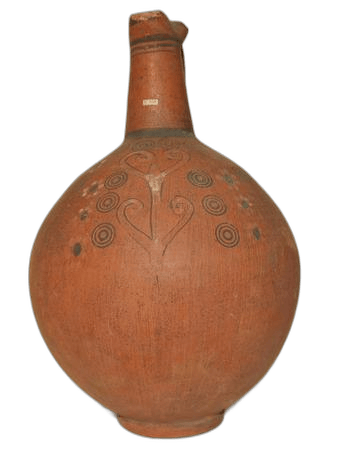
A British Museum oinochoe dated by the museum to the Cypro-Archaic period shows the repertoire at full size: 30.2 cm high, with a floral volute on the body opposite the handle drawn in black outline with white infill, flanked by vertical rows of concentric circles, and a shoulder frieze of rosettes built from black and white dots (British Museum 1876,0909.65; site record). A 39.5 cm krater in the same museum, catalogued as Bichrome Red II, carries panels of lotus flowers and concentric circles in red, black and white on a dull red slip (British Museum 1869,0604.51; site record).
Figure-jugs and the Marion Bird Style
The shapes Gjerstad treated as new to Bichrome Red II (V) are jugs with a bull's protome on the shoulder and jugs with a human figure holding a jug on the shoulder; rarer still are jugs whose neck ends in a human head, sometimes combined with a bull's protome [1]. The first class already had spout-jugs with human protomes [1], and the figure holding a jug continued into Bichrome Red III (VI) [1]. These are among the complex shapes of Iron Age Cyprus, and they are discussed further in the site's article on an anthropomorphic hydria.
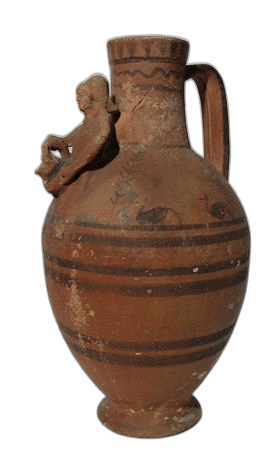
The British Museum's jug 1919,1201.1 from Marion-Arsinoe is a securely classified example (British Museum record; site record). It stands 34 cm high: a wheel-made ovoid jug in red slip with black and white paint, onto which a handmade woman in a long robe has been attached. She holds a small pierced jug that acts as the vessel's spout. On each side of the shoulder a pair of black birds in silhouette stands between schematic tree branches. Alicia Dissinger's catalogue of Cypro-Archaic bird imagery lists it as Bichrome Red II (V), Cypro-Archaic II, from Polis-tis-Chrysokhou, and assigns it with several others to a "Marion Bird Style": birds with almond-shaped bodies on either side of the vessel, accompanied by tall plant motifs [4, p. 366]. Another jug of the group in the British Museum, 1887,0801.67, came from Tomb 84 of Necropolis II at Polis and is dated to about 500 BC [4, p. 366].
Painted figures were not limited to Marion. In 1967 a Cypro-Archaic tomb at the locality "Maraes" on the southern edge of Episkopi yielded large quantities of Bichrome Red I (IV), Black-on-Red II (IV) and Red Slip II (IV). Two of the Bichrome Red jugs carried figured decoration on the shoulder opposite the handle, painted in white. Vassos Karageorghis, reporting the find, remarked that this style was much favoured in the region of Kourion [5, p. 33].
Distribution
The published contexts are Cypriot tombs. Marion (modern Polis-tis-Chrysokhou) is the best-represented findspot, because the Swedish Cyprus Expedition excavated its cemeteries: its report records, for example, a Bichrome Red II (V) jug from Marion Tomb 51 with a black wavy line on a white ground below the rim [3, p. 378]. The Episkopi tomb places the ware in the Kourion region in quantity by Cypro-Archaic I [5, p. 33], and the British Museum amphora extends it to Amathus.
Outside the island the ware is scarce. Schreiber states that "Bichrome Red pottery is, however, almost never found on the Levantine mainland" [2, p. 284]. The movement of the parent ware beyond the island is treated in the origins of Black-on-Red ware. Individual pieces did leave: the British Museum holds a Bichrome Red II oinochoe with concentric circles whose recorded findspot is Turkey (British Museum 1905,1206.5). A single object does not make a trade, and we know of no systematic study of Bichrome Red outside Cyprus.
The Drakopoulos amphorae
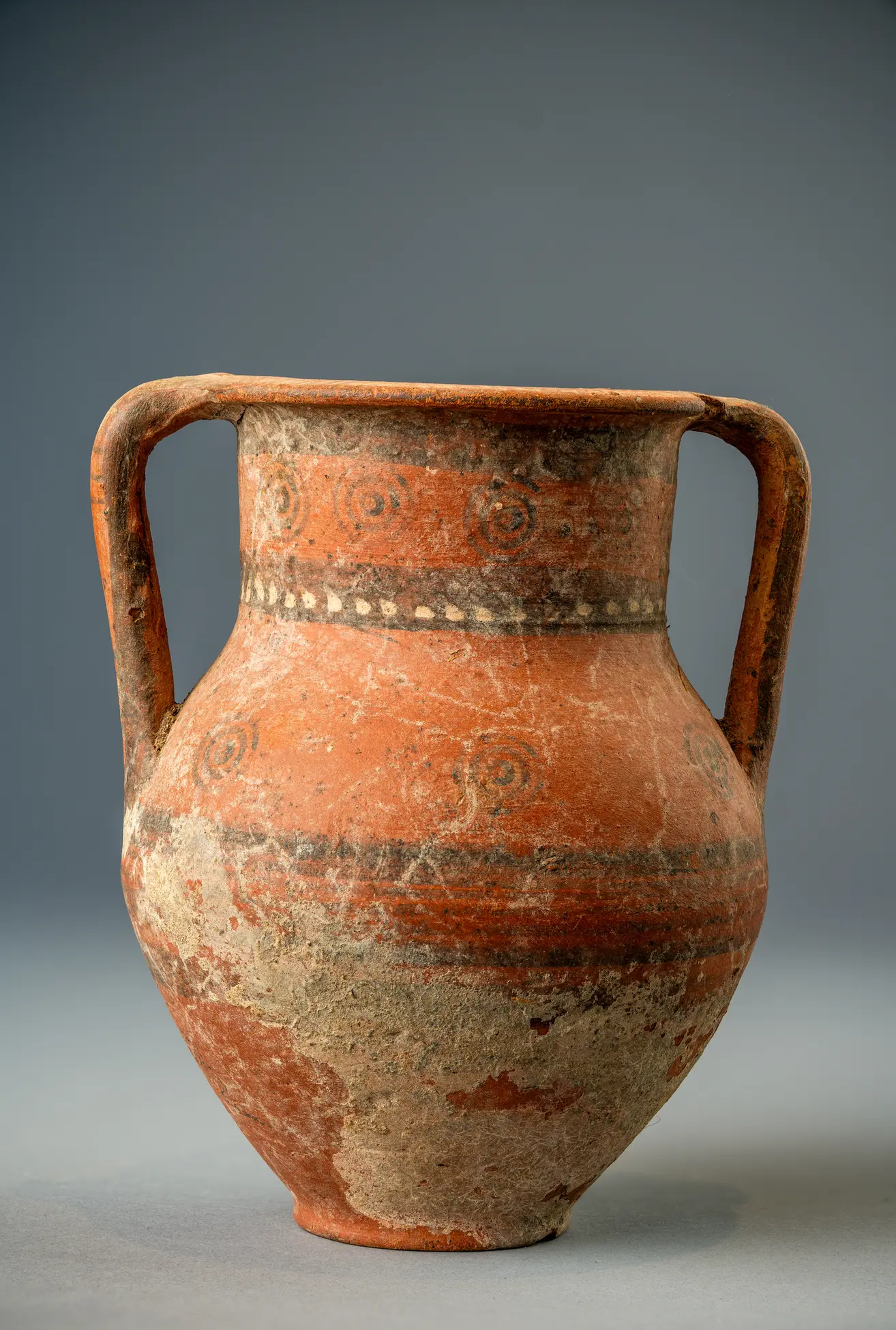
Two amphorae in the Alexis Drakopoulos collection are catalogued as "Bichrome on Red", a descriptive label for the same technique. The first (JAR-GE-004, ex-Goodman collection since the 1960s) is a two-handled neck-amphora with a red slip, black bands, groups of small concentric circles on the neck and shoulder, and a band of white dots on the neck. Red slip, black circle-style decoration and added white dots match Gjerstad's description of Bichrome Red I (IV), whose decoration repeats Black-on-Red II (IV) with white bands and dots added [1], and amphorae are among the shapes he lists for that class.
The identification also narrows the amphora's date. On Gjerstad's evidence no Bichrome Red occurs before Cypro-Archaic I B, in the later 7th century BC [1], so if the white dots are original paint, the amphora belongs within about 650–475 BC on his scheme. Schreiber's view that Gjerstad's dates are too late [2, p. 284] would move the start somewhat earlier, but no work we know of brings Bichrome Red back into the Cypro-Geometric period.
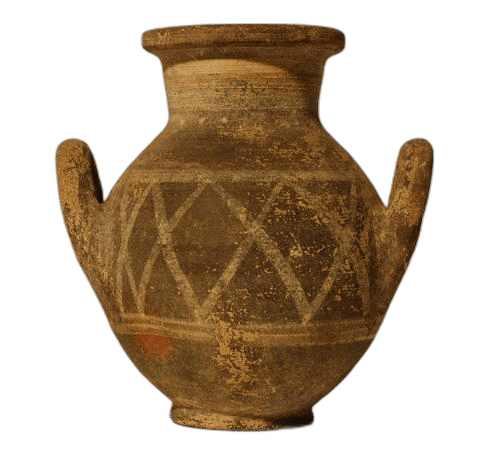
The second amphora (JAR-GE-008, 29 cm, ex-collection of Dr Steven D. Nicklas, USA) has a red-slipped lower body, black bands, white dots around the neck and faint white crossing lines on the body. Its shoulder is buff rather than red, which leaves room for doubt: a pot with a light zone and red slip in the same scheme sits close to the Bichrome and Bichrome Red boundary that Gjerstad's own "black-and-white variety" and the Amathus amphora already blur. Bichrome Red is the more likely reading, and the same dating correction applies. The shoulder has not yet been examined closely enough to say whether the buff is a reserved zone, a separate slip or wear to the red slip.
Status of the class
Bichrome Red is a category defined by one technical choice, white paint added to a red-slipped surface, laid across shapes and motifs it shares with Black-on-Red, Red Slip and Bichrome. Its three classes follow Gjerstad's general Types IV to VI rather than any break in the ware itself. That makes it a useful label for sorting tomb groups and a weak one for identifying workshops, since, as far as we know, no study has yet separated Bichrome Red fabrics or production centres. The figures that make the class distinctive, the jug-holding women and the paired birds of the Marion Bird Style, belong to Cypro-Archaic II and early Cypro-Classical tombs, and it is in those tombs, excavated by the Swedish Cyprus Expedition and catalogued by Gjerstad, that the ware is still best understood. Pieces from older collections in the British Museum and elsewhere can usually be placed within that framework by class, though rarely by findspot.
Objects on this page
 Bichrome Red AmphoraArchaic II · 600–475 BC
 Bichrome Red OinochoeArchaic I · 750–600 BC
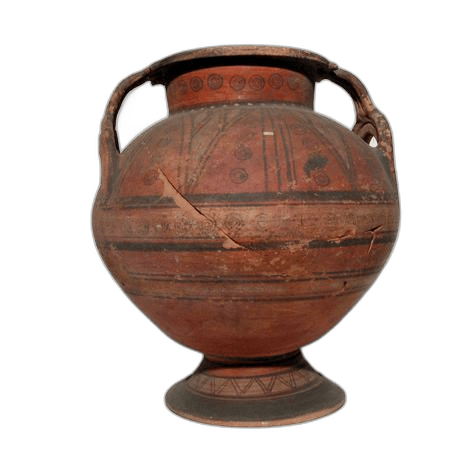 Bichrome Red Ware KraterArchaic II · 600–475 BC
- Bichrome Red Ware Figurine JugArchaic II · 600–475 BC
- Bichrome Red Amphora with Concentric Circles and a Row of White DotsArchaic II · 700–480 BC
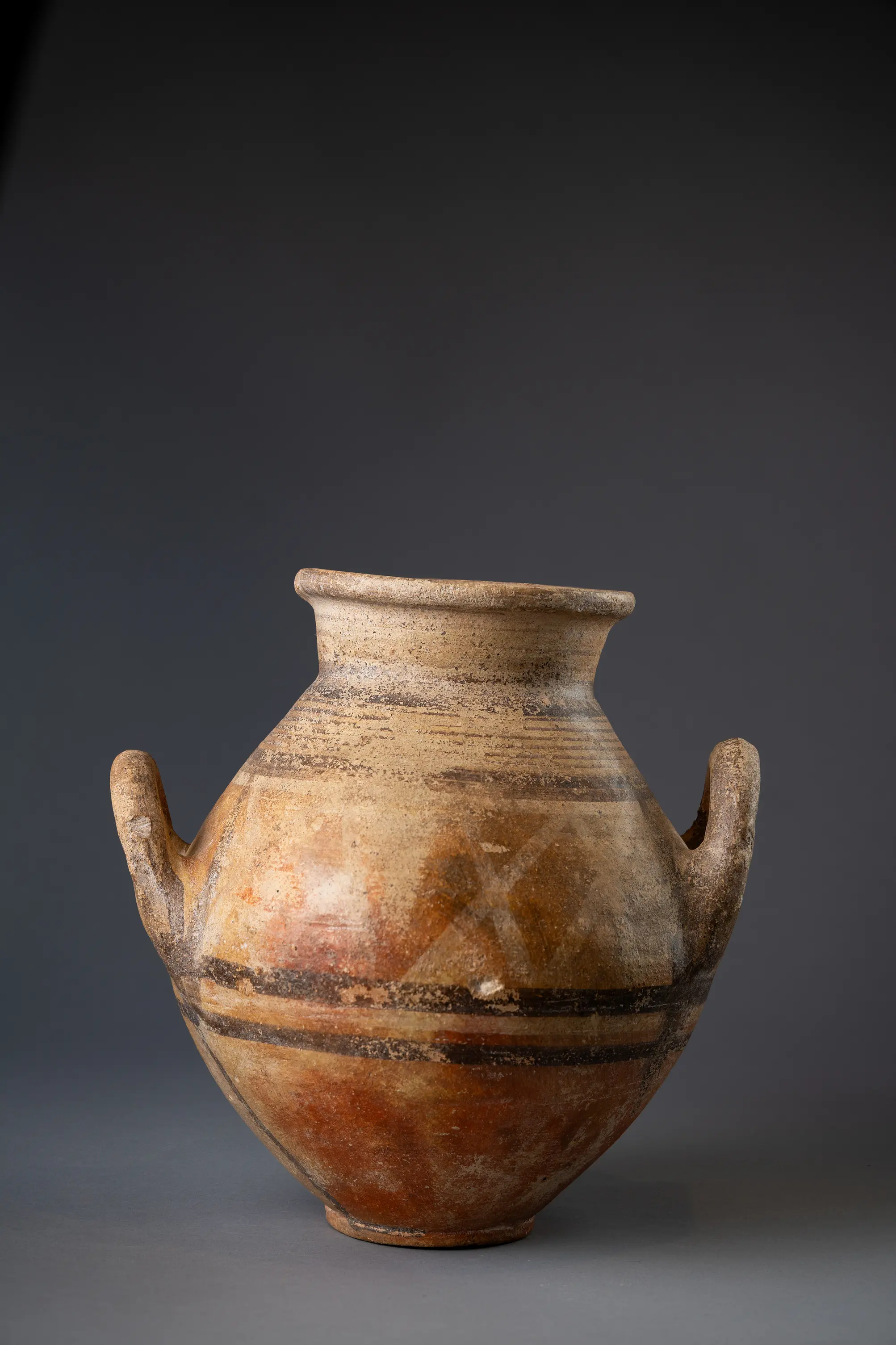 Red-Slipped Amphora with Pale Crosses on the Shoulder, probably Bichrome Red WareArchaic · 750–480 BC
References
- 1.Gjerstad, E. (1948). The Swedish Cyprus Expedition, Vol. IV, Part 2: The Cypro-Geometric, Cypro-Archaic and Cypro-Classical periods. The Swedish Cyprus Expedition.
- 2.Schreiber, N. (2003). The Cypro-Phoenician pottery of the Iron Age (Culture and History of the Ancient Near East 13). Brill.
- 3.Gjerstad, E., et al. (1935). The Swedish Cyprus Expedition: Finds and results of the excavations in Cyprus 1927–1931, Vol. II (text volume). The Swedish Cyprus Expedition. https://archive.org/details/in.ernet.dli.2015.106120
- 4.Dissinger, A. M. (2017). Cypro-Archaic bird iconography: Types, uses, and meanings [Doctoral dissertation, University of Virginia].
- 5.Karageorghis, V. (1968). Chronique des fouilles et découvertes archéologiques à Chypre en 1967. Bulletin de correspondance hellénique, 92(1).