
Contents
A ring-dance group is a small votive model of a dance: three to six figures, sometimes more, standing on one clay base with their hands joined or laid on each other's shoulders, circling a musician or a tree. The type belongs to Iron Age Cyprus. Its roots go back to the end of the Late Bronze Age, most examples date to the Cypro-Geometric and Cypro-Archaic periods, and it ends in the Cypro-Classical period with a handful of limestone groups of veiled women. The provenanced models come from open-air sanctuaries and none from tombs, and they are among the few objects that record an action performed in those sanctuaries. The figures are made in the same way as the island's other small hand-modelled terracottas, treated under snowman figurines; the instruments are covered under music and musical instruments.
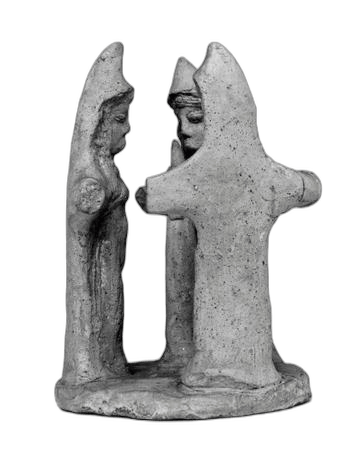
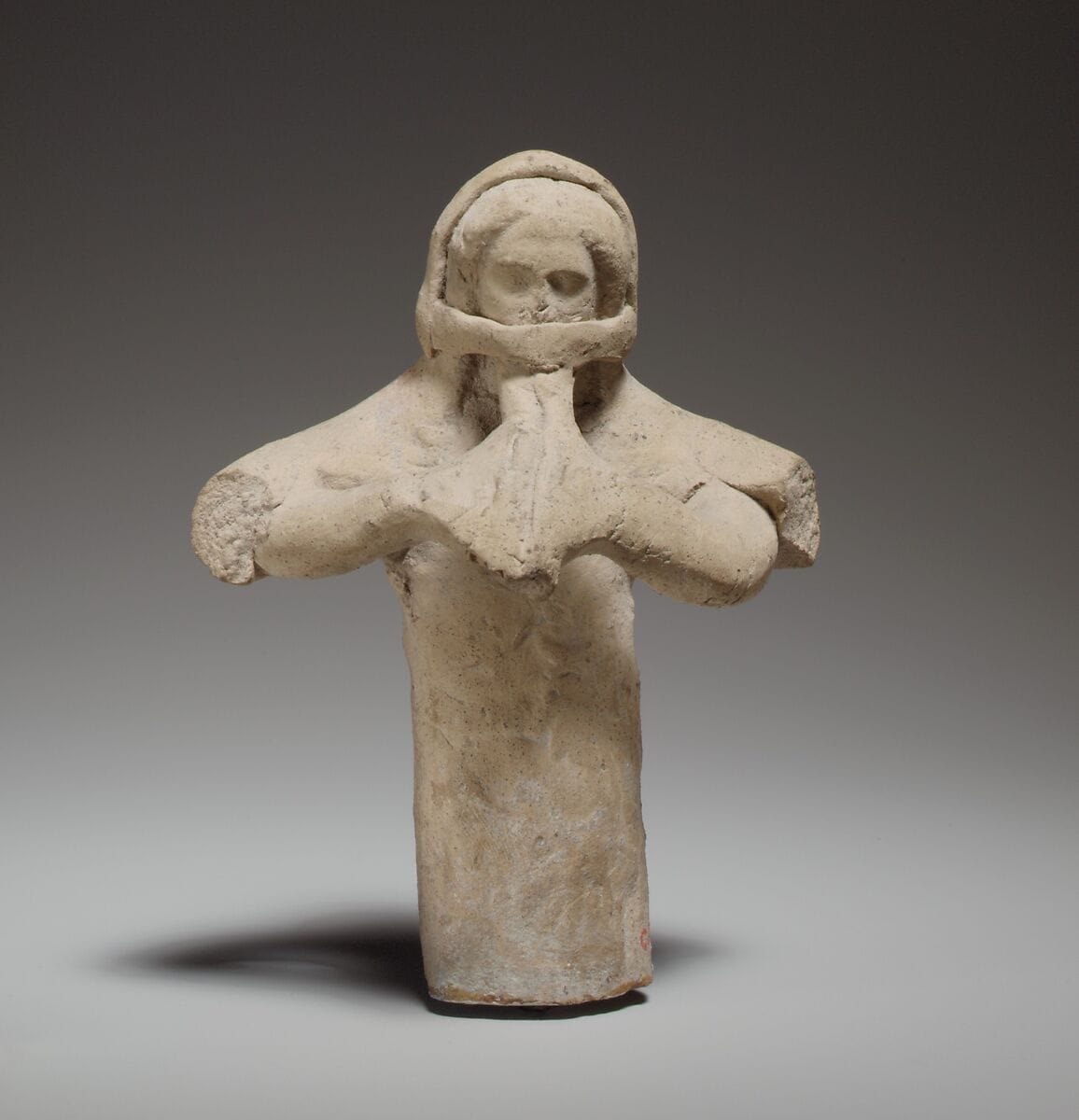
The photograph at the head of this page shows the Drakopoulos group: two robed, hooded clay figures on a single base, turned towards each other across a central shaft that is broken off near the top. It is described, and read as the remains of a dance round a tree, in the site's article Two Figures and a Tree. The identification rests on that article's description; the piece has not been published elsewhere.
Definition and composition
Anastasia Leriou describes the models as groups of figures, "usually three to six, holding hands or placing them on each other's shoulders and dancing around a flute player or a tree; all figures are fixed on a clay plaque of circular shape" [1, p. 528]. The Metropolitan Museum's catalogue of its Cesnola terracottas gives much the same definition: "four or more male or female figures, fixed to a round plaque and encircling a central flutist. In some cases, the musician is replaced by a sacred tree" [2, p. 72]. The Turin exhibition catalogue edited by Bombardieri and Panero calls ring dancers round a player "a popular theme in the Cypriot terracotta repertoire" [3, p. 279, no. 076].
Three elements, then, define the type: a shared base, usually round; a ring of dancers joined at the hands or shoulders; and a central element, which is a piper, less often a lyre player, or a tree. The piper plays the aulos, which the Met catalogue glosses as "a double flute" [2, p. 127, cat. 216]. When the musician is present, he is "usually male" [1, p. 529].
The sex of the dancers is less clear. The figures of the Geometric and Archaic groups carry few sexual markers, and Leriou follows a rule of thumb from Karageorghis: figures in conical caps are male, figures in a flat, tiara-like headdress female. On that basis "both men and women" took part [1, p. 529]. The six dancers of the Cypro-Geometric group in the Cyprus Museum, C 336, wear flat tiaras and are "presumably female", while the central piper in a conical headdress is "most probably male" [3, p. 279, no. 076]. The Met's Cypro-Archaic group 74.51.1650 is catalogued as three male dancers round a male piper [2, p. 72]. The limestone groups at the end of the series show only women [1, p. 529].
Chronology
When the type begins is disputed. The Turin catalogue places its start in the "Late Bronze-early Geometric period" and records that the earliest examples come from Enkomi, "where a large array of broken terracotta figurines performing ring-dances come from deposits westward the Horned God Sanctuary" [3, p. 279, no. 076]. The Civitillo catalogue Cipro: Isola di Afrodite likewise dates the first depictions of the dance to the 13th to 11th centuries BC [4, p. 102, no. 26]. Leriou, by contrast, states that the earliest terracotta ring-dance models "date from the Cypro-Geometric I" [1, p. 529]. The Enkomi material is fragmentary and Leriou is counting complete models, so the two positions may describe different evidence, but neither source reconciles them. For the Late Bronze Age there are broken figures; the first complete rings on a base are Iron Age.
The oldest known complete example is the Cyprus Museum group C 336, dated Cypro-Geometric II to III, c. 900 to 750 BC: a flat circular platform 10.3 cm across, six crudely rendered dancers, and a seventh figure at the centre playing a flute, with traces of reddish and black paint [3, p. 279, no. 076]. The Met catalogue has the theme becoming popular "from the end of the Cypro-Geometric down to the end of the Classical period" [2, p. 72], and the Cypro-Archaic period supplies most of the known groups.
The terracotta type survives well into the fifth century. A group from the sanctuary at Arsos, Cyprus Museum B 240a, dated Cypro-Classical I (475 to 400 BC), has three handmade dancers in flat tiaras round a flute player in a conical headdress, on a disc only 5.6 cm across [4, p. 102, no. 26]. The Met's loose female dancer 74.51.1649 and flute player 74.51.1689 are of the fifth or early fourth century, and the catalogue observes that "the type of the figurine follows the Cypro-Archaic tradition" even when the modelling of the face is later [2, pp. 127–128].
Stone comes last. According to the catalogue Cyprus: A Dynamic Island, limestone dance groups "do not emerge until the end of this period, around the 4th century BC, and only include veiled female figures" [5, p. 115]. Leriou counts five such groups from Achna and two from Pyla-Stavros, all of the end of the Cypro-Classical period and all "clearly female" [1, p. 529]. Earlier stone votives are treated under Archaic limestone sculpture.
How the groups were made
The earlier groups are wholly handmade. Young and Young's account of the solid handmade figures from Kourion describes the method: "the body, including the head, was shaped by rolling a piece of clay between the palms; this was then set on end, the base slightly spread ... and the head modelled. Arms were added, and pellets to form ears, nose, and often mouth", and in some cases the bodies were "somewhat flattened" [6, p. 28]. Paint was black and red, the red matching the crimson of the pottery of the day, and was often laid over a thick white ground [6, p. 28]. The general technique is described under snowman figurines. The Met group 74.51.1650, said to be from Lapithos and dated to the sixth century BC (Cypro-Archaic II), shows it applied to a dance: "The handmade solid figures are attached to a single circular disk. Three male dancers encircle a central male figure playing a double flute. The dancers have flattened bodies and stretch their arms to the sides to form a circle." The noses are large pellets and the headdresses conical; the group stands 9.5 cm high [2, p. 72].
Later groups combine mould and hand. The British Museum's group of three women round a tree, 1903,1215.6, has "mould-made figurines; handmade base and tree", and "although the backs of the figures are rudimentary, the fronts are carefully detailed using a mould" [3, p. 279, no. 077]. The museum's record describes solid mould-made figures with plain backs, with a tree that is "a simple column of clay with attached leaves" (British Museum record).
Loose figures in the Met show how the ring was joined. The flute player 74.51.1689 is "handmade and solid, with a mold-made head"; her body "is a cylinder", and behind the upper arms are "two arm extensions, for joining with other participants in the dance". Her aulos is strapped to the face by a clay strip across the mouth, "called a phorbeia" [2, p. 127, cat. 216]. The extensions put this piper in the ring itself, though "the flute player usually stands at the center" [2, p. 127, cat. 216]. Her near neighbour in the catalogue, the mould-made standing female flute player 74.51.1690, "originally stood at the center of a group of ring dancers" [2, p. 127, cat. 217]. On the dancer 74.51.1651, "the right arm is almost like a flipper, the flat hand intended for attachment to the adjacent figure" [2, p. 128, cat. 218].
This construction explains why groups come apart. The dancers were joined to each other only at the hands, and the central tree or shaft was a separate, slender piece of clay, so a group can survive as single dancers, a detached piper or a base with stumps.
Find contexts: sanctuaries, not tombs
Leriou's survey found that the models "don't come up in burial contexts", and every example with a secure provenance comes from an open-air sanctuary (her counts, about twenty models of which seven are provenanced, are given under music and musical instruments) [1, pp. 528–529]. She sets them in the ritual of the Cypro-Archaic sanctuaries, where ceremonies were "probably taking place in open spaces: almost all sanctuary-sites ... incorporated a large courtyard", and where worshippers were "possibly walking past sacred groves"; the figurines, on this reading, are "commemorative 'snap-shots' of rituals" [1, p. 528].
The sanctuary of Apollo Hylates at Kourion produced a related but distinct class. Young and Young called them "ritual groups" and stressed the difference: "our dancers move in single file and at some distance from each other" [6, p. 39]. They stand on rectangular bases; one was reconstructed with eight dancers proceeding clockwise round a central figure [6, p. 40]. "Whereas ring-dancers hold arms and circle about a central object, our choral groups move one behind another as though in sacred procession"; the objects of veneration are "apparently trees, a well or spring, and in one case perhaps a column" [6, p. 220]. The Kourion groups are "carelessly handmade", were probably all made locally, and came almost entirely from the Archaic Precinct Fill [6, p. 39]. Leriou counts more than ten complete examples and suggests a local version of the type with no parallels elsewhere [1, p. 529].
The limestone groups have one excavated anchor. At Athienou-Malloura, near Athienou, a group of three veiled women holding hands on a circular base, one "a whole head taller" than the others, is "the only complete version of a dancing group to have been excavated from stratified soil". Traces of red paint probably show "the garland that would encircle the dancers". It is dated to the fourth century BC, stands 13.5 cm high and is in the Larnaka District Museum (AAP-AM-5492). More than forty other fragments were found at the site, including a figure over 20 cm tall from a base that held six to eight dancers, in an area also rich in figures of Artemis. The catalogue notes that the stone groups found in the nineteenth century at Achna, Pyla and Golgoi all have associations with Apollo or Artemis, and that the Pyla group and one from Achna have "a posthole in the centre of the circular base, in which a musician was inserted" [5, p. 115].
The centre of the ring: piper, lyre and tree
The piper is the commonest centre. The Louvre group AO 22221, "allegedly from Idalion", has four dancers and a lyre player round "a central column-like feature with perforations along its sides and topped by three birds". Leriou reads the column as a dovecote with pigeons, "connecting the model with the cult of Aphrodite" [1, p. 528]. The Louvre's own record, which dates the group to Cypro-Archaic I (700 to 600 BC) and gives its height as 20 cm, describes it as a "ronde de personnages (danseurs ?) autour d'un pigeonnier" and indexes two birds, not three (Louvre record). Neither source comments on the difference.
For the tree, three readings are on offer. Leriou takes the schematic tree as "an allusion to the groves in the sanctuary's peribolos" [1, p. 528]. The entry on the British Museum group in the Turin catalogue allows that the tree "might simply be a natural object, perhaps indicating a rural setting", but thinks it "likely that this had a religious meaning and that the tree represents a deity in whose honour the individuals are dancing", citing Keel [3, p. 279, no. 077]. The same entry notes that clay tree models were dedicated on their own: Max Ohnefalsch-Richter found "numerous examples" at Achna and Kythrea, one was excavated at Ayia Irini, and "some 45" came from the Sanctuary of the Great Goddess at Palaepaphos (Paphos) [3, p. 279, no. 077].
Leriou also weighs a fertility reading. The appearance of the type in Cypro-Geometric I, the Aphrodite associations of several find-spots, and the cults of "nature and fruitfulness" at Achna and Pyla-Stavros mean that a link with "the Cypriot Mother Goddess and the associated fertility cults" "cannot be excluded" [1, p. 529]. She limits the claim, however: the models show "a very specific type of ceremonial dance that was taking place in certain cult areas", not dancing in general [1, p. 529]. The Civitillo catalogue takes a wider view, arguing that such groups "in many sanctuaries in Cyprus and the rest of the Greek world suggest that dancing must have been a common ritual during religious ceremonies" [4, p. 102, no. 26].
The fourth-century limestone groups, with their Apollo and Artemis associations [5, p. 115], are centuries later than most terracottas, and need not share their meaning.
The Kourion "dance floor"
The Met catalogue states that "a paved circular floor for ritual dancing was found at the sanctuary of Apollo Hylates at Kourion, with evidence for trees or shrubs within the ring" [2, p. 72], and the Turin catalogue cites the "actual paved ring" there as evidence for "a ritual character of this performance" [3, p. 279, no. 076]. Buitron and Soren, in a report on the sanctuary, describe "7 pits cut into soft limestone bedrock, surrounded by a circular walkway/enclosure", interpreted as "a sacred grove dating to the 1st century A.C." (that is, the first century AD). They note that terracotta figures dancing round trees "recall the circular monument", but that no definite parallel exists [7, p. 188]. Connelly, discussing dance in the third report on the excavations on Geronisos Island, calls the Kourion complex "the best, and only, candidate in Cyprus" for a dance floor, gives it a diameter of 13 m with "nine planting pits for trees", and treats the surviving remains as Roman but duplicating Hellenistic predecessors. "Tree dancing", she writes, "would have been a most appropriate form of worship for Apollo Hylates, whose very name means 'of the Woodlands'" [8].
The sources therefore disagree on the number of pits (seven or nine) and on the date (first century AD, or Roman over a Hellenistic original). On either account the monument is several centuries later than most of the terracotta groups. It shows that dancing round trees had a place in Cypriot cult; it cannot show that the Archaic models copy this particular structure.
Principal examples
The table collects the groups discussed above for which the sources give a date and a context. Dates are those of the source cited; where sources differ, both are given.
| Object | Date | Centre and dancers | Find-spot | Technique | Source |
|---|---|---|---|---|---|
| Cyprus Museum C 336 | CG II–III, c. 900–750 BC | Flute player; 6 dancers | Cyprus | Handmade, crude; red and black paint; Ø 10.3 cm | [3, no. 076] |
| Louvre AO 22221 | CA I, 700–600 BC (Louvre) | Column with birds (3 per Leriou, 2 per Louvre); 4 dancers and lyre player | Idalion (alleged) | Terracotta; H 20 cm | [1]; Louvre record |
| Met 74.51.1650 | CA II, 6th c. BC | Double-flute player; 3 male dancers | Said to be from Lapithos | Handmade, solid; H 9.5 cm | [2, cat. 118] |
| British Museum 1903,1215.6 | c. 500–400 BC (Turin cat.); 600–400 BC (BM) | Stylised tree; 3 women | Idalion (?); ex R. H. Lang | Mould-made fronts, handmade base and tree; H 14 cm | [3, no. 077]; BM record |
| Cyprus Museum B 240a | CC I, 475–400 BC | Flute player; 3 dancers | Arsos sanctuary | Handmade; disc Ø 5.6 cm | [4, no. 26] |
| Larnaka District Museum AAP-AM-5492 | 4th c. BC | None; 3 veiled women | Athienou-Malloura (stratified) | Limestone; H 13.5 cm | [5] |
The British Museum group is the best-known of these. It was given by Robert Hamilton Lang, and its provenance from Idalion is marked as uncertain. The three women wear "long robes showing East Greek influence, but with elaborate jewellery and coiffure in a Cypriot fashion" (British Museum record). Its two dates come from different sources: the Turin catalogue gives c. 500 to 400 BC (late Cypro-Archaic II to Cypro-Classical) [3, p. 279, no. 077], and the museum's record gives 600 to 400 BC. The Turin entry also records a very similar group in the Louvre, "probably made in the same mould series" [3, p. 279, no. 077].
Three women dancing round a stylised tree, mould-made figures on a handmade base; British Museum 1903,1215.6. See the artifact page and the British Museum collection.
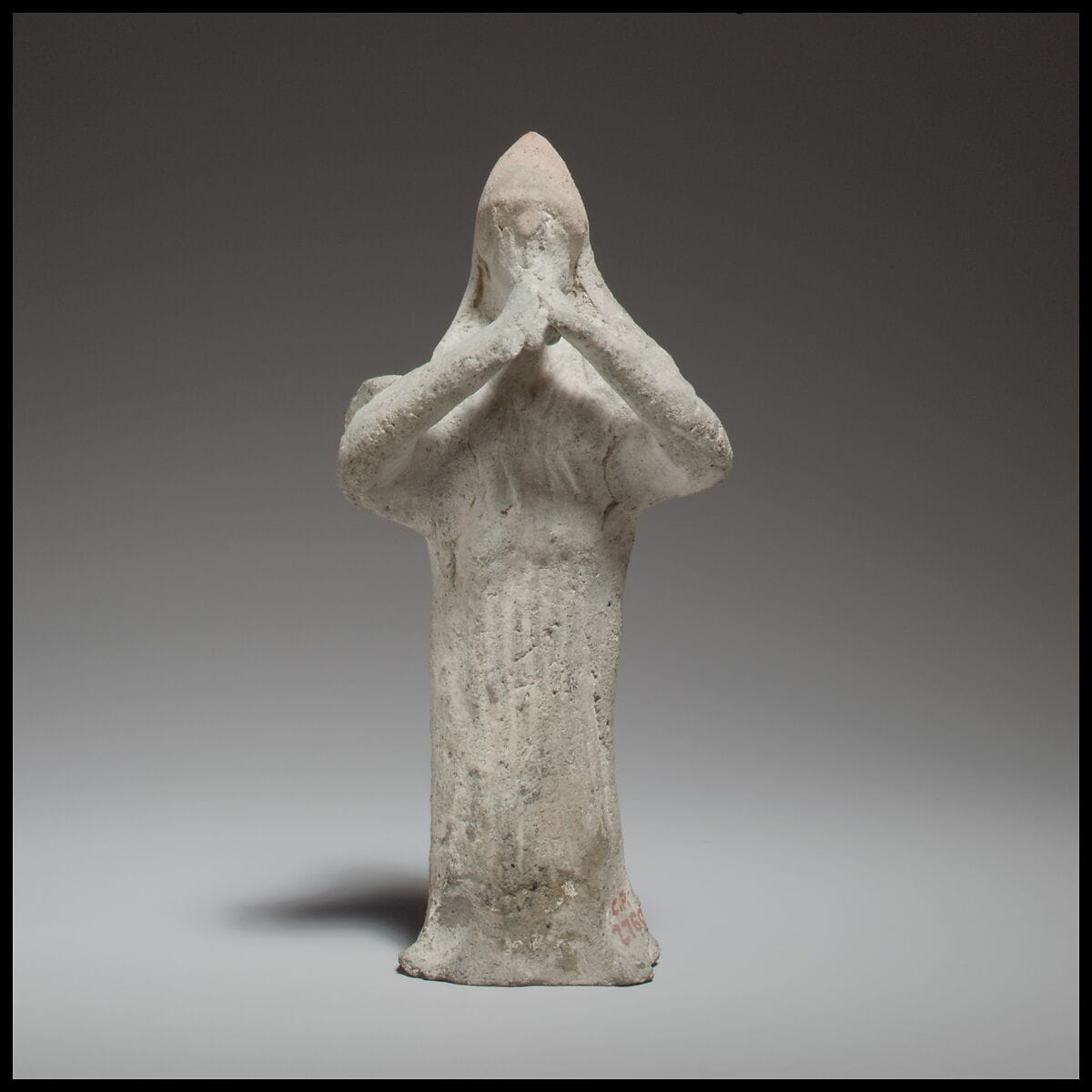
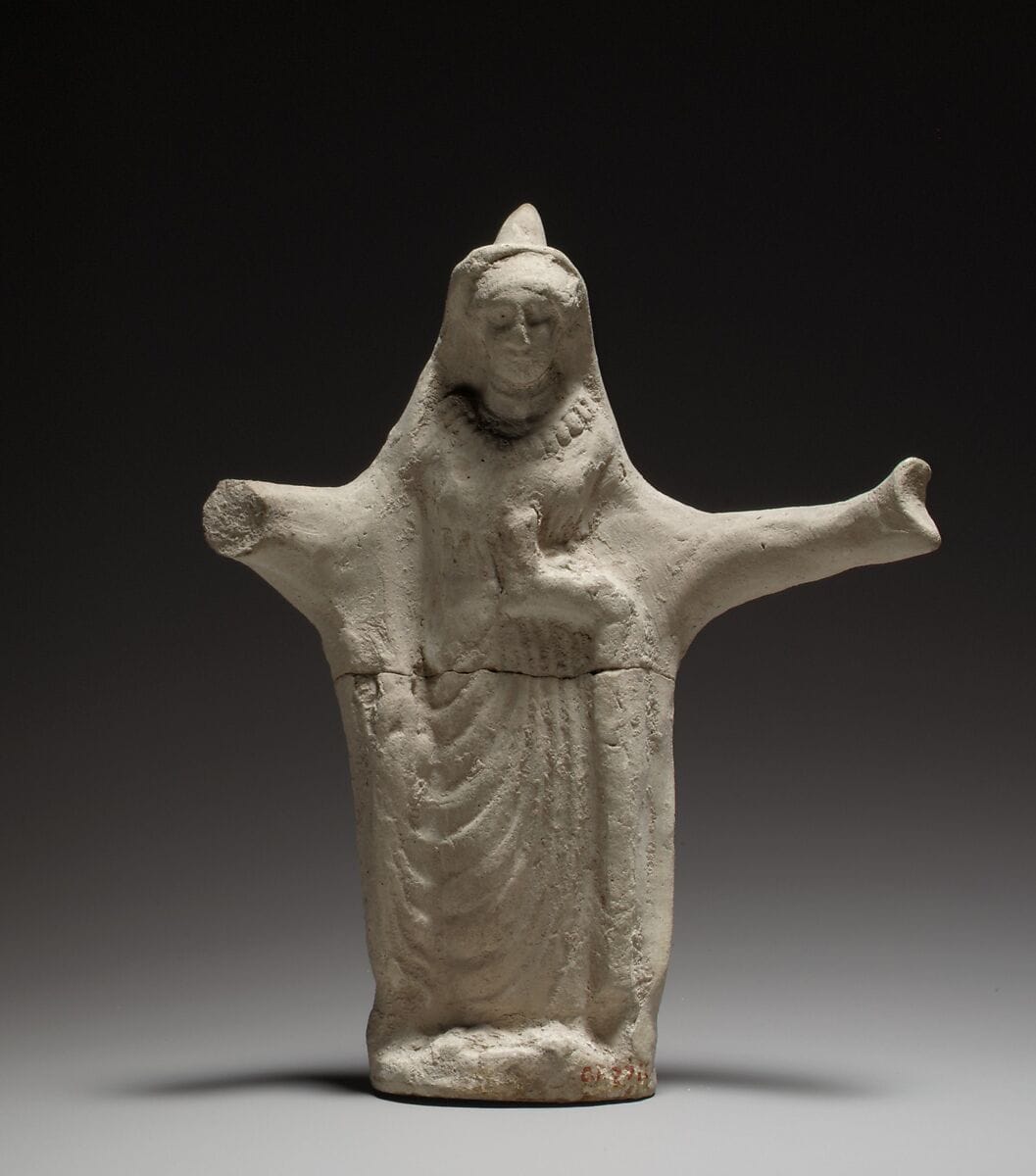
The Met's examples all come from the Cesnola collection, and they illustrate both complete groups and the loose members into which groups break. The ring dance 74.51.1650 (Met record) is the handmade Archaic type. The woman from a ring dance 74.51.1649 (Met record), Cypro-Classical I, 14.3 cm high and said to be from Kythrea or Soli, is a single dancer of the fifth century. Two flute players, 74.51.1690 (Met record) from a group's centre and 74.51.1689 (Met record) from within a ring, show the two positions of the musician. All are in the Metropolitan Museum; AO 22221 is in the Louvre.
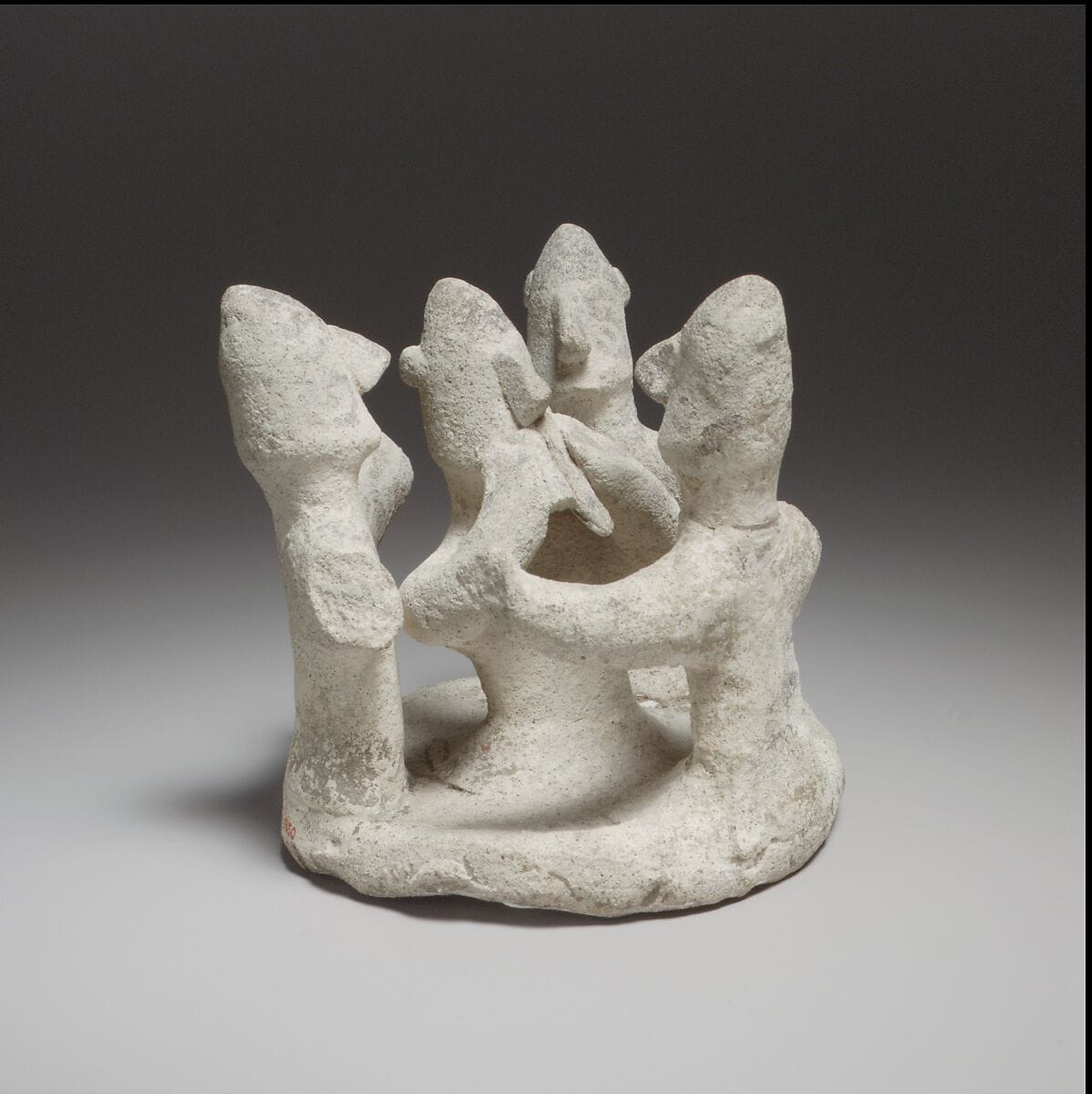
Three dancers round a double-flute player, handmade, Cypro-Archaic II, said to be from Lapithos; Metropolitan Museum 74.51.1650. See the artifact page.
Identifying a ring-dance group or fragment
A complete group is easy to recognise; fragments are harder. The features that mark a figure as having belonged to a ring are practical ones: arm extensions or flat, flipper-like hands meant to be joined to a neighbour [2, pp. 127–128]; a base shared with another figure; figures turned inwards; and the stump of a central element, whether a musician, a column or a clay tree [3, p. 279, no. 077].
Date is read from technique. Solid handmade figures with pellet features and black and red paint belong to the Geometric and Archaic groups; mould-made fronts with plain backs appear in the later groups, such as the British Museum group and the fifth-century Met figures; limestone groups of veiled women are fourth-century [2, p. 72; 3, p. 279; 5, p. 115]. Because the mould-made Cypro-Classical figures keep the Archaic type [2, p. 128], a fragment's date should rest on the modelling of the face and the method of manufacture, not on its pose.
The Drakopoulos group shown at the head of this page shows these features in reduced form: two figures on a single base, facing inwards, with a broken shaft between them. Its reading as a tree dance is argued in Two Figures and a Tree. Other figure classes of the period are covered under horse and rider figurines, temple boys and snowman figurines.
Objects on this page
References
- 1.Leriou, A. (2017). The musician, the dancer and the priest: Readdressing Cypro-Archaic ritual. In V. Vlachou & A. Gadolou (Eds.), ΤΕΡΨΙΣ: Studies in Mediterranean archaeology in honour of Nota Kourou (Études d'archéologie 10). CReA-Patrimoine.
- 2.Karageorghis, V., Merker, G. S., & Mertens, J. R. (2016). The Cesnola Collection of Cypriot art: Terracottas [Online publication]. The Metropolitan Museum of Art.
- 3.Bombardieri, L., & Panero, E. (Eds.). (2021). Cyprus: Crossroads of civilizations [Exhibition catalogue, Musei Reali, Turin].
- 4.Civitillo, M. (Ed.). (n.d.). Cipro: Isola di Afrodite [Exhibition catalogue].
- 5.Cyprus: A dynamic island [Exhibition catalogue]. (n.d.).
- 6.Young, J. H., & Young, S. H. (1955). Terracotta figurines from Kourion in Cyprus. The University Museum, University of Pennsylvania.
- 7.Buitron, D., & Soren, D. (n.d.). [Report on the sanctuary of Apollo Hylates at Kourion, meeting abstract]. https://doi.org/10.2307/505041
- 8.Connelly, J. B. (n.d.). Excavations on Geronisos Island: Third report.