
Early Bronze Age II
Red Polished Bowl with Two Opposed Tab Lugs
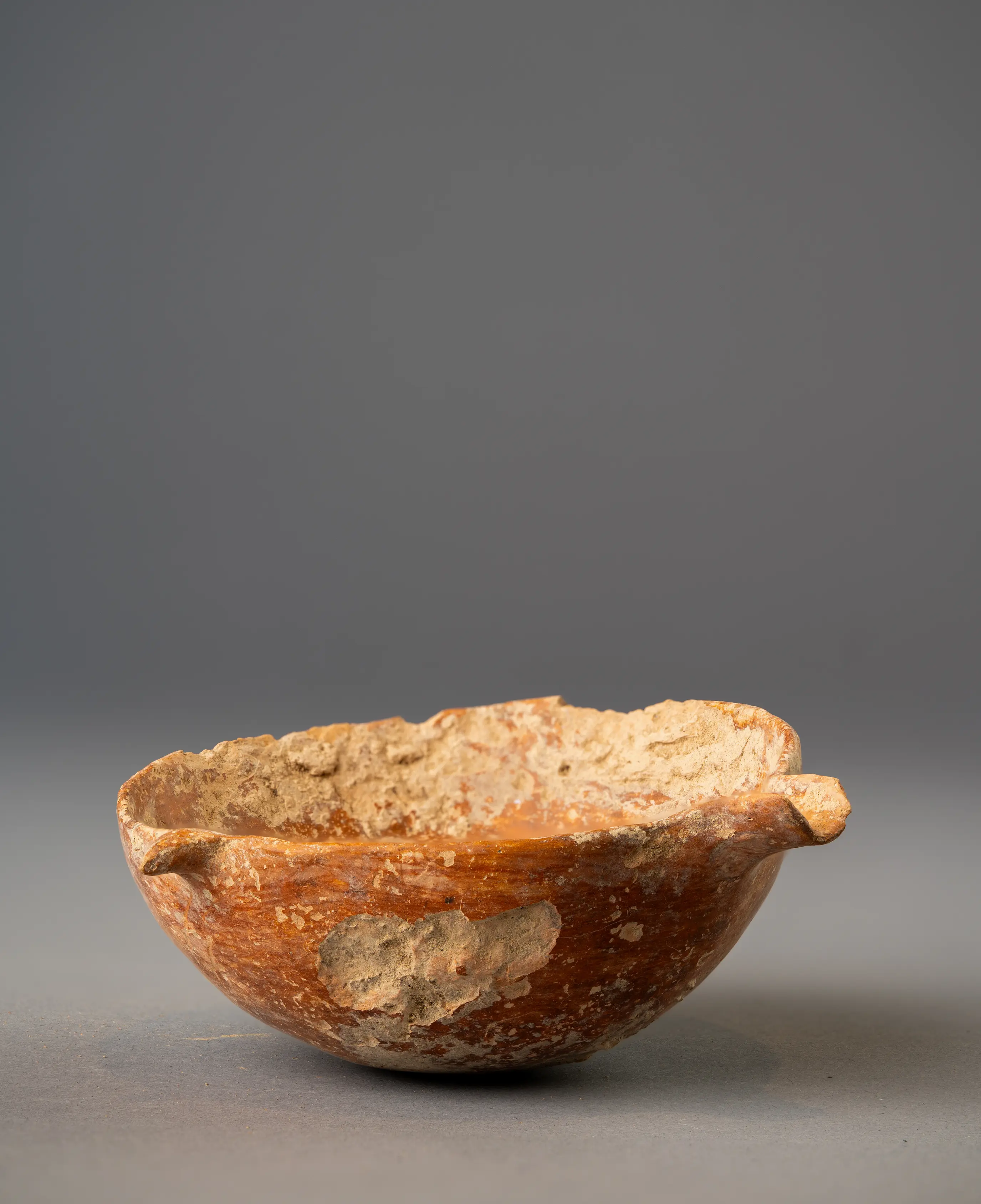
Hand-made Red Polished hemispherical bowl with two opposed tab lugs and burnished orange-red slip, in worn condition. Early Bronze Age Cyprus, c. 2200–1900 BCE.
Date
2200 - 1900 BC
Accession No.
BWL-BA-014
Collection
Alexis Drakopoulos
Provenance
- 1965–1969, The Goodman Collection
- 2025–present, Alexis Drakopoulos, London
Early Cypriot II–Middle Cypriot I, c. 2200–1900 BCE · Red Polished ware · Hand-made
A shallow-to-medium hemispherical bowl on a rounded base, with a plain rim that rises and dips around the circuit in the manner of hand-built work. Two short horizontal tab lugs project from the rim on opposite sides, each thickened and turned slightly upward at the tip; neither shows a piercing in the photographs. The exterior carries a warm orange-red slip with fine horizontal burnishing strokes still visible under the light. The surface is in poor condition. A large raised patch of rough buff material sits on the lower wall, smaller pale spots are scattered across the body, and much of the upper interior is covered by rough, uneven buff matter, with smooth red slip surviving only in the bowl's floor. The rim is chipped in places.
Commentary
This is a plain Red Polished bowl of the hemispherical class that Stewart grouped as Class XIII F [1], distinguished here by its pair of opposed lugs. The great majority of these bowls have a single knob or tab lug, often pierced; two-lug bowls form a smaller variant that occurs alongside them, and Morris illustrates both forms [2]. The lugs on this piece are flat tabs pulled out from the rim, placed so that the bowl could be lifted with both hands.
The slip and burnish are typical of the ware: a single red-firing slip, burnished with a hard tool in horizontal strokes, and no black top. In shape and finish it compares with a bowl from Nicosia-Ayia Paraskevi in the British Museum, a shallow hemispherical bowl with a slightly incurving rim, polished red slip and a single pierced lug, dated c. 2150–1950 BCE [3]. Bowls of this family were among the most frequent vessels in north-coast Early Cypriot tombs [4], and the knob-lug series ran on from Early Cypriot II into the Middle Cypriot period [5]. Stewart's Roman-numeral sub-wares for these bowls are partly chronological labels: Merrillees observes that the knob-lug bowl Stewart classed as "RP II" is technically mostly RP III, with some RP IV [5]. The neutral term Red Polished is used here. A plain bowl gives no internal clue for a closer date, so the type range is quoted.
The pale material inside the bowl and in the patch on the outer wall is either burial concretion adhering to the surface or areas where the slip and outer skin of the clay have flaked away; the raised, lumpy profile of the exterior patch looks more like adhering deposit or an old fill than a loss, but the photographs cannot settle this. Morris notes that such small bowls are often called cups without direct proof of drinking use, and that they may have held food [2]. The find-place of this example is unrecorded.
References
- 1.Stewart, J.R. (1962) The Early Cypriote Bronze Age. The Swedish Cyprus Expedition IV.1A. Lund, Index of Types, Class XIII F.
- 2.Morris, D. (1985) The Art of Ancient Cyprus. Oxford: Phaidon, pp. 69–72 and pls. 115–116.
- 3.British Museum, London, 1888,0927.7. Red Polished I–II (mottled) shallow hemispherical bowl with slightly incurving rim and one pierced lug, Nicosia-Ayia Paraskevi, c. 2150–1950 BC. D. 12.5 cm, H. 6 cm.
- 4.Kehrberg, I. (1982) Early and Middle Cypriote Chronology Again. Levant 14, 59–72.
- 5.Merrillees, R.S. (1991) In Barlow, J.A., Bolger, D.L. and Kling, B. (eds) Cypriot Ceramics: Reading the Prehistoric Record. Philadelphia: University Museum, p. 263.
More from the Catalogue
Browse related objects
Bichrome Kylix with Bird Free Field Art
Geometric III
Milk bowl
Bronze Age
Bowl
Geometric III
Krater
Archaic I
Handle of a bowl
Bronze Age
Bowl
Geometric I
Bowl
Bronze Age
Terracotta bowl
Chalcolithic
Silver bowl
Archaic I
Alabaster bowl
Classical
Bronze phiale (libation bowl)
Archaic II
Bowl fragment, inscribed
Archaic II
Bowl
Bronze Age
Bowl
Archaic I
Bowl
Late Bronze Age II
Bowl
Geometric III
Terracotta footed bowl
Archaic I
Marble bowl fragment with Phoenician inscription
Classical