
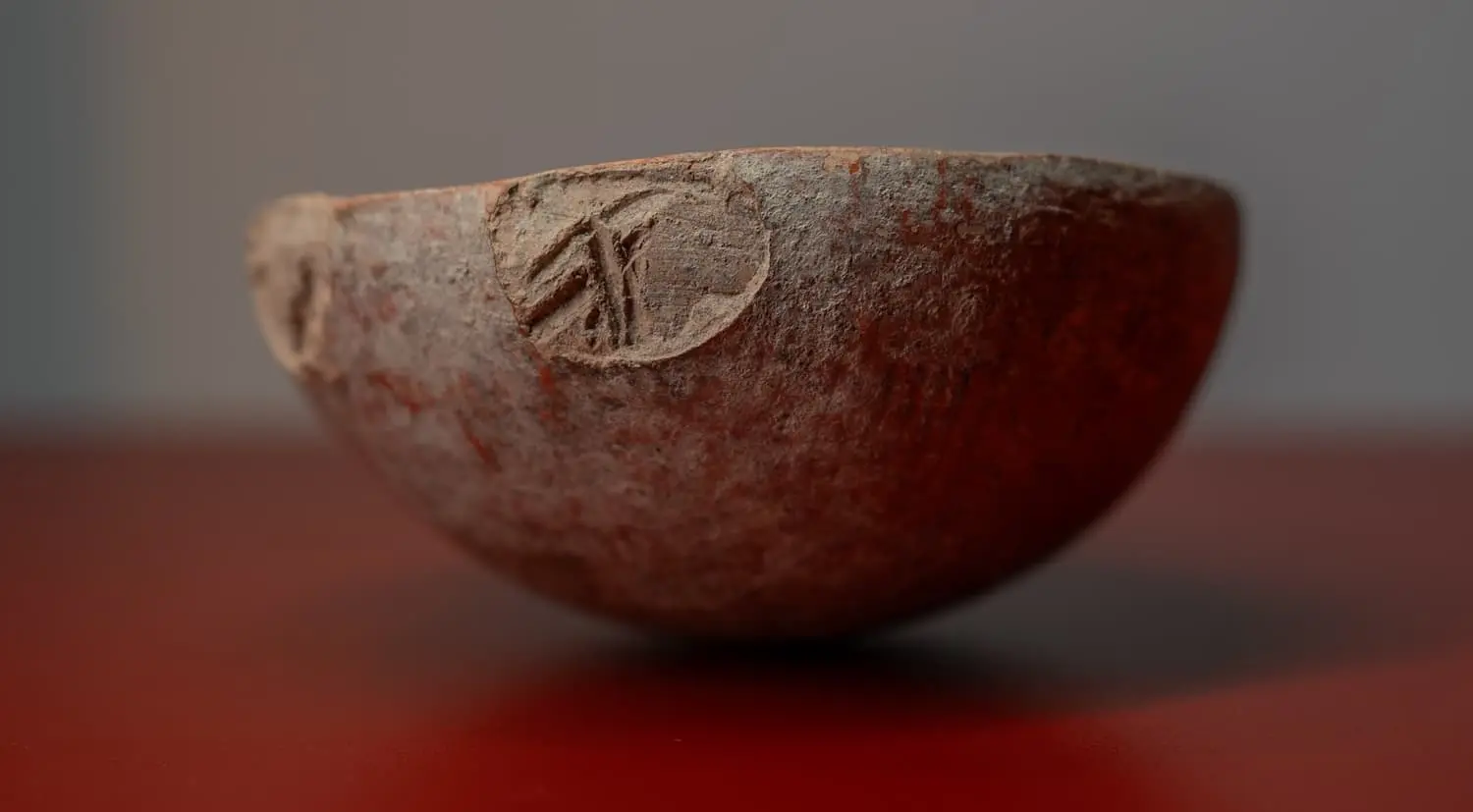
Early Bronze Age III
Red Polished Bowl with an Incised Mark
Worn hand-made Red Polished hemispherical bowl with an incised branch-like mark in a smoothed oval zone below the rim, possibly a potter's mark.
Date
2100 - 1750 BC
Accession No.
BWL-BA-010
Collection
Alexis Drakopoulos
Early Cypriot III–Middle Cypriot II, c. 2100–1750 BCE · Red Polished ware · Hand-made
A shallow hemispherical bowl with a rounded base and a simple, slightly thickened rim. The surface is heavily worn to a granular grey-brown, with the red slip surviving only in scattered patches and streaks, most strongly on the right side and lower body.
Just below the rim sits an oval zone, flattened and smoother than the surrounding wall and outlined by a shallow groove. Within it are deep incised strokes: one long diagonal line crossed by three or four short oblique cuts, giving the effect of a branch or feather. At the far left, on the curve of the rim, is a second raised feature, probably a lug, which also seems to carry an incised line.
Commentary
The shape is the ordinary hemispherical Red Polished bowl of the Early and Middle Cypriot periods, related to Stewart's Class XIII F [1]. The worn, drab surface makes the grade of the ware hard to judge. A thin grey-brown body of this kind fits the later Red Polished series better than the glossy early bowls, and a broad date of Early Cypriot III–Middle Cypriot II is proposed on that basis, with the proportions matching bowls of that date in Oxford [4] and London [5].
The incised sign is the reason for including the bowl in a catalogue, and also its main problem. Marks cut into Red Polished bowls before firing are well documented. Åström's corpus of pot-marks records them on knob-lug bowls from Vounous and Lapithos, noting that "the marks on the bowls are applied near the lugs" and occur on decorated and undecorated bowls alike [2]. His examples include a horizontal mark about 12 mm long beneath the lug of a bowl from Vounous Tomb 151, and a stroke immediately below the string-hole of another [2]. A small Vounous bowl in Cambridge carries a potter's mark under its lug [3]. The position of the sign on this bowl, beside the rim feature, fits that pattern.
Other features do not fit so easily. The published marks are simple strokes and groups of lines cut directly into the wall; we know of no parallel for a mark set inside a smoothed, grooved oval panel, and the texture of the oval differs from the rest of the surface. It may be an ancient smoothed or applied pad, a later fill or restoration of a damaged area, or the result of cleaning. Until the object has been examined under magnification and ultraviolet light, to see whether the grooves are worn and whether burial deposit runs into them, the sign is best described as an incised mark, possibly a potter's mark. The bowl was previously published on this site as a bowl with linear decoration of the Archaic period; that attribution is withdrawn.
References
- 1.Stewart, J.R. (1962) The Early Cypriote Bronze Age. In The Swedish Cyprus Expedition IV.1A. Lund: Swedish Cyprus Expedition, Index of Types, Class XIII F.
- 2.Åström, P. (1966) Excavations at Kalopsidha and Ayios Iakovos in Cyprus. Studies in Mediterranean Archaeology 2. Lund: Paul Åström, pp. 153–195, esp. pp. 166, 169, 193.
- 3.Museum of Archaeology and Anthropology, University of Cambridge, inv. 1951.1081 L. Small Red Polished bowl with one pierced lug and potter's mark beneath the lug, Bellapais-Vounous.
- 4.Ashmolean Museum, Oxford, inv. AN1953.267. Red Polished hemispherical bowl, Early Cypriot III–Middle Cypriot II.
- 5.British Museum, London, inv. 1888,0927.16. Red Polished hemispherical bowl with pierced lug, Nicosia-Ayia Paraskevi.
More from the Catalogue
Browse related objects
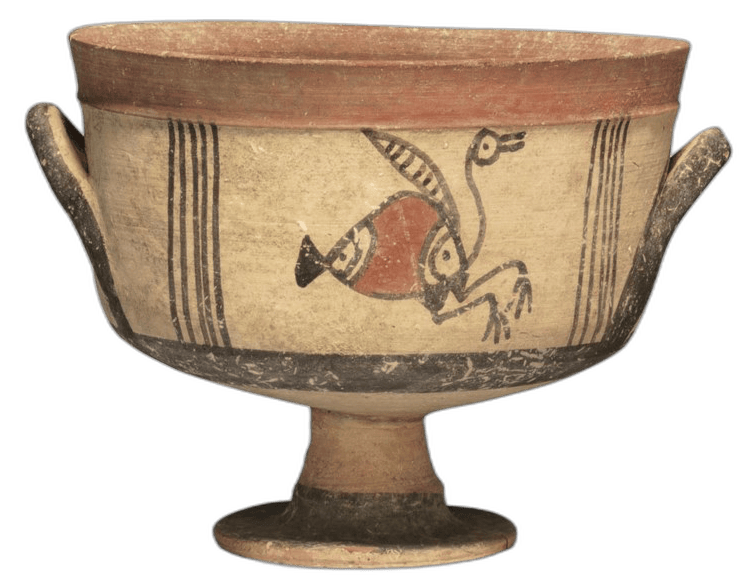
Bichrome Kylix with Bird Free Field Art
Geometric III
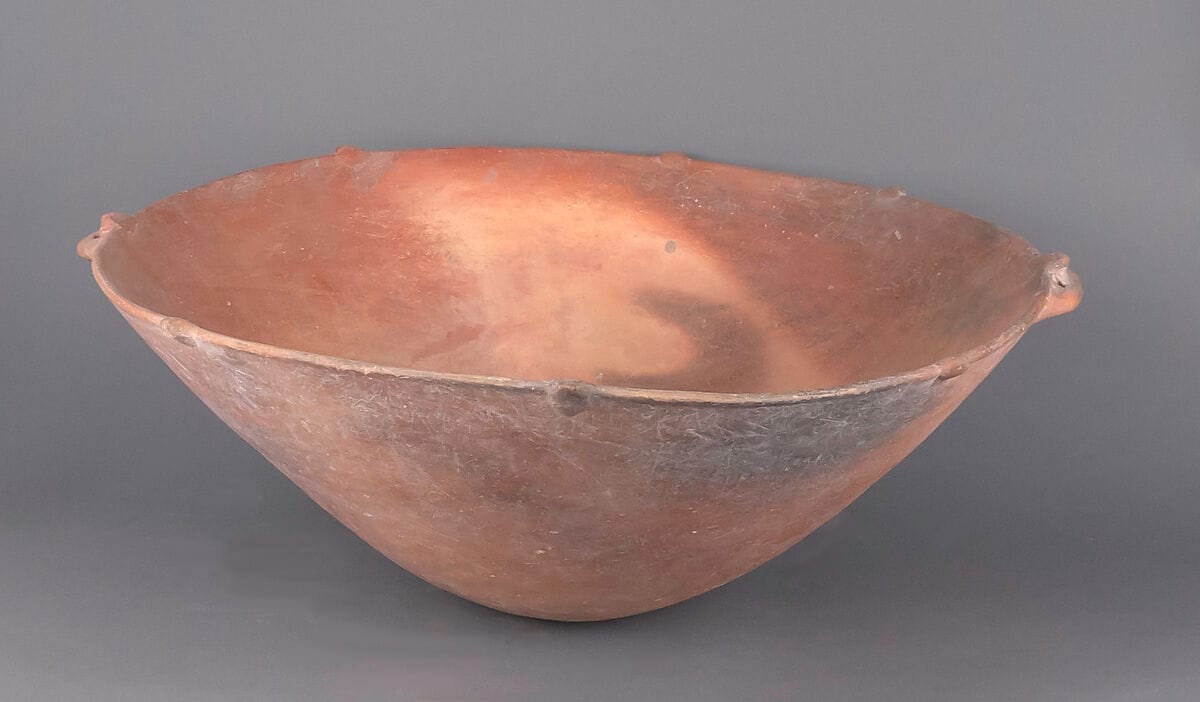
Milk bowl
Bronze Age
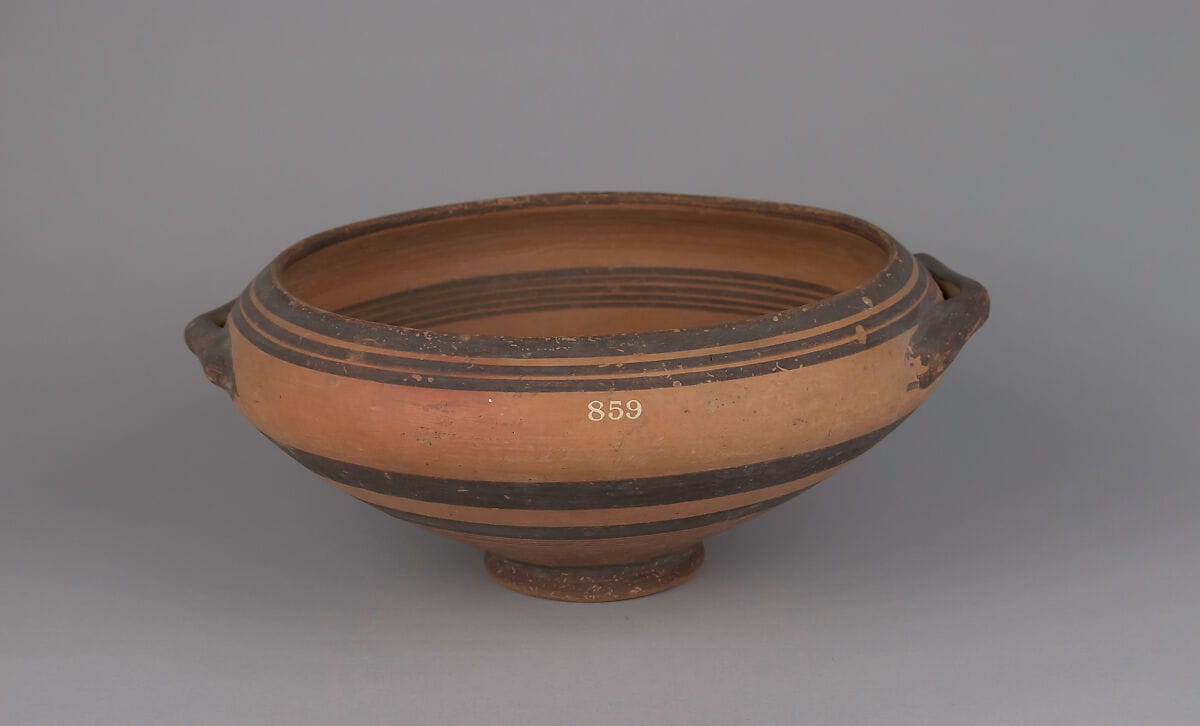
Bowl
Geometric III
Krater
Archaic I
Handle of a bowl
Bronze Age
Bowl
Geometric I
Bowl
Bronze Age
Terracotta bowl
Chalcolithic
Silver bowl
Archaic I
Alabaster bowl
Classical
Bronze phiale (libation bowl)
Archaic II
Bowl fragment, inscribed
Archaic II
Bowl
Bronze Age
Bowl
Archaic I
Bowl
Late Bronze Age II
Bowl
Geometric III
Terracotta footed bowl
Archaic I
Marble bowl fragment with Phoenician inscription
Classical