
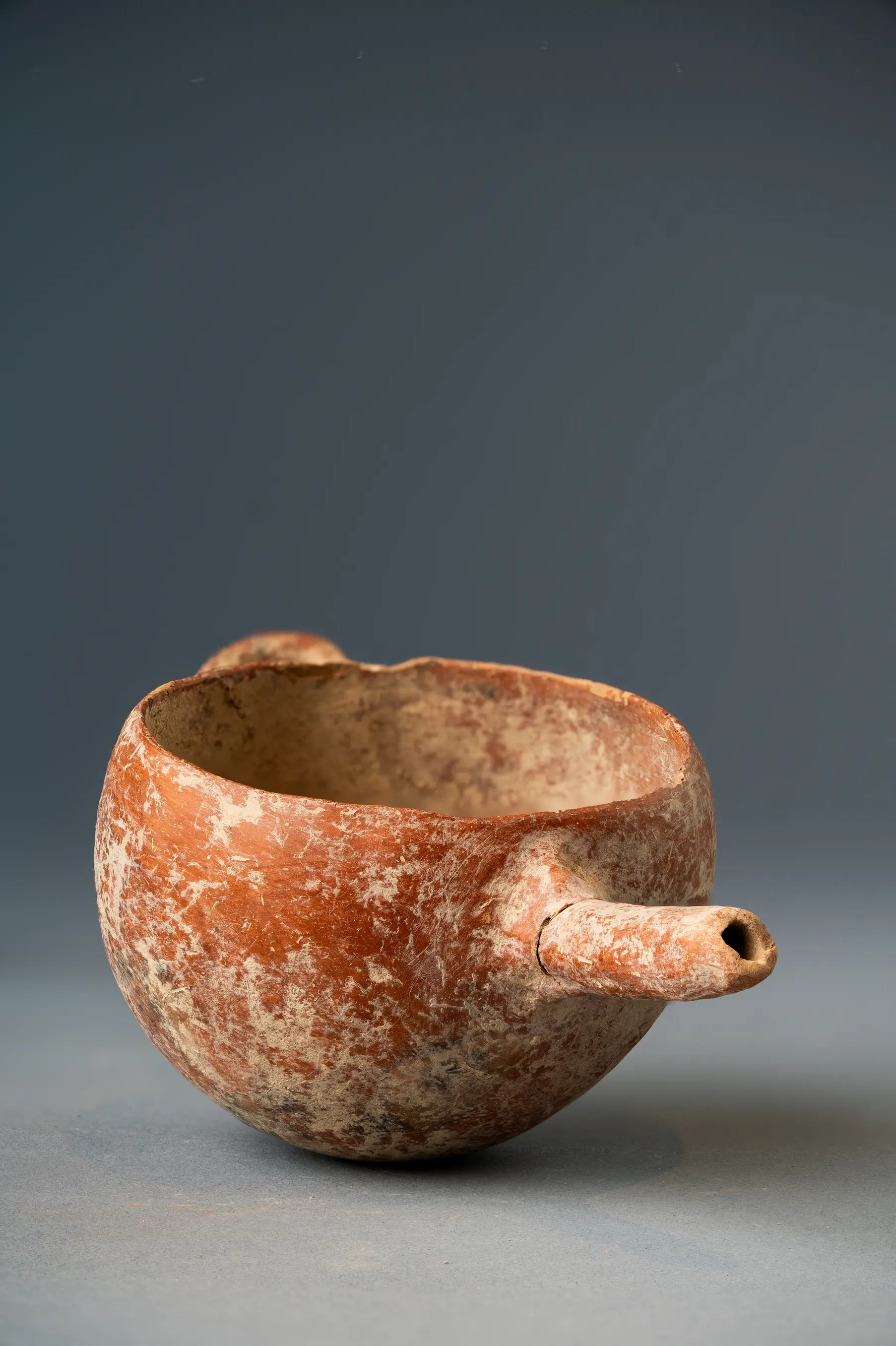
Early Bronze Age II
Red Polished Spouted Bowl
Small, deep Red Polished bowl with a horizontal tubular spout below the rim and a knob lug across from it, the red slip mottled with burial crust.
Date
2200 - 1900 BC
Accession No.
BWL-BA-008
Collection
Alexis Drakopoulos
Provenance
- By 1965–1969, The Goodman Collection
- 2025–present, Alexis Drakopoulos, London
Early Cypriot II–Middle Cypriot I, c. 2200–1900 BCE · Red Polished ware · Hand-made
A deep, almost globular bowl on a rounded base, the wall curving in to a plain, slightly uneven rim. A tubular spout is set just below the rim and projects horizontally, its tip very slightly raised, with a clean round bore. Across the bowl from it, a little to one side, a rounded knob lug rises above the rim.
The red slip is burnished and patchy, deep red on the shoulders and around the spout, much of it veiled by a mottled whitish crust from burial. The interior is a paler buff-red with crust in the bowl. A distinct line encircles the root of the spout where it meets the wall.
Commentary
Spouted bowls are one of the standard Red Polished shapes, made alongside the far more numerous plain hemispherical bowls of Stewart's Class XIII [6]. The form has deep roots on the island: Webb and Frankel note that of all the Philia shapes, only the tubular-spouted bowl has clear local antecedents in the Chalcolithic [5]. In the Early and Middle Cypriot period the usual arrangement is the one seen here, a spout below the rim and a lug on the opposite side. A deep Vounous bowl in the Fitzwilliam Museum, from Tomb 90, has a tubular spout and a pierced vertical lug opposite it [1]; two bowls in Cambridge, one with a round base and inturned rim [2] and one with a mottled red and black surface [3], repeat the scheme.
Those larger bowls belong to the family Karageorghis calls the "milk-bowl", after the modern Cypriot vessel used for milking goats and sheep. He observes that the shape appears as early as Early Cypriot I and is deep at first, becoming shallow in its Middle Cypriot development [1]. This bowl is small and deep, with a rounded base, and it resembles the Ashmolean's spouted bowl of 10.3 cm height, dated to Early Cypriot III [4]. A date of c. 2200–1900 BCE fits the shape, with the caveat that small plain spouted bowls changed slowly and a closer date needs a tomb context. The find-place is unrecorded.
The spout implies pouring or serving from the bowl. What was poured is unknown, and the "milk-bowl" label is a modern analogy that says nothing about the contents. The lug could have been pierced for a cord, though no hole is visible from the side shown here.
The line around the spout root could be the seam left where the potter joined a separately modelled spout to the wall, or it could mark a break and a modern re-attachment. The two are hard to tell apart without close examination.
References
- 1.Karageorghis, V., Vassilika, E. & Wilson, P. (1999) The Art of Ancient Cyprus in the Fitzwilliam Museum, Cambridge. Cambridge: The Fitzwilliam Museum and Nicosia: A.G. Leventis Foundation, cat. 16 and commentary (entries by V. Karageorghis).
- 2.Museum of Archaeology and Anthropology, Cambridge, Z 14834 C. Spouted bowl of burnished red slip ware, round base, pierced lug on the rim opposite the spout, H. 121 mm. Collection record.
- 3.Museum of Archaeology and Anthropology, Cambridge, 1951.2002 A. Rounded Red Polished bowl with vertical pierced lug opposite a tubular spout, mottled surface. Collection record.
- 4.Ashmolean Museum, Oxford, AN1965.722. Red Polished spouted bowl, H. 10.3 cm, D. 12 cm, Early Cypriot III. Collection record.
- 5.Webb, J.M. & Frankel, D. (1999) Characterizing the Philia Facies: Material Culture, Chronology, and the Origin of the Bronze Age in Cyprus. American Journal of Archaeology 103, 3–43, p. 39.
- 6.Stewart, J.R. (1962) The Early Cypriote Bronze Age. The Swedish Cyprus Expedition IV.1A. Lund: Swedish Cyprus Expedition.
More from the Catalogue
Browse related objects
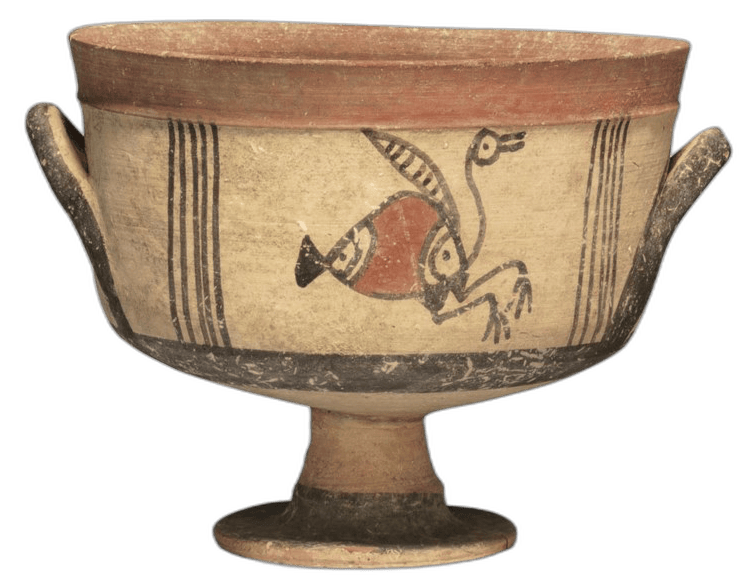
Bichrome Kylix with Bird Free Field Art
Geometric III
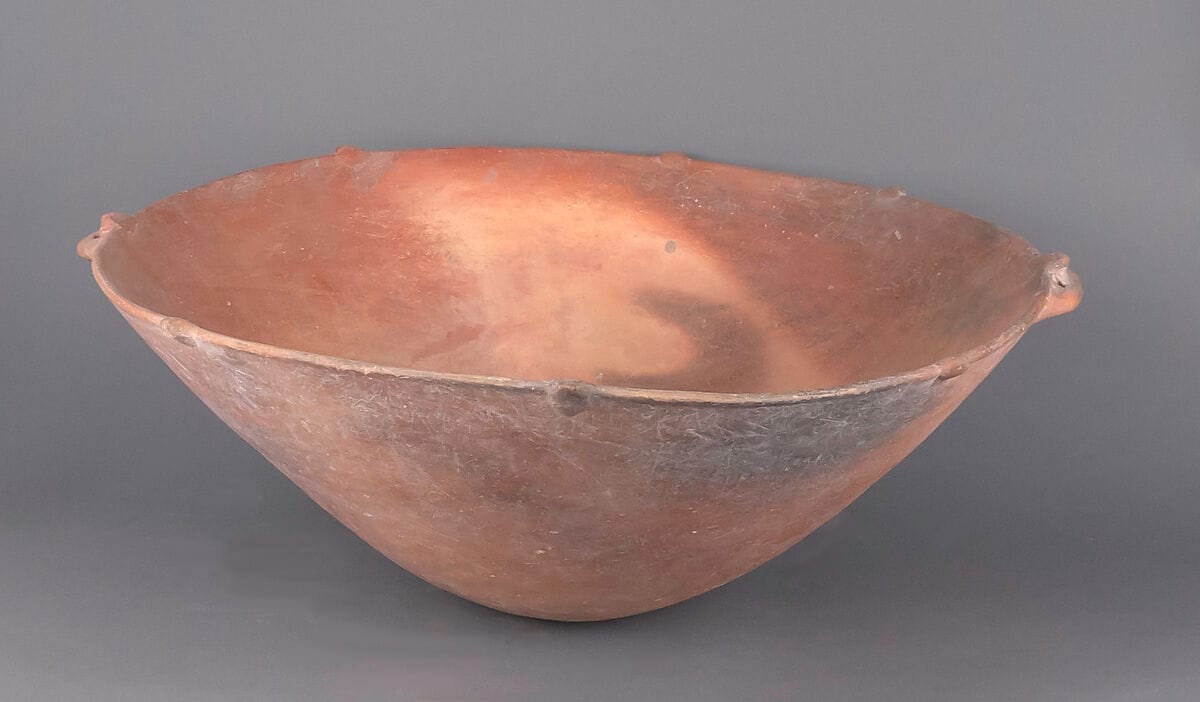
Milk bowl
Bronze Age
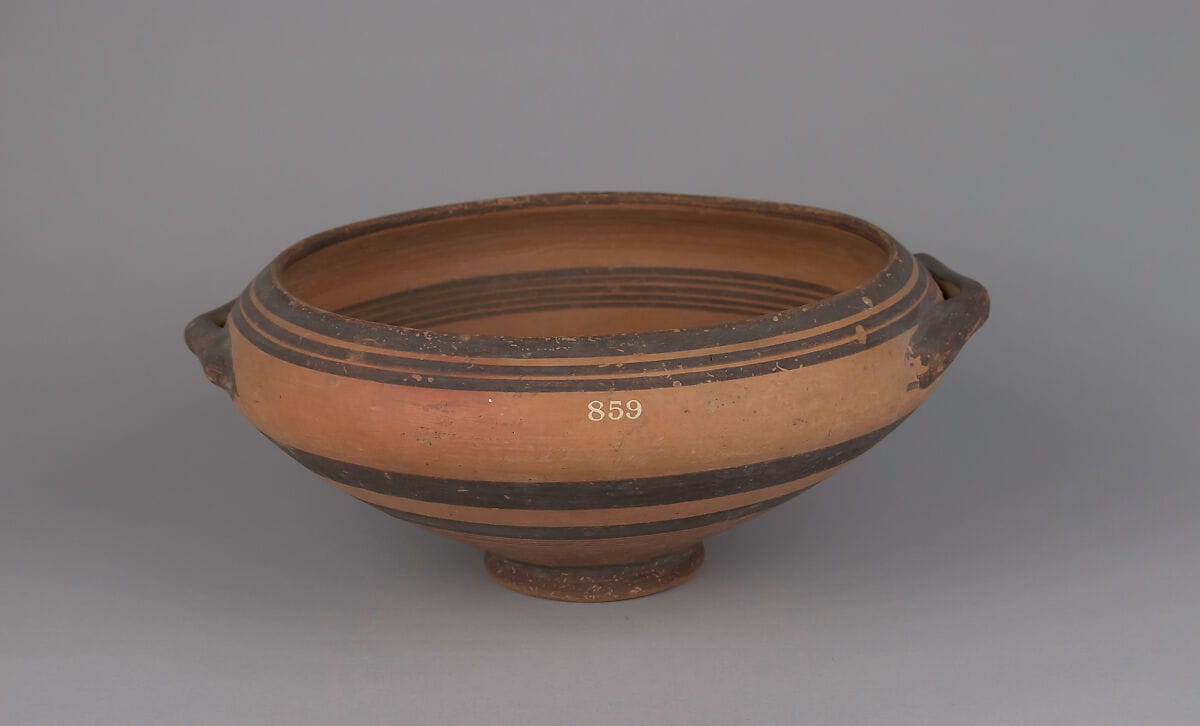
Bowl
Geometric III
Krater
Archaic I
Handle of a bowl
Bronze Age
Bowl
Geometric I
Bowl
Bronze Age
Terracotta bowl
Chalcolithic
Silver bowl
Archaic I
Alabaster bowl
Classical
Bronze phiale (libation bowl)
Archaic II
Bowl fragment, inscribed
Archaic II
Bowl
Bronze Age
Bowl
Archaic I
Bowl
Late Bronze Age II
Bowl
Geometric III
Terracotta footed bowl
Archaic I
Marble bowl fragment with Phoenician inscription
Classical