
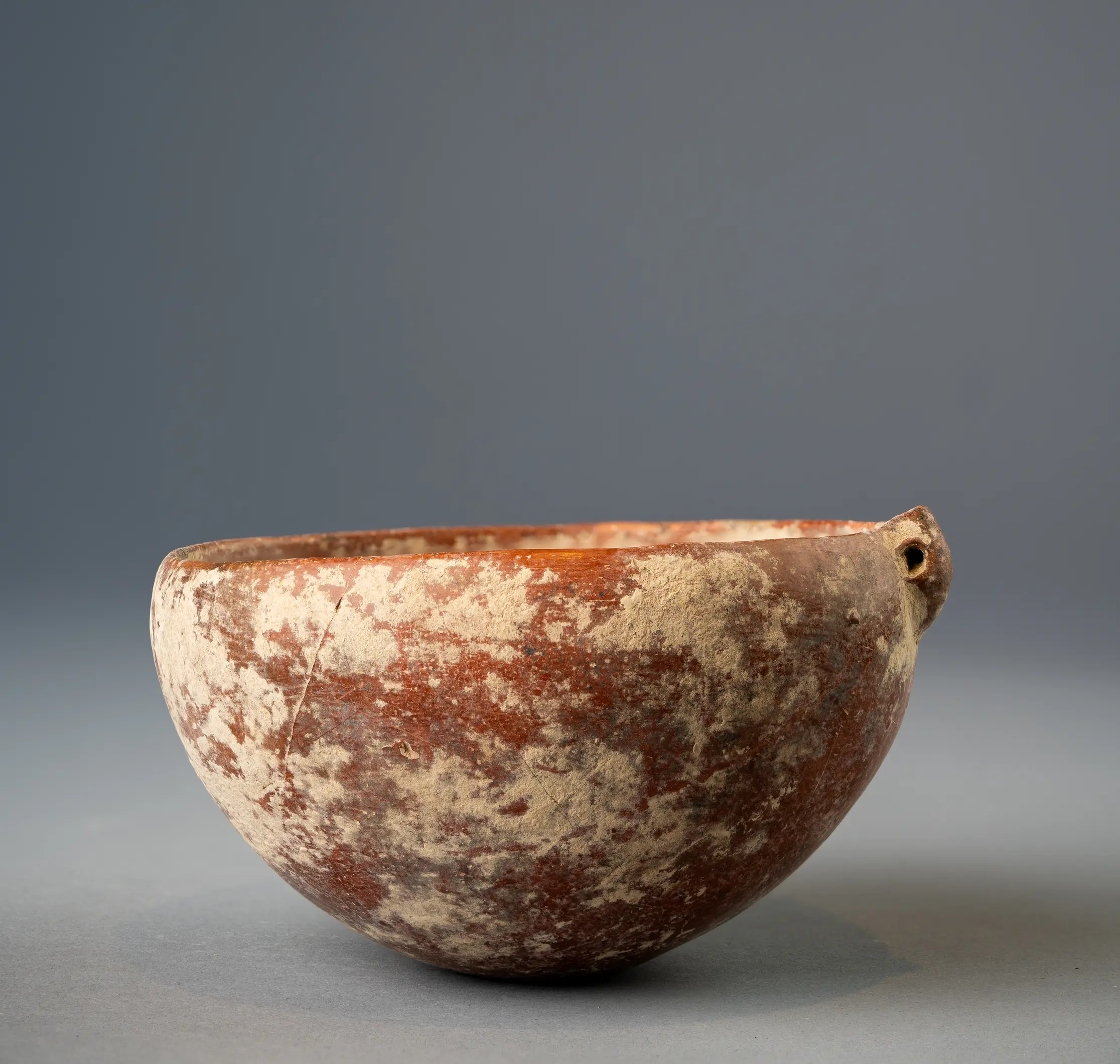
Early Bronze Age II
Red Polished Bowl with Pierced Lug, under Burial Crust
Hand-made Red Polished hemispherical bowl with a pierced string-hole lug at the rim, much of its burnished red slip hidden under white burial crust.
Date
2200 - 1900 BC
Accession No.
BWL-BA-005
Collection
Alexis Drakopoulos
Provenance
- By 1965–1969, The Goodman Collection
- 2025–present, Alexis Drakopoulos, London
Early Cypriot II–Middle Cypriot I, c. 2200–1900 BCE · Red Polished ware · Hand-made
A hemispherical bowl on a rounded base, its plain rim finished thin and very slightly incurved. A single lug rises from the rim and stands a little above it, a small vertical tongue of clay pierced right through by a round string-hole.
Beneath a heavy mantle of whitish-buff burial crust the red slip survives in broken patches, deep brick-red where the crust has flaked away and still glossy in places from the burnishing pebble. The crust clings thickest on one flank and thins toward the base and around the lug. Inside, a band of orange slip shows below the rim. A fine hairline crack descends from the rim on the side opposite the lug and runs about halfway down the wall.
Commentary
The bowl belongs to the commonest vessel of the Early Cypriot Bronze Age, the hemispherical "knob-lug" bowl that Stewart placed in his Class XIII F; undecorated examples like this one fall under his XIII F2 [1]. The type turns up in almost every north-coast chamber tomb, sometimes by the dozen: Kehrberg counted 43 plain examples in a single tomb at Vounous and 59 in one tomb at Lapithos-Palealona [2]. It was ordinary tableware, and this piece should be read as one of many.
Plain bowls of this kind changed little between Early Cypriot II and Middle Cypriot I, and without a tomb group they cannot be dated more closely than c. 2200–1900 BCE. Museum examples with a single pierced rim lug share that bracket: a black-topped bowl from Vounous in the British Museum, described with a "pierced lug at rim", is dated c. 2100–1900 BC [3], and a smaller bowl from Dhali with "one pierced lug for suspension" c. 2200–1900 BC [4]. The lug form here, a vertical tongue set on the rim and pierced horizontally, matches a small bowl from Politiko-Tamassos in Cambridge [5] and a Vounous bowl in the Louvre [6].
The string-hole suggests the bowl was hung from a cord or had a cover tied to it when not in use, though this is inferred from the form alone. Morris cautioned that calling such small bowls "cups" assumes a drinking use that has never been proved; they may equally have held small portions of food [7]. Most complete bowls of this kind come from tombs; the find-place of this one is unrecorded.
The white coating is the most visible feature of this piece and needs to be read correctly. It is calcareous deposit that formed on the pot while it lay in the ground, and it has nothing to do with the white lime paste that fills the incised lines on decorated Red Polished ware. Where the crust has come away the slip beneath is often still glossy, so the deposit seems to have protected the burnished surface more than it has damaged it.
References
- 1.Stewart, J.R. (1962) The Early Cypriote Bronze Age. The Swedish Cyprus Expedition IV.1A. Lund: Swedish Cyprus Expedition, Index of Types, Class XIII F.
- 2.Kehrberg, I. (1982) Early and Middle Cypriote Chronology Again. Levant 14, 59–72.
- 3.British Museum, 1980,1126.4. Red Polished (Black Topped) bowl, Bellapais-Vounous, c. 2100–1900 BC. Collection record.
- 4.British Museum, 1868,0905.47. Black-topped Red Polished bowl with one pierced lug, Dhali, c. 2200–1900 BC. Collection record.
- 5.Museum of Archaeology and Anthropology, Cambridge, D 1951.2. Small hemispherical Red Polished bowl with horizontally pierced vertical lug, Politiko-Tamassos. Collection record.
- 6.Musée du Louvre, AM 2517. Coupe à une oreille percée horizontalement, Vounous tomb 57A no. 36. Collection record.
- 7.Morris, D. (1985) The Art of Ancient Cyprus. Oxford: Phaidon, pp. 69–72, pl. 115.
More from the Catalogue
Browse related objects
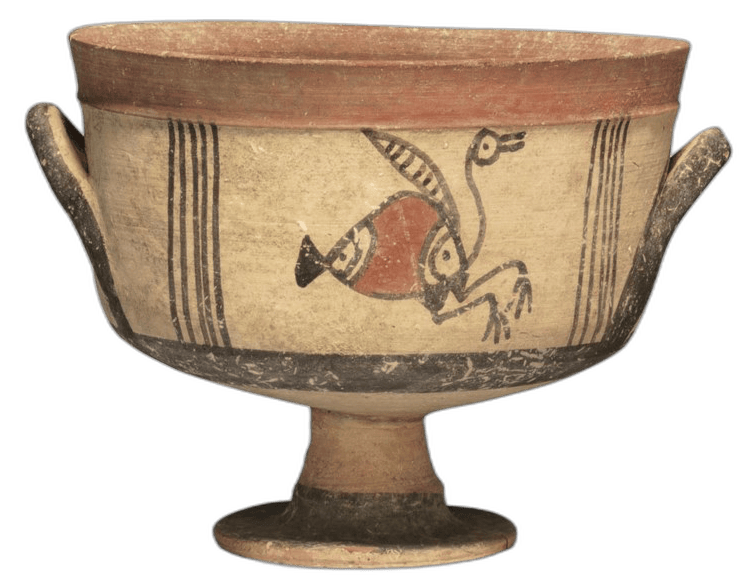
Bichrome Kylix with Bird Free Field Art
Geometric III
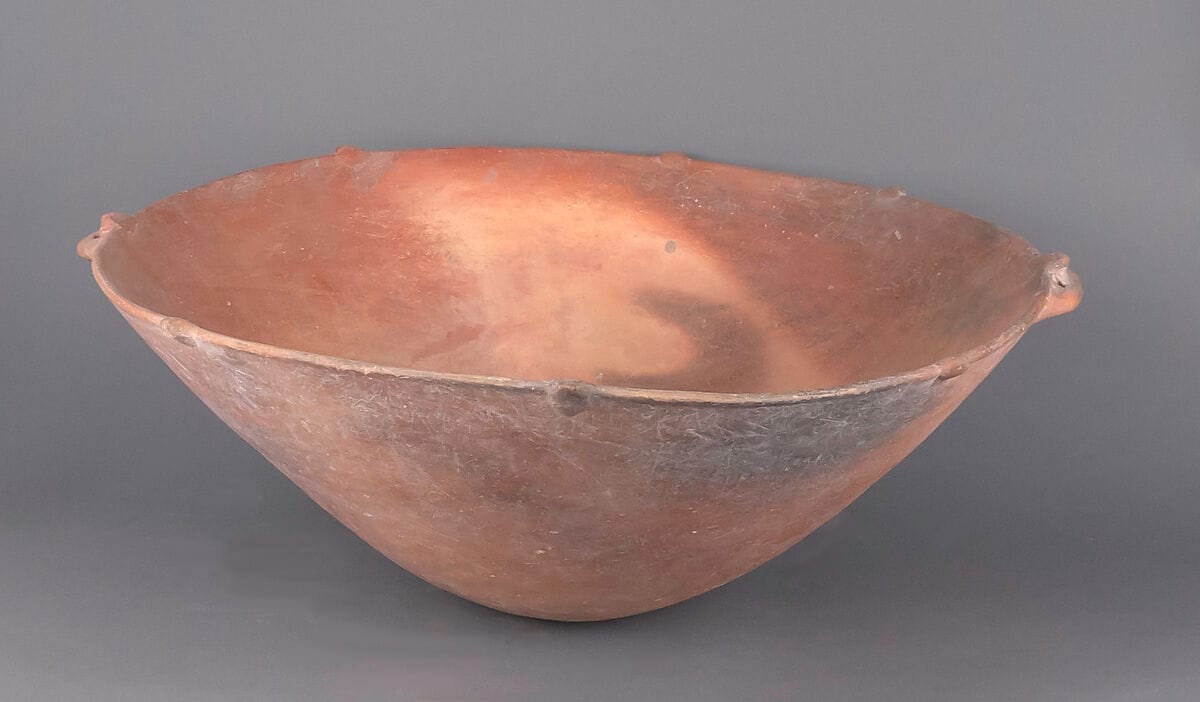
Milk bowl
Bronze Age
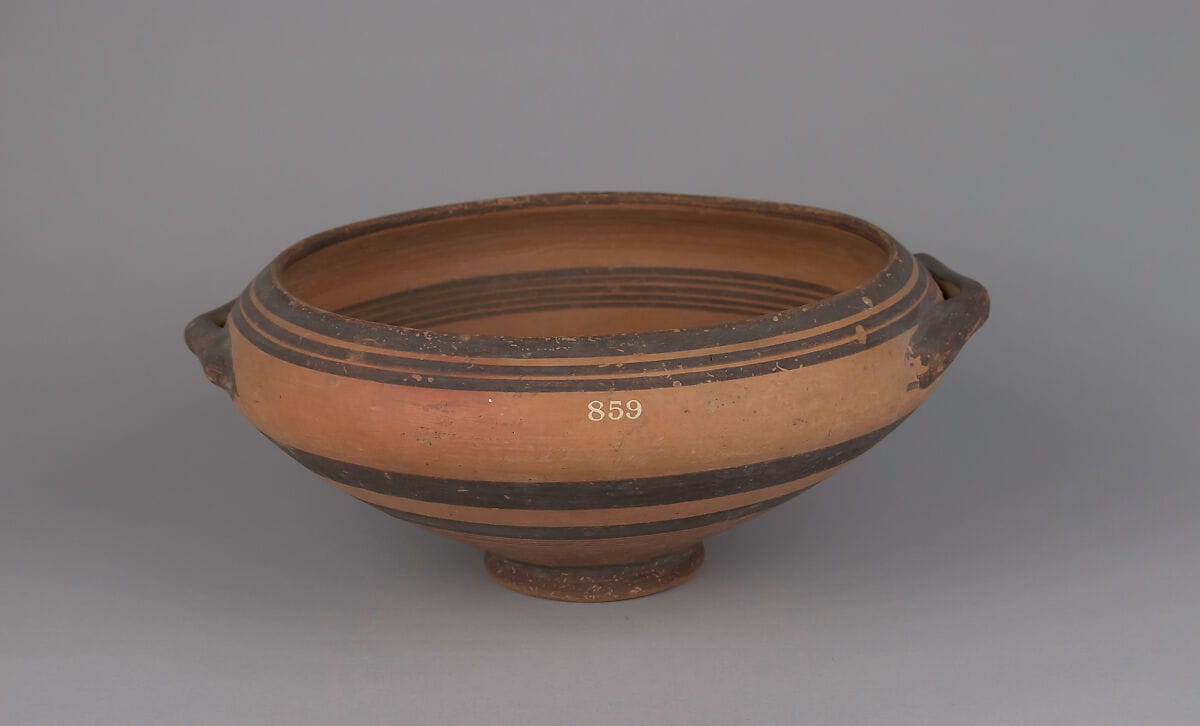
Bowl
Geometric III
Krater
Archaic I
Handle of a bowl
Bronze Age
Bowl
Geometric I
Bowl
Bronze Age
Terracotta bowl
Chalcolithic
Silver bowl
Archaic I
Alabaster bowl
Classical
Bronze phiale (libation bowl)
Archaic II
Bowl fragment, inscribed
Archaic II
Bowl
Bronze Age
Bowl
Archaic I
Bowl
Late Bronze Age II
Bowl
Geometric III
Terracotta footed bowl
Archaic I
Marble bowl fragment with Phoenician inscription
Classical