Cypro-Archaic · c. 750–600 BC
The Free‑Field Bird
One bird, painted in black and red on the bare clay of a Cypriot jug. Then a Cesnola dig, a general's museum, two Sotheby's sales and a round trip to Chicago, all of it on record.
Begin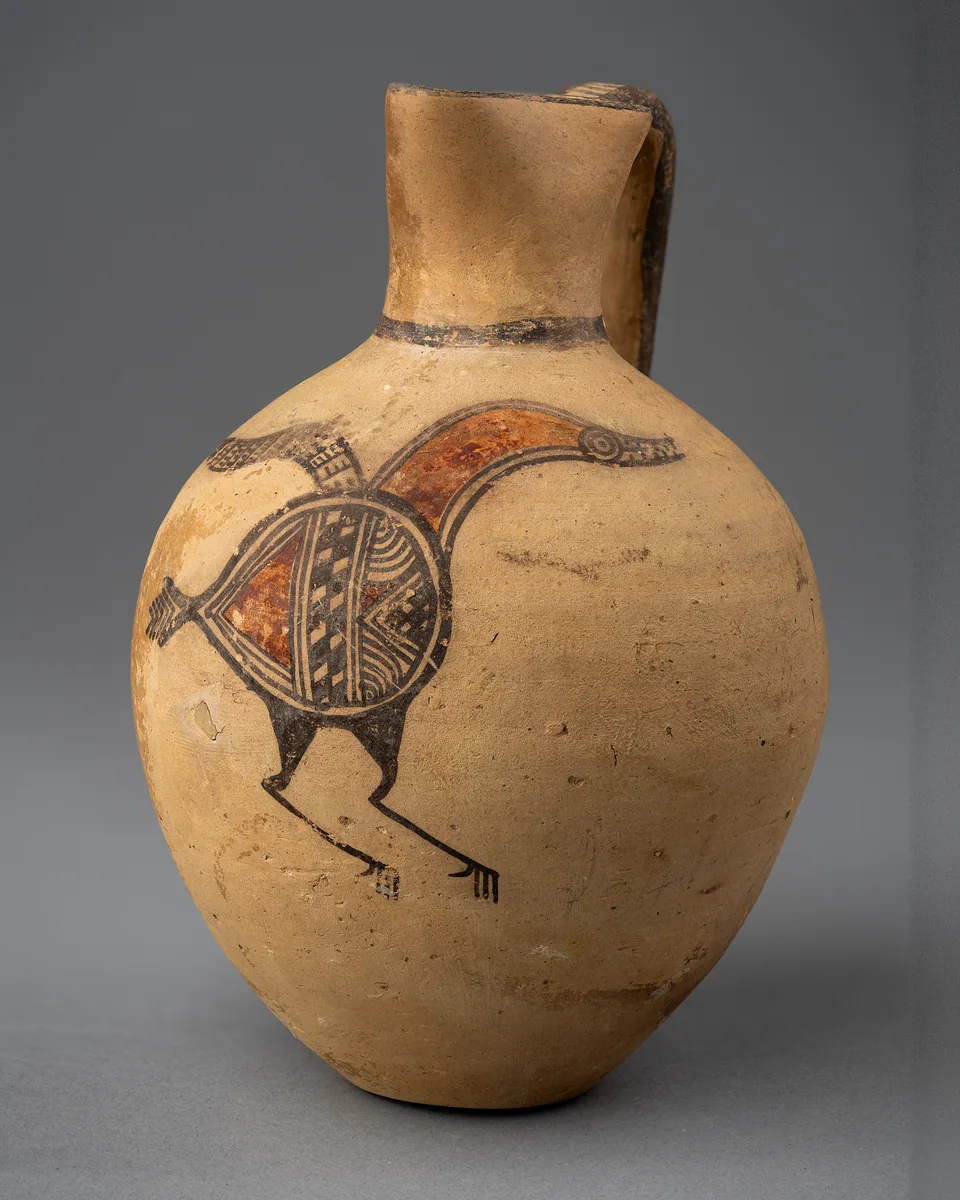
Bichrome IV trefoil jug · H. 19 cm
I · The jug
One bird on bare clay
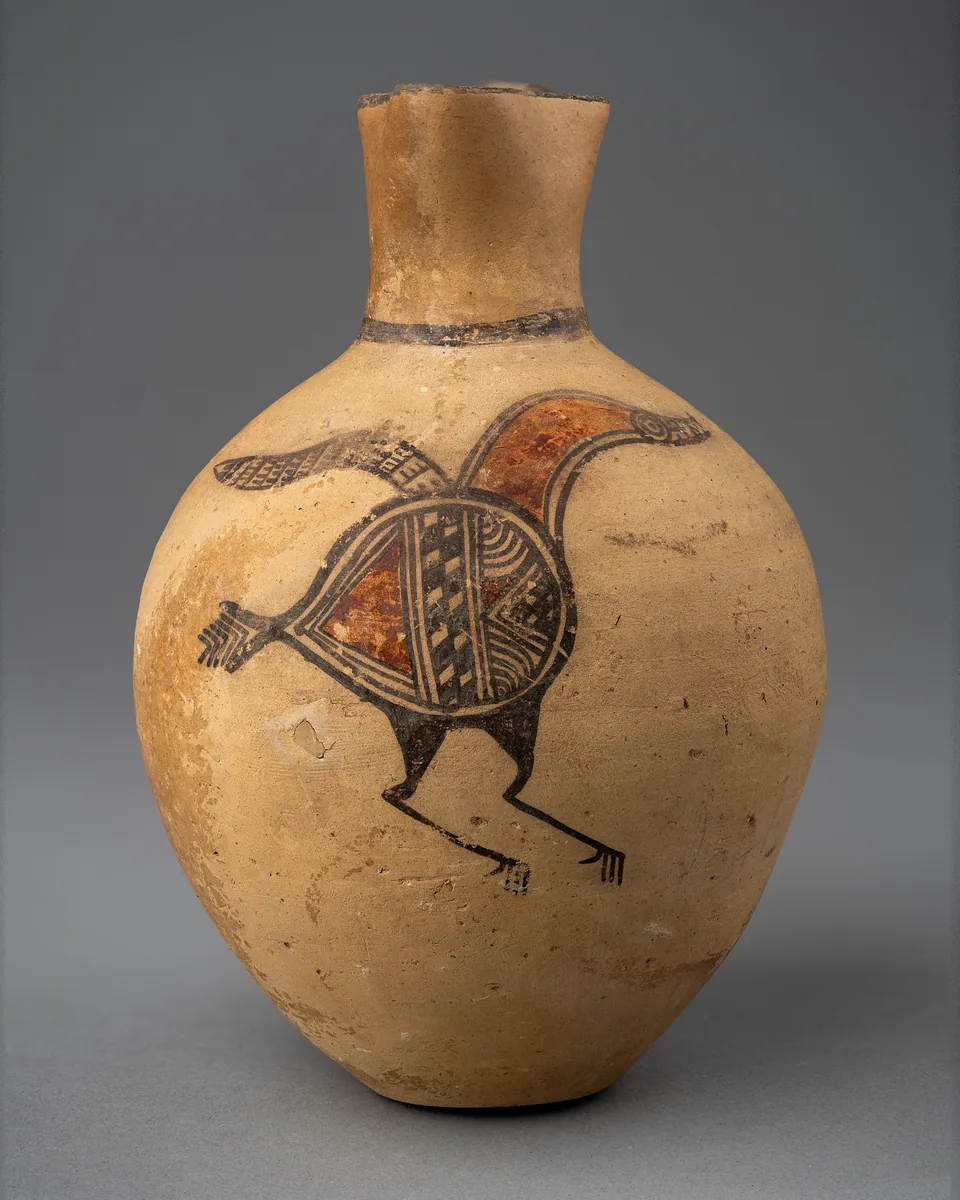
Some time between 750 and 600 BC a Cypriot potter threw this jug on the wheel, pinched its mouth into a trefoil and covered it in a pale buff slip. A painter then ringed the neck with a black band, laddered the handle, and left almost everything else empty. On the side facing away from the handle went a single bird.
The ware is Bichrome IV, painted in two colours, a matt black and a red. The layout has a name too. Einar Gjerstad, who sorted Cypriot Iron Age pottery for the Swedish Cyprus Expedition, called it the free-field style, and saw that it belonged above all to jugs with a pinched mouth like this one. Its favourite subject was the bird.
Where in Cyprus the jug was made or buried is not recorded. What happened to it after it came out of the ground, in the 1870s, is recorded unusually well.
II · The layout
Four ways to dress a jug
Gjerstad described three ways Cypriot painters organised a pot, and then a fourth that grew out of the third. Here they are, drawn side by side on the same jug.
a · Zone
“the body is divided into horizontal or vertical zones, separated by encircling bands and lines”
b · Panel
“the zones are divided into panels by vertical bands and lines; the panels are either plain or filled with a single ornament”
c · Plain body
“the whole body is left undecorated between encircling bands round rim, neck, base, etc.”
d · Free field
“on the free surface of the vase a single ornament is applied”
The free field is a plain body with one motif set on it and no frame. It begins with geometric ornament on White Painted III jugs and reaches its height on Bichrome IV pinched-mouth jugs, c. 750–600 BC, where the bird is the favourite subject.
Free field describes the layout and says nothing about the subject. A bird can march in a zone or stand in a panel, and a free-field jug can carry nothing but a chequered triangle. The figured subjects, however they are laid out, are what Karageorghis and des Gagniers catalogued as the “figure style”.
III · Look closer
Anatomy of a bird
Ten details of the painting. Choose a number to read about it; the drawing below lights up the same part.
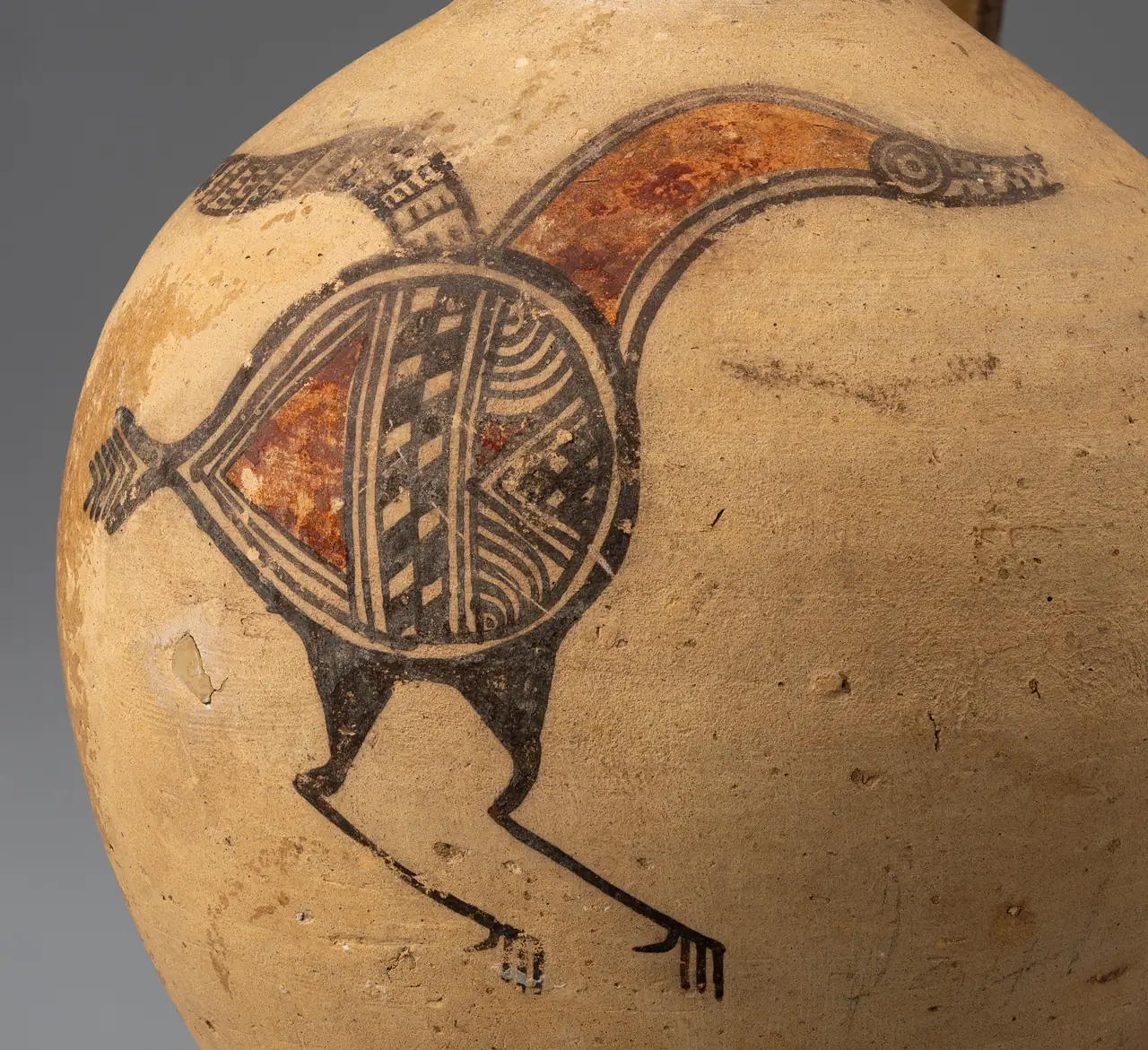
The body
A disc drawn with compasses, then filled like a shield in wedges of chequer, hatching, concentric arcs and solid red. Bodies divided into red and hatched quarters recur across the bird jugs of the period.
The same part, redrawn
IV · The proof
Plate 13
The jug's modern story hangs on a photograph. In 1881 the finds of Alessandro Palma di Cesnola were photographed for a printed album. Plate 13 shows five vessels in a row, printed in reverse, and one of them is this jug. Can you find it?
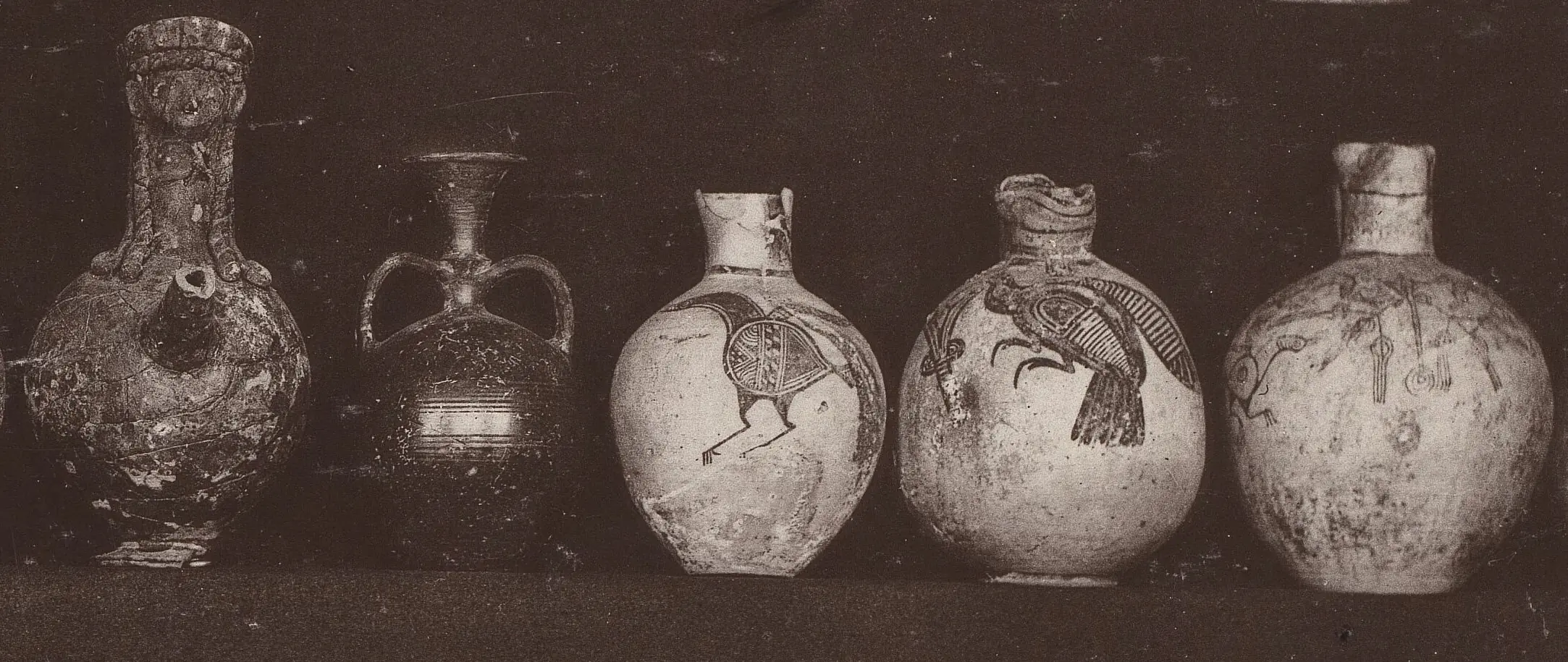
Tap the vessel you think is the bird jug.
V · Provenance
From Cyprus to London, the long way
The record rests on paper: an album plate, two sale catalogues, a general's handwritten catalogue, a photograph of his museum and a dealer's stock number.
c. 750–600 BC
Cyprus
Painted
A potter throws the jug on the wheel. A painter outlines a single bird in matt black on the pale slip and fills its neck with red. Jugs of this kind were for pouring, and complete ones come mostly from tombs.
1876–79
Cyprus
Dug up
Alessandro Palma di Cesnola, brother of the American consul Luigi, digs on the island with money from the London stockbroker Edwin Henry Lawrence, later his father-in-law. The jug comes out of the ground in these years. Nobody wrote down where.
1881
London
Photographed
Alessandro's finds, now in London, are photographed for a printed album titled Lawrence-Cesnola Collection. On plate 13 the jug stands third from the left, printed in reverse, so its bird strides the wrong way.
June 1883
London
Lot 277
Sotheby, Wilkinson and Hodge open the first of four sales of the Lawrence-Cesnola Collection. Lot 277 pairs the jug with a larger one painted with a horse-like animal.
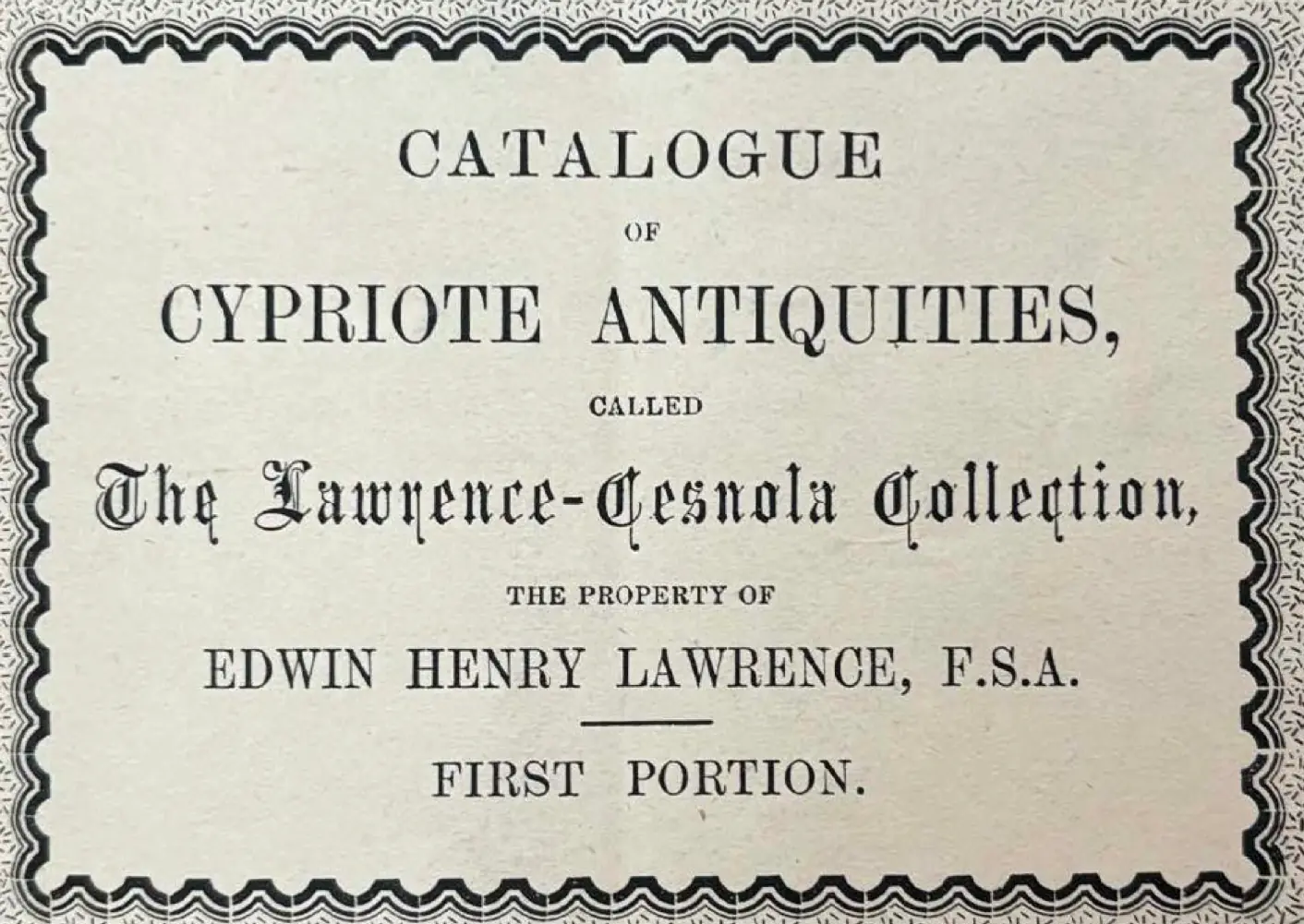
Title page of the 1883 sale catalogue. 1883
London
“A bird flying”
The buyer is General Augustus Henry Lane Fox Pitt-Rivers, soldier and pioneer of archaeological method, and the biggest private buyer at the Lawrence-Cesnola sales. His handwritten catalogue sketches both jugs in watercolour. The larger shows “a nondescript animal of the horse kind eating a sprig”; this one, 7½ inches high, has “a bird flying”, and he adds “very fine archaic art”. Seven and a half inches is 19 cm, the jug's height today.
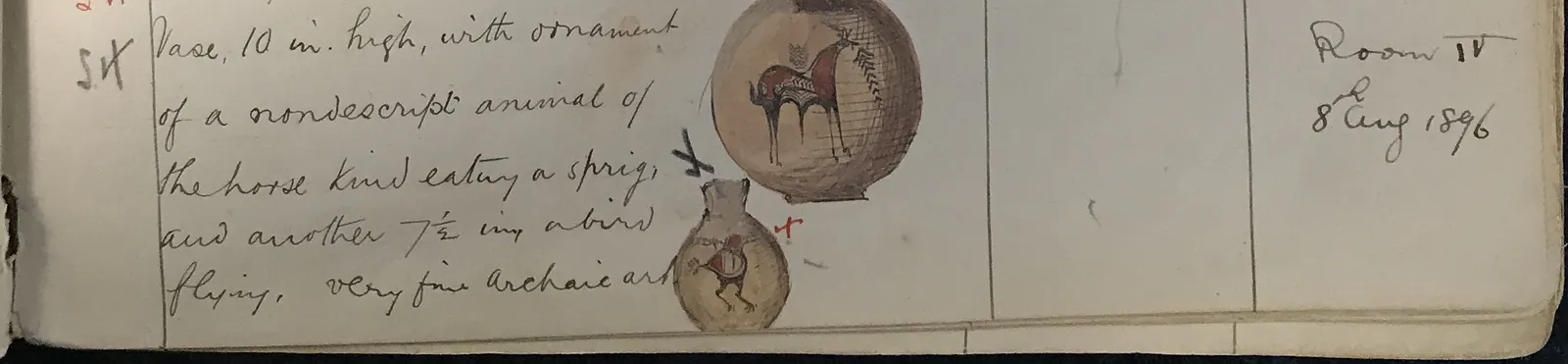
Pitt-Rivers's manuscript catalogue, vol. 1, p. 241 (detail). The bird jug is the small sketch; the note at right reads “Room IV, 8 Aug 1896”. 8 August 1896
Farnham, Dorset
Room IV
The jug goes on show in the Pottery Room of the General's private museum at Farnham, arranged by type among pots from around the world to show how forms developed. The Pitt Rivers Museum in Oxford, founded with his first collection in 1884, is a separate institution.
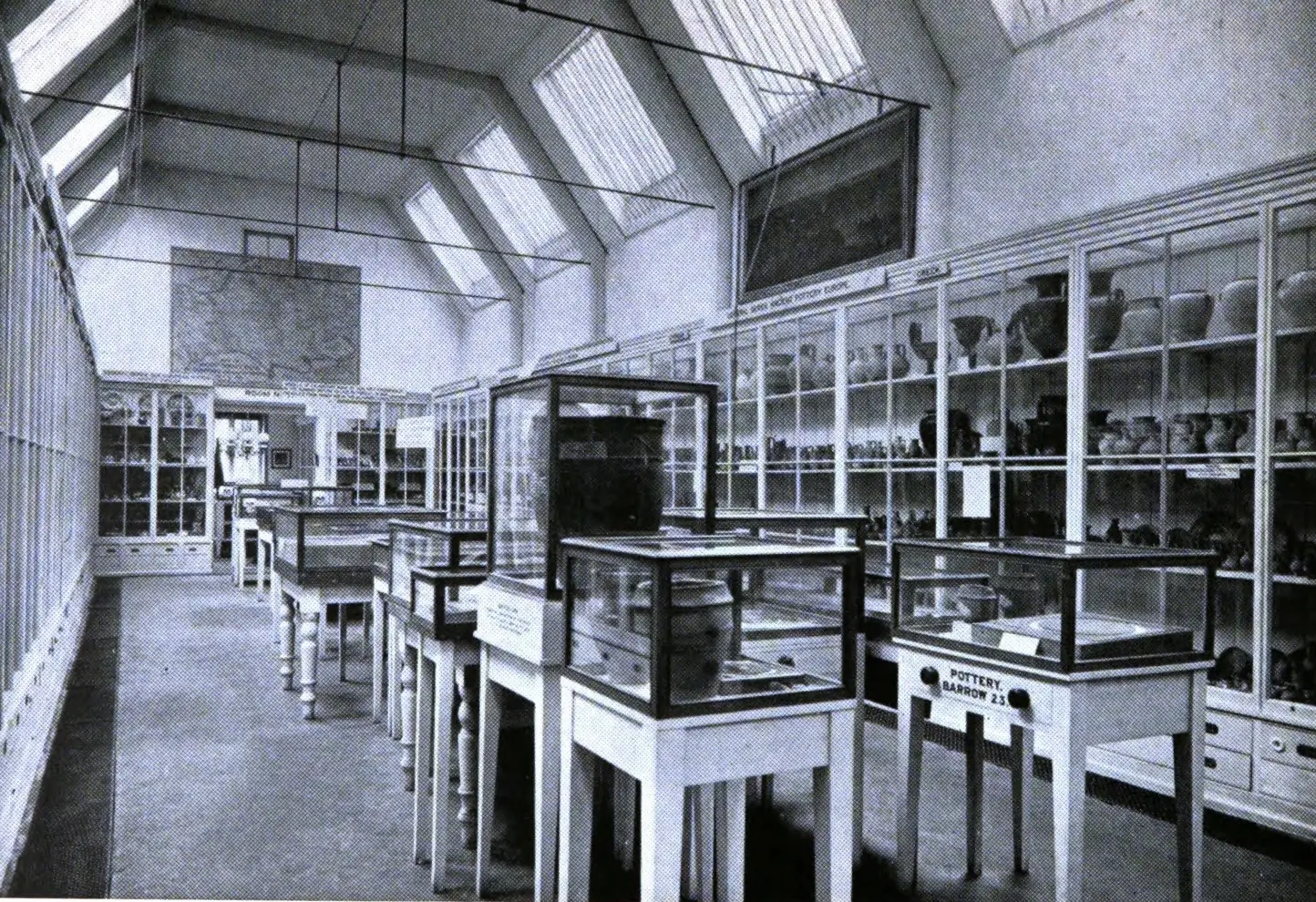
Room IV, the Pottery Room, Farnham. General Handbook (1929), pl. VIII. 1900–1975
Farnham, Dorset
By descent
The General dies in 1900 and the museum stays in the family. It reaches his grandson George Pitt-Rivers, a eugenicist and admirer of Hitler who was interned in 1940. When George dies in 1966 it passes to his partner Stella Lonsdale, who took his surname. During the war MI5 had arrested her as a suspected German spy. She closes the museum and sells its contents.
24 February 1975
London
Lot 168
Ninety-two years after lot 277 the jug is back at Sotheby's, catalogued as “a Cypriot Iron Age pottery trefoil-lipped oinochoe decorated in red and black slip with the figure of a bird”.

Sotheby's, London, 24 February 1975, lot 168. 1975–76
London
Charles Ede Ltd
The London antiquities dealers Charles Ede Ltd acquire the jug and enter it in their stock as E4614.
May 1976
Chicago
Private collection, Chicago
Across the Atlantic to a private collection in Chicago, where it stays for some forty years.
2016
Chicago
Harlan J. Berk Ltd
It passes to the Chicago dealers Harlan J. Berk.
2016–18
London
Charles Ede Ltd, again
Back across the Atlantic to the dealers who sold it forty years before.
2018–c. 2024
Surrey
Private collection, Surrey
Some six years in an English private collection.
2025
Maastricht
TEFAF Maastricht
Charles Ede, which has handled the jug three times in fifty years, shows it at the European Fine Art Fair.
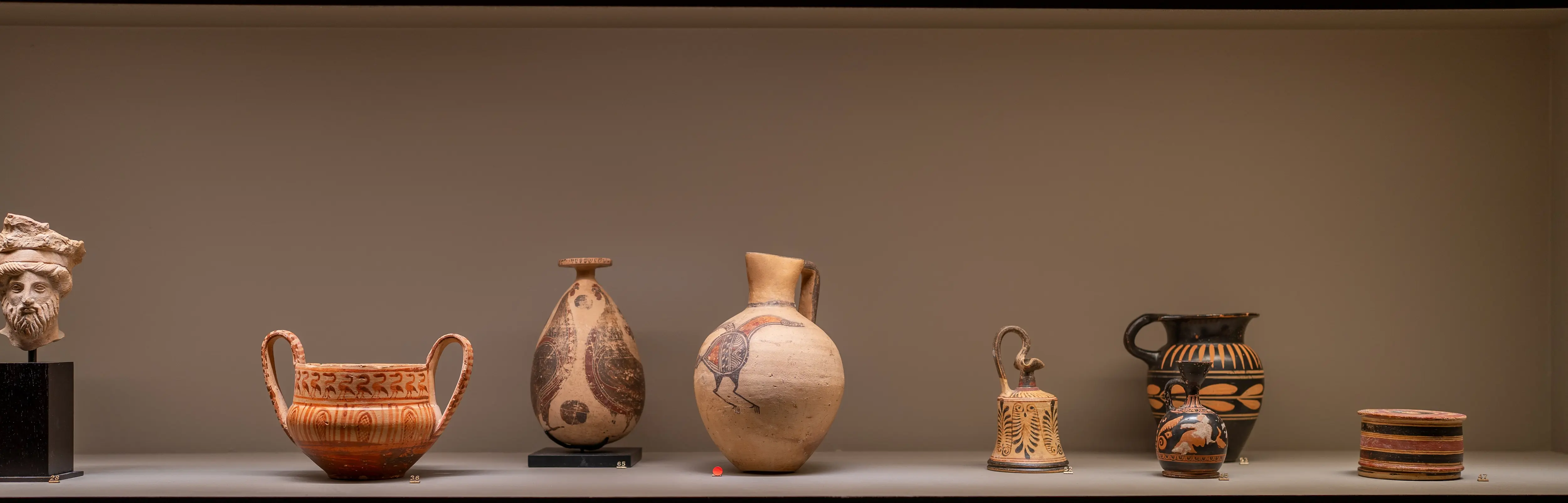
On the Charles Ede stand, TEFAF Maastricht 2025. 2025
London
The Drakopoulos Collection
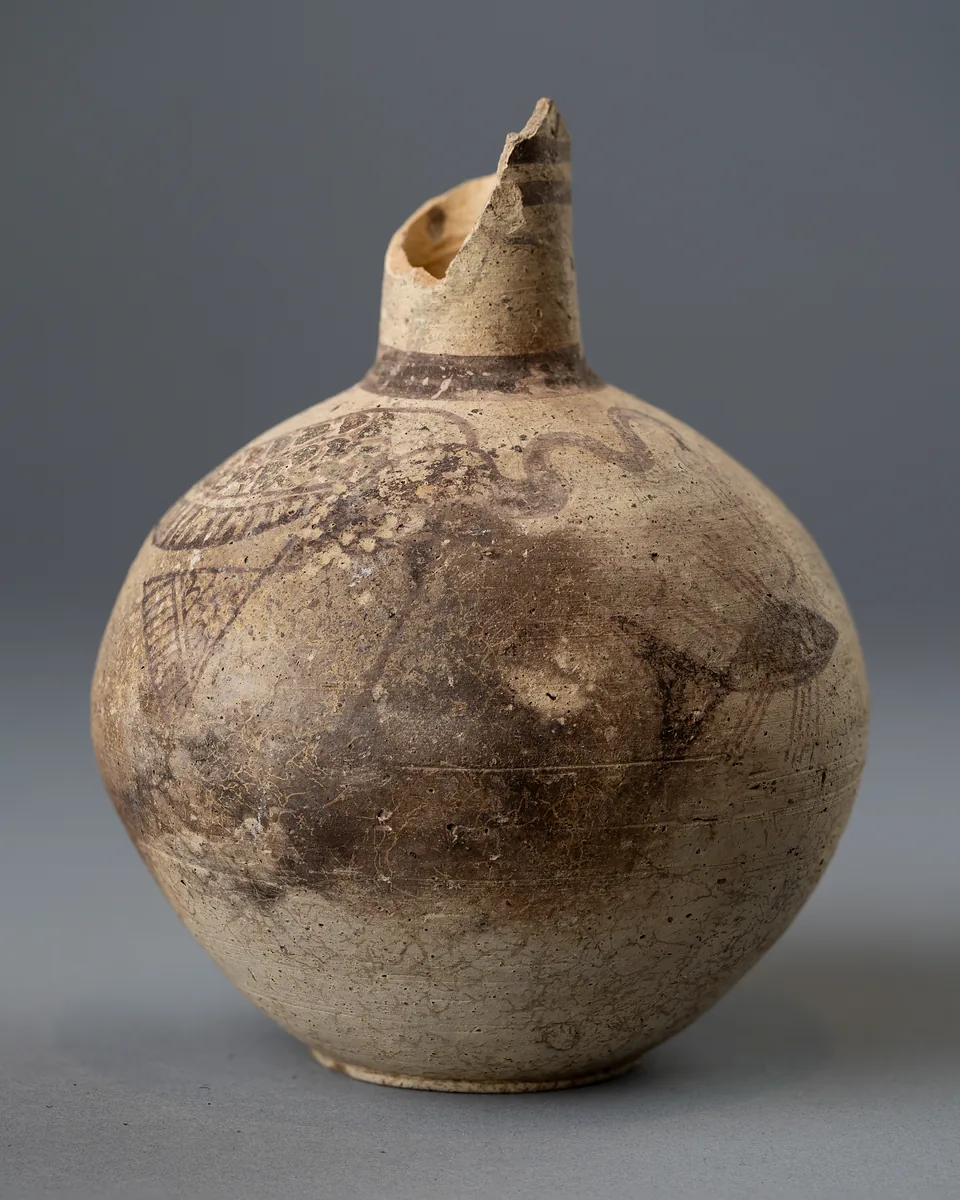
Acquired for the Drakopoulos Collection in London, where it joins a smaller Bichrome IV jug painted with a waterfowl and a fish.
VI · A second bird
The fisher
The collection holds a smaller Bichrome IV jug of the same period, 15 cm high, with a different kind of bird. A waterfowl stretches its neck across the whole shoulder in tight S-bends, dropping its beak towards a fish with a forked tail. The Metropolitan Museum has a Cesnola jug of almost the same size with the same encounter, among the best-known subjects of the free-field style.
The grey clouding is modern: the jug was caught in a fire that damaged the collection it once belonged to.
Catalogue entry