The Early Bronze Age
Red clay, burnished to a flame, and the rituals of the grave
2400 – 1900 BCSomewhere around 2400 BC, the long quiet of Neolithic and Chalcolithic Cyprus gives way to something faster and more connected. Newcomers, or new ideas, arrive on the island during what archaeologists call the Philia horizon: cattle and the plough, the first sustained working of copper, and a new way of making pots. From this transitional moment grows the Early Cypriot world, a society of village communities scattered across the north coast and the central plain, knit together by kinship, by the movement of copper, and above all by an extraordinary care for the dead.
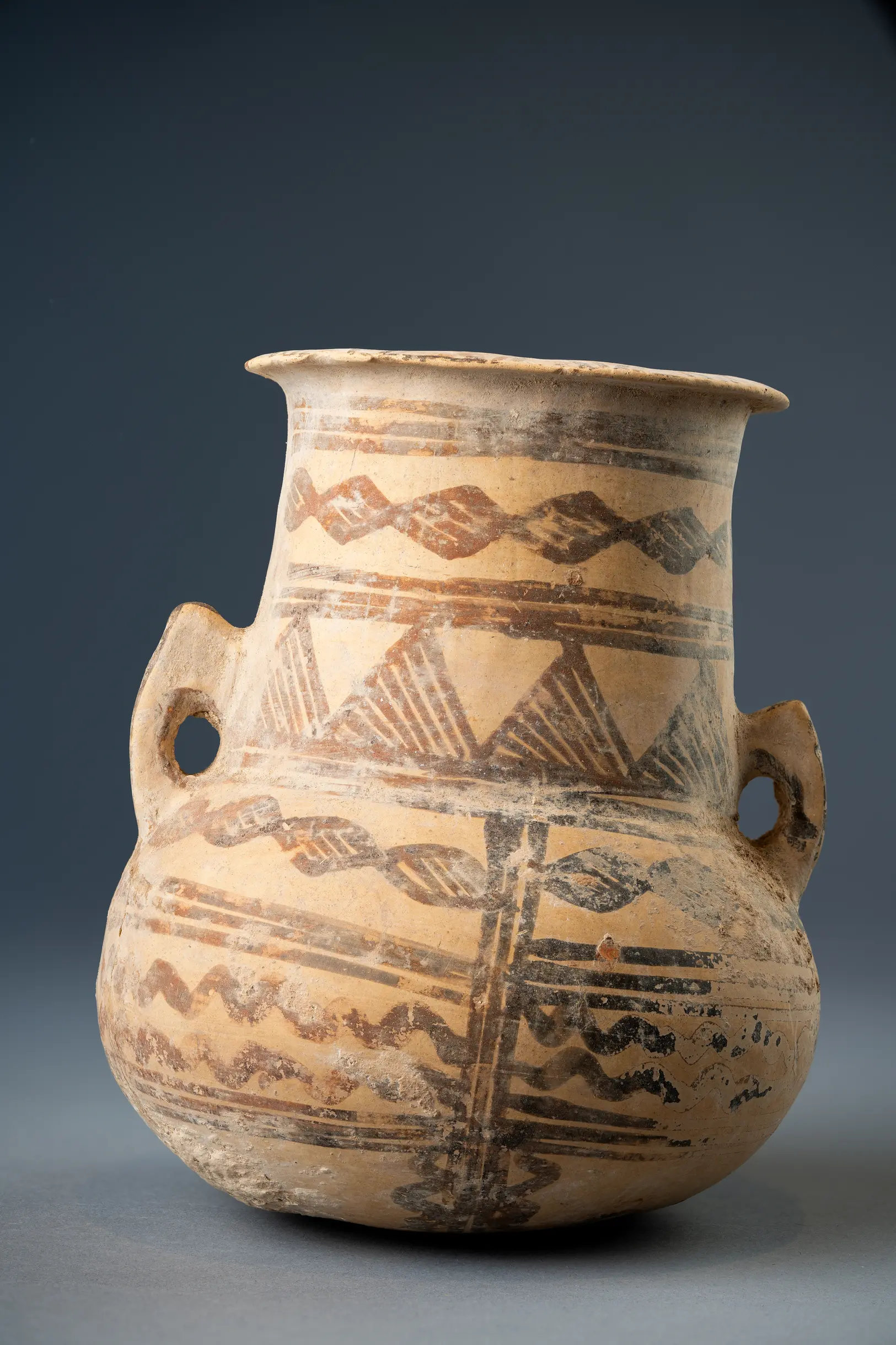
We know these people almost entirely through their tombs. Few of their settlements have been found and fewer still excavated, so the picture we have is assembled, oddly, from the furnishings of graves. Into rock-cut chambers, reopened and reused across generations, they placed food and drink, tools and weapons, and pottery of remarkable beauty. The signature of the age is Red Polished ware: hand-built, burnished until the surface holds the light, fired to deep reds and browns, and sometimes incised with fine geometric patterns picked out in white. It is among the most accomplished and inventive pottery the ancient Mediterranean produced before the potter's wheel, and it is everywhere in this era's archaeology.
The roughly thirty-four pieces of this part of the collection belong to that funerary world. Bowls and jugs, bottles and a single jar, three bronze tools, and two enigmatic figurines: objects that once accompanied the living to the threshold of the dead and were left there. Read together, they describe a culture that fed its ancestors, that measured status in copper, and that gave shape to its beliefs in modelled clay. The two showpieces here, a pair of multi-headed plank figures and a Vounous-milieu vessel modelled with a scene of sacrifice, carry that argument as far as the surviving material allows.
What follows moves from the everyday to the extraordinary: first the ware itself, lifted out of the earth, then the vessels that served both the living and the dead, and finally the figures and scenes in which an early Cypriot cosmology becomes briefly, tantalisingly visible.
In this section
Out of the Earth
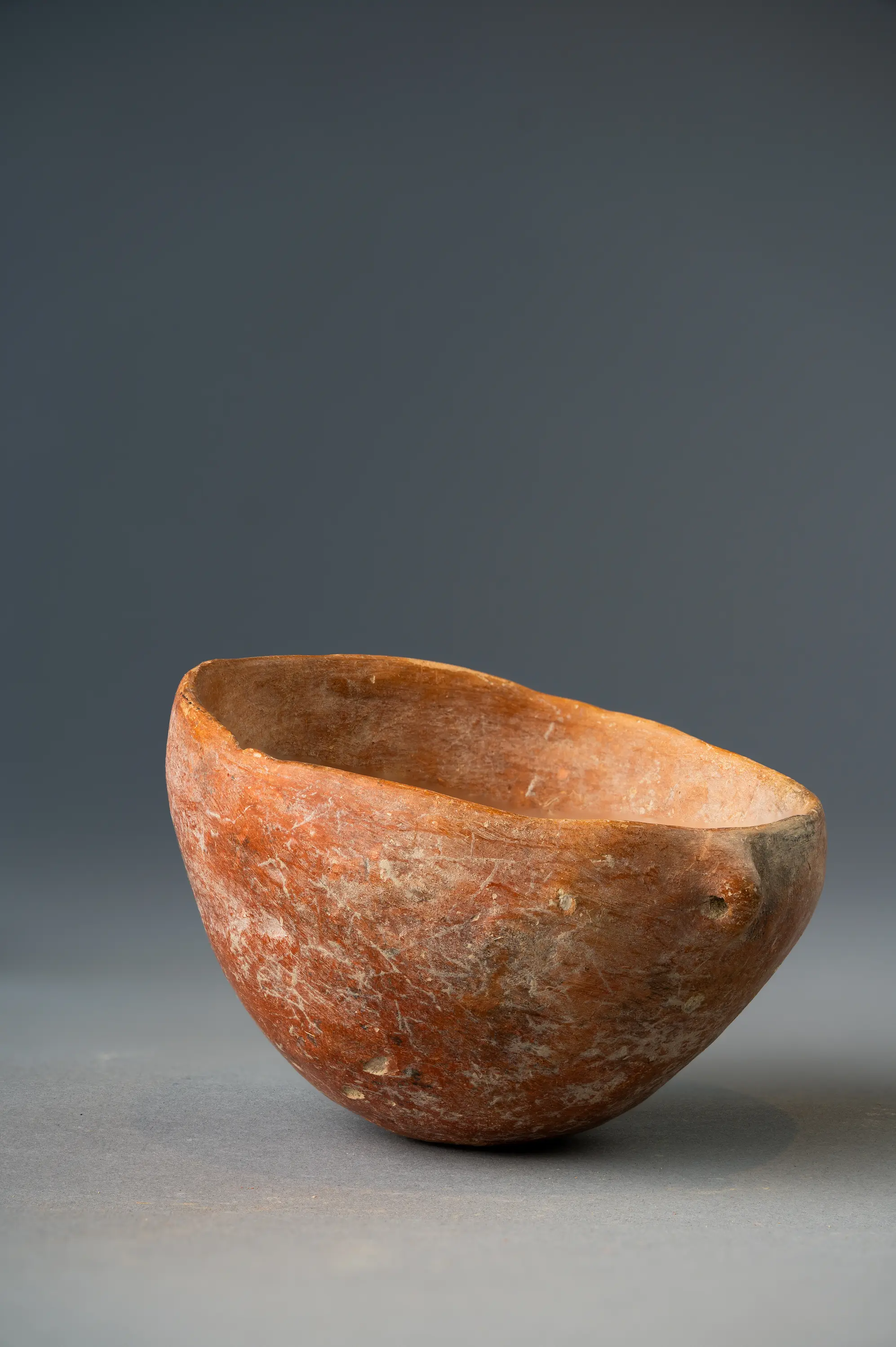
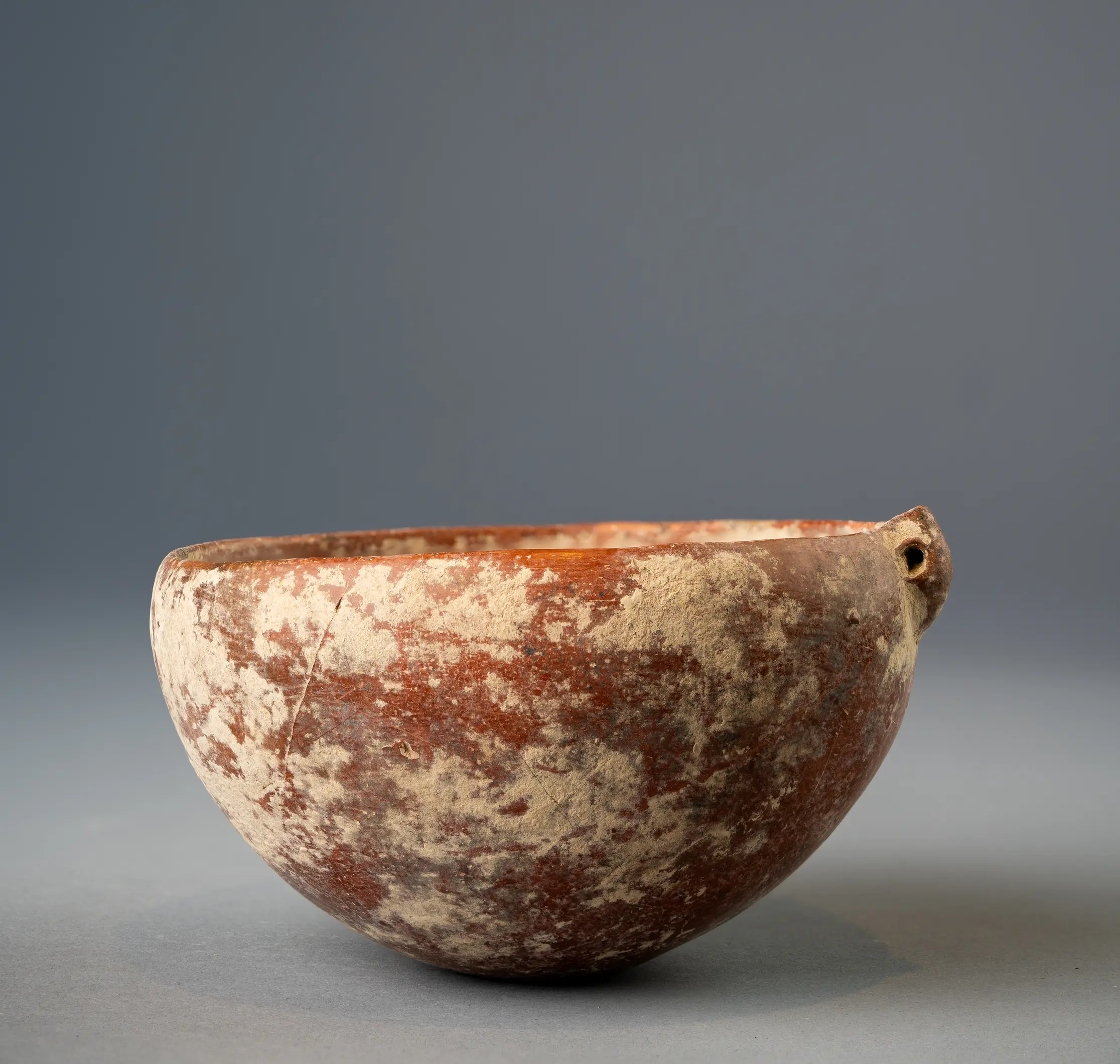
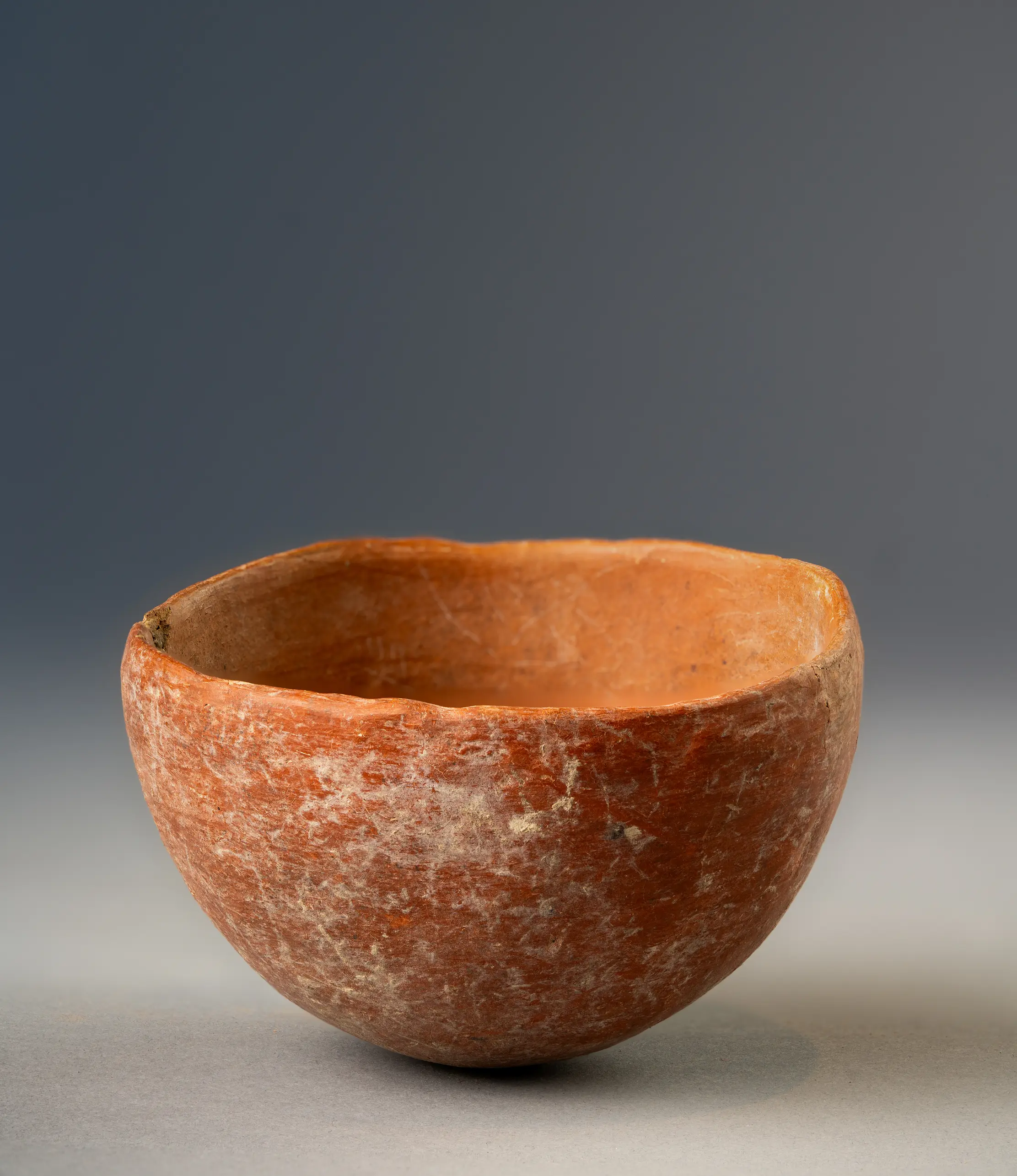
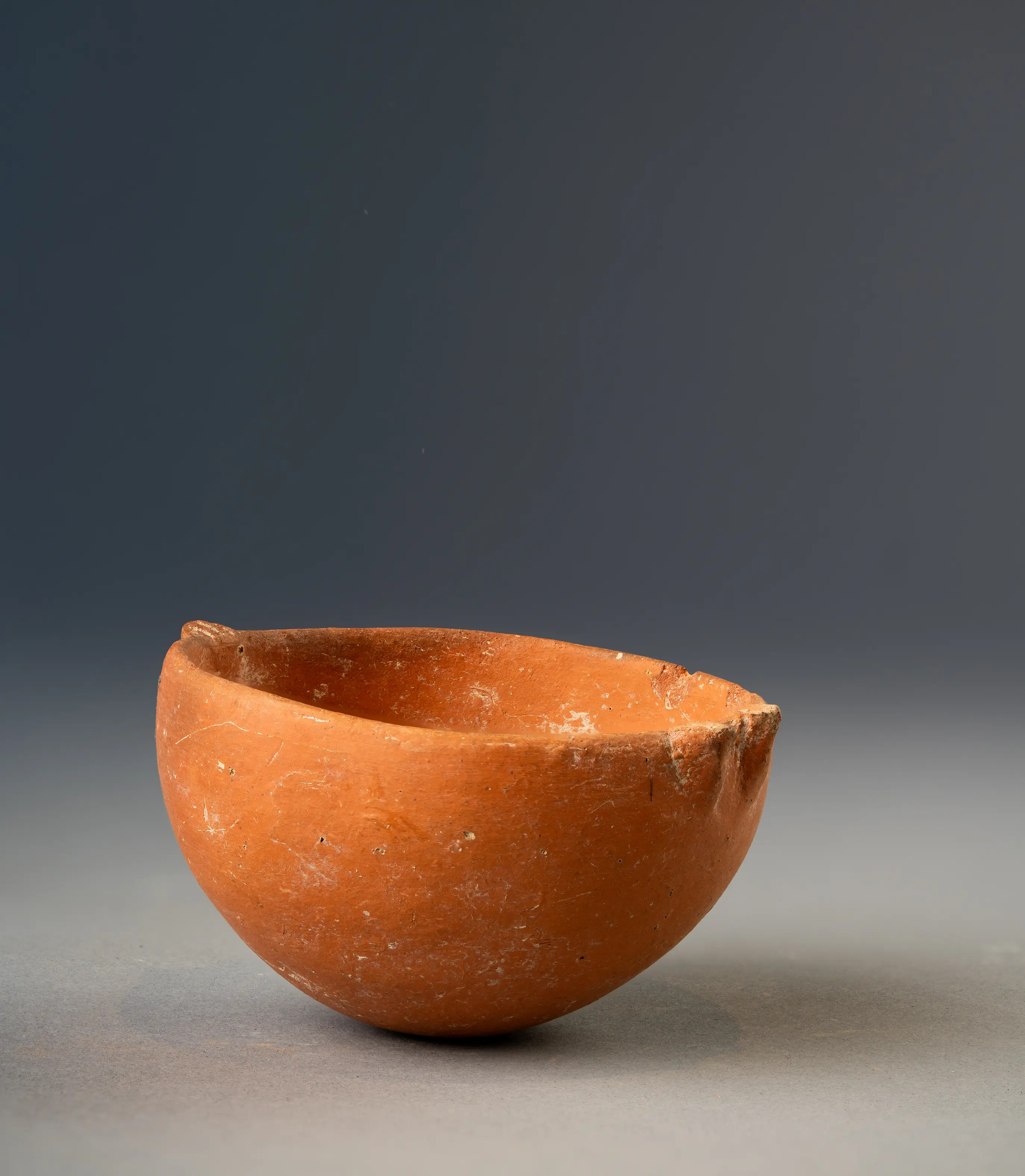
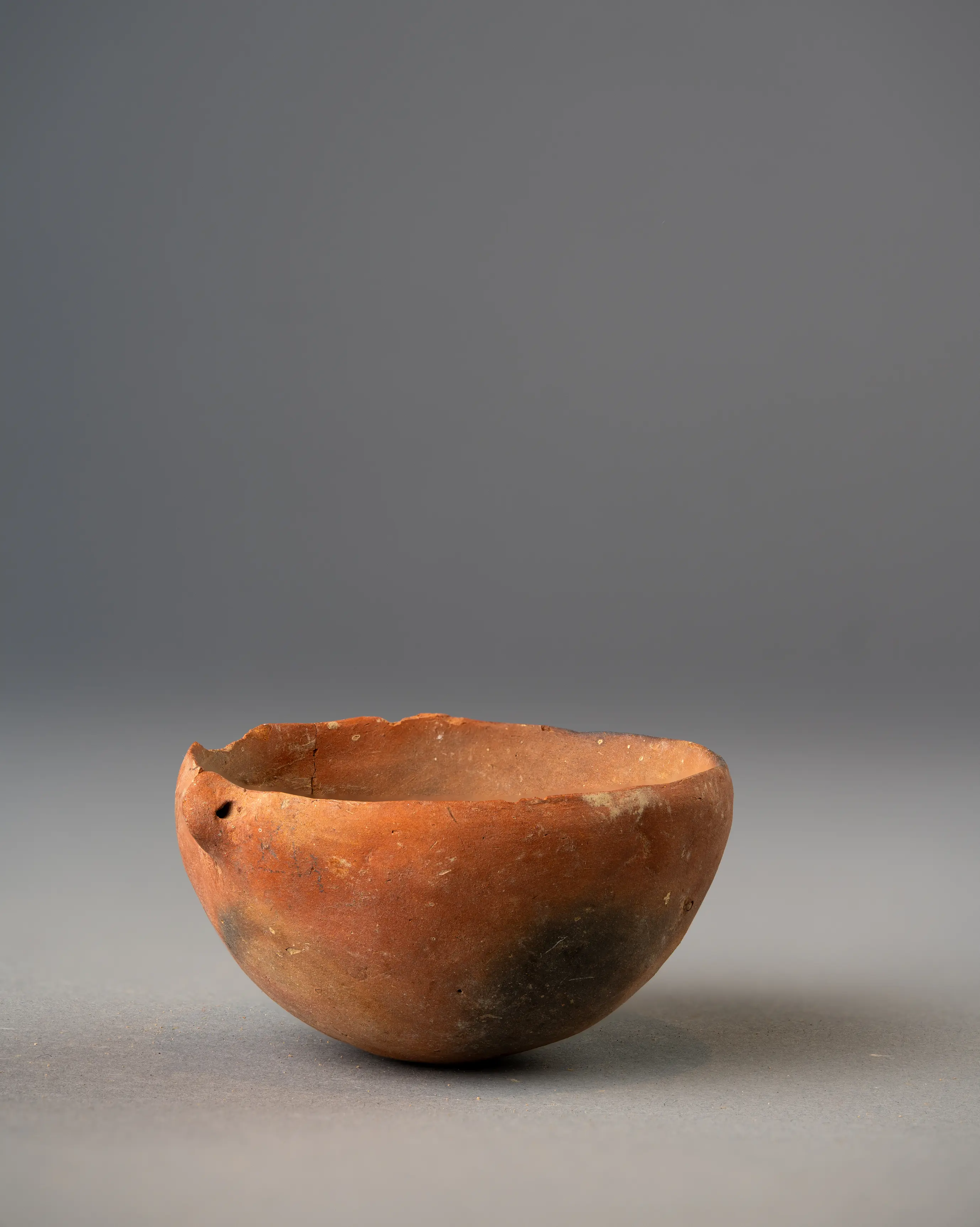
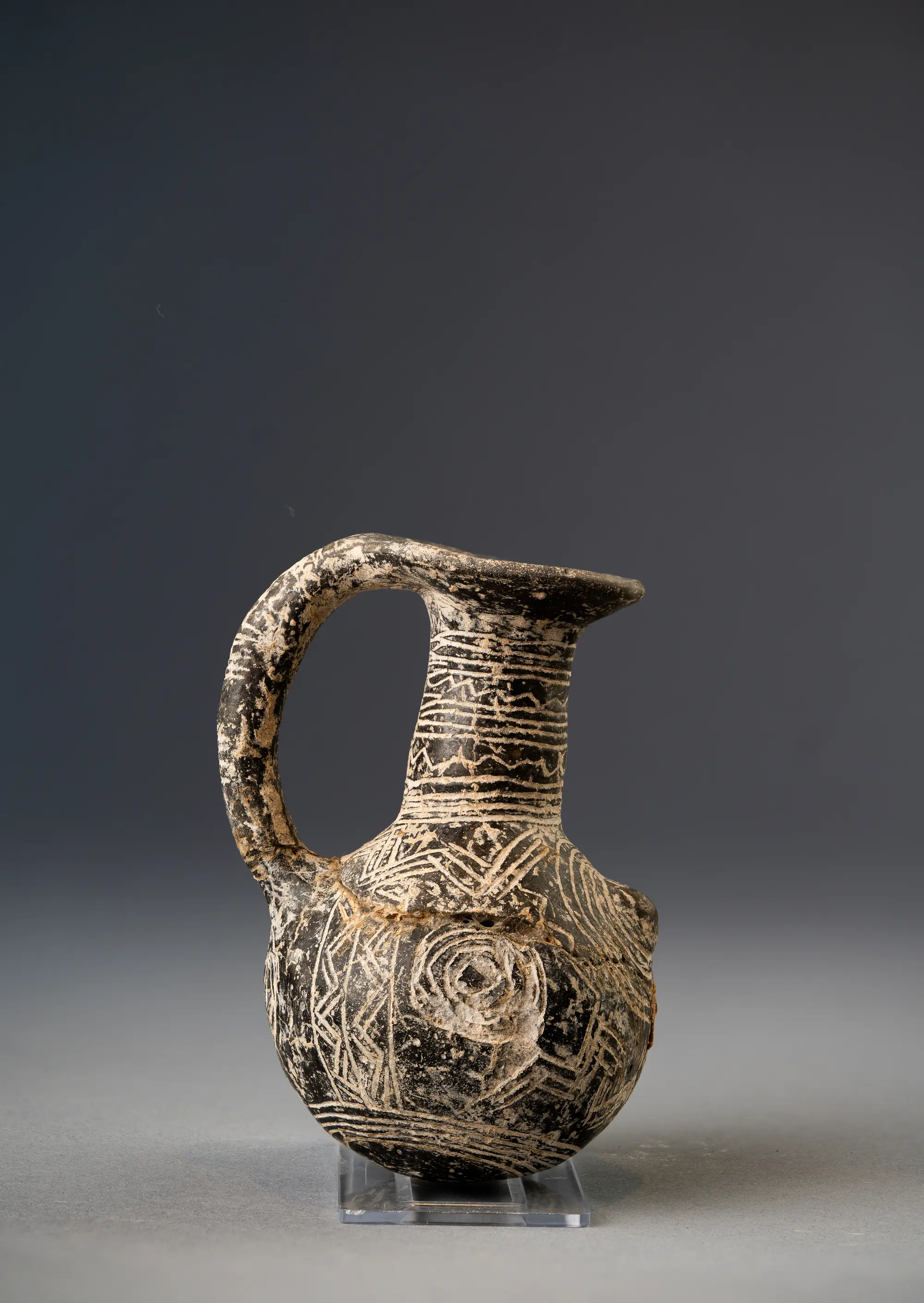
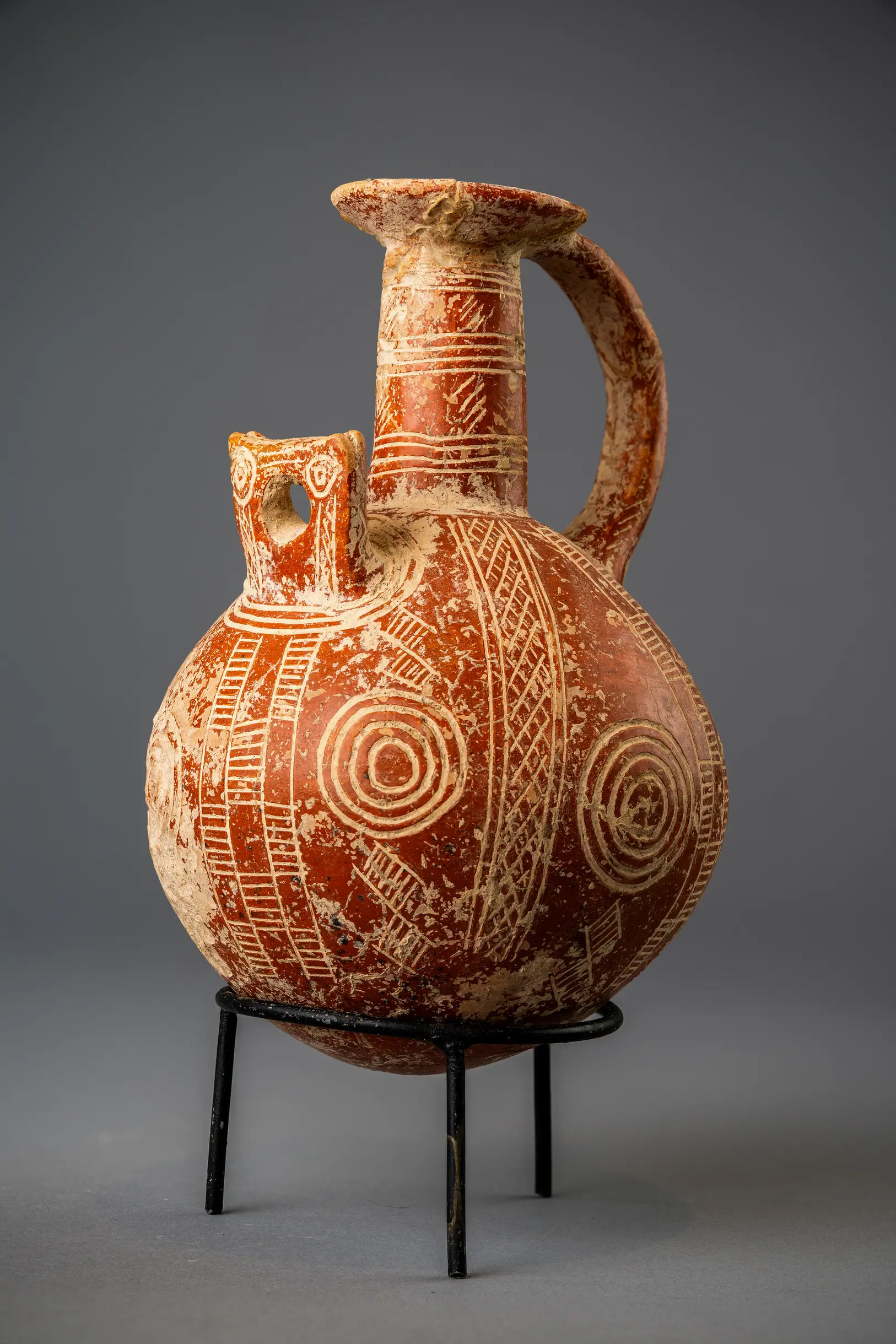
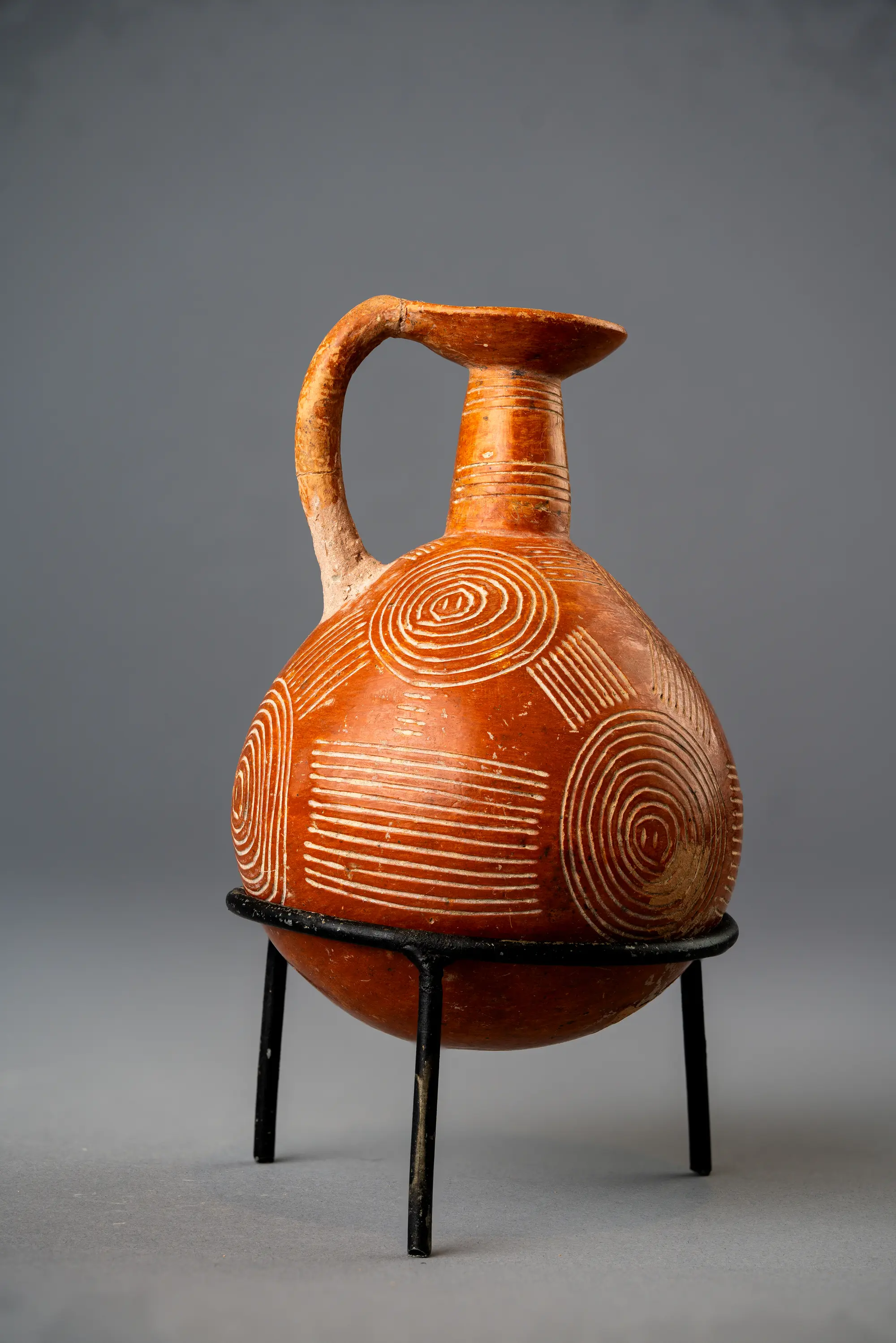
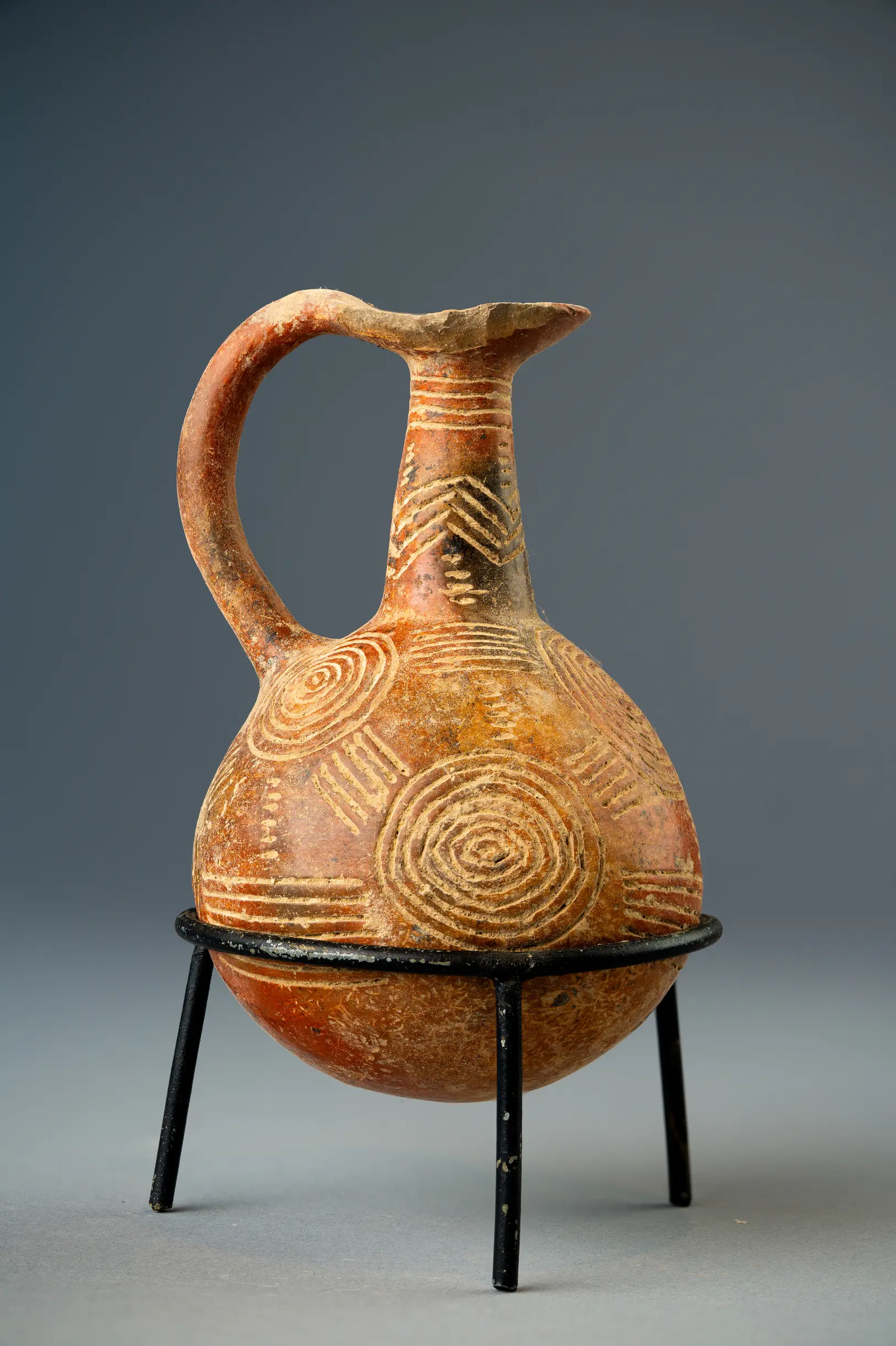
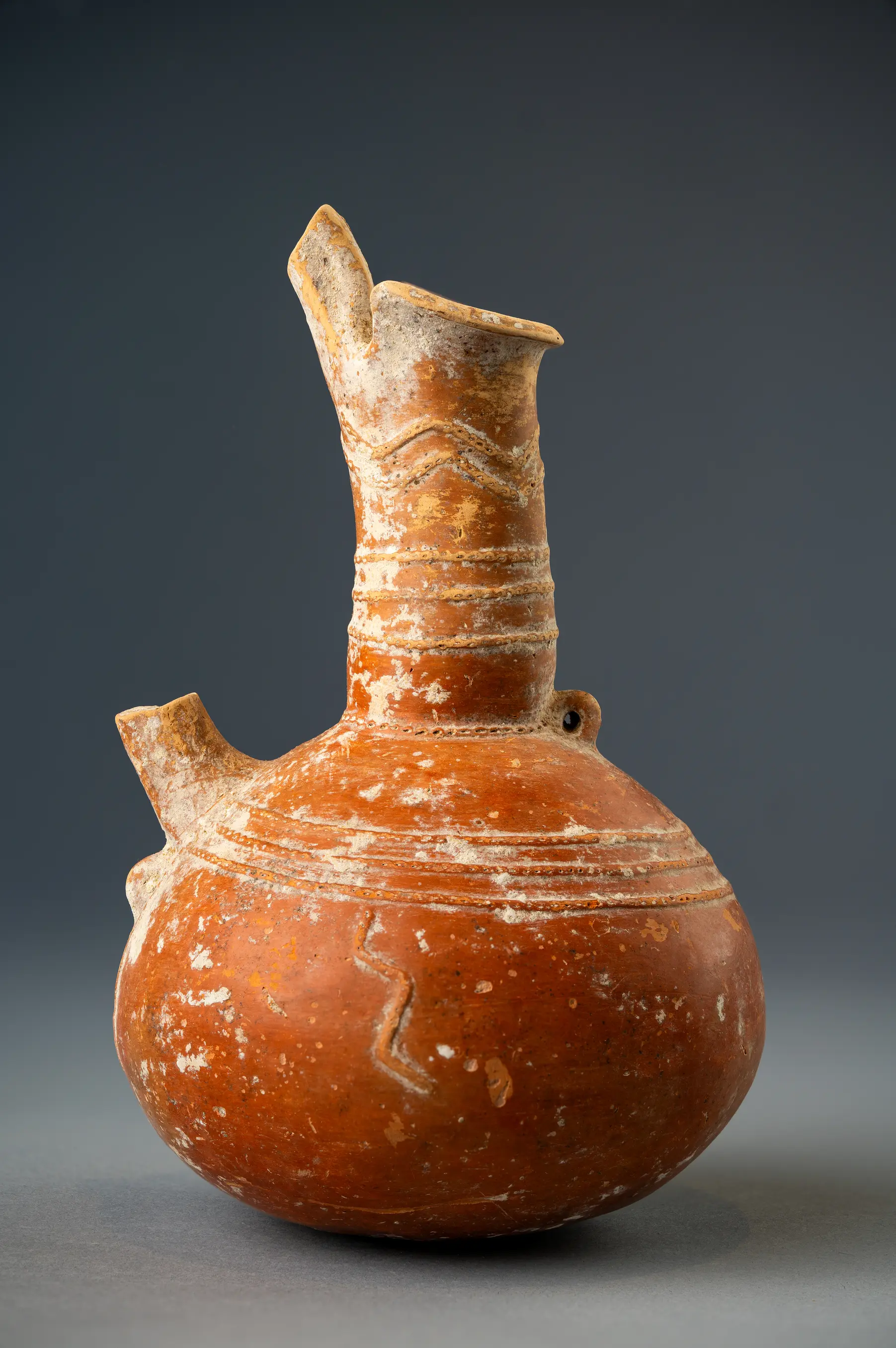
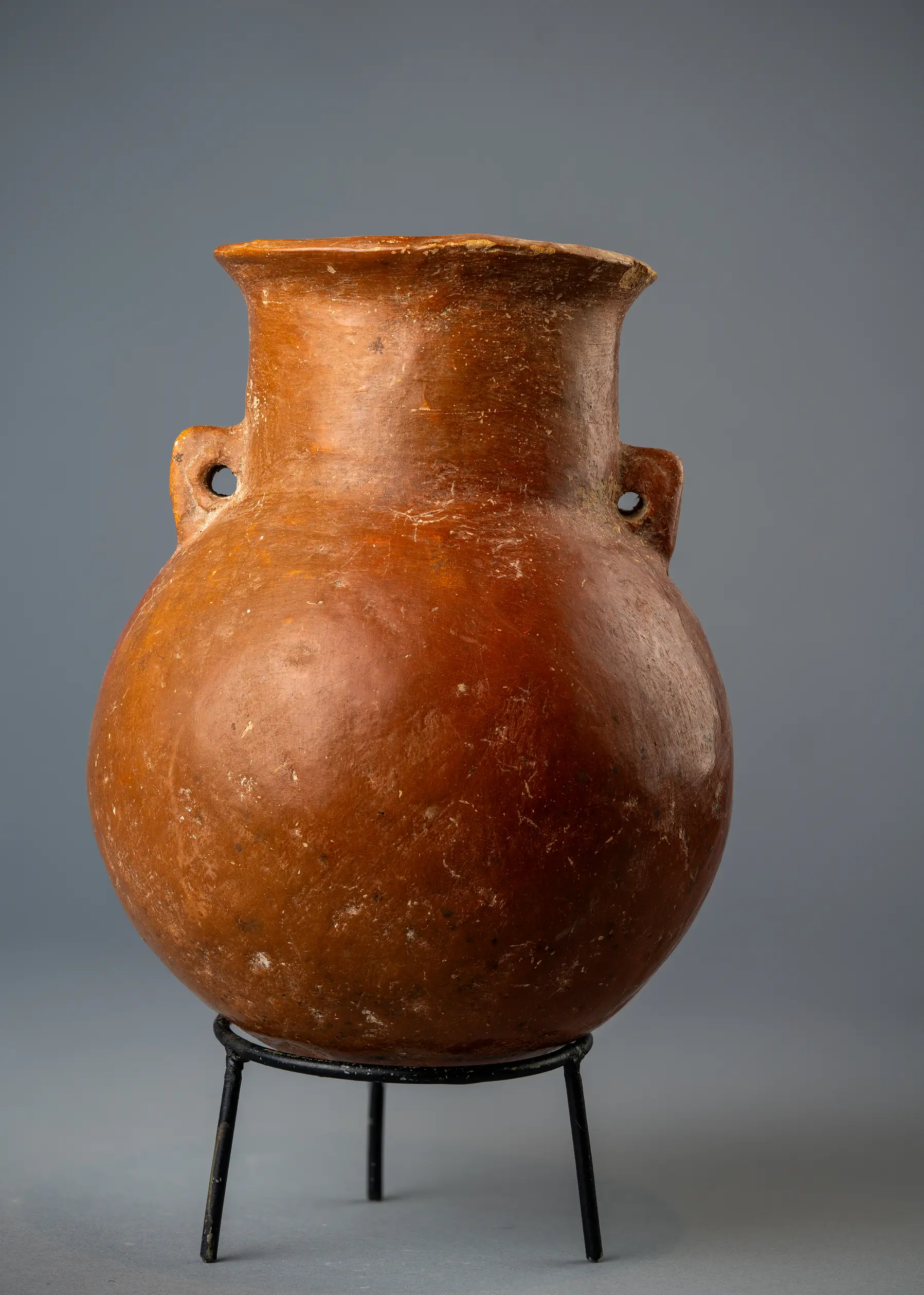
Red Polished ware is the defining substance of the Cypriot Early Bronze Age, and it is almost the only thing the period has left us in quantity. It first appears with the Philia phase, the horizon of change around 2400 BC that brought cattle, the plough and copper-working to the island, and it remains dominant for the better part of a millennium. None of it was thrown on a wheel. Every piece was built by hand, coil upon coil, the walls drawn up and smoothed, then burnished with a pebble or a polished bone while the clay was leather-hard. That burnishing compacted the surface and, after firing in a controlled, oxygen-rich atmosphere, gave the ware its characteristic lustre: a red that ranges from brick to oxblood to a near-black where the firing was uneven or deliberately reduced.
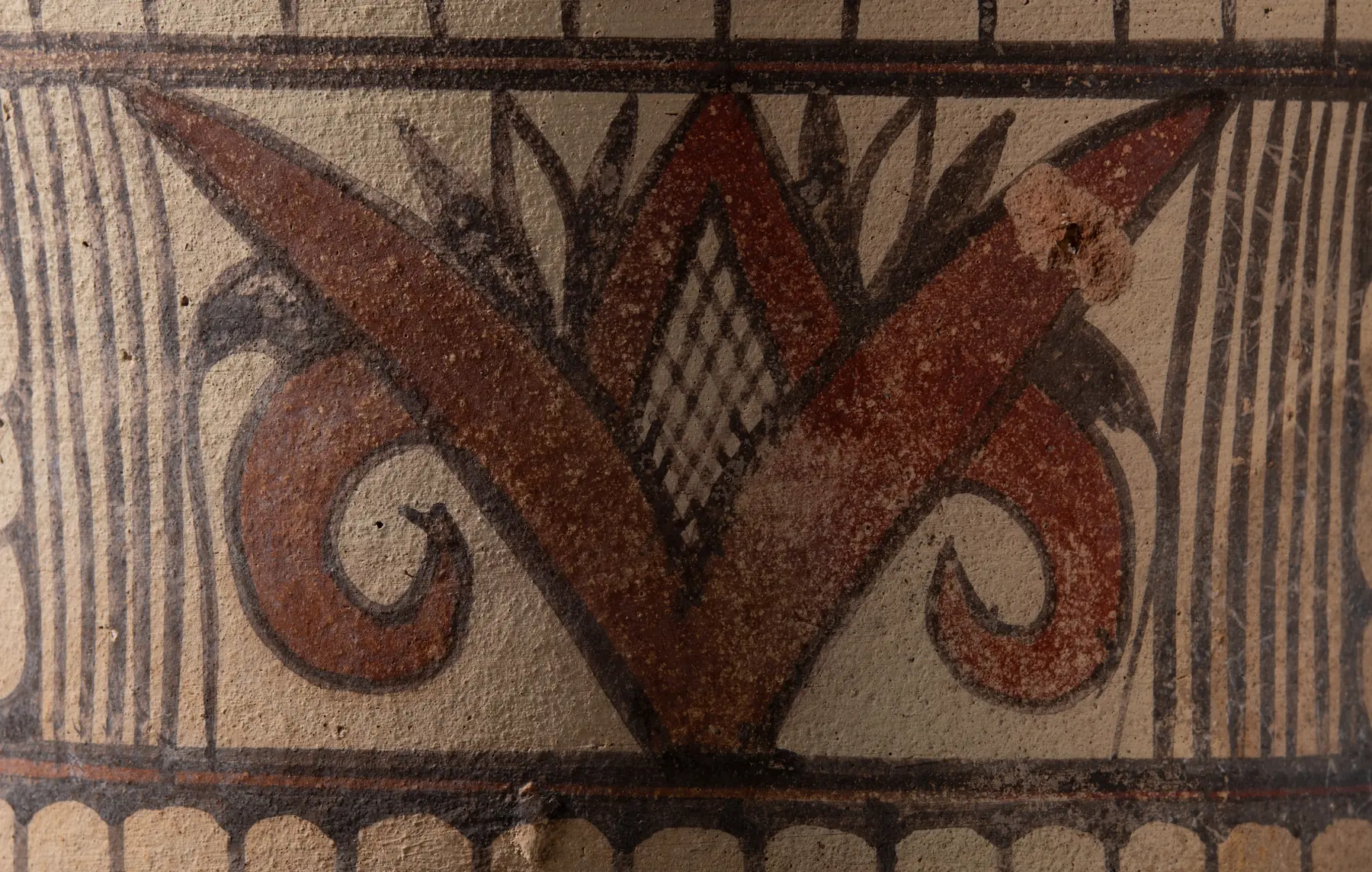
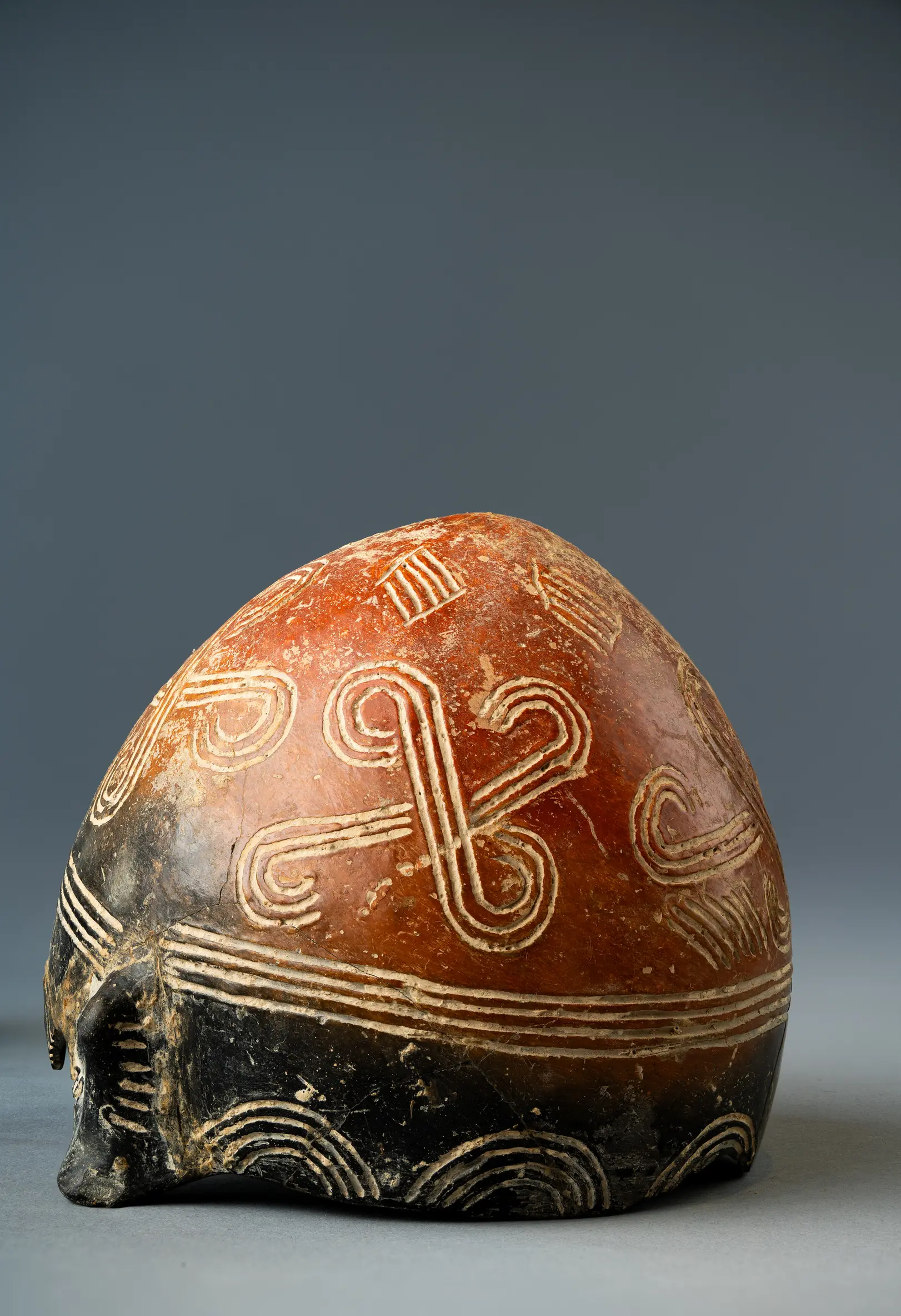
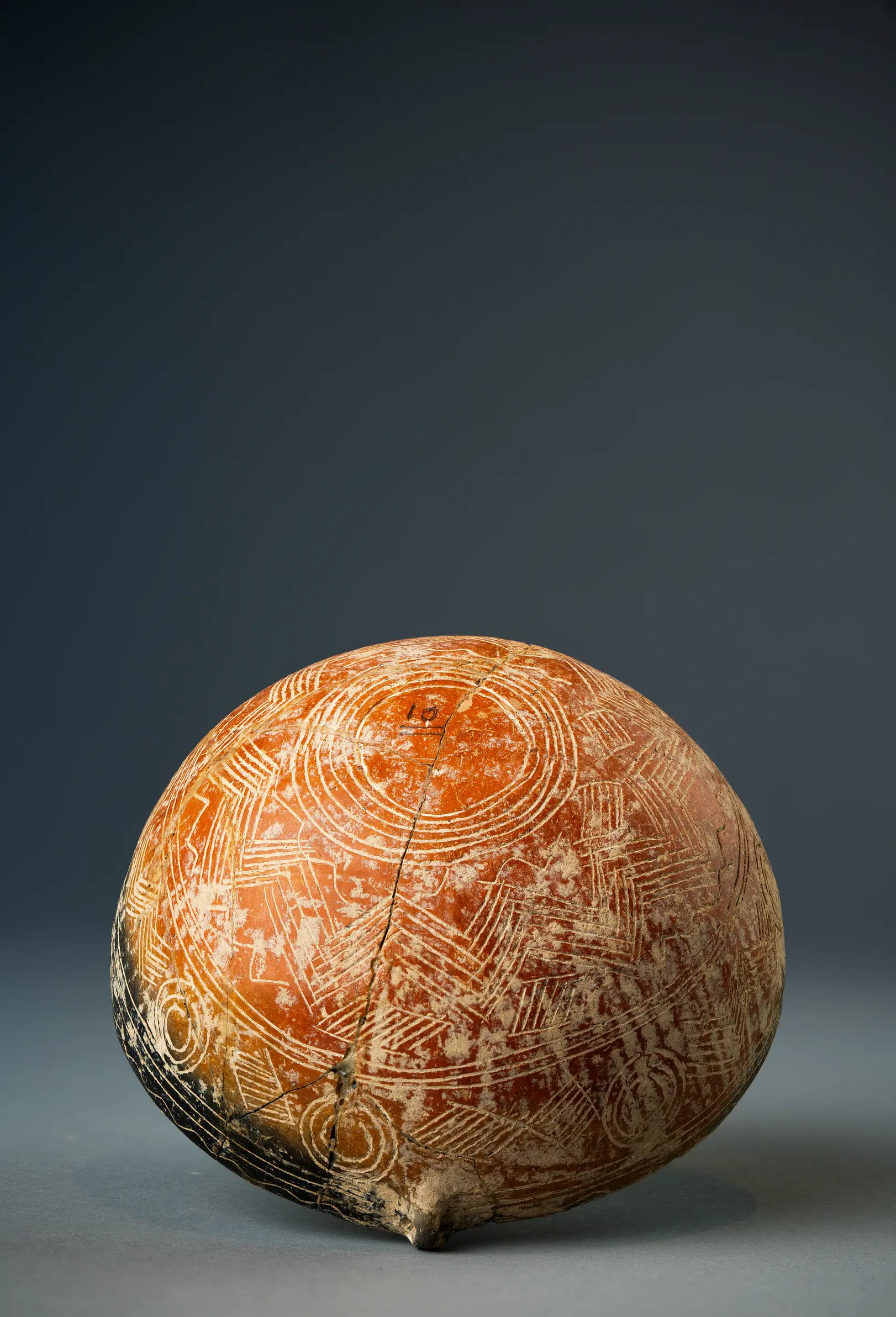
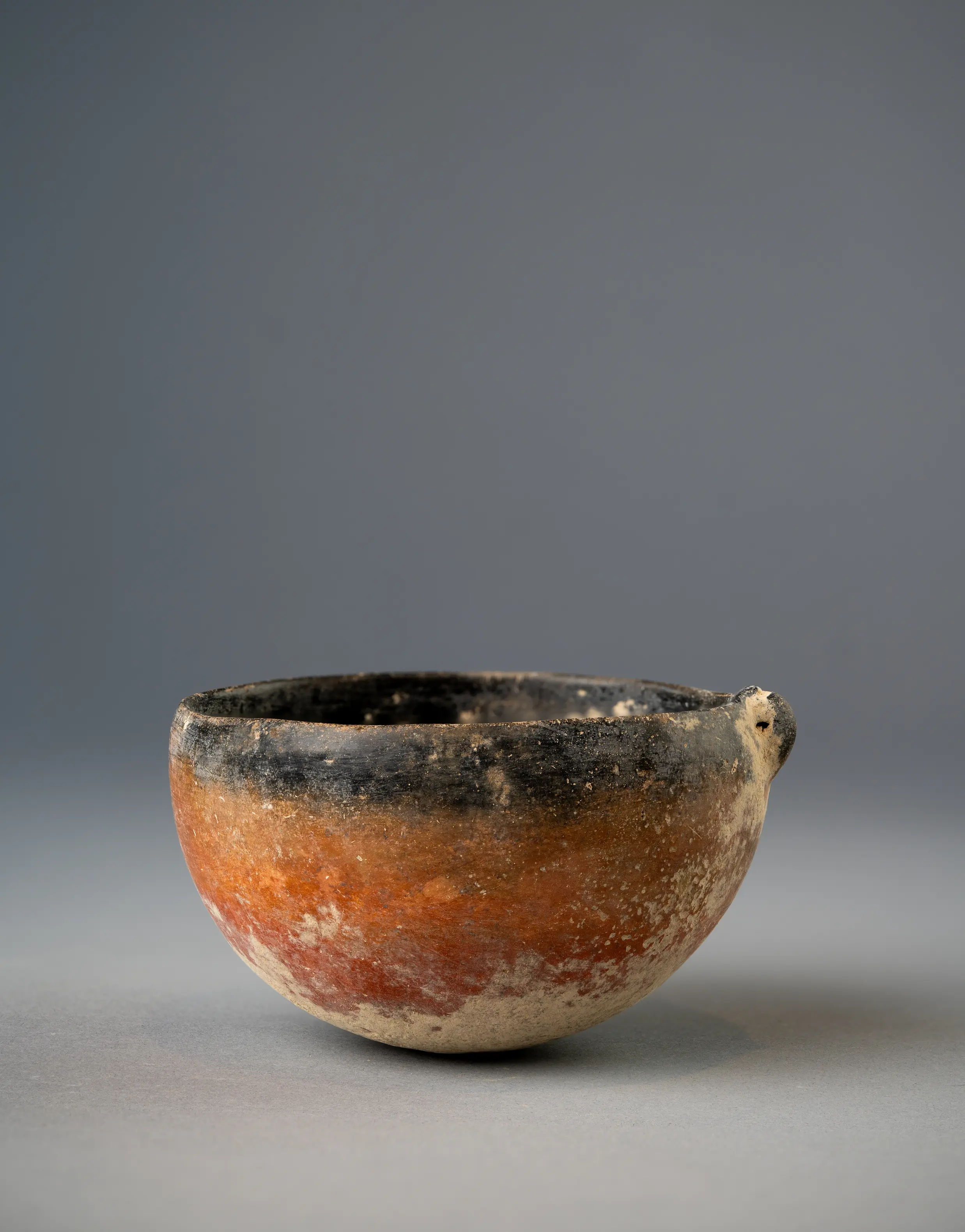
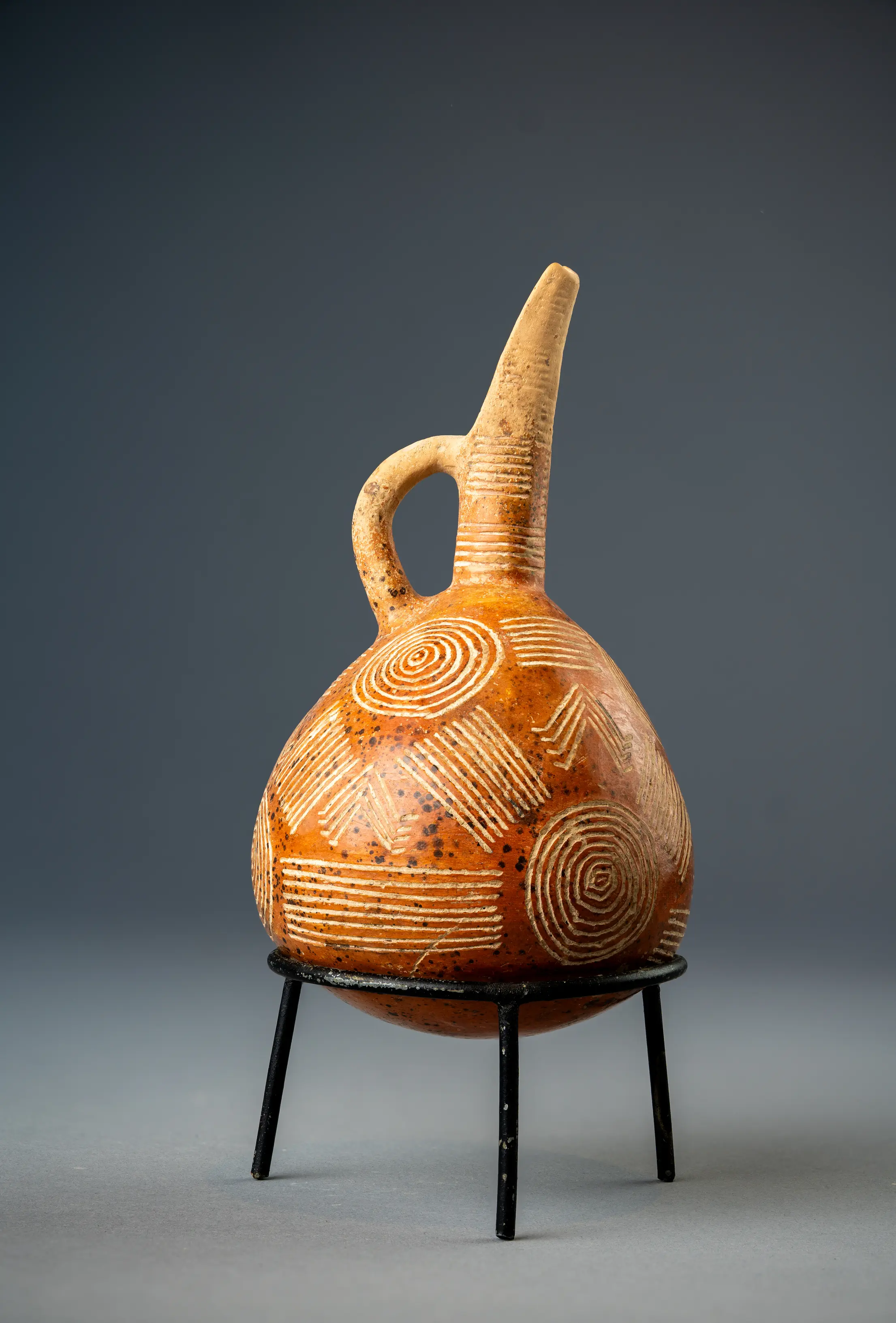
The potters of the north coast were the most accomplished of all. At cemeteries such as Bellapais Vounous they produced vessels of an even, glossy red, often with intentionally blackened rims and interiors, a refinement that southern and central workshops rarely matched. Onto these surfaces they cut fine geometric ornament before firing: hatched triangles, zigzags, concentric arcs, lattices and bands. The incisions were then rubbed with a white lime paste, so that pale lines stood out against the polished red. The effect is graphic and confident, a decorative grammar that the makers varied endlessly without a single template.
Nearly all of it comes from tombs. The rock-cut chambers of the period were not sealed once and forgotten but reopened across generations, the earlier dead swept aside to receive the new. Pottery was placed with the body, around it, stacked in the chamber, sometimes broken in the act of the funeral. To handle a Red Polished bottle or bowl now is to handle an object made, in many cases, expressly for that passage, and recovered from the one context the period reliably preserves.
2300 BC – 1900 BC
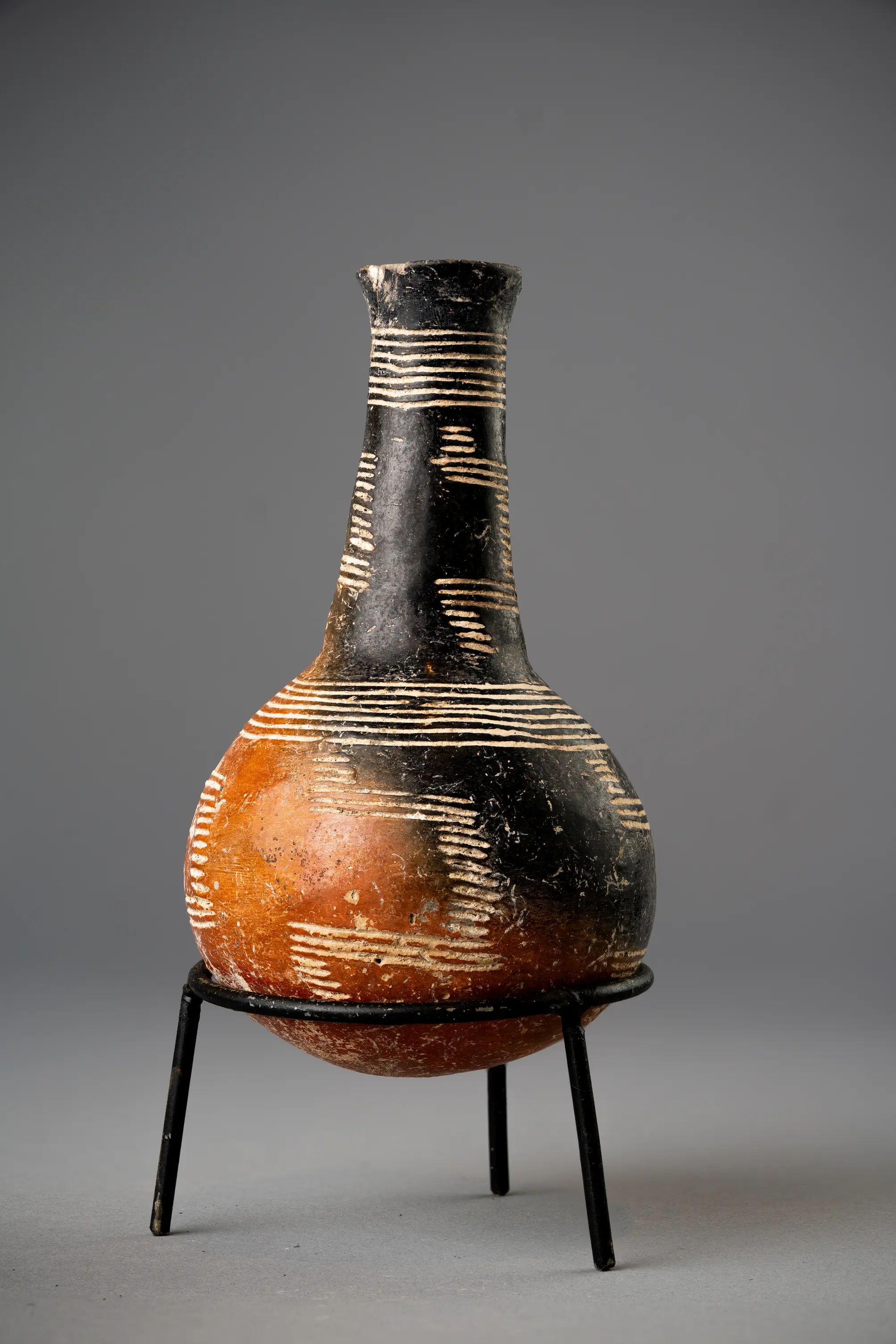
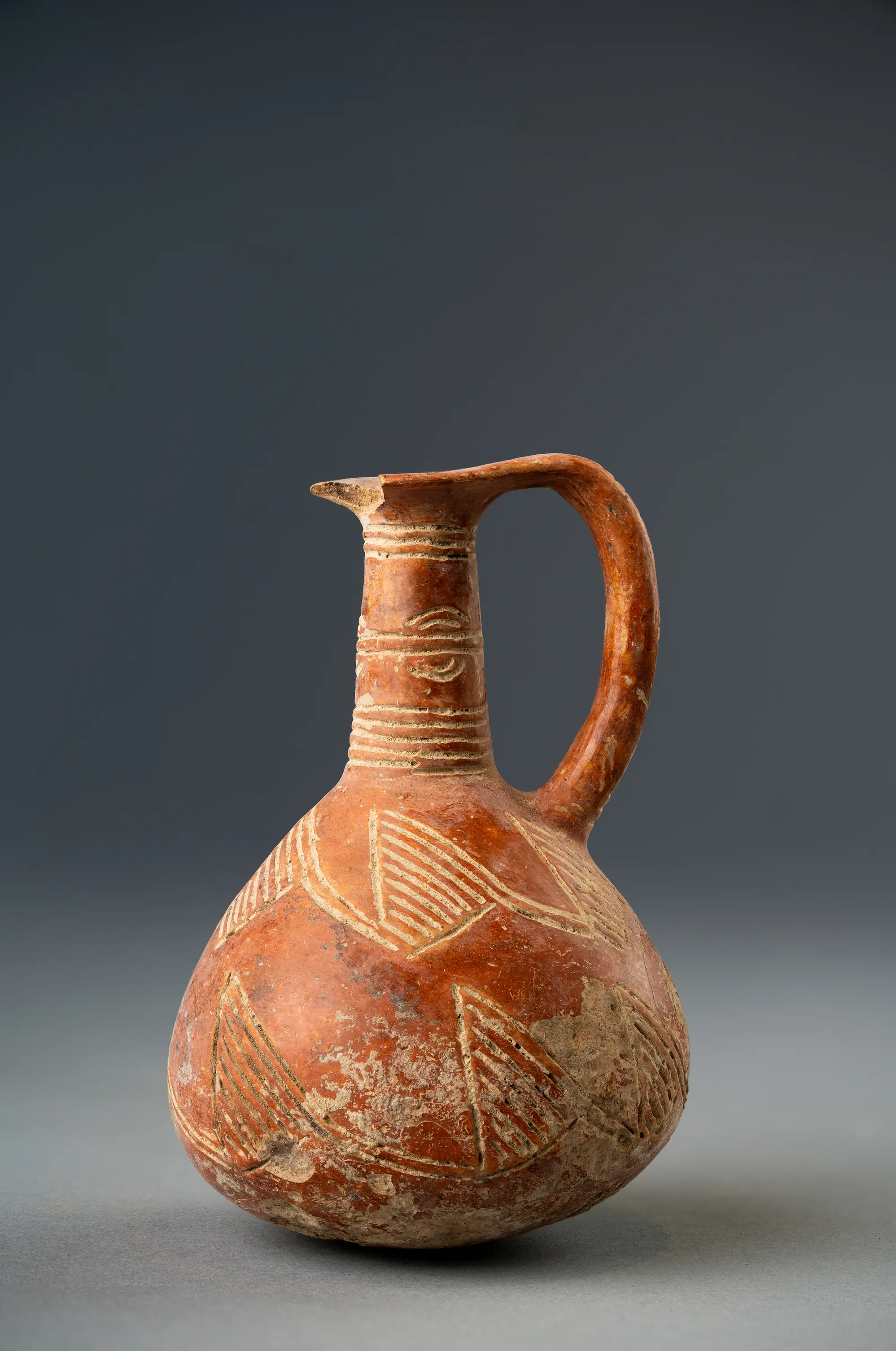
Incised Red Polished Bottle
Red Polished Ware bottle with incised decoration, typical of the Early Bronze Age in Cyprus.
Provenance:
- Goodman Collection, 1960s - 2025
- 2025 - Present, Alexis Drakopoulos, London, UK
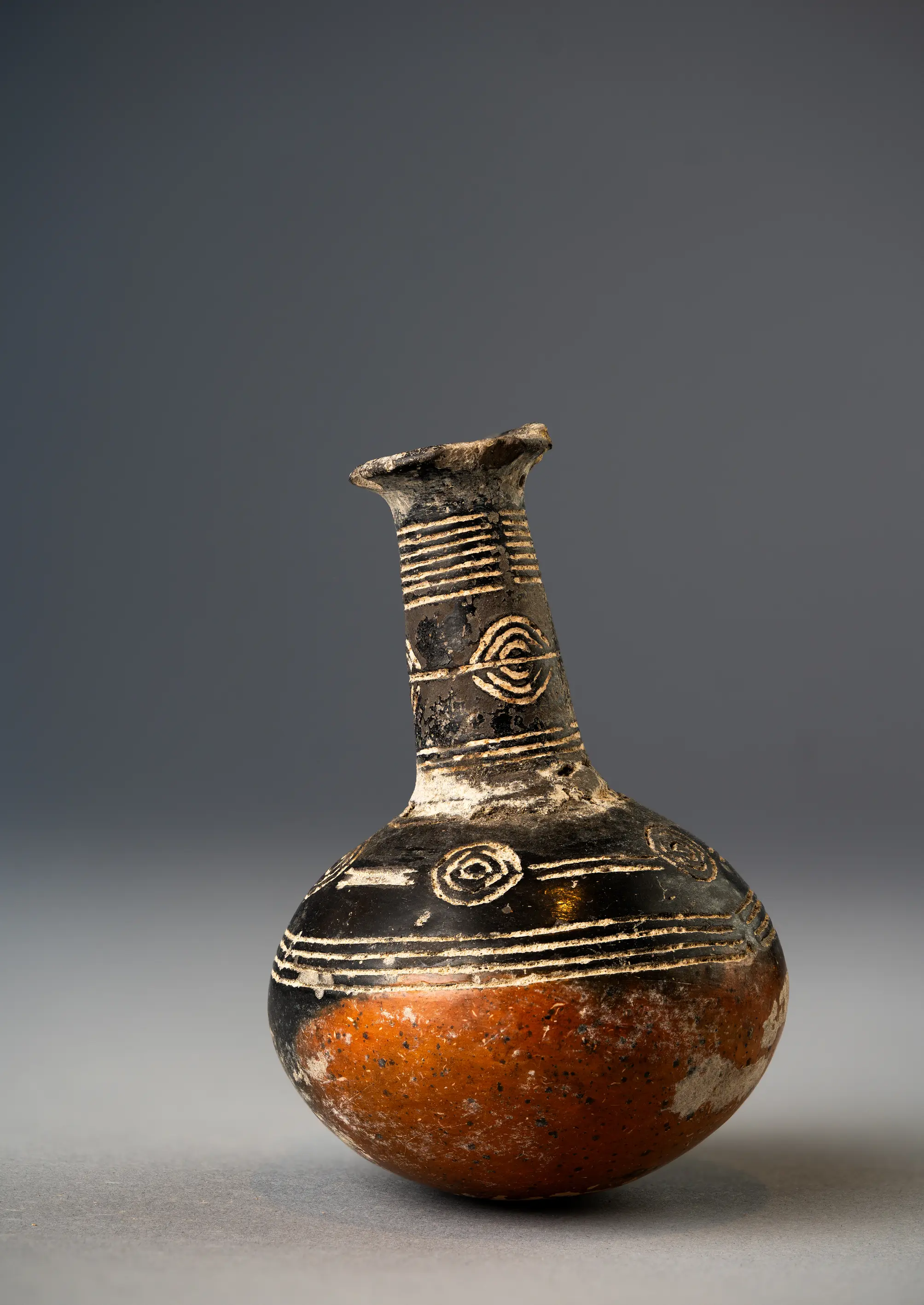
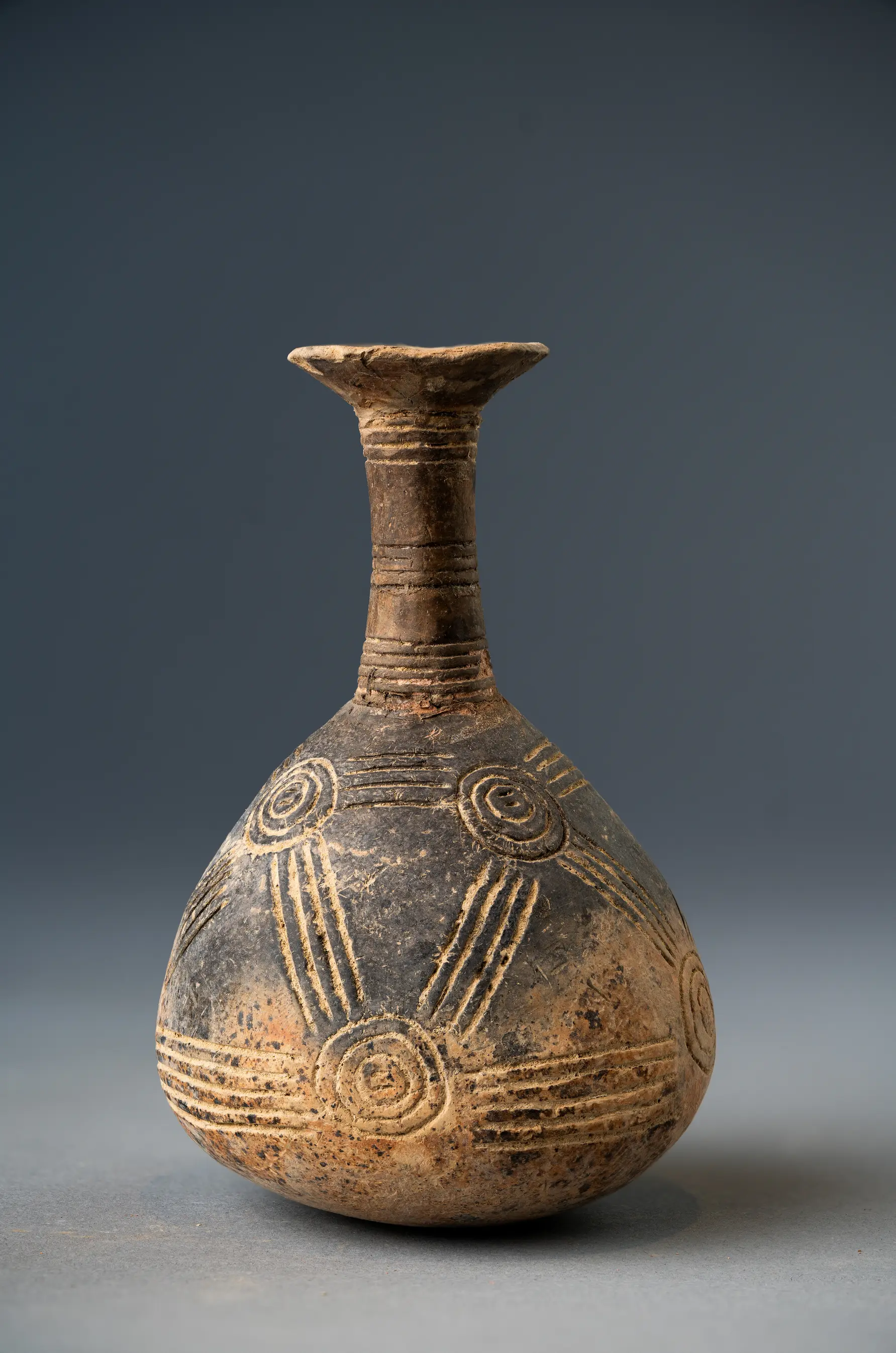
The Incised Bottles
Slender Red Polished bottles, their burnished surfaces cut with hatched and banded geometry and filled with white lime, where the era's decorative ambition is at its most concentrated.
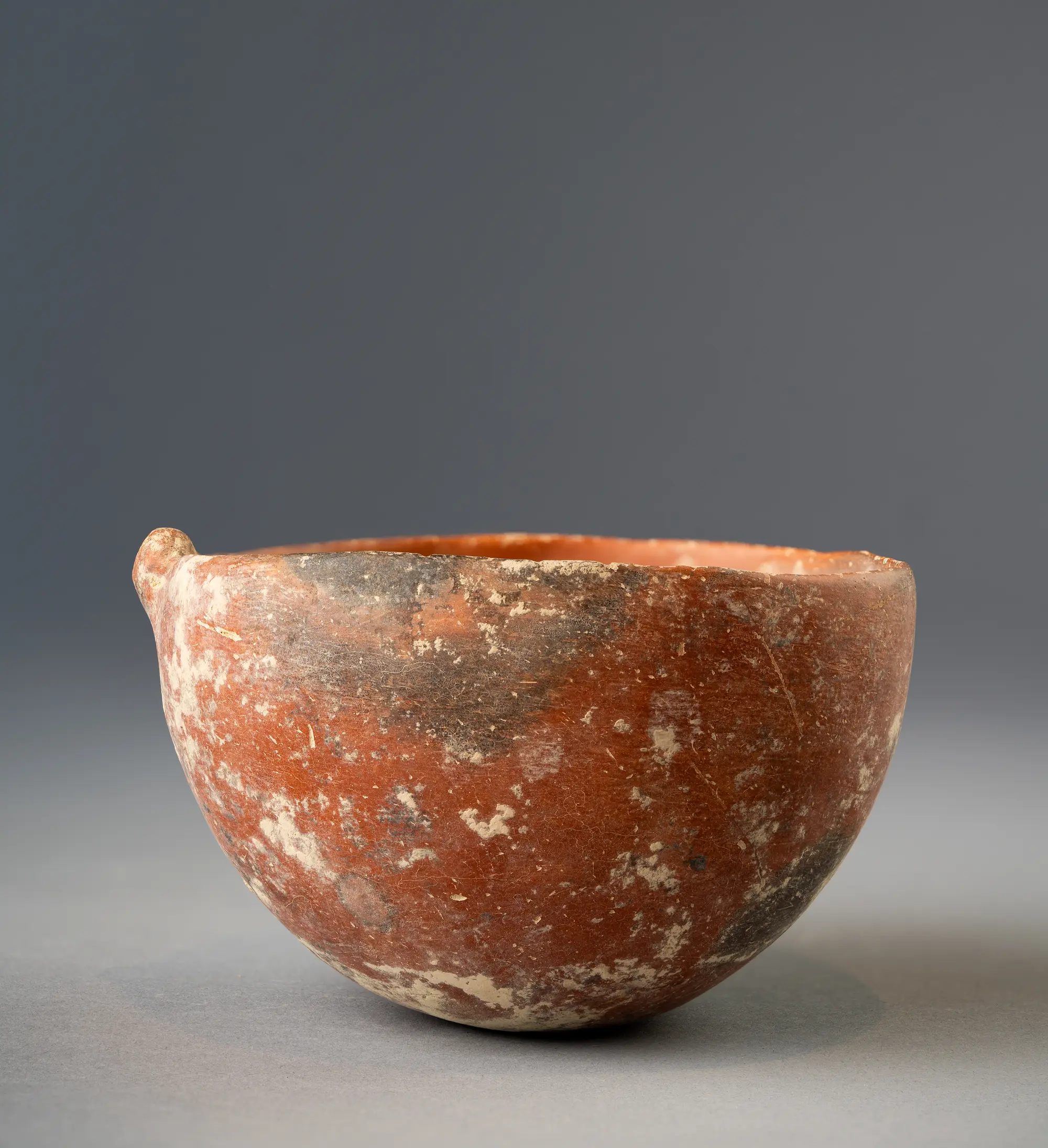
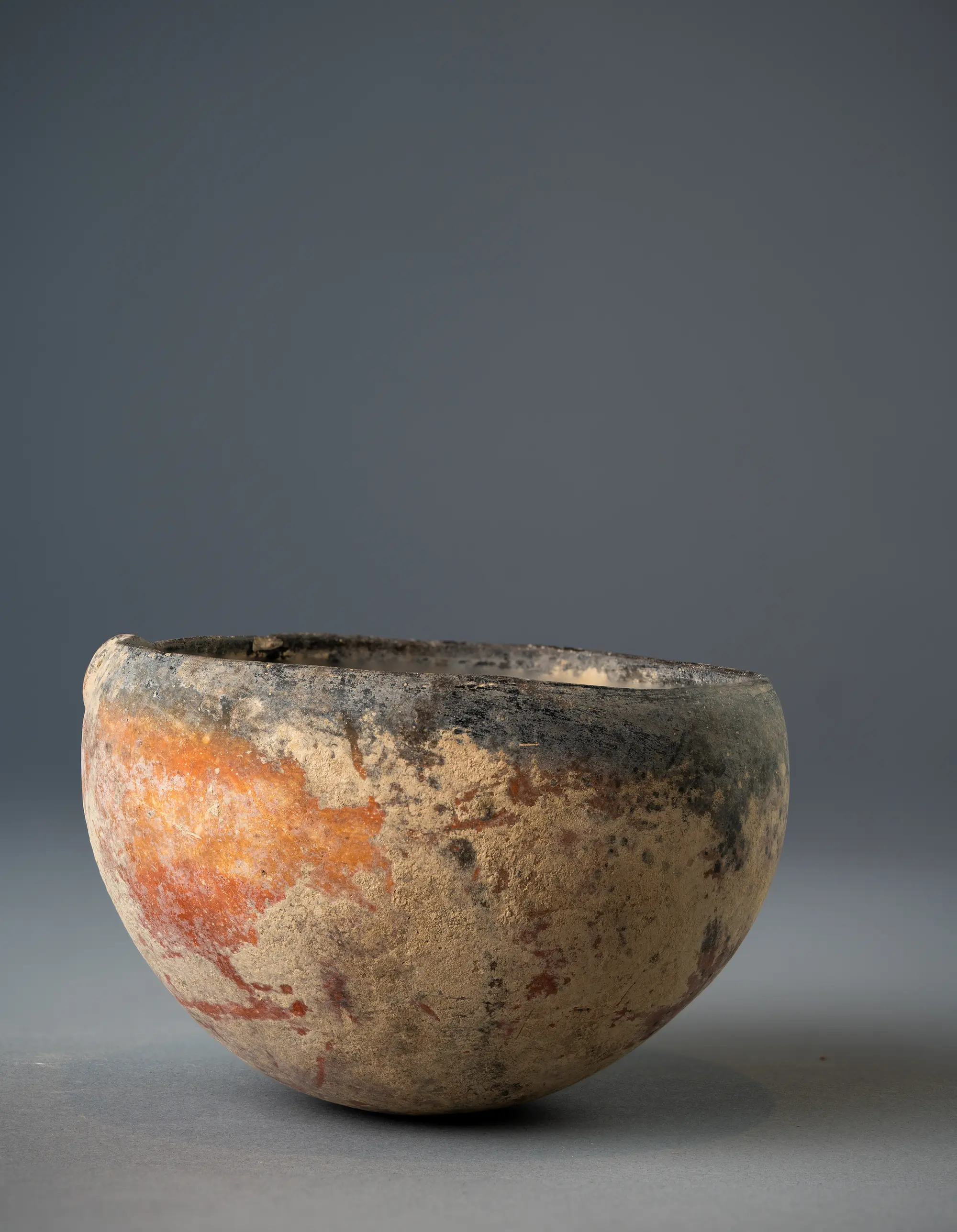
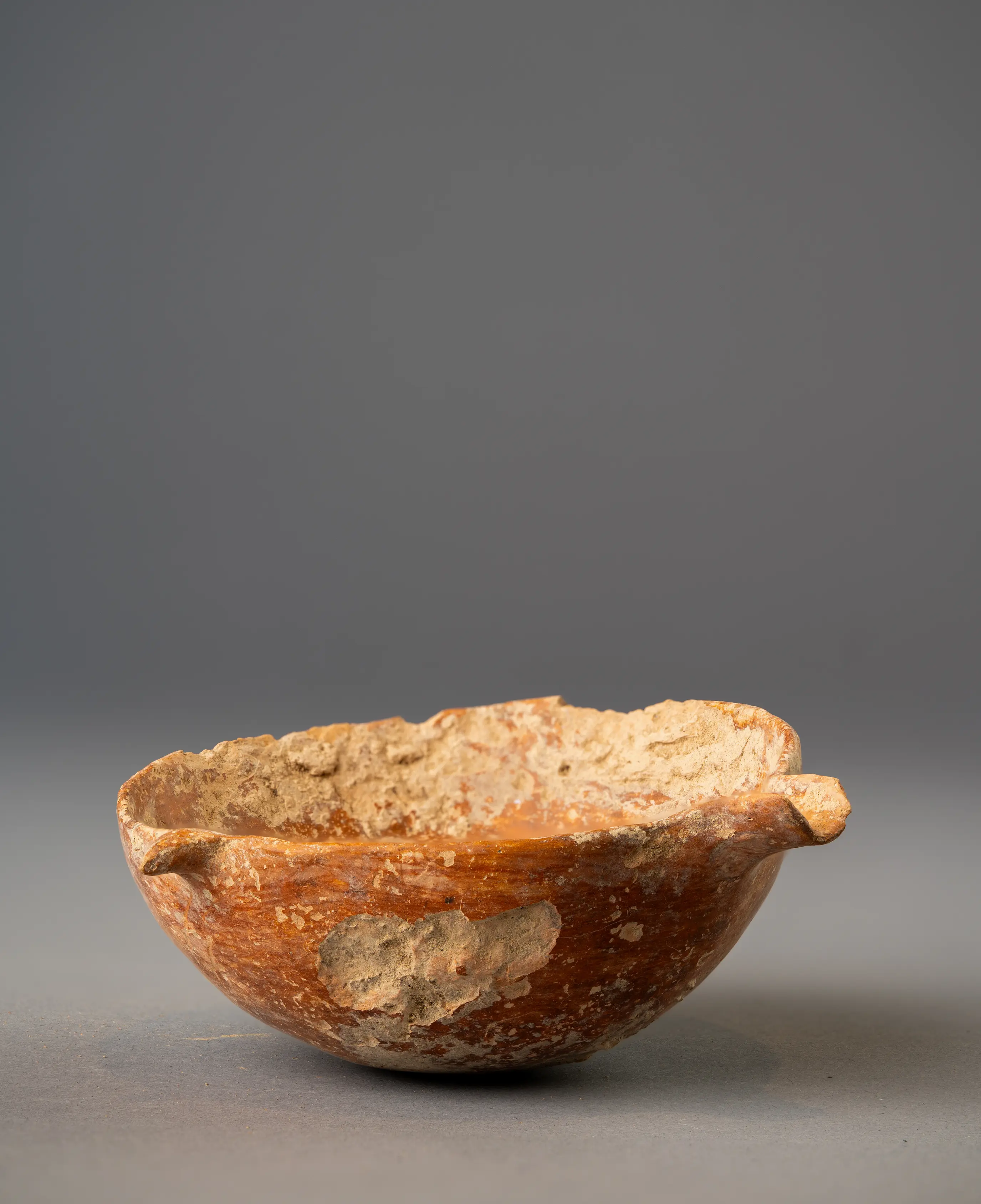
Bowls for the Chamber
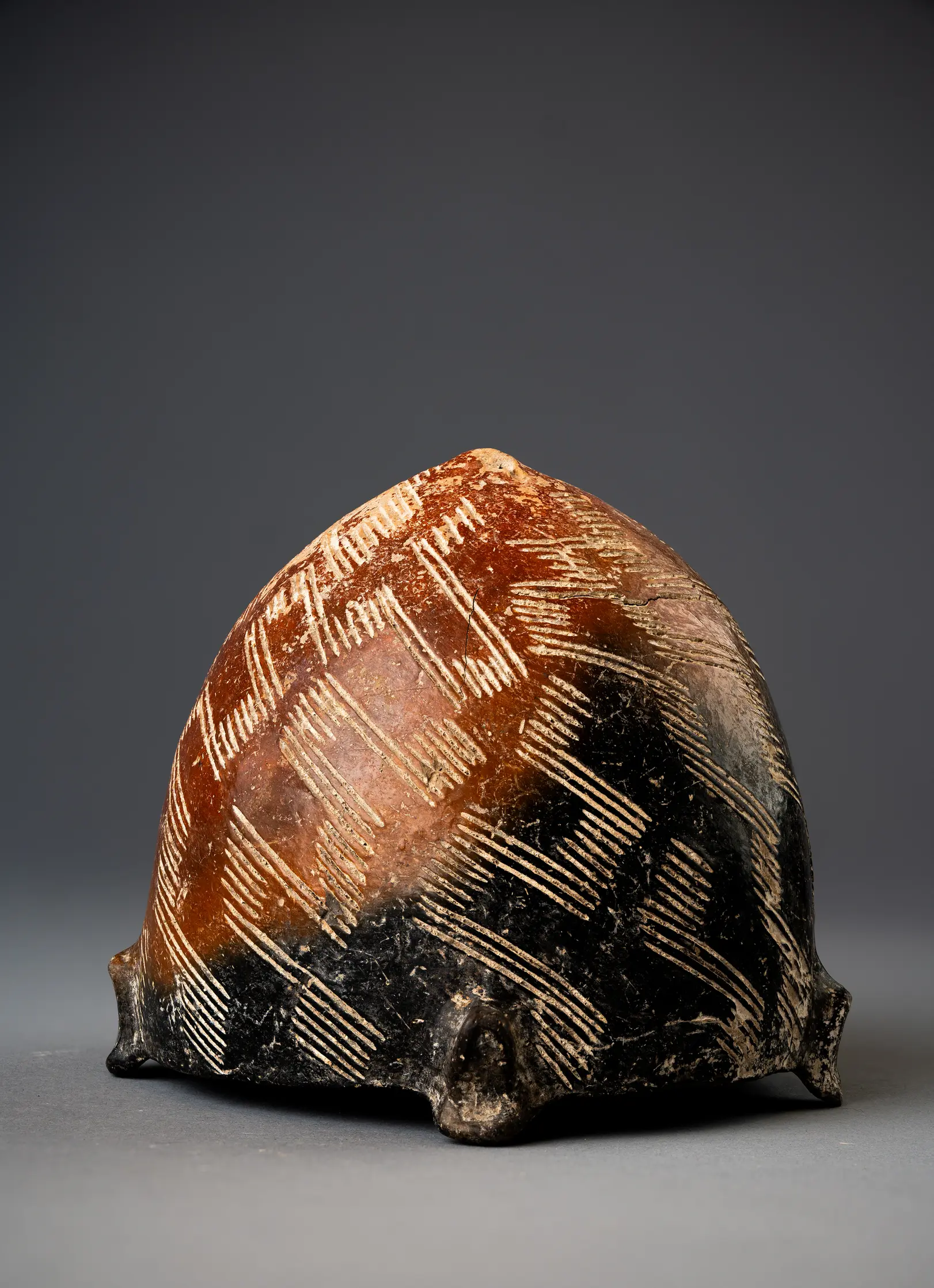
Hand-built Red Polished bowls, several with the deliberately blackened rims of the north-coast workshops, the most common and most quietly perfect form the period made.
Vessels for the Living and the Dead
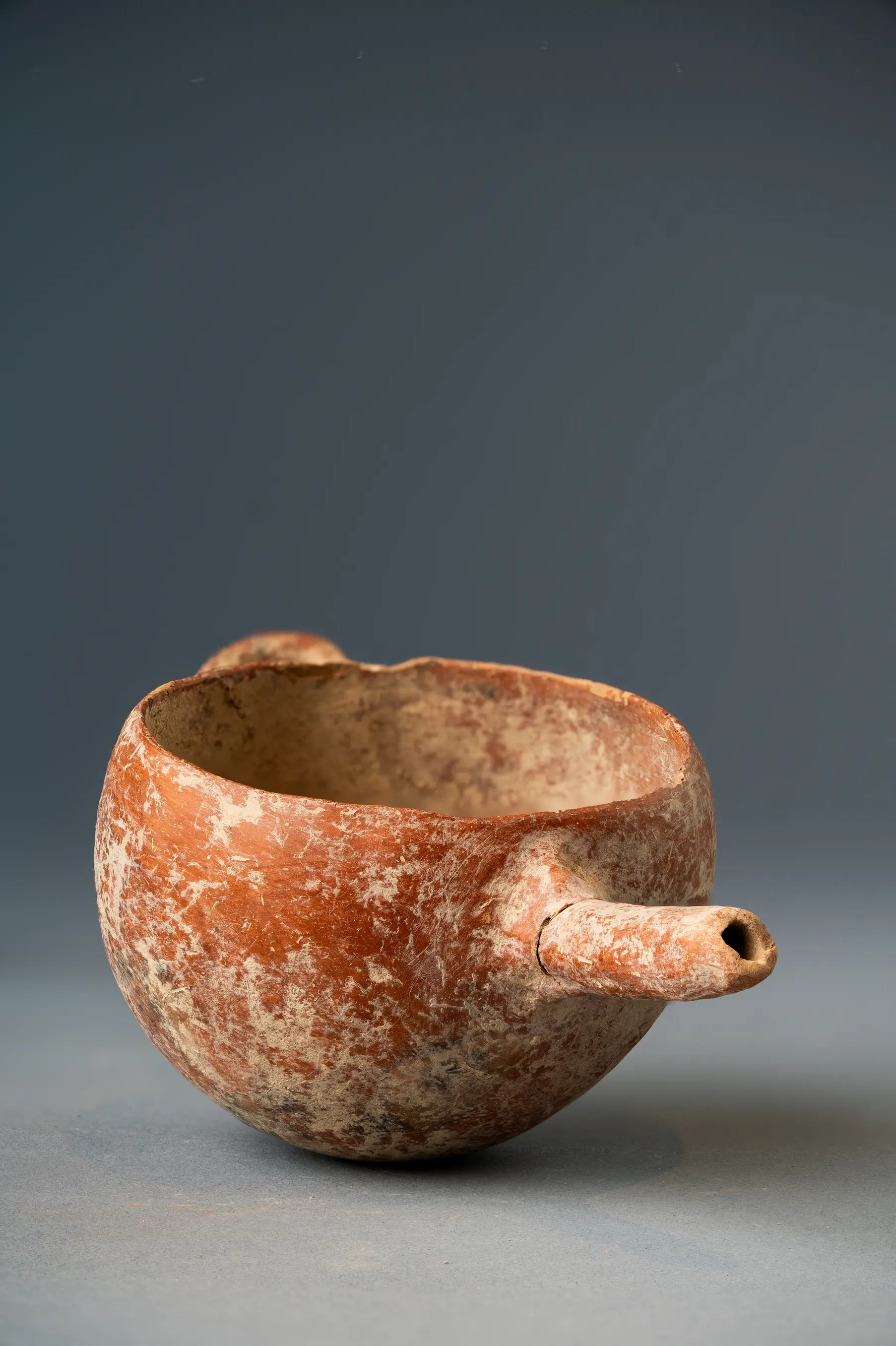
Pottery in the Early Cypriot tomb was rarely just pottery. Some of these vessels were made for the household and brought to the grave at the end of their working lives; others were never used at all, formed for the funeral itself and placed with the dead unworn. A jug holds liquid for the living and a libation for the dead with equal ease, and the line between domestic and ritual function is one the makers seem not to have drawn sharply. What the tombs make clear is the scale of the investment: chambers crowded with vessels, and alongside them the bones of cattle, sheep and goat, the remains of feasts staged at the graveside.
Those feasts mattered. The animal bone from cemeteries like Vounous includes not only the meaty joints but skulls and feet, the evidence of beasts slaughtered and butchered at or near the tomb, with portions deposited inside it. Cattle in particular carried weight, both as agricultural wealth and as ritual currency, a theme that returns with force in the modelled scenes of this era. To pour from a jug and to kill an ox were parts of the same vocabulary of provision for the dead and display among the living.
The bronze tools mark the other great change of the age. The earliest metalwork on the island is essentially pure copper, drawn from Cyprus's own ores; over the course of the Early Bronze Age, true tin-bronze begins to appear, harder and more durable, though it remains comparatively scarce. Knives, axes, awls and pins were deposited in the tombs as markers of identity and status, their distribution uneven enough to hint at real differences of wealth. Copper was the island's making, the resource that drew it into Mediterranean exchange, and in the grave a blade was never only a blade.
2300 BC – 1900 BC
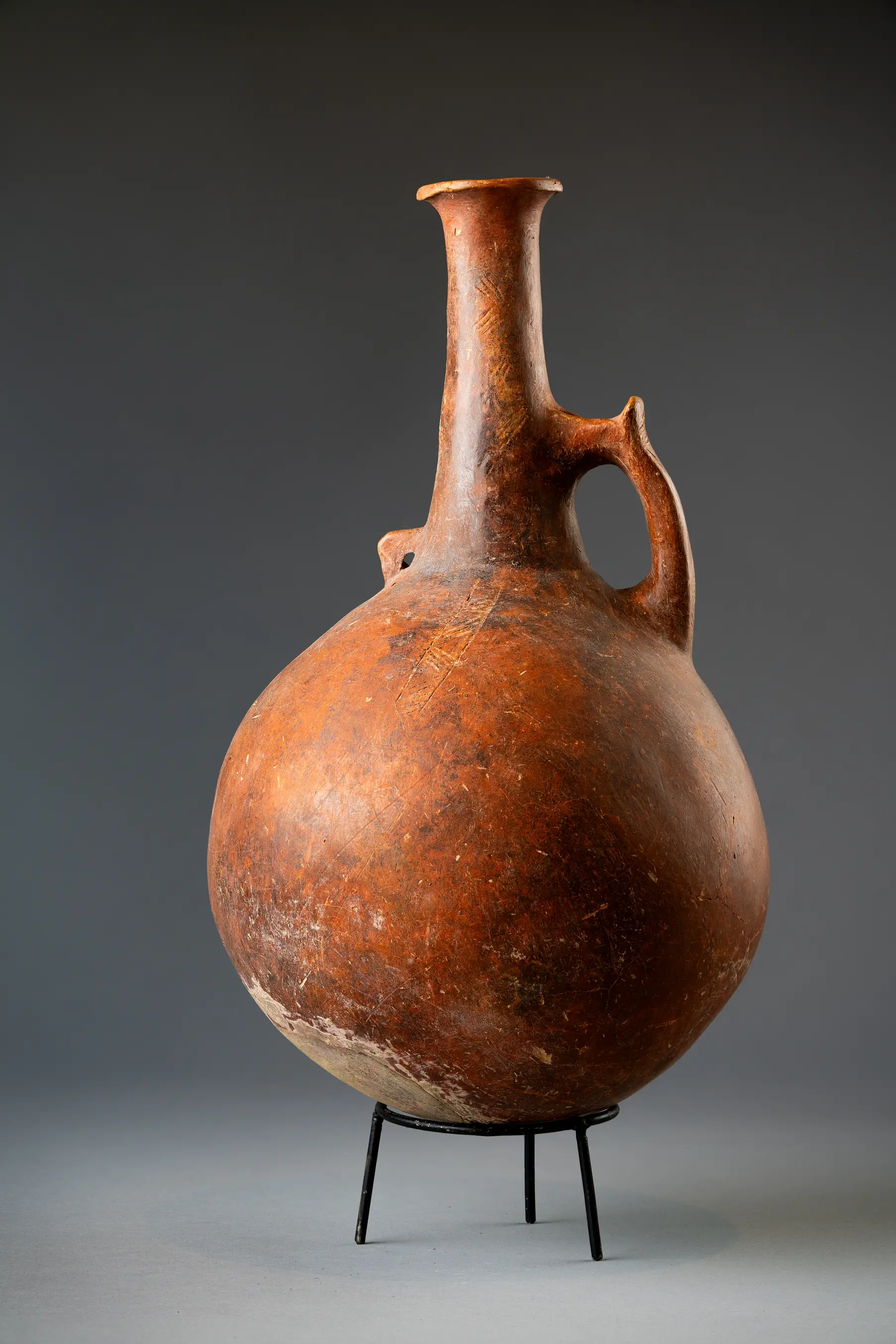
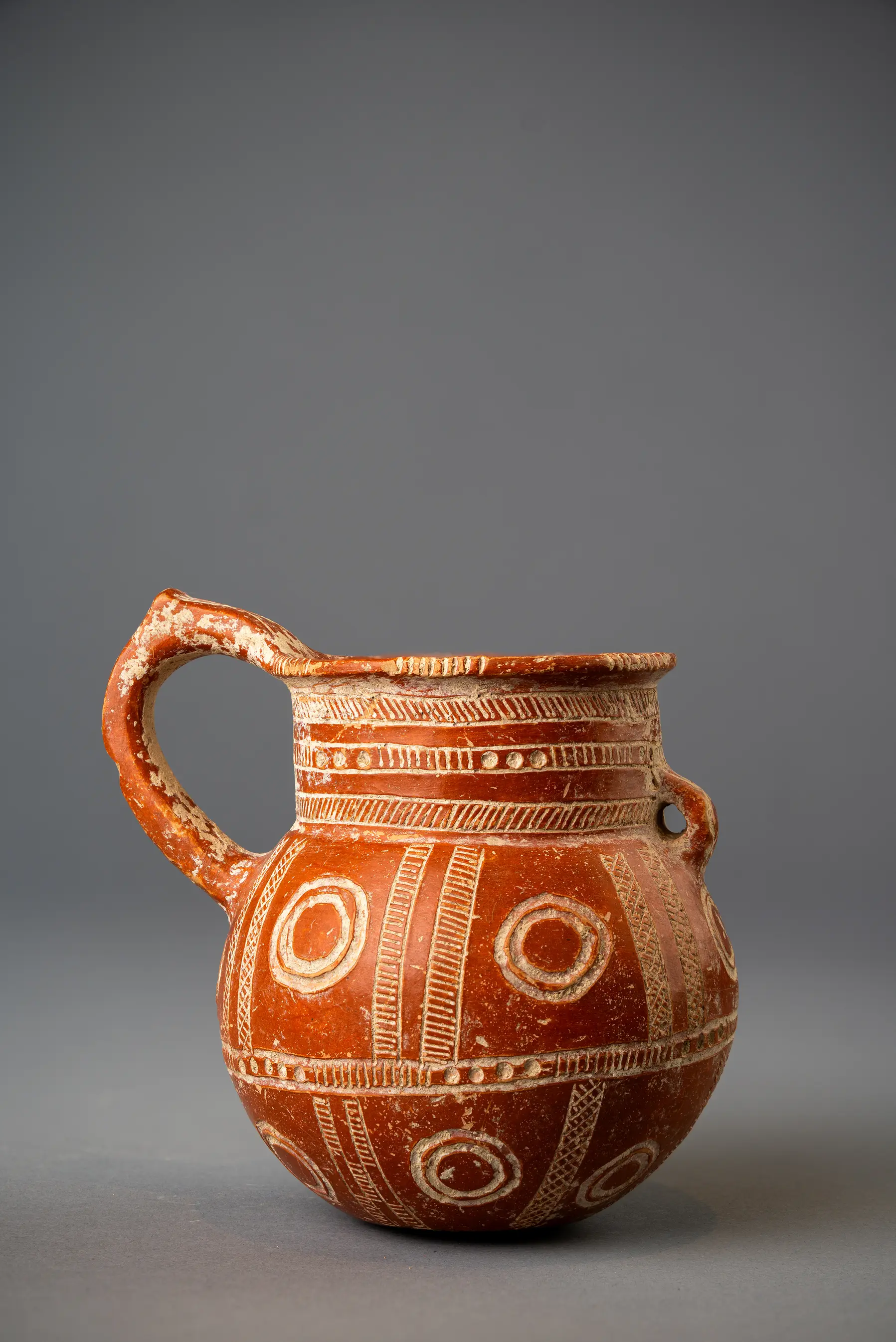
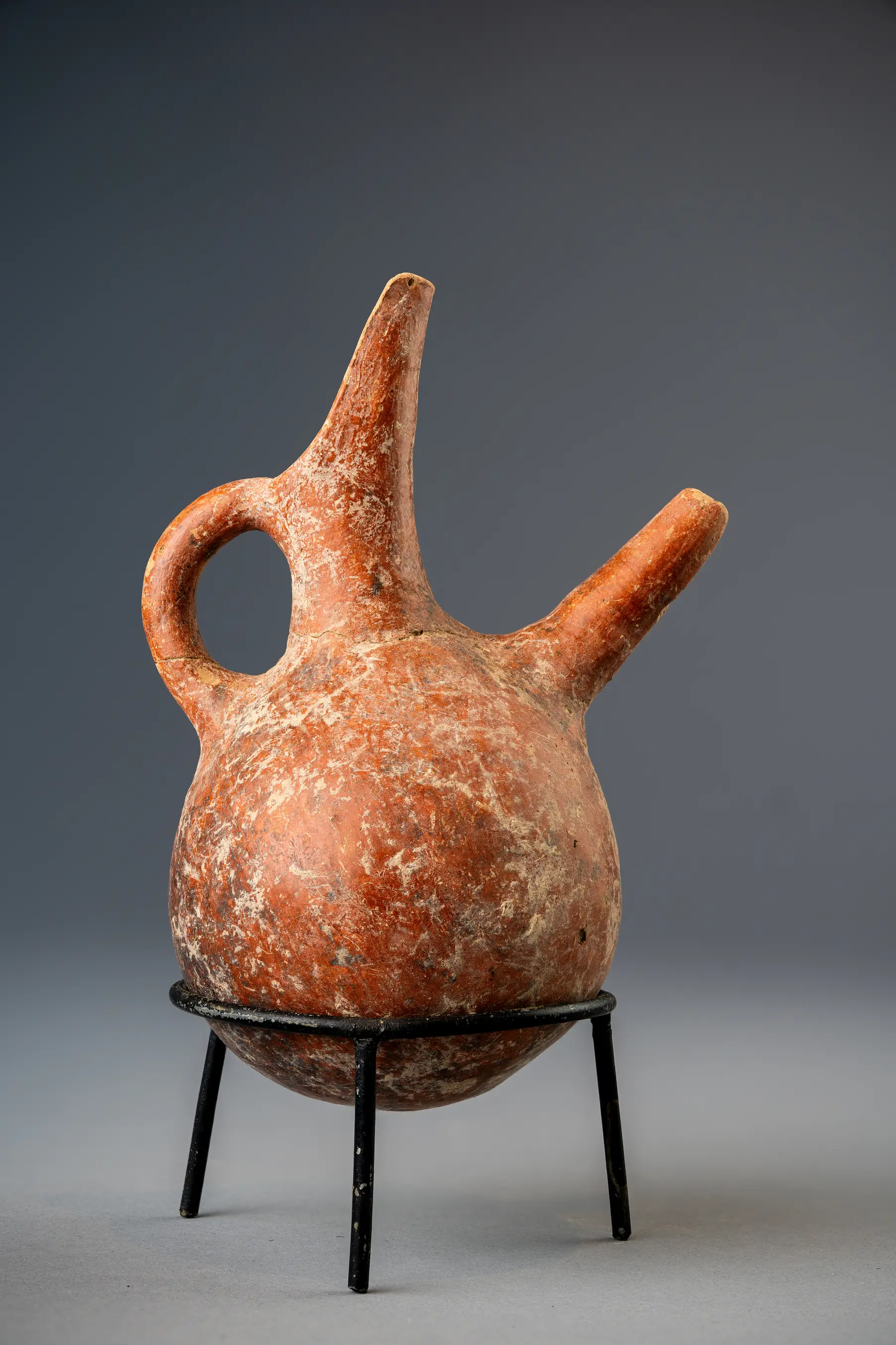
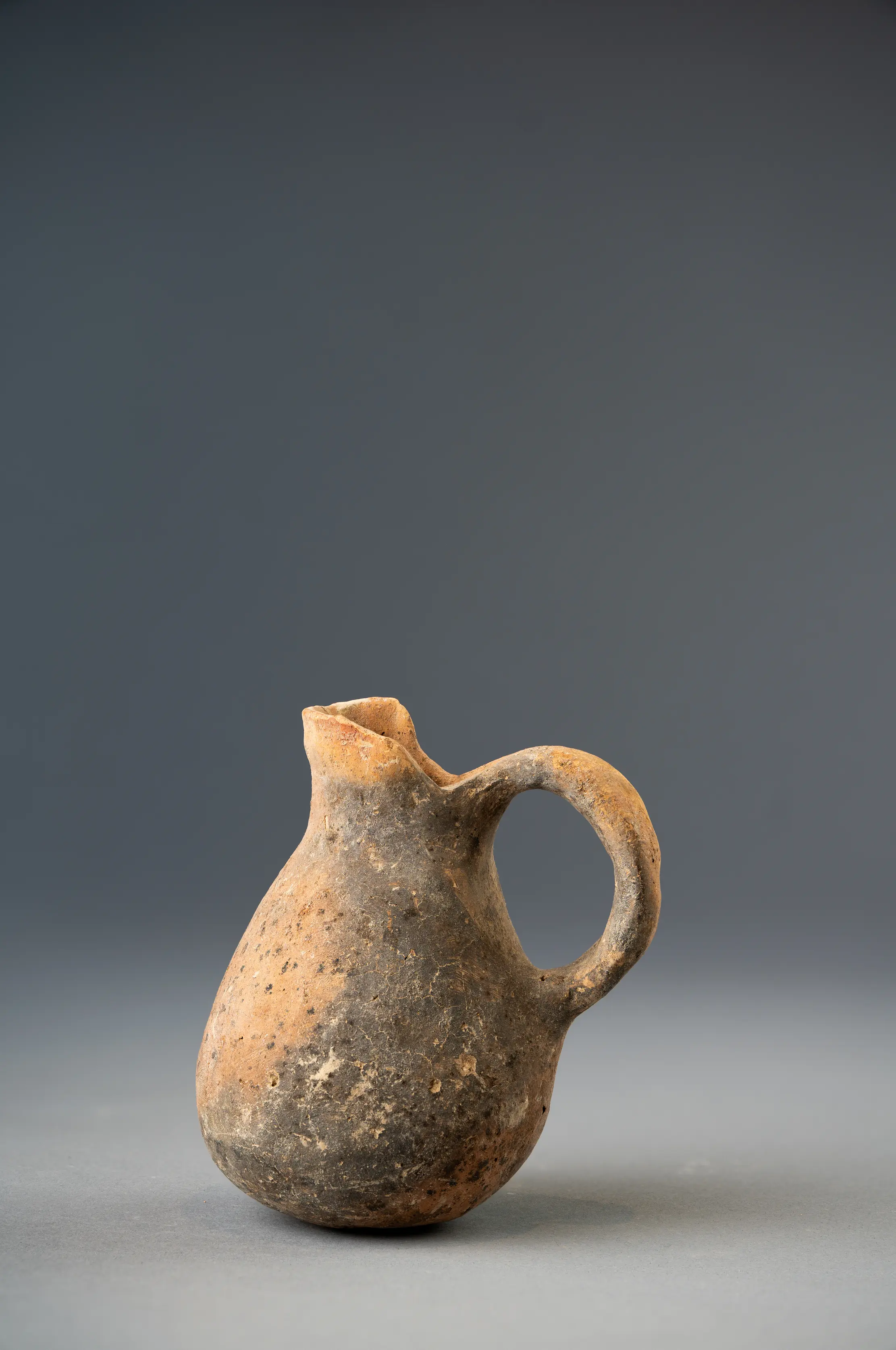
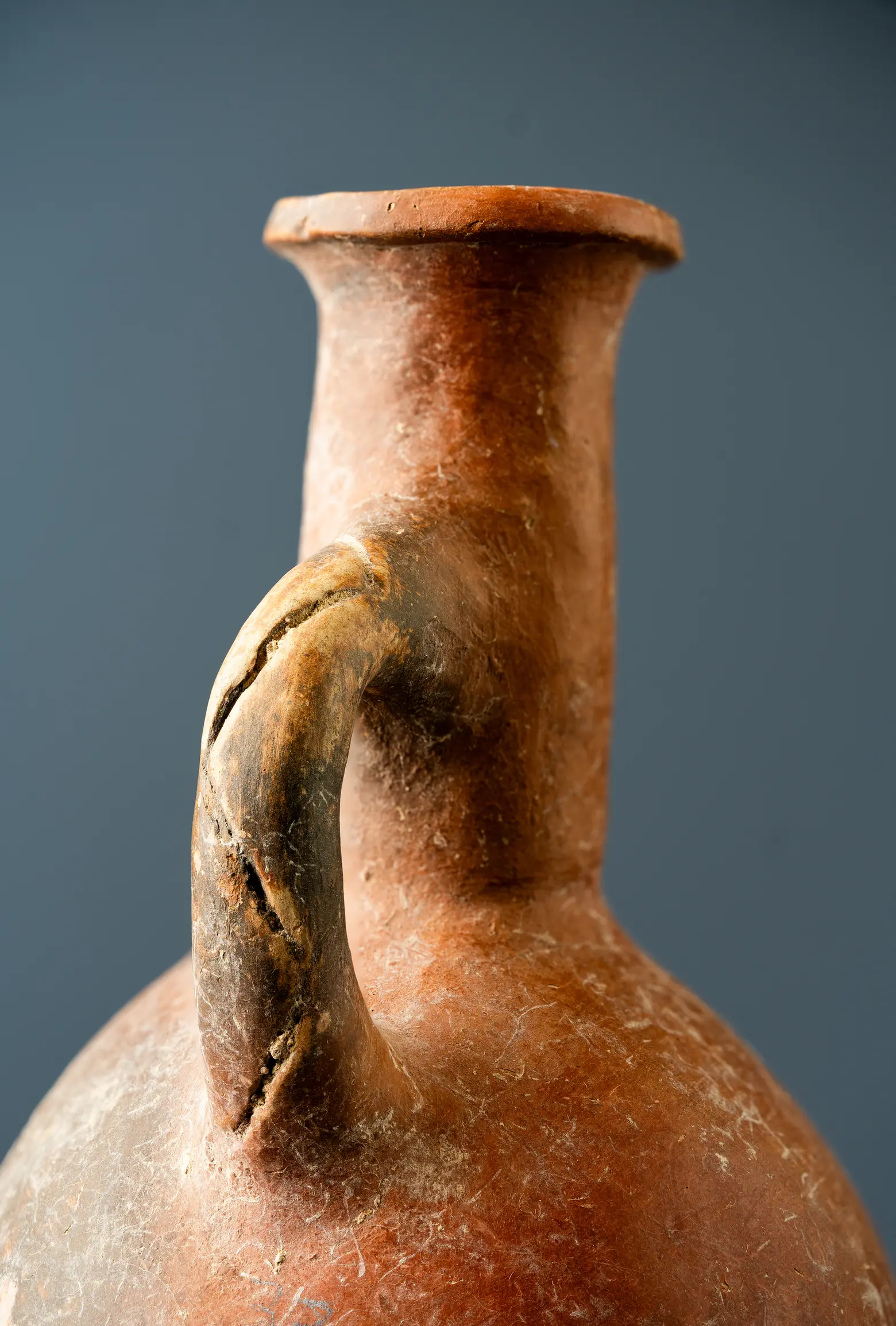
Red Polished Ware Jug
Red Polished Ware jug, typical of the Early Bronze Age in Cyprus.
Provenance:
- Goodman Collection, 1960s - 2025
- 2025 - Present, Alexis Drakopoulos, London, UK
The Jugs
Red Polished jugs with cutaway or beaked spouts and high handles, made to pour for the living and the dead alike, the boundary between table and tomb left deliberately open.
Copper into Bronze
Three bronze tools from the funerary record, small instruments of the age in which Cyprus turned its copper into the metal that defined it and carried that wealth into the grave.
The Plank Figures
Two flattened Red Polished idols, one with two heads and one with three, from a tradition no one has fully explained.
Turn the figures in 3D to read the incised collars and necklaces, and to count the heads along the shared body.
Two Boards of Fired Clay
The plank figure is one of the strangest forms the Cypriot Bronze Age produced, and one of the most immediately recognisable. The body is reduced almost to a flat board, a rectangular slab of clay with little or no modelling of the torso and limbs. What detail there is sits on the surface: the face rendered in relief and incision, with a long ridged nose, applied or punched eyes, and ears sometimes pierced for ornament; the neck and chest marked with incised bands that scholars read as headbands, collars, multi-stranded necklaces and patterned garments. The whole is finished in the Red Polished technique, burnished and fired to the same lustrous red as the pottery of the period, the incised lines often filled with white.
The two pieces here depart from the ordinary plank in a way that makes them genuinely rare. One carries two heads, the other three, set side by side on a single shared body. Most surviving planks are single-headed; multi-headed examples are scarce, and where their findspots are recorded they cluster heavily at the north-coast cemetery of Lapithos. A figure with three heads is rarer still. Whatever these objects meant, the maker has multiplied the most charged part of the image, the face, and left the body as its plain support.
A Question of Date
The plank tradition sits across the seam between the Early and Middle Bronze Age. The form has roots in the Early Cypriot period, and the technique and ware belong squarely to the Red Polished world described in this era, but the great majority of dated planks fall at the very end of the Early Cypriot sequence and on into the Middle Cypriot, roughly the last centuries of the third millennium and the first of the second. Production seems to have run for something like three or four hundred years in total.
For that reason these figures are best understood as a bridge between this era and the next. They are placed here because they are made of, and belong to, the Red Polished tradition that defines the Early Bronze Age; but a cautious catalogue would date the type broadly across the EC III to Middle Cypriot horizon rather than pinning it to a single phase. Without a secure excavated context, any closer date for these particular pieces would be a guess, and a responsible one should be offered as a range.
Goddess, Ancestor, or Toy?
No one knows for certain what the planks represent, and the honest position is that the debate remains open. Several readings compete. The oldest sees them as images of a fertility goddess or a divine female, the necklaces and ornament marking a deity; the difficulty is that many planks are sexually ambiguous or unmarked, and a confident reading as 'goddess' often says more about the interpreter than the object. A second view treats them as ancestor figures, kept and curated within kin groups and deposited in the family tomb, their role bound up with the cult of the dead that the cemeteries make so visible. A third, more deflationary line points out that some examples are hollow and contain loose clay pellets, making them function as rattles, and that figures have been found cradled in the arms of larger planks, which has suggested to some a connection with infancy, dolls or play. None of these need exclude the others; an object can be a toy in one hand and a sacred thing in another, across the long life of a household.
The multiple heads sharpen the puzzle rather than solving it. They have been read as twins, which many societies regard as uncanny or powerful; as a sign of plurality or multiplication, perhaps tied to fertility and increase; and as a protective doubling, more eyes and more faces against harm. Comparisons have even been drawn, speculatively, to Near Eastern double idols that fuse male and female. What can be said plainly is that the head, the seat of identity and the locus of all the ornament, is the element the maker chose to repeat. The body is a board; the heads are the point.
Why They Were Buried
Whatever else they are, plank figures belong to the tomb. They turn up in burial chambers alongside the pottery and the bronze and the bones of the funeral feast, part of the same furnishing of the dead. If they are ancestors, the placement is self-explanatory; if they are protective or divine, they accompany the deceased across a threshold; if they are heirlooms or playthings, they are still possessions surrendered to the grave. The figurative objects of this period, the planks and the models of knives and spindles and cattle horns, seem to have carried the identities and concerns of the living into the chamber.
That a society without writing chose to render the human form at all, and to render it in this severe, frontal, heavily ornamented way, tells us that the image mattered. These were not casual objects. They were made with the same care as the finest pottery, decorated with the same incised grammar, and committed to the same charged context. They are among the few things from the Early Cypriot world that look back at us.
On Acquiring the Pair
A note for revision, to be corrected against the record. Single-headed plank figures appear on the market with some regularity; a collector can reasonably hope to find one. A two-headed example is uncommon, and a three-headed one is the kind of thing one waits years for, if it appears at all. To hold both in a single collection is, frankly, the part of this group I find hardest to believe even now.
I should set out the provenance honestly rather than dress it up, and these lines are a placeholder until the paperwork is squared. [DRAFT, to verify: the acquisition history, the chain of prior ownership, and any export or collection documentation for both figures need to be stated exactly here, with dates and names, and nothing claimed that the file cannot support.] What I can say without hesitation is the feeling of the thing: the surprise of seeing the third head, the recognition that this was a rarity within a rarity, and the small fear that comes with taking responsibility for an object that has already outlasted four thousand years of people who thought, briefly, that they owned it.
“The body is a board; the heads are the point.”
Provenance
- Goodman Collection, 1960s - 2025
- 2025 - Present, Alexis Drakopoulos, London, UK
The Vounous Scene
A Red Polished vessel modelled with a figure leading two bulls, from the milieu that produced Cyprus's most famous ritual bowl.
Move around the vessel in 3D to follow the figure, the tether and the two modelled bulls from every side.
A Vessel That Tells a Story
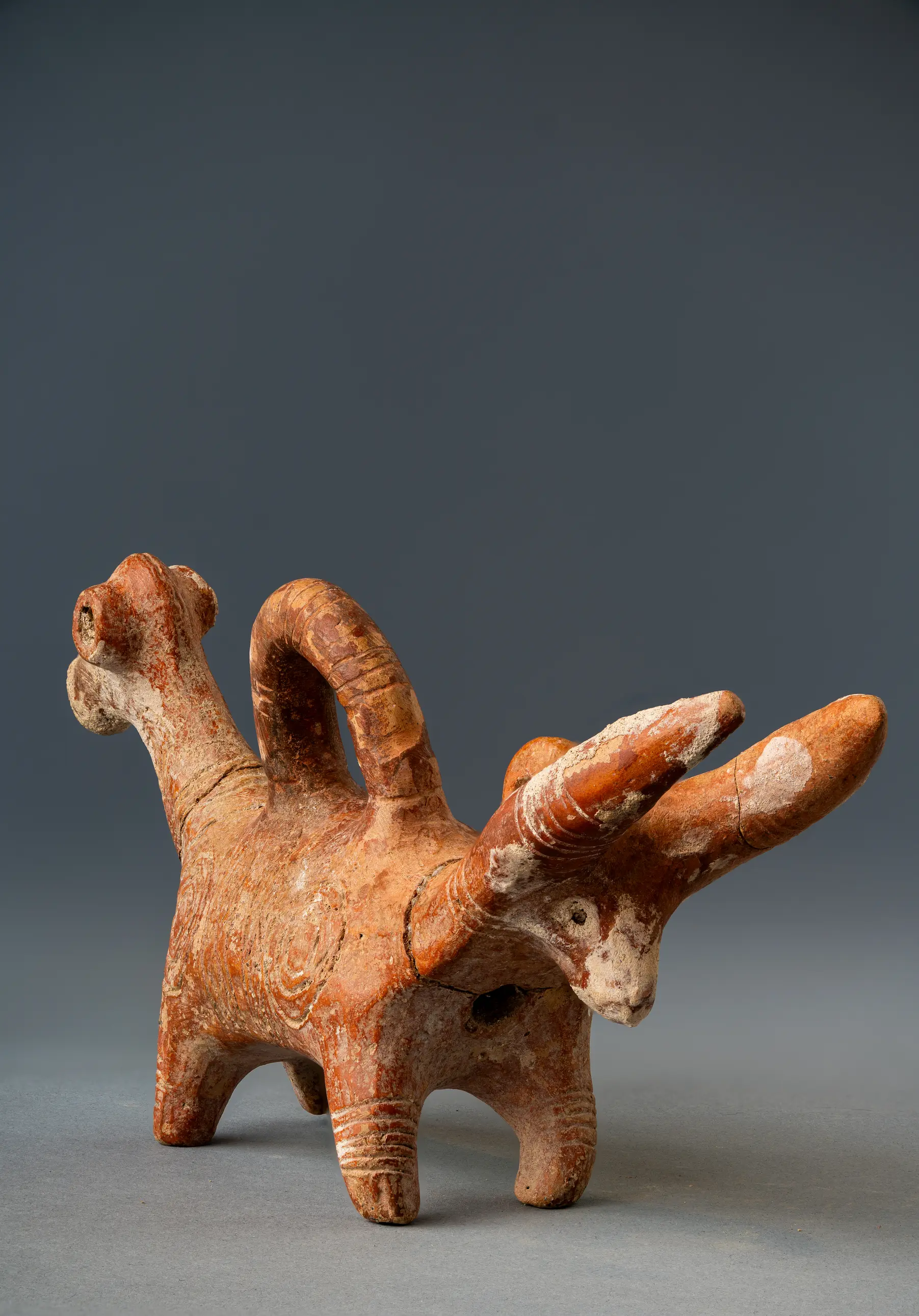
Most Early Cypriot pottery is decorated; a small and remarkable group is narrated. At and around the north-coast cemetery of Bellapais Vounous, potters built scenes directly onto and into their Red Polished vessels: little worlds of modelled figures, human and animal, caught in the middle of some action. This piece belongs to that tradition. Onto a Red Polished vessel a maker has set a modelled scene in which a single figure leads two bulls, the animals worked as solid, horned forms and the human reduced to the same economical, frontal style as the plank idols.
The modelling is deliberately plain by later standards and powerful because of it. The bulls are unmistakably bulls, their bulk and horns established in a few decisive moves of the clay; the leading figure controls them by a tether or by the horns. Nothing is incidental. In a tradition where most vessels carry pattern, the choice to carry a scene marks this out as something made to say something, and what it says, on the evidence of its world, is about cattle, ritual and the feast.
The Cemetery at Bellapais Vounous
Vounous sits on the gentle slopes of the north coast near the village of Bellapais, and it is one of the central sites of the Cypriot Early Bronze Age. Like so much of the period it is known through its dead: a cemetery of well over a hundred rock-cut tomb complexes, dug across the 1930s by Porphyrios Dikaios of the Cyprus Museum, by C. F. A. Schaeffer for the Louvre, and by the Australian archaeologist James Stewart with his wife Eleanor, who recorded and drew the finds. The associated settlement has never been located, which leaves the necropolis as the sole witness to the community that used it for roughly five centuries.
It was here, in 1931 or 1932, that Dikaios recovered the object that gives the whole tradition its name. The Vounous Bowl, from Tomb 22 at the site's later area, is a large shallow Red Polished basin containing a modelled scene of more than two dozen human and animal figures within a circular walled enclosure: people seated on benches, a prominent figure on a larger seat or throne, cattle penned inside, and figures apparently engaged in ritual before a structure read as a shrine. It is the single most discussed object of the Cypriot Bronze Age, and it is the reason a vessel like this one, with its figure and its two bulls, can be placed so confidently in its world.
Leading Two Bulls
Cattle run through everything at Vounous. The bones in the tombs are largely those of adult cattle; the modelled vessels return again and again to bulls, in pens, with figures, as plastic ornament on the rims of bowls. Cattle were among the innovations of the Philia horizon that opened the era, and they remained both the chief form of agricultural wealth and the chief victim of ritual. To slaughter an ox was to spend a great deal, and the cemetery's feasting bones show that this was exactly what funerals demanded.
A figure leading two bulls, then, almost certainly shows the moment before that expenditure: an animal, or a pair, being brought to sacrifice and to the feast that followed. Two is not an idle number. It suggests an occasion of scale, a killing meant to feed and impress a gathering, the kind of event the great Vounous Bowl seems to freeze at its climax. The scene compresses a whole social and religious logic into a few centimetres of clay: provision for the dead, display among the living, and the offering of the most valuable thing the community raised. Whether the leading figure is a priest, a host, a herdsman or a more-than-human presence is beyond what the modelling will tell us, and any caption should leave that open.
What the Scene Cannot Settle
The interpretation of the Vounous scenic vessels has never been agreed, and the famous bowl is a warning against confidence. It has been called a sacred enclosure, a funeral, an ancestor rite, an image of an emerging leader staging a feast to legitimise his power, and, more soberly, a scene of ordinary village life. The fact that Tomb 22 was otherwise modest in its contents complicates any reading of the bowl as a straightforward emblem of elite status. The scholarship is alive and unresolved, and the right posture before these objects is curiosity rather than conclusion.
This vessel should be presented in that spirit. It clearly shows a figure with two bulls; the framework of cattle, sacrifice and funerary feasting gives that image a plausible meaning; but the precise ceremony, the identity of the figure, and the beliefs behind it remain inferences. The vessel is a fragment of a lost grammar, legible in outline and obscure in detail.
On Provenance and Care
A note for revision. Scenic vessels from the Vounous milieu are uncommon and, given the fame of the cemetery, demand particular care over their history; this section is a draft to be checked line by line against the documentation. [DRAFT, to verify: the precise relationship of this piece to the Vounous cemetery should be stated only as far as the evidence allows, distinguishing clearly between a secure find-spot, a stylistic attribution to the Vounous milieu, and a market provenance. The full ownership chain, acquisition date, and any export or collection records must be set out here exactly, and no association with a specific tomb or excavation should be claimed unless the file supports it.]
What I would want a visitor to feel, once the facts are squared away, is the smallness and the reach of the thing: a hand-sized scene of a person and two animals, built without a wheel and without writing, that carries a community's whole idea of how to honour the dead. The great bowl sits in a museum. This is a quieter cousin, and the privilege of living with it is also a responsibility to get its story right.
“The scene compresses a whole social and religious logic into a few centimetres of clay.”
The Cemeteries of Bellapais-Vounous
The north-coast necropolis whose modelled vessels and scenic bowls gave the Early Bronze Age its most vivid record of ritual and belief.
Read More