
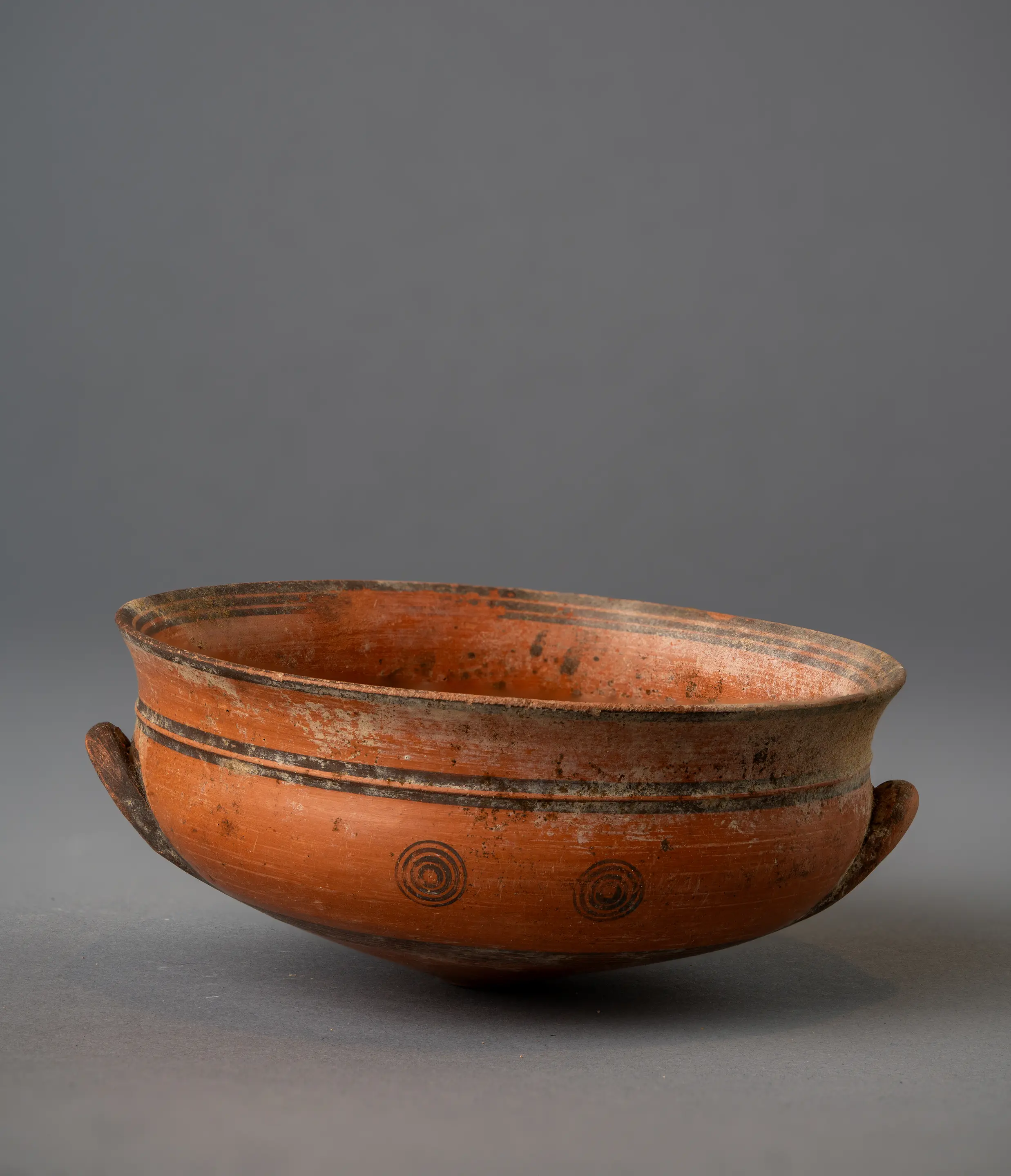
Archaic I
Black-on-Red Two-Handled Bowl with Raised Flaring Rim
Cypriot Black-on-Red bowl with a raised flaring rim, a sharp shoulder, two small upturned handles and paired bull's-eye circles, Cypro-Archaic I, c. 750–600 BCE.
Date
750 - 600 BC
Accession No.
BWL-GE-002
Collection
Alexis Drakopoulos
Provenance
- 1965–1969, The Goodman Collection
- 2025–present, Alexis Drakopoulos, London
Cypro-Archaic I, c. 750–600 BCE · Black-on-Red ware · Wheel-made
A wide, shallow-bodied bowl with a rounded lower wall that turns at a firm shoulder into a tall rim, splaying outward to a plain lip. Two small horizontal roll handles sit at the widest point, tilted upward. The bright orange-red slip keeps much of its sheen. The black paint is spare: fine bands on the outer lip and inner edge of the rim, a pair of bands at the shoulder, and on the lower body small concentric-circle bull's-eyes; a pair is visible between the handles on the photographed side.
The surface is in good order. There is light pitting, a few dark spots, and a grey film over part of the rim. The base is not visible in the photographs.
Commentary
The bowl belongs to the raised-rim class of Cypriot Black-on-Red ware. It has a lustrous red slip with matt black paint [1]. Gjerstad placed bowls with a raised rim, straight or splayed, and a pronounced shoulder in his second stage, Black-on-Red II (IV), as types 18a–c. He remarked that in these shapes "the metal prototypes are conspicuous" [1]. The sharp transition from body to rim and the small handles at the carination follow the profile of hammered bronze bowls, and skeuomorphism of this kind recurs throughout the ware [3].
The closest excavated parallel is Kourion-Kaloriziki K 695 (Tomb 24), now in the Penn Museum (282500). It is a Black-on-Red II bowl of Cypro-Archaic I date, 7.4 cm high and 13.7 cm across. It has a small ring base, a convex wall, a flaring plain rim and raised horizontal roll handles at the widest part [2]. A bowl in the British Museum (1876,0909.61), with a straight neck, two small upward-sloping side handles and concentric circles, is dated 760–600 BCE. A two-handled bowl in the Museum of Fine Arts, Boston (177675), catalogued as Cypro-Archaic I, shows the same arrangement of small circle groups on the body.
These parallels support a Cypro-Archaic I date, c. 750–600 BCE. The raised-rim form is not a secure chronological marker on its own, however. Schreiber showed that "the bowl with a carinated body" appears in the earliest firm Black-on-Red contexts on the Levantine mainland, so it was not confined to a late stage [3]. Radiocarbon from Megiddo places those first exports around 900 BCE [4]. For this bowl, the sparse decoration of small bull's-eyes favours the Cypro-Archaic I dating of the Kaloriziki and British Museum pieces, but an earlier date cannot be excluded.
Bowls of this size were used for drinking and serving at table and were placed in tombs as part of the same sets. The Kaloriziki example has three concentric circles painted on its interior floor. The inside of this bowl has not yet been recorded, and it may carry a similar central motif.
References
- 1.Gjerstad, E. (1948) The Swedish Cyprus Expedition IV.2: The Cypro-Geometric, Cypro-Archaic and Cypro-Classical Periods. Stockholm: Swedish Cyprus Expedition, Black-on-Red II (IV) ware section, bowls types 18a–c, Figs. XXXVII–XL.
- 2.Benson, J.L. (1973) The Necropolis of Kaloriziki (Studies in Mediterranean Archaeology 36). Göteborg: Paul Åströms Förlag, Black-on-Red II miscellaneous bowls, no. K 695.
- 3.Schreiber, N. (2003) The Cypro-Phoenician Pottery of the Iron Age. Leiden and Boston: Brill, pp. 89, 280–284.
- 4.Kleiman, A., Fantalkin, A., Mommsen, H. and Finkelstein, I. (2019) 'The Date and Origin of Black-on-Red Ware: The View from Megiddo', American Journal of Archaeology 123.4, pp. 531–555.
More from the Catalogue
Browse related objects
Bichrome Kylix with Bird Free Field Art
Geometric III
Milk bowl
Bronze Age
Bowl
Geometric III
Krater
Archaic I
Handle of a bowl
Bronze Age
Bowl
Geometric I
Bowl
Bronze Age
Terracotta bowl
Chalcolithic
Silver bowl
Archaic I
Alabaster bowl
Classical
Bronze phiale (libation bowl)
Archaic II
Bowl fragment, inscribed
Archaic II
Bowl
Bronze Age
Bowl
Archaic I
Bowl
Late Bronze Age II
Bowl
Geometric III
Terracotta footed bowl
Archaic I
Marble bowl fragment with Phoenician inscription
Classical