
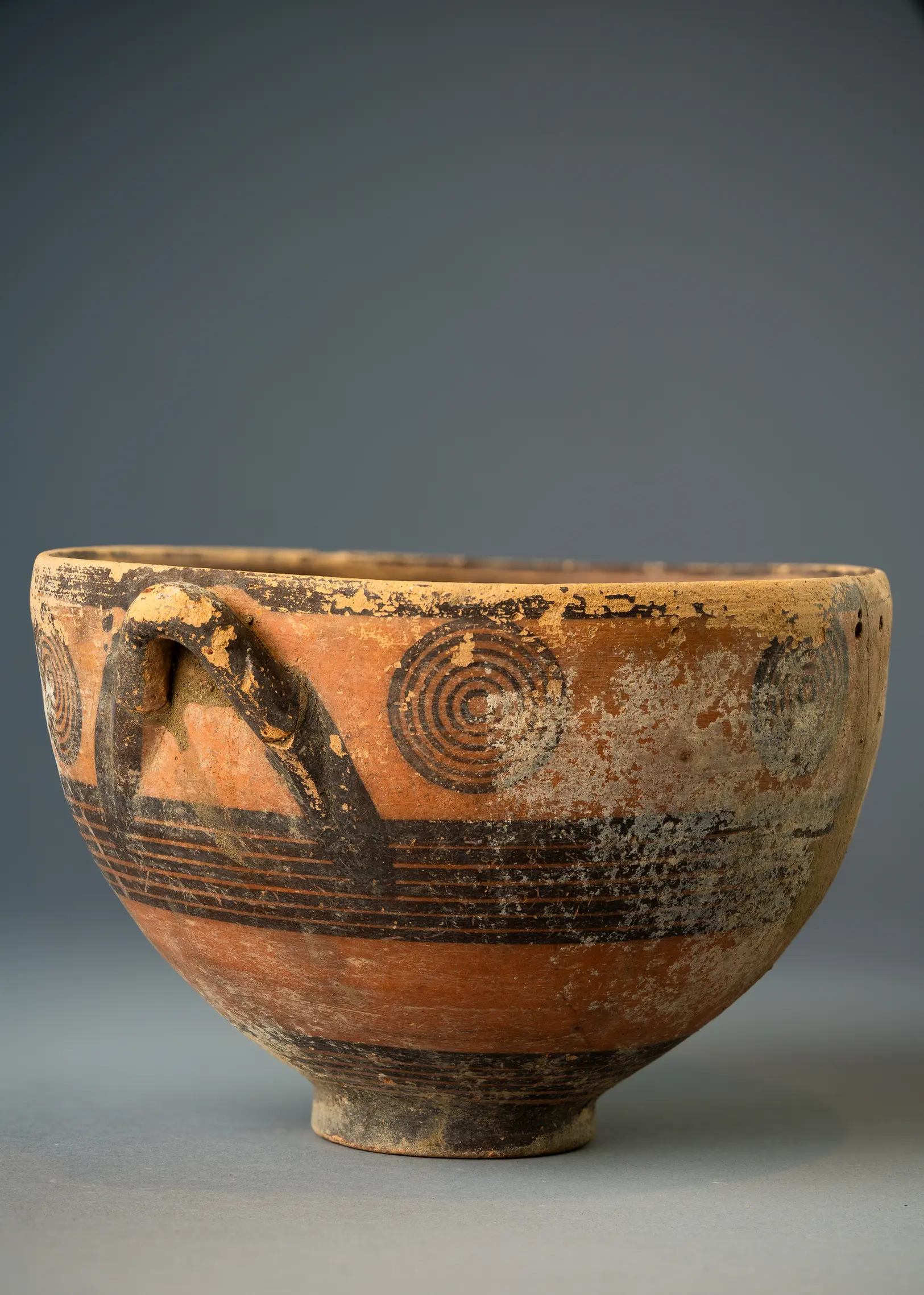
Geometric III
Black-on-Red Deep Bowl with Concentric Circles below the Rim
Cypriot Black-on-Red deep bowl on a ring foot, with a lifted loop handle and compass-drawn concentric circles below the rim, c. 850–600 BCE.
Date
850 - 600 BC
Accession No.
BWL-GE-001
Collection
Alexis Drakopoulos
Provenance
- 1965–1969, The Goodman Collection
- 2025–present, Alexis Drakopoulos, London
Cypro-Geometric III–Cypro-Archaic I, c. 850–600 BCE · Black-on-Red ware · Wheel-made
A deep, almost hemispherical bowl rising from a low, spreading ring foot to a plain rim. A horizontal loop handle, rolled in section, is set well below the lip and lifted so that it arches up towards the rim; a second handle presumably stood opposite. The orange-red slip carries decoration in matt black. A band runs round the lip, and in the handle zone large concentric circles of seven or eight rings are spaced round the body. Beneath them sits a broad register of fine encircling lines held between heavier bands, and further bands darken the lower body and foot.
About half of the surface is dulled by whitish lime accretion and grey patches where the slip has gone. The slip flakes at the rim, and the foot is dark with burial staining.
Commentary
This is the standard deep bowl of Cypriot Black-on-Red ware, the painted member of the Iron Age Red Slip family. It was wheel-made in a fine reddish clay, coated in a lustrous red slip and painted in matt black [1]. Gjerstad named isolated concentric circles "placed below the rim of the deep bowls" as the most characteristic ornament of the earliest stage, Black-on-Red I (III). Two small horizontal handles below the rim define his deep bowl type 5, which he called a shape "of entirely Cypriote tradition" [1]. The bowl here follows that scheme closely. The fine-line register below the circles and the dark lower body belong to the same repertoire.
The closest published match is a deep bowl from Amathus Tomb 5 excavated by the Swedish Cyprus Expedition. It has a high ring base, curved sides, small horizontal handles below the rim and "groups of small, concentric circles" below the rim, and it measures 15.8 cm across [2]. At Kourion-Kaloriziki, Benson's Black-on-Red II bowls of Type 4 (K 686–688) are deep bowls on ring bases with lifted roll handles set well below the rim and small concentric circles spaced in the handle zone. Their handles are "bent vertically" in the same way as the handle on this bowl [3]. A footed Black-on-Red bowl with small loop handles in the Yale Peabody Museum (36-72-40/3656; H. 9 cm, D. 17.5 cm), dated 675–550 BCE, is a close visual parallel.
The date range is kept broad deliberately. The shape and the circles-below-rim arrangement are present from Black-on-Red I (III), in Cypro-Geometric III. The Kaloriziki examples come from Cypro-Archaic I tombs. Gjerstad's division of the ware into a first and second stage was built on tomb seriation. Stratified finds on the Levantine coast show that many of his "later" forms were already in circulation at the start [4]. Radiocarbon-anchored contexts at Megiddo put the first Cypriot Black-on-Red production at about 900 BCE [5]. A date between the ninth century and the end of Cypro-Archaic I, c. 850–600 BCE, is therefore the most the bowl itself will support.
Whole bowls of this kind come mainly from tombs, as at Amathus and Kourion, where they were part of the drinking and serving sets placed with the dead. The lifted handles and neat profile imitate metal bowls, a habit that recurs throughout the ware. We know of no find-spot for this example.
References
- 1.Gjerstad, E. (1948) The Swedish Cyprus Expedition IV.2: The Cypro-Geometric, Cypro-Archaic and Cypro-Classical Periods. Stockholm: Swedish Cyprus Expedition, Black-on-Red I (III) and II (IV) ware sections, Figs. XXIV–XXVI, XXXVII–XL.
- 2.Gjerstad, E., Lindros, J., Sjöqvist, E. and Westholm, A. (1935) The Swedish Cyprus Expedition II: Finds and Results of the Excavations in Cyprus 1927–1931. Stockholm: Swedish Cyprus Expedition, Amathus Tomb 5, no. 35.
- 3.Benson, J.L. (1973) The Necropolis of Kaloriziki (Studies in Mediterranean Archaeology 36). Göteborg: Paul Åströms Förlag, Black-on-Red II bowls Type 4, nos. K 686–688.
- 4.Schreiber, N. (2003) The Cypro-Phoenician Pottery of the Iron Age. Leiden and Boston: Brill, pp. 280–284.
- 5.Kleiman, A., Fantalkin, A., Mommsen, H. and Finkelstein, I. (2019) 'The Date and Origin of Black-on-Red Ware: The View from Megiddo', American Journal of Archaeology 123.4, pp. 531–555.
More from the Catalogue
Browse related objects
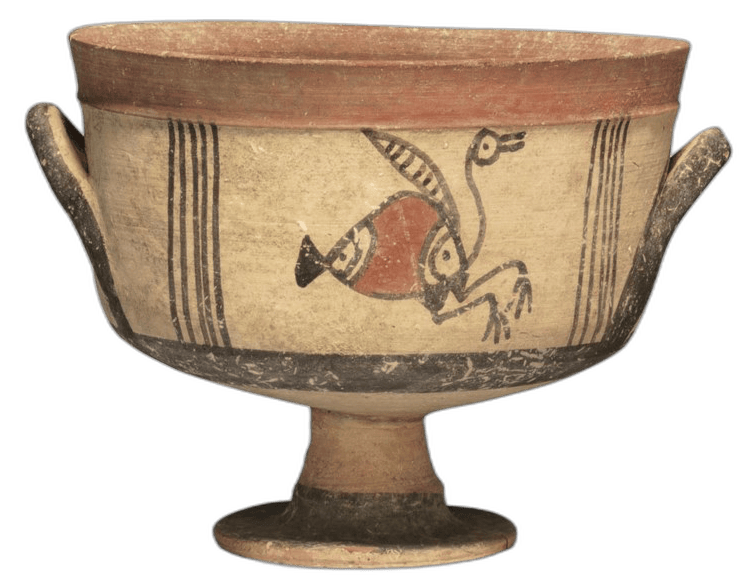
Bichrome Kylix with Bird Free Field Art
Geometric III
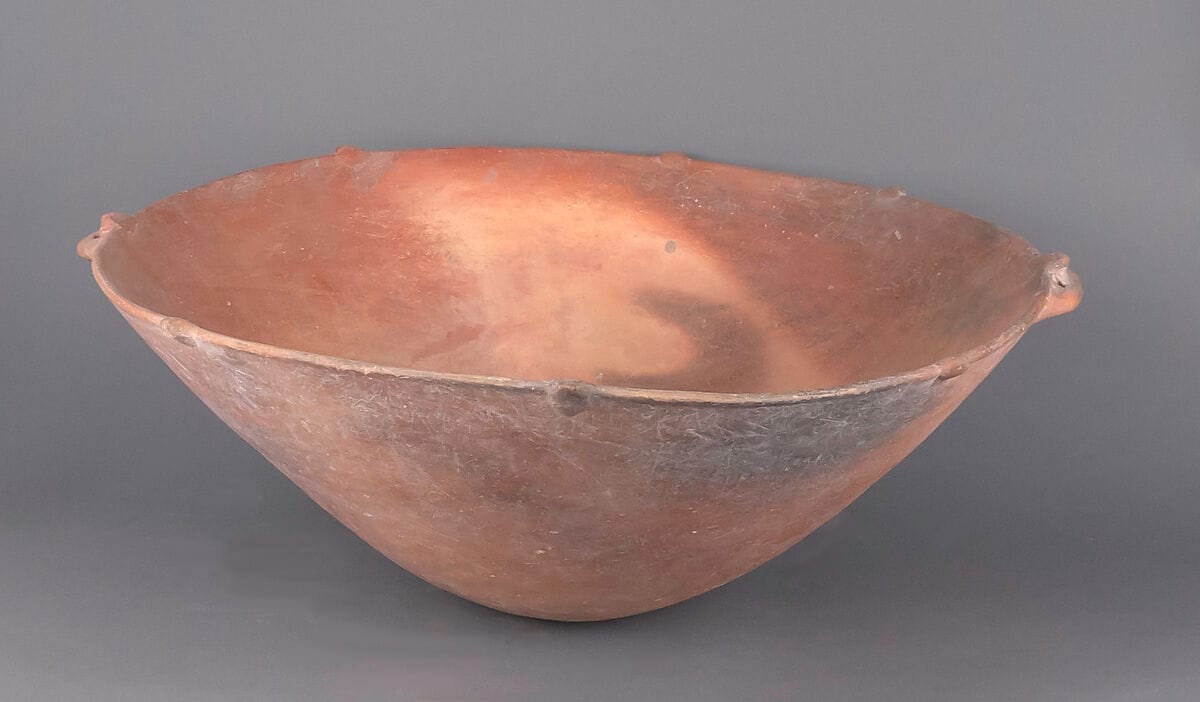
Milk bowl
Bronze Age
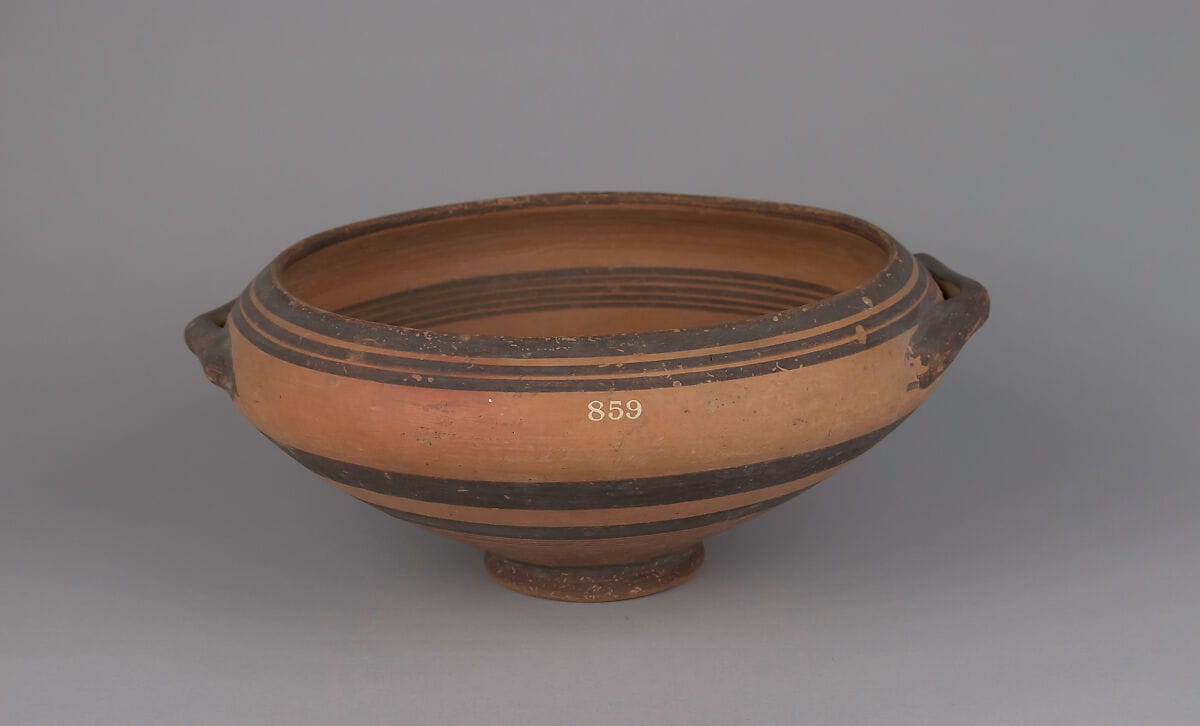
Bowl
Geometric III
Krater
Archaic I
Handle of a bowl
Bronze Age
Bowl
Geometric I
Bowl
Bronze Age
Terracotta bowl
Chalcolithic
Silver bowl
Archaic I
Alabaster bowl
Classical
Bronze phiale (libation bowl)
Archaic II
Bowl fragment, inscribed
Archaic II
Bowl
Bronze Age
Bowl
Archaic I
Bowl
Late Bronze Age II
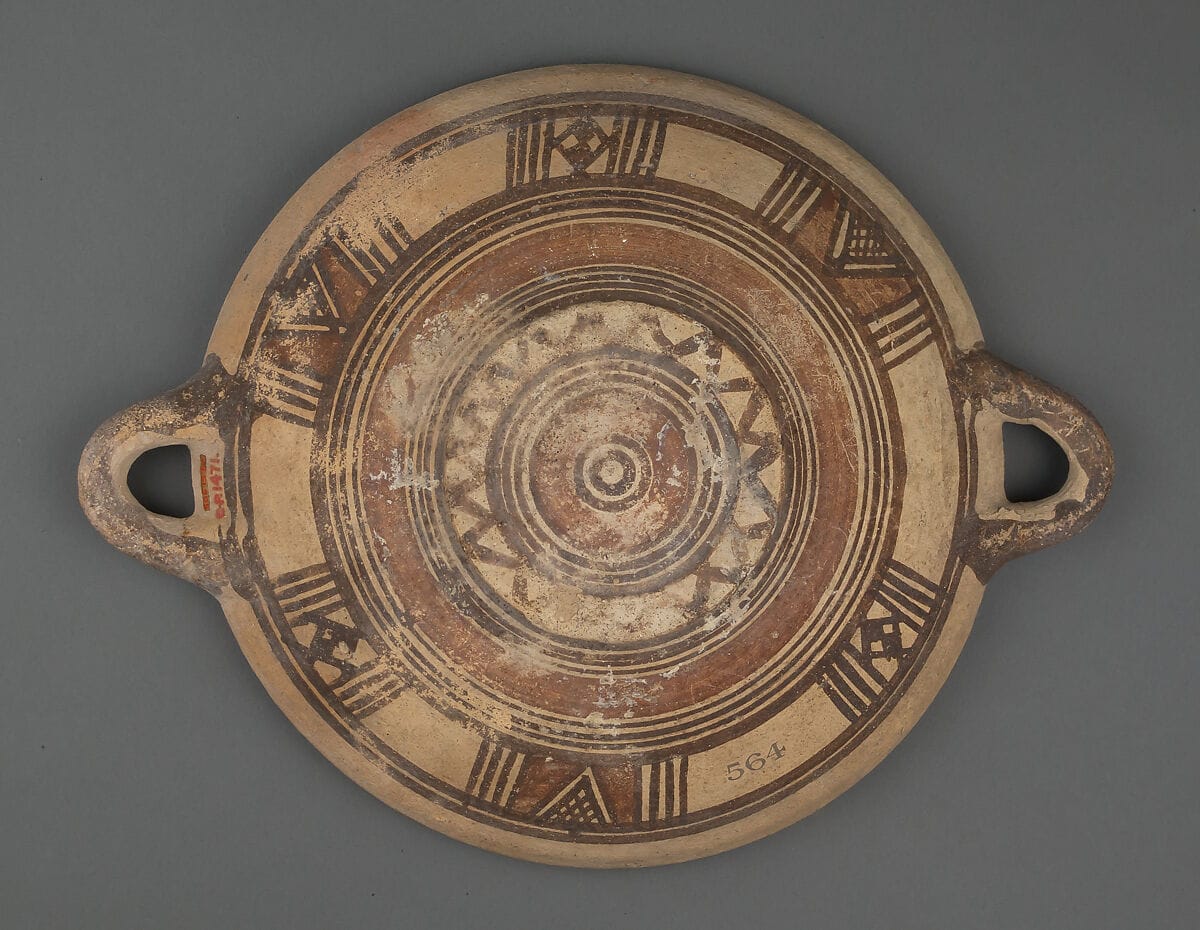
Bowl
Geometric III
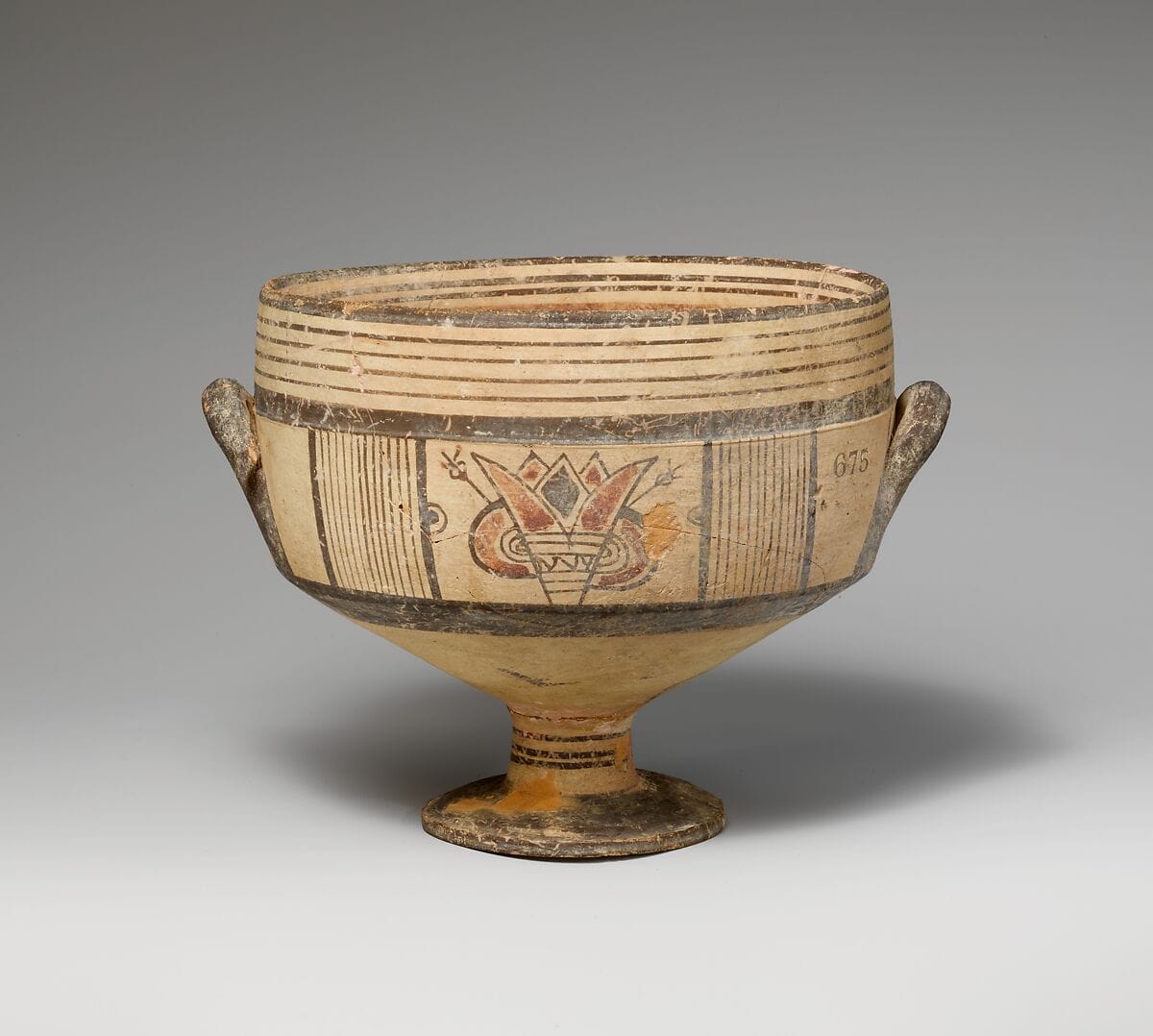
Terracotta footed bowl
Archaic I
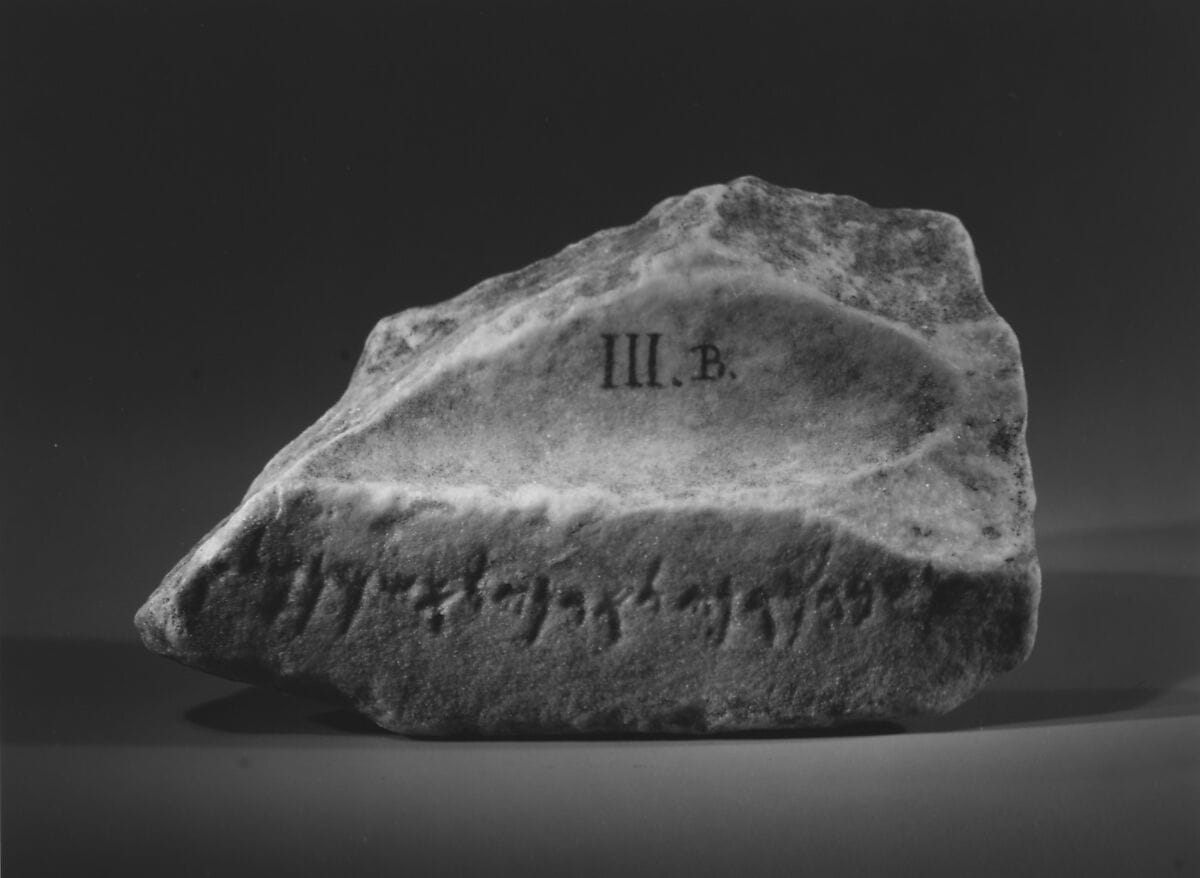
Marble bowl fragment with Phoenician inscription
Classical