
Classical
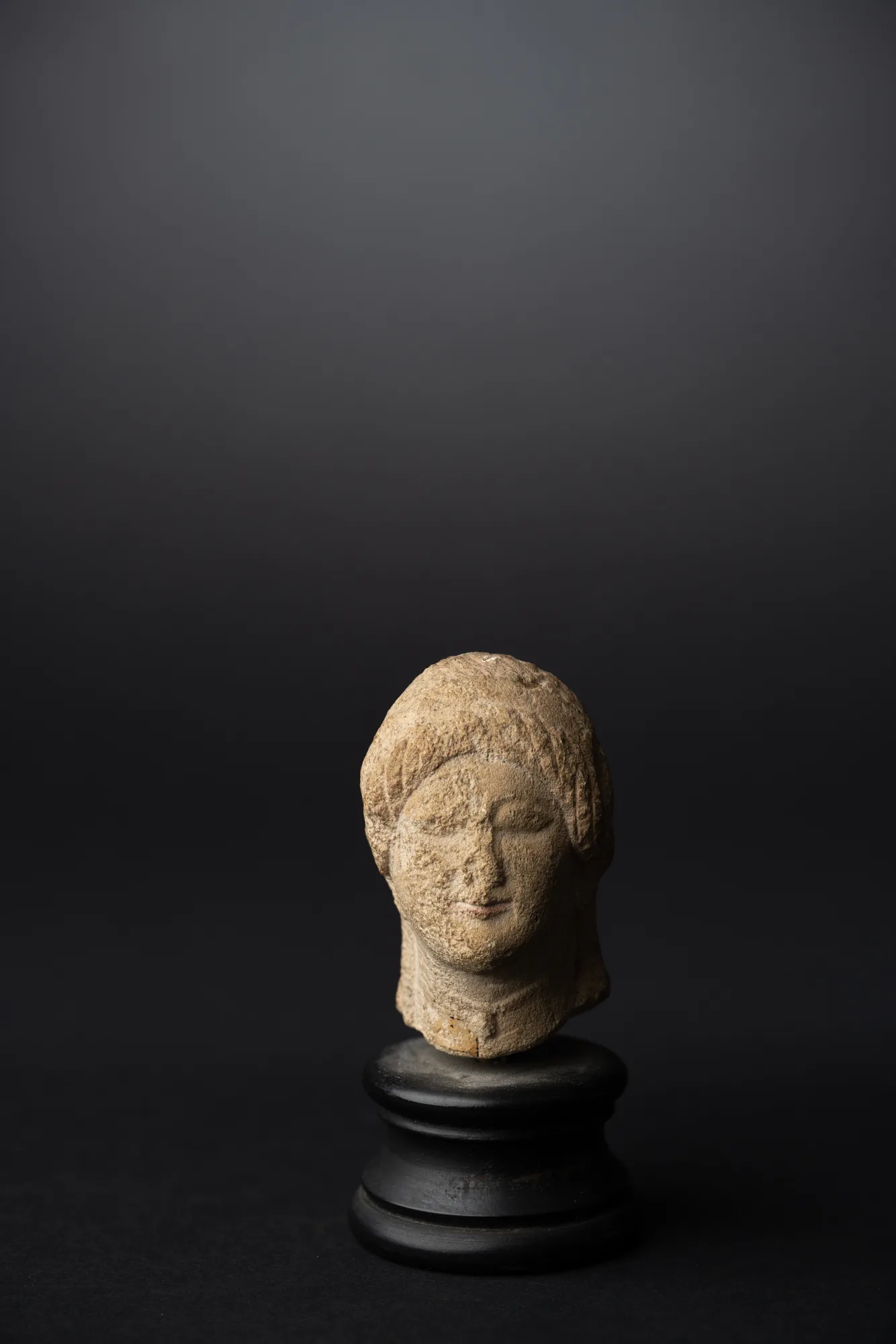
Limestone Head of a Votary with a Wreath
Cypro-Classical limestone votary head with a rolled wreath or hair roll, long hair behind the ears and a faint smile, c. 475–400 BCE.
Date
475 - 400 BC
Accession No.
STA-AR-016
Collection
Alexis Drakopoulos
Cypro-Classical I, c. 475–400 BCE · Limestone · Carved
A small limestone head and neck from a votive statuette, shown on a black turned wooden socle. The face is a full, rounded oval with a smooth brow, heavy-lidded almond eyes, a straight nose and a small closed mouth held in a faint smile; the lips may keep a trace of pinkish colour. A thick rolled band encircles the head above the forehead and temples. Its surface is worn smooth, and it is either a wreath of leaves or a roll of hair. Behind it the hair falls in a plain mass behind the ears to the neck.
At the base of the neck a raised edge with a short vertical line marks the neckline of a garment. The pale buff stone is lightly weathered, with surface loss on the right cheek, the nose and the crown.
Commentary
Most Cypriot limestone figures of the 6th to 4th centuries BCE are votaries, permanent stand-ins for the worshipper set up in open-air sanctuaries. Their dress and headdress changed over time. In the 5th and 4th centuries BCE male and female votaries alike adopt contemporary Greek hairstyles and "almost invariably wear a wreath of leaves" [1]. The calm, rounded face, the heavy lids and the restrained smile on this head belong to that Classical phase, after the sharper Archaic smile and before the softer modelling of the 4th century.
The nearest published parallel is a head in the Ashmolean Museum (AN1896-1908 C.281), possibly from Idalion and dated Cypro-Classical I (c. 470–420 BCE), with long hair falling behind the ears and crowned by a wreath [2]. Its catalogue entry reasons that, since the preserved ear shows no earring, it is most probably a beardless male votary [2]. The same argument applies here: no earrings are visible, and a wreath over long hair drawn behind the ears is usually male in this period. It is not decisive. Long hair becomes less common for men in the Classical period [2], and female votaries of the same date also wear wreaths, usually with a sakkos and prominent earrings, as on a head from Golgoi in the Louvre [3]. The sex of this head is therefore left open.
A second close comparison is a wreathed male head from Golgoi in the Louvre, dated c. 450 BCE, which keeps red paint on the lips and on the edge of the garment [4]. It shows how heads like this one were finished, and it supports reading the faint colour on these lips as ancient paint, which should be confirmed under magnification. Golgoi and Idalion in central Cyprus produced large numbers of such small heads in the soft local limestone.
Gjerstad's style labels for Cypriot sculpture no longer hold as a fixed chronology [5], so the date given here, c. 475–400 BCE, rests on the type (wreath, Greek hairstyle) and on the dated Ashmolean and Louvre parallels. Whether the rolled band is a worn wreath of leaves or a roll of hair cannot be settled from the present surface.
References
- 1.Ulbrich, A. (2020) Adoption and Adaptation of Greek Iconography in Cypriot Votive Sculpture of the Late Archaic and Classical Periods. In M. Christidis, A. Hermary, G. Koiner and A. Ulbrich (eds), Classical Cyprus (Kypriaka 5). Vienna: Holzhausen, section 'Male and Female Votaries'.
- 2.Pilides, D. and Papadimitriou, N. (eds) (2012) Ancient Cyprus: Cultures in Dialogue. Nicosia: Department of Antiquities, p. 112, cat. 5 (A. Ulbrich): Ashmolean Museum, Oxford, AN1896-1908 C.281, limestone head with wreath of leaves, possibly Idalion, Cypro-Classical I (c. 470–420 BCE), H. 8.5 cm.
- 3.Musée du Louvre, Paris, AM 2865: limestone head of a woman in a sakkos with rosette earrings, Golgoi, c. 475–425 BCE, H. 11 cm.
- 4.Musée du Louvre, Paris, AM 3078: limestone head of a man wearing a wreath of leaves and buds, Golgoi, Cypro-Classical I (c. 450 BCE), H. 9.3 cm.
- 5.Hermary, A. and Mertens, J. R. (2014) The Cesnola Collection of Cypriot Art: Stone Sculpture. New York: The Metropolitan Museum of Art.
More from the Catalogue
Browse related objects
Horse and rider figurine
Archaic II
Seated female figurine of the dea gravida type
Archaic II
Terracotta rattle in the form of a pig
Hellenistic
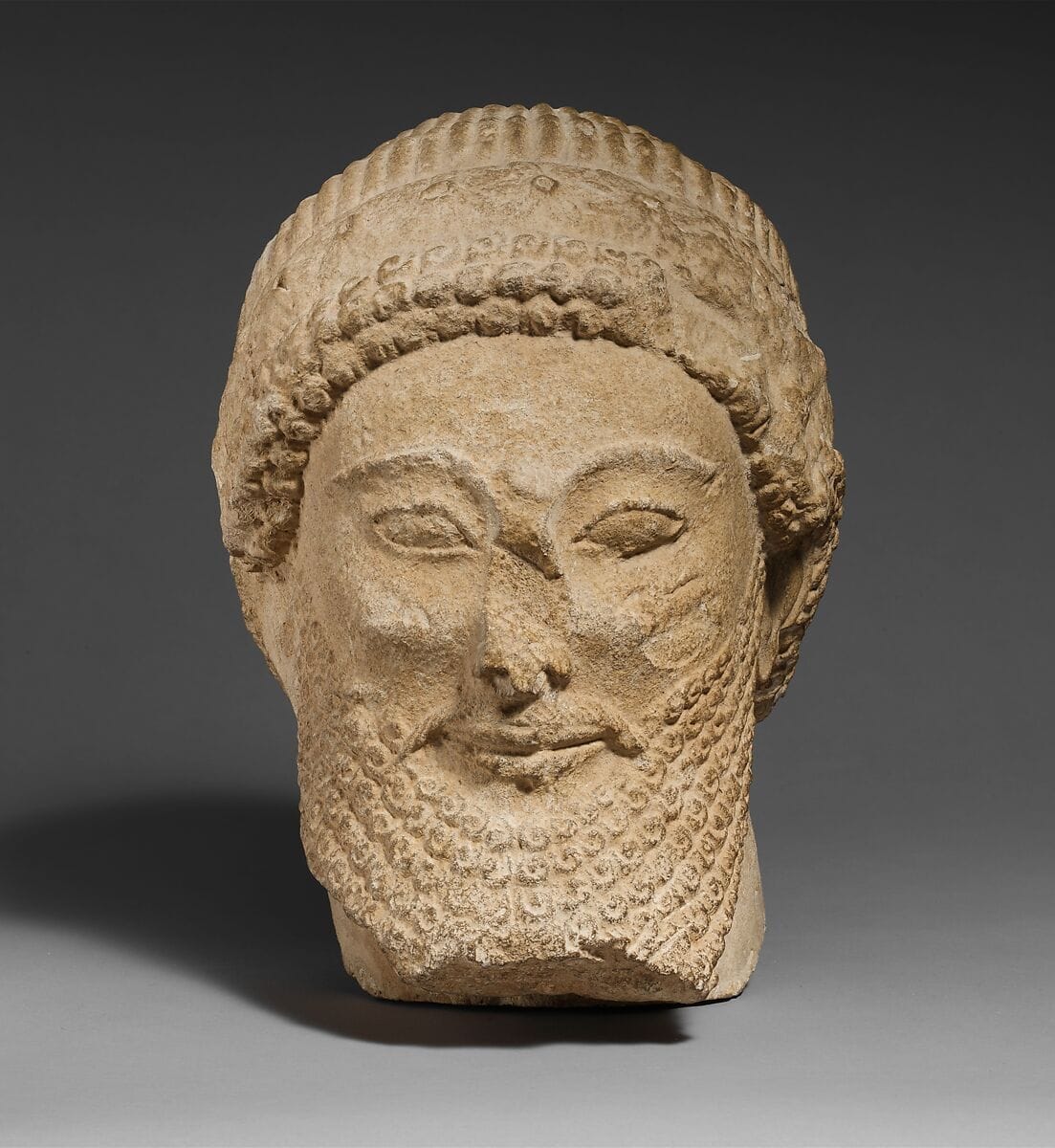
Limestone head of a bearded male with a wreath of flowers
Archaic II
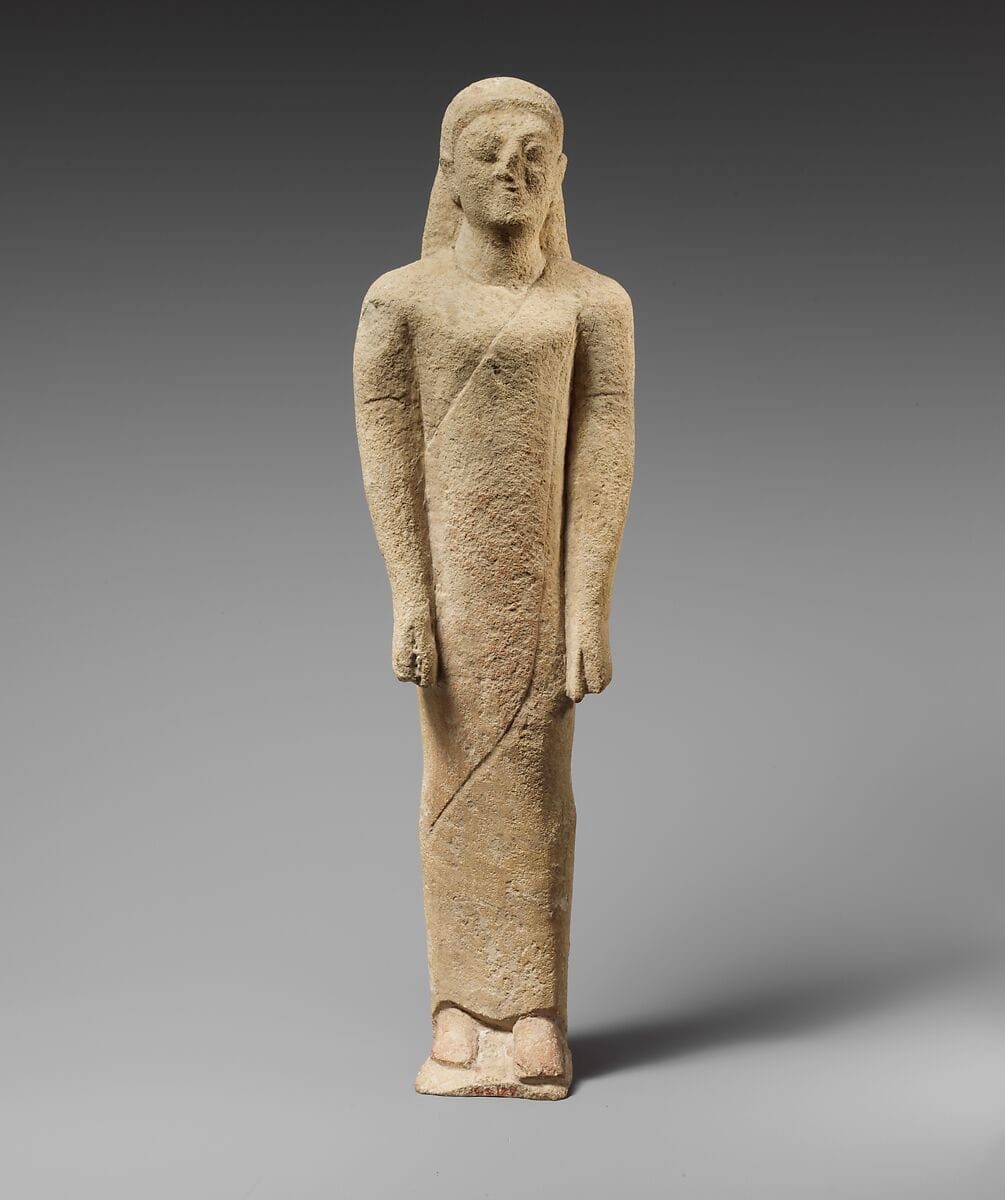
Limestone statuette of a beardless male votary in Greek dress
Archaic II
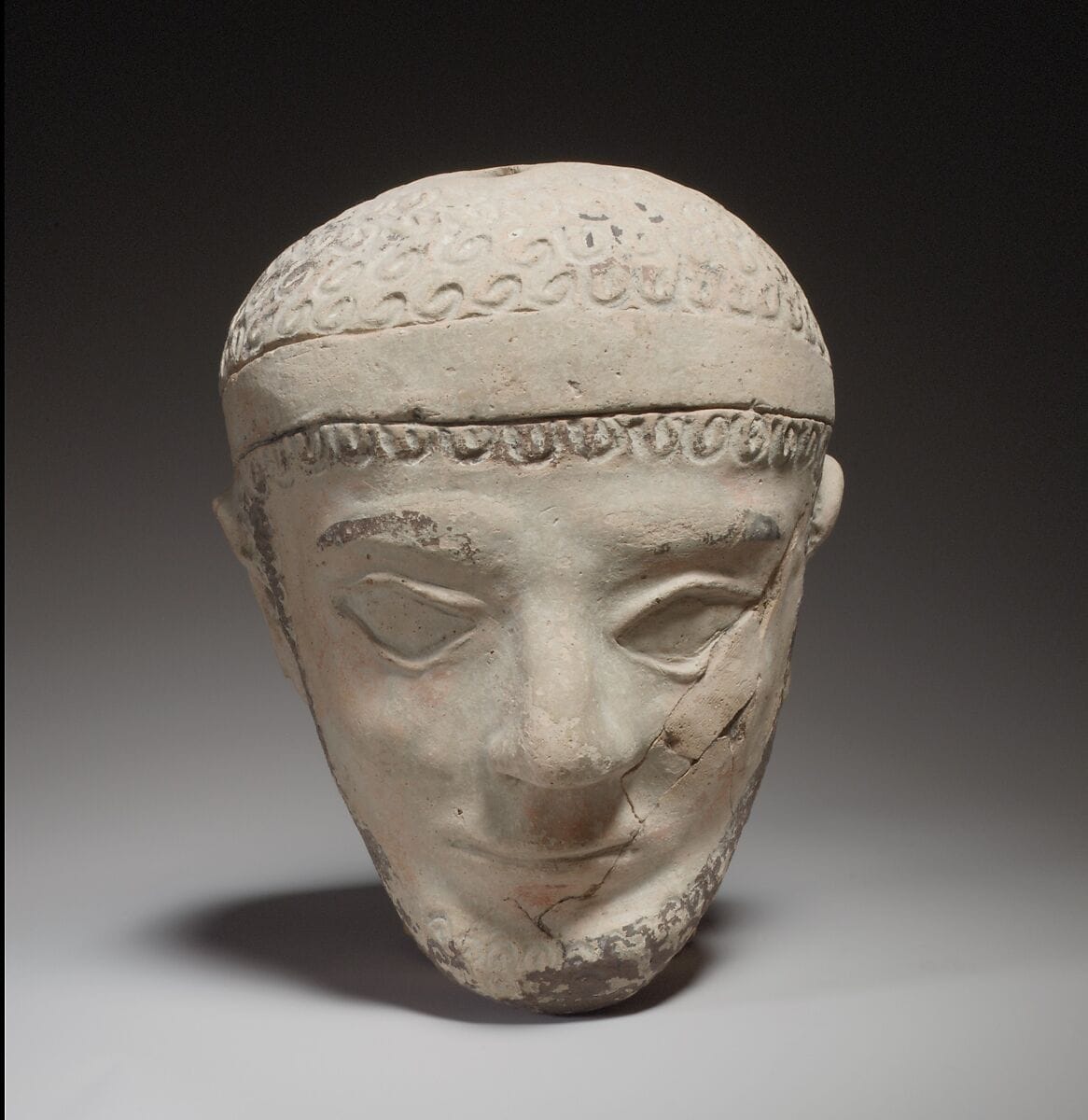
Terracotta head of a man
Archaic II
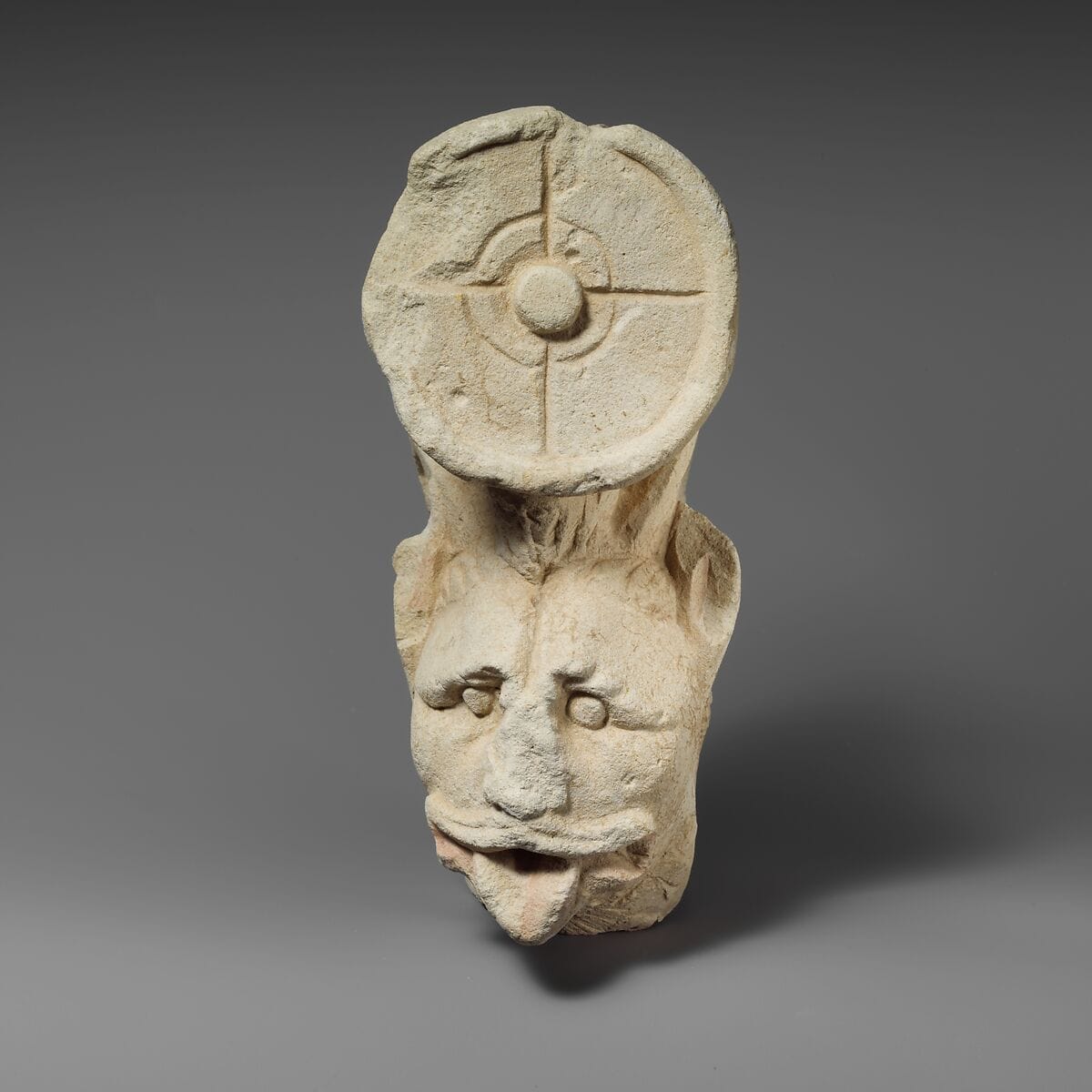
Fragment of a limestone throne (?) with the head of a horned lion
Roman
Head of a comic figurine
Hellenistic
Limestone statuette of a female votary of the kore type
Archaic II
Limestone head of Apollo
Hellenistic
Standing female flute player
Classical
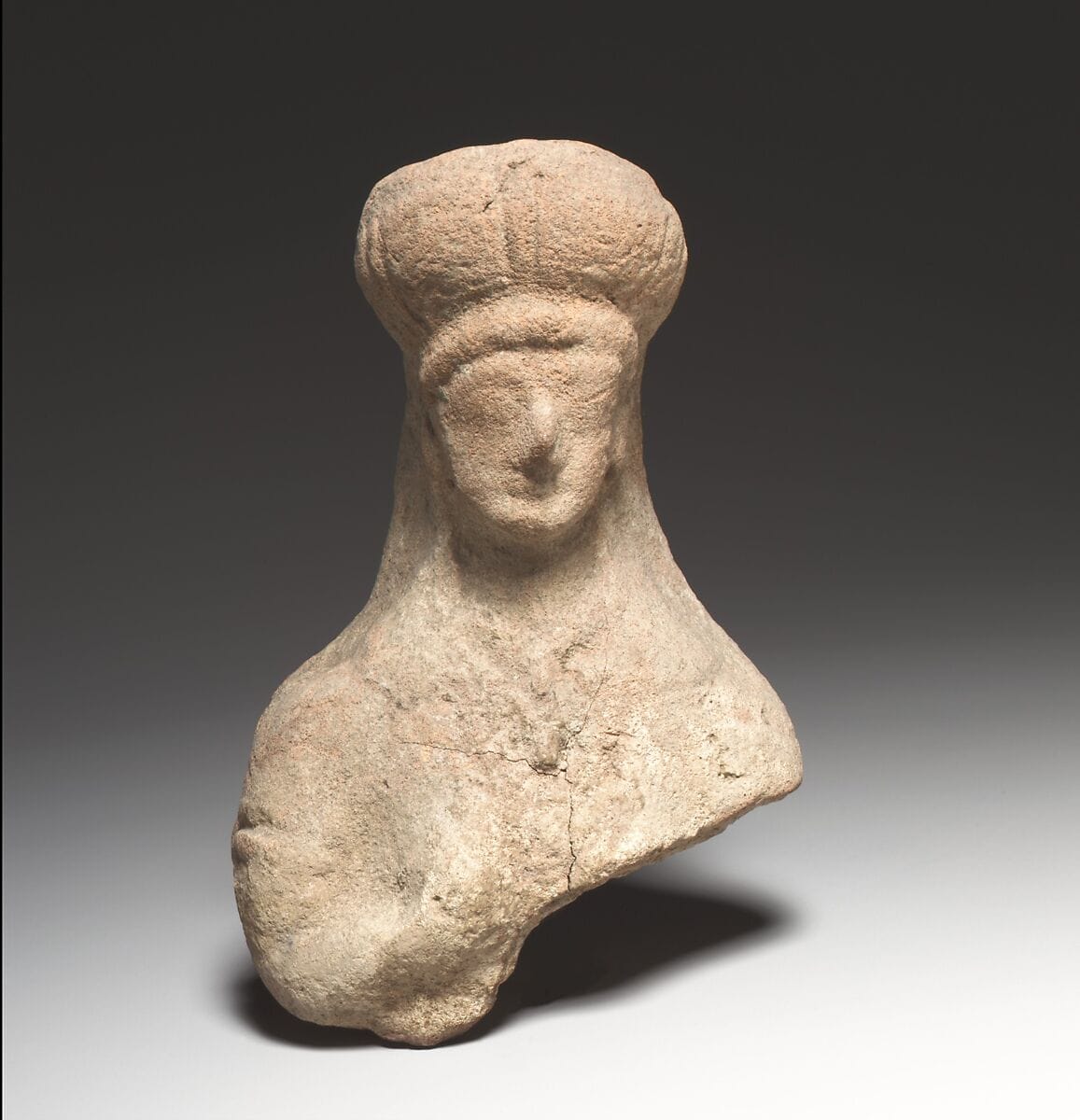
Standing female figurine
Archaic II
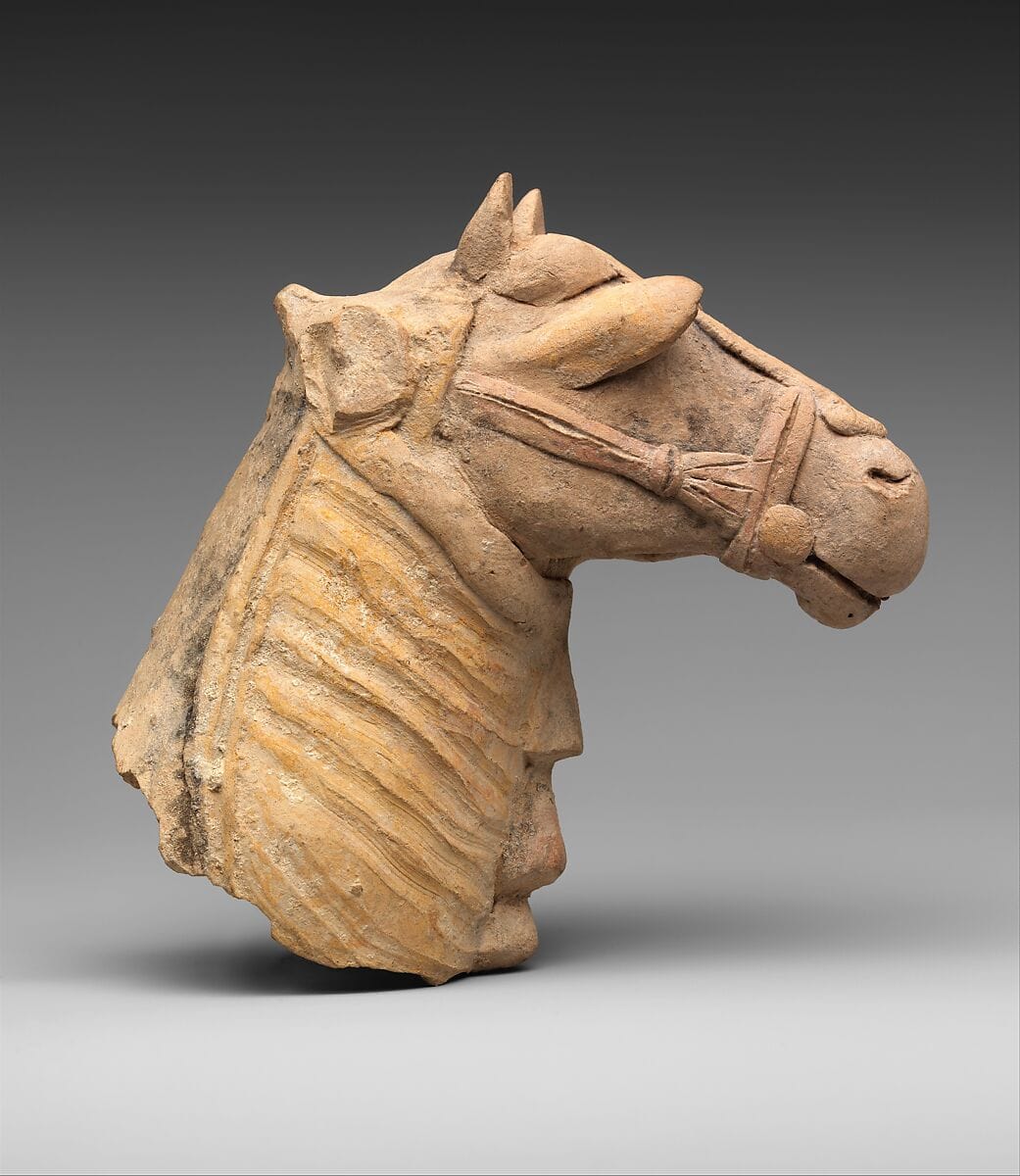
Horse's head with harness
Archaic II
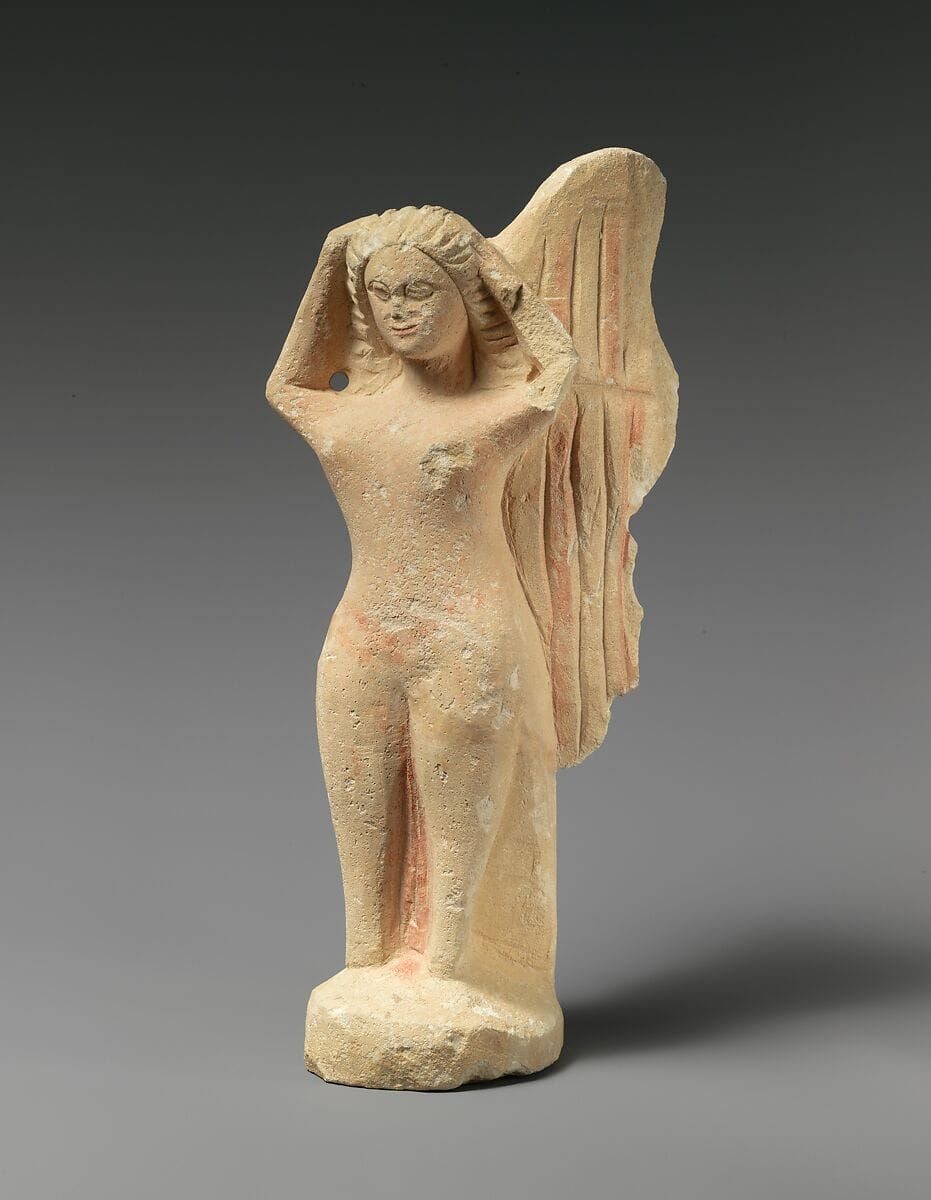
Limestone statuette of a mourning siren
Hellenistic
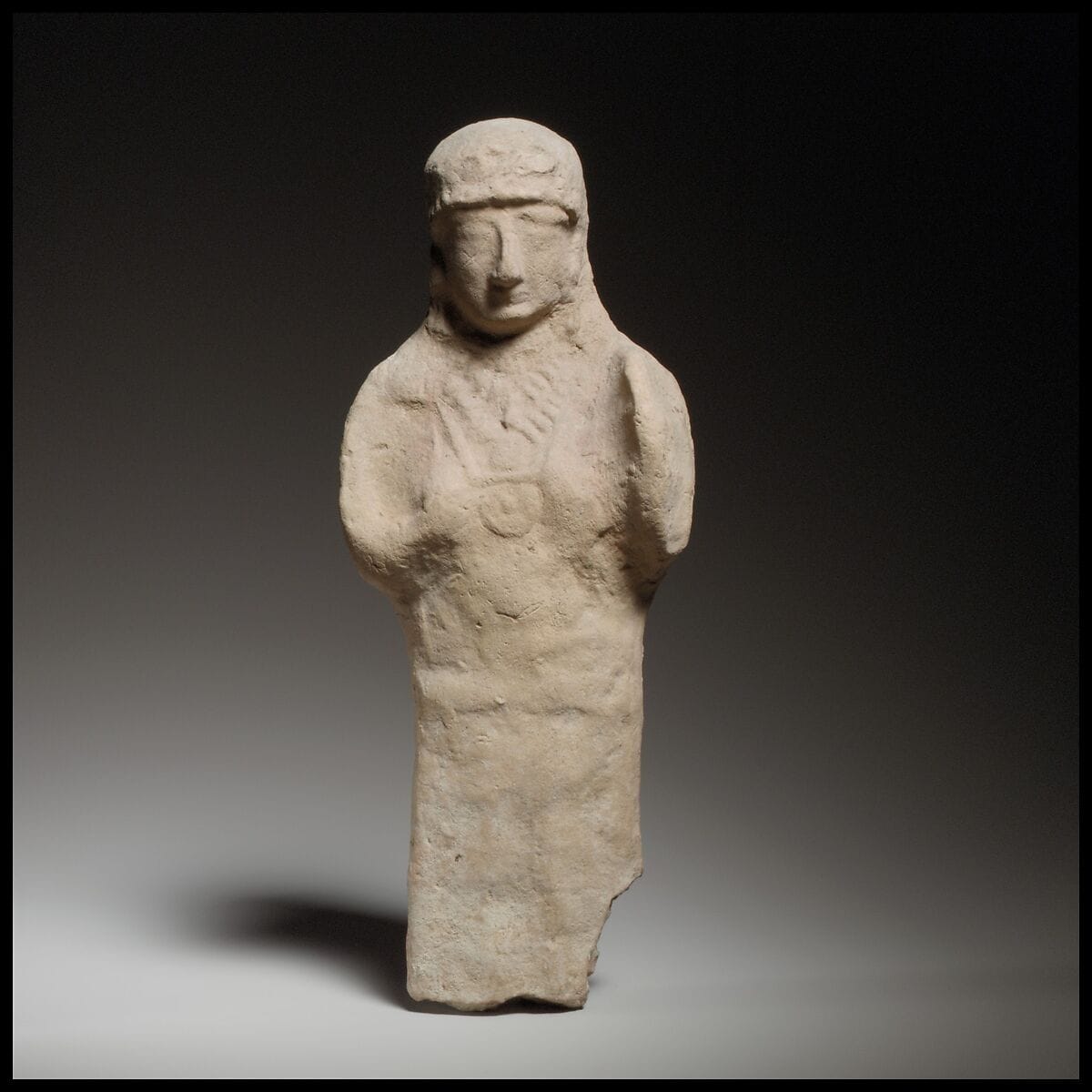
Standing female figurine
Archaic II
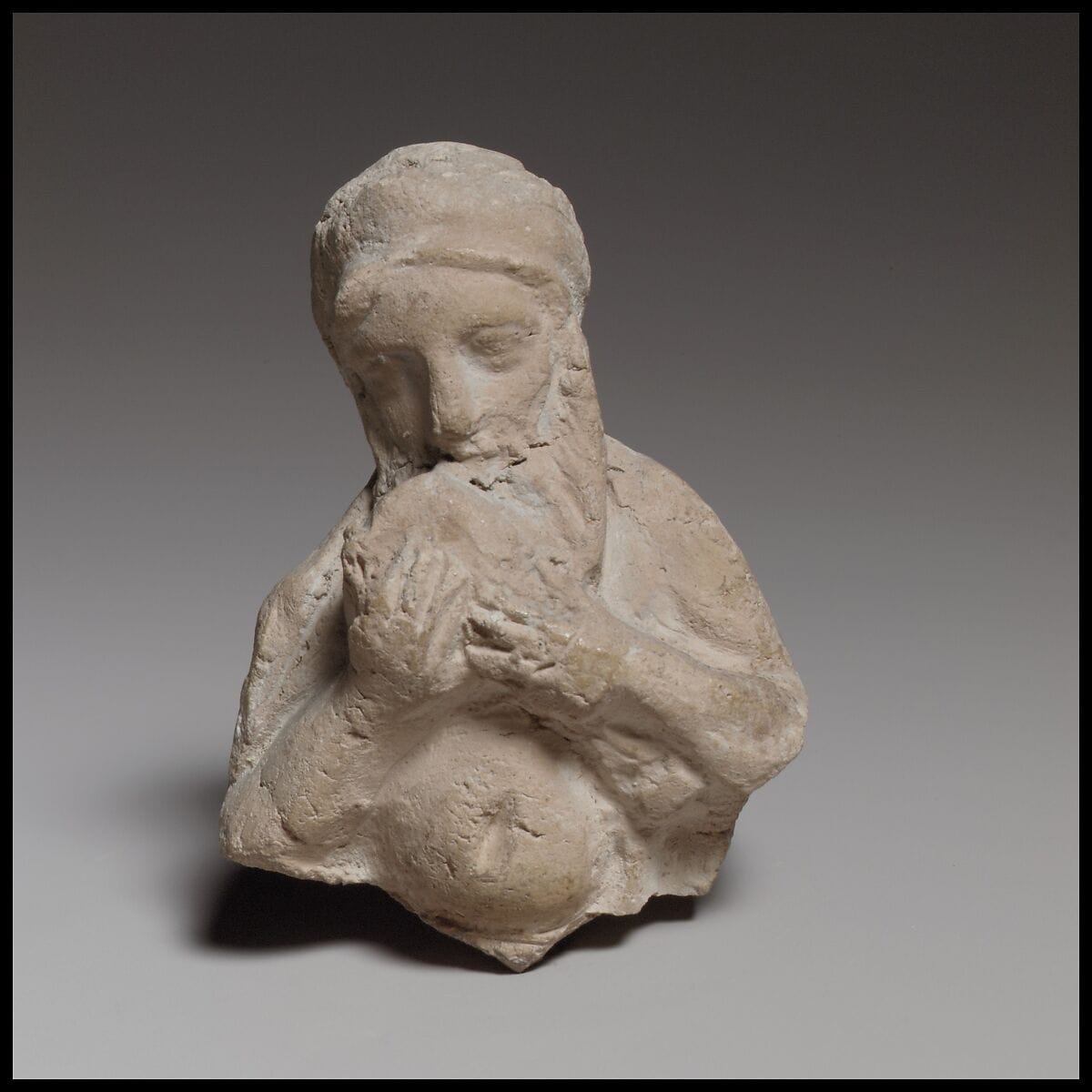
Terracotta statuette of Silenos (?) drinking
Hellenistic
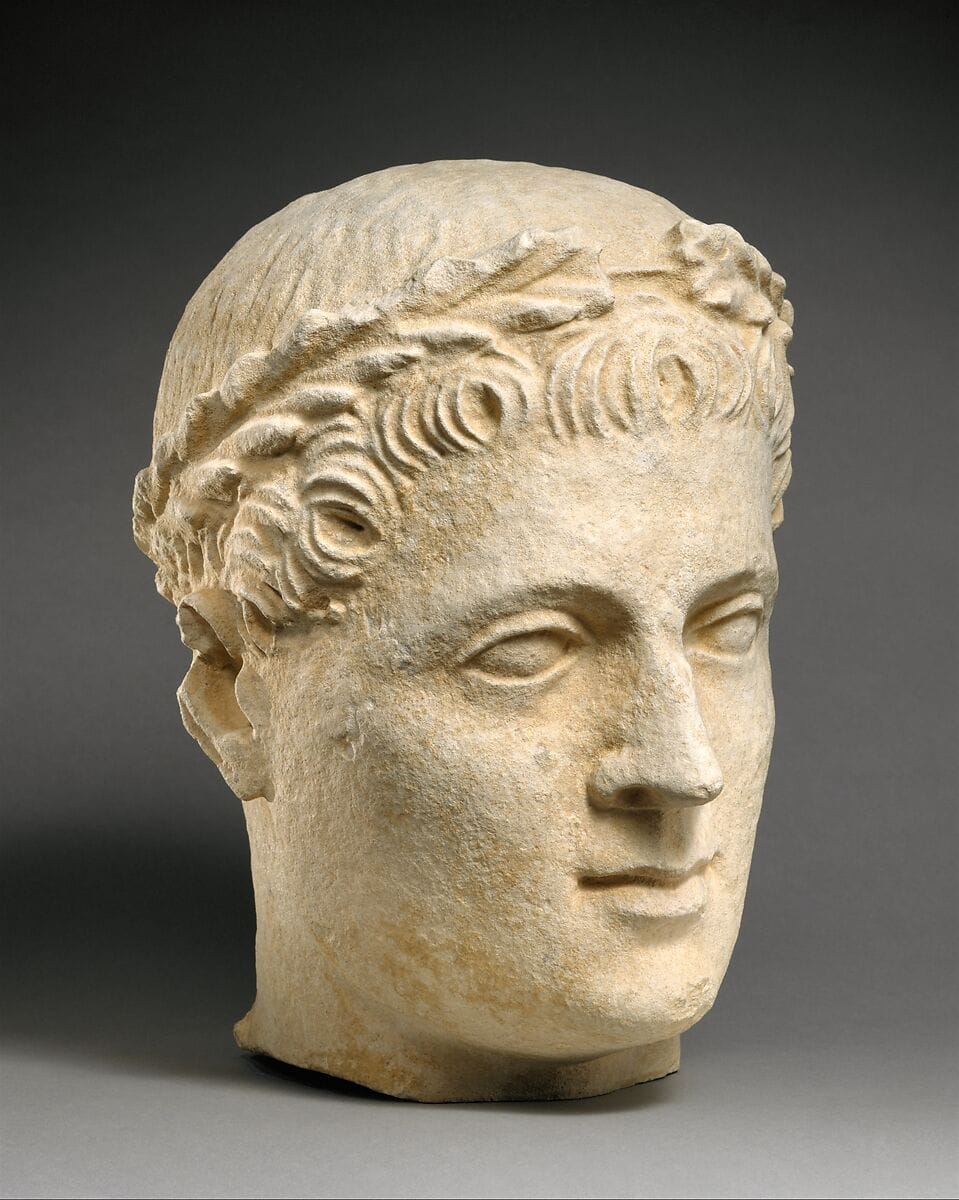
Limestone head of beardless male votary with wreath of leaves
Hellenistic
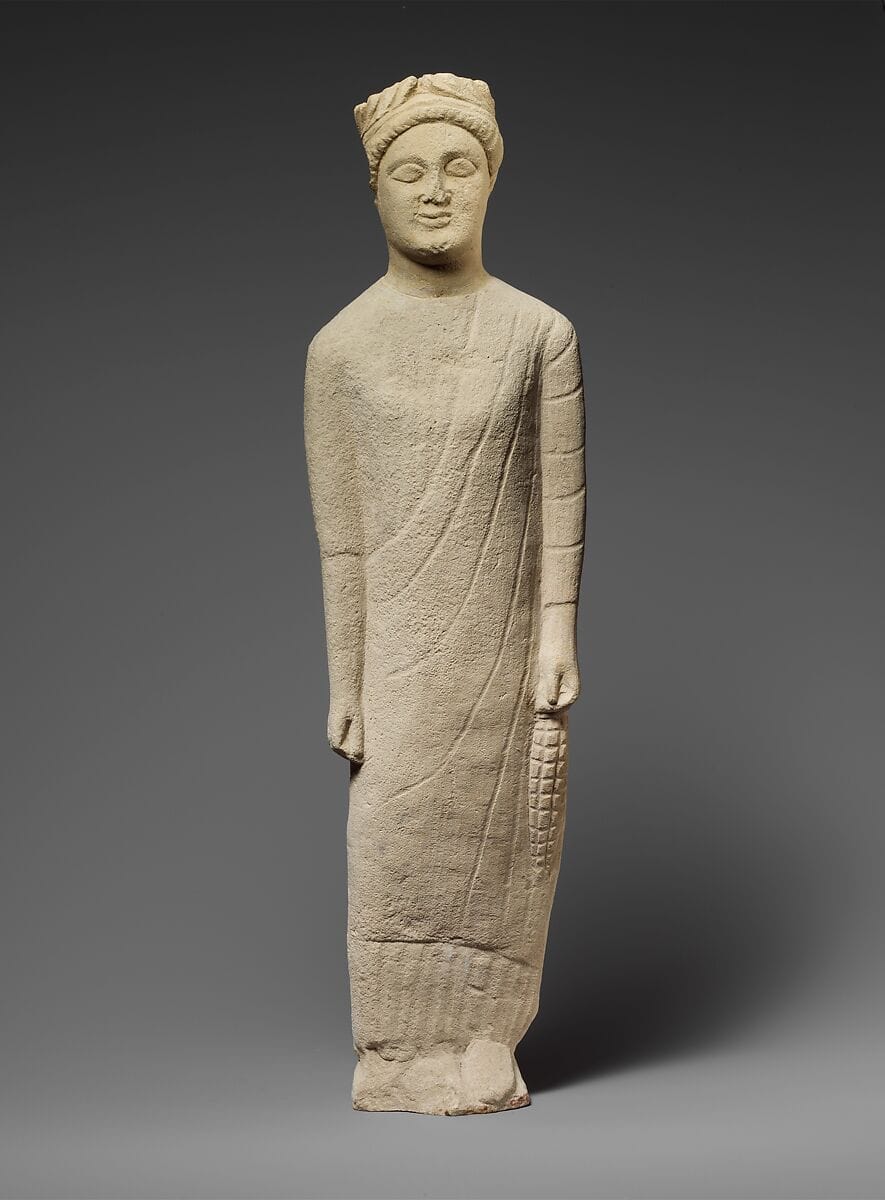
Limestone statuette of a beardless male votary with a wreath of leaves
Classical