
Archaic I
Bichrome IV Jug with Vertical Circle Systems
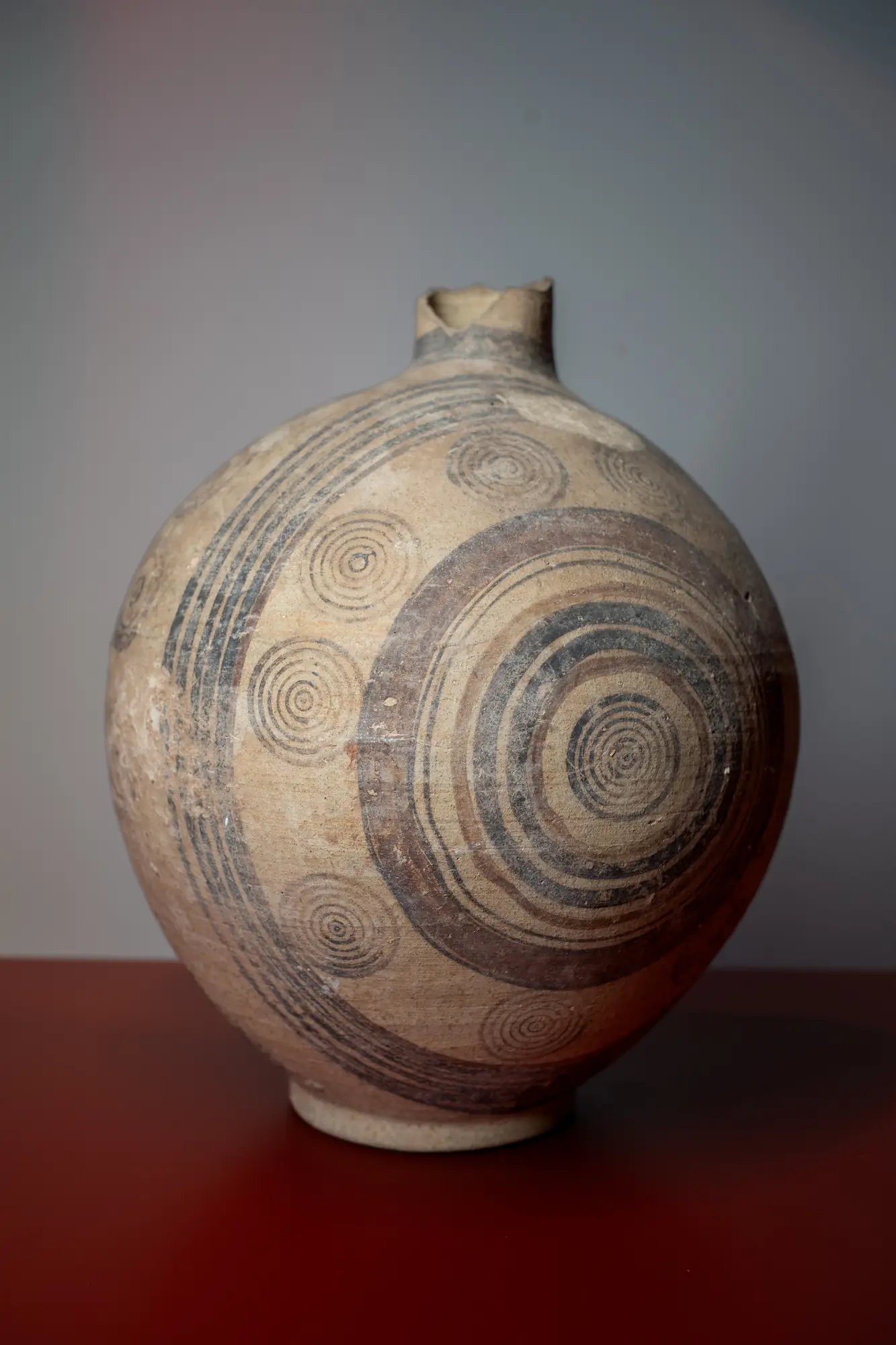
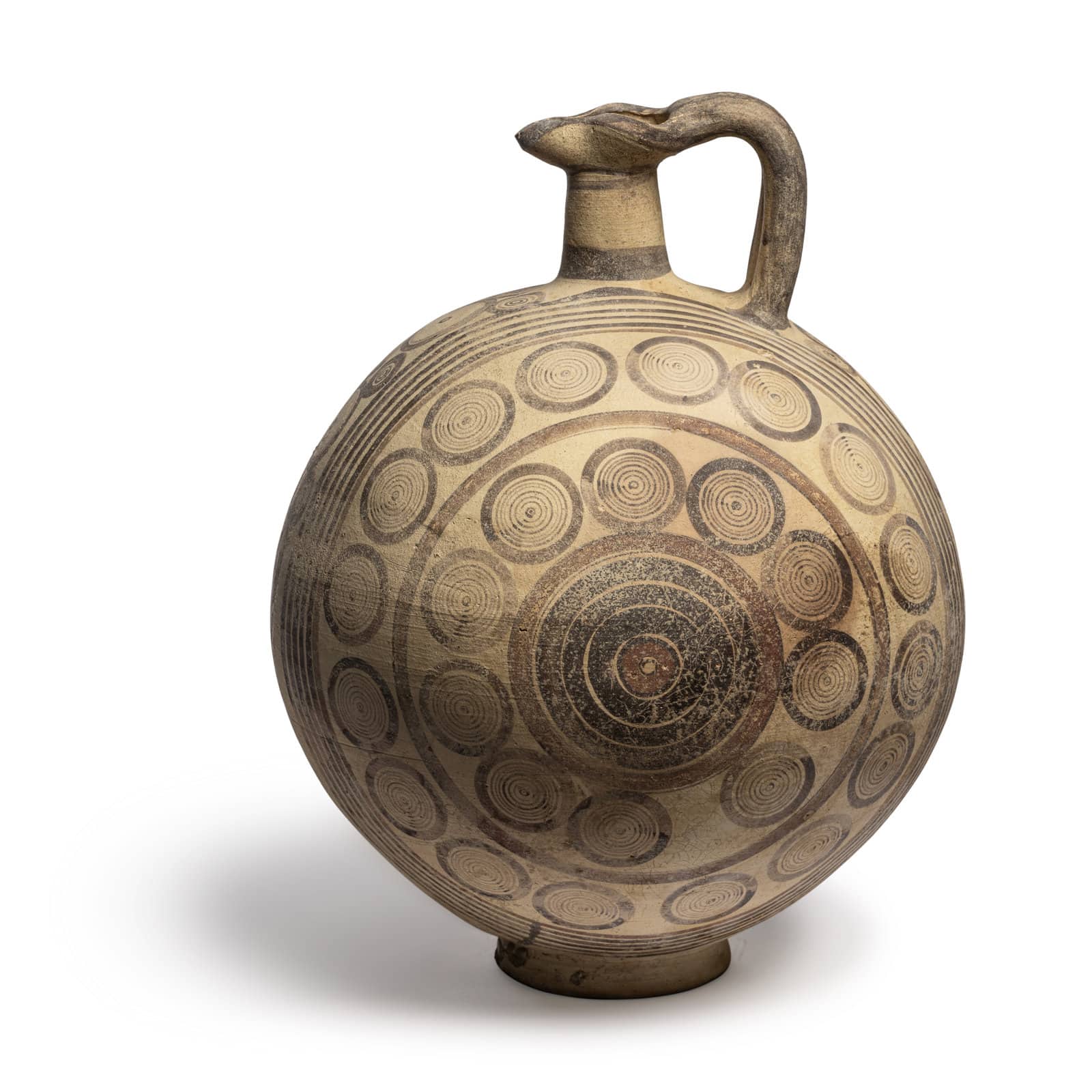
Large Cypro-Archaic I Bichrome IV jug in the Western circle style, each side filled by a great red-and-black circle system ringed by small circle groups.
Date
750 - 600 BC
Accession No.
JUG-GE-017
Collection
Alexis Drakopoulos
3D Model
Provenance
- Alfred Boucher collection, France
- By descent in the Boucher family, France, until 2024
- 2024–present, Alexis Drakopoulos, London
Cypro-Archaic I, c. 750–600 BCE · Bichrome IV ware · Wheel-made · H. 28 cm (as preserved)
A large globular jug, slightly egg-shaped, on a low ring base. Only the lower part of the narrow neck survives, with a black band at its base; the mouth is lost, and the handle survives as a broken stump on the shoulder. The pale buff surface carries dark brown-black and red-brown paint.
Each side is dominated by a single great circle system. Broad red rings alternate with black and with fine lines around a central group of small concentric circles, the whole filling the middle of the side. Around it runs a ring of ten or so smaller concentric-circle groups, and these are enclosed in turn by bundles of multiple arcs that sweep from shoulder to base. Some of the small groups are drawn slightly off-centre, their inner rings wobbling. Between the two systems, on front and back, further small circle groups run in a vertical row. A pale oval patch below the neck marks a lost area of surface, and a band of encrustation and loss runs down one flank.
Commentary
This is a Bichrome IV jug of the kind Gjerstad placed in his "Western" or circle style, which he localised to the western and northern parts of Cyprus. He described it in terms that fit this pot closely: "There is a veritable circle dance on the pots ... The outer line of the concentric circles is sometimes thicker than the others, and the circles are often connected in vertical or horizontal rows" [1, p. 52]. Bichrome IV corresponds to Cypro-Archaic I, and the conventional modern dates for that phase are c. 750–600 BCE.
The Swedish Cyprus Expedition found the same scheme in a tomb of the Stylli necropolis: a "Bichrome IV globular jug ... black and red vertical circles on body, and concentric circles in their interstices", 22.5 cm high, and a Bichrome IV oval jug with "black and red vertical circles around body; rows of concentric circles in their interstices", 23.8 cm high [2, p. 201, nos. 6, 12]. Both belong to the later burial in that tomb, above Bichrome III material. Four Bichrome IV jugs in Turin, two of them from nineteenth-century collections, repeat the arrangement, with large longitudinal circles in red and black on each side and rows of smaller circle groups in the spaces between [3, pp. 287–288]. The Walters Art Museum's pinched-spout jug 48.2347 and the Rijksmuseum van Oudheden's jug I 1913/10.2 are further examples; the Leiden museum dates its jug earlier, to 850–750 BCE, which shows that the scheme's starting point is still debated.
At 28 cm without its neck and mouth, this is a large example of the type. The Stylli globular jug keeps a narrow cylindrical neck and a pinched mouth, and this jug probably had the same. Complete, it would have stood perhaps 32–34 cm high, although that figure is an estimate.
Large Cypriot concentric circles were painted on the turning pot or with a multiple brush fixed on a pivot, which gives even spacing. Several of the small groups here have a drifting centre and uneven spacing, which suggests they were set down more freely, perhaps by hand, after the large systems were in place.
Like most complete jugs of the period, it was probably a table pourer later placed in a tomb. We know of no record of where it was found.
References
- 1.Gjerstad, E. (1948) The Swedish Cyprus Expedition, Vol. IV, Part 2: The Cypro-Geometric, Cypro-Archaic and Cypro-Classical Periods. Stockholm: The Swedish Cyprus Expedition, p. 52. (Page numbers follow the digitised text, which is not paginated like the printed volume.)
- 2.Gjerstad, E., Lindros, J., Sjöqvist, E. and Westholm, A. (1935) The Swedish Cyprus Expedition, Vol. II: Finds and Results of the Excavations in Cyprus 1927–1931. Stockholm: The Swedish Cyprus Expedition, p. 201, nos. 6, 12.
- 3.Bombardieri, L. and Panero, E. (eds) (2021) Cyprus. Crossroads of Civilizations. Exhibition catalogue, Musei Reali, Turin, cat. 092, pp. 287–288.
More from the Catalogue
Browse related objects
Bichrome Oinochoe
Archaic I
Free-field bichrome jug with image of an Ibis bird and reeds
Archaic
Squat bichrome jug in free-field style with image of bird picking a lotus flower
Archaic
A Cypriot Bichrome-Ware Oinochoe Jug
Archaic I
Oinochoe with Free Field Bird
Archaic I
Small Oinochoe with Free Field Bird
Archaic I
Red Polished Shrine
Middle Bronze Age I
Black-On-Red Geometric Jug Sherd
Geometric II
Bichrome Jug
Geometric
Bichrome Juglet
Geometric
Bichrome Oinochoe
Geometric
Juglet
Archaic II
Oinochoe
Geometric III
Jug
Archaic I
Juglet
Archaic I
Jug
Geometric I
Terracotta jug
Early Bronze Age I
Juglet
Geometric I