
Early Bronze Age III
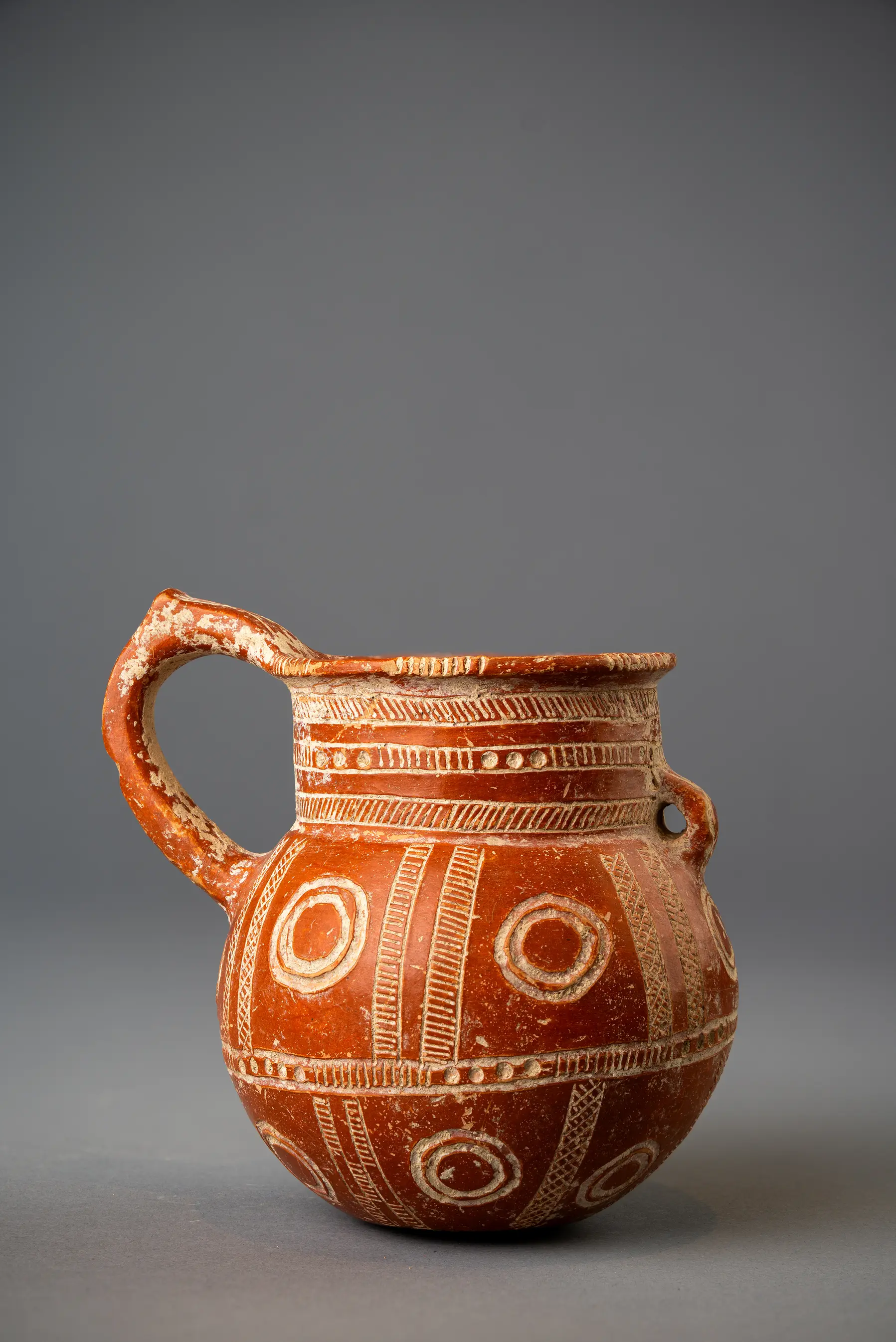
Red Polished One-Handled Jar with Concentric Circles, Deneia Style
Wide-mouthed Red Polished one-handled jar with a pierced lug, raised double rings, hatched bands and impressed dots in the Deneia style. Cyprus, c. 2100–1800 BCE.
Date
2100 - 1800 BC
Accession No.
JUG-BA-007
Collection
Alexis Drakopoulos
Provenance
- 1965–2025, The Goodman Collection (acquired 1965–1969)
- 2025–present, Alexis Drakopoulos, London
Early Cypriot III to Middle Cypriot II, c. 2100–1800 BCE · Red Polished ware · Handmade, incised, impressed and white-filled
A compact, globular vessel with a rounded base, a short wide neck and an everted rim whose lip is nicked with short incised strokes. A stout handle rises from the rim in a high arch and descends to the shoulder; opposite it, at the junction of neck and shoulder, projects a small pierced lug. The slip is a glossy orange-red. The neck carries three bands: two of fine oblique hatching framing a row of small round impressions between incised lines. On the body a horizontal band of impressions and short strokes divides two registers, each filled with incised double rings alternating with vertical ladder and cross-hatched bands. The white filling is thick and well preserved; lime deposits speckle the handle and one side, and the slip has flaked in small patches.
Commentary
Although it has been listed as a jug, the vessel is a wide-mouthed one-handled jar, sometimes called a mug. It is handmade Red Polished ware, burnished and decorated with a mixture of incision and impressed dots, all filled with white paste. The type is well matched by a vessel in the Louvre (AM 831): a globular wide-mouthed pot with a thumb-grip handle and a perforated lug at the neck-shoulder junction opposite the handle, decorated with concentric circles and hatched fields, which the museum assigns to the Deneia style and dates Early Cypriot III to Middle Cypriot II [1]. This jar repeats that combination of features closely.
Deneia, in the Ovgos valley in north-western Cyprus, was one of the most productive pottery centres of the Middle Bronze Age. Webb identifies as its hallmarks heavily drawn concentric circles, ring and wheel motifs, fretwork ornament and multiple pierced lugs, and notes that Deneia and Lapithos belonged to the same regional sphere [2]. The cemeteries at Deneia were looted over generations, and very large numbers of their vessels are now dispersed in collections with no record of their tombs [2, 3]. This jar has no recorded find-spot. Its decoration places it in the Deneia style, while its actual origin at Deneia or a neighbouring site cannot be demonstrated.
The date rests on the round base, which follows the flat-based vessels of the earlier Early Cypriot phases [1, 5], and on the parallels. The Louvre attribution to Early Cypriot III to Middle Cypriot II, combined with the current radiocarbon framework, gives a range of roughly 2100–1800 BCE [6]. A Red Polished III jar from Ayia Paraskevi in the British Museum (1888,0927.28), with pierced lugs and concentric circles, shows that the same decorative repertoire reached the Nicosia area [4].
The wide mouth and single handle suit dipping, drinking or ladling; a narrow-necked jug is better for controlled pouring. The pierced lug could have held a cord for hanging the vessel or tying a cover. Like most complete Red Polished pottery, it probably survived in a tomb, where drinking and serving vessels were placed with the dead.
The surface is unusually fresh and the ornament very regular. Both are consistent with the best Deneia-style work.
References
- 1.Musée du Louvre, Paris, AM 831: Red Polished globular wide-mouthed vase with thumb-grip handle and perforated lug, 'style de Dhenia', Early Cypriot III–Middle Cypriot II.
- 2.Webb, J.M. (2010) 'The ceramic industry of Deneia: crafting community and place in Middle Bronze Age Cyprus', in Bolger, D. and Maguire, L.C. (eds) The Development of Pre-State Communities in the Ancient Near East: Studies in Honour of Edgar Peltenburg. BANEA 2. Oxford: Oxbow, pp. 173–174.
- 3.Frankel, D. and Webb, J.M. (2007) The Bronze Age Cemeteries at Deneia in Cyprus. Studies in Mediterranean Archaeology 135. Sävedalen: Paul Åströms Förlag.
- 4.British Museum, London, 1888,0927.28: Red Polished III jar with pierced lugs and concentric circles, Ayia Paraskevi.
- 5.Brown, A.C. and Catling, H.W. (1980) Ancient Cyprus. Oxford: Ashmolean Museum, p. 27.
- 6.Manning, S.W. (2013) 'A new radiocarbon chronology for prehistoric and protohistoric Cyprus', in Knapp, A.B. The Archaeology of Cyprus. Cambridge: Cambridge University Press, pp. 485–533.
More from the Catalogue
Browse related objects
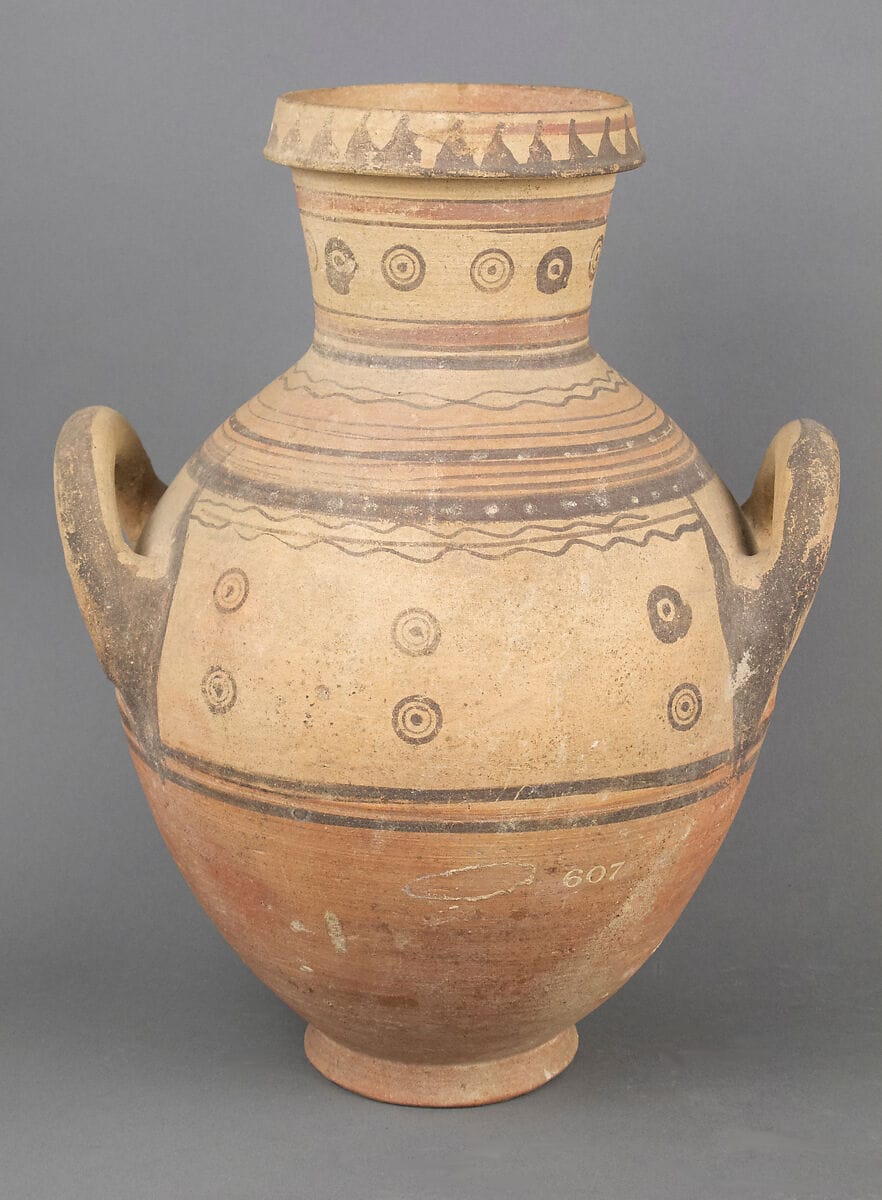
Amphora
Archaic II
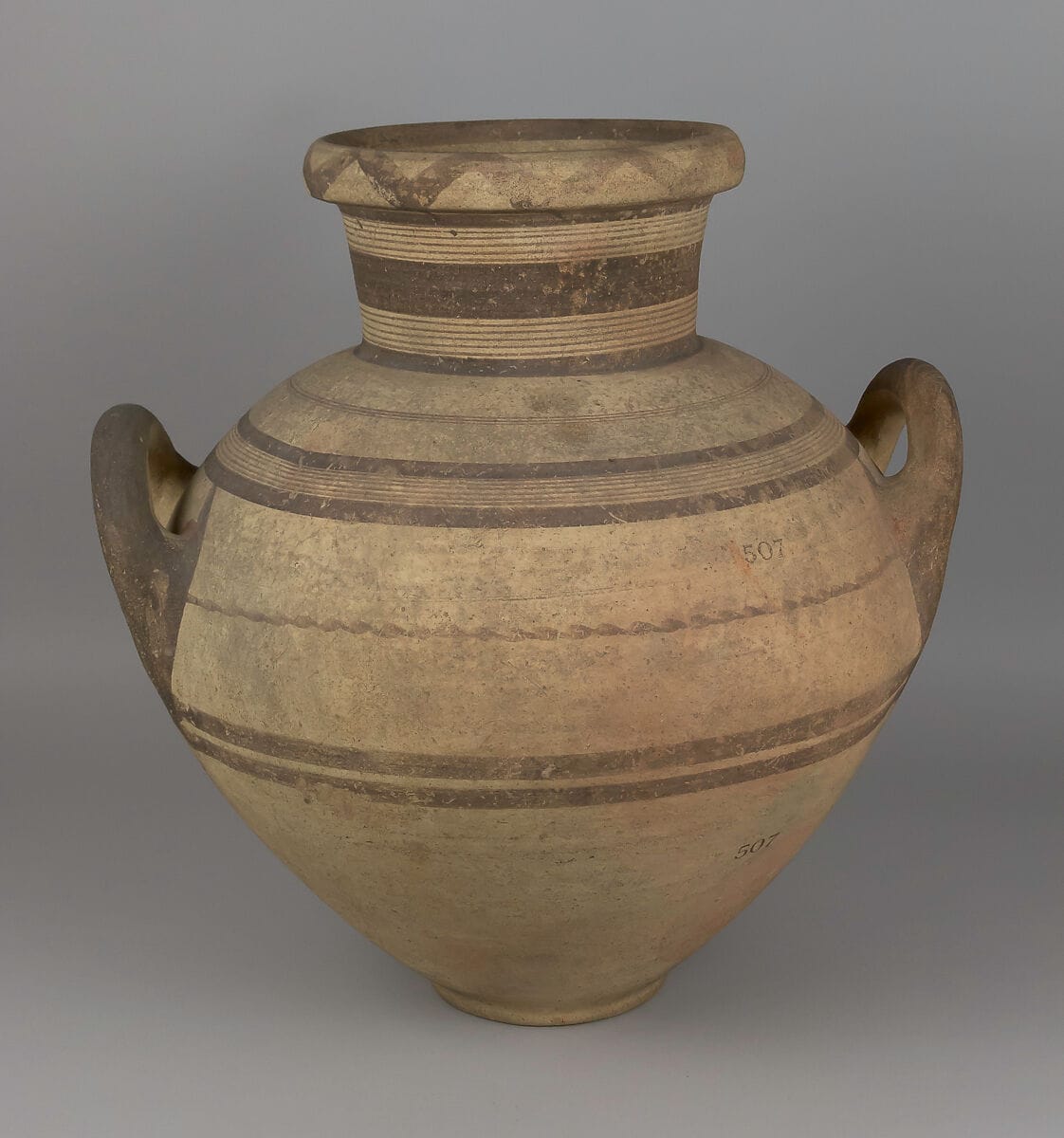
Amphora
Geometric I
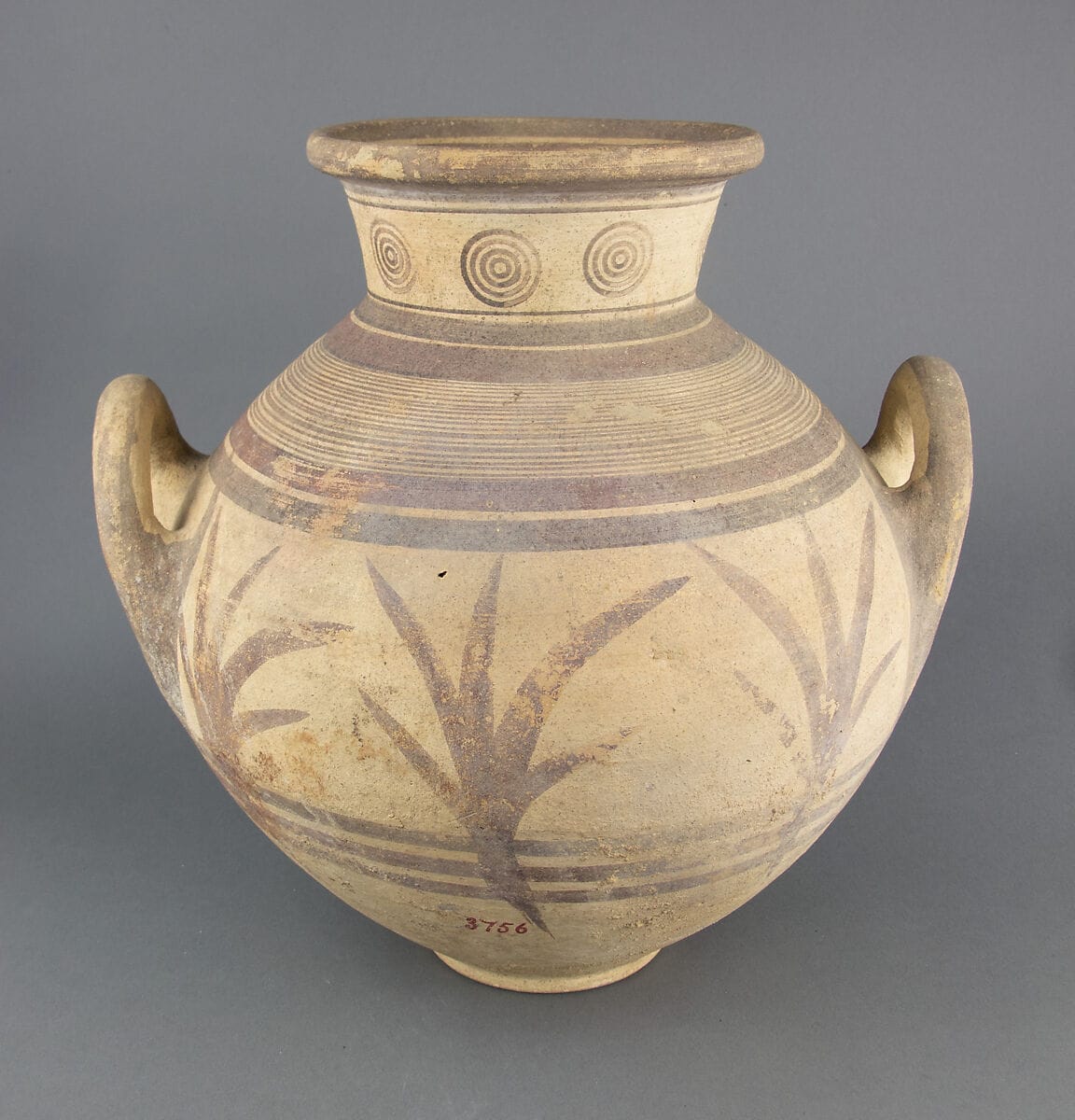
Amphora
Archaic II
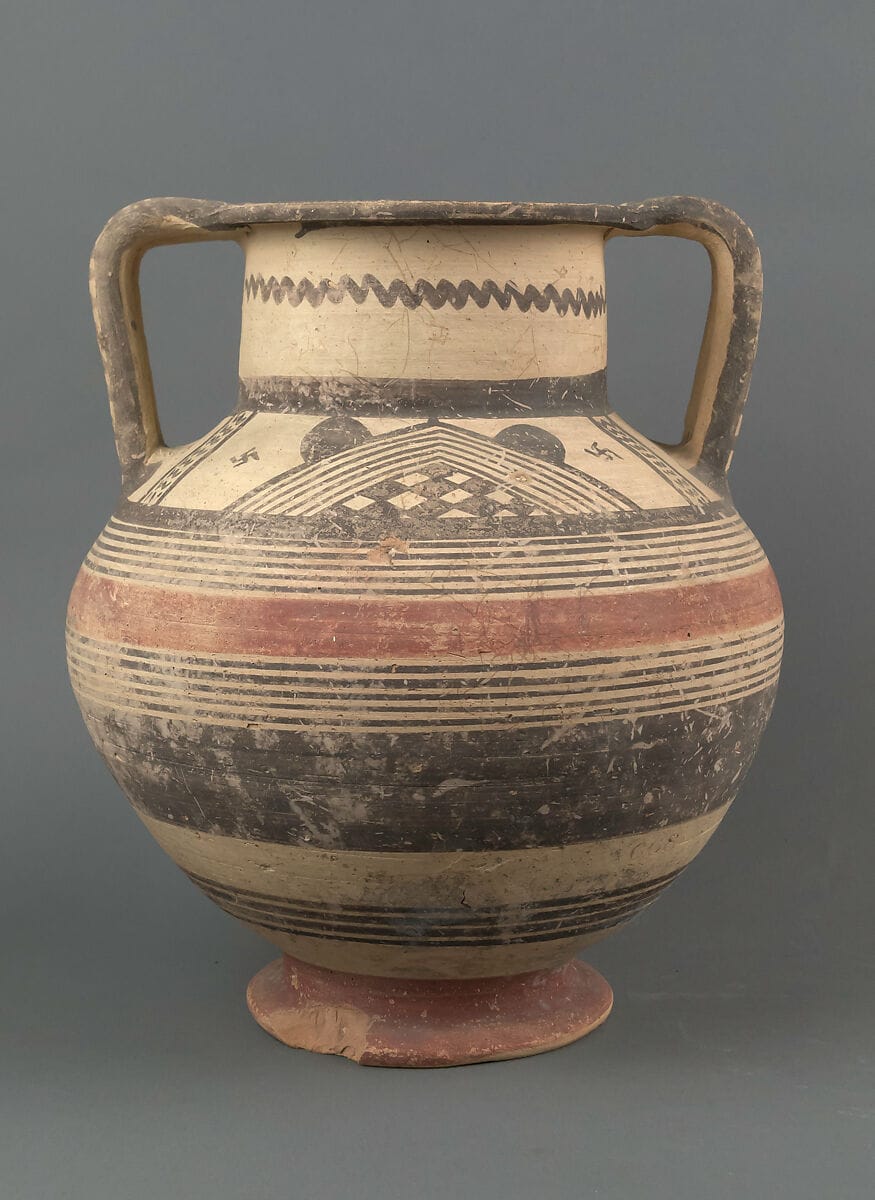
Amphora
Archaic I
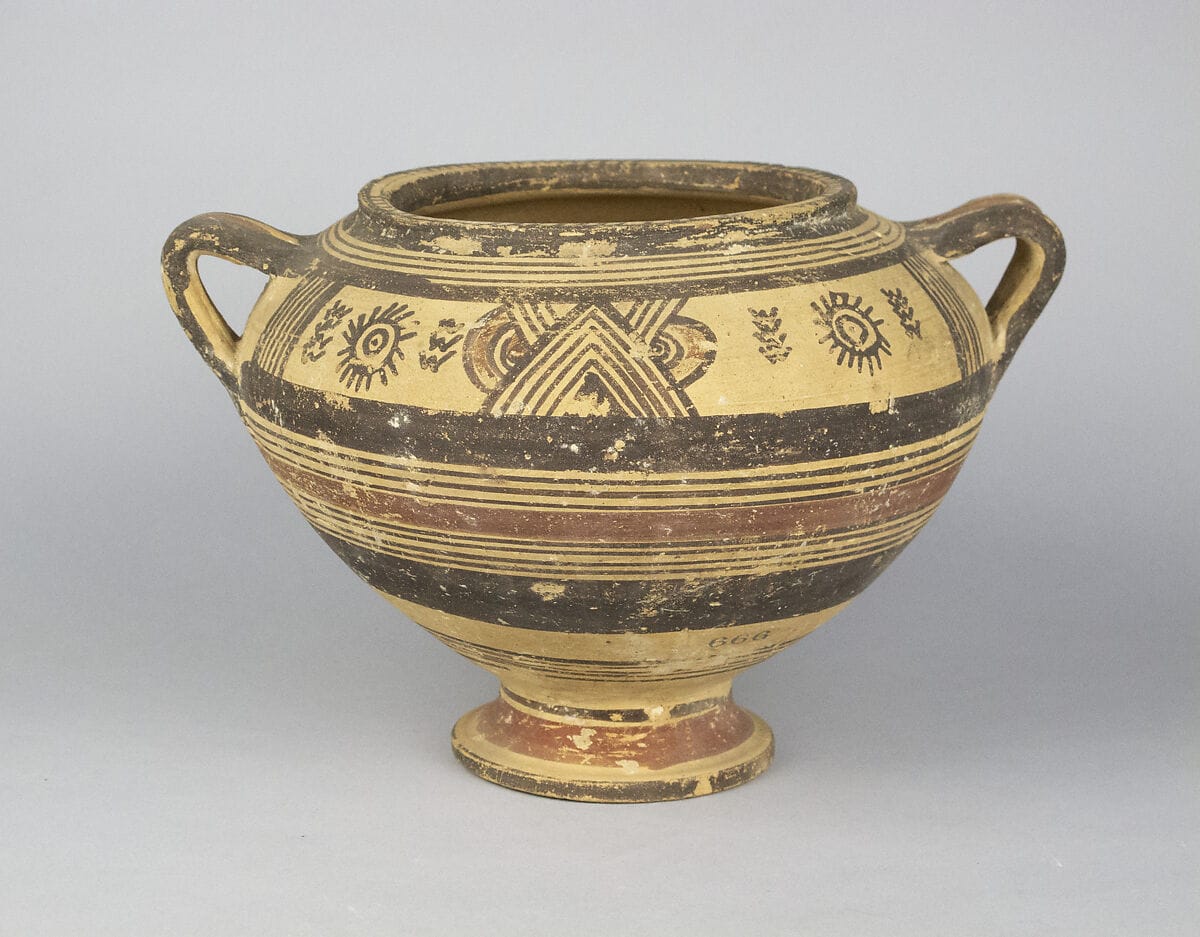
Dinos
Archaic I
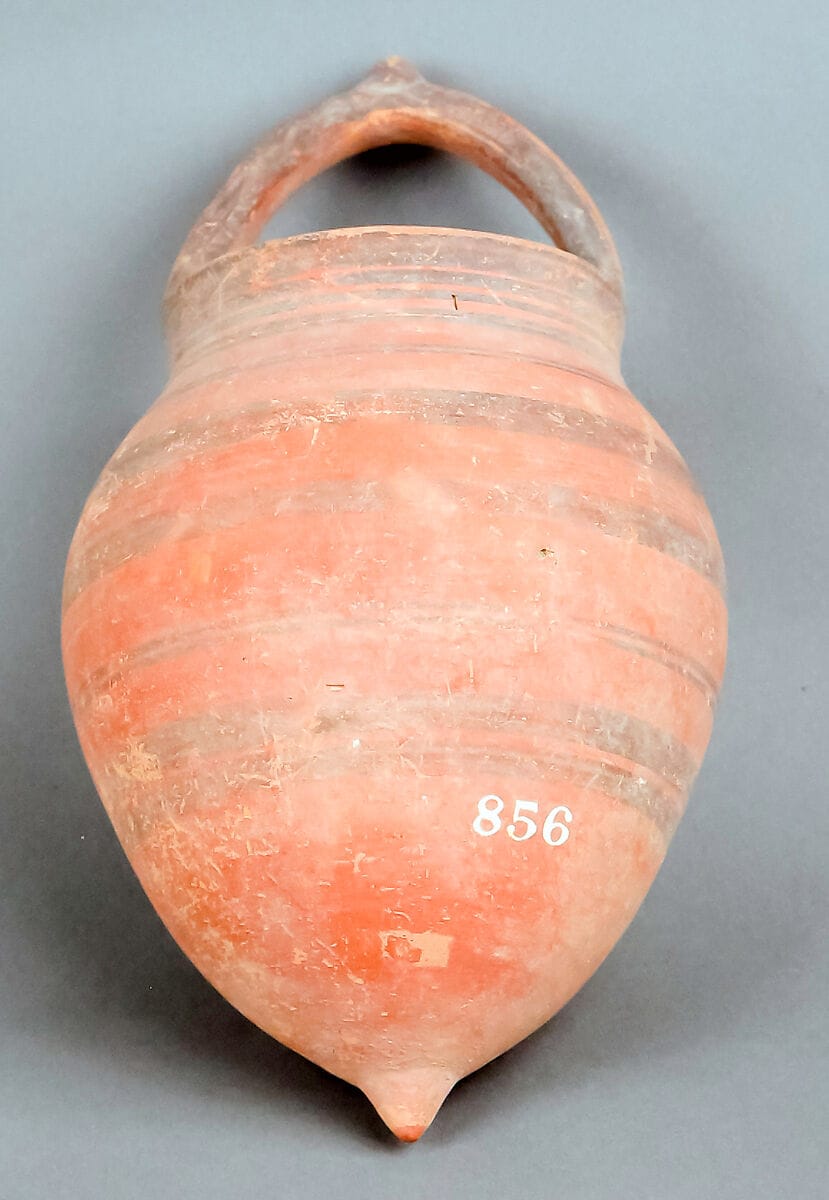
Amphoriskos
Geometric III
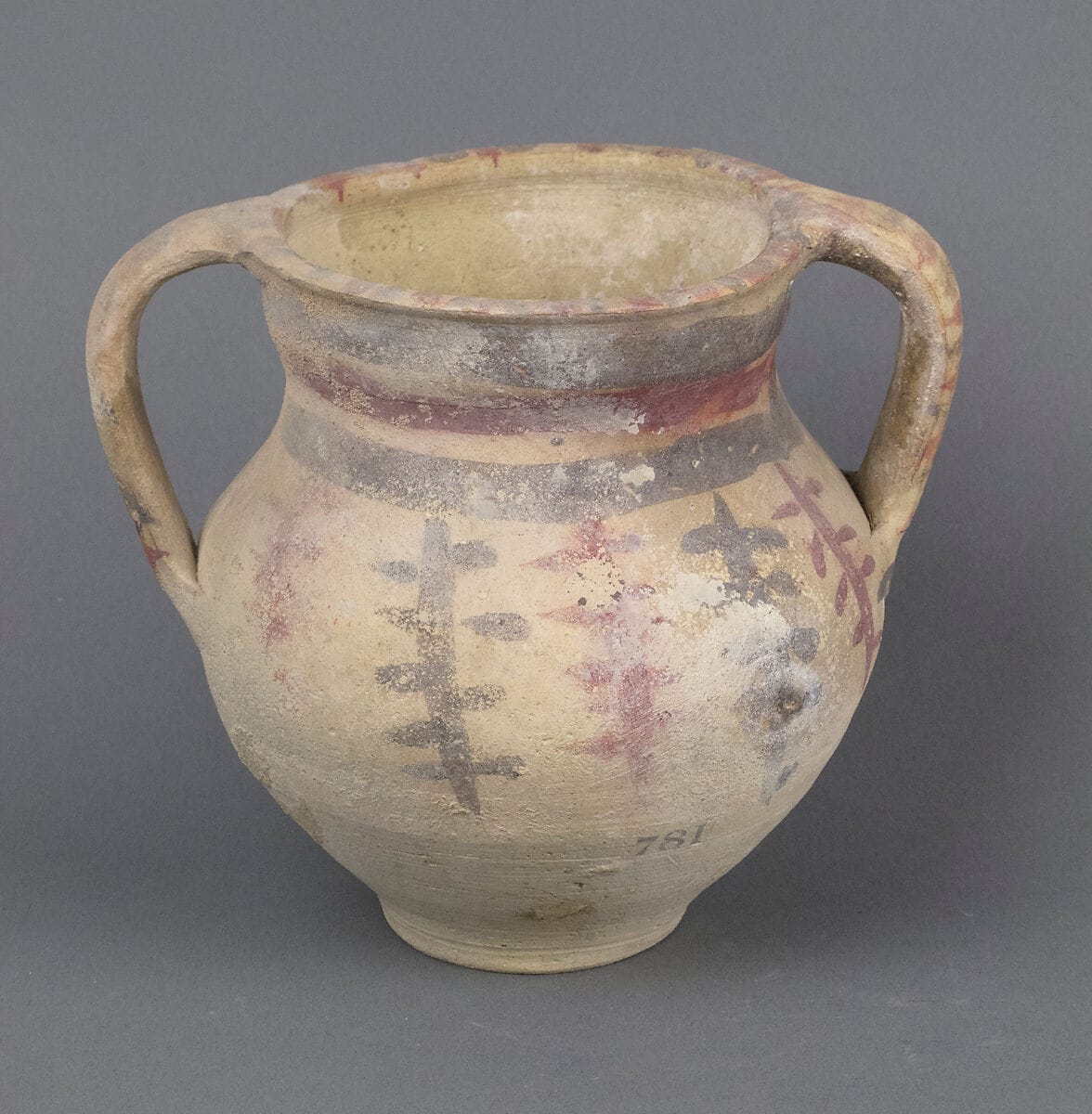
Amphoriskos
Archaic II
Limestone statuette of a boy holding an amphora
Hellenistic
Terracotta krater
Late Bronze Age III
Krater
Geometric I
Terracotta miniature amphora
Geometric III
Amphora
Late Bronze Age III
Amphora
Archaic II
Krater
Late Bronze Age III
Dinos
Archaic I
Amphora
Archaic
Terracotta amphora
Middle Bronze Age II
Amphora
Bronze Age