
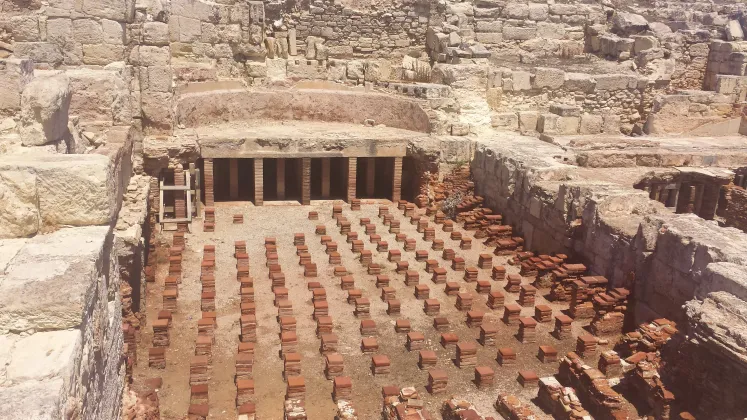
Dhekelia
A significant Late Bronze Age settlement in the Kition area of Cyprus, known primarily through its tomb-groups which reveal insights into the island's vibrant trade networks and material culture.
Dhekelia: A Glimpse into Late Bronze Age Cyprus in the Kition Area
The archaeological landscape of Cyprus, a dynamic crossroads in the Eastern Mediterranean, frequently yields insights into past societies. Among its many sites, Dhekelia, situated within the broader Kition area, represents a significant, albeit less extensively published, node in the Late Bronze Age network of the island. For those unfamiliar with the complexities of Cypriot archaeology, particularly during the second millennium BCE, Dhekelia offers a localized lens through which to examine wider regional phenomena: the flourishing trade networks, evolving social structures, and cultural interchanges that characterized this pivotal period. While direct published excavations of Dhekelia are limited, its documented material culture places it firmly within the vibrant Late Cypriot IIA (LC IIA) period, broadly dating from approximately 1450 to 1200 BCE. Understanding Dhekelia requires contextualizing it within the rich tapestry of contemporaneous sites, especially Kition and Hala Sultan Tekke, which dominated the southern coastal plain of Cyprus.
The geographical setting of Dhekelia is intrinsically linked to the strategic importance of Larnaca Bay. This region, encompassing modern Larnaca, was historically a nexus of settlement, with significant foci including Pyla—specifically localities such as Koukouphoudhkia, Kokkinokremmos, and Steno—as well as Verghi. The modern Larnaca Salt Lake, now a prominent landscape feature, was in antiquity a deep inlet, providing an ideal natural harbor that facilitated maritime activities and settlement. This maritime accessibility positioned the Kition area, and by extension Dhekelia, as a key point for engagement with the wider Eastern Mediterranean. Kition itself stands as a preeminent site on Cyprus, uniquely demonstrating continuous settlement from the Late Bronze Age well into the later Iron Age. Its historical significance is underscored by its earliest mention in texts from Ugarit dating to the thirteenth century BCE, identifying it as a city crucial for understanding the character and development of a Cypriot city at the close of the Bronze Age, and subsequently, the emergence of a Phoenician city-kingdom on the island. The extensive archaeological investigations at Kition, spanning from the Late Bronze Age through the destruction of the Phoenician kingdom by the Ptolemies in 312 BCE, have unveiled a rich historical record through literary references, inscriptions, topographic studies, tombs, sanctuaries, domestic remains, its harbors, and ship docks.
Within this active Late Bronze Age landscape, Dhekelia emerges as a "flourishing site" during the LC IIA period. Archaeological knowledge of Dhekelia-Steno and Dhekelia-Koukouphoudhkia largely stems from tomb-groups, which, though largely unpublished themselves and mentioned as secondary evidence, provide crucial insights into the site's material culture. These funerary contexts at Koukouphoudhkia have yielded a diagnostic assemblage of Late Bronze Age ceramics, including Base-ring I and II, White Slip II, Plain White Hand-made wares, and Mycenaean IIIA2a pottery. Notably, the proportion of Base-ring II ware was low, and Mycenaean wares were absent in the documented tomb material, while White Slip II pottery was found in large quantities. This ceramic profile is significant for several reasons, reflecting both local production and broader trade patterns. White Slip II, in particular, is a hallmark ware of the Late Cypriot period, widely distributed across the Eastern Mediterranean. Its abundance at Dhekelia underscores the site’s integration into Cypriot and regional exchange networks.
To fully appreciate Dhekelia's significance, it is imperative to delve into the broader context of Late Bronze Age Cyprus. This period, characterized by interconnectedness and dynamic socio-economic shifts, witnessed the island's emergence as a vital player in Mediterranean trade, particularly in copper. Urban centers, such as Kition and Hala Sultan Tekke, developed into complex societies with distinct administrative and social structures. The presence of elites, often closely associated with the ruling king, played a pivotal role in the governance of these city-states, sometimes even influencing the succession of rulers. While the degree of popular involvement in decision-making, as seen in texts from Idalion, remains debated for other city-states like Kourion, the political landscape was clearly hierarchical. The concept of damos, referring to both population and geographical districts, hints at the internal organization of these territories.
Hala Sultan Tekke, located in the same Larnaca Bay area as Dhekelia, stands as one of the most important Late Bronze Age harbor cities in the Eastern Mediterranean. Its establishment can be traced back to the beginning of the Late Bronze Age, around 1630 BCE, or possibly earlier. However, its most prominent period of occupation and prosperity spanned LC II to LC IIIA (from the latter half of the fifteenth to the first half of the twelfth century BCE), after which the city was destroyed and never resettled. Excavations at Hala Sultan Tekke have revealed a densely built city center and an extra-urban cemetery (Area A), which is notable as the only known Late Cypriot 'extramural' cemetery directly associated with a known urban center. The discovery of numerous wells with unusual fillings and potential ritual pits suggests continuous use of this area throughout the city's lifespan, not merely for burial but also for mortuary rituals, feasting, and commemoration. This emphasis on ritual and communal activity, potentially mirroring practices across the region, provides a framework for interpreting similar features if unearthed at Dhekelia.
The material culture of Late Bronze Age Cyprus, exemplified by finds at sites like Dhekelia, reflects profound regional and interregional connections. Pottery, such as the White Slip wares found at Koukouphoudhkia, was a key component of this interconnectedness. White Slip I ware, for instance, has been identified at sites across Syria (Alalakh, Ugarit) and Canaan, demonstrating extensive trade networks, though its presence in Egypt was comparatively rare. The discovery of a Proto-White Slip (PWS) bowl in a grave assigned to the final Hyksos settlement at Tell el-Dab'a in Egypt further highlights these linkages, linking Cypriot ceramic developments to the broader chronological sequences of the Near East. The influence of Aegean cultures, particularly Mycenaean, is also evident in the Cypriot material record, although the sources indicate a complex relationship. While Dhekelia-Koukouphoudhkia's tombs contained Mycenaean IIIA2a pottery, the absence of later Mycenaean wares (e.g., Mycenaean IIIC:1b) found at some other sites, such as Pyla-Kokkinokremmos, points to varying degrees or phases of interaction across different Cypriot locations. This suggests a nuanced picture of foreign cultural adoption and local adaptation.
Beyond ceramics, other aspects of material culture and settlement patterns contribute to understanding Dhekelia's context. The transition from Middle Cypriot III to Late Cypriot I saw a shift in habitation patterns in the Kouris river valley, with earlier sites abandoned and new centers, including Episkopi Bamboula and Alassa, developing, indicating increased population and a tendency towards settlement nucleation. Episkopi Bamboula, in particular, holds a major role in the interpretation of the Late Cypriot sequence, showcasing connections with excavations at Tell el-Dab'a. The Late Bronze Age also witnessed developments in metallurgy, with evidence of metalworking and recycling at Kition, further cementing Cyprus's role as a major copper producer and exporter in the ancient world.
The end of the Late Bronze Age, specifically LC IIIB (c. 1125/1100–1050 BCE), marked a period of significant upheaval across Cyprus. This era, often referred to as a "Dark Age" in the Northern Levant, saw the disintegration of city-state systems and the arrival of new populations, including the "Sea Peoples," profoundly impacting material culture and social organization. While some areas of the island experienced a "terrifying diminution in the population" and abandonment of large tracts, certain sites maintained occupation, exhibiting reasonable prosperity and a vigorous material culture where indigenous Cypriot elements were significantly overlaid by cultural traits attributed to Achaean colonists. Kition, for example, continued to be occupied, with early Cypro-Geometric (CG I, c. 1050-950 BCE) material found, indicating a continuous transition from the Late Bronze Age, before an apparent abandonment during CG II and subsequent reoccupation by Phoenicians in the Cypro-Geometric III/Archaic period. The transition from the Bronze Age to the Iron Age at Kition-Kathari involved an early Cypro-Geometric occupation that terminated around 1000 BCE, only to be replaced by a Phoenician colony around 850 BCE, demonstrating a complex urban history.
Dhekelia's position as a flourishing LC IIA site within this dynamic region places it within a crucial phase of Cypriot prehistory. Its material record, particularly the presence of Base-ring and White Slip wares, signifies its participation in the sophisticated ceramic industries and trade networks that defined the Late Bronze Age. While the "absence of Mycenaean wares" in some of its tomb groups (in contrast to the presence of Mycenaean IIIA2a in others) warrants further investigation to fully understand the nuances of foreign contact at Dhekelia specifically, the overall picture is one of a community engaged with wider Mediterranean trends. The use of collective burial practices, evident at other Cypriot sites like Dhenia Kafkalla and Mali, likely contributed to the mortuary landscape of Dhekelia, aligning with broader Cypriot traditions that often involved secondary treatment and reburial. The discovery of horse sacrifice in tombs at Palaepaphos and Salamis, a funerary custom described by Homer, further illuminates the complex ritual practices present on the island, even at a time when they had ceased in mainland Greece. While not directly documented for Dhekelia, such practices underscore the rich and distinct cultural milieu of Late Bronze Age and Early Iron Age Cyprus.
The challenges in fully understanding Dhekelia stem largely from the limited publication of its primary archaeological contexts. Unlike major, extensively published sites such as Palaepaphos-Skales, where Iron Age cemeteries have been presented with meticulous detail, or Kissonerga-Mosphilia, which offers comprehensive data on Chalcolithic settlement, Dhekelia's direct contributions to scholarly discourse have been more circumscribed. The brief mention of its tomb-groups as "secondary evidence" highlights a common issue in archaeological research where rescue excavations or chance finds are not always followed by full, detailed reports. This gap in comprehensive publication hinders a deeper understanding of Dhekelia's specific social organization, economic activities, and its precise relationship with its powerful neighbor, Kition. Did Dhekelia function as a satellite settlement, an agricultural hinterland, or a specialized craft center for Kition? The existing data suggest its prosperity in the LC IIA period, but without detailed excavation reports, these questions remain largely unanswered.
Despite these limitations, Dhekelia's documented existence and its ceramic finds solidify its importance in reconstructing the Late Bronze Age landscape of Cyprus. It underscores the density of occupation along the southern coast and the widespread distribution of key Cypriot ceramic types. Future archaeological endeavors, whether through new excavations or the systematic re-examination and publication of existing archival data from past discoveries, hold the potential to unlock Dhekelia’s full story. Such research could provide granular details about household structures, economic specializations, and the precise nature of its integration into the political and social fabric of the Kition city-kingdom. By bringing Dhekelia more fully into the academic discourse, archaeologists can refine the understanding of regional variation and inter-site relationships during a pivotal era of Cypriot history, moving beyond broad narratives to reconstruct the lived experiences of communities in the ancient Mediterranean. Dhekelia, therefore, remains a compelling subject, a testament to the archaeological richness of Cyprus and a reminder of the many narratives still awaiting their complete telling.