
Contents
"Basket" is not a vessel class in the standard Cypriot typologies: no shape called "basket" appears in the Swedish Cyprus Expedition classifications of Gjerstad and Paul Åström. The word turns up instead in four narrower uses: as the name of a handle ("basket handle"), in the names of vessels that carry one (basket-handled jugs, askoi and amphorae), as the English meaning of the Greek kalathos, a real Cypriot shape of the eleventh and tenth centuries BC, and as a museum title for a handful of openwork bowls in the Cesnola collection, which John Myres described in 1914 as imitating "openwork in wood or basketry" [1, nos. 586–587]. This entry treats each in turn and replaces an earlier placeholder that described "baskets" as a common Cypro-Geometric shape, which the evidence does not support.
The basket handle
In Cypriot pottery description a basket handle is an arched handle that spans the top of a vessel, like the handle of a carrying basket, as opposed to a jug handle that runs from rim to shoulder on one side. It is the defining feature of the askos. Nota Kourou's study of Early Iron Age zoomorphic askoi reduces all five of her types to the same elements: "a closed shape with a basket handle and a cylindrical spout", and she distinguishes the askos from the animal-shaped rhyton precisely because the rhyton has two openings and "no spout or basket handle" [6, p. 2].
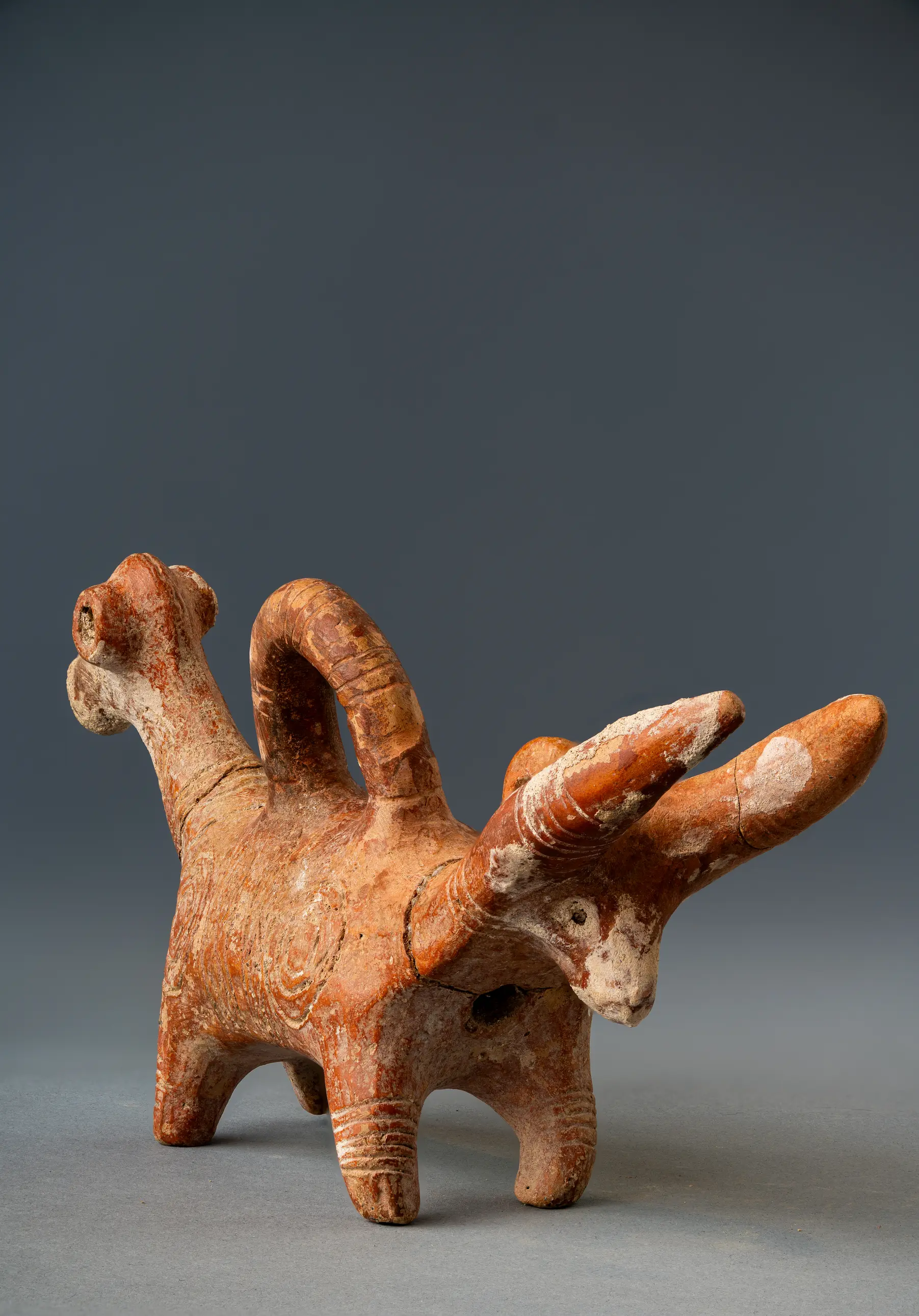
The form is old on the island. Kourou traces the Early Iron Age askoi back to a Middle Cypriot askos with "a vessel-shaped body and a basket handle with a spout by one end and an animal protome by the other", and notes a Late Cypriot II variant in Base Ring II, a juglet with a bull protome joined to the neck by a short basket handle [6, p. 3]. A White Painted ring kernos from Lapithos Tomb 50 (no. 272), dated MC III, has a tubular spout and a large basket handle [7, p. 157]. The earliest examples in this collection are Red Polished: the two-headed animal askos illustrated here, a quadruped on four legs with an arched handle rising from its back, belongs to the Early to Middle Cypriot class treated under Red Polished zoomorphic vessels and in the article The Bull Was a Newcomer.
Baskets themselves appear on some of these vessels. A small White Painted Handmade askos bought on the London market by the A. G. Leventis Foundation for the Cyprus Museum (inv. 1989/I-10/1) shows an animal, possibly a donkey, carrying panniers on either side of its basket handle; Vassos Karageorghis notes that panniers carried in this way also appear in the scenes on Red Polished bowls of the Middle Bronze Age [8, p. 61].
In the Iron Age the handle is common on White Painted askoi of Cypro-Geometric I, such as the askos from Lapithos Tomb 420 in the Medelhavsmuseet (L. 420:065), and it continues into the zoomorphic askoi that reappear in LC IIIB after their absence in LC IIIA, a reappearance Kourou connects with Aegean contact [6, p. 3].
Basket-handled jugs
The basket-handled spouted jug, sometimes called a feeding bottle, has a wide neck, an arched handle over the mouth and a side spout on the shoulder. Hector Catling identified one in Decorated Late Cypriot III ware from Evreti Tomb VIA at Kouklia (Palaepaphos), comparing Furumark's Type H [9, p. 197]. Schreiber lists the "basket-handled jug with spout and low foot" among the White Painted I shapes of early Cypro-Geometric [10, p. 46]. Harvard Art Museums has a white-slipped feeder jug with basket handle (1966.130), dated to the 11th to 8th centuries BC, painted with bands and cross-hatched triangles. The shape is covered with other pouring vessels under jugs.
Basket-handled amphorae
The largest vessels to carry the name are the Cypro-Archaic transport jars known as basket-handled amphorae. Stella Demesticha explains the term: their "arched horizontal handles, rising from the shoulder to well above the rim, are the most characteristic feature", hence the names basket-handled, loop-handled or basket storage jar; Gjerstad had classified the type as a "pithoid amphora" under Plain Ware Type IV [11, p. 130]. The type developed from a Cypro-Geometric amphora with raised horizontal handles and was made from the late eighth century BC; the earliest large group, 34 jars, came from Tomb 79 at Salamis [11, pp. 130–131]. Petrographic and neutron activation analysis of examples from Tell Keisan pointed to south-eastern Cyprus, around Salamis, and a Type A jar from Salamis Tomb 2 of about 600 BC is painted with the Cypro-Syllabic word e-la-i-wo, "olive oil" [11, p. 131]. Whether they held oil or wine is argued both ways: Humbert read a thick interior coating on the Tell Keisan jars as wine residue [11, p. 131]. Heights range from 45 to 82 cm, and one Salamis example holds 64 litres [11, p. 132]. The British Museum has a complete basket-handle transport amphora of Cypriot type from Kamiros on Rhodes, 82.5 cm high (1864,1007.32). The trade in these jars is the subject of Ancient Cypriot Transport Amphorae, and the jar form is treated under jars.
The handle type also reached the Bronze Age plain wares: the Ashmolean holds a Plain White basket-handle sherd from Enkomi (AN1953.1203), catalogued as Late Cypriot. See Plain White ware.
The kalathos
Kalathos is the Greek word for a basket, and the Metropolitan Museum's label for one Cypriot example reads "Terracotta kalathos (basket)" (74.51.1137, Late Cypriot IIIB). As a Cypriot pottery shape the kalathos is an open bowl with flaring, often concave sides and a flat base, frequently with two small horizontal handles below the rim. Åström placed the kalathoi of Proto-White Painted ware, his Type IV, among the shapes "of Mycenaean inspiration" [2, p. 750]. The shape continues into White Painted I: at Palaepaphos-Skales Karageorghis's type AXIII(ii) kalathoi have flat bases and are richly decorated with latticed and composite triangles, one of them inside as well "in the fashion of the Proto-White Painted ware examples" [3, p. 46]. Two small White Painted I kalathoi in the National Archaeological Museum, Athens (inv. 12385), 3.9 and 4.1 cm high, have concave sides, opposed loop handles and a Maltese cross or a star painted on the base, and Karageorghis describes the type as "derived from the Aegean" [4, p. 63].
Public examples include a Proto-White Painted kalathos from Lapithos Tomb 420 in the Medelhavsmuseet (L. 420:006, CG I) and a Cypro-Geometric I kalathos in the Met (74.51.735). For the Aegean background, compare the Mycenaean terracotta "basket vase" in the Met (06.1021.3a, b, Late Helladic IIIA), a lidded vase in the form of a basket that has no known Cypriot counterpart of the same period. The kalathos is also discussed under bowls and in Cypriot Bowls.
The same Greek word explains a translation found in Cypriot museum catalogues. The Pierides Foundation catalogue describes a Middle Cypriot Red Polished vessel with a high arched handle ending in "horns", a flat elliptical base and incised horizontal decoration as a "basket-shaped vase"; the Greek text calls it καλαθόσχημο, literally "kalathos-shaped" [5, p. 92]. Here "basket" describes a single object's silhouette.
Openwork "basket bowls"
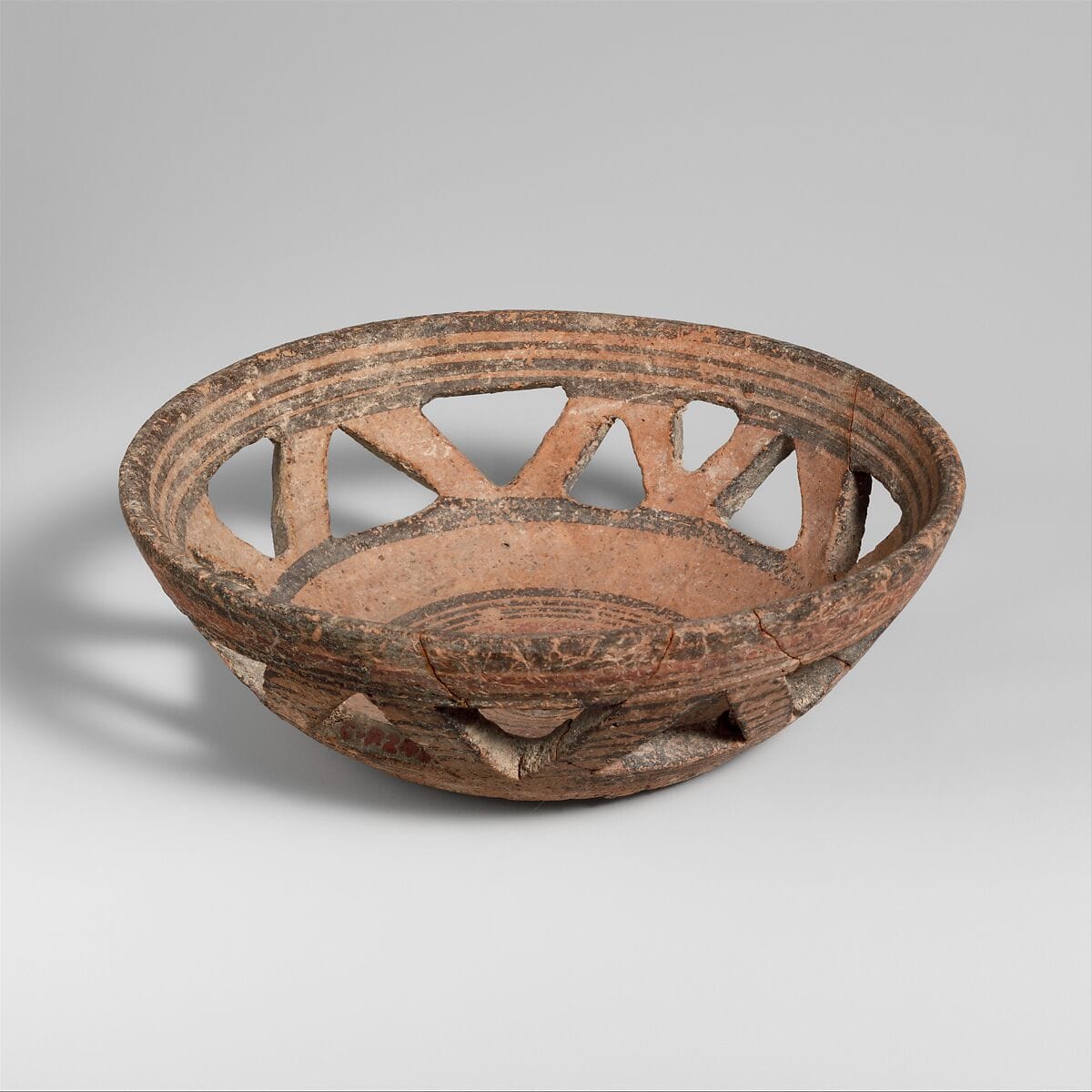
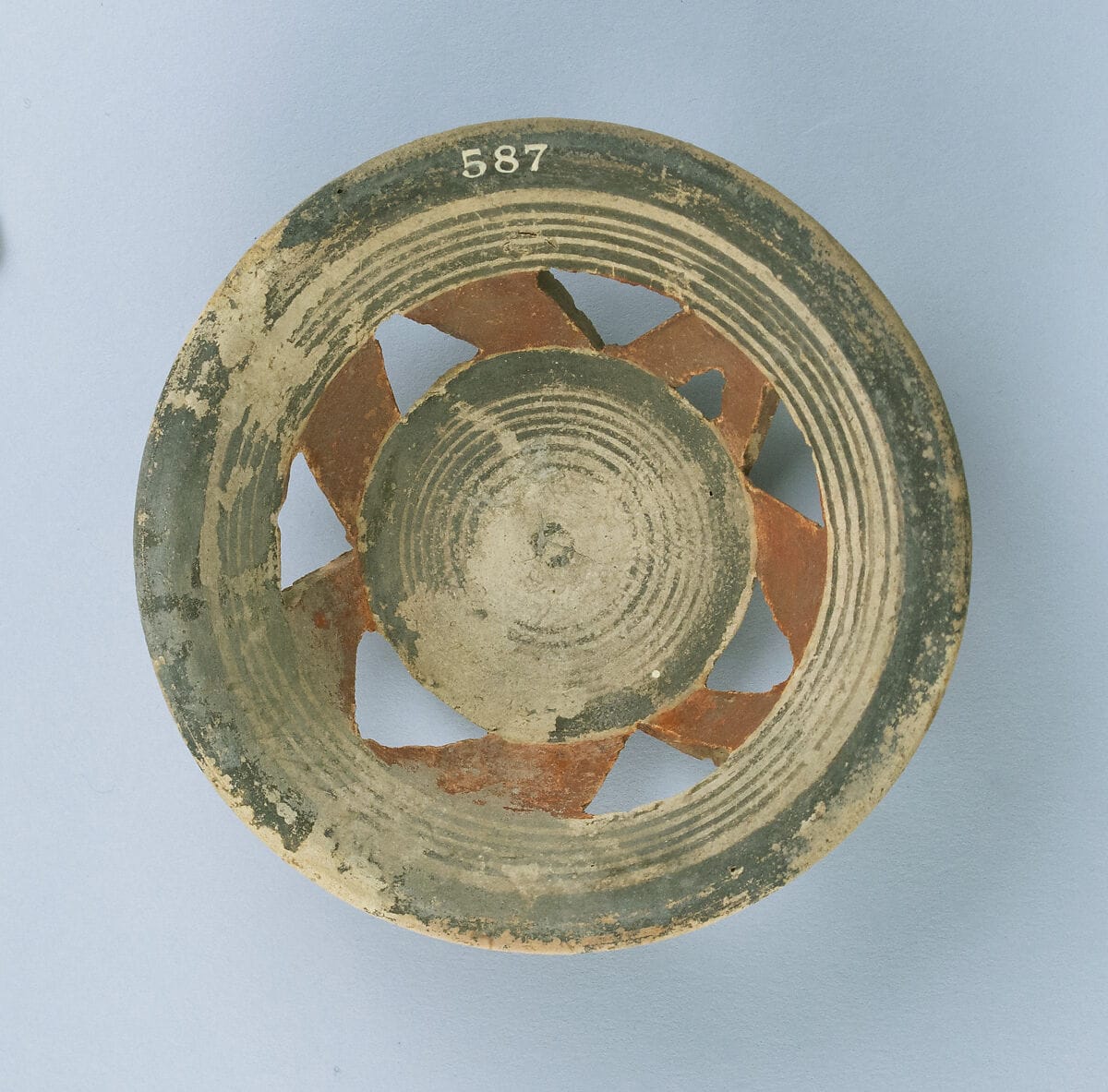
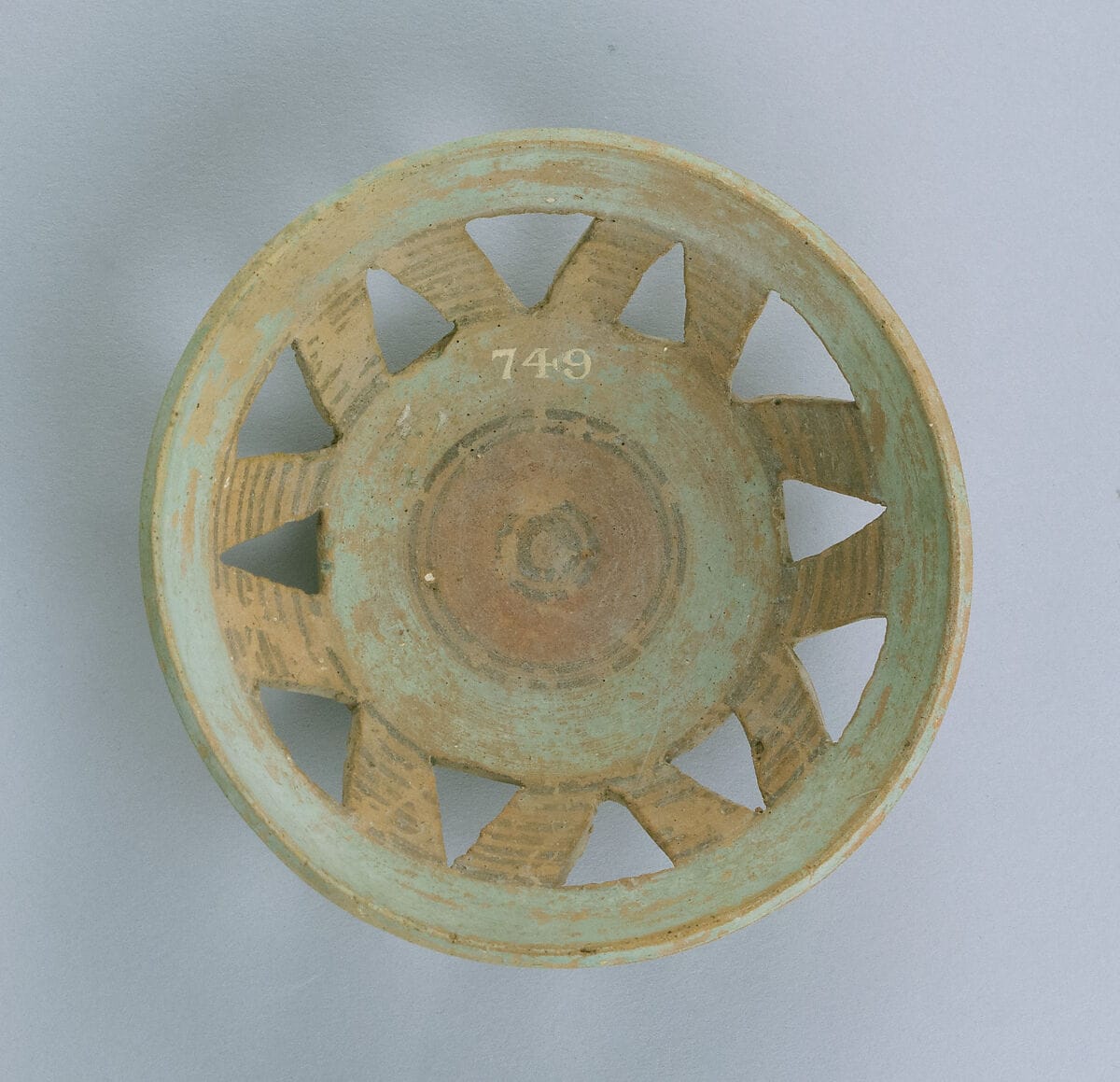
The source of the placeholder on this page is a small group of shallow bowls from the Cesnola collection whose walls are cut through with triangular openings. The Met titles one a terracotta basket bowl (74.51.440), 4.9 cm high and 14.3 cm across, dated Cypro-Geometric III, 850 to 750 BC; on this site it is the basket bowl. Myres grouped it with a second bowl (his nos. 586 and 587) as having "triangular openings cut in their sides, to imitate openwork in wood or basketry", and described a saucer, no. 749, as pierced the same way [1, nos. 586–587, 749]; these are the Bichrome basket and the second Bichrome basket on this site. Another ex-Cesnola basket-bowl, sold by the Met in 1928, is now in the Ringling Museum (SN28.741). We know of no study of these openwork bowls as a type, and their number is small.
Myres's reading was part of a broader view that early Cypriot pots copied containers in other materials. He described an Early Bronze Age oval box with a flat lid, "intended to be tied with cord to the 'string-hole' handle at each side", as imitating basketry, and saw basketry and the stitched seams of leather bottles behind the incised ornament of Red Polished ware [1, nos. 76–98]. That skeuomorphic argument is a 1914 interpretation, and we have not found it tested in more recent work.
Summary
For a Cypriot vessel, "basket" is shorthand for one of five things: an arched basket handle; a jug, askos or amphora defined by such a handle; the kalathos, a Proto-White Painted and White Painted I bowl of Aegean origin; a catalogue translation of the Greek word for that shape; or a museum title for a few openwork bowls. Only the basket-handled amphora and the kalathos are established typological terms with a literature behind them. The collection's closest example is the handle on its Red Polished askos, dated from late in the Early Bronze Age into Middle Cypriot I (c. 2100 to 1850 BC); for the complex shapes that carry such handles see complex vessels.
Objects on this page
References
- 1.Myres, J. L. (1914). Handbook of the Cesnola Collection of antiquities from Cyprus. The Metropolitan Museum of Art. https://archive.org/details/handbookofcesnol00metriala
- 2.Åström, P. (1972). The Swedish Cyprus Expedition, Vol. IV, Part 1D: The Late Cypriote Bronze Age. Relative and absolute chronology, foreign relations, historical conclusions. Swedish Cyprus Expedition.
- 3.Karageorghis, V. (1983). Palaepaphos-Skales: An Iron Age cemetery in Cyprus (Ausgrabungen in Alt-Paphos auf Cypern 3). Universitätsverlag Konstanz.
- 4.Karageorghis, V. (2003). Ancient Cypriote art in the National Archaeological Museum of Athens. A. G. Leventis Foundation.
- 5.Karageorghis, V., et al. (1985). Ancient Cypriote art in the Pierides Foundation Museum. Pierides Foundation.
- 6.Kourou, N. (1997). Cypriot zoomorphic askoi of the Early Iron Age: A Cypro-Aegean interplay. In V. Karageorghis, R. Laffineur, & F. Vandenabeele (Eds.), Four thousand years of images on Cypriote pottery. A. G. Leventis Foundation.
- 7.Buchholz, H.-G., & Karageorghis, V. (1973). Prehistoric Greece and Cyprus: An archaeological handbook. Phaidon.
- 8.Karageorghis, V. (1990). The A. G. Leventis Foundation and the cultural heritage of Cyprus. A. G. Leventis Foundation.
- 9.Catling, H. W. (2020). Kouklia: Late Bronze Age and Early Iron Age tombs at Palaepaphos 1951–1954 (R. W. V. Catling, Ed.; BAR International Series 2994). BAR Publishing. https://doi.org/10.30861/9781407357324
- 10.Schreiber, N. (2003). The Cypro-Phoenician pottery of the Iron Age (Culture and History of the Ancient Near East 13). Brill.
- 11.Knapp, A. B., & Demesticha, S. (2017). Mediterranean connections: Maritime transport containers and seaborne trade in the Bronze and Early Iron Ages. Routledge. https://doi.org/10.4324/9781315537009