
Geometric II
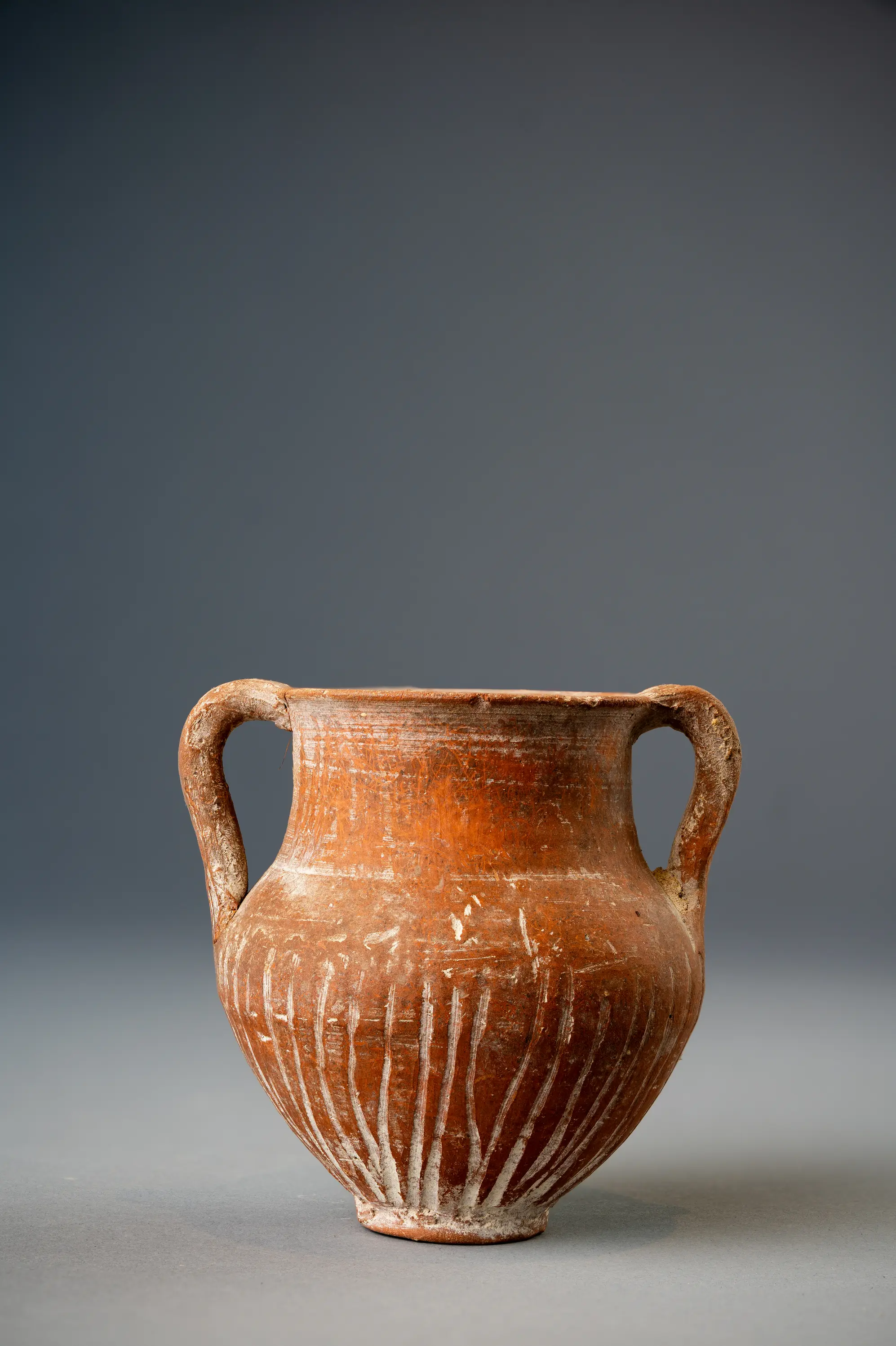
Two-Handled Amphoriskos with Grooved Bucchero Body
Small red-surfaced, wheel-made amphoriskos with two loop handles and vertical grooves on the lower body, an Iron Age 'Bucchero' type of c. 950–600 BCE.
Date
950 - 600 BC
Accession No.
JAR-BA-003
Collection
Alexis Drakopoulos
Provenance
- 1965–1969, acquired by The Goodman Collection
- 2025–present, Alexis Drakopoulos, London
Cypro-Geometric II to Cypro-Archaic I, c. 950–600 BCE · Red-surfaced "Bucchero" ware · Wheel-made
A small two-handled jar with an ovoid body on a low ring foot, a wide concave neck and a plain rim. Two loop handles, oval in section, rise from the shoulder and join the rim. The surface is a warm orange-red, smoothed and lightly worn, with fine horizontal rilling on the neck from the potter's wheel. A shallow groove marks the join of neck and shoulder. The lower two-thirds of the body are cut with close-set vertical grooves that taper towards the foot, and a white deposit lodged in the grooves now picks them out against the red ground. Scattered lime flecks cover the shoulder and handles. The vessel is complete, with minor surface chips.
Commentary
Vertical grooving on the lower body of a small jar or jug is the mark of the so-called "Bucchero" group in Cypriot pottery. The name was borrowed long ago from Etruscan black ware and has no real connection with it [1]. In Cyprus it covers two separate things. In the Late Bronze Age, a handmade ribbed variant of Base Ring II appears in Late Cypriot IIB and becomes more common in Late Cypriot III. In the early Iron Age, a wheel-made class with grooved or fluted bodies, usually classified as Black Slip "Bucchero" I and II, is common in Cypro-Geometric tombs [2][3].
This amphoriskos belongs with the Iron Age group. The wheel rilling on the neck, the regular profile, the ring foot and the incised grooves all fit the Cypro-Geometric and early Cypro-Archaic class; the Late Bronze Age variant is handmade, with pinched or applied ribs. Desmond Morris illustrates a red "Bucchero-style" jar with a ring base, two vertical handles and vertical stripes on the lower body, 14 cm high, that could stand beside this piece, and places it in the Iron Age wheel-made red family [1]. The nearest museum parallel is an amphoriskos from the Cesnola Collection in the Metropolitan Museum, 74.51.400, also red-surfaced with a grooved lower body, dated to Cypro-Geometric III [4]. Grooved two-handled amphorae of Black Slip I–II from Kition in the Ashmolean [5] and from Amathus Tomb 10 in Stockholm [6], and a Black Slip II Bucchero amphora with a ring base at Palaepaphos-Skales [3], show the same form in a dark slip. Together these support a date between Cypro-Geometric II and Cypro-Archaic I, c. 950–600 BCE, with the Met piece suggesting the ninth or eighth century as the most likely point in that range.
The grooving imitates the fluted bodies of metal vessels, and the red surface may have been meant to recall bronze or copper. Small amphorae of this size are common grave goods and probably held oil or another liquid for the burial.
Two points remain open. The red surface could be a red slip or a Black Slip vessel fired red, and only close inspection can decide it. It is also unclear whether the white in the grooves is burial deposit or a deliberate filler meant to contrast with the red.
References
- 1.Morris, D. (1985) The Art of Ancient Cyprus. Oxford: Phaidon, pp. 43, 45, pl. 40a.
- 2.Benson, J.L. (1973) The Necropolis of Kaloriziki. Studies in Mediterranean Archaeology 36. Göteborg: Åström, pp. 22–23.
- 3.Karageorghis, V. and Raptou, E. (2016) Palaepaphos-Skales: Tombs of the Late Cypriote IIIB and Cypro-Geometric Periods (Excavations of 2008 and 2011). Nicosia, p. 52.
- 4.Metropolitan Museum of Art, New York, 74.51.400, amphoriskos, Cypro-Geometric III, c. 850–700 BCE, H. 13.2 cm (Cesnola Collection).
- 5.Ashmolean Museum, Oxford, AN1946.62, Black Slip I–II bucchero amphora, from Kition, Cypro-Geometric I–II, H. 15 cm.
- 6.Medelhavsmuseet, Stockholm, A.010:024, amphora, Black Slip II ware, from Amathus Tomb 10, Cypro-Geometric II, H. 15.8 cm.
More from the Catalogue
Browse related objects
Amphora
Archaic II
Amphora
Geometric I
Amphora
Archaic II
Amphora
Archaic I
Dinos
Archaic I
Amphoriskos
Geometric III
Amphoriskos
Archaic II
Limestone statuette of a boy holding an amphora
Hellenistic
Terracotta krater
Late Bronze Age III
Krater
Geometric I
Terracotta miniature amphora
Geometric III
Amphora
Late Bronze Age III
Amphora
Archaic II
Krater
Late Bronze Age III
Dinos
Archaic I
Amphora
Archaic
Terracotta amphora
Middle Bronze Age II
Amphora
Bronze Age