
Archaic II
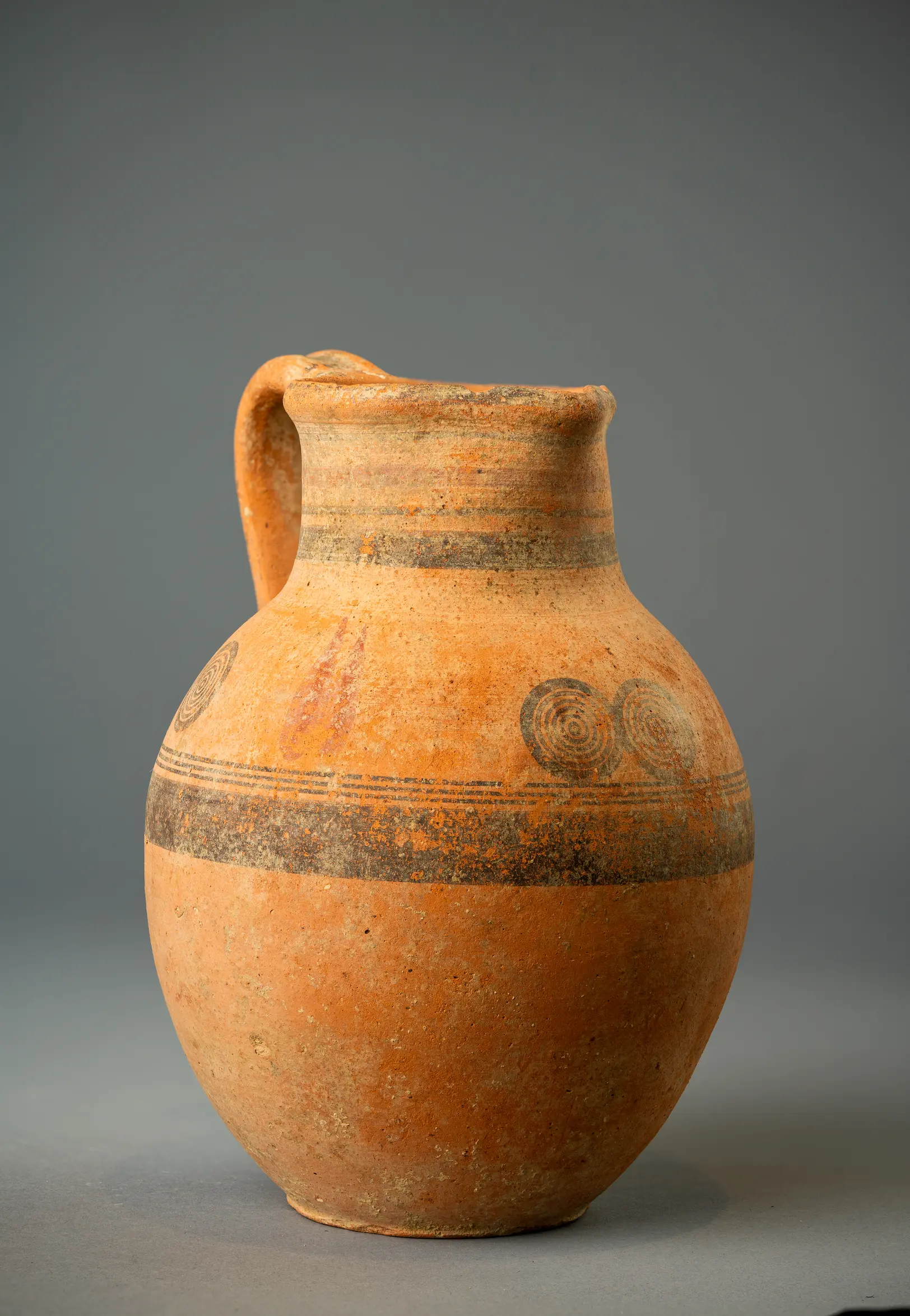
Bichrome Jug with Wide Neck, Shoulder Circles and Red Strokes
Cypro-Archaic Bichrome jug with a wide neck, paired concentric circles and red leaf strokes on the shoulder, and a broad dark belly band.
Date
700 - 500 BC
Accession No.
JUG-GE-015
Collection
Alexis Drakopoulos
Provenance
- 1965–1969, The Goodman Collection, formed in Cyprus
- 2025–present, Alexis Drakopoulos, London
Cypro-Archaic, c. 700–500 BCE · Bichrome IV–V ware · Wheel-made
An ovoid jug on a low ring base, with a wide cylindrical neck, a thickened rim drawn very slightly towards a pouring lip, and a strap handle from rim to shoulder that rises to about the level of the mouth. The clay has fired a warm orange-buff throughout, and the surface is matt and gritty, with a scatter of small pits and pale lime spots on the lower body.
The painter kept the scheme spare. Dark bands, one broad and several fine, ring the neck. On the shoulder small dark concentric-circle groups stand singly and in pairs, and between them, towards the handle, two red leaf-shaped strokes hang side by side, now pale. A broad dark band framed above by three fine lines girdles the widest point. The lower body is left plain.
Commentary
The jug belongs to the Bichrome ware of the Cypro-Archaic period, in which dark matt paint is combined with red on a light ground [1]. The orange tone of the ground here is the colour of the fired clay. The red of the two leaf strokes is a separate paint, and it is this second colour, used sparingly, that makes the piece Bichrome.
Its shape points towards the later part of the series. Gjerstad lists a wide neck that widens upwards, with a handle rising above the mouth, among the features characteristic of his Type V, which corresponds to Cypro-Archaic II [1, p. 53]. On this jug the neck is broad and nearly cylindrical, and the handle reaches the rim without clearly overtopping it. The piece therefore sits on the boundary between Types IV and V, and a date in the seventh or sixth century BCE, c. 700–500 BCE, is the most the evidence allows.
The decoration supports the same range. Small concentric-circle groups set freely on the shoulder belong to the circle repertoire of Bichrome IV, which Gjerstad associates with the western and northern parts of the island [1, p. 52]. The red leaf-shaped strokes are the more telling detail. A Bichrome V jug from a tomb in the Stylli necropolis, excavated by the Swedish Cyprus Expedition, carries "three red, leaf-shaped strokes as front ornament" [2, p. 201, no. 9], and the same tomb produced Bichrome IV circle jugs in the same later burial [2, p. 201, no. 6]. On the Drakopoulos jug the strokes sit towards the handle, and a pair of circle groups takes the front, so the painter combined the two schemes on one pot.
Among museum pieces, the Toledo Museum of Art's Bichrome trefoil jug 1916.96, dated 750–600 BCE, pairs concentric circles on the shoulder with horizontal bands including a red band, much as here. The Turin Bichrome IV jugs published by Bombardieri and Panero show how varied the placement of small circle groups could be within one ware, with a date range of 750–480 BCE [3, pp. 287–288].
Jugs of this kind were household and table pourers for water, wine or oil. Almost all complete examples in collections come from chamber tombs, where they were placed with the dead, and that is the likeliest origin of this one, although its findspot is unknown.
The red strokes are unusually faint beside the dark paint. Whether that reflects wear or a fugitive red that has faded more than the black has not been established.
References
- 1.Gjerstad, E. (1948) The Swedish Cyprus Expedition, Vol. IV, Part 2: The Cypro-Geometric, Cypro-Archaic and Cypro-Classical Periods. Stockholm: The Swedish Cyprus Expedition, pp. 52–53. (Page numbers follow the digitised text, which is not paginated like the printed volume.)
- 2.Gjerstad, E., Lindros, J., Sjöqvist, E. and Westholm, A. (1935) The Swedish Cyprus Expedition, Vol. II: Finds and Results of the Excavations in Cyprus 1927–1931. Stockholm: The Swedish Cyprus Expedition, p. 201, nos. 6, 9.
- 3.Bombardieri, L. and Panero, E. (eds) (2021) Cyprus. Crossroads of Civilizations. Exhibition catalogue, Musei Reali, Turin, cat. 092, pp. 287–288.
More from the Catalogue
Browse related objects
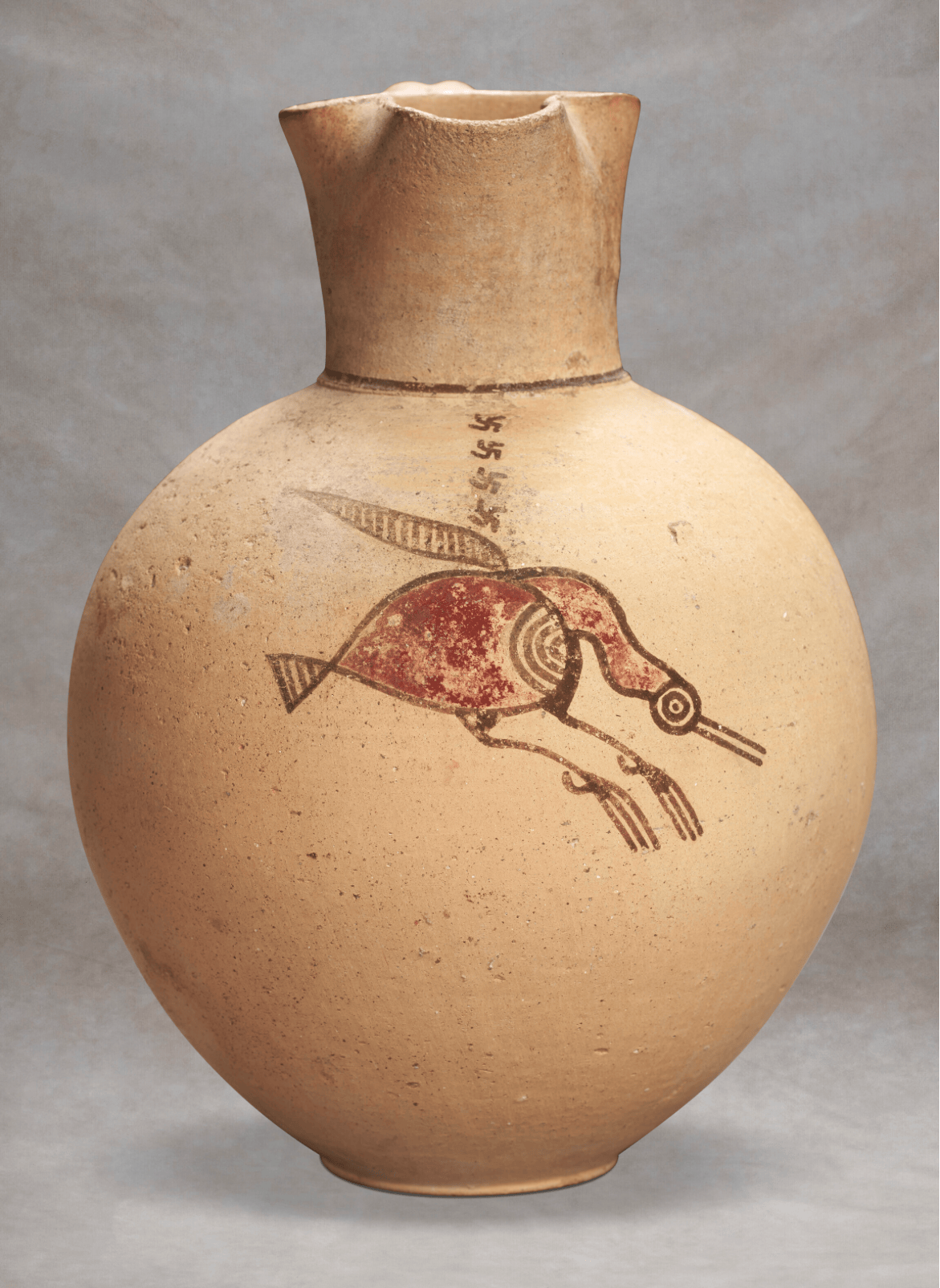
Bichrome Oinochoe
Archaic I
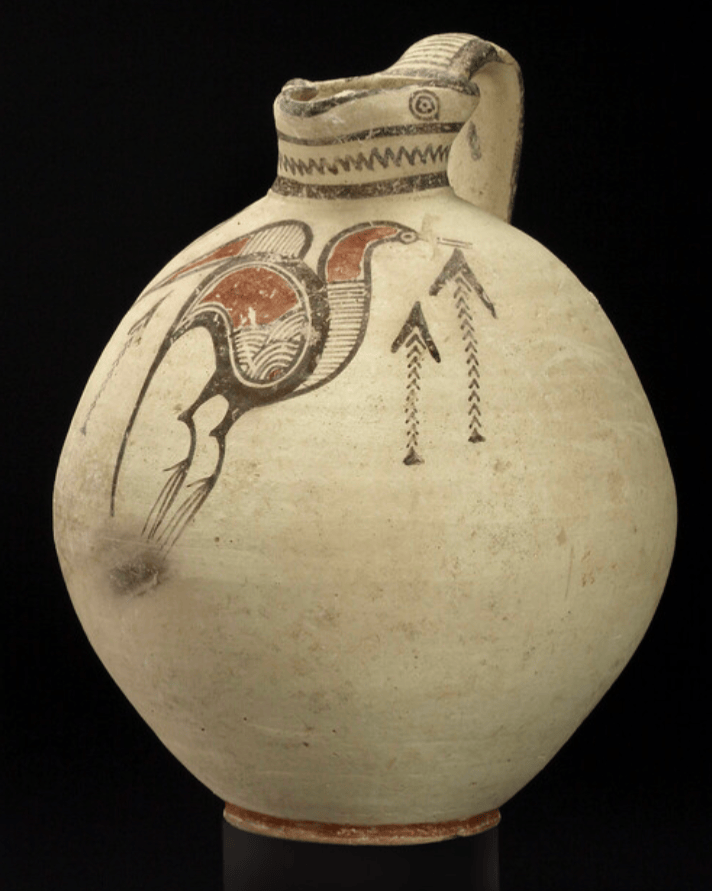
Free-field bichrome jug with image of an Ibis bird and reeds
Archaic
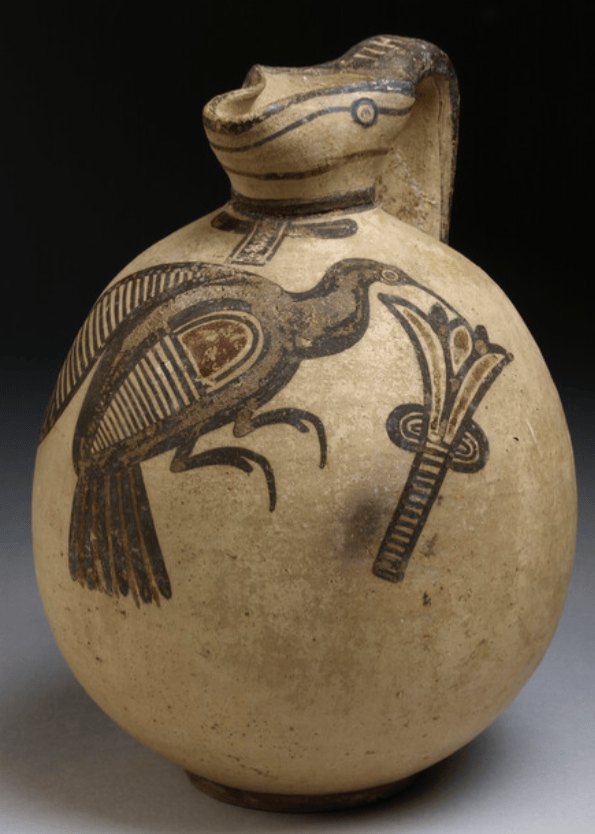
Squat bichrome jug in free-field style with image of bird picking a lotus flower
Archaic
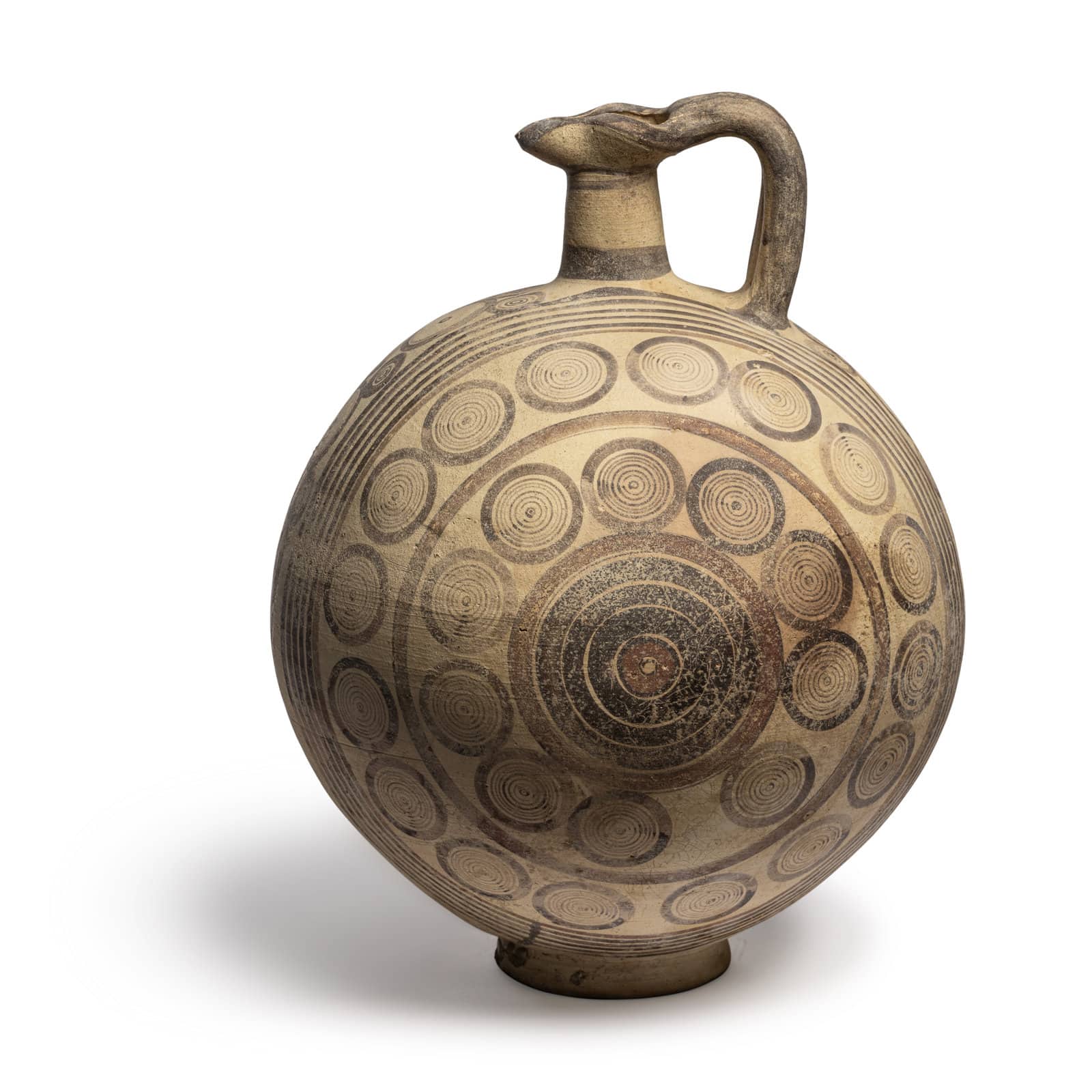
A Cypriot Bichrome-Ware Oinochoe Jug
Archaic I
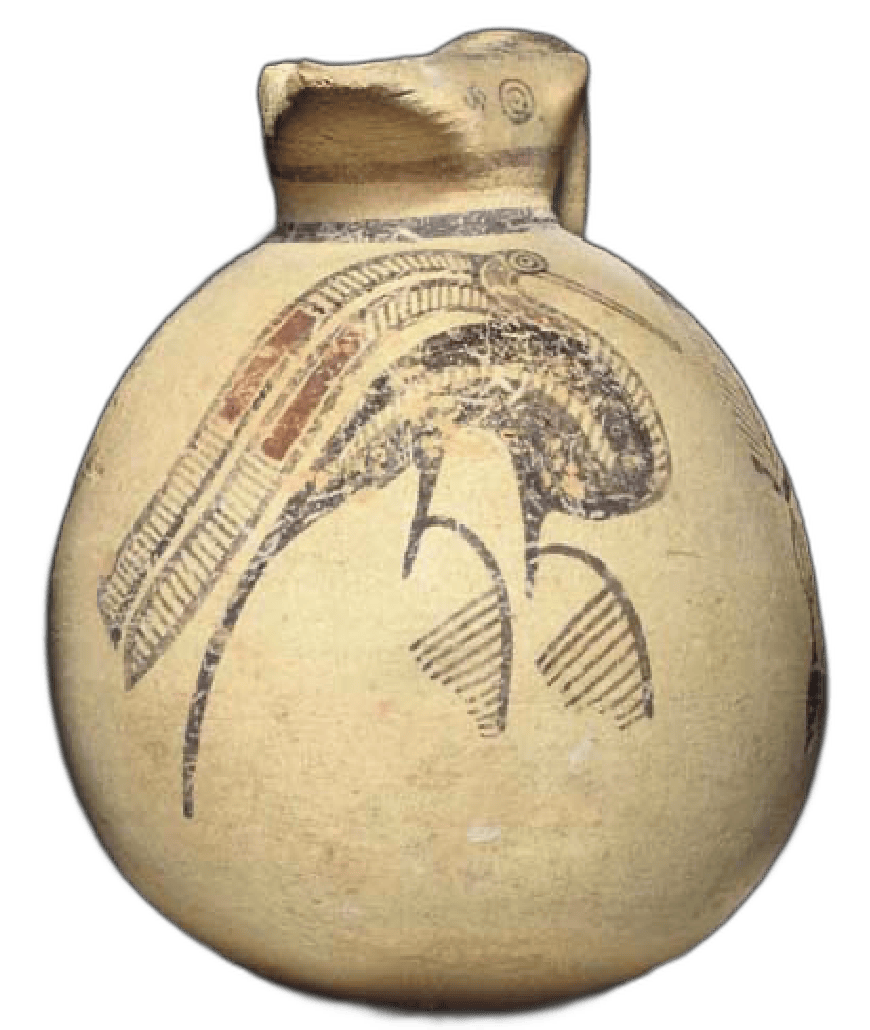
Oinochoe with Free Field Bird
Archaic I
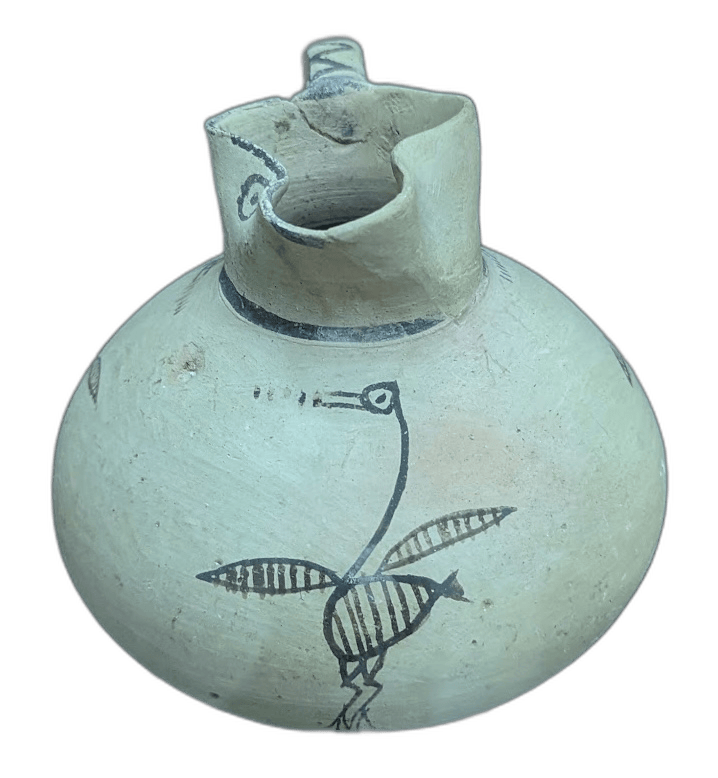
Small Oinochoe with Free Field Bird
Archaic I
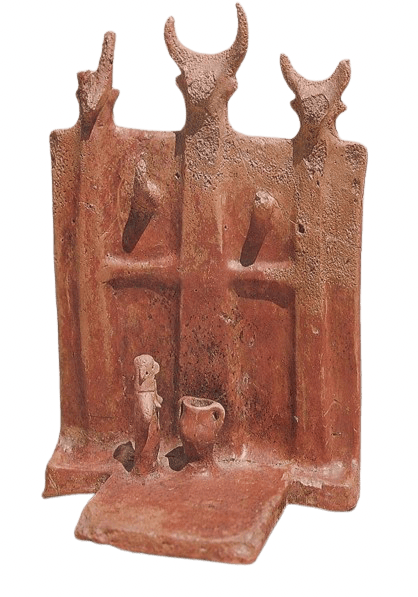
Red Polished Shrine
Middle Bronze Age I
Black-On-Red Geometric Jug Sherd
Geometric II
Bichrome Jug
Geometric
Bichrome Juglet
Geometric
Bichrome Oinochoe
Geometric
Juglet
Archaic II
Oinochoe
Geometric III
Jug
Archaic I
Juglet
Archaic I
Jug
Geometric I
Terracotta jug
Early Bronze Age I
Juglet
Geometric I