
The Island With No Dark Age: Maria Iacovou and the Kingdoms of Cyprus
Maria Iacovou went to Palaepaphos in 2003 to trace a city wall and decided the land forbade one. Eleven years later her team found the wall after all, a Cypro-Classical rampart the kingdom of Paphos had buried under thirteen thousand cubic metres of its own hillside.
Alexis Drakopoulos
March 27, 2026·History · Archeology · Research·12 min read


Share


Alexis Drakopoulos is a Greek Cypriot Machine Learning Engineer working in Financial Crimes. He is passionate about Archeology and making it accessible to everyone. About Me.
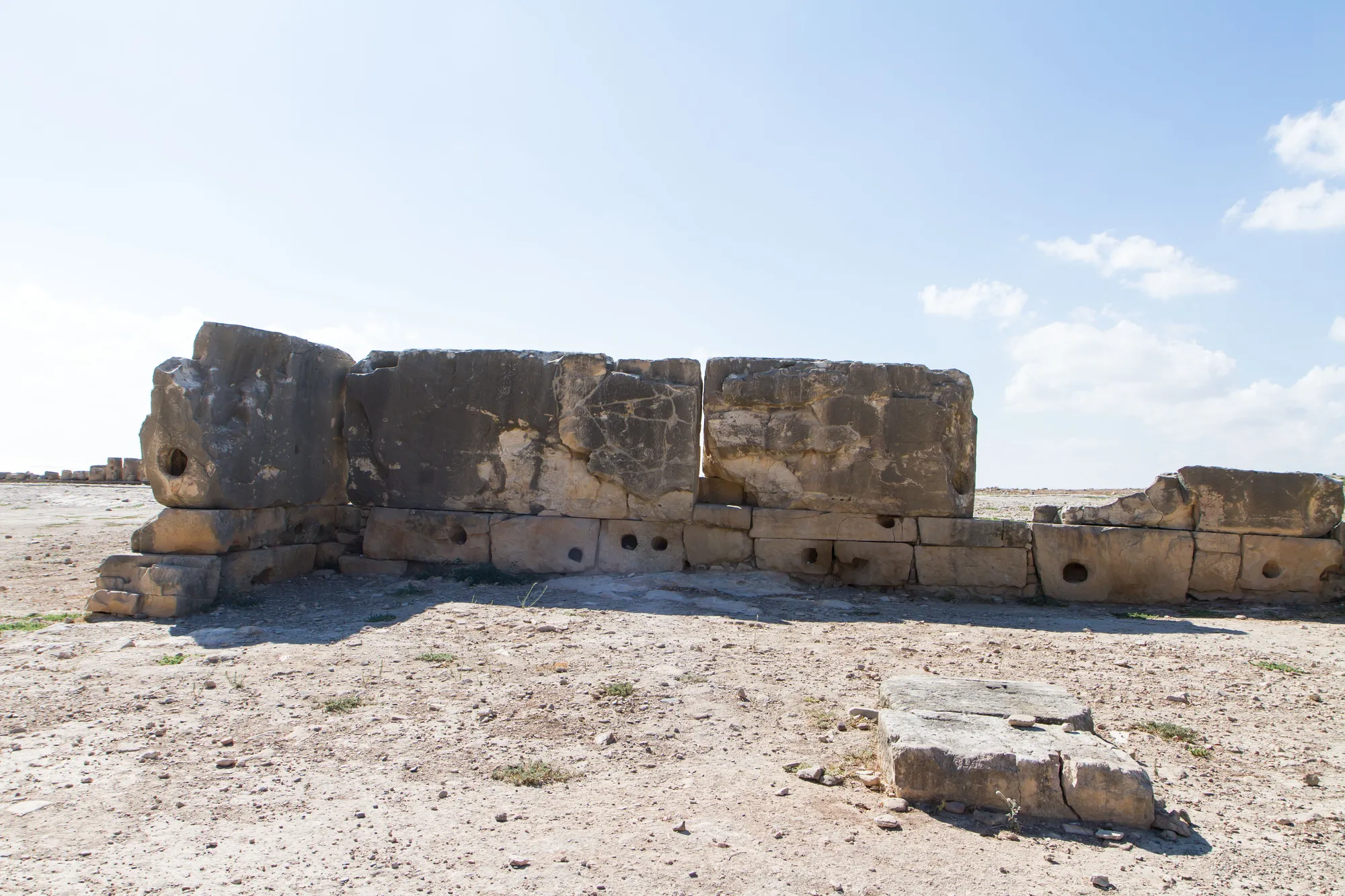
In 2003 Maria Iacovou went looking for the wall of a city and decided the ground would not hold one. The city was Palaepaphos, Old Paphos, on the southwest coast of Cyprus; the wall was the kind every Cypriot kingdom was assumed to possess, an encircling line that marked where the polity stopped. A geophysical survey mapped the terrain instead, and the terrain refused. Palaepaphos lay in what she called the inside of a deep bowl, a basin tilting down toward a silted inlet that had once been its harbour. You do not run a defensive circuit around the rim of a bowl. [1]
She had assumed the wall because the discipline had handed her the question, and she said so in print. The project she was starting rested on a premise the first season falsified, and rather than quietly drop it she made the falsification the hinge of the work. If the kingdom could not be found by tracing its perimeter, it would have to be read out of the whole basin: the sanctuary, the cemeteries, the harbour, the copper road inland, the scatter of monuments across fields that developers were waiting to build on. The wall would come back, eleven years later, in a shape she had not pictured. For now it was gone, and its absence reorganised the project around her.
Trained in America, fixed on the eleventh century
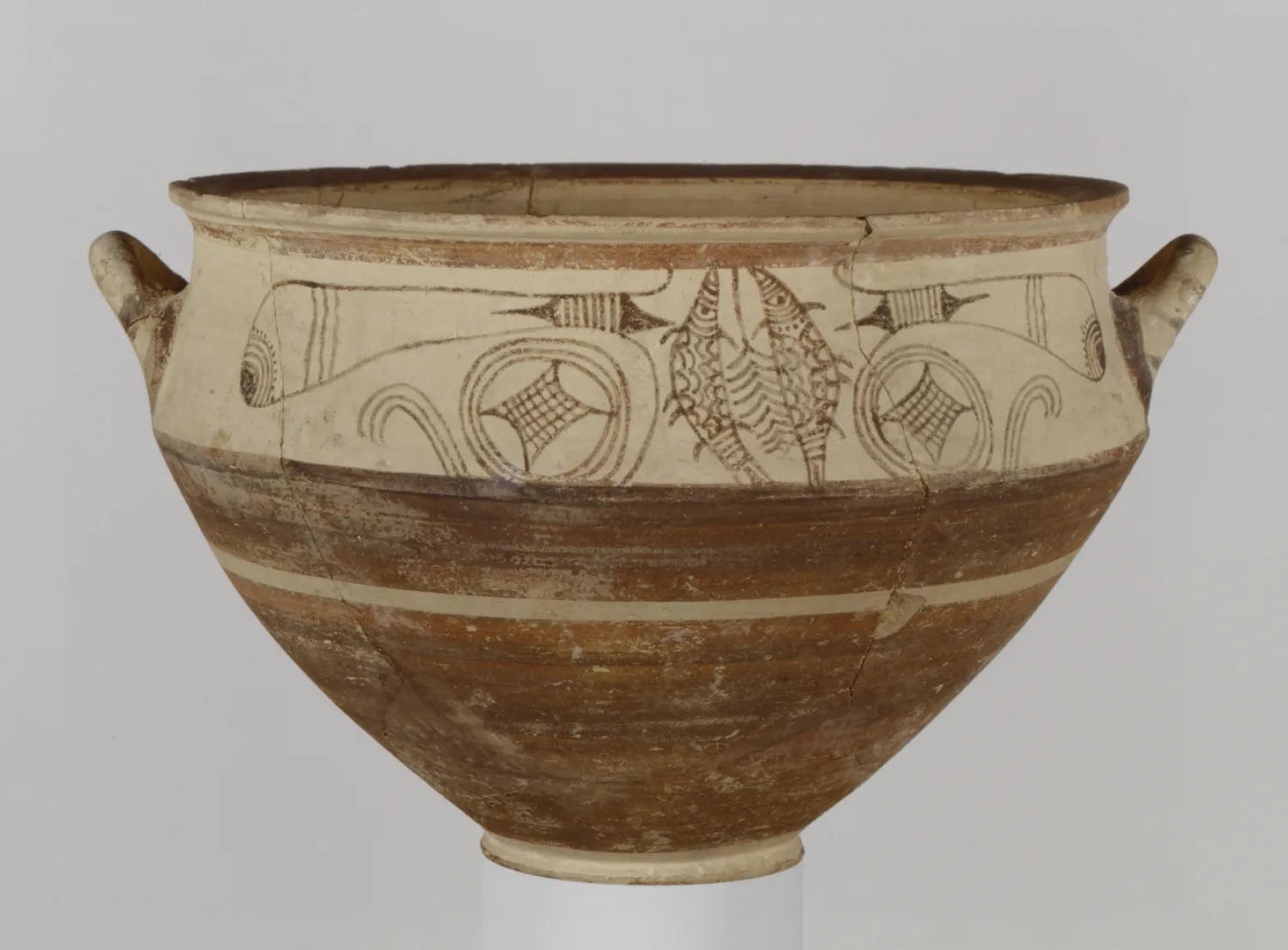
This was late in a career that had begun, as Cypriot careers of her generation often did, abroad. Iacovou was born in 1957 and took her first degree in the United States, summa cum laude in classics and classical archaeology at the State University of New York at Albany, on a Fulbright travel grant. Her doctorate, finished at the University of Cincinnati in 1984, where she held a Louise Taft Semple fellowship, was on the pictorial pottery of eleventh-century Cyprus [2]: the painted vases of exactly the stretch for which the island's record runs thinnest, the two centuries on either side of 1100 BCE, when the Bronze Age towns were closing and the Iron Age kingdoms had not yet declared themselves.
The common belief that she trained in London is a half-truth worth correcting. The London year came after the doctorate, a 1986 fellowship at University College working with Nicolas Coldstream, the authority on Geometric Greek and Cypriot pottery, with a bursary at the British School at Athens the same year. Her training was American; the British connection was a postdoctoral season.
She had been an archaeological officer in the Department of Antiquities of Cyprus since 1982, while still finishing the Cincinnati thesis, and from 1987 to 1997 she directed the Bank of Cyprus Cultural Foundation, a decade running one of the island's principal heritage institutions before she moved to the University of Cyprus, where she became professor of prehistoric and protohistoric archaeology in 2008. Oxford made her a British Academy visiting professor in 2004; the Onassis Foundation a senior fellow in 2011. By 2026 she is emerita and still directing the Palaepaphos programme. The pottery of the eleventh century, the subject she started with, never really left her. It set the question her whole body of work would answer: what happened to Cyprus in the dark stretch between the Bronze Age and the historical kingdoms.
A thousand years without a break
Her answer, held with unusual consistency across forty years, is that nothing did. There was no dark stretch. Aegean archaeology had taught the eleventh to eighth centuries as a collapse, a Dark Age in which Greece lost its writing, its palaces, its long-distance trade and most of its people, and Iacovou's argument is that Cyprus simply did not go through it. "The transition from the Late Bronze Age to the Early Iron Age," she wrote in 2007, "did not cause a break in the political culture of Cyprus. The island's Iron Age state model was nothing new. It was an encore of what seems to have become established no later than LC IIC," Late Cypriote IIC, the thirteenth century BCE. [3] The kingdoms of the historical period were, on this reading, the consolidation of structures already some centuries old.
One piece of evidence carries much of the weight: the writing. When the Mycenaean palaces fell, the Aegean abandoned Linear B and went illiterate for roughly four hundred years. Cyprus did not. Its syllabic script stayed in continuous use across the same centuries, and Iacovou reads that unbroken literacy as the signature of an unbroken political order, a royal administrative instrument handed from the Bronze Age polities to the Iron Age kingdoms without an interval of silence. [4] A state that keeps writing is a state that did not collapse.
The kingdoms themselves she models as territorial polities, defined by geography and economy rather than by the ethnic origin of their rulers. There was never a canonical number of them: "their number kept fluctuating, along with the administrative capitals and the state boundaries," she wrote, until the end of the fourth century BCE. [3] What a Cypriot kingdom needed in order to survive was a particular combination, which she names flatly as a triad: "copper sources, agricultural wealth, and access to a port of export. Only the triad could produce a Cypriot state." [3] The formula has predictive force. The inland kingdoms that sat on copper but had no coast of their own, Idalion, Tamassos, Ledra, are the ones that failed and were absorbed; the survivors, Salamis on the east coast and Paphos on the southwest, held all three legs. Copper runs through the whole argument as the thing the kingdoms lived on and the thing that made them fragile, since a polity exporting a single commodity is hostage to it. [13]
Iacovou against Rupp
Not everyone reads the same scarce evidence the same way, and the clearest fault line in the field runs between Iacovou and the Canadian archaeologist David Rupp. Through the late 1980s and 1990s Rupp argued the opposite case: that the Late Bronze Age organisation of Cyprus did collapse after the twelfth century, and that hierarchical regional states reappeared only in the later eighth century, prompted from outside, as a response to Phoenician expansion, itself the trading arm of an expanding Neo-Assyria, planting a colony at Kition. On his model the Early Iron Age belonged to chiefdoms, not states, and the kingdoms were a secondary formation that foreign contact triggered. Iacovou rejects both halves. The process, she holds, "must have begun no later than the twelfth century," and "there was never a time when Cyprus was without any regional managing structures." [5] On her account the eighth-century kingdoms made visible a structure laid down six hundred years earlier.
Her critics put their finger on the soft spot. The settlement evidence for those six hundred years is almost absent; the kingdoms are documented mainly from the seventh century onward, in inscriptions and later texts, and to argue twelfth-century continuity from seventh-century evidence is to project backward across exactly the gap that needs explaining. That the fullest recent re-examination of that transition, by Nathan Meyer and A. Bernard Knapp in 2021, frames itself largely around her continuity thesis is a fair measure of where she sits: she sets the terms other people argue over. [6]
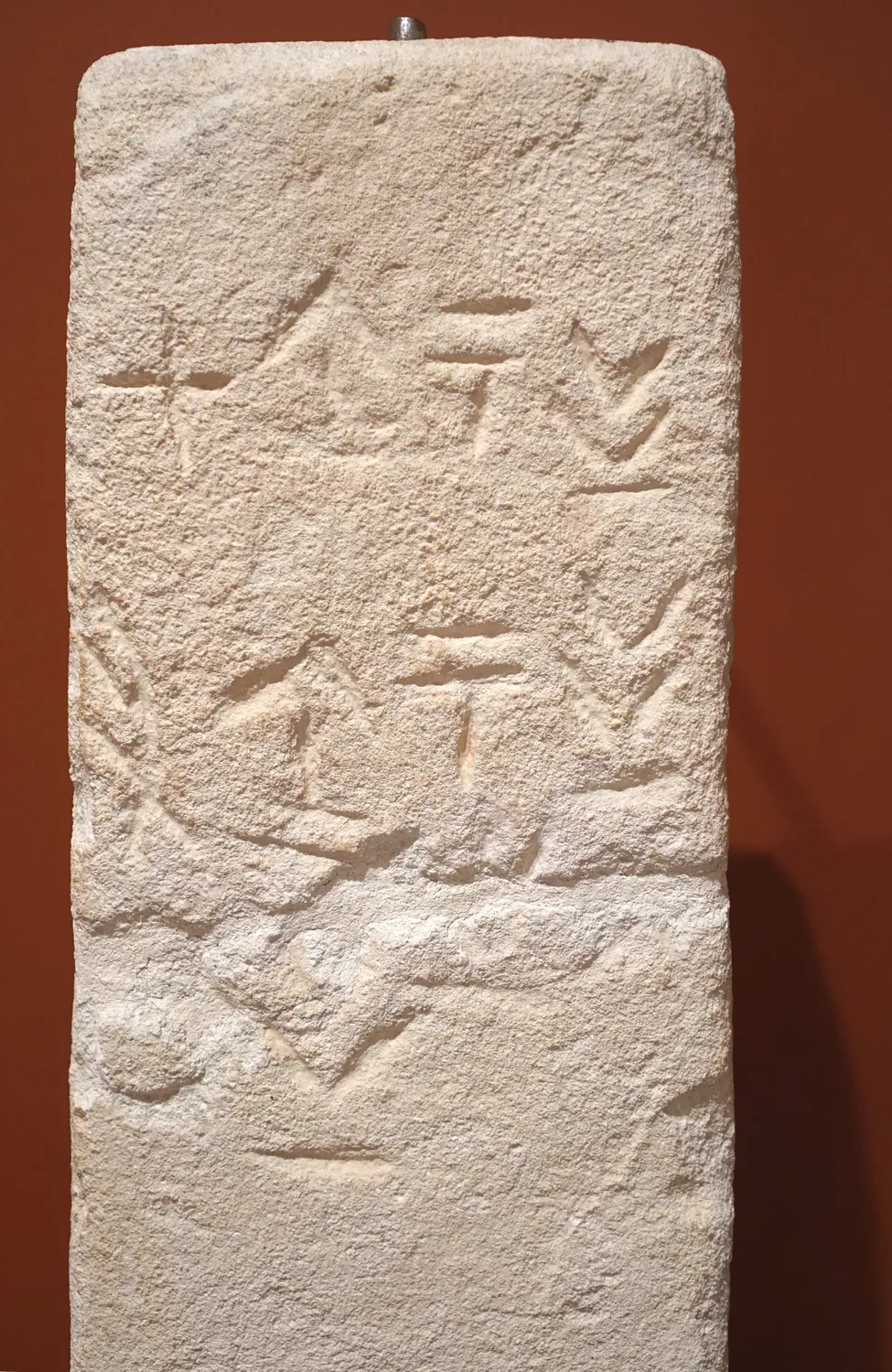
There is a second debate, easy to confuse with the first. On state formation Iacovou is the indigenist, insisting Cyprus made its own institutions. On ethnicity and language she is read, by some of the same scholars, as leaning the other way. She rejects the old picture of an Achaean colonisation, a single folk-migration of Greeks founding the kingdoms, and replaces it with a gradual Hellenisation from the twelfth century: illiterate Aegean settlers adopting the local script and slowly shifting the island's burial and ceramic habits, a process better called hybridisation. Yet she also holds that the eventual dominance of Greek marked a real transfer of power, "a power struggle fomented by the heirs of the Greek-speaking basileis," and it is there that A. Bernard Knapp and Ioannis Voskos fault her for over-weighting the Greek strand. [7] Her own evidence cuts against any easy equation of script with people: at Amathus the same syllabary was used to write Eteocypriot, a non-Greek language, which is why she treats the script as a shared instrument of royal administration standing above three coexisting languages, Greek, Phoenician and Eteocypriot.
Knowing more about the dead than the living
Behind all of this sits a methodological conviction that is also the closest thing Iacovou has to a position on collecting. Cypriot archaeology, she has observed, has long known more about the dead than the living, because the settlements dissolved while the tombs survived, and because the discipline spent its first century digging the tombs. Palaepaphos is a case study in what that century cost. The site was robbed from the sixteenth century onward; Luigi Palma di Cesnola "investigated" it in the years around 1870; in 1888 the British Cyprus Exploration Fund put some two hundred and thirty workmen through its sanctuary, and structures recorded in those weeks have since vanished. A hundred years of attention had produced museum cases full of Paphian objects and almost no knowledge of the Paphian town. She had been arguing for the alternative for years, convening and editing the field-survey programme that asked archaeologists to map settlement instead of emptying graves. [9]
Her instrument was the Palaepaphos Urban Landscape Project, which she launched in 2006 after the atlas survey, and which inverts the older method point by point. [10] Where the antiquarian asked what could be lifted and displayed, the project asks what people did across a whole territory, and what is destroyed when an object is pulled from its stratum. It privileges geophysics, GIS and remote sensing over the recovery of saleable finds; it excavates the plots that development threatens, not the ones that promise objects, surgically, to rescue what is about to be lost. The unit of study is the polity, sanctuary and harbour and cemetery and copper route together, not the artifact. When the team did open the ground, at Hadjiabdoulla in 2009, it found a Classical-period citadel over a palatial residence and, beneath that, proof of settlement in the thirteenth century BCE, the deep continuity her thesis predicted, read out of stratified earth rather than asserted from pots.
She has never turned this into the public campaign against the antiquities trade that Vassos Karageorghis and Sophocles Hadjisavvas waged. The looting of the occupied north, the sawn-out Kanakaria mosaics and the rest, is documented by Hadjisavvas, and a biography should not lend her that fight. Her objection to collecting is quieter and structural, built into a method that treats the decontextualised object as a loss of information before it is anything else. The interpretive twin of that method is what she calls Cyprocentrism: reading the island's development from within, as an indigenous long-term process, rather than as a satellite of Mycenae or Phoenicia or Assyria. [8] The colonial collectors had done both at once, shipping the material abroad and explaining the island by reference to whoever shipped it.
The wall under the mound at Laona
The wall came back in 2014. Just north of the Hadjiabdoulla citadel sat a low mound the local maps called Laona, about a hundred metres long, sixty wide and ten high, that a century of archaeologists had walked past without a second look, because tumuli are foreign to Cyprus and a man-made hill is not the first thing a Cypriot eye expects. In 2012 the team established that it was artificial: built, not weathered, from an estimated thirteen thousand seven hundred cubic metres of marl and the red terra rossa soil of the basin, carted in and dumped, with residual pottery dating the mound's construction to the third century BCE. [12] They began to dig the southeast quarter to find out why anyone would raise it.
Underneath was a fortification. A monumental rampart of the Cypro-Classical period, its mould-made mud-bricks cast to a uniform forty by fifty by twelve centimetres and packed between long runs of unworked stone, survived in places to more than six metres; by 2022, with some hundred and sixty metres of its length exposed, it was standing close to eight. Pottery from the foundation trenches beneath two opposed internal staircases dated its building to the turn of the sixth and fifth centuries BCE. Marta Lorenzon and Iacovou, publishing it in 2019, called the structure "certainly unprecedented in Cyprus and extremely rare in the rest of the Mediterranean." [11] It was a royal work, raised by the dynasty that ran Paphos, the same authority behind the megalithic sanctuary of the Cypriot goddess, the Paphian Aphrodite, that had anchored the town since around 1200 BCE.
The mound was a burial, and what it buried was the wall. Some time in the third century BCE the Paphians took a standing royal rampart eight metres high and entombed it under thirteen thousand cubic metres of their own hillside, and the date of that act falls within a generation of the moment the kingdom of Paphos ceased to exist.
At the end of the fourth century BCE the kingdoms were abolished, all of them, by Ptolemy I, the Macedonian general who took Egypt and then Cyprus out of the wreck of Alexander's empire. This is the one rupture Iacovou allows in her thousand years, and on her reading it came from outside. The kingdoms had not, she insists, "experienced an economic decline or reached a political stalemate"; a new empire found a thousand-year-old arrangement of independent royal houses inconvenient and erased it. [3]
The wall she had said the land forbade was there the whole time, standing on the citadel hill rather than ringing the town, and the people who built it had buried it themselves, at the very point her long continuity ran out.
References
- 1.Iacovou, M. (2013). 'Paphos before Palaepaphos: New Approaches to the History of the Paphian Kingdom.' In D. Michaelides (ed.), Papers in Honour of Ino Nicolaou, 275–291. SIMA-PB 179. Uppsala: Paul Åströms Förlag. (The 'inside of a deep bowl' topography and the falsified encircling-wall premise, pp. 2–5 of the offprint.)
- 2.Iacovou, M. (1988). The Pictorial Pottery of Eleventh Century B.C. Cyprus. Studies in Mediterranean Archaeology 79. Göteborg: Paul Åströms Förlag. (Her University of Cincinnati doctoral monograph.)
- 3.Iacovou, M. (2007). 'Site Size Estimates and the Diversity Factor in Late Cypriote Settlement Histories.' Bulletin of the American Schools of Oriental Research 348: 1–23. (The 'encore,' the triad of copper, agriculture and port, and the fluctuating number of polities, pp. 16–18.)
- 4.Iacovou, M. (2013). 'The Cypriot Syllabary as a Royal Signature: The Political Context of the Syllabic Script in the Iron Age.' In P. Steele (ed.), Syllabic Writing on Cyprus and its Context, 133–152. Cambridge: Cambridge University Press.
- 5.Iacovou, M. (2018). 'From the Late Cypriot Polities to the Iron Age "Kingdoms": Understanding the Political Landscape of Cyprus from Within.' In A. Cannavò & L. Thély (eds.), Les royaumes de Chypre à l'épreuve de l'histoire, 7–28. BCH Supplément 60. Athens: École française d'Athènes. ('There was never a time when Cyprus was without any regional managing structures,' p. 21.)
- 6.Meyer, N., & Knapp, A.B. (2021). 'Resilient Social Actors in the Transition from the Late Bronze to the Early Iron Age on Cyprus.' Journal of World Prehistory 34 (4): 433–487.
- 7.Voskos, I., & Knapp, A.B. (2008). 'Cyprus at the End of the Late Bronze Age: Crisis and Colonization or Continuity and Hybridization?' American Journal of Archaeology 112 (4).
- 8.Iacovou, M. (2008). 'Cultural and Political Configurations in Iron Age Cyprus: The Sequel to a Protohistoric Episode.' American Journal of Archaeology 112 (4): 625–657. (The 'Cyprocentric' reading.)
- 9.Iacovou, M. (ed.) (2004). Archaeological Field Survey in Cyprus: Past History, Future Potentials. BSA Studies 11. London: British School at Athens.
- 10.Iacovou, M. (2008). 'The Palaepaphos Urban Landscape Project: Theoretical Background and Preliminary Report 2006–2007.' Report of the Department of Antiquities, Cyprus (RDAC) 2008: 263–289.
- 11.Lorenzon, M., & Iacovou, M. (2019). 'The Palaepaphos-Laona Rampart: A Pilot Study on Earthen Architecture and Construction Technology in Cyprus.' Journal of Archaeological Science: Reports 23: 348–361. ('Certainly unprecedented in Cyprus and extremely rare in the rest of the Mediterranean'; the 40 × 50 × 12 cm mud-bricks; over 6 m survival.)
- 12.Gkouma, M., Karkanas, P., & Iacovou, M. (2021). 'A Geoarchaeological Study of the Construction of the Laona Tumulus at Palaepaphos, Cyprus.' Geoarchaeology 36 (4): 601–616. (The c. 13,700 m³ of marl and terra rossa; third-century BCE date for the mound.)
- 13.Iacovou, M. (2013). 'Historically Elusive and Internally Fragile Island Polities: The Intricacies of Cyprus's Political Geography in the Iron Age.' Bulletin of the American Schools of Oriental Research 370: 15–47.