
Cyprus Before the Bronze Age - Book Review
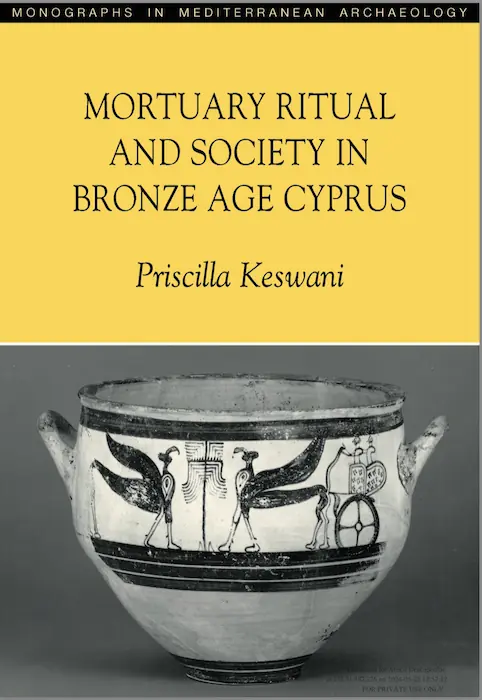
Keswani's book offers a captivating and insightful exploration of the complex interplay between funerary practices and social structure in ancient Cyprus, making it a must-read for anyone interested in the archaeology and history of the Eastern Mediterranean.

Alexis Drakopoulos
July 21, 2024·Archeology · History · Review · Book·3 min read


Share


Alexis Drakopoulos is a Greek Cypriot Machine Learning Engineer working in Financial Crimes. He is passionate about Archeology and making it accessible to everyone. About Me.
"Cyprus Before the Bronze Age: Art of the Chalcolithic Period" is a slim yet illuminating catalogue accompanying an exhibition held at the J. Paul Getty Museum in 1990. This work offers a focused examination of the artistic achievements and cultural developments of Chalcolithic Cyprus, a period spanning from approximately 4000 to 2500 BCE.
The catalogue is divided into three main sections. The first, an introduction by Vassos Karageorghis, sets the stage for the importance of this exhibition in showcasing a lesser-known period of Cypriot prehistory. Karageorghis emphasizes how recent excavations and research have dramatically changed our understanding of the Chalcolithic period, elevating it from a mere transitional phase to a culturally rich and significant era in its own right.
The heart of the book is Edgar J. Peltenburg's essay on Chalcolithic Cyprus. Peltenburg divides the period into Early, Middle, and Late phases, providing a nuanced view of the cultural evolution during this time. His discussion covers settlement patterns, technological innovations, social structures, and artistic developments. Particularly noteworthy is his analysis of the flourishing sculptural traditions that emerged during this period, including the iconic cruciform figurines made of picrolite.
Peltenburg's essay is especially valuable in its exploration of the social implications of artistic production. He argues for the emergence of social ranking in the Middle Chalcolithic, evidenced by differential access to resources and the production of high-status goods. His interpretation of the ritual significance of certain figurines and their potential role in public ceremonies adds depth to our understanding of Chalcolithic society.
The final section, a detailed catalogue of the exhibition items by Pavlos Flourentzos, provides a comprehensive look at the material culture of the period. The catalogue entries, accompanied by high-quality photographs, cover a wide range of artifacts including stone bowls, figurines, and pottery. These entries offer insights into the manufacturing techniques, stylistic evolution, and potential uses of these objects.
One of the strengths of this catalogue is its ability to contextualize the Chalcolithic period within the broader sweep of Cypriot prehistory. By including a few key Neolithic artifacts, the authors effectively demonstrate both the continuities and innovations of Chalcolithic culture. The discussion of the transition to the Early Bronze Age is particularly thought-provoking, with Peltenburg suggesting links between the end of the Chalcolithic in Cyprus and broader upheavals in the Eastern Mediterranean.
However, like many exhibition catalogues, this work is constrained by the limitations of the exhibition itself. While the artifacts presented are undoubtedly significant, they represent only a small sample of Chalcolithic material culture. Additionally, the focus on art and high-status objects may not fully capture the daily life of Chalcolithic Cypriots.
Despite these minor limitations, "Cyprus Before the Bronze Age" succeeds admirably in its goal of bringing attention to this important period of Cypriot prehistory. The combination of Peltenburg's insightful analysis and the detailed catalogue entries provides both specialists and interested laypeople with a solid foundation for understanding Chalcolithic Cyprus.
This catalogue is an essential resource for anyone interested in Cypriot archaeology or prehistoric art of the Eastern Mediterranean. Its clear writing, beautiful illustrations, and thoughtful interpretations make it accessible to a wide audience while still offering valuable insights to specialists in the field. As our understanding of Chalcolithic Cyprus continues to evolve with new excavations and research, this work remains a crucial reference point for studying the artistic achievements of this fascinating period.
References
- 1.Keswani, P. (2006). Mortuary ritual and society in Bronze Age Cyprus. Equinox.